Parent infant-directed speech (IDS) is critical for language development, and there is a large literature, based primarily on mother–infant observations during early infancy, examining variation in IDS according to a wide range of speaker factors, including age, verbal ability, education, SES, culture, language spoken, and mental health (Cristia, Reference Cristia2013). A smaller literature has considered infant-based variability in IDS, the idea that infants themselves influence their language development by shaping the language infrastructure and opportunities for communicative interaction made available to them.
The current study focused on just one component of IDS, lexical diversity (LD), as it plays a key role in infant vocabulary development (Huttenlocher, Waterfall, Vasilyeva, Vevea, & Hedges, Reference Huttenlocher, Waterfall, Vasilyeva, Vevea and Hedges2010; Pan, Rowe, Singer, & Snow, Reference Pan, Rowe, Singer and Snow2005; Rowe, Reference Rowe2012). Infant receptive language or vocabulary knowledge is a direct product of language experience and exposure (Hoff, Reference Hoff2003; Huttenlocher et al., Reference Huttenlocher, Waterfall, Vasilyeva, Vevea and Hedges2010; Pace, Luo, Hirsh-Pasek, & Golinkoff, Reference Pace, Luo, Hirsh-Pasek and Golinkoff2017), and there is ample evidence that amount of language input is related to language growth (Hart & Risley, Reference Hart and Risley1995; Ramirez-Esparza, Garcia-Sieira, & Kuhl, Reference Ramirez-Esparza, Garcia-Sieira and Kuhl2014; Rowe, Reference Rowe2012). But it is not just quantity of IDS that matters (Kuchirko, Reference Kuchirko2017; Pan et al., Reference Pan, Rowe, Singer and Snow2005). The dissociation between amount of speech and lexical diversity has been persuasively demonstrated (Montag, Jones, & Smith Reference Montag, Jones and Smith2018): parents who talk more do not necessarily use more complex syntactic constructions or more diverse vocabulary.
Lexical diversity of input is an active ingredient in promoting vocabulary growth (Hsu, Hadley, & Rispoli, Reference Hsu, Hadley and Rispoli2017), is correlated with infant speed of processing (Jones & Rowland, Reference Jones and Rowland2017; Mahr & Edwards, Reference Mahr and Edwards2018) which is crucial for learning new words (Weisleder & Fernald, Reference Weisleder and Fernald2013), and is increasingly recognised as important in the acquisition of syntax (e.g., Hadley, Rispoli, & Holt, Reference Hadley, Rispoli and Holt2017). Fathers’ lexical diversity has been linked with both receptive and expressive infant language, concurrently and longitudinally, and has been shown to uniquely influence child language outcomes over and above mothers’ input (e.g., Pancsofar & Vernon-Feagans, Reference Pancosfar and Vernon-Feagans2006, Reference Pancosfar and Vernon-Feagans2010; Salo, Rowe, Leech, & Cabrera, Reference Salo, Rowe, Leech and Cabrera2016; Tamis-LeMonda, Baumwell, & Cristofaro, Reference Tamis-LeMonda, Baumwell and Cristofaro2012), yet there has been little investigation of the factors that influence this aspect of fathers’ IDS.
Infant characteristics and IDS
Infant-to-father effects remain under-researched, with few studies exploring the range of infant factors that influence fathers’ IDS. One such factor is infant age. There is evidence, primarily for mothers, that infant age significantly predicts amount and quality of input (Bingham, Kwon, & Jeon, Reference Bingham, Kwon and Jeon2013; Gergely, Farago, Galambos, & Topal, Reference Gergely, Farago, Galambos and Topal2017; Hoff, Reference Hoff2006) where older infants are exposed to more lexically diverse input.
The literature on gender and language is nuanced and lacks consensus, notwithstanding the well-attested female linguistic advantage. One study of mothers and fathers in interaction with toddlers (Lovas, Reference Lovas2011) revealed bi-directional influences and a descending pattern, from most to fewest words and longest to shortest mean length of utterance (MLU), from mother–daughter, to mother–son, to father–daughter, to father–son dyads, although parent gender differences decreased over time. Also reflecting these bi-directional influences, it is hypothesised that children adjust their communicative behaviours in response to differences between maternal and paternal speech (Tomasello, Conti-Ramsden, & Ewert, Reference Tomasello, Conti-Ramsden and Ewert1990). For example, children produce more diverse vocabulary with fathers who request more clarifications and use more wh-questions (Leech, Salo, Rowe, & Cabrera, Reference Leech, Salo, Rowe and Cabrera2013). Young children also address more requests to their fathers and more assertions to their mothers (Barachetti & Lavelli, Reference Barachetti and Lavelli2010; Ryckebusch & Marcos, Reference Ryckebusch and Marcos2004), possibly in response to differing expectations concerning mothers’ and fathers’ behaviours, derived from repeated experiences.
Dispositional characteristics also influence parent–child relationships (Kim & Kochanska, Reference Kim and Kochanska2012), and there is evidence that parents actively adapt their parenting in response to their child's personality (Ayoub et al., Reference Ayoub, Briley, Grotzinger, Patterson, Engelhardt, Tackett, Paige Harden and Tucker-Drob2018). Kucirkova, Dale, and Sylva (Reference Kucirkova, Dale and Sylva2018) found that parents’ impression of their child's sociability positively predicted the quality of language in a reading interaction, and an ‘easy’ temperament has long been associated with better infant language outcomes (e.g., Salley & Dixon, Reference Salley and Dixon2007). But there is little information on how infant temperament might function in interaction to elicit different patterns of language input from caregivers. Spinelli, Fasolo, Shah, Genovese, and Aureli (Reference Spinelli, Fasolo, Shah, Genovese and Aureli2018) investigated the role of the quality of maternal input (indexed by syntactic complexity and lexical variability) in the temperament–language association and found that infants who showed greater attention abilities at 3 months and whose mothers produced more complex and variable input at 6, 9, and 12 months had better language outcomes one year later. There were no moderating effects on the association of infant positive or negative affect with language. There has been no comparable study with fathers, although Cabrera, Fitzgerald, Bradley, and Roggman (Reference Cabrera, Fitzgerald, Bradley and Roggman2014) suggest that children's sociability might be uniquely related to fathers’ sociability, and theoretically might interact with fathers’ input.
Toddlerhood is a critical developmental period for children's regulatory and attentional control systems, and although there is little research directly assessing causal relationships between executive functions (EF) and language skills in children (Diamond, Reference Diamond2013), strong concurrent associations between EF and early language skills are frequently reported. For example, Vallotton and Ayoub (Reference Vallotton and Ayoub2011) found that vocabulary was the best predictor of self-regulation in children aged 14–36 months. Lexical diversity plays a key role in infant vocabulary development, and rich parental language in the home is associated with better EF for children (Matte-Gagné & Bernier, Reference Matte-Gagné and Bernier2011). However, bi-directional relations between infant EF and father's LD have yet to be explored.
Parents dynamically respond to infant language (Tamis LeMonda, Kuchirko, & Suh, Reference Tamis-LeMonda, Kuchirko, Suh, Saylor and Ganea2018), and a growing literature micro-analysing parent–infant interactions demonstrates how infants contribute to their own language learning environment by influencing their partners’ response patterns (e.g., Albert, Schwade, & Goldstein, Reference Albert, Schwade and Goldstein2018; Gros-Louis, Goldstein, West, & King, Reference Gros-Louis, Goldstein, West and King2006). These studies focus on the complex interplay of contingency, timing, and patterns of responsiveness in the context of prelinguistic infant vocalisations.
The current study, with older infants, focuses on the verbal aspects of the interaction. Older infants who talk more, use more vocabulary and more advanced syntax elicit more complex and diverse linguistic feedback to facilitate their language learning (Topping, Dekhinet, & Zeedyk, Reference Topping, Dekhinet and Zeedyk2013). For example, mothers in one study adjusted the amount of speech and number of questions to their two-year-olds according to the size of the infants’ productive vocabulary (Smolak & Weinraub, Reference Smolak and Weinraub1983). A study of reciprocal effects between child and parent language in autism found that parents respond more to the language level of the child than to the level of severity of their autism (Fusaroli, Weed, Fein, & Naigles, Reference Fusaroli, Weed, Fein and Naigles2019).
Although infant language skills have been robustly linked to differential parenting behaviours in mothers (Schwab & Lew-Williams, Reference Schwab and Lew-Williams2016a), and vocabulary in particular has been specifically identified as an individual characteristic of children that influences parenting (Tamis-LeMonda, Briggs, McClowry, & Snow, Reference Tamis-LeMonda, Briggs, McClowry and Snow2009), they have rarely been explored as predictors of fathers’ behaviours and as a measurable source of individual difference in input. In one of the only studies with fathers, fathers’ repetition of words was coupled with their two-year-old's vocabulary (Schwab, Rowe, Cabrera, & Lew-Williams, Reference Schwab, Rowe, Cabrera and Lew-Williams2018), such that fathers used less repetition of words with children who had larger vocabularies.
The present study
The target of this study is the IDS of biological, resident fathers and its association with the infant's own characteristics presumed to play a role in the creation of their own communicative environment. Relevant demographic factors like education level and income were controlled through sampling by recruiting middle-income, educated, dual-earner families, where each parent spends roughly equivalent amounts of time with, and caring for, the infant. Parents’ verbal ability, as a potential source of individual difference in LD, was measured. We analysed dyadic interaction in a free-play setting as it has been found to elicit optimum levels and types of interaction and language, especially for father–infant pairs (Gergely et al., Reference Gergely, Farago, Galambos and Topal2017; Kwon, Bingham, Lewsader, Jeon, & Elicker Reference Kwon, Bingham, Lewsader, Jeon and Elicker2013; Salo et al., Reference Salo, Rowe, Leech and Cabrera2016).
The aim of this study was to extend findings on IDS to include consideration of factors contributing to variability in paternal IDS features, and to examine links in particular with infant language. While several studies have found a positive relationship between fathers’ vocabulary and infant language, no study to our knowledge has examined the relative combined contribution of a host of relevant infant factors, both language and non-language based. Based on findings that mothers adapt their IDS as a function of infant characteristics, we predicted that the same set of factors would be associated with fathers’ IDS, specifically measures of lexical diversity, as have been established in the literature for maternal vocabulary. We predicted the following:
Infant age, gender, temperament, executive function, verbal IQ, and real-time language would be associated with fathers’ LD in dyadic interaction. Specifically, that older infants, infant girls, infants scoring high on sociability, infants with higher EF and verbal IQ scores, and infants using more different word types (defined as a category or class of linguistic item) in real-time interaction would be associated with higher levels of paternal LD in dyadic interaction.
Method
Participants
Sixty-four mother–father–infant triads were recruited to a study on parent–infant interaction via local childcare centres, advertisements in national media, and via social media. The current study utilises data on the infants and their fathers, although mothers were the source of some of the infant data. Infants were 24 months of age (M = 24.1 months, SD = 1.39) at the time of assessment. All infants (35 female) were acquiring English as their first language in monolingual households. Infants were all full-term, with normal birthweight, and had no reported health or developmental difficulties. Fathers’ mean age was 36.5 years (SD = 5.39); 95% had completed second-level education, 44% had achieved a Bachelor Degree, and 27% had achieved a postgraduate degree. All fathers were cohabiting full-time with their child's mother and both parents gave informed consent to participate with their infant in the research.
Procedure
Ethical approval to conduct the study was obtained from the School of Psychology Ethics Committee within Trinity College, Dublin. Mothers, fathers, and their infants attended the university-based laboratory, where developmental assessment of the infants was conducted and father–infant free-play sessions were video-recorded. During the infant–father free-play session, mothers completed a battery of measures on their infants. Upon arrival at the laboratory, the language subscales of the Bayley Scales of Infant Development were administered by a trained research assistant in the presence of one parent. Following the administration of the subscale, a box of toys was introduced to the room and the father was asked to “play with their child as they normally would” for 10 minutes, and the research assistant left the room. Following this, the WAIS verbal subtests were completed with the father. All father–infant play interactions were recorded in the observation room using VideoSyncPro recording software, which merges recordings from two wall-mounted cameras and a professionally calibrated BeyerDynamic MPC 66 V SW 12-84V microphone connected to a XENYX 802 audio-mixer.
Measures
Bayley Scales of Infant Development
The expressive and receptive language subscales of the BSID-III (Bayley, Reference Bayley2005) were administered to the infants by a trained research assistant. The raw scores for each subscale were converted to standard scores. The receptive and expressive standard language scores are used in this study.
Brief-P
The Behaviour Rating Inventory of Executive Function – Preschool Version (Gioia, Espy, & Isquith, Reference Gioia, Espy and Isquith2003) was completed by mothers. The scale comprises 63 items that measure various aspects of executive functioning among two- to five-year-olds: Inhibit, Shift, Emotional Control, Working Memory, and Plan/Organize. The scales form three broad indexes (Inhibitory Self-Control, Flexibility, and Emergent Metacognition) and one composite score (Global Executive Composite). The Global Executive Composite is used in the present study. The scale authors report good reliability (Cronbach's alpha > 0.80 for parent-report; Gioia et al., Reference Gioia, Espy and Isquith2003).
ECBQ
The Early Childhood Behaviour Questionnaire (Putnam, Gartstein, & Rothbart, Reference Putnam, Gartstein and Rothbart2006) was completed by mothers. The scale assesses 18 dimensions of temperament in children between the ages of 18 and 36 months. The sociability subscale, based on four items, which refers to seeking and taking pleasure in interactions with others is used in the present study. The scale authors reported good reliability for the sociability subscale on infants at 24 months (0.89; Putnam et al., Reference Putnam, Gartstein and Rothbart2006).
WAIS Verbal subtest
Three subtests of the WAIS-IV (Wechsler, Reference Wechsler2008a) were administered to fathers: Similarities, Vocabulary and Information, which together yield a standardised verbal comprehension index (VCI). The Verbal subtests have demonstrated excellent internal consistency and test–retest reliability (Wechsler, Reference Wechsler2008b).
Parent and infant language
Father–infant interactions were transcribed at the level of the utterance using CHAT conventions of CHILDES, where an utterance was defined as a unit of speech delineated by a change in intonation, pause, or change in conversational turn (MacWhinney, Reference MacWhinney2000). Fathers’ number of utterances, number of words (tokens), mean length of utterance calculated in morphemes (MLU), and lexical diversity (indexed by VOCD, where lower values of D indicate more repetition and a vocabulary which is not lexically rich and vice versa) were automatically generated through the CLAN software program available as part of the CHILDES L1 database. Additionally, for the father–infant interaction, the number of total word tokens and the total number of different word types used by the infants were generated, yielding two infant language variables: infant word tokens with father; infant word types with father. As calculation of VOCD requires a minimum of 50 tokens, a threshold not met by all the infants in this study, a count of different word types for the infant speech was used.
Data analysis
SPSS Version 25 was used to analyse the data. A number of outliers were identified in the dataset and all analyses were run inclusive and exclusive of outlier scores. No differences in effects were observed so the outliers were retained for the final analyses in order to maximise sample size. Standard simultaneous regressions were used in this study, with father VOCD as the dependent variable. Assumptions of multiple regression were tested by examining the normal probability plots of residuals and scatter diagrams of residuals versus predicted residuals. No violations of linearity, normality, homoscedasticity, or residuals were detected. The EBCQ score was missing for one family, and therefore analyses including these scores was completed on a sample of 63 fathers and their 24-month-old infants.
Results
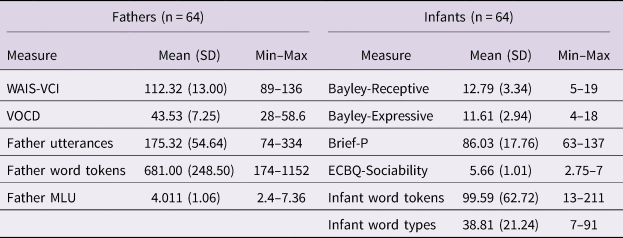
The prediction tested in the current study was that infant age, gender, temperament, executive function, verbal IQ, and real-time language would be associated with fathers’ LD in dyadic interaction. Descriptive analyses were first conducted to examine correlations among the variables and to describe the language performance of fathers in interaction with their children (Table 1).
Descriptive statistics for indicators of fathers’ language in interaction, and infants’ language to fathers, and scores on standardised measures

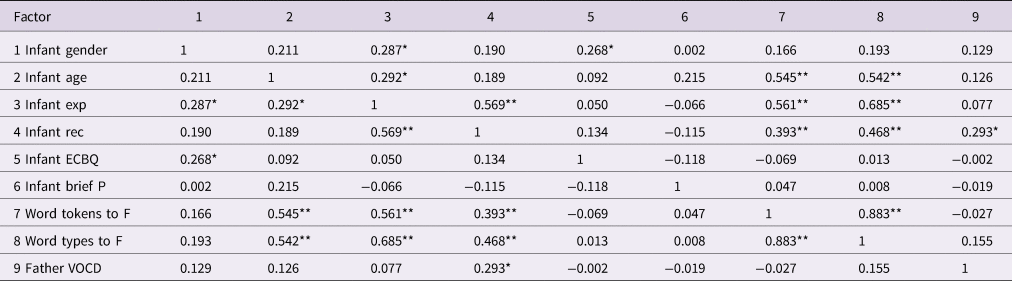
Bivariate correlational analyses were conducted to assess the relationship between aspects of fathers’ and infants’ language measures separately. Fathers’ verbal ability (WAIS score) was not correlated with their LD (VOCD score) (r = –0.025, N = 64, p = .846). Indicators of quantity and complexity of fathers’ IDS (number of word tokens and MLU) and VOCD were not correlated (r = 0.001, N = 64, p = .994 for word tokens; r = 0.159, N = 64, p = .213 for MLU), indicating that these measures are capturing distinct aspects of the input to infants, and that longer, more syntactically complex utterances or more words do not mean greater LD. Infant Bayley Receptive and Expressive scores were significantly and positively correlated to infant number of word tokens and word types with fathers, indicating that the interactions are capturing and reflecting actual language ability. Bivariate correlational analyses were then conducted to investigate the relationship among variables to be included in the model as shown in Table 2. The measure of executive function was not independently related to any variable and was not included in the model.
Correlational analysis among the model variables (N = 64)

Notes. Rec – Bayley receptive score; Exp – Bayley expressive score; * p < 0.05, ** p < 0.05, two-tailed tests.
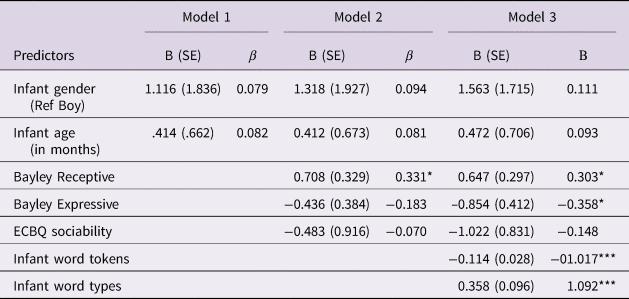
The prediction that a set of infant characteristics established as being related to mothers’ LD would be associated with fathers’ LD in dyadic interaction was tested using multiple regression analysis with fathers’ VOCD as the dependent variable (Table 3). Predictors were infant gender, age, Bayley receptive and expressive scores, ECBQ sociability, and number of word tokens and word types.
Multiple regression model predicting fathers’ VOCD

Notes. * p < .05, ** p < .01, ***p < .001; 1. R 2 = .016, F(2,60) = 0.474, p > .05; 2. R 2 = .090, F(5,57) = 1.134, p > .05; 3. R 2 = .307, F(7,55) = 3.484, p < .01.
We entered the predictor variables in separate models in an attempt to distinguish the contribution of fixed infant characteristics (age, gender), from that of language competence (BSID receptive and expressive scores) and finally language performance measures, the dynamic interactive variables. The first two models indicate that fathers’ VOCD was predicted only by Bayley receptive language ability, with higher receptive language ability associated with higher VOCD. In the final model, which explains 31% of variance, fathers’ VOCD was predicted by Bayley receptive language ability as in the previous model, and infant language behaviour in interaction. Fathers produced greater lexical diversity when infants produced more word types but fewer word tokens. Additionally, Bayley expressive language, which had heretofore not been significant, was now negatively associated with VOCD. Infant sociability was not related to fathers’ VOCD.
Discussion
This study investigated fathers’ IDS to two-year-olds, controlling through sampling for the known confounds of parental education, family SES, and income, and including a standardised measure of parental verbal ability to partially account for shared genetic influences (Dale, Tosto, Hayiou-Thomas, & Plomin, Reference Dale, Tosto, Hayiou-Thomas and Plomin2015). The focus was on lexical diversity against a backdrop of debate over the relative importance of quantity versus diversity in input for infant language development. With the aim of identifying sources of infant variability on paternal IDS, the study was carefully designed to take account of findings to date in relation to the context, setting, props, and time sampling reported to facilitate and reflect naturally occurring and preferred interaction patterns between fathers and their infants.
Quantity of IDS was not related to LD for fathers in this study, therefore it can be inferred that these measures are capturing different aspects of the input delivered to the infant. The focus of the analysis was on accounting for the relative contribution of a set of infant characteristics to this variability in a bid to understand the infants’ contribution to their own language environment.
Fathers’ LD is only predicted by infant language
Fathers’ LD to their infants in this study was not predicted by infant characteristics of age, gender, or sociability, and was predicted only by infant receptive language ability and by infant language behaviour in interaction, suggesting that fathers are attuning their vocabulary to the language proficiency of each individual infant. Specifically, fathers produced more different words when their infant had higher receptive language ability and when their infant used more word types in interaction. Fathers produced less diverse vocabulary when the infant used more word tokens. Fathers appear to be responding not simply to the amount of talk produced by the infant but to the diversity of vocabulary produced by, and appearing to be comprehended by, the infant. An analysis of the actual words used by the infants would help to conclusively determine if this is that case. In this study, and in some of the literature, fathers’ lexical diversity is associated with infant receptive language ability. According to Mahr and Edwards (Reference Mahr and Edwards2018), input has a stronger effect on receptive than expressive vocabulary and receptive vocabulary is more susceptible to variability in input.
Schwab et al. (Reference Schwab, Rowe, Cabrera and Lew-Williams2018), in a study of low-income fathers and two-year-olds, found that fathers used more repetition with infants with smaller vocabularies. In this sample, fathers also use less lexically diverse speech, hence more repetition, with infants who have lower receptive language ability. Although we will need longitudinal data to determine this, we interpret fathers’ LD to be an effect of, or response to, the infants’ receptive language ability in this context, rather than as a potential contributor to lower infant receptive language ability. In a separate analysis, reported in Quigley, Nixon, and Lawson, Reference Quigley, Nixon and Lawsonin press), infant receptive language was also linked to pitch variability in fathers’ IDS, with fathers using pitch characteristics typical of IDS with younger infants with infants who had lower receptive language ability. Schwab et al.’s (Reference Schwab, Rowe, Cabrera and Lew-Williams2018) longitudinal study concluded that fathers were tailoring their speech to the infants’ vocabulary levels rather than their increased repetition being the cause of the infants’ poorer vocabulary. Fathers may be making use of targeted repetition with the infant whose receptive language and conversational language is less advanced. It is possible that fathers are also repeating infant word tokens used. Several studies have reported that parental overlap of content with the infant's previous utterances predicted later infant language (Che, Brooks, Alarcon, Yannaco, & Donnelly, Reference Che, Brooks, Alarcon, Yannaco and Donnelly2018; Newman, Rowe, & Bernstein Ratner, Reference Newman, Rowe and Bernstein Ratner2016; Schwab & Lew-Williams, Reference Schwab and Lew-Williams2016b). It would be informative to adopt a similar approach to analyse the extent of father–infant vocabulary overlap in this study.
Strengths and limitations
A major strength of this study is the focus on fathers as a source of critical developmental influence and as an under-researched group in this area (Tamis-LeMonda, Baumwell, & Cabrera, Reference Tamis-LeMonda, Baumwell, Cabrera, Cabrera and Tamis-LeMonda2013). As is well documented, a wide range of influences are considered in relation to parenting, language input, and infant language development (Rogers, Nulty, Betancourt, & DeThorne, Reference Rogers, Nulty, Betancourt and DeThorne2015). We have accounted for many of these influences, using multiple methods and measures (observational, parental report, questionnaire, standardised assessment), and for genetic confound via parental verbal ability in order to learn what we can of the influences on dynamic language interaction. Both infant and parent language competence and performance were measured directly by standardised instrument, which is rare in this research, and by analysis of real-time dyadic conversation in a naturalistic context.
The homogeneity of the participant sample, while a deliberate design feature, could have limited variance in paternal behaviour, and the sample size, although offset somewhat by the wealth of important background information available, is moderate. The extent to which the short play session conducted in the lab represents naturally occurring patterns of interaction remains open for debate, with some proposing that laboratory recordings or ‘best behaviour’ interactions inflate estimates of parental language input (Bergelson, Amatuni, Dailey, & Koorathota, Reference Bergelson, Amatuni, Dailey and Koorathota2019; Tamis-LeMonda, Custode, Kuchirko, Escobar, & Lo, Reference Tamis-LeMonda, Custode, Kuchirko, Escobar and Lo2018; Tamis-LeMonda, Kuchirko, Luo, Escobar, & Bornstein, Reference Tamis-LeMonda, Kuchirko, Luo, Escobar and Bornstein2017). However, this paradigm is widely used in the field and, as the present study is not measuring rates of paternal lexical output but rather the relationship between paternal and infant vocabulary and other infant characteristics, we believe that the validity of these findings is not overly impacted.
The data analysed are cross-sectional. Longitudinal data are required to determine the direction of influence between speakers and for a full analysis of the bi-directional effects of infant characteristics and paternal language associations. Although we are interested in the real-time online dynamics of parent–infant interaction, and the immediate effect of the linguistic environment provided by parental input on the infant's language and vice versa, consistent with a transactional model of development, it is critical to investigate if, and how, parental speech is related to the infant's later language development. A follow-up study with the infants aged 36 and 48 months is under way and will address the relative predictive value of the interactive linguistic features studied here.
Individual difference in language at all levels of the system and across all speakers is pervasive (Kidd, Donnelly, & Mortensen, Reference Kidd, Donnelly and Christiansen2018), and the sources of individual difference explored here ultimately account for a relatively small proportion of both paternal language input and infant language. While the study is broad in scope in terms of including many relevant influences, whether by design, sampling, or measurement, many other environmental and genetic factors are implicated but were beyond the scope of this study.
Conclusion
This study contributes to our rudimentary understanding of the relationship between fathers’ speech input and infants’ language. These findings add to the limited body of research on sources of individual difference in fathers’ IDS and provides some evidence that paternal speech is tailored to infants’ receptive vocabulary.