INTRODUCTION
In recent years, molecular tools have become essential for the proper identification of Cryptosporidium spp. in both human and animal hosts. The application of these methods to differentiation of Cryptosporidium species and genotypes has revealed that the genus is composed of host-adapted, genetically distinct forms as well as others infecting a wide range of mammals, with Cryptosporidium parvum (cattle genotype, Type 2) being the most common and ubiquitous zoonotic species. Likewise, a second-generation of highly discriminatory fingerprinting techniques based on analysis of the most polymorphic loci have facilitated identification of human-specific, animal-specific and zoonotic C. parvum subtypes, revealing that subtyping techniques are essential to unravel the public health significance of C. parvum isolates from animals (Cacciò et al. Reference Cacciò, Thompson, McLauchlin and Smith2005).
Traditionally, cattle have been considered the primary non-human species impacted by cryptosporidiosis and the major reservoir of Cryptosporidium for human infections (Xiao and Feng, Reference Xiao and Feng2008). This parasite is recognized worldwide as one of the most common enteropathogens causing neonatal diarrhoea in calves and more prevalence studies have been conducted in cattle than in any other animals (Santín and Trout, Reference Santín, Trout, Fayer and Xiao2008). However, molecular studies in both dairy and beef cattle have concluded that only pre-weaned calves are frequently infected with the zoonotic species C. parvum whereas most infections in post-weaned calves, heifers or adult cattle are due to other ruminant-adapted Cryptosporidium species, including C. bovis, C. andersoni and C. ryanae (formerly known as the Cryptosporidium deer-like genotype) (Santín et al. Reference Santín, Trout, Xiao, Zhou, Greiner and Fayer2004; Fayer et al. Reference Fayer, Santín, Trout and Greiner2006, Reference Fayer, Santín and Trout2007, Reference Fayer, Santín and Trout2008; Langkjær et al. Reference Langkjær, Vigre, Enemark and Maddox-Hyttel2007; Feltus et al. Reference Feltus, Giddings, Khaitsa and McEvoy2008).
The 60 kDa glycoprotein gene (GP60) is the most polymorphic marker identified so far in the Cryptosporidium genome, and is currently the most widely used Cryptosporidium subtyping target. Sequence analyses of this gene have revealed at least 10 subtype families among C. parvum isolates from humans and/or cattle (IIa to IIj) as well as several subtypes within each family (Misic and Abe, Reference Misic and Abe2007; Wielinga et al. Reference Wielinga, de Vries, van der Goot, Mank, Mars, Kortbeek and van der Giessen2008; Xiao and Ryan, Reference Xiao, Ryan, Fayer and Xiao2008). Nevertheless, only 2 subtype families are considered to be zoonotic: IId and particularly the major family IIa, reported as the most common in cattle worldwide, with the subtype IIaA15G2R1 being the most widely distributed. The frequent detection of this subtype in humans suggests that cattle are potentially an important zoonotic reservoir of human cryptosporidiosis (Santín and Trout, Reference Santín, Trout, Fayer and Xiao2008).
In Spain, Cryptosporidium infection is known to be prevalent in dairy calves, although the species infecting cattle are not well documented (Quílez et al. Reference Quílez, Sánchez-Acedo, Del Cacho, Clavel and Causapé1996; De la Fuente et al. Reference De la Fuente, García, Ruiz-Santa-Quiteria, Luzón, Cid, García, Orden and Gómez-Bautista1998; Castro-Hermida et al. Reference Castro-Hermida, González-Losada and Ares-Mazás2002). Molecular studies have reported the presence of C. parvum in sporadic isolates from both heifers and cows, but no studies with a large sample size from diarrhoeic calves have been conducted and no work at the subtype level has been published (Navarro-I-Martínez et al. Reference Navarro-I-Martínez, Bornay-Llinares, Rueda, Del Aguila, Da Silva, Oleaga, Ramajo, Fenoy and Pieniazek2003; Castro-Hermida et al. Reference Castro-Hermida, Almeida, González-Warleta, Correira Da Costa and Mezo2006, Reference Castro-Hermida, Almeida, González-Warleta, Correira Da Costa, Rumbo-Lorenzo and Mezo2007). The current study was designed to provide data on the occurrence and zoonotic potential of Cryptosporidium species from diarrhoeic pre-weaned dairy calves in northern Spain.
MATERIALS AND METHODS
Sample collection
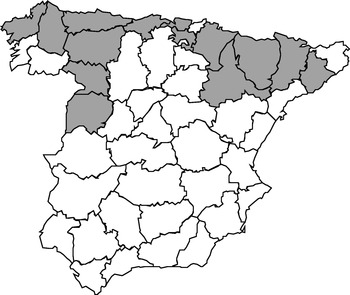
Faecal specimens from 287 diarrhoeic calves aged up to 21 days analysed for diagnosis of cryptosporidial infection over a 2-year period (2006 and 2007) were used in this study. Fresh faeces were directly collected from the rectum of the animals originating from 82 dairy cattle farms in 14 provinces across the north of Spain (Fig. 1). From 1 to 16 farms were surveyed at each province (mean: 5·8±4·2). From each farm, between 1 and 29 samples were analysed throughout the period of study (mean: 3·5±4·4). Faecal samples were examined for the presence of Cryptosporidium oocysts by microscopy of carbol fuchsin negative-stained smears (Heine, Reference Heine1982) and positive specimens were selected for molecular examination. A farm was considered infected if at least 1 positive sample was detected at any time during the period of study.
Map of Spain showing the provinces (shaded) where cattle farms were sampled.

DNA extraction
Oocyst suspensions from whole faecal specimens were prepared by saturated salt flotation, re-suspended in reverse osmosis water and stored at 4°C as previously described (Elwin et al. Reference Elwin, Chalmers, Roberts, Guy and Casemore2001). Total DNA was extracted from 200 μl of oocyst suspension using the QIAamp DNA mini kit (Qiagen) according to the manufacturer's instructions, incorporating in the protocol an initial step of 3 freeze-thaw cycles (freezing in liquid nitrogen for 1 min and heating at 100°C for 5 min), followed by incubation at 56°C for 30 min in lysis buffer containing proteinase K. DNA extracts were stored at −20°C.
Cryptosporidium species differentiation
Cryptosporidium species were determined by nested PCR of an SSU rRNA gene fragment and RFLP analysis with the endonucleases SspI and VspI using primers previously described (Xiao et al. Reference Xiao, Singh, Limor, Graczyk, Gradus and Lal2001). PCR products and restriction fragments were subjected to electrophoresis separation using 1% or 2% agarose gels, respectively, stained with ethidium bromide and visualized on a UV trans-illuminator. Samples that produced a banding pattern different from that of C. parvum with the conventional SspI and VspI restriction enzymes were digested with MboII. A subset of 50 representative positive isolates collected on 40 farms was selected for confirmation of the RFLP results by DNA sequence analysis. This subset included at least 1 of each subtype identified at the GP60 locus as well as the isolates that did not amplify on the GP60 gene.
Subtyping of C. parvum
Subtyping was achieved by sequence analysis of the GP60 gene using a protocol described previously (Alves et al. Reference Alves, Xiao, Sulaiman, Lal, Matos and Antunes2003). Selected SSU rRNA products as well as all GP60 products were purified and sequenced in both directions with the forward and reverse primers used in the secondary PCRs on a MegaBACE 500 sequencer (Amersham Biosciences) according to the manufacturer's instructions. The consensus sequences of both the sense and anti-sense strands were analysed using a BLAST search on the NCBI databases. Subtypes were named based on the number of TCA and TCG repeats in the tri-nucleotide repeat region, as well as the number of copies of the sequence ACATCA immediately after the repeat region for subtypes belonging to the family IIa (Sulaiman et al. Reference Sulaiman, Hira, Zhou, Al-Ali, Al-Shelahi, Shweiki, Iqbal, Khalid and Xiao2005).
For phylogenetic analysis, nucleotide sequences were aligned against each other and with reference sequences retrieved from GenBank with Clustal W and edited with BioEdit version 7.0.9 (http://www.mbio.ncsu.edu/BioEdit/bioedit.html). A neighbor-joining tree was generated using TreeCon (http://www.psb.rug.ac.be/bioinformatics/psb/Userman/treeconw.html) based on genetic distances calculated by the Kimura two-parameter model. The tree was rooted with a GP60 sequence of C. parvum subtype IIcA5G3a (AY738195). The reliability of branches was assessed by bootstrap analysis using 1000 replicates. The unique nucleotide sequence generated in this study was deposited in the GenBank database under Accession number EU868625.
RESULTS
Prevalence and Cryptosporidium species identification
Overall, 63 farms (76·8%) from all 14 provinces and 166 calves (57·8%) tested positive for Cryptosporidium by microscopy after negative staining with carbol fuchsin. Most positive specimens were available for molecular analysis, but some samples from the two more extensively sampled farms were excluded. Altogether, faecal specimens from 149 calves originating from 61 farms (mean: 2·4±1·9 calves per farm) in the 14 provinces were selected for molecular analysis. A single isolate from each of 26 farms and 2–10 isolates from each of the remaining 35 farms were included in the molecular analyses. DNA extracted from them all yielded SSU rRNA gene products of the expected size in the nested PCR. Restriction analyses with SspI and VspI generated profiles of C. parvum in all PCR products (visible bands of 449, 267, 108 bp and 628, 104 bp, respectively), except for 2 specimens originating from different farms in the same province, which yielded an SspI banding pattern of C. bovis (3 visible bands of 432, 267 and 103 bp) in addition to an upper band of approximately 465 bp. Restriction analyses of these two specimens with MboII generated a typical C. bovis pattern, with 3 visible bands of approximately 412, 162 and 76 bp (Feng et al. Reference Feng, Ortega, He, Das, Xu, Zhang, Fayer, Gatei, Cama and Xiao2007). Sequence analysis of the secondary PCR products of a subset of 50 isolates confirmed the identification of C. parvum in all but the 2 latter specimens, which had 100% sequence identity with C. bovis (GenBank Accession number AY741305). Calves infected with C. parvum were also detected in both farms where the C. bovis isolates were identified. Two types of C. parvum sequences were found. Forty specimens showed 100% identity to the C. parvum reference sequence AF093490 from a calf in the US (Xiao et al. Reference Xiao, Escalante, Yang, Sulaiman, Escalante, Montali, Fayer and Lal1999), and 8 specimens were identical to the reference sequence AF308600 from calves experimentally infected with bovine strain KSU-1 in the US (Le Blancq et al. Reference Le Blancq, Khramtsov, Zamani, Upton and Wu1997).
GP60 subtypes
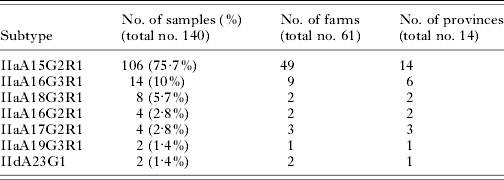
Subtyping at the GP60 locus generated products of the expected size for 143 of the 149 specimens analysed. Two of the 6 isolates which did not amplify on the GP60 gene were identified as C. bovis by sequencing of the SSU rRNA gene and the remaining 4 isolates were C. parvum. All these products were sequenced successfully, except for 3, which had underlying signals in the electropherogram preventing the accurate read-out of sequences. Alignment of the sequences obtained with reference sequences downloaded from GenBank revealed that most isolates (138) belonged to the C. parvum subtype family IIa and only 2 isolates were identified as subtype family IId. Overall, 7 different subtypes were found using the recently proposed nomenclature system, including 6 subtypes within the family IIa and 1 subtype within the family IId (Sulaiman et al. Reference Sulaiman, Hira, Zhou, Al-Ali, Al-Shelahi, Shweiki, Iqbal, Khalid and Xiao2005) (Table 1). All IIa subtypes were homologous with reference sequences previously reported in either humans or animals and were identical to each other in the non-repeat region, except for 1 isolate subtyped as IIaA16G3R1 which differed from the remaining sequences in a single C to T transition downstream of the tri-nucleotide repeats, but with no change in the amino acid coded. The 2 isolates belonging to the C. parvum family IId originated from 2 different farms in the same province and were identified as the novel subtype IIdA23G1.
Distribution of Cryptosporidium parvum GP60 subtypes in diarrhoeic calves under 21 days of age from dairy farms at different provinces in the north of Spain
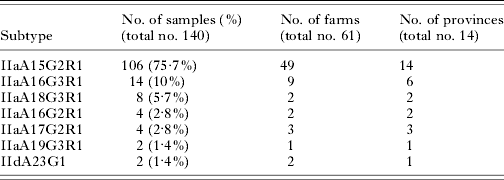
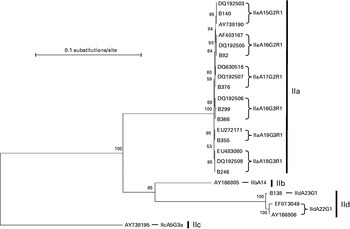
Subtype IIaA15G2R1 was the most common and widely distributed, identified in 80·3% of the farms within the 14 provinces surveyed, followed by subtype IIaA16G3R1 which was seen in 14·7% of the farms in 6 provinces. Other subtypes were geographically restricted to 1–3 farms in 1–3 provinces (Table 1). A single subtype was identified in most farms where 2 or more animals were analysed (29/35). Of the remaining 6 farms, 2 subtypes were found on 5 and 3 subtypes on 1 individual farm. Subtype IIaA15G2R1 was seen in all of the 6 latter farms, concurrently with the less prevalent subtypes IIaA16G2R1, IIaA17G2R1, IIaA19G3R1 and IIdA23G1, whereas farms infected by subtypes IIaA16G3R1 or IIaA18G3R1 did not have any other subtype circulating in calves. The close relationship among the isolates examined in the current study and some reference isolates previously identified as subtype family IIa or IId is shown in the phylogenetic analyses of the GP60 gene (Fig. 2).
Phylogenetic relationships of the isolates examined in the current study to different Cryptosporidium parvum subtypes as inferred by neighbor-joining analysis of the GP60 gene based on genetic distances calculated by the Kimura two-parameter model. Bootstrap values over 50% from 1000 pseudo-replicates are indicated at the left of the supported node.

DISCUSSION
Results of the current study do not reflect the prevalence of Cryptosporidium infection at a point in time since most farms were repeatedly sampled during the 2-year period. Nevertheless, the percentage of both infected calves (57·8%) and farms (76·8%) suggests that Cryptosporidium is a common and widespread pathogen for pre-weaned calves in northern Spain, and correlates well with cross-sectional studies conducted in dairy farms in central and north-western Spain, recording prevalence rates ranging from 52·5% to 64·7% in diarrhoeic neonatal calves by using negative-staining methods (Quílez et al. Reference Quílez, Sánchez-Acedo, Del Cacho, Clavel and Causapé1996; De la Fuente et al. Reference De la Fuente, García, Ruiz-Santa-Quiteria, Luzón, Cid, García, Orden and Gómez-Bautista1998; Castro-Hermida et al. Reference Castro-Hermida, González-Losada and Ares-Mazás2002).
The SSU rRNA-based PCR-RFLP used in this molecular analysis has been reported to be useful to identify most Cryptosporidium spp., although sequencing or alternative digestion with a combination of SspI and MboII is required for reliable differentiation of some Cryptosporidium species commonly seen in cattle (Feng et al. Reference Feng, Ortega, He, Das, Xu, Zhang, Fayer, Gatei, Cama and Xiao2007). In the present study, C. parvum was the only species identified by restriction analyses of all the positive isolates and sequencing of a subset of these isolates, except for 2 specimens that showed slight differences in the SspI pattern and were identified as C. bovis by MboII digestion. The presence of a C. bovis mixed population with a nucleotide mutation in the SspI cutting site producing the 33 bp fragment (not visible in agarose gel electrophoresis) may explain the presence of an extra upper band of approximately 465 bp in both specimens, although DNA sequencing of PCR products revealed that they were identical to the C. bovis GenBank AY741305. Concurrent infections by other Cryptosporidium species may not be excluded since the SSU rRNA-based PCR tools selectively amplify the dominant Cryptosporidium populations, and it has been suggested that the presence of non-C. parvum species in young calves can be masked by overwhelming C. parvum infections (Cama et al. Reference Cama, Gilman, Vivar, Ticona, Ortega, Bern and Xiao2006; Feng et al. Reference Feng, Ortega, He, Das, Xu, Zhang, Fayer, Gatei, Cama and Xiao2007). Nevertheless, our findings clearly demonstrate that C. parvum is the main species involved in the aetiology of cryptosporidiosis in diarrhoeic pre-weaned calves in Spain. These results were further supported by the finding that all but 6 isolates were successfully amplified by GP60 subtyping, a method which amplifies DNA of C. parvum and closely related species, but does not amplify DNA of C. bovis, C. andersoni or C. ryanae (Feng et al. Reference Feng, Ortega, He, Das, Xu, Zhang, Fayer, Gatei, Cama and Xiao2007; Xiao and Ryan, Reference Xiao, Ryan, Fayer and Xiao2008). In fact, the 2 specimens identified as C. bovis by sequencing of the SSU rRNA locus did not amplify on the GP60 gene.
The distribution of Cryptosporidium species seen in pre-weaned calves is similar to that reported in other European countries and Canada, with most infections due to C. parvum, whereas C. bovis and C. ryanae are only occasionally found in calves under 30 days of age (Trotz-Williams et al. Reference Trotz-Williams, Martin, Gatei, Cama, Peregrine, Martin, Nydam, Jamieson and Xiao2006; Geurden et al. Reference Geurden, Berkvens, Martens, Casaert, Vercruysse and Claerebout2007; Langkjær et al. Reference Langkjær, Vigre, Enemark and Maddox-Hyttel2007; Plutzer and Karanis, Reference Plutzer and Karanis2007; Thompson et al. Reference Thompson, Dooley, Kenny, McCoy, Lowery, Moore and Xiao2007; Broglia et al. Reference Broglia, Reckinger, Cacciò and Nöckler2008; Brook et al. Reference Brook, Hart, French and Christley2008). In the United States, age-related variations in the distribution of different Cryptosporidium spp. have been reported to occur in both dairy and beef cattle, with C. parvum being responsible for most infections in pre-weaned (5 days to 2 months) calves, whereas C. bovis and C. ryanae are found predominantly in 3-month-old to 2-year-old cattle and C. andersoni is much more prevalent in cows older than 2 years, revealing that the post-weaned cattle do not contribute significantly to zoonotic cryptosporidiosis (Santín et al. Reference Santín, Trout, Xiao, Zhou, Greiner and Fayer2004; Fayer et al. Reference Fayer, Santín, Trout and Greiner2006, Reference Fayer, Santín and Trout2007; Feltus et al. Reference Feltus, Giddings, Khaitsa and McEvoy2008).
Sequence analysis of the GP60 gene identified 7 subtypes within 2 C. parvum subtype families, although all but 2 isolates belonged to the subtype family IIa, the major zoonotic family of C. parvum found worldwide in cattle. Most molecular analyses in Europe and North America have shown that it is clearly the dominant C. parvum subtype family infecting calves, although subtypes belonging to the families IId, IIb and IIj have occasionally been identified (Alves et al. Reference Alves, Xiao, Sulaiman, Lal, Matos and Antunes2003; Wu et al. Reference Wu, Nagano, Boonmars, Nakada and Takahashi2003; Geurden et al. Reference Geurden, Berkvens, Martens, Casaert, Vercruysse and Claerebout2007; Misic and Abe, Reference Misic and Abe2007; Plutzer and Karanis, Reference Plutzer and Karanis2007; Broglia et al. Reference Broglia, Reckinger, Cacciò and Nöckler2008; Wielinga et al. Reference Wielinga, de Vries, van der Goot, Mank, Mars, Kortbeek and van der Giessen2008). The subtype family IIa is also commonly seen in humans, especially in rural areas of Europe and the United States (Xiao and Feng, Reference Xiao and Feng2008). Currently there are no data on the distribution of C. parvum subtypes in humans in Spain. However, a recent study in the Zaragoza province identified this species in 34 patients, mostly children from rural areas, compared to 69 patients infected by C. hominis, revealing that although Cryptosporidium transmission in this geographical area seems to be largely anthroponotic, zoonotic transmission may not be excluded (Llorente et al. Reference Llorente, Clavel, Goñi, Varea, Seral, Becerril, Suárez and Gómez-Lus2007). In fact, all C. parvum IIa subtypes identified in this study have previously been described in human patients, indicating that most isolates from diarrhoeic calves in northern Spain have the potential to infect humans.
The finding of 7 different subtypes in this study also reveals a modest genetic diversity of C. parvum among the cattle population, similar to that previously reported in Belgium or eastern United States, but much more limited to that seen in Northern Ireland or The Netherlands, where 16 and 18 different subtypes were found in calves, respectively (Geurden et al. Reference Geurden, Berkvens, Martens, Casaert, Vercruysse and Claerebout2007; Thompson et al. Reference Thompson, Dooley, Kenny, McCoy, Lowery, Moore and Xiao2007; Xiao et al. Reference Xiao, Zhou, Santín, Yang and Fayer2007; Wielinga et al. Reference Wielinga, de Vries, van der Goot, Mank, Mars, Kortbeek and van der Giessen2008). The reasons for these geographical differences in the distribution of C. parvum subtypes are not well documented, although a correlation between number of cattle movements and genetic diversity has recently been reported (Morrison et al. Reference Morrison, Mallon, Smith, MacLeod, Xiao and Tait2008). The introduction of new subtypes through exchange or purchase of calves may also explain the frequent detection of concurrent infections with mixed C. parvum subtypes in cattle farms (Peng et al. Reference Peng, Wilson, Holland, Meshnick, Lal and Xiao2003; Tanriverdi et al. Reference Tanriverdi, Markovics, Arslan, Itik, Shkap and Widmer2006; Xiao et al. Reference Xiao, Zhou, Santín, Yang and Fayer2007). In the present study, only 6 cattle farms were found to have 2 or 3 subtypes, although the remaining farms could also have multiple subtypes circulating in cattle, because not all calves were sampled on every farm.
Subtype IIaA15G2R1 was responsible for 76% of C. parvum infections in calves at more than 80% of the farms and its occurrence was not linked to a particular province. This subtype has been reported as one of the major subtypes responsible for zoonotic cryptosporidiosis and the most common C. parvum subtype in calves (Glaberman et al. Reference Glaberman, Moore, Lowery, Chalmers, Sulaiman, Elwin, Rooney, Millar, Dooley, Lal and Xiao2002; Peng et al. Reference Peng, Wilson, Holland, Meshnick, Lal and Xiao2003; Chalmers et al. Reference Chalmers, Ferguson, Cacciò, Gasser, Abs El-Osta, Heijnen, Xiao, Elwin, Hadfield, Sinclair and Stevens2005; Sulaiman et al. Reference Sulaiman, Hira, Zhou, Al-Ali, Al-Shelahi, Shweiki, Iqbal, Khalid and Xiao2005; Alves et al. Reference Alves, Xiao, Antunes and Matos2006; Trotz-Williams et al. Reference Trotz-Williams, Martin, Gatei, Cama, Peregrine, Martin, Nydam, Jamieson and Xiao2006; Geurden et al. Reference Geurden, Berkvens, Martens, Casaert, Vercruysse and Claerebout2007; Broglia et al. Reference Broglia, Reckinger, Cacciò and Nöckler2008; O'Brien et al. Reference O'Brien, McInnes and Ryan2008; Brook et al. Reference Brook, Hart, French and Christley2008). The percentage of calves infected by this subtype was similar in large sample size studies conducted in eastern United States (77%) or The Netherlands (69%), revealing that calves are also an important reservoir for this zoonotic C. parvum subtype in the north of Spain (Xiao et al. Reference Xiao, Zhou, Santín, Yang and Fayer2007; Wielinga et al. Reference Wielinga, de Vries, van der Goot, Mank, Mars, Kortbeek and van der Giessen2008). By contrast, the second most common and widely distributed subtype in the current study, IIaA16G3R1, found in 9 farms from 6 provinces, is much less common in other geographical areas. It seems to play a minor zoonotic role, since it has only been identified in modest numbers of specimens from calves and only one case of human infection has been recorded (Strong et al. Reference Strong, Gut and Nelson2000; Peng et al. Reference Peng, Wilson, Holland, Meshnick, Lal and Xiao2003; Trotz-Williams et al. Reference Trotz-Williams, Martin, Gatei, Cama, Peregrine, Martin, Nydam, Jamieson and Xiao2006; Thompson et al. Reference Thompson, Dooley, Kenny, McCoy, Lowery, Moore and Xiao2007; Wielinga et al. Reference Wielinga, de Vries, van der Goot, Mank, Mars, Kortbeek and van der Giessen2008; Brook et al. Reference Brook, Hart, French and Christley2008).
Another widely distributed subtype IIaA18G3R1, reported as the most prevalent in calves in Northern Ireland and the predominant subtype in waterborne outbreaks of cryptosporidiosis in the same country (Glaberman et al. Reference Glaberman, Moore, Lowery, Chalmers, Sulaiman, Elwin, Rooney, Millar, Dooley, Lal and Xiao2002; Thompson et al. Reference Thompson, Dooley, Kenny, McCoy, Lowery, Moore and Xiao2007), was responsible for the diarrhoeic illness in only 2 cattle farms in this study. The remaining subtypes were also seen at a low prevalence in the cattle population and always concurrently found with the major subtype IIaA15G2R1. The previous finding of subtypes IIaA16G2R1, IIaA17G2R1 and IIaA19G3R1 in sporadic isolates from calves and humans suggests that they have a world-wide distribution but play a minor role in the aetiology of cryptosporidial infections in cattle (Glaberman et al. Reference Glaberman, Moore, Lowery, Chalmers, Sulaiman, Elwin, Rooney, Millar, Dooley, Lal and Xiao2002; Peng et al. Reference Peng, Wilson, Holland, Meshnick, Lal and Xiao2003; Stantic-Pavlinic et al. Reference Stantic-Pavlinic, Xiao, Glaberman, Lal, Orazen, Rataj-Verglez, Logar and Berce2003; Chalmers et al. Reference Chalmers, Ferguson, Cacciò, Gasser, Abs El-Osta, Heijnen, Xiao, Elwin, Hadfield, Sinclair and Stevens2005; Alves et al. Reference Alves, Xiao, Antunes and Matos2006; Blackburn et al. Reference Blackburn, Mazurek, Hlavsa, Park, Tillapaw, Parrish, Salehi, Franks, Koch, Smith, Xiao, Arrowood, Hill, da Silva, Johnston and Jones2006; Feltus et al. Reference Feltus, Giddings, Schneck, Monson, Warshauer and McEvoy2006; Trotz-Williams et al. Reference Trotz-Williams, Martin, Gatei, Cama, Peregrine, Martin, Nydam, Jamieson and Xiao2006; Geurden et al. Reference Geurden, Berkvens, Martens, Casaert, Vercruysse and Claerebout2007; Thompson et al. Reference Thompson, Dooley, Kenny, McCoy, Lowery, Moore and Xiao2007; Xiao et al. Reference Xiao, Zhou, Santín, Yang and Fayer2007; Broglia et al. Reference Broglia, Reckinger, Cacciò and Nöckler2008; O'Brien et al. Reference O'Brien, McInnes and Ryan2008; Wielinga et al. Reference Wielinga, de Vries, van der Goot, Mank, Mars, Kortbeek and van der Giessen2008). The same holds true for the novel subtype IIdA23G1, the only subtype within the family IId seen in this study, which agrees with previous studies concluding that calves are not an important reservoir of this zoonotic group of C. parvum (Alves et al. Reference Alves, Xiao, Antunes and Matos2006; Geurden et al. Reference Geurden, Berkvens, Martens, Casaert, Vercruysse and Claerebout2007; Misic and Abe, Reference Misic and Abe2007; Plutzer and Karanis, Reference Plutzer and Karanis2007; Broglia et al. Reference Broglia, Reckinger, Cacciò and Nöckler2008). It is noteworthy that a recent molecular study in north-eastern Spain revealed that this family accounted for 98% of the cryptosporidial infections in diarrhoeic lambs and goat kids although subtype IIdA23G1 was not identified, suggesting that it may be apparently adapted to calves (Quílez et al. Reference Quílez, Torres, Chalmers, Hadfield, del Cacho and Sánchez-Acedo2008). Further subtyping studies with Cryptosporidium isolates from humans are required to increase our understanding of the zoonotic transmission of cryptosporidiosis in Spain.
This work was supported by funds from Spanish (AGL2004-03233) and regional (DGA-B82) research programmes. E. Torres is a fellowship holder of the Diputación General de Aragón. We thank Kristin Elwin and Stephen J. Hadfield (UK Cryptosporidium Reference Unit) and J. Luis Juaristi (Rancho Las Nieves) for their helpful assistance.