Poor educational success is generally one of the major factors impeding Aboriginal advancement. There are many jobs that would be available to Aboriginal people, if only they had the basic education required to do them. Higher levels of education contribute to better health and housing as well as achieving better economic outcomes and is considered one of the main strategies for addressing Indigenous disadvantage in Australia (Hunter & Schwab, Reference Hunter and Schwab2003). Indigenous students and staff make up about 1% of the student and staffing numbers nationally, but 3% of the population as a whole, so there is underrepresentation of Indigenous Australians, in higher education and we have a way to go to achieve parity (Liddle, Reference Liddle2014).
The many barriers preventing Indigenous students from accessing and succeeding in higher education have been identified by Bin-Sallik (Reference Bin-Sallik2000), Biddle, Hunter, and Schwab (Reference Biddle, Hunter and Schwab2004), Andersen, Bunda, and Walter (Reference Andersen, Bunda and Walter2008). These include financial pressures, living away from home, health-related problems (Australian Institute of Health and Welfare, 2011), racism and prejudice towards Indigenous people, and low levels of academic readiness and aspirations of Indigenous students, coupled with the high academic demands of study and insufficient academic support.
The Review of Higher Education Access and Outcomes for Aboriginal and Torres Strait Islander People: Final Report 2012 (IHER, 2012) recommended that Indigenous culture and knowledge be embedded across the entire university so greater cultural change was achieved, and that Indigenous-specific spaces on campus needed to be increased and strengthened. While the Background Paper on Indigenous Australian Higher Education: Trends, Initiatives and Policy Implications, also highlighted that cultural issues are important, particularly the clashes that some students experience as a result of nonIndigenous sociocultural values in teaching styles, course content and support provided. These aspects contribute to Aboriginal and Torres Strait Islander students feeling isolated and excluded from the academic environment within universities (Pechenkina & Anderson, Reference Pechenkina and Anderson2011). To redress this, as well as including Indigenous content within courses, the whole institution needs to be culturally inclusive (Andersen, Reference Andersen2014).
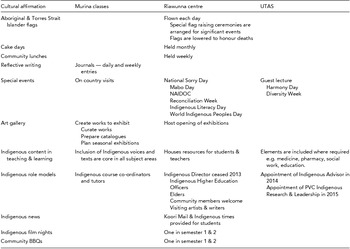
Generally, low socioeconomic status students perform as well as other students, but this does not seem to be the case for Indigenous and low socioeconomic status students from remote and regional areas (CSHE, 2008). It is evident that admission is only one aspect impacting on Indigenous performance in higher education and affirms the view that ‘access without effective support is not opportunity’ (Tinto, Reference Tinto2008). Outcomes for Indigenous Australians at university fall largely into two groups according to Pechenkina, Kowal and Paradies (Reference Pechenkina, Kowal and Paradies2011) those with high enrolment and low completions and those with low enrolments and high completions; on this basis the University of Tasmania (UTAS) is in the second group largely due to work of the Riawunna Centre, which has progressed a number of strategies to affirm Aboriginal culture at the university as Table 1 shows. In this article, we share some of the practical ways in which we attempted to provide students with the raw ingredients to create their own new story of themselves as students.
Strategies to Support Cultural Affirmation at UTAS

Method
The core of this paper is based on a series of conversations/yarns with the two main academics involved in program delivery and also student participant contribution by way of focus group discussion and end of course evaluations. As recommended by Smith (Reference Smith1999, p. 39), we wanted to work in partnerships with our students to focus on the Murina program, using participant observations and discussions with Murina staff and students. Various documents were also analysed including student feedback sheets, reflective journals and staff reports.
The three authors met monthly to reflect on issues, share views and plan coming events and activities. These meetings enabled us to probe, elaborate and clarify our thinking through reflective dialogue. A guiding principle for the work was the right of our students to participate as partners to generate knowledge relating to their culture, identity and wellbeing (Castellano, Reference Castellano2004, p. 110). In keeping with this ethos, students were invited to contribute or withdraw their information from inclusion in our presentations and reports about the program.
Rationale
There are a number of programs across Australia designed to assist Aboriginal people to gain access to university. The program under research is innovative as it drew on participants’ stories to foster their engagement. The small numbers of students enabled the use of a ‘conversational methodology’ in contrast to more theoretical methodological approaches. This process reflects appropriate cultural practice as argued by Smith (Reference Smith1999, p. 120) which respond to Indigenous cultural protocols. ‘The conversational method is of significance to Indigenous methodologies because it is a method of gathering knowledge based on oral story telling tradition congruent with an Indigenous paradigm’ (Kovach, Reference Kovach2010: 40). Methodologically this paper is based on the work of Kovach (Reference Kovach2010) where, ‘a dialogic participation that holds a deep purpose of sharing story as a means to assist others’ (Kovach, Reference Kovach2010: 40). This means of gathering information through the stories of the participants enabled students to work through significant personal and psychological issues which emerged as part of their daily lives which were significantly based in this program. Students attended 4 days a week and a 5th day was used from time to time for field trips. A conversational methodology has been adopted as it aptly describes our work and also most practitioners tend to refrain from extensive theoretical and methodological discussion in their research reports (Have, Reference Have1990).
In this project, story, listening to story, and compassion, was critical to retention and engagement. The stories reflected shared cultural experiences of difficulties arising from colonisation and it enduring neo-colonial practices. Trauma and disadvantage characterise the lives of many Aboriginal people with experiences of racism (DOHA, 2012) have been shown to impact on health, wellbeing and all aspects of life including access and success in education. The ongoing impact of stolen generations (RCIADIC, 1991) and intergenerational trauma (Atkinson, Reference Atkinson2002) are significant factors. To disregard these experiences when Aboriginal students enter education is an assumed educational norm within classroom practice. In the small and intimate educational context of this program such a response would have been culturally insensitive and culturally inappropriate. A nonsensitive psychological response would clearly impact on student engagement and outcomes. Consequently, story was privileged and became integral as a methodology, and we positioned our students at the centre of the learning and teaching process, not at the margins as argued by Rigney (Reference Rigney1999).
Riawunna Centre
‘Riawunna’ is a Tasmanian Aboriginal word meaning ‘place of learning’ for Aboriginal people, from entry level to tertiary studies at the University of Tasmania and operates at Hobart, Launceston and Burnie campuses. The Riawunna Centre was established to encourage Aboriginal people to aspire to higher levels of education, and to support them to be successful in their chosen course of study. Riawunna provides a welcoming space for Aboriginal and Torres Strait Islander students to get together, study and access academic and pastoral support at all three locations. It also offers tutorial support through the Indigenous Tutorial Assistance Scheme (ITAS), assistance in applying for bursaries, scholarships, a resource library, computer room and a student common room for informal interaction and relaxation. The Centre and its staff play an important role in promoting and supporting cultural affirmation as outlined in Table 1.
The need for greater involvement of Aboriginal people in the development and delivery of educational programs has been improved at UTAS by fostering stronger relationships with Aboriginal communities, through the appointment of Indigenous Higher Education Officers and Murina Pathways staff who maintain regular contact with their respective regional communities in north-western, northern and southern Tasmania. Also, the presence of Elders has been beneficial for students along with on-country experiences, both have contributed to enhanced social accountability (Boellen & Wollard, Reference Boellen and Wollard2009). Our programs are based on the premise of ‘cultural respect — recognition and respect of the inherent rights and traditions of Indigenous Australians which incorporates a holistic approach involving partnership, capacity building and accountability’ (Andersen, Reference Andersen2009), because we know cultural identity has a pivotal role in shaping wellbeing.
Background
As a team the Murina staff began gathering information, from student feedback and the endless staff discussions about what we do well and what we might do better to form the basis of a presentation at the National Association of Enabling Educators of Australia (NAEEA) conference in November 2013, which informs this article.
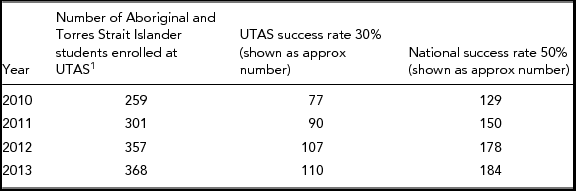
Of all the Aboriginal and Torres Strait Islander students enrolled at the University of Tasmania, about 30% manage to succeed (see Table 2). No research has been done to date on the reason for this low figure.
UTAS Aboriginal and Torres Strait Islander Success Rate Compared to the National Success Rate for Students

1 Source: UTAS Student Evaluation, Review & Reporting Unit.
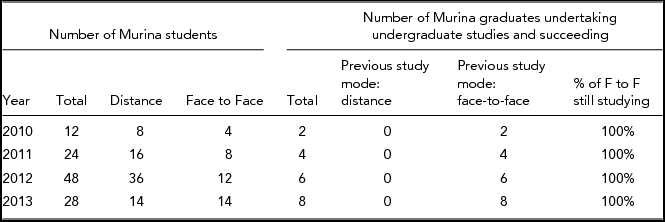
The number of Aboriginal and Torres Strait Islander students enrolled at UTAS has steadily increased from 259 in 2010, to 368 in 2013. However, the number of students succeeding does not reflect this upward trend, as the success rate has remained around the 30% level, which is well below the national rate. Our program grew out of the need to engage and retain more Aboriginal and Torres Strait Islander students and to bring back those who had disengaged. The attrition rates for most enabling courses with no minimum academic entrance requirements are more than 50% (Bennett et al., Reference Bennett, Hodges, Kavanagh, Fagan, Hartley and Schofield2012). In comparison, of all the students who enrolled in undergraduate courses after completing the Murina Pathways Program, during the four years 2010 to 2013, 100% are still studying successfully (see Table 3).
Aboriginal and Torres Strait Islander Murina Students in Undergraduate Studies

The numbers are small, yet impressive, indicating the success of the program particularly for the face-to-face students. Table 3 clearly shows that these students were more likely to continue with university studies and to be successful as all are progressing well. In contrast it can be suggested that the Distance Murina students missed out on participating in the full range of cultural affirmation activities and hence were less motivated to engage in further studies at the university.
The success of this program supports the key findings of the NCVER Research Report (Dockery, Reference Dockery2013) that stronger cultural identity appears to promote greater participation and achievement in education and training. The causal effect flowing from cultural identity to outcomes is strong and regardless of whether individuals live in remote or nonremote areas, and irrespective of their extent of cultural attachment, there is increased likelihood of employment and income with additional years of completed education.
Success for our students is measured in different ways. If a student chooses not to pursue a university degree but decides to enrol in a TAFE diploma course instead, that is a success. If a student discovers the joy of learning, that too is success. If our students leave understanding more of themselves, and the world around them, and taking that knowledge back to their communities, that is a success. For the purposes of this article, the particular success we are looking at is the transition from bridging course to undergraduate studies of students who are completely confident that they can at the very least pass in any unit they choose and have the resilience to complete their chosen course.
Murina: Pathway
‘Murina’ a Tasmanian Aboriginal word meaning ‘pathway’ is an enabling program designed for Aboriginal and Torres Strait Islander people, to gain the skills to commence university studies. The program focuses on promoting a positive sense of identity through affirmation of Indigenous student's culture. It is not enough only to develop students’ academic study skills, as complete preparation for university studies must also include the development of a mindset and resilience to enable students to cope with the longer term goal of completing their degrees. The program has been developed on the premise that a positive sense of identity is important for wellbeing, and materials and activities to support this have been incorporated wherever possible. This involved the use of Aboriginal voices through text and film within the teaching program as well as drawing and listening to music as these stimulate the brains auditory and emotional functions and also help motor functions (Sacks, Reference Sacks2008; Sennett, Reference Sennett2008: 274).
We adopted the use of narrative based on the work of Chandler, Lalonde, Sokol, and Hallett (Reference Chandler, Lalonde, Sokol, Hallett and Marcia2003) who noted narrative strategies were employed by indigenous Canadian youth in understanding their persistence though time and suggested, that if young Indigenous Australians adopted similar strategies, positive self-identity is likely to be fostered through an appreciation of and respect for kinship structures, attachment to place and knowledge of the stories and law of their ancestors, and this may help lay the foundation for future educational success.
Over the last 4 years every student at UTAS who has graduated from the Murina program and chosen to enrol in undergraduate studies has been successful, indicating that the program seems to be working as highlighted in Table 3. Many Aboriginal families have experienced unexpected setbacks and unwelcome change in their lives largely due to imposed neo-colonial policies (Havemann, Reference Havemann1999). Some are robust and resilient and able to bounce back from change while many cope less well with their grief and anxiety (Australian Human Rights Commission, 1997; World Health Organisation, 2008).
Our goal was to assist our students to understand these imposed changes, the struggle to resist them (Attwood & Markus, Reference Attwood and Markus1999) and help them to become more resilient, by being productive and developing an enhanced sense of wellbeing which in turn led to longer term positive outcomes. Rose (Reference Rose1990) in Healing Hurt Minds proposed setting up a new approach which involved developing a community identity as well as an individual identity and this is what we aimed to achieve through our program.
Often our students had negative views of themselves as students due to their poor achievements during earlier schooling years. Many also had no pride in their Aboriginal ancestry, were isolated from their communities and lacked any sense of belonging. All of these facets had to be addressed and developed, to do this required creating a healing place where students were comfortable and welcome, with caring staff who practiced deep listening (Atkinson, Reference Atkinson2002) and elders who were available to yarn (Bessarab & Ng'andu, Reference Bessarab and Ng'andu2010; Fredericks et al., Reference Fredericks, Adams, Finlay, Fletcher, Andy, Briggs, Briggs and Hall2011; Fredericks et al., Reference Fredericks, Clapham, Bainbridge, Collard, Adams, Bessarab, Andersen, Duthie, Ball, Thompson and Daniels2014). It was almost like providing ‘therapy’ to heal past hurts, or at least starting the process so people could be referred to other services as required, but this would not have happened without the trusting relationships developed in the classes.
We had to adopt decolonizing methodologies as a way to prioritize Indigenous values and worldviews, and contribute to positive change in the way they thought about themselves and their people (Walker, Fredericks, Mills, & Anderson, Reference Walker, Fredericks, Mills and Anderson2014). Atkinson's (Reference Atkinson2002) teachings and words of wisdom on cultural healing, provided important tools for us to incorporate in our program. These included the following:
-
re-membering — seeing the past as a means to re-joining and becoming members of both a particular Aboriginal community and society in general (story telling vs. homelessness);
-
re-sourcing — creating a map to find locations/situations/relationships where our people feel culturally safe (community wealth vs. poverty);
-
empowering voice — helping people access places of cultural safety by having an effective voice (resilience and resistance vs. powerlessness);
-
re-creation — of cultural products through creative activity such as music, film, theatre, craft and art (cultural expression vs. disorientation).
As its about identity and re-finding one's place in the world and re-weaving the relationships to create a sense of community, Smith's (Reference Smith1999) Maori principles were helpful in guiding our work, this involved being respectful to all students, being available to yarn with students, being prepared to look and listen before speaking, sharing and being generous with food and resources, being careful, not to promise what cannot be delivered, and not boasting about our knowledge or ‘big noting’ ourselves. Instead, we focused on creating opportunities for our students to achieve successes which we could celebrate together. One of the tools used to achieve this was the strong use of narrative and imagery in our teaching.
A narrative is defined as a spoken or written account of connected events, a story, which can also be a work of poetry or prose, or even song, theatre, or dance. Denning (Reference Denning2007) introduces the concept of narrative intelligence to counter the view that storytelling is a one-way relationship between the teller and the listener, when really narrative and storytelling takes place within a two-way, interactive relationship. It is this two-way relationship which the tutors and students focused on fostering and developing through their lessons together.
The tutors also used imagery, which can be defined as descriptive language in a literary work and or images collectively, to engage the students. This involved them creating expressive or evocative images in their art using pictures created from their memory or imagination in response to experiences provided by their tutors. We wanted to provide opportunities to enable our students to critically reflect on their life events, to understand how past policies had impacted on their families in order to change their beliefs or behaviours (Mezirow, Reference Mezirow1997).
We adopted a holistic, whole person approach (Dewey, Reference Dewey1886) which meant using a mixture of resources, techniques and skills, along with cultural wisdom and intuition to support the student. This involved considering the mind–body connection in each student, taking account of their emotional state and exploring their sense of meaning and belonging (Atkinson, Reference Atkinson2002), while looking at the bigger picture including relationships, the community and the physical environment to create a sense of health and healing as well as competence as a student. For us, this meant creating a safe healing place for the students as well as addressing their knowledge gaps. It involved the following:
-
empowering the student to value himself or herself by listening to their concerns with attention and providing strategies to support resolution of immediate issues, and empower the student;
-
considering the mind–body connection when making ‘co-assessment’ of student's problems that were impacting on their participation;
-
enabling the student to look at the bigger picture that included relationships, the community and the physical environment and;
-
fostering health and healing as well as study skills.
We have developed this approach so that the student is treated holistically, whereby all aspects of their lives are taken into consideration including income, food, shelter, of the family and community, as well as, a sense of purpose and belonging, as affirmed by Atkinson (Reference Atkinson2002). The English language has few words for holistic whereas, according to Inoue (Reference Inoue2012), Japanese has at least four words:
‘Kizuna’ — a lifelong bond between two people;
‘Ba’— a social space in which people can co-create understanding;
‘Takumi’ — skills in professional practice implying deep wisdom and insight;
‘Omoi’ — an integrated form of thinking and being that provides a strong sense of identity and role in society. These are the qualities which we aspired to develop in our students so that they have both the strength of identity and wisdom to be advocates and future leaders as well as successful students.
This whole-person approach to teaching resonates culturally with Aboriginal and Torres Strait Islander people, but is also applicable to any student of any culture, especially those who come to university tentatively and with low expectations of what they can achieve.
Teaching for Success: Building Resilience
One of the factors students identified for us and that we have developed is the use of narrative and imagery to build resilience. What do we mean by resilience? It is the ability to adapt well in the face of adversity, such as trauma, tragedy, threats, or even significant sources of stress, such as family and relationship problems, serious health problems, or workplace and financial stressors. It means ‘bouncing back’ from difficult experiences, and often ‘the road to resilience is likely to involve considerable emotional distress.’ It also refers to the ability to cope with stress and adversity and to do well in life despite difficulties (Gunnestad, Reference Gunnestad2006).
For us this includes personal, family, social and cultural resilience. It is not an individual trait but a learnt process of interacting with environments in ways that either promote wellbeing or protect against, or reduce the impact of, risk factors (Zautra, Hall, & Murray, Reference Zautra, Hall, Murray, Reich, Zautra and Hall2010). The literature also indicates an interface of Indigenous social and cultural resilience with individual and family resilience (Lalonde, Reference Lalonde, Flynn, Duding and Barber2006). Hence social, cultural and identity practices and Indigenous knowledges that support positive adaptation despite the presence of hazards are vital for developing individual and family resilience. Without question the students who come to us already have resilience. Most of them have already endured more in their lifetime than we ever hope to have to deal with. What they do not have yet is resilience as students.
We know we can teach the skills they need to succeed in the university environment: by the end of a year with us most of them can reference their work; they know how to deconstruct an essay topic; how to write an essay outline; how to research and how to avoid plagiarising.
These are the easy things to teach: what they also need to learn is that they can succeed as students; that they can prosper in an institution that is heavily oriented toward Western culture; that they can find the support that they need; that if they fall, they can pick themselves up again; that they can finish what they started; and, perhaps most importantly, that they have a right to be at university and a right to gain a degree.
These things cannot be taught but they can be learned in the right environment. Moleli (Reference Moleli2005) indicates this ‘involves behaviours, thoughts and actions that can be learned and developed’. The challenge for Murina staff is to create that specific kind of environment in which students can do this in order to re-write their own stories. We can provide the ingredients but we cannot write these stories for them; they must write these themselves.
Tools for Learning
This section discusses the approaches taken by the Murina coordinator, Ann and the Art coordinator, Brigitte and includes examples of four student's experiences.
Stories
As teachers, we all know that no learning takes place in a vacuum. Before I started teaching my first class in the Murina program, I asked our then Director if she had any advice for me. I was already well experienced in teaching children and adults but this would be the first all — Aboriginal class I had ever taught. She said, ‘Stories, lots of stories.’ (Murina Co-ordinator, Ann).
Ann believed in the power of stories to support us from the cradle to the grave. She often spoke about stories with the students and why they were important. She shared her childhood experiences of the power of story, how she learnt that the possibilities of the future were limitless, that the gentle voices, waxing and waning through bouts of delirium, did not just soothe a sick child, they created internal spaces and enabled her to negotiate a lonely and damaging childhood. Stories allowed her to create safe worlds where she could fashion roles and outcomes of her own will. They built resilience for her. That was another place, another time, another culture, but Ann was able to link her experience to that of Yolngu people in Arnhem Land singing stories to a clan member who was dying through sharing Why Warriors Lie Down and Die, (Trudgen, Reference Trudgen2000). Family members sing the story of the clan and the story of place of the dying person. She asks the students, ‘What could be kinder or better in any way than, when you are dying, to have those you love place you with narrative into the context in which you have lived?’ and explores the ideas that you might be dying, but you hold both a personal and a larger place within the community. Your death, as your life, belongs in community. This supports Parker J. Palmers’ philosophy of teaching: ‘we teach who we are: good teaching comes from the identity and integrity of the teacher’ (Palmer, Reference Palmer1998, p.10).
Ann also used stories as an aid to understand concepts.
For example, in our Learning and Communication Skills unit, we come to the point where students need to understand the concept of a paradigm shift. I have never yet had a student come to class who knows the meaning of the word ‘paradigm’. I write it on the board. I explain it. They look as if they are trying to process what I am saying but I know they are still not sure. (Murina Co-ordinator, Ann).
Then she tells them her best illustration of a paradigm shift from Covey's (Reference Covey2004) book The 7 Habits of Highly Successful People. The simple story of a man travelling with his noisy children, after the death of their mother, fixes in the student's minds forever what a paradigm shift is and how one extra fact can change your thinking and your feeling and your attitude completely in a second.
Journals: Narrative Becomes Image, Images Become the Future
Journal writing was another important tool for the students to respond to material encountered in their classes, in the news or events in their lives. These journals became almost works of art with drawings as well as collected objects and articles all woven together with future aspirations. Some became important collections of family history, highly valued and proudly shared with other family members. One student has written a book based on her journal.
Carofiglio (Reference Carofiglio2007), in his book Reasonable Doubts, sums this up:
. . .facts and actions have no meaning in themselves. The only thing that can mean anything is the narrative we make out of those facts and actions.
We all of us. . .construct stories to give meaning to facts which in themselves have none. To try and bring order out of chaos.
When we get down to it, stories are all that we have.
Human beings are creatures of narrative and images. Story is built into the fabric of our being. All our outcomes in life are created through story. The earliest history we have is story expressed through oral story-telling, through art and through dance. These are the oldest and most enduring of our expressions of ourselves as individuals and as communities. Our thoughts flow backwards and forwards from narrative which becomes image to images which become narratives to create a portrait of a self-fulfilling future. Our students often responded through drawing first then went on to talking, sharing a story about the work before proceeding to write about their feelings and thoughts.
Mattingly (Reference Mattingly1998) indicates the need for narrative arises at liminal points in people's lives and that it is critical when occupational therapists are working with clients whose stories are deficient or cut short. This is also important when working with Indigenous students, as many have had very challenging life experiences.
Creating Stories Through Doing: Seeing Ourselves with Fresh Eyes
While Ann focused on written words to share stories, Brigitte the Art Coordinator provided opportunities for students to create images to tell their stories.
It was important to get across the idea that all we accomplish in our lives comes from the stories in our heads that we tell ourselves about ourselves and how we, as educators, can help (not do it for them - students have to do it themselves) students to rewrite their own stories with successful outcomes, instead of the stories of defeat and victimisation that they often present themselves with when they first come to us. (Murina Art Co-ordinator, Brigitte)
Brigitte mentored the students through all the processes involved in arranging an exhibition to showcase their work, through a series of workshops and site visits. This included planning a launch, how to hang works, preparing artist statements and creating catalogues. These students then mentored other students to pass on the skills, through the Volunteer, Mentor and Leadership Program to assist students to participate in in-house solo exhibitions. The rules were that they must do the work themselves under supervision from the Art Coordinator. To have a solo they had to commit to supporting the next student exhibitor. In this way, the image they have of themselves changes from receiving help to being leaders.
The following four student stories illustrate their experiences and the impact of the program:
Student A
The image he had of himself at the start was that he could do art, but he did not see himself as successful or, as producing anything that people would admire or even purchase. The story he saw of himself was as a person who needed and received help from others.
Through the Volunteer Mentor and Leadership Program he hung his first solo exhibition with help from another student. The first change that happened was that he saw people admiring his work and then when he sold some of his work, he started to value himself, not as just a student but as a working and potentially successful artist.
The second change that happened to this student was when it was his turn to help hang the next students’ work. It was through this process that he started to see himself as a leader rather than someone always needing help from others.
I wasn't sure people would like my art work. Or if they would even buy it but I know that I am good at art now.
This artist/student has continued to exhibit and sell his work long after completing the program.
Student B
Student B came to our program extremely disengaged and could not see herself achieving anything let alone a university degree. Student B always had an interest in art but no formal training. It took her quite some time to progress through the Murina art units and to engage in the Riawunna gallery program. Student B is now currently enrolled and studying a Bachelor of Contemporary Arts Degree through the University's Tasmanian College of the Arts, receiving credits and passes.
Doing the Murina art program has changed my life; I didn't know where I fitted in this world until I did the Murina art program.
Student B is also exhibiting her work in the broader community.
The Murina Art Coordinator promoted the art students through her programs to give them opportunities to receive public recognition and to build on their portfolios and CVs.
Student C
Student C had a very poor self-image before coming into the Murina art program and lacked confidence in everything she did.
Her artwork was used on the front cover of one of our promotional brochures; the change in her overall self-image was an instant one; she went from ‘feeling like nobody to somebody who now has a lot to offer the world’.
Student D
Student D had long struggled with many barriers to her education. Poor literacy skill was one of her most pressing issues. Student D had a passion for photography and over the past few years she used this passion to push through these barriers. After completing the Murina art program student D applied and was accepted into the Bachelor of Contemporary Arts degree. With ITAS support this student is overcoming the education barriers she faced and succeeding.
Last semester I received two credits - I couldn't have done this without the Murina Art program.
Creating a New Story: The Next Generation
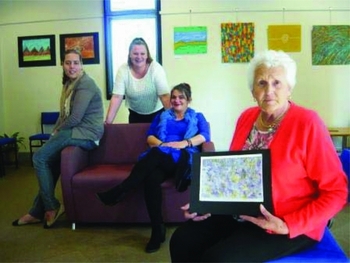
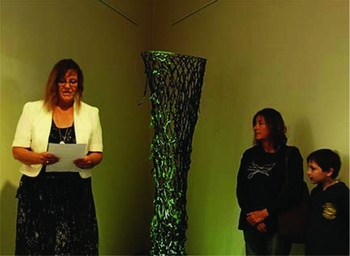
As well as creating art work students built their portfolios, developed artist statements and produced a Murina Art calendar with an annual plan of Gallery events and exhibitions. In December 2013, the Riawunna Art Gallery was launched with our annual Murina Art student exhibition, with more than 170 people attending (see Figures 1 and 2). The number of Aboriginal, UTAS and broader community people present speaks volumes for the support of such a gallery in our community and the student's art work was enjoyed and praised by all.
Murina students showing their art work.

Brigitte welcoming people at the Gallery opening.

The first exhibition for 2014 was Vicki West's kelp installation, which attracted more than 65 people to the opening and was admired by all. This was followed by emerging artist Will Stackhouse's amazing 3D wood and 2D pictures which attracted sales and further commissioned work. This is an important aspect of the gallery as it can be a launching pad for Aboriginal and Torres Strait Islander artists to show their work, and contact with real role models for the students.
Through the care and nurturing of teachers like Ann and Brigitte to develop trust (Fugelli, Reference Fugelli2001) a core group of confident students has been established who will be able to contribute to sustaining the gallery and the art program to support future Aboriginal and Torres Strait Islander artists. Students’ stories are their own. We cannot write them. The challenge for us as teachers is to recognise the process and ‘help shape endings’ (Dickie, Reference Dickie1998).
Nor can we know which stories or which elements of stories will resonate with which students. Philip Jackson in Hunter and Egan's (Reference Hunter and Egan1995) Narrative in Teaching, Learning and Research, states that ‘there is intuition, thoughtfulness and reflection’ on the part of teachers using narrative but never full knowledge of what works and what does not.
Our goal was to provide a quality learning experience and appropriate support networks (Asmar, Reference Asmar2014) to ensure students had the best chance of success, in order to counter and redress their past poor educational experiences. What we have endeavoured to do is enable the students to create stories that speak to the whole person that can be life-changing, stories that can become images of what is possible, through finding space in the teaching program for the inclusion of Indigenous voices and providing a culturally safe place for our students.
Conclusion
As indicated by Nicholls, Crowley and Watt (Reference Nicholls, Crowley and Watt1996) and Harris (Reference Harris and Sherwood1982) it is time to move on from theorising and get into action if we are to redress the inequity in higher education outcomes for Aboriginal and Torres Strait Islander students. This program enabled us to form a community of practice, to share our knowledge, skills, tools and resources to build our capacity to teach in this space and to form intercultural collegial relationships. Opportunity to meet and discuss matters relating to teaching in a challenging context helped us to create a culturally safe place for both students and staff. Although the numbers involved are small there are strong indications that this innovative program can support and enhance the educational success of our students through creating interactive opportunities that are inclusive and culturally safe and also challenging and stimulating to prepare them for their future studies. With the appointment of a new Murina coordinator it is anticipated the program will continue to grow and expand over the next few years to prepare increasing numbers of successful students into the future.
Acknowledgements
Special thanks to the Murina students for their dedication and commitment to creating a wonderful learning space and gallery within Riawunna.
About the Authors
Clair Andersen has Yanyuwa and Gunggalida clan connections in the Gulf country of Northern Australia. She began her education in the Northern Territory before continuing her schooling in Tasmania, where she completed a Bachelor of Education at the University of Tasmania. Currently, Clair is the Aboriginal Higher Education Advisor at University of Tasmania and her research interests are in improving education and training pathways for Aboriginal and Torres Strait Islander students and the development of appropriate learning resources.
Ann Edwards is a graduate of the University of Wales and the former coordinator the Murina (bridging) program within Riawunna at the University of Tasmania. Ann is committed to supporting Aboriginal and Torres Strait Islander students in higher education, and continues to provide mentoring to many students on a voluntary basis.
Brigitte Wolfe is a Bundjalung woman from New South Wales who has lived in Tasmania for most of her life where she has raised her three children. Brigitte graduated in 2014 with a Bachelor of Contemporary Arts and is studying Honours in 2015. In conjunction with her own studies, Brigitte taught Aboriginal and Torres Strait Islander students contemporary art through the Murina enabling program and also set up an art gallery within the Riawunna Centre on the Newnham campus in Launceston. Her aim was to provide a space for the Community and for Murina art students to exhibit in a culturally safe and inexpensive environment. Brigitte also developed a volunteer, mentor and leadership program which supported Aboriginal and Torres Strait Islander students in diverse ways and formed an advisory committee for the gallery comprised of prominent Aboriginal Elders and art workers.