When do voters punish corrupt politicians? Recently, many studies of electoral democracies have tried to answer this question. Taking as a starting point that one precondition for electoral accountability is sufficient knowledge by the citizenry of politicians' records, these studies have adopted varied methods to inform voters about corruption cases involving candidates. Although some work has suggested that better-informed voters tend to punish corrupt candidates (Pande Reference Pande2011), more recent studies have suggested a more mixed response, showing effects only on particular subgroups and contexts (Dunning et al. Reference Dunning2019). Whether voters punish corrupt politicians appears to reflect factors like current economic conditions, partisanship, and the level and type of corruption in a society (Klašnja and Tucker Reference Klašnja and Tucker2013). In addition, many voters punish incumbents by disengaging from the political process (Chong et al. Reference Chong2014).
In times of increasingly polarized politics, however, another strand of the literature finds that partisanship is an important factor when voters evaluate corruption allegations. In general, these studies show that voters minimize or forgive corruption accusations involving candidates from parties they support (Anduiza, Gallego, and Muñoz Reference Anduiza, Gallego and Muñoz2013; Rundquist, Strom, and Peters Reference Rundquist, Strom and Peters1977). In developing countries, for instance, identification with a traditional party appears associated with higher tolerance of vote-buying practices (Gonzalez Ocantos, de Jonge, and Nickerson Reference Gonzalez Ocantos, de Jonge and Nickerson2014).
The present study engages this debate by showing that information about candidate corruption can result in voters punishing politicians. However, some candidates are more accountable to voters when it comes to corruption than others, particularly as voters' views on corruption can vary substantially according to party cleavages. Our results suggest that voters who identify with parties with an anti-corruption brand punish their own candidates more harshly. As a result, we show that increased transparency can have divergent consequences and can reduce turnout, even when two competing candidates are convicted of corruption by lower courts. Instead of acting as a buffer, party identification intensifies the punishment by voters sympathizing with parties branded as anti-corrupt.
Based on data from a field and survey experiment conducted during the 2008 mayoral election in São Paulo, Brazil, we test how party allegiances affect voters' responses to candidate corruption. We find that supporters of a challenger candidate coming from an anti-corruption party are more willing to punish their own candidate, while supporters of an incumbent candidate from a more traditional party lack this inclination.Footnote 1 Our study shows that corruption is an important issue in the developing world and also identifies the relevance of party identification dynamics in Brazil, a relatively young democracy.
Corruption and Party Bias
An important precondition for electoral accountability is whether or not voters have access to information about the corrupt behavior of public officials, which may prompt them to vote against such candidates on Election Day. An empirical literature that examines the effects of corruption on voting behavior has emerged, showing that voters in developing democracies care about the misconduct of incumbent candidates. Banerjee et al. (Reference Banerjee2014) find, for instance, that voters in India react negatively to corruption allegations independently of socioeconomic or caste conditions. In addition, Chong et al. (Reference Chong2014) show in Mexico that the effect of corruption information about incumbents is a general disengagement from the political process, with vote losses not only for the incumbent, but also for the challenger, along with higher abstention.
A second strand of literature focused on the electoral effects of anti-corruption campaigns involving elected officials in established democracies shows that partisanship plays an important role in explaining voter responses to corruption. McCann and Redlawsk (Reference McCann and Redlawsk2006) show that Republican voters, when compared to Democrats, place less emphasis on corruption situations close to the ones experienced by officials of the George W. Bush administration. Similarly, Eggers et al. (Reference Eggers2014) find that British MPs involved in scandals were reelected at higher rates in competitive districts than in noncompetitive ones, suggesting that voters would downplay the seriousness of corruption scandals rather than face the risk of the opposing party winning the seat. Anduiza, Gallego, and Muñoz (Reference Anduiza, Gallego and Muñoz2013) also show that Spanish voters tend to consider accusations of corruption as less serious when they involve politicians of parties they identify with, particularly for those with lower levels of political awareness.
The evidence suggests that partisan bias may function as a buffer against corruption scandals and hinder electoral accountability for voters in democracies with established parties. Voters sympathizing with a particular party may consider the ideology and policies sponsored by a candidate as more relevant than involvement in corruption. In young democracies, by contrast, less consolidated party identities, political volatility, and a higher skepticism of institutions and politicians should weaken this effect. Voters would have fewer reasons to filter corruption allegations through a party lens, as party identification and general trust in the party system tends to be weaker.
In practical terms, though, parties in young democracies are dynamic organizations engaged in an effort to create their own brand and identity among voters. Although the specifics of these identities are intertwined with historical, national, and local contexts, anti-corruption platforms tend to be a common banner for many rising parties. Relatively young parties that built their reputation among voters on an anti-corruption platform may thus suffer harsher punishment from sympathizers when compared to other traditional parties. In such a context, party bias would no longer work as a buffer, but rather as an amplifier of punishment by disappointed voters. As Arias et al. (Reference Arias2016) show, prior beliefs and expectations about candidates and parties are a crucial aspect that explains how voters process information about corruption; a sympathizer of a party or candidate that has a reputation of malfeasance will not update their priors as much as a sympathizer of a party or candidate that has a clean reputation.
Context
In this study, we conducted a field and survey experiment during the 2008 mayoral runoff election in São Paulo, Brazil. Specifically, we took advantage of a unique set of events that took place during the election period. The Brazilian Magistrates Association (Associação dos Magistrados Brasileiros [AMB]) published a document called the “Lista Suja” (“Dirty List”), which listed politicians running in the 2008 elections who had convictions involving impropriety while in government office. Both candidates running in the mayoral election of São Paulo—Gilberto Kassab of the Democratic Party (DEM) and Marta Suplicy of the Workers’ Party (PT)—appeared on the AMB's Dirty List.
At the time of the experiment, both parties also had different stances regarding corruption. The PT was traditionally associated with leftist ideology and an enthusiastic sponsor of clean and participatory governance. At the time of the study, the PT led congressional investigations about corruption in São Paulo (Hunter Reference Hunter2010; Samuels Reference Samuels2004). Kassab's DEM, by contrast, was less distinctive. Nominally a center-right party, the DEM was particularly strong in the poorer states in the Brazilian northeast, and its major leaders were frequently associated with extensive use of patronage while in office (Montero Reference Montero2010; Power and Rodrigues-Silveira Reference Power, Rodrigues-Silveira and Ames2019). Locally, the DEM was a supporter of Paulo Maluf, a popular politician and two-time mayor of the city who was later convicted of corruption charges involving illegal government contracts, being known by the phrase “rouba, mas faz” (“He robs, but gets things done”) (Pimentel and Penteado Reference Pimentel, Penteado, Lavareda and Telles2011). During the week prior to the election, we administered two treatments in the form of fliers informing voters that either Kassab or Suplicy appeared on the Dirty List and gave information about the nature of their respective charges and trial results. The AMB included Kassab on the Dirty List because a court convicted him of “administrative impropriety” in 1997 while he served as the Secretary of Planning for the City of São Paulo. The case, launched by public prosecutors in São Paulo, accused the mayor at the time, Celso Pitta, and his staff, which included Kassab, of taking out newspaper advertisements paid with municipal funds in which they allegedly defended their own “personal interests” while they were under investigation. A lower court held that Kassab was guilty, but the decision was overturned on appeal. The public prosecutor appealed this decision, but it had yet to be resolved at the time of the election. Despite objections from the Kassab campaign, the AMB kept him on the Dirty List.
Suplicy's conviction involved more serious charges. In 2005, a São Paulo court convicted her of inappropriately giving a R$2 million (approximately US$840,000 at the time of the election) no-bid contract to a nongovernmental organization (NGO) focused on advocacy for and increasing awareness of sexual orientation issues. The municipality awarded the contract to train São Paulo school teachers on sexual orientation issues. Suplicy founded the NGO in 1990 and served as its honorary chairperson until 2000. At the time of the election, the decision was under appeal.Footnote 2
Corruption featured prominently in the campaign, as both candidates accused each other of engaging in malfeasance while in office, particularly after the first round in which Kassab won with 34 per cent of the vote versus Suplicy's 33 per cent.Footnote 3 Suplicy went so far as to petition the election authorities to make Kassab ineligible for reelection because of alleged politicized distribution of public benefits. Kassab's attacks primarily focused on Suplicy's record on public works when she was mayor between 2000 and 2004, but his campaign also raised the corruption issue. Early in the election, before Kassab was on the Dirty List, he even attacked Suplicy for being declared as “dirty” by the AMB. Despite the closeness of the first round, polls showed Kassab with a consistent lead throughout the second round, and he subsequently won the election with a decisive 60 per cent of the vote.
Research Design
Our empirical strategy relies on three distinct components: a field experiment, survey, and embedded survey experiment. For the field experiment, we designed two fliers—one for each candidate—which are featured in Appendix 1 of the Online Supplementary Materials. The fliers incorporate aspects similar to other political marketing material in Brazil, while having credibility in the information they are conveying. Both fliers have newspaper articles from Folha de São Paulo, one of the country's most respected newspapers, detailing the corruption allegations of each candidate. We also included the case numbers of each court case to increase the credibility of the information in the fliers.
The unit of analysis for the experiment is the local de votação (voting precinct). Voting precincts are the smallest units for which we could administer a treatment while obtaining vote share and turnout data. In selecting precincts in the randomization group, we made a number of decisions based on our substantive interests and logistical constraints. We chose 400 of São Paulo's 1,759 precincts by utilizing a constraint-optimization algorithm, which is described in detail in Appendix 2 in the Online Supplementary Materials.
We randomly assigned voting precincts that would receive the Kassab or Suplicy flier and had a control group of precincts that did not receive the flier. In all, households in the vicinity of 100 precincts received the Kassab flier, another set of households in the vicinity of 100 precincts received the Suplicy flier, and 200 precincts were in the control group. In the week prior to the election, we distributed 187,177 fliers to individual households.Footnote 4 To measure the effect of the intervention, we examined official electoral outcomes of each candidate's vote share, turnout, and spoiled ballots.Footnote 5
The week after the election, we launched a survey to determine what voters already knew about accusations involving both candidates. The survey (n = 200) covered São Paulo residents living near polling stations in the field experiment's control group.Footnote 6 Since the treatment was not administered in these precincts, knowledge among surveyed voters should reflect knowledge among voters prior to the intervention. In addition to collecting basic attitudinal data, we also used a survey experiment to observe individual-level attitudinal responses to the information contained in the fliers. For the survey experiment, we randomly assigned 200 respondents with equal probability to receive the Kassab flier, the Suplicy flier, or a placebo flier showing basic biographical information for both candidates (shown in Appendix 4 of the Online Supplementary Materials). After the respondents read the fliers, the interviewers asked voters to grade Kassab and Suplicy on a scale from 0 to 10, where 0 indicated strong opposition and 10 indicated strong support for the candidate.
Results
Field Experiment
For the survey experiment, we present two sets of results for each of our three dependent variables. Our quantity of interest is the average treatment effect on precincts. The first estimator is the simple intent-to-treat estimator, which is the average within-block difference in treatment and control precinct means. Our second set of estimates are from a simple linear regression of the outcome variable on a treatment indicator, a vector of covariates, and block dummy variables. The model we estimate is as follows:
 $$Y_i = \beta _0 + \beta _1T_i + \mathop {\mathop \sum }\limits_{k = 1}^{K\ndash 1} \gamma _kB_{ki} + \lambda _1X_1 + \lambda _2X_2 + u_i, $$
where Y i is the outcome of interest, T i is the treatment indicator, X 1 and X 2 are two pretreatment covariates, and u i is the disturbance term. To account for the fact that randomization occurred within matched pairs or blocks (k), we add fixed effects (B ki) for all but one matched pair. Since we are interested in the separate effects of each type of flier, we estimate this model separately for each intervention. We adjust for two covariates: PT vote share in the 2004 mayoral election and the number of registered voters in the precinct. The 2004 PT vote share is an important covariate because it is highly predictive of our outcome variables and can increase the precision of our estimates. We also adjust for the number of voters in the precinct because we detected some imbalance in this covariate after randomization (see Appendix 5 of the Online Supplementary Materials). Finally, all standard errors account for heteroskedasticity, as robust standard errors are used in covariate-adjusted results and the intent-to-treat estimates do not assume equal variance across treatment conditions.
Table 1 presents the effect of the Suplicy fliers on the vote share, turnout, and spoiled ballots of Suplicy.Footnote 7 For vote share (votes as a percentage of total votes cast), we find a negative effect of 2.6 percentage points, which amounts to about 15 per cent of a standard deviation. The 90 and 95 per cent confidence intervals of the unadjusted estimate overlap with 0 (p = 0.2), but the adjusted estimate, which is also −2.6 percentage points, is statistically significant at conventional levels. While estimated with some imprecision, this result does suggest that receiving the flier induced some voters who otherwise would have supported Suplicy to abstain or vote for Kassab.
Results of the Marta Suplicy fliers on election outcomes

Notes: Estimates without covariates are from the simple intent-to-treat (ITT) estimator. Estimates with covariates are from the linear model. N = 200 precincts, with 100 treated units. Estimates with covariates are from a linear model, including a treatment indicator, PT vote share in 2004, total number of registered voters in the precinct, and block fixed effects.
Our estimates support the hypothesis that providing information about Suplicy's corruption convictions lowered the candidate's vote totals, but where did these votes go? When we estimate the effect of the Suplicy intervention on total votes received by Kassab as a percentage of registered voters (not vote share as a percentage of ballots cast), we find a statistically insignificant increase of 1.5 percentage points (standard error of 1.7). Thus, while it is likely that some Suplicy voters changed their vote and cast a ballot for Kassab, abstention was likely the primary response by voters to the intervention. Further evidence that the intervention reduced turnout is presented in the second two columns of Table 1, where we find an effect of −1.9 percentage points, which is statistically significant at conventional levels. Results using covariate adjustment are substantively equivalent to the unadjusted results (point estimate of −1.8 percentage points). For spoiled ballots, we find a small positive difference, but both estimates are statistically indistinguishable from 0.
The estimated effects of the Kassab fliers are found in Table 2. Surprisingly, the point estimate on Kassab's vote share is positive, ranging from 1.5 to 1.9 percentage points, depending on the specification. This result, however, is estimated imprecisely and consequently not statistically significant at conventional levels. The estimates for the other two outcome variables—turnout and spoiled ballots—are small and not statistically significant.
Results of the Gilberto Kassab fliers on election outcomes

Notes: Estimates without covariates are from the simple ITT estimator. Estimates with covariates are from the linear model. N = 200 precincts, with 100 treated units. Estimates with covariates are from a linear model, including a treatment indicator, PT vote share in 2004, total number of registered voters in the precinct, and block fixed effects.
Survey Experiment
As discussed earlier, voters may already have existing beliefs about how corrupt each candidate is, and these beliefs will affect their response to new information. If voters already perceive a candidate as corrupt, discovering they are on the Dirty List may not change their attitudes. It is possible, for example, voters already assumed Kassab was corrupt and thus the flier would not affect their evaluation of him. To check this possibility, the survey asked voters to rank each candidate by their perceived corruption level. On average, voters' evaluations of the candidates on this quality differed, in that 29 per cent of voters identified Suplicy as the most corrupt candidate, while 20 per cent named Kassab. Moreover, 20 per cent said both were equally corrupt, while another 30 per cent stated they did not know.Footnote 8 These responses suggest that while a plurality of voters considered Suplicy to be more corrupt, the majority of voters believed both candidates were equally corrupt or could not make the comparison. Overall, these results suggest the differential effects in the field experiment unlikely result from diverging ex ante candidate evaluations.
These aggregate figures, however, mask considerable heterogeneity when voters are disaggregated by their past political behavior. Figure 1 shows how voters rank the candidates in subgroups defined by their self-reported vote in the runoff for the 2004 mayoral election.Footnote 9 Suplicy, the incumbent in 2004, lost the election against former presidential candidate José Serra. The political leanings of each voter strongly predict how voters evaluate each candidate on corruption. A total of 34 per cent of Suplicy voters in 2004 viewed Kassab as the more corrupt candidate, while only 7 per cent of Serra voters felt similarly. The views of Suplicy and Serra voters are not completely symmetric: Serra voters are more likely to believe that Suplicy is more corrupt (49 per cent) than Suplicy voters are to believe that Kassab is more corrupt (34 per cent). As expected, voters who abstained or cast a spoiled ballot in the 2004 election were more likely to claim that each candidate was equally corrupt.
Ranking candidates on perceived corruption by vote in 2004.

Given that voters' ex ante perception of the candidates' corruption varied markedly by their political leanings, any intervention designed to increase voters' information could have highly heterogeneous effects, depending on the candidate the voter intends to support. If a Suplicy supporter received information about Suplicy and viewed the new information as credible, for example, then they might be less inclined to turn out or cast a ballot for Suplicy. This is especially the case if Suplicy voters were more likely to be weak supporters of the candidate. Thus, a potentially important distinction between the two candidates is the intensity of their voters’ preferences, since a candidate with many weak supporters would likely suffer more upon receiving information. In this election, we find no evidence of a divergence in the intensity of preferences among the candidate's supporters. To assess this, we asked respondents to rate the candidates with a 1 to 10 “feeling thermometer” score. The distribution among each candidate's voters was almost identical, with a mean score of 7.8 (median of 8) for Suplicy among Suplicy voters and a mean score of 7.6 (median of 8) for Kassab among Kassab voters. The similarity across the two groups of voters suggests that intensity of preferences is an unlikely explanation for the divergent effects found in the field experiment.
Even in the absence of differences in the intensity of support across each candidate's voters, the effects of information about corruption could diverge if a candidate's supporters differ in the importance they place on corruption. That divergence may exist, since Suplicy's party, the PT, had a long history at the time of emphasizing transparency in government. This history may have caused voters who care about this issue to support her. We find a marked difference between Suplicy supporters and other voters in the importance placed on corruption. Among Suplicy supporters, 70 per cent stated that when deciding who to vote for in the 2008 election, corruption was “very important” or “important” in their decision. By contrast, a considerably fewer 48 per cent of Kassab supporters said that corruption was “very important” or “important.” This 22-percentage-point difference suggests that Suplicy voters would, on average, be considerably more sensitive to learning about Suplicy's placement on the Dirty List.
Overall, the findings of the survey suggest that the most substantial difference across Kassab and Suplicy voters is the weight each candidate's supporters place on corruption in their decision making. Perhaps because of the PT's historical image as not engaging in the corrupt practices used by other parties, more Suplicy voters than Kassab voters said that corruption was an important factor when choosing candidates. This suggests that learning about one's preferred candidate's placement on the Dirty List would have a larger effect on behavior among Suplicy supporters than Kassab supporters, which is consistent with the results of the field experiment.
While we are interested in the overall impact of the fliers on voter attitudes, the survey experiment also allows us to test other hypotheses explaining the divergent effects found in the field experiment. In particular, we test the hypothesis that Suplicy's supporters' views are more affected by learning about her placement on the Dirty List than the views of Kassab's supporters when they learn about his corruption record.
After asking respondents to read the fliers described earlier, we asked voters about the plausibility and seriousness of the accusations. If voters perceived the Suplicy accusations to be were more believable or serious, then this difference could explain the disparate behavioral response to the fliers. We find no evidence for either explanation. Only 30 per cent thought the flier was mostly or completely false; most voters exposed to the Suplicy flier said the accusations were mostly or completely true. For those given the Kassab flier, the proportions are very similar: only 28 per cent thought the flier was mostly or completely false. When it comes to the seriousness of the accusations, once again, few differences appeared by flier: 80 per cent and 78 per cent of voters exposed to the Suplicy flier and Kassab flier, respectively, thought the accusations were very serious or serious. The similarity in voter perceptions provides evidence that differences in the accusations are not an explanation for why the Suplicy flier was more effective at changing voting behavior.
We also examine the overall effects of the fliers on voters' evaluations of the candidates by comparing voters' evaluations of Suplicy and Kassab when they view the Suplicy or Kassab flier versus a placebo flier. These results are shown in the first two columns of Table 3. The effect of the Suplicy flier on voters' evaluations of Suplicy is larger than the effect of the Kassab flier on voters' evaluations of Kassab, though the difference between the two effects is not significantly distinguishable from 0. After being exposed to the Suplicy flier, respondents in the treatment group, on average, adjusted their evaluations downward by an estimated 0.78 points on a ten-point scale, which amounts to about 60 per cent of a standard deviation. The point estimate for the Kassab flier was an insignificant −0.36. The third column compares those receiving the Suplicy flier to those receiving the Kasab flier. The Suplicy flier more negatively affects attitudes, though this difference is not statistically significant. Overall, these individual-level estimates are in keeping with the field experiment evidence: the Suplicy flier harms voter evaluations of her, while the Kassab flier has weaker effects.
Survey experiment results for the Suplicy (PT) and Kassab (DEM) fliers

Notes: The dependent variable is the posttreatment minus pretreatment candidate evaluation feeling thermometer on a scale of 0 to 10. N = 200 respondents with 67 respondents shown the Kassab flier, 67 shown the Suplicy flier, and 66 shown the placebo flier.
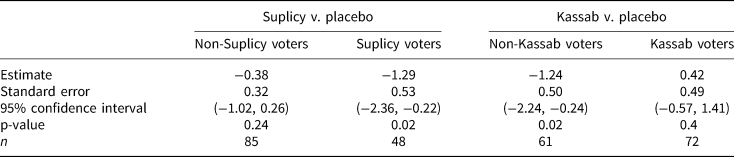
To test whether or not Suplicy voters respond differently to increased information about their favored candidate's corruption record than Kassab voters, we estimated treatment effects separately in strata defined by vote choice. The first two columns of Table 4 show the effect of the Suplicy flier, as compared to the placebo flier, on Suplicy versus non-Suplicy voters. The estimate for Suplicy voters is more than three times the size of the estimate for non-Suplicy voters: −1.29 versus −0.38. Given the small samples, however, the difference between the two estimates (the interaction) is not statistically significant. Still, the difference in magnitudes certainly suggests that Suplicy voters are more sensitive to corruption-related information than supporters of other candidates.
Heterogeneity in survey experiment results for the Suplicy (PT) and Kassab (DEM) fliers

Notes: The dependent variable is the posttreatment minus pretreatment candidate evaluation feeling thermometer on a scale of 0 to 10.
When we examine heterogeneity in the effect of the Kassab flier, the contrast with the effect of the Suplicy flier is striking. As shown in the third and fourth columns of Table 4, the heterogeneity observed is the opposite of what we found for the Suplicy flier. Kassab voters who read the flier, on average, give a higher evaluation of the candidate. Although this estimate is not statistically distinguishable from 0, it is distinguishable from the effect of the flier among non-Kassab voters. For non-Kassab voters, reading the Kassab flier induced a statistically significant 1.24-point decrease in their evaluation of the candidate. The difference in the size of the effect between Kassab voters and non-Kassab voters is 1.7 points (standard error of 0.7).
Overall, the results from the survey experiment provide further evidence that Suplicy's voters have a larger reaction to increased information about their candidate's corruption record than Kassab's voters. Upon learning of Suplicy's position on the Dirty List, Suplicy's voters perceive her more negatively, on average. When Kassab's voters learn about their candidate's placement on the Dirty List, their evaluation of their candidate is essentially unchanged. Furthermore, our survey evidence shows that Suplicy's base professes to place more importance on corruption than Kassab's base. We posit that this difference in how each candidate's voters view the importance of corruption resulted in a differential behavioral response in our field experiment. In general, our evidence indicates that Suplicy's voters viewed their candidate more negatively after learning about her record and became more likely to abstain. To a lesser degree, her supporters switched their vote to Kassab. Kassab voters, because they view corruption as less central to their decision making, failed to change their views or their behavior.
Discussion and Conclusion
In this study, we show that publicizing a candidate's record on corruption alters voters' behavior, but the effects are contingent upon the importance voters place on clean governance in their decision making. Furthermore, the importance voters place on a candidate's corruption record can be shaped by political cleavages, an important mechanism previously unexplored in the experimental literature on corruption. As a result, the effects of increased transparency may result in outcomes where one politician may be punished when their corruption record is revealed, while another is not.
In the case of São Paulo, we document the existence of a partisan cleavage in how voters perceive the importance of corruption. Furthermore, we argue that this cleavage has real consequences for the effectiveness of an anti-corruption intervention. Despite voters viewing the accusations against each candidate as equal in seriousness, our field-experimental evidence revealed that only Suplicy, the PT's candidate, was punished at the ballot box when voters learned about her placement on the Dirty List. Data from our survey and survey experiment provide evidence of a mechanism: Suplicy's supporters are much more sensitive to corruption information than Kassab's supporters. As a result of this increased sensitivity, the information induced some of Suplicy's supporters to abstain and others, to a lesser degree, to switch their vote to her opponent.
An important question raised by these results is: why are Suplicy's voters more willing to change their behavior when they learn about their candidate's record? We suspect that the PT's historical cultivation of a brand as a party with a distinct modo petista de governar (“mode of governance”) emphasizing transparency and citizen participation may have raised PT voters' expectations on the corruption issue. For many PT voters at the time, clean governance may be central to their political identity. Kassab's party, if anything, has developed a brand as a party whose candidates may “rob, but get things done.” As a result, Kassab voters likely had lower expectations about their candidate's integrity in office and, consequently, new information about past misdeeds failed to change their behavior.
Our findings suggest that the historical factors that explain how a party becomes particularly trusted on the issue of corruption and that cause its supporters to vote based on candidates' corruption records are an important area for future research. Thus, previous studies that merely treat corruption as a valence issue are likely to overlook this important dimension of the effects that corruption information can have on the electorate.
Moreover, considering recent developments in Brazil—with PT governments being involved in massive corruption scandals—the anti-corruption brand has likely faded. Other parties and politicians are trying to brand themselves as clean, such as the current president, Jair Bolsonaro, during his campaign against a PT candidate. Reputations are dynamic characteristics of a party, and future studies should take this into consideration.
One troubling possibility raised by our findings is that increased transparency may disadvantage candidates from parties with a reputation for clean governance when they compete against candidates from parties with no such reputation. In the case of Brazil, PT candidates may be particularly vulnerable to attacks by opposing parties on the corruption issue. Increased transparency could paradoxically, at least in the short term, reduce the chances of PT candidates winning office, even if they are less corrupt than candidates from parties like the DEM. Of course, this may be an acceptable outcome to PT voters as long as it creates a long-term incentive for PT politicians to govern without resorting to corruption and for the party to select clean candidates. Still, the heterogeneity across candidates that we document counterintuitively suggests that information campaigns can increase the incidence of corruption in government by disproportionately punishing “clean” parties.
More broadly, our findings suggest that future experimental work on information and accountability will find varying effects across different political contexts. As we found in São Paulo, the existence of information effects depends on highly contextual factors associated with particular candidates, parties, and the distribution of preferences in the electorate. Future work on the effects of information on political accountability should not treat corruption strictly as a valence issue, but instead address how these antecedent factors affect voters' responses to increased transparency. As we have documented, the relationship between information and accountability is by no means a simple one.
Supplementary Material
Online appendices are available at: https://doi.org/10.1017/S0007123421000727
Data Availability Statement
The data, replication instructions, and the data's codebook can be found at: https://doi.org/10.7910/DVN/PQ4JEZ
Acknowledgments
We would like to thank Diego Werneck Arguelhes, Desmond Arias, Henry Brady, David Broockman, Gabriel Cepaluni, Adam Cohon, David Collier, Ruth Berins Collier, Bob Cooter, John de Figueiredo, Rui de Figueiredo Jr, Ana De La O, Thad Dunning, Chris Elmendorf, Joaquim Falcão, Marcus Figueiredo, Nuno Garoupa, Alan Gerber, Enoque Gomes, Don Green, Andrew Guzman, Christine Jolls, Bruce Kobayashi, Al Klevorick, Paul Lagunes, Antônio Lavareda, Malte Lierl, Fernando Limongi, Yair Listokin, Daniel Markovits, Lindsay Mayka, Marcus Melo, John Morley, David Nickerson, Jairo Nicolau, Roger Noll, Lucas Novaes, Anne Joseph O'Connell, Kevin Quinn, Lúcio Rennó, Neal Richardson, Alberto Luis Rollo, Roberta Romano, Susan Rose-Ackerman, Eric Schickler, Luis Schuartz, Luis Schiumerini, Jas Sekhon, Peter Siegelman, Rodrigo Soares, Neel Sukhatme, Eric Talley, Haroldo Torres, Matt Winters, and Cesar Zucco for helpful assistance in the field and for comments on drafts. The article also benefitted from comments given during presentations at Fundação Getúlio Vargas-Rio Law School's Faculty Workshop, Instituto de Pesquisas Sociais, Políticas e Econômicas (IPESPE), Yale Law School's John M. Olin Law and Economics Summer Workshop and Oscar M. Ruebhausen Lecture, the 2009 American Political Science Association Annual Meeting, the 2010 American Law and Economics Association Annual Meeting, the 2012 Latin American Studies Association International Congress, the 2012 Latin American & Caribbean Economic Association America Latina Crime and Policy Network (AL CAPONE) Conference, the Yale Comparative Politics Workshop, the Northwestern Law and Political Economy Workshop, the University of Texas Law and Economics Workshop, the University of California, Berkeley (UC Berkeley) Development Lunch, the George Mason Law and Economics Workshop, and the Georgetown Law and Economics Workshop. Fabricio Costa and Nara Pavão provided excellent research assistance. We dedicate this article to David A. Freedman, an influential mentor and scholar to de Figueiredo and Hidalgo, who passed away when we were doing the fieldwork for this project.
Financial Support
Support for this research came from the Social Science Research Council's Dissertation Proposal Development Fellowship (de Figueiredo), UC Berkeley's Survey Research Center (de Figueiredo and Hidalgo), and Yale Law School's John M. Olin Fellowship and Oscar M. Ruebhausen Fund (de Figueiredo).
Competing Interests
None.
Ethical Standards
The research was conducted in accordance with the human subjects protocols approved by the institutional review boards of UC Berkeley and Yale University. Additional discussion of ethical standards is found in Section 6 of the Online Supplementary Materials.