Introduction
In the context of rising geopolitical tensions, rapid industrialization, and emerging infectious diseases, the risk of chemical, biological, radiological, and nuclear (CBRN) disasters has shifted from a theoretical possibility to a pressing public health concern.Reference Bland, James, Walter and Iain1 India’s vast population, industrial complexity, and geopolitical setting make it especially vulnerable. While the National Disaster Management Authority (NDMA) has issued CBRN-specific response frameworks (ndma.gov.in), implementation at institutional and departmental levels remains fragmented.
Anesthesiologists, with expertise in airway management, life support, sedation, and critical care, are essential in mass casualty responses.Reference Gondode, Asai and Lambe2 However, their role in CBRN contexts has rarely been explored in a structured, specialty-specific manner. Most disaster preparedness literature emphasizes emergency medicine or paramedical staff, overlooking anesthesiology needs—particularly in low- and middle-income countries (LMICs) like India.Reference Khirekar, Badge, Bandre and Shahu3
This study addresses this gap by evaluating knowledge, attitude, practice, and institutional support (KAP-IP) among Indian anesthesiologists, aiming to inform policy, enhance curricula, and promote simulation-based preparedness modules tailored to the specialty.
Materials and Methods
Study Design and Setting
This cross-sectional observational study employed a self-administered, structured questionnaire to evaluate CBRN preparedness among anesthesia professionals in India. The survey was conducted between May and June 2025 and included participants from government, private, and corporate health care institutions.
Participants and Sampling
Eligible participants were qualified anesthesiologists (MD/DNB/DA or equivalent) practicing in India who provided electronic consent. Exclusion criteria included non-anesthesiology personnel, those practicing abroad, and incomplete or duplicate responses. Using Cochran’s formula, a sample size of 260 was estimated (95% confidence, 6% margin of error). To account for non-response, 280 participants were targeted; 294 valid responses were ultimately analyzed.
Survey Instrument
The 52-item questionnaire covered demographics, knowledge (11 items), attitude (8), practice (8), institutional support (7), barriers and motivators (3), and one open-ended feedback item.
Tool Validation and Reliability
Content validity was confirmed by experts (S-CVI = 0.96). A pilot with 20 professionals’ refined clarity and completion time (~11 minutes). Reliability testing showed Cronbach’s alpha: Attitude α = 0.72, Practice α = 0.78, Institutional Support α = 0.74.
Data Collection
Following ethics approval (AIIMSA4004), the survey was circulated via Google Forms, professional networks, and society mailing lists. Participation was voluntary, anonymous, and preceded by informed consent.
Scoring System
Knowledge scores ranged 0–11 (≥9 adequate). Likert-scale items were averaged with reverse coding where applicable. Binary items and thematic analysis were applied to barriers and open-text responses.
Statistical Analysis
Data were managed in Excel and analyzed using Jamovi® v2.6.44. Descriptive statistics were reported, with t-tests, Welch’s ANOVA, Pearson’s correlation, and multiple regression used for inferential analysis.
Results
Participant Characteristics
A total of 294 anesthesia professionals participated in the survey. Only 10.9% reported prior CBRN training, and 8.2% had participated in a CBRN drill within the past 2 years. Awareness of institutional preparedness was limited: 72.8% were unaware of a designated CBRN coordinator, and 48.6% were unsure of trauma/disaster network affiliation. Among those trained, formats included online courses (51.6%) and SOP briefings (29.0%).
Knowledge Score Analysis
The mean knowledge score was 7.74 ± 1.48. Trained participants scored significantly higher (9.66 ± 1.32) than untrained peers (7.51 ± 1.31; P < 0.001). Regression identified training (β = 2.15, P < 0.001) and trauma network affiliation—“Yes” (β = 1.17, P = 0.006) and “Not sure” (β = 1.32, P = 0.002)—as predictors of higher knowledge (Table 2).
Demographic profile of study participants (N = 294)

Multivariable linear regression predicting knowledge scores (N = 294)

Model Summary: R2 = 0.239, Adjusted R2 = 0.226, F(18.1, 288) = [calculated], P <0.001.
Attitude, Practice, and Institutional Support Scores: Reliability
-
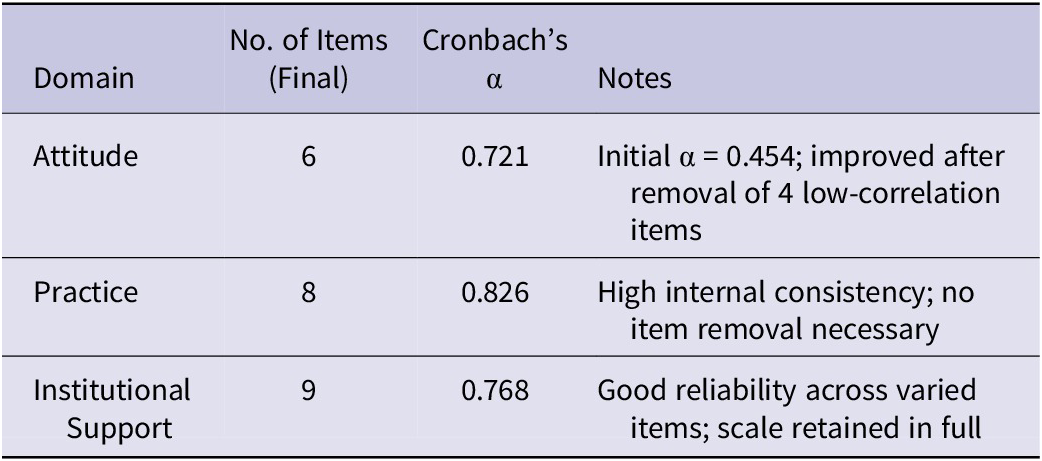
• Attitude: α = 0.454 initially; improved to α = 0.721 after removing 4 items.
-
• Practice: α = 0.826, stable across items.
-
• Institutional support: α = 0.768, unchanged on item deletion (Table 3).
Table 3.Summary of internal consistency (Cronbach’s α) across survey domains

Cronbach’s alpha (α) ≥0.7 is considered acceptable; values ≥0.8 indicate good internal consistency.

Descriptive Analysis of KAP Domain Scores
Mean scores: Attitude 3.46 ± 0.30, Practice 2.91 ± 0.83, Institutional Support 3.09 ± 0.67, Knowledge 7.74 ± 1.48. Medians mirrored means with narrow IQRs. Shapiro-Wilk confirmed non-normal distributions (P <0.001).
Effect of Prior Training and Drill Participation
-
• Training: 9.66 ± 1.31 vs. 7.51 ± 1.32 (P <0.001).
-
• Drill: 9.54 ± 1.41 vs. 7.59 ± 1.37 (P <0.001).
-
• No significant differences were seen in attitude, practice, or institutional support.
Spearman Correlation Analysis
Age strongly correlated with experience (ρ = 0.991, P <0.001). Practice correlated with attitude (ρ = 0.35, P <0.001) and weakly with institutional support (ρ = 0.18, P = 0.002). Knowledge was not correlated with other domains or demographics (Figure 1).
Spearman correlation matrix of KAP domain scores and demographic variables.

Barriers, Motivators, and Institutional Limitations
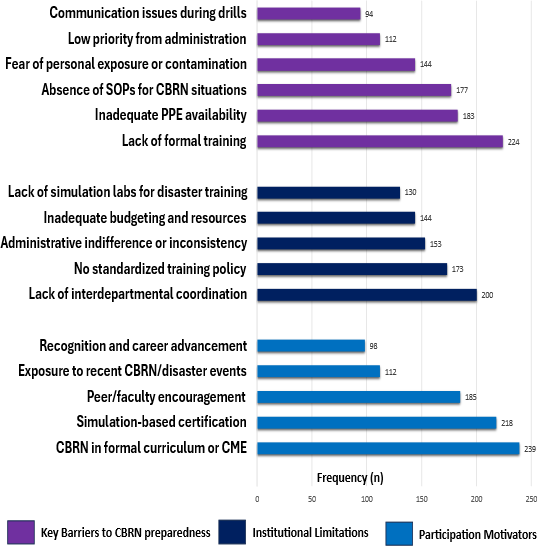
Top motivators: CBRN content in curricula/CME (n = 239) and simulation-based certification (n = 218). Institutional barriers: poor interdepartmental coordination (n = 200) and absence of policies (n = 173). Individual barriers: lack of training (n = 224), inadequate PPE (n = 183), and absence of SOPs (n = 177) (Figure 2).
Barriers, motivators, and institutional limitations.

Thematic Analysis of Open-Ended Responses (Q52)
Of 294 respondents, 103 provided qualitative input. Five themes emerged: inadequate training, unclear protocols, infrastructure deficits, curriculum integration, and psychosocial concerns. Emotional readiness was noted: “The idea of working in contaminated zones is frightening—more psychological support is needed.” These insights highlight gaps between institutional planning and individual preparedness, underscoring the need for structured training, role clarity, and psychological reassurance
Discussion
This survey highlights a critical gap in CBRN preparedness among Indian anesthesia professionals. Despite increasing geopolitical instability and the proliferation of dual-use technologies, only a minority reported prior training or drill participation, and most were unaware of institutional frameworks such as designated coordinators or trauma network affiliations.Reference Baikmohammadi, Amirheidari and Dehesh4 Such deficiencies are concerning, given the frontline role of anesthesiologists in airway management, resuscitation, and critical care during CBRN events.
Internationally, bodies such as WHO, NATO, and the UN have stressed cross-sectoral preparedness, integrating health care with emergency and military systems. Reference Baikmohammadi, Amirheidari and Dehesh4–6 High-income countries exemplify structured approaches: the US Hospital Preparedness Program, UK NHS CBRNE Response Plans, and the EU CBRN Action Plan incorporate curricula, stockpiles, and sustained training.Reference Coleman, Bader and Koerner7 In India, although NDMA guidelines and DRDO innovations exist, implementation in civilian hospitals remains inconsistent, with gaps in decontamination facilities, simulation labs, and interdepartmental coordination.8
Global evidence mirrors these findings: Swedish data showed low baseline CBRN knowledgeReference Castellheim, Persson and Kuikka9 Farhat et al. reported high satisfaction with formal CBRN training,Reference Farhat, Alinier and Gangaram10 and Mani et al. highlighted systemic deficits across MENA.Reference Mani, Plummer and Kuhn11 Collectively, these studies confirm a preparedness deficit, most pronounced in LMICs.
Barriers in our cohort included perceptions of rarity, fear of invisible hazards, and lack of SOPs. Yet, recent conflicts, chemical weapon use, and bioterror threats demonstrate that complacency is untenable. To address this, curricula must integrate simulation-based CBRN training, hospitals should appoint nodal officers, conduct drills, and adopt tailored protocols. Collaboration with NDMA, NDRF, and DRDO, along with resilience training, is essential. Preparedness must extend beyond anesthesiologists, requiring multistakeholder engagement and ISA-led advocacy to embed CBRN readiness into national disaster frameworks.
Author contribution
-
• Dr. Prakash Gondode: Conceptualization, survey design, data interpretation, manuscript drafting, final approval.
-
• Dr. Sakshi Duggal, Dr. Prakash Gondode: Statistical analysis, results visualization, manuscript editing.
-
• Dr. Amit Malviya, Dr. Ram Singh: Literature review, drafting introduction and discussion.
-
• Dr. Ram Singh, Dr. Prakash Gondode, Dr. Sakshi Duggal: Ethics approval process, tool validation, data cleaning.
-
• Dr. Avinash Prakash: Qualitative analysis, thematic coding, figure generation.
-
• Dr. Ombhushan Asai: Qualitative analysis, thematic coding, data cleaning.
-
• Dr. Parul Gupta, Dr. Jitendre Shah: Review of results, critical manuscript revision, supervision.
Financial support
This research received no specific grant from any funding agency in the public, commercial, or not-for-profit sectors.
Competing interests
The author(s) declare none.