Over-the-counter (OTC) drugs, which do not require a prescription from a physician prior to purchase, are ubiquitous in the US: 240 million people use them each year.Reference Michele 1 More than 300,000 OTC drugs are marketed in the US, and OTC drugs make up a large and growing market. Although there are numerous areas of controversy related to OTC drugs — such as misuse of certain products and the way they are advertised — one policy issue that federal legislators have sought to address in recent years is that it can be challenging for new OTC drugs to reach the market. The process through which OTC drugs are recognized as safe and effective can take a long time: for example, in 2016 the FDA issued a final rule concerning consumer antiseptic washes more than 40 years after beginning the process and over a decade after some researchers flagged safety issues related to the antibacterial agent triclosan found in some OTC products.Reference Richardson 2
As a result, policymakers have debated how to modernize and streamline the system for establishing conditions under which new OTC drugs are recognized as safe and effective and for addressing safety issues with existing OTC drugs. On March 27, 2020, the Coronavirus Aid, Relief, and Economic Security (CARES) Act finalized a multiyear legislative effort that reforms OTC regulation at the FDA, creating a new review process and providing for collection of funds to implement it. In this article, we discuss the prior system of OTC regulation that the CARES Act attempts to address and then provide an overview and analysis of the OTC legislation, including benefits and potential drawbacks. We conclude with policy implications of the OTC reforms.
OTC Drugs: Benefits and Risks
OTC products are important to consumers because they are useful in treating a wide variety of common health problems, are convenient to obtain, and can be more affordable than prescription drugs. By allowing self-treatment, OTC drugs can also appeal to patients wanting to maximize personal autonomy in therapeutic decision-making.
However, OTC drugs also have important individual and public health risks. Even though consumers are presumed to read OTC labels before using the drugs, survey data suggest that one-third of consumers of OTC drugs exceed the recommended dose on the label.Reference Brass 3 Incorrect dosing of OTC drugs causes important adverse events, which can lead to hospitalization or even death. Some studies have also indicated that switches from prescription to OTC status are associated with higher use of medical services, due to self-care complications or other factors.Reference Harrington and Shepherd 4 Although OTC drugs generally have a lower retail price than prescription drugs, consumers with health plans that cover prescription drugs with very low co-payments can end up paying more for OTC products. Finally, OTC drugs are also advertised much more freely than prescription-only drugs; one review found that OTC drug advertisements tend not to feature potential harms, which can lead to consumer misunderstanding of the benefits and risks of the drugs.Reference Greene 5
OTC Regulatory System
OTC drugs are regulated by FDA’s Office of Nonprescription Drugs within the Center for Drug Evaluation and Research. For a long time, there were two primary pathways to market for OTC drugs. Some, like prescription drugs, are marketed under an approved new drug application (NDA). Many common OTC drugs, such as ibuprofen, are marketed this way. However, in 1972 FDA created an alternative regulatory pathway, the monograph system, for OTC drugs to be deemed generally recognized as safe and effective (GRAS/E). Because of the large number of OTC drugs in the market, FDA reviewed the active ingredients and labeling of more than 80 therapeutic classes of OTC drugs, rather than individual products, via the monograph system. That is, for each therapeutic class, a monograph was developed and published in the Federal Register and the Code of Federal Regulations. The monograph for a category provides marketing conditions and standards for OTC products in that category, including active ingredients, labeling, indications, doses, and other requirements.
The monograph system grew out of an exigency to review many products already on the market. For several decades after the passage of the 1938 Food, Drug, and Cosmetic Act, there was no statutory distinction between prescription and OTC products. That changed in 1951, with the passage of the Durham-Humphrey Amendment, which defined classes of drugs that were required to be limited to prescription use, thus defining, by exclusion, the category of OTC drugs.
A decade later, the Kefauver-Harris Amendments revolutionized FDA’s regulatory authority over drugs, but there were decades’ worth of drugs on the market that had not been subject to Kefauver-Harris’s pre-approval efficacy requirement. To fill that gap, the Amendments mandated a retrospective review of effectiveness of drugs approved between 1938 and 1962 called the Drug Efficacy Study Implementation (DESI). Several hundred OTC drugs with approved NDAs were covered by DESI, but many thousands more were on the market without an NDA and thus not subject to DESI review. As a result, a decade after Kefauver-Harris, FDA promulgated regulations creating monograph review. Because monograph review pertained to therapeutic classes rather than individual products, FDA would be able to review the many OTC drugs on the market more efficiently.Reference Kaplan and Adams6
The OTC Monograph Safety, Innovation, and Reform Act made three major changes: it defined requirements for effectiveness and safety of OTC drugs, set up an administrative order system to replace notice-and-comment procedures involved in implementing OTC monographs, and provided for collection of user fees.
Monograph creation for OTC products involved a three-stage rulemaking process. First, the agency appointed an advisory panel to review the active ingredients of OTC drugs in a therapeutic category. At this stage, FDA published a notice in the Federal Register requesting data and information relevant to the category of drugs under review. After deliberation, the advisory panel sent a report to the Commissioner containing a recommended monograph and other conclusions and recommendations. Conditions including active ingredients, labeling claims, and other statements were divided into three categories. Under conditions classified as Category I, drugs in the category under review were generally recognized as safe and effective and not misbranded. Conditions classified as Category II were excluded from the monograph on the grounds that they would result in a drug not being generally recognized as safe and effective or would result in misbranding. Conditions classified as Category III were excluded from the monograph on the grounds that the available data were insufficient to classify the conditions as either Category I or Category II. Advisory panels could recommend the type of further testing that might be required to establish these conditions as either Category I or II. 7 The agency reviewed the ingredients based on the advisory panels’ findings, after which the agency published an order in the Federal Register containing a proposed monograph and statements of the conditions excluded from the monograph (both Category II and Category III). Second, after a comment period, the agency published a tentative final monograph in the Federal Register with conditions under which the category of products would be considered generally recognized as safe and effective. Third, after a final comment period, the agency published the final monograph in the Federal Register. 8 Manufacturers were then required to adjust available products or develop new products to be consistent with the monograph. Once a monograph was complete, no further FDA premarket review or approval would be required for OTC products meeting the standards in the applicable monograph. 9
In reality, the process involves numerous corrections, amendments, and reopenings of the administrative record to account for new data. 10 The difficulties associated with these tasks have been greater in recent years as a result of the judicial trend towards “hard look review” of agency action. 11 Resource constraints have also made this process difficult to complete efficiently: the OTC monograph program had 30 full-time employees and in 2016, its budget was $8.23 million. 12 By contrast, 18 full-time employees are typically assigned to review one new drug application, and the FDA’s new drug review process received almost $1.2 billion in fees from industry in 2016 to support its work. 13 This can make it hard for the FDA to nimbly respond to evolving information about OTC products. For example, after an FDA advisory committee recommended a liver toxicity warning on OTC acetaminophen products, it took four years to issue a proposed rule effecting the change and another three to finalize the rule. 14
The substantial time commitment required to finalize a monograph in concert with the limited resources allocated to this process by Congress has led to a large backlog of unfinished monographs, preventing timely availability of OTC products; some monographs have been under development for decades. For example, the agency issued an advance notice of proposed rulemaking based on advisory panel recommendations for the external analgesic drug product monograph on December 4, 1979. 15 Although some indications were finalized in 1992, 16 other indications have not yet been finalized. 17 This is not atypical: as of 2017, the OTC Drug Review Program consisted of about 88 simultaneous rulemakings covering thousands of products and uses, making the program an extremely complex undertaking. 18 At the time of the Act’s passage, more than 20 percent of FDA’s monographs were still unfinished.Reference Spangler and Rathore 19 Even completed monographs faced significant hurdles if new data demonstrated that modifications were necessary. 20
While some monographs were under review, consumers continue to purchase and use the OTC products without recognizing the heightened risks. For example, OTC cough and cold medications were marketed before the monograph system was established in 1972, and when the advisory panel reviewed these drugs for their monograph, the panel recognized the dearth of data on their use in children.Reference Sharfstein, North and Serwint 21 Over a decade ago, the FDA learned of risks of administering OTC cough and cold medications containing codeine to young children, but the agency has been criticized for not updating the drugs’ monograph in a timely fashion. Agency officials have estimated that monograph updates, even those for urgent safety issues, can take a minimum of 6 years to complete, and many take even longer due to the need to provide notice and opportunity for public comment and responding adequately to high volumes of comments.Reference Dicken 22 For example, despite serious breathing problems and deaths resulting from codeine in children’s medications, the agency has not removed codeine from the cough and cold monograph. 23
In lieu of changing monographs, the FDA has attempted to use public education and industry guidance to address OTC safety issues such as skin reactions to acetaminophen and the use of codeine in the treatment of cough in children. 24 Although there is evidence of high industry adherence to FDA guidance in some areas,Reference Budnitz, Lovegrove and Rose 25 agency guidance lacks the advantage of enforceability: while monographs are promulgated via notice-and-comment rulemaking and thus carry the force of law, agency guidance documents may be issued without the public notice and comment required for rulemaking under the Administrative Procedure Act. FDA often voluntarily solicits comments on draft guidance documents, 26 but these documents are subject to fewer procedural requirements than monographs and other regulations, and despite high adherence, they do not have the force of law.
The OTC Monograph Safety, Innovation, and Reform Act
The OTC Monograph Safety, Innovation, and Reform Act, packaged into the CARES Act, made three major changes: it defined requirements for effectiveness and safety of OTC drugs, set up an administrative order system to replace notice-and-comment procedures involved in implementing OTC monographs, and provided for collection of user fees. These reforms had been working their way through Congress since at least 2017, when a House committee held a hearing on the topic. In 2018, monograph reform bills were introduced in both the House and the Senate, but neither made it to the president’s desk; the same thing happened in 2019. 27 The 2020 legislation packaged with the CARES Act was substantially similar to those bills.
The Act laid out how existing OTC drugs being marketed based on the monograph system would be treated following enactment. Drugs already subject to a final monograph would continue to be recognized as safe and effective and may continue to be marketed in conformity with applicable requirements. For drugs without a finalized monograph, the Act’s treatment varied across the three categories of conditions established by the original monograph system. Drugs recognized as safe and effective (Category I) and subject to a monograph that had not been finalized are deemed GRAS/E and may be marketed in conformity with applicable requirements. Conditions for drugs with GRAS/E determinations may be modified by an administrative order issued under the new law. 28
Drugs not generally recognized as safe and effective (Category II) under a monograph that had not been finalized are subject to more formal FDA approval requirements. Finally, for Category III drugs (those with insufficient information to be classified as either Category I or II) subject to a monograph that had not been finalized and Category I drugs subject to a proposed monograph or a set of advisory panel recommendations (pub-lished in the Federal Register as an advance notice of proposed rulemaking, before the tentative final monograph stage) there is no GRAS/E finding, but these drugs may remain on the market in conformity with applicable requirements until the FDA issues a final order. However, unlike the provision for other Category I drugs, conditions for these drugs cannot be modified by an administrative order before an initial order determining their status as GRAS/E. 29
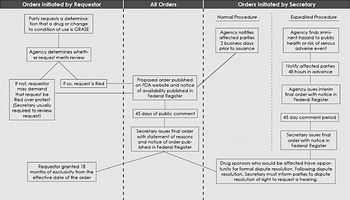
Second, the Act created a new process for OTC products’ market entry to replace the cumbersome monograph system. As shown in Figure 1, either the Secretary of HHS or another requestor may initiate a so-called administrative order determining that an OTC product is generally recognized as safe and effective or modifying conditions under which the drug may be marketed and used, such as labeling requirements, indications, and dosage forms, which are currently set out in existing monographs. 30
Schematic Overview of Novel Process for Generally Recognized as Safe and Effective Determinations of New OTC Drugs by FDA

In the case of administrative orders initiated by the Secretary, the Secretary is required to make an effort to notify sponsors of drugs that will be affected by the administrative order at least two business days before the order is issued. The agency might decide to issue an order on its own initiative if it determines that a drug already on the market poses a safety risk or that a drug’s labeling should be changed. The Secretary then publishes a proposed administrative order on the FDA website and a notice of the availability of the order in the Federal Register. Following publication of the proposed order, the Secretary must provide for a comment period of at least 45 calendar days (in most cases), after which the Secretary can issue a final administrative order with a detailed statement of reasons, as well as a notice of the order in the Federal Register. The order cannot take effect until the time for requesting judicial review has run its course, and parties have 60 days to file a request for judicial review after the latest of four dates: publication of the notice of the order, denial of a hearing with respect to an order, the final decision made after a hearing, or, if no hearing is requested, the expiration of the time for requesting a hearing. In addition to judicial review, parties adversely affected by an administrative order are given an opportunity for dispute resolution and an administrative hearing. 31
Orders initiated by the Secretary may also be eligible for expedited procedures if the Secretary determines that the drug, class of drugs, or combination of drugs at issue represents an “imminent hazard to the public health” or if a labeling change will mitigate a “significant or unreasonable risk of a serious adverse event.” In such cases, the Secretary may issue an interim final order, publish a notice in the Federal Register regarding the order, and provide for a comment period of at least 45 calendar days. At the end of the comment period, the Secretary issues the final order. 32
Administrative orders initiated by request of another party follow a similar procedure to agency-initiated orders. 33 The agency refers to these requests as Over-the-Counter Monograph Order Requests, or OMORs. An OMOR may seek a GRAS/E finalization for an ingredient without a finalized monograph under the previous system, 34 or it may seek a change to a monograph ingredient that already has a GRAS/E determination. The latter are called Innovation OMORs, and they fall into two tiers. Tier 1 Innovation OMORs (which the agency expects will encompass most Innovation OMORs) are for substantial changes such as the addition of a new ingredient to a monograph that already has one or more GRAS/E ingredients or the addition of a new indication for an existing monograph ingredient. Tier 2 Innovation OMORs are limited to changes such as reordering existing information in a drug facts label or the addition of an interchangeable term. If the Secretary determines that a request merits review, the Secretary files the request and the process mirrors that for internally initiated orders, with an estimated timeline of 12 months from OMOR to proposed order for Tier 1, and 10 months for Tier 2. 35 If the Secretary determines that a request does not merit substantive review, the requestor may demand that the request be filed over protest. To incentivize parties to request administrative orders, the Act provides for 18 months of exclusivity for request-ors starting when the administrative order takes effect, when the requested order concerns a new active ingredient or when the requestor conducted new human studies. A drug company merely seeking a new indication for an existing active ingredient would not be entitled to the exclusivity period. In addition, as with agency-initiated orders, industry-initiated orders are subject to dispute resolution, administrative hearings, and judicial review. 36
Finally, the Act dramatically increased FDA’s capacity to review OTC products, update labeling or other requirements for existing products, and determine that new OTC products are generally recognized as safe and effective via administrative order by setting up a user fee system beginning in fiscal year 2021. The FDA currently receives user fees to pay for staffing from new drug, device, generic, and biosimilar applications. The first OTC user fee is a facility fee, assessed annually, and applies to entities that manufacture or process the finished form of an OTC product. 37 The second type is a fee paid by each party requesting an administrative order under the act, unless the order seeks to make a change in labeling to increase safety, in which case the fee is waived. 38
Policy Implications
The OTC monograph legislation changes the old method for regulating OTC drugs in a number of important ways. The administrative order procedures will allow drug companies a more efficient pathway to marketing OTC products, making OTC drug development more attractive. Although meeting the generally recognized as safe and effective standard may prove to be a high burden for new OTC products, the combination of the exclusivity period and faster turnaround (a matter of months, rather than years) may lead OTC manufacturers to prefer the administrative order system to the traditional NDA system. If the Act works as intended, it may benefit consumers seeking to self-manage their medical conditions by facilitating market entry for a wider variety of OTC products, but only if the new procedures continue to ensure that those products are sufficiently safe and effective.Reference Andrade, Gurwitz and Fish 39 The streamlined OTC drug process will allow FDA to respond more quickly to new safety information, thereby protecting consumers from situations such as the issues related to cough and cold medicine in children. However, because many third-party payers do not cover OTC drugs without a prescription, increasing the number of OTC drugs in the market may shift costs from third-party payers to consumers.Reference Brass 40
While OTC drugs promote patient autonomy, such autonomy only improves health care outcomes if consumers correctly identify their own health conditions, understand proper recommendations for administration, and avoid unsafe interactions between products — all responsibilities for which patients usually rely on physicians. 41 If patients use OTC products improperly, they can cause important side effects or may mask serious conditions that require professional medical attention.Reference Schulke 42 Increas ing the number of OTC products available to consumers compounds this risk and increases the need to ensure that the benefits and risks of OTC products are clearly communicated. Relatedly, increased use of OTC products could be a sign of enhanced patient access, but it could also signal overuse or improper use. One way to help determine whether OTC drugs are being used safely would be to subject them to routine pharmacovigi-lance and monitoring, but large databases of patient experiences with OTC products currently do not exist. With the new expedited pathways now in place, such registries should be created by the OTC drug manufacturers in concert with insurers and sellers to be managed by the FDA.
The user fees collected under the Act may benefit manufacturers and consumers by increasing agency resources, but they open the door to the same concerns that are associated with the other user fees. When the FDA collects user fees (such as for prescription drug applications), they often require substantial coordination between the industry and the agency on terms such as the size of the user fees and how the user fees are distributed. In such a context, government watchdog organizations have warned of regulatory capture: that the FDA may be more likely to accede to industry goals such as rushed reviews and lower standards for approval when it is financially linked to industry. Such organizations cite to reports of increased pressure to meet deadlines and anecdotal evidence of drugs being approved without sufficient scientific support.Reference Hilzenrath 43 User fees also have the potential to inflate consumer drug prices if manufacturers pass the fees along in higher prices, thereby undermining another objective of the Act.
The exclusivity provision may also lead to unintended consequences. Exclusivity for products with active ingredients not previously incorporated in a nonprescription drug and for products with newly conducted human studies was perhaps intended to allow companies to recoup their investments in developing OTC drugs. The architects of the statute may have been concerned that without such a provision, manufacturers would opt to use the NDA route to approval instead of the new administrative order system. But few new drugs are brought to market and immediately made available as OTC products. Rather, most OTC drugs in the modern era start as prescription-only products marketed under an NDA and are administratively switched to OTC once it is clear that they can safely be administered directly by patients. Pharmaceutical manufacturers often seek out OTC switches towards the end of their drug’s patent-protected exclusivity periods as generic competition is imminent to retain some revenue stream. One review found that OTC products remain profitable after a switch in part because OTC status removes a major barrier to purchasing these drugs. 44 Prescription-to-OTC switching via administrative order is not expressly prohibited in the statute, nor is it expressly allowed. However, since the effect of an administrative order is to deem a drug not to require an approved NDA, it seems plausible that drug manufacturers will seek to use this route instead of submitting a more burdensome supplemental NDA to accomplish prescription-to-OTC switches. Thus, the incentive should be revised to apply only to new drugs being sold OTC without previously being available as prescription products. A compromise of this sort would balance two policy objectives of the Act: increasing the availability of drugs that may be marketed without an approved NDA and driving down costs for consumers.
Regulators and researchers should observe the ways in which OTC drug sponsors use the new administrative order system. Initial experience can help determine whether the 18-month exclusivity period properly incentiv-izes pharmaceutical companies to initiate administrative order requests by offsetting costs and providing a profit incentive for OTC drug development. In addition, researchers could track denials to review a request or unfavorable administrative orders issued pursuant either to a request or to the Secretary’s independent authority. In particular, researchers could evaluate the frequency and the ways that sponsors use the dispute resolution process, and the extent to which they are able to bypass administrative processes and seek judicial review immediately after an unfavorable action by the agency.
Conclusion
FDA oversight of the OTC drug market before the CARES Act relied on a system that was not keeping pace with the development of new OTC products, nor with increasing knowledge of safety risks of products already on the market. By passing OTC reform, Congress recognized these issues, as well as the importance of OTC products to consumers for self-treating a wide variety of minor medical conditions. The legislation facilitates market entry of new OTC products and modification of conditions of use with the new administrative order system. In addition, the user fee provision in the Act will supplement the agency’s resources to allow it to process requests efficiently. It will be important to follow how the OTC market evolves under these new regulatory features.
Note
Dr. Kesselheim is supported by Arnold Ventures.