Implications
This review demonstrates that plant phytochemicals can have important effects on rumen methanogens, either by affecting methanogens directly and/or indirectly by affecting rumen protozoa. Modulation of the rumen microbiota, including methanogens and protozoa, with plant extracts such as saponins, tannins and essential oils has implications in improvement of animal nutrition through decreased dietary energy loss, and in limitation of the negative impact on the environment through mitigation of methane production.
Characteristics of the rumen ecosystem in relation to methanogenesis
The rumen ecosystem is one of the richest microbial environments, inhabited by numerous microorganism species including roughly 1011 bacterial cells/ml of rumen fluid, roughly 106 protozoal cells/ml of rumen fluid, roughly 103 fungal cells/ml of rumen fluid and roughly 109 methanogen cells/ml of rumen fluid. Only ∼10% of the microbial population of this ecosystem has been identified and described (Pers-Kamczyc et al., Reference Pers-Kamczyc, Zmora, Cieslak and Szumacher-Strabel2011), mainly due to the difficulty with maintaining them in in vitro culture. According to the literature data, the population of methanogens is very important to rumen functioning. Together with bacteria and fungi, methanogens are the earliest colonizers of the rumen. Archaea can be found in the lamb rumen as soon as 30 h after birth (Morvan et al., Reference Morvan, Dore, Rieulesme, Foucat, Fonty and Gouet1994). The population of these microorganisms in lambs in the 1st week of life was 104 cells/g of the rumen contents, whereas in the 3rd week of life it was 108 to 109 cells/g (Skillman et al., Reference Skillman, Evans, Naylor, Morvan, Jarvis and Joblin2004). It is estimated that the methanogen population accounts for ∼3% to 5% of rumen microbial biomass. So far 113 species of methanogen have been described, and although there are many more in other ecosystems, only a few have been described in the rumen (Janssen and Kirs, Reference Janssen and Kirs2008).
Methanogens appearing first in the rumen are of the genus Methanobrevibacter (Skillman et al., Reference Skillman, Evans, Naylor, Morvan, Jarvis and Joblin2004). In the case of Methanobacterium, representatives of the family colonize the rumen environment rapidly, but, in contrast to Methanobrevibacter, they disappear rapidly, that is, on the 12 to 19th day after birth (Zhu et al., Reference Zhu, Mao, Liu, Cheng, Iqbal and Wang2007). According to some literature data, predominant methanogens in the rumen ecosystem of farm animals include microorganisms of the genus Methanobrevibacter and Methanosaricina, and especially the following species: Methanobacterium formicicum, Methanobrevibacter ruminantium, Methanosaricina barkeri, Methanosaricina mazei and Methanomicrobium mobile (Stewart et al., Reference Stewart, Flint and Bryant1997; St-Pierre and Wright, Reference St-Pierre and Wright2012). Other data demonstrated predominance of only M. ruminantium (Leahy et al., Reference Leahy, Kelly, Altermann, Ronimus, Yeoman, Pacheco, Li, Kong, McTavish, Sang, Lambie, Janssen, Dey and Attwood2010), whereas other data indicated the order Methanobacteriales as predominant in the rumen (Jarvis et al., Reference Jarvis, Strompl, Burgess, Skillman, Moore and Joblin2000). However, the literature is still expanding and newer methanogens are being identified (Wright et al., Reference Wright, Ma and Obispo2008; Zhou et al., Reference Zhou, Hernandez-Sanabria and Guan2009; King et al., Reference King, Smith, St-Pierre and Wright2011; Lee et al., Reference Lee, Rhee, Kumar, Lee, Chang, Kim, Choi, Lee, Yoon and Kim2013).
There are also differences in the methanogen populations associated with rumen solid- and liquid phases. M. mobile, Methanobacterium aarhusense and Methanosphaera stadtmanii are species occurring only as free-living forms in rumen fluid, which account for a small percentage of the general Archaea population (Zhu et al., Reference Zhu, Mao, Liu, Cheng, Iqbal and Wang2007). Archaea associated with solid phases may be a much larger part of the total population of rumen methanogens (Tajima et al., Reference Tajima, Nagamine, Matsui, Nakamura and Animov2001). Zhu et al. (Reference Zhu, Mao, Liu, Cheng, Iqbal and Wang2007) named Methanobrevibacter spp., Methanosphaera spp. and unidentified methanogens as species characteristic for the solid fraction. However, Shin et al. (Reference Shin, Choi, Lim, Hong, An, Cho, Kim, An, Kang, Lee, Kim and Yun2004) showed that the most numerous group of Archaea inhabiting solid particles are the families Methanomicrobiaceae and Methanobacteriaceae. In the group of microorganisms related to the rumen wall, predominant methanogens include Methanobrevibacter spp. and Methanosphaera spp. (Zhu et al., Reference Zhu, Mao, Liu, Cheng, Iqbal and Wang2007). A considerable part of the population of methanogens in the rumen are of unknown taxonomy and properties.
Previous research demonstrated that quantitative as well as qualitative variability of microorganisms (including methanogens) in the rumen depends on many factors, such as: animal species, geographical location, feed and also on the use of feed additives that affect rumen fermentation (Szumacher-Strabel et al., Reference Szumacher-Strabel, Cieslak and Nowakowska2009; Hook et al., Reference Hook, Wright and McBride2010; Huang et al., Reference Huang, Tan, Long, Liang and Wright2012; Popova et al., Reference Popova, Morgavi and Martin2012; Kumar et al., Reference Kumar, Dagar, Puniya and Upadhyay2013).
Analysis of the process of methanogenesis in the rumen requires understanding of interactions between hydrogen producers (bacteria, protozoa, fungi) and consumers (methanogens) in the rumen ecosystem in terms of the possibility of reducing the negative effects (both environmental and economic) of methane production in the rumen. Therefore, growth and development of Achaea directly depends on the population of microorganisms, for example, those utilizing cellulose, which leads to an increase in the concentration of hydrogen (substrate for the process of methanogenesis), a by-product of crude fiber hydrolysis (Morvan et al., Reference Morvan, Bonnemoy, Fonty and Gouet1996; Wang et al., Reference Wang, Mao, Liu, Zhang, Cheng, Jin and Zhu2011). Syntropic interaction was demonstrated between rumen bacteria and methanogens by Wolin et al. (Reference Wolin, Miller and Stewart1997). Bacteria provide a substrate for methanogenesis in the form of hydrogen and formic acid, whereas methanogens decrease the concentration of bacterial metabolism products (i.e. in the process of horizontal hydrogen transfer). High amounts of bacterial metabolism products may be harmful to other microorganisms inhabiting the rumen environment. Maintaining low (10−6 to 10−7 mole/dm3) concentration of hydrogen favorably influences the development of particular groups of microorganisms that are important for a range of rumen processes (Wolin and Miller, Reference Wolin and Miller1988; Ushida and Jouany, Reference Ushida and Jouany1996). Additionally, the hydrogen concentration in the rumen affects effectiveness of the process of methanogenesis. Acidification to pH 5.5 causes loss of the ability to bind H+ by Archaea, leading to further acidification of the rumen and a reduction in the methanogen population (Russell et al., Reference Russell, Hall, Cairns-Smith and Braterman1988; Van Kessel and Russell, Reference Van Kessel and Russell1996).
Rumen archaea use large amounts of hydrogen for methane production (Hungate, Reference Hungate1967). The simplest reaction eliminating hydrogen from the rumen of ruminants is a combination of H2 and CO2 according to the following equation: CO2 + 4H2 = CH4 + 2H2O (Whitmann et al., Reference Whitmann, Bowen and Boone1992; Morgavi et al., Reference Morgavi, Forano, Martin and Newbold2010). The theory of hydrogen utilization was confirmed in the study of Demeyer and De Graeve (Reference Demeyer and De Graeve1991), where hydrogen addition to rumen fluid caused an increase in methane production by 94% with little change in the production of volatile fatty acids (VFA). Methane may also come from other rumen reactions, including the reduction of formic acid, methanol, methylamine, diethylamine, triethylamine (Hungate et al., Reference Hungate, Smith and Bauchop1970). It is likely that the scale of methane production in the above processes is modest (Wolin et al., Reference Wolin, Miller and Stewart1997).
The process of methanogenesis, and thereby the number of methanogens in the rumen has been directly correlated with the protozoal population (Newbold et al., Reference Newbold, Lassalas and Jouany1995). Some in vitro and in vivo studies demonstrated that the lack of the protozoal population in the rumen ecosystem has a significant effect on both the population of methanogens and the level of methane production (Cieslak et al., Reference Cieslak, Váradyová, Kišidayová and Szumacher-Strabel2009a; Morgavi et al., Reference Morgavi, Martin, Jouany and Ranilla2012). The research also showed that sheep maintained without protozoa for more than 2 years have reduced methanogenesis in comparison with sheep kept without protozoa for only 2 months (Morgavi et al., Reference Morgavi, Martin, Jouany and Ranilla2012). Similarly, earlier studies also demonstrated that short-term (up to 3 months) defaunation of the sheep rumen causes reduction of methane emission in comparison with the rumen of sheep inhabited by all groups of microorganisms and after long-term defaunation for ca. 1 year (Ranilla et al., Reference Ranilla, Morgavi and Jouany2004). The results from other study emphasize the need to consider the different methanogen communities (free-living v. protozoa-associated methanogen) when developing strategies for mitigating methane emissions in ruminants (Tymensen et al., Reference Tymensen, Beauchemin and McAllister2012). Further, it is important to recognize that different archaeal phylotypes are associated with specific groups of protozoa (Ohene-Adjei et al., Reference Ohene-Adjei, Teather, Ivan and Forster2007). A number of experiments have shown that the methanogens living in close symbiosis with rumen protozoa include: M. formicicum, M. ruminantium, M. barkeri, M. mazei and M. mobile (Stewart et al., Reference Stewart, Flint and Bryant1997). Regensbogenova et al. (Reference Regensbogenova, Kisidayova, Michalowski, Javorsky, Moon-Van Der Staay, Moon-Van Der Staay, Hackstein, McEwan, Jouany, Newbold and Pristas2004) demonstrated that M. mobile occurs mainly in single-species cultures of Metadinium medium, Entodinium furca monolobum and Diplodinium dentatum, while Kamra (Reference Kamra2005) named four species of rumen ciliates of the group Entodiniomorpha, which are in close symbiosis with the methanogens: Entodinium elonginucleatum, Entodinium bursa, Eudiplodinium maggii and Eremoplastron bovis. Other researchers (Finlay et al., Reference Finlay, Esteban, Clarke, Williams, Embley and Hirt1994; Kisidayova et al., Reference Kisidayova, Varyadova, Zelenak and Siroka2000; Cieslak et al., Reference Cieslak, Miltko, Belzecki, Szumacher-Strabel, Potkanki, Kwiatkowska and Michalowski2006) added to the list Dasytricha ruminantium, Entodinium caudatum, E. f. monolobum, D. dentatum, Eremoplastron dilobum, Epidinium ecaudatum and Ophryoscolex caudatus. It is presumed that the species preferences of the methanogens result from differences in the protozoal cell surface (Vogels et al., Reference Vogels, Hoppe and Stumm1980). However, literature data are ambiguous mainly because of the difficulty of culturing methanogens in vitro.
This review focuses on the effects of plant components on rumen methanogens and an important first step in understanding responses, and variation in responses, is to consider the structure, biochemistry and chemical analysis of these compounds.
Standardization of plant material and extract for biological activity studies
Saponin sources
One of the most commonly researched plant materials for anti-methanogenic activity is Yucca schidigera. It was approved by Food and Drug Administration as a food and feed additive with the ‘GRAS’ label (Generally Recognized as Safe). Two different product of yucca are available on market, that is, yucca powder (YP) and yucca extract (YE). Y. schidigera contains as much as 10% of steroidal saponins on a dry matter (DM) basis, which makes this plant one of the richest commercial source of saponins. YP, which is just powdered yucca log also contains 10% saponins. YE is prepared by squeezing the juice present in yucca logs, followed by the condensation to produce a syrup, and may contain 15% to 19% of steroidal saponins. Acid-hydrolyzed fractions of these saponins contain both furostanol and spirostanol aglycones. These include sarsapogenin, markogenin, smilagenin, samogenin, gitogenin and neogitogenin (Kaneda et al., Reference Kaneda, Nakanishi and Staba1987). In the plant, these can be found in a multi-component mixture of glycosides (Tanaka et al., Reference Tanaka, Ikeda, Ohtani, Kasai and Yamasaki2000; Oleszek et al., Reference Oleszek, Sitek, Stochmal, Piacente, Pizza and Cheeke2001, Kowalczyk et al., Reference Kowalczyk, Pecio, Stochmal and Oleszek2011). They can be found both as monodesmosides with one sugar chain attached at the 3-O- and bidesmosides with two sugar chains at the 3-O- and 26-O- positions. Tanaka et al. (Reference Tanaka, Ikeda, Ohtani, Kasai and Yamasaki2000) identified as many as 13 structurally different monodesmosidic saponins, giving them trivial names from YS-I to YS-XIII.
In the work of Oleszek et al. (Reference Oleszek, Sitek, Stochmal, Piacente, Pizza and Cheeke2001) eight individual saponins were isolated and identified out of which five were known spirostanol and three new furostanol structures. However, monodesmosides made up about 93% of the total saponins present. Recent LC-MS analysis showed that there are substantial qualitative and quantitative differences in the concentration of monodesmoside and bidesmoside saponin components between YP and YE; YE contains predominantly monodesmosides, whereas YP has higher amount of bidesmosidic forms. The bidesmosides in YP result from the presence of yucca bark (Kowalczyk et al., Reference Kowalczyk, Pecio, Stochmal and Oleszek2011).
The effects of Y. schidigera have been historically attributed to its saponin content. However, experiments performed with rats showed effects of both saponin-containing and non-saponin-containing fractions (Duffy et al., Reference Duffy, Killeen, Connolly and Power2001). Several mechanisms have been proposed for the mode of action of Y. schidigera extract, but none has been conclusively proven.
The above discussion shows the difficulty of standardizing batches of yucca product, and also the potential for large variation between batches. Typical quality control procedures for the yucca products involve acid hydrolysis of the butanol phase followed by GC-FID analysis of resulting sapogenins. No information is given on glycosidic composition. In fact, glycosidic composition rather than aglycone content determines the biological activity of these compounds.
Additional difficulties in interpretation of experimental data when YE is used relate to the composition of the rest of the product. Even if concentration of steroidal saponins is 20% of the sample, the other 80% still remains unknown. A high proportion of YE is made up of polysaccharides of unknown composition and their effects on extract activity is not known.
Similar problems arise with other saponin sources, for example, quillaya saponins, the second largest commercial source of triterpene saponins. The term quillaya saponins covers the multicomponent mixture of individual glycosides of high polarity and complex structural diversity. Most of the published work on this plant refers to one of the best known component (QS-21) of acylated bidesmosidic triterpene saponin. No analytical protocols are available to standardize these saponins and not much is known about their stability under different extraction/purification conditions. Usually acylation is very sensitive to temperature, pH or other extraction/purification treatments. Thus, the development of analytical protocols for standardization of quillaya saponins is essential.
Tannins and proanthocyanidins
Tannins are a complex mixtures of individual compounds having molecular weights ranging from 500 to over 3000 (gallic acid esters) and up to 20 000 (proanthocyanidins). Their standardization before in vitro or in vivo trials represents a unique analytical problem. They are usually standardized using a spectrophotometric technique with Folin–Ciocalteu reagent, with results expressed as gallic acid equivalents. In fact this method is not specific, measuring total reducing capacity. There is a need for more specific analytical approaches, such as HPLC for procyanidins and GCMS for proanthocyanidins.
Essential oils
Widely occurring in plants and animals, the essential oils may consist of volatile constituents of terpenoid or non-terpenoid origin. Under this group, hundreds of large or small molecules can be present, consisting of hydrocarbons and their oxygenated derivatives. Some of these compounds may additionally contain nitrogen or sulfur. They may exist in the form of alcohols, acids, esters, epoxides, aldehydes, ketones, amines and sulfides but in some cases halogenated compounds are also found. The composition of essential oils is usually characteristic for the particular plant species and responsible for its fragrance. Each of the compounds may have different effects on organisms causing damage to the plant tissue (e.g. herbivorous insects or microorganisms).
As with other groups of secondary metabolites, the level and composition of essential oils change depending on the variety, environmental factors, time of harvest, etc. A further source of variation in commercially available essential oils is differences in the technology used for their isolation, as well as storage. The most effective analytical method for essential oils remains GS-MS. More advanced techniques, such as GC/FT-IR and NMR, are required for identification of new components of essential oils.
Effect of plant components on rumen methanogens
Plant components (e.g. saponins, tannins, essentials oils) may affect methanogenesis by inhibiting growth, development and activity of the population of methanogens both indirectly (by reducing the number of protozoa associated with methanogens) and directly, by affecting methanogens. Moreover, plant components may also case a shift toward propionate production, which affects methanogenesis through reduced competition for hydrogen.
Saponins
Although saponins have reduced the amount of enteric methane production by up to 50% in some studies (Szumacher-Strabel and Cieslak, Reference Szumacher-Strabel and Cieslak2010; Patra and Saxena, Reference Patra and Saxena2010; Bodas et al., Reference Bodas, Prieto, García-González, Andrés, Giráldez and López2012), these effects need to be confirmed in more in vivo studies. There is some ambiguity in the literature concerning the mechanism of saponins action to reduce methanogens and methanogenesis. According to Guo et al. (Reference Guo, Liu, Lu, Zhu, Denman and McSweeney2008), mitigation of methanogenesis using tea saponins results from decreased activity of the mcrA gene (an indicator of the methanogenic activity of the methanogen population), without changing the total methanogen numbers. This effect was noted when using a mixed rumen culture for in vitro studies, but not when pure cultures of M. ruminantium were tested. Other researchers used 3 g/day of tea saponins in sheep diets and concluded that there was no effect on the populations of methanogens (Mao et al., Reference Mao, Wang, Zhou and Liu2010; Zhou et al., Reference Zhou, Mao, Jiang, Wang, Liu and McSweeney2011). Earlier in vitro research had suggested mitigation of the process of methanogenesis without reduction in the number of methanogens with the use of saponins from Sapindus saponaria or tea saponins (Hess et al., Reference Hess, Kreuzer, Diaz, Lascano, Carulla, Soliva and Machműller2003; Hu et al., Reference Hu, Liu, Ye, Wu and Guo2005). It seems likely that the reduction in methanogenesis was related to a reduction in Archaea associated with protozoa as a result of partial defaunation. A reduction in the protozoal population decreases the amount of hydrogen available in the rumen for the process of methanogenesis (Szumacher-Strabel and Cieslak, Reference Szumacher-Strabel and Cieslak2010).
Saponins, due to their structure (hydrophobic sapogenin, i.e. aglycone, and a hydrophilic sugar part – glycone, which may comprise glucose, arabinose, xylose, galactose) can interact with cholesterol present in eukaryotic cell membranes and thereby cause destruction of this cell type (Cheeke, Reference Cheeke1996; Wina et al., Reference Wina, Muetzel, Hoffmann, Makkar and Becker2005). This may explain also a lack of direct saponin effect on methanogen cells. Wina et al. (Reference Wina, Muetzel, Hoffmann, Makkar and Becker2005) found that lower doses (1 mg/ml) of methanol extract of Sapindus rarak containing saponins, used in in vitro research, did not reduce the concentration of methanogen RNA. The reduction was observed only for higher concentrations (4 mg/ml). Similar conclusions were drawn by other authors (Staerfl et al., Reference Staerfl, Kreuzer and Soliva2010; Wang et al., Reference Wang, Mao, Liu, Zhang, Cheng, Jin and Zhu2011; Zmora et al., Reference Zmora, Cieslak, Pers-Kamczyc, Nowak, Szczechowiak and Szumacher-Strabel2012b and Reference Zmora, Cieslak, Pers-Kamczyc and Szumacher-Strabel2012c). Moreover, Bodas et al. (Reference Bodas, Prieto, García-González, Andrés, Giráldez and López2012) demonstrated that low saponin concentrations indirectly influence methane production in the rumen by reducing the number of protozoa, whereas higher saponin concentrations have direct negative effect on methanogens.
As the rumen is a highly dynamic ecosystem, examination of the influence of phytofactors on microorganisms involved in the process of methanogenesis should take into account factors that can deactivate biological properties of saponins, including degradation, hydrolysis, deglycosylation, detoxication of saponins (Miles et al., Reference Miles, Wilkins, Munday, Holland, Smith, Lancaster and Embling1992; Makkar and Becker Reference Makkar and Becker1997; Odenyo et al., Reference Odenyo, Osuji and Karanfil1997; Wang et al., Reference Wang, McAllister, Newbold, Rode, Cheeke and Cheng1998; Teferedegne et al., Reference Teferedegne, McIntosh, Osuji, Odenyo, Wallace and Newbold1999). According to other authors, the duration of saponin administration and the ratio of forage to concentrate may have a significant influence on their effect (Newbold et al., Reference Newbold, ElHassan, Wang, Ortega and Wallace1997, Teferedegne et al., Reference Teferedegne, McIntosh, Osuji, Odenyo, Wallace and Newbold1999; Goel et al., Reference Goel, Makkar and Becker2008).
Tannins
Research on the effects of tannins on the populations of methanogens has been carried out both under in vitro and in vivo conditions, however, results were not always unequivocal (Tavendale et al., Reference Tavendale, Meagher, Pacheco, Walker, Attwood and Sivakumaran2005; Bhatta et al., Reference Bhatta, Uyeno, Tajima, Takenaka, Yabumoto, Nonaka, Enishi and Kurihara2009; Szumacher-Strabel et al., Reference Szumacher-Strabel, Zmora, Roj, Stochmal, Pers-Kamczyc, Urbanczyk, Oleszek, Lechniak and Cieslak2011; Cieslak et al., Reference Cieslak, Zmora, Pers-Kamczyc and Szumacher-Strabel2012). The range of mitigation of methane production by using tannins is quite broad, from 2% to 58% in comparison with analyzed control groups (Patra and Saxena, Reference Patra and Saxena2010a; Bodas et al., Reference Bodas, Prieto, García-González, Andrés, Giráldez and López2012), and factors responsible for the mitigation are various, for example, tannin type, plant source. Tavendale et al. (Reference Tavendale, Meagher, Pacheco, Walker, Attwood and Sivakumaran2005) suggested that inhibition of methanogen growth is due to the bacteriostatic and bactericidal effects of condensed tannins (CT). The study demonstrated deactivation of methanogens (M. ruminantium), linked to reduction of produced methane (Tavendale et al., Reference Tavendale, Meagher, Pacheco, Walker, Attwood and Sivakumaran2005). Similar conclusions were drawn by Pellikaan et al. (Reference Pellikaan, Stringano, Leenaars, Bongers, van Laar-van Schuppen, Plant and Mueller-Harvey2011).
Other researchers analyzed six commercial sources of tannins containing hydrolysable tannins (HT) or HT and CT, and showed greater potential for mitigation of methanogenesis after using a mixture of HT and CT (Bhatta et al., Reference Bhatta, Uyeno, Tajima, Takenaka, Yabumoto, Nonaka, Enishi and Kurihara2009). The mixture of HT and CT suppresses methanogenesis by reducing the methanogenic populations in the rumen either directly or by reducing the protozoal population, thereby reducing methanogens symbiotically associated with the protozoal population (Bhatta et al., Reference Bhatta, Uyeno, Tajima, Takenaka, Yabumoto, Nonaka, Enishi and Kurihara2009). However, Goel and Makkar (Reference Goel and Makkar2012) showed that HT led to a larger reduction in the population of methanogens or microorganisms providing them with H2 than CT. Other authors noted not only a direct tannin effect on methanogens but also a direct influence on protozoa associated with them (Patra and Saxena, Reference Patra and Saxena2009). Research with dairy cattle showed that addition of CTs from Vaccinium vitis idaea at 2 g/kg dietary DM caused mitigation of methanogenesis mainly resulting from a reduction in protozoal numbers without a negative effect on the digestibility of organic matter and VFA production (Cieslak et al., Reference Cieslak, Zmora, Pers-Kamczyc and Szumacher-Strabel2012).
CT extracted from Leucaena leucocephala caused a linear reduction in total methanogens (up to 99%) and total protozoa (up to 83%) with increasing levels (from 20 to 60 mg/g DM of substrate) of CT in an in vitro study (Tan et al., Reference Tan, Sieo, Abdullah, Liang, Huang and Ho2011). However, the reduction in protozoal population was not always proportionally related to the decrease in methanogen population. Another study also confirmed that tannin effects on the protozoal population are varied, probably because some tannins have a direct effect on methanogens, which are not associated with protozoa (Bhatta et al., Reference Bhatta, Baruah, Saravanan, Suresh and Sampath2012). Other researchers have demonstrated a decline in the methanogen population associated with protozoa, for example, species belonging to Methanobacteriaceae, and simultaneous increase in the number of free-living Methanobacteriales, after inhibition of protozoa (Goel and Makkar, Reference Goel and Makkar2012). A reduction in the number of protozoa is not always accompanied by a reduction in the number of methanogens. Limitation of the population of one methanogen may cause an increase in the populations of the others. As phytofactors may increase populations of some microorganisms by decreasing others, the analysis of rumen microorganisms should include also the quantitative and qualitative analysis of other organisms in the rumen (Zmora et al., Reference Zmora, Cieslak, Jedrejek, Stochmal, Pers-Kamczyc, Oleszek, Nowak, Szczechowiak, Lechniak and Szumacher-Strabel2012a).
Interpretation of results with extracts containing one bioactive phytofactor, even in a predominant concentration, is difficult because of the complexity of structures, as well as the possibility of interactions between individual bioactive extract components or bioactive extract components and feed components. Soltan et al. (Reference Soltan, Morsy, Sallam, Louvandini and Abdalla2012) also suggested that the potential methanogenic properties of feed containing tannins may be related not only to the tannin content, but also to other factors. Another cause of lack of the effect of feed additives containing tannins on the number of methanogens in rumen fluid under in vitro conditions may be the use of too low concentrations of tannins in the supplement (Szumacher-Strabel et al., Reference Szumacher-Strabel, Zmora, Roj, Stochmal, Pers-Kamczyc, Urbanczyk, Oleszek, Lechniak and Cieslak2011). Jayanegara et al. (Reference Jayanegara, Leiber and Kreuzer2012) stressed that methane declined when dietary tannins increased, however, when the amount of tannin (in the batch culture system) is too high (more than 100 g tannin/kg DM) the accuracy of estimates of the impact of tannins on methanogenesis decreased.
Evaluation of the effects of tannins on rumen methanogenesis should also include other responses whose modulation may indirectly cause mitigation. For example, the use of extracts or feed containing considerable amount of tannins may limit feed intake or reduces digestibility of organic matter, and therefore decreases the amount of methane produced (e.g. Carulla et al., Reference Carulla, Kreuzer, Machmueller and Hess2005).
There is scarce information about the direct effect of tannins on methanogens. Smith et al. (Reference Smith, Zoetendal and Mackie2005) demonstrated a number of mechanisms improving tolerance of bacteria to the unfavorable environment produced by tannins. These include modification of the cell membrane, secretion of a protective exo-polysaccharide layer around the cells, and degradation/modification of tannins.
Essential oils
Essential oils are mixtures of terpenoids, low-molecular-weight aliphatic hydrocarbons, acids, alcohols, aldehydes, acyclic esters, and/or lactones (Dorman and Deans, Reference Dorman and Deans2000), and are usually extracted from plant material by water or aqueous alcohol steam distillation. Antimicrobial effects of essential oils are manifested in their high affinity for microbial cell membranes (Jouany and Morgavi, Reference Jouany and Morgavi2007). However, the effect of individual essential oils depends on their structure, which results from chemical composition and type of functional group, for example, terpenoids or phenols. They cause disturbances of ion transport (electrons) through the cell membrane, mitigate protein translocation, phosphorylation and enzyme-dependent reactions taking place in the membrane (Jouany and Morgavi, Reference Jouany and Morgavi2007). Essential oils affect individual groups of microorganisms differently because of differences in the structure of the cell membrane, for example, between bacteria and methanogens.
In some studies, essential oils stimulated some protozoa species, for example, Isotricha spp. or Dasytricha spp. and this led to an increase in associated Methanobrevibacter smithii. However, in many studies authors showed decreased rumen methane production in response to essential oil supplements, without alterating protozoa population (Evans and Martin, Reference Evans and Martin2000; Busquet et al., Reference Busquet, Calsamiglia, Ferret, Carro and Kamel2005). The direct influence of essential oils on methanogen cells may be related to the structure and properties of the oil used or secondary plant metabolites contained therein. In an experiment carried out by Busquet et al. (Reference Busquet, Calsamiglia, Ferret, Carro and Kamel2005), garlic oil (Allium sativum) was used as the supplement. In contrast to the essential oils that are active only against Gram-positive bacteria, garlic oil is active against Gram-negative and Gram-positive bacteria, fungi, viruses and parasites, and the main mechanism of action is related to the ability to react with –SH groups (O'Ghara et al., Reference O'Ghara, Hill and Maslin2000). Similar results of a decrease in total methanogens were obtained by Kongmun et al. (Reference Kongmun, Wanapat, Pakdee, Navanukraw and Yu2011) after using the addition of 7% coconut oil with 100 g/day of garlic powder in rumen fistulated swamp buffalo bulls. In their study, there was no relationship between the protozoal population and the methanogen population, probably because methanogens are found in a wide range of environments in the rumen: (i) free in the rumen fluid; (ii) attached to particulate material and rumen protozoa and (iii) attached to the rumen epithelium (Janssen and Kirs, Reference Janssen and Kirs2008). According to Goel et al. (Reference Goel, Makkar and Becker2009), decreases in methanogen populations can be correlated with decreased bacteria populations, for example Ruminococci that produce significant amounts of hydrogen. However, these effects may depend on the concentration of the specific treatment factor used and, according to McIntosh et al. (Reference McIntosh, Williams, Losa, Wallace, Beever and Newbold2003), ruminal methanogens seem to be affected only at high concentrations of essential oils. In their experiment, EO blend (containing thymol, eugenol, vanillin and limonene) of the concentration up to 160 ppm did not alter the M. smithii population, which was inhibited only at a concentration of 1000 ppm.
Essential oils can modulate either the rumen methanogen population or methanogen activity and they do not always influence the total number of methanogens inhabiting the rumen, instead affecting the distribution among methanogen species. This thesis is confirmed by the results of Ohene-Adjei et al. (Reference Ohene-Adjei, Chaves, McAllister, Benchaar, Teather and Forster2008), where an increase in the diversity of methanogenic Archaea (Methanosphaera stadtmanae, M. smithii and some uncultured groups) was observed in response to treatment with cinnamaldehyde, garlic and juniper berry oil, without alteration of the total rumen methanogenic capacity.
Therefore, inhibition of the process of methane production in the rumen is not always accompanied by changes in the diversity of methanogens or a decrease in their population. Twofold increase in the number of rumen methanogens resulting from using the addition of 0.33 μl peppermint oil per ml of incubation medium in vitro was followed by 20% decrease in methane production, while using higher concentrations of peppermint oil (1 or 2 μl/ml) decreased methanogen populations (on average by 82%) and methanogenesis by 61% (Agarwal et al., Reference Agarwal, Shekhar, Kumar, Chaudhary and Kamra2009). A similar effect was observed in an in vitro experiment where limonene, the main component of fir oil (Abies alba), at 40 or 400 mg/l (Cieslak et al., Reference Cieslak, Zmora, Nowakowska and Szumacher-Strabel2009b) was used. The addition of limonene in greater amounts caused reduction of the population of methanogens (on average by 25%) with simultaneous mitigation of the process of methanogenesis (on average by 28%; Cieslak et al., Reference Cieslak, Zmora, Nowakowska and Szumacher-Strabel2009b). The lower level had no effect on methanogen numbers or methane production. This confirmed earlier observations that medium and high concentrations of essential oils can affect the number of methanogens (Cieslak et al., Reference Cieslak, Zmora, Nowakowska and Szumacher-Strabel2009b). The authors also do not exclude that the addition of limonene, indirectly reducing the number of microorganisms providing the substrate for methanogens in the form of H2 and CO2, can reduce the amount of methane produced in the rumen.
The possible mechanism of action of essential oils on methane production in the rumen may be the result of direct inhibition of methanogens (Calsamiglia et al., Reference Calsamiglia, Busquet, Cardozo, Castillejos and Ferret2007). Essential oils may affect the unique methanogen cell membrane structure (isoprenoid unit) that leads to cell destruction. Studies with essential oils have not considered the possibility that methanogen species may change in response to treatments as an adaptive response. This would complicate targeted efforts to minimize the methane production (Ohene-Adjei et al., Reference Ohene-Adjei, Chaves, McAllister, Benchaar, Teather and Forster2008). In addition to studies of effects of essential oils on methanogens, a number of other studies have made indirect observations based on measurements of VFA production and VFA proportions (Szumacher-Strabel and Cieslak, Reference Szumacher-Strabel and Cieslak2010; Vasta and Bessa, Reference Vasta and Bessa2012).
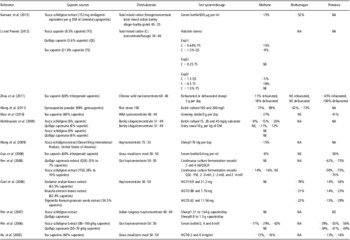
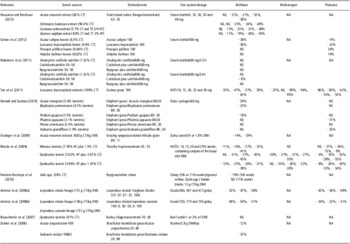
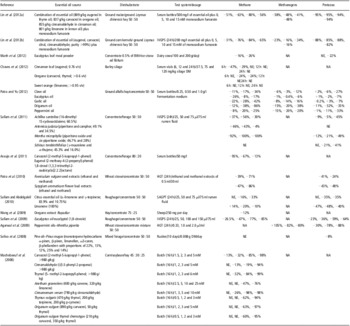
Several studies have investigated effects of saponins, tannins and essential oils on rumen fermentation, including methane production, but only a few have specifically determined their effects on methanogen population. The most recent results are presented in Table 1 for saponins, Table 2 for tannins and Table 3 for essential oils.
Effects of saponin sources on methane production, methanogen and protozoa populations in the rumen

DM = dry matter; HGT = hohenheim gas test system; NE = no effect; NA = not analyzed; –decrease; +increase.
Effects of tannin sources on methane production, methanogen and protozoa populations in the rumen

CT = condensed tannins; HT = hydrolysable tannins; DM = dry matter; DMI = dry matter intake; HGT = hohenheim gas test system; NE = no effect; NA = not analyzed; –decrease; +increase.
Effects of essential oil sources on methane production, methanogen and protozoa populations in the rumen

HGT = hohenheim gas test, IVGPS = in vitro gas production system; DM = dry matter; SAGPT = semi-automatic gas production technique; NE = no effect; NA = not analyzed; −decrease; +increase.
Conclusions
Studies of the influence of plant bioactive components (phytochemicals) on methane control in ruminants should be performed using as far as possible standardized samples. Natural products like saponins, tannins or essential oils occur in the plant material as multicomponent mixtures. The composition of the mixture and quantitative relations of individual compounds may change under different circumstances. The plant variety, time of harvest, climate, water availability or even sample treatment after plant harvest may influence qualitative/quantitative relations of the sample.
We can generally conclude that the saponins mitigate methanogenesis mainly by reducing the number of protozoa; CTs act both by reducing the number of protozoa and by a direct toxic effect on methanogens, whereas essential oils act mostly by a direct toxic effect on methanogens. However, because the rumen is the complex ecosystem, analysis of influence of plant components on the populations of methanogens should take into account not only the total population of methanogens but also individual orders or species. Most of tested plant and plant components have presented their antimicrobial activity in in vitro research when tested at high doses. The limited scientific information available from long-term in vivo trials suggested that benefits associated with bioactive components in vitro are not always obtained in vivo or are diminished over time due, for example, microbial adaptation. Hence, there is an urgent need to establish a clear definition of the optimal active dose of plant components that can be used as additives for ruminants.
Acknowledgements
The following manuscript was supported in part by the Polish Ministry of Science and Higher Education, Grant no. N N311 476339.
This paper was published as part of a supplement to animal, publication of which was supported by the Greenhouse Gases & Animal Agriculture Conference 2013. The papers included in this supplement were invited by the Guest Editors and have undergone the standard journal formal review process. They may be cited. The Guest Editors appointed to this supplement are R. J. Dewhurst, D. R. Chadwick, E. Charmley, N. M. Holden, D. A. Kenny, G. Lanigan, D. Moran, C. J. Newbold, P. O'Kiely, and T. Yan. The Guest Editors declare no conflict of interest.