INTRODUCTION
This paper investigates English-speaking children's acquisition of raising constructions such as Donald seems to Mickey to be short, in which an experiencer argument (Mickey) ‘intervenes’ between seem and the predicate to be short. We argue that children's poor performance on these patterns, which is crucial to a more general understanding of the acquisition of raising patterns in general, is best attributed to a performance limitation commonly referred to as an intervention effect.
BACKGROUND
The term ‘raising’ is often used to describe the relationship between the two patterns exemplified in (1).
-
(1)
-
a. It seems [that John is working].
-
b. John seems [to be working].
-
In (1a), the NP John is the subject of the verb work. In (1b), in contrast, it has ‘raised’ to the subject position in the higher clause, where it triggers agreement on the verb seem (see Perlmutter & Soames, Reference Perlmutter and Soames1979, and Postal, Reference Postal1974, for classic analyses).
We focus here on a subset of raising patterns in which an experiencer argument (e.g. Mary in (2)) occurs between the matrix verb and the infinitival clause.
-
(2)
-
a. Unraised: It seems to Mary [that John is working].
-
b. Raised: John seems to Mary [_ to be working].
-
Several acquisition studies (Hirsch, Reference Hirsch2011; Hirsch, Orfitelli & Wexler, Reference Hirsch, Orfitelli, Wexler, Belikova, Meroni and Umeda2007; Hirsch & Wexler, Reference Hirsch, Wexler, Dubinsky and Davies2007) report that while young children comprehend unraised patterns such as (2a), they have difficulty comprehending their raised counterparts such as (2b). See Choe and Deen (Reference Choe and Deen2015) for a comprehensive review of the literature on the acquisition of raising with and without an experiencer.
Children's difficulty with patterns such as (2b) has often been interpreted as evidence for deficits in child grammar (Borer & Wexler, Reference Borer, Wexler, Roeper and Williams1987). Detailed proposals along these lines include the Universal Phase Requirement (UPR; Wexler, Reference Wexler2004), the Universal Freezing Hypothesis (UFH; Hyams & Snyder, Reference Hyams and Snyder2005), and the Argument Intervention Hypothesis (AIH; Orfitelli, Reference Orfitelli2012), which offer competing grammar-based explanations for the acquisition path of A-movement structures, such as passives, unaccusatives, and raising. An alternative hypothesis, which we endorse, favors a processing explanation. On this view, the difficulty of raising patterns with an experiencer is attributed to processing-related limitations that are independently manifested in a variety of other constructions, including those involving Á-movement (which underlies the formation of wh-questions and relative clauses, among other patterns). Although there are important structural differences between A-movement and Á-movement, the two have in common the existence of a filler–gap dependency, which is a crucial part of the processing-based hypothesis that we pursue.
It is well known that children have difficulty processing structures in which an NP intervenes between a filler and the associated gap in cases of Á-movement (e.g. Avrutin, Reference Avrutin, Grodzinsky, Shapiro and Swinney2000; de Vincenzi, Arduino, Ciccarelli & Job, Reference de Vincenzi, Arduino, Ciccarelli, Job and Bagnara1999; Friedmann, Belletti & Rizzi, Reference Friedmann, Belletti and Rizzi2009; Friedmann & Lavi, Reference Friedmann, Lavi, Belleti, Bennati, Chesi, Di Domenico and Ferrari2006). These structures include object relatives, object topicalizations, and object wh-questions.
-
(3)
-
a. Object relative: The boy who the girl kissed _
↑ ________________ ↑
-
b. Object topicalization: The boy, the girl kissed _.
↑ ________________ ↑
-
c. Object wh-questions: Which boy did the girl kiss _?
↑ ____________________ ↑
-
Raising patterns resemble these constructions in that the experiencer argument intervenes between the raised NP and its original position, as illustrated in (4).
-
(4) Raising: The boy seems to the girl _ to be happy.
↑ _________________ ↑
A signature property of intervention effects is that their difficulty can be modulated by manipulating the features of the intervener (Arnon, Reference Arnon2010; Friedmann et al., Reference Friedmann, Belletti and Rizzi2009; Kidd, Brandt, Lieven & Tomasello, Reference Kidd, Brandt, Lieven and Tomasello2007). For example, Kidd et al. (Reference Kidd, Brandt, Lieven and Tomasello2007) report that English-speaking children are better at repeating object relatives with pronominal interveners, as in (5a), than ones with lexical NP interveners, as in (5b). Friedmann et al. (Reference Friedmann, Belletti and Rizzi2009) and Arnon (Reference Arnon2010) report a parallel result for Hebrew-speaking children on a comprehension task.
-
(5)
-
a. Pronoun intervener:
the nurse [that I am drawing _]
↑ ___________________ ↑
-
b. Lexical NP intervener:
the nurse [that the girl is drawing _]
↑ ________________________ ↑
-
Crucially, Choe and Deen (Reference Choe and Deen2015) found that children's comprehension of raising sentences significantly improved with a pronominal experiencer, as in (6a), compared to a lexical NP experiencer, as in (6b).
-
(6)
-
a. Pronoun intervener (81·5% accuracy):
Bart seems to her [_ to be studying].
↑ ______________ ↑
-
b. Lexical NP intervener (40·9% accuracy):
Bart seems to Lisa [_to be studying].
↑ _______________ ↑
-
This finding suggests that children's difficulty with raising patterns is sensitive to the same sort of influences that contribute to intervention effects in other structure types.
Different theories have been put forward as to the exact motivation for intervention effects in language acquisition and processing, including a grammatical account built on Relativized Minimality (Belletti, Friedmann, Brunato & Rizzi, Reference Belletti, Friedmann, Brunato and Rizzi2012; Friedmann et al., Reference Friedmann, Belletti and Rizzi2009; Rizzi, Reference Rizzi2013) and a processing-based account that draws on Dependency Locality Theory (DLT; Gibson, Reference Gibson, Miyashita, Marantz and O'Neil2000).Footnote 1
Relativized Minimality (RM) invokes a syntactic locality principle, proposed by Rizzi (Reference Rizzi1990, Reference Rizzi and Belletti2004), which rules out a dependency involving X and Y in the configuration … X … Z … Y … , if Z is too ‘similar’ to X. Friedmann et al. (Reference Friedmann, Belletti and Rizzi2009) argue that children apply a stricter version of RM than adults, requiring the features of X and Z to be entirely distinct. This idea predicts that young learners should have trouble with object relatives such as (5b), repeated as (7) below, in which the relativized head the nurse (X) and the intervener the girl (Z) share the NP feature.
-
(7) XZY
the nurse [that the girl is drawing _]
[+NP][+NP]
↑ ___________________________ ↑
(‘+NP’ designates a full lexical noun phrase.)
As we have seen, children do in fact have trouble comprehending object relative clauses of this type. And, predictably, they have been reported to do better on patterns such as (5a), repeated as (8) below, in which the intervener is a pronoun rather than a lexical NP.
-
(8) XZY
the nurse [thatIam drawing _]
[+NP][+pronoun]
↑ ________________________ ↑
While the RM account focuses on the similarity of the intervener to other NPs in the construction, the Dependency Locality Theory (Gibson, Reference Gibson1998, Reference Gibson, Miyashita, Marantz and O'Neil2000) focuses on its referential accessibility. For example, Warren and Gibson (Reference Warren and Gibson2002) show that processing difficulty is sensitive to the information-related gradations that make up the Givenness Hierarchy (Gundel, Hedberg & Zacharski, Reference Gundel, Hedberg and Zacharski1993) in (9), which correlates NP types with the accessibility of their referents.
-
(9) The Gundel et al. (Reference Gundel, Hedberg and Zacharski1993) Givenness Hierarchy:
Central Peripheral
in focus < activated < familiar < uniquely identifiable < referential
I, we, you he, she, they Donald Trump the chairman a chairman
For example, in object relatives like (10), the reading time at the main verb was fastest when the subject was a pronoun (we), slower for a definite NP (the chairman), and slowest of all for an indefinite NP (a chairman).
-
(10) The consultant who
 called advised wealthy companies about tax laws.
 called advised wealthy companies about tax laws.
Warren and Gibson (Reference Warren and Gibson2002) interpret these results as evidence that an intervener whose referent is highly accessible has a less disruptive effect on dependencies than one whose referent requires more effort to recover.
Choosing between the RM and DLT accounts of intervention would obviously shed important light on children's difficulty with raising patterns and possibly even on the nature of intervention effects in general. We report next on an experiment on raising that helps tease apart the claims made by the two approaches.
EXPERIMENT
METHOD
As mentioned in ‘Background’, Choe and Deen (Reference Choe and Deen2015) have found that children's comprehension is better for patterns such as (11a) than (11b).
-
(11)
-
a. Bart seems to her to be studying.
-
b. Bart seems to Lisa to be studying.
-
Both the RM and DLT accounts predict this result – the RM because the pronoun is sufficiently different from the lexical NP that raises over it, and the DLT because the pronoun has a highly accessible referent. However, the predictions of the two accounts diverge in the following pattern, in which the matrix subject is a pronoun and the intervening experiencer is a lexical NP:
-
(12) He seems to Lisa to be studying.
On the one hand, the RM account predicts no increase in difficulty, compared to the pronominal experiencer case in (11a), since the raised NP and the intervening NP are still of different types – one is a pronoun and the other a lexical NP. On the other hand, the DLT-based account predicts an increase in difficulty, compared to the pronominal experiencer pattern, since the intervener is a lexical NP whose referent is lower on the accessibility hierarchy. In order to tease apart the two accounts, we conducted a comprehension experiment.
Participants
We initially tested thirty-nine native English-speaking children, all of whom were recruited from the University of Hawai‘i Mānoa Children's Center, Montessori Community School, and Kaimuki Christian School in Honolulu, Hawai‘i. Eleven children were subsequently excluded on the basis of their failure to complete the experiment or to properly interpret the filler items.
Design
The experiment employed a mixed design with one between-participants factor and one within-participants factor. Participants were assigned to one of the two conditions: (1) the Lexical NP–Pronoun condition (14 children, aged 3;6–6;8, mean = 4;6), which tested patterns in which a lexical NP is raised across a pronominal experiencer,Footnote 2 and (2) the Pronoun–Lexical NP condition (14 children, aged 3;0–5;11, mean = 4;3), which examined raising patterns in which a pronoun is raised across a lexical NP experiencer.
Participants were also tested on the unraised counterpart of the raising pattern (within-participants with two levels: unraised vs. raised). Table 1 illustrates the design of the experiment, along with the test sentences for each condition.
Design of the experiment

Procedure
Following the format commonly used in a Truth-Value Judgment Task (Crain & McKee, Reference Crain, McKee, Berman, Choe and McDonough1985; Crain & Thornton, Reference Crain and Thornton1998), we showed children illustrated stories on a laptop computer. At the end of each story, a puppet appeared on the screen and made a one-sentence statement about what she thought had happened in the story. Children were then asked to determine whether the puppet's statement was a true or false description of what happened in the story and to provide a justification for their choice. The whole experiment took no more than thirty minutes for each child.
Materials
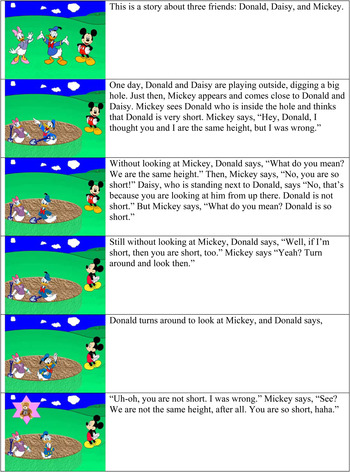
For each main condition (Lexical NP–Pronoun or Pronoun–Lexical NP), a child watched ten short stories in total, of which two were warm-up items, two were fillers, and the rest were critical items, divided into Unraised and Raised patterns. For the Raised pattern in the Lexical NP–Pronoun condition, a lexical NP was raised across a pronominal experiencer, as in Donald seems to him to be short. In the Pronoun–Lexical NP condition, a pronoun was raised across a lexical NP experiencer, as in He seems to Mickey to be short. The items were balanced for match and mismatch,Footnote 3 and the critical test sentences were counterbalanced across four different lists in order to minimize any item effects. The complete script of a sample story and the corresponding pictures shown to children are presented in Figure 1. A sample set of test sentences for each condition is also presented in Tables 2 to 5. In half of the six critical items, the referents of the raised NP and the experiencer NP had the same gender, as in Tables 2 and 3, while in the other half they had different genders, as in Tables 4 and 5.Footnote 4
A sample story with pictures.

A sample set of test sentences (match) in the Lexical NP–Pronoun: same gender

A sample set of test sentences (match) in the Pronoun–Lexical NP: same gender

A sample set of test sentences (match) in the Lexical NP–Pronoun: different gender

A sample set of test sentences (match) in the Pronoun–Lexical NP: different gender

In order to increase the naturalness of the pronoun and establish its antecedent, the experimenter's prompt and the puppet's lead-in sentence were presented immediately before the test sentence. For example, in the match item in (13) for the Pronoun–Lexical NP condition, only the intended referent Donald is explicitly mentioned in the first sentence of the experimenter's prompt. Then, in the second sentence, a pronoun is used to refer to the same referent while the experimenter points to the picture of Donald. Then the puppet also mentions the intended referent, making Donald the undisputed topic, which leads children to easily choose Donald as the antecedent of the pronoun in the test sentence.
-
(13) <Match item>
Experimenter's prompt: That was a fun story about Donald and his friends. He (pointing to Donald) is playing with Daisy, and then Mickey comes along. Hey, puppet, can you tell us what happens next?
Puppet: Donald is in a hole. He's playing down there, and …
(Unraised) it seems to Mickey that he is short.
(Raised) he seems to Mickey to be short.
In order to assure children's understanding, the stories were presented to children with matching visual scenes and moving characters. In a previous study (Choe & Deen, Reference Choe and Deen2015), the same stories were paired up with a slightly different test sentence (To Mickey, Donald seems to be short), in which the experiencer does not intervene between the two subject positions. On this condition, children (age 3;3 to 5;8, mean = 4;7, N = 28) had a success rate of over 80% accuracy, demonstrating that they had no trouble understanding the stories that preceded the test items.
RESULTS
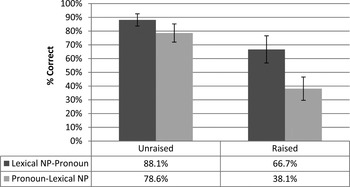
Figure 2 shows the mean correct percentage for each pattern (Raised and Unraised), across the two main conditions, Lexical NP–Pronoun and Pronoun–Lexical NP. For data analysis, we performed a mixed-effects logistic regression analysis, using R (R Core Team, 2014) and lme4 (Bates, Maechler, Bolker, & Walker, Reference Bates, Maechler, Bolker and Walker2014). The dependent variable was the correct response to each item. Pattern (Raised vs. Unraised) and Condition (Lexical NP–Pronoun vs. Pronoun–Lexical NP) were entered as fixed effects, and participants and items were included as random effects. With the unraised pattern, the accuracy rate was similar between the two conditions (Lexical NP–Pronoun: 88·1% vs. Pronoun–Lexical NP: 78·6%), showing no statistically significant difference (β = –0·84, Z value = –1·14, p = ·26). Crucially, children's comprehension of the raised pattern was significantly better in the Lexical NP–Pronoun condition (66·7%) than in the Pronoun–Lexical NP condition (38·1%; β = –1·40, Z value = –2·27, p = ·023).Footnote 5
Mean accuracy by condition.

Additional analyses with the maximum likelihood ratio test indicated that none of the potential factors (the match/mismatch items and the age of the child) provided a significant improvement in fit over the null model (all ps > ·1). In other words, there was no difference in children's rate of success on match items and mismatch items in any pattern, and no effect of age (as well as its interaction with Condition) within patterns (all ps > ·1).Footnote 6
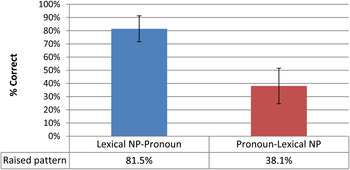
Finally, the results were further analyzed by looking at the mean accuracy of the sixteen children who scored 100% on the unraised pattern, thus filtering out those children who had trouble comprehending the verb seem itself. As can be seen in Figure 3, the difference in performance on the two conditions becomes sharper, with a success rate of 81·5% on the raised pattern in the Lexical NP–Pronoun condition, compared to just 38·1% in the Pronoun–Lexical NP condition. This difference was significant by a mixed-effects logistic regression analysis (β = –2·60, Z value = –2·16, p = ·031), with Condition as the fixed effect and participants and items as random effects.
Mean accuracy of children who scored 100% on Unraised patterns.

To investigate the potential effects of the children's age (N = 9 [age 3;8 to 6;8, mean = 4;6] for Lexical NP–Pronoun; N = 7 [age 3;0 to 5;10, mean = 4;3] for Pronoun–Lexical NP),Footnote 7 we compared the likelihoods of two models: the full model with the effect in question against the model without the effect in question. The results revealed that whereas Condition turned out to be a significant predictor (χ 2(1) = 6·50, p = ·01), neither age nor its interaction with Condition significantly improved the fit over the null model: Age (χ 2(1) = 0·10, p = ·75); Age × Condition (χ 2(1) = 2·04, p = ·15).
CONCLUSION
The main finding of our experiment is that whereas children's comprehension of raising sentences improves when the experiencer is a pronoun, as in (14a), they still have difficulty with raising sentences in which a pronoun is raised across a lexical NP experiencer, as in (14b).
-
(14)
-
a. Bart seems to her _ to be studying.
-
b. He seems to Lisa _ to be studying.
-
Taken together, these results demonstrate an asymmetric effect of NP type on children's comprehension of raising. Whereas a pronominal facilitated comprehension when it occurred in the experiencer position, as in (14a), no such effect was observed when it occurred in the matrix subject position, as in (14b).
This finding is not expected under the grammar-oriented RM account of intervention (Friedmann et al., Reference Friedmann, Belletti and Rizzi2009; Rizzi, Reference Rizzi2013), which focuses on the (dis)similarity of the two NPs. This theory predicts no increase in difficulty for the raising sentence in (14b), compared to the pronominal experiencer case in (14a), since the raised NP and the intervening NP are sufficiently different in terms of their feature specifications – one is a pronoun and the other is a proper name. In contrast, the results are consistent with the Dependency Locality Theory-based approach, whose appeal to the referential accessibility of the intervening NP predicts improved comprehension only when it is a pronoun.Footnote 8
Given our view that an intervention effect is responsible for children's non-target performance on both raising (an A-movement structure) and object relative clauses (an Á-movement structure), a question arises as to why children are able to do well on object relative clauses one to two years before they master comprehension of raising (Hirsch, Reference Hirsch2011). The likely answer is that there is no reason to expect intervention effects to be overcome at the same time in relative clauses and raising patterns, given the many differences between the two patterns. These differences include the type of movement (from a lower subject position to a higher subject position in raising patterns but not in a relative clause), the patterns' internal structure (raising patterns involving an infinitival clause), and frequency of occurrence in the input (object relatives are far more frequent than raising patterns with an experiencer argumentFootnote 9 ).
In sum, the results reported here strongly support an account of comprehension asymmetries in raising that draws on a familiar theory of processing difficulty. It would of course be unwise to suggest that this is a complete account of children's problems with raising patterns. We do not rule out the possibility that grammatical factors of a type yet to be determined may also be in play, nor do we rule out the possibility that future work will alter the line between grammar and processing. For now, it suffices to note that the results for the contrast that our study was designed to investigate are highly compatible with what is traditionally thought of as a processing account, but not with any currently known grammatical account.