Introduction
Adolescence is a period of great change in physical, emotional, psychosocial, and cognitive domains. Research in neurodevelopment indicates that an adolescent's brain undergoes dramatic maturation, including extensive reorganization and synaptic pruning, until approximately the mid-twenties (e.g., Giedd, Reference Giedd2008; Giedd et al., Reference Giedd, Clasen, Lenroot, Greenstein, Wallace, Ordaz and Chrousos2006; Gogtay et al., Reference Gogtay, Giedd, Lusk, Hayashi, Greenstein, Vaituzis and Thompson2004). Due to the fact that an adolescent brain is still in active development, any injury to the brain incurred either during adolescence or before this time (i.e., childhood) can be particularly detrimental to newly-developed or later-emerging skills. Research in pediatric traumatic brain injury (TBI) has demonstrated that long-term recovery is often characterized by a persistent gap or “neurocognitive stall” between children with TBI and their typically developing peers in terms of both cognitive and everyday life functioning (e.g., Anderson, Reference Anderson1999; Chapman, Reference Chapman2006; Cook, DePompei, & Chapman, Reference Cook, DePompei and Chapman2011; Sohlberg, Todis, & Glang, Reference Sohlberg, Todis and Glang1998).
Executive Function and Social Aspects in Adolescent TBI
Especially vulnerable to pediatric TBI are the complex neural pathways associated with the frontal lobes, which can be prematurely disconnected as a result of injury, having a negative impact on long-term cognitive outcome (Chapman & McKinnon, Reference Chapman and McKinnon2000). Corresponding with ongoing neural changes, predominantly in regard to frontal lobe maturation, is the protracted development of executive functions, which begin in infancy but are not fully mature until early adulthood (Anderson, Anderson, Northam, Jacobs, & Catroppa, Reference Anderson, Anderson, Northam, Jacobs and Catroppa2001; Kelly, Reference Kelly2000; Klenberg, Korkman, & Lahti-Nuutila, Reference Klenberg, Korkman and Lahti-Nuutila2001; Levin, Culhane, Hartman, Evankovich, & Mattson, Reference Levin, Culhane, Hartmann, Evankovich and Mattson1991; Stuss, Reference Stuss1992). As a result, youth with brain injury typically demonstrate deficits in executive functioning, affecting key cognitive domains which allow an individual to regulate thinking and behavior in the service of everyday goals (Levin & Hanten, Reference Levin and Hanten2005). In particular, weaknesses in emotional regulation, problem-solving, impulsivity, and self-monitoring increase the likelihood that an adolescent with TBI would engage in reckless behaviors or activities which would present a risk to self or others (e.g., Ylvisaker & Feeney, Reference Ylvisaker and Feeney2002). Recent study of adolescents and young adults with TBI suggests that an increased level of executive dysfunction is associated with immature social problem-solving skills and poorer social outcome overall (Muscara, Catroppa, & Anderson, Reference Muscara, Catroppa and Anderson2008).
In general, adolescents have been shown to engage in significantly more risky behavior than adults, with risk-taking being particularly increased in the presence of peers (e.g., Gardner & Steinberg, Reference Gardner and Steinberg2005). Recent investigation using fMRI suggests that this increase in risk-taking may be attributable to elevated sensitivity to the potential reward value of risky decisions (Chein, Albert, O'Brien, Uckert, & Steinberg, Reference Chein, Albert, O'Brien, Uckert and Steinberg2011). Particularly implicated reward-based brain areas include the ventral striatum and the orbitofrontal cortex, which have been posited to guide decision-making based on the assessment and prediction of potential rewards and punishments (e.g., Bechara, Reference Bechara2005; Van Leijenhorst et al., Reference Van Leijenhorst, Moor, de Macks, Rombouts, Westenberg and Crone2010), and are neural regions which may often be compromised by TBI. Therefore, an adolescent with TBI, relative to his or her peers, may be even more prone to act without evaluating the effectiveness and safety of possible action choices. Namely, he or she may have difficulty seeing the “big picture” or considering the outcome or full range of consequences for an action (Hanten et al., Reference Hanten, Cook, Orsten, Chapman, Li, Wilde and Levin2011), opting instead for more impulsive decision-making based largely on what is immediately apparent or gratifying. Moreover, considering the frequency with which youth with brain injury report being lonely, dissatisfied with their social situations, or having few close friendships (Yeates et al., Reference Yeates, Bigler, Dennis, Gerhardt, Rubin, Stancin and Vannatta2007), the underlying desire to “fit in” could exacerbate inappropriate decisions stemming from susceptibility to peer pressure, such as recreational drug use, legal infractions, or injury to self or others.
Social dysfunction has been well-documented in youth with TBI (e.g., Hanten et al., Reference Hanten, Wilde, Menefee, Li, Lane, Vasquez and Levin2008; Muscara et al., Reference Muscara, Catroppa and Anderson2008; Turkstra, McDonald, & DePompei, 2001; Yeates et al., Reference Yeates, Bigler, Dennis, Gerhardt, Rubin, Stancin and Vannatta2007), with several underlying cognitive skills being implicated, including the ability to use age-appropriate social problem solving (Yeates et al., Reference Yeates, Swift, Taylor, Wade, Drotar and Stancin2004; Hanten et al., Reference Hanten, Cook, Orsten, Chapman, Li, Wilde and Levin2008, Reference Hanten, Wilde, Menefee, Li, Lane, Vasquez and Levin2011; Muscara et al., Reference Muscara, Catroppa and Anderson2008). Yeates and colleagues (2004) demonstrated that children with moderate to severe TBI used socially immature strategies for conflict resolution relative to uninjured peers and orthopedic controls through performance on the Interpersonal Negotiations Strategy Test (INS; Yeates, Schultz, & Selman, Reference Yeates, Schultz and Selman1991). These findings were replicated by Hanten and colleagues (2008), who also reported impaired social problem-solving performance in youth with TBI on the INS as well as significant relations to memory and language functioning.
More recently, Hanten and colleagues (2011) sought to enhance the ecological validity of the INS by modifying it for use in a computer-generated virtual reality (VR) environment, where the social conflicts were presented through spoken dialogue of virtual adolescent characters, or simulated avatars, rather than through narrative presentation of conflict scenarios (i.e., being read aloud by the examiner). Additionally, the cognitive processing load was manipulated by varying the number of speakers and amount of irrelevant or tangential information presented. Results indicated overall impairment in social problem solving for adolescents with TBI, with their difficulties being most apparent with increased levels of cognitive processing load. However, unlike previous studies using the narrative version of the INS, TBI participants who completed the VR version of the task demonstrated impairment not only in the most complex stages of problem solving (e.g., generating solutions, evaluating outcomes), but also at most basic stage of defining the problem, suggesting that the VR version was perhaps more sensitive to deficits in identifying the social problem. Namely, to even identify the conflict for the VR scenarios, or abstract the “gist” of the conversational exchange, participants were required to select, interpret, and integrate relevant information, all aspects of social processing that would likely be necessitated by corresponding real-life situations.
Virtual Reality Applications
In social cognitive research, accurate simulation of social environments has become an important goal, secondary to the need to balance experimental control with ecological validity. Measures that demonstrate mundane realism, that is, in which the experimental demands match the relevant real-world situation, increase the subject's experience of the authenticity of interaction (Blascovich et al., Reference Blascovich, Loomis, Beall, Swinth, Hoyt and Bailenson2002). Traditional measures allow more controlled experimental manipulation and, therefore, may be experimentally more rigorous. However, these types of measures also create a situation in which the measurement reliability of social cognitive processes takes precedence over the validity of those processes. With emerging technologies, the trade-off between realism and experimental control can be lessened, as virtual technology can be modified and controlled without compromising measurement (Blascovich et al., Reference Blascovich, Loomis, Beall, Swinth, Hoyt and Bailenson2002; Loomis, Blascovich, & Beall, Reference Loomis, Blascovich and Beall1999). In general, the use of VR technology facilitates the dynamic, graphical simulation of the social environment more likely to be encountered during real-life application of social problem solving or decision-making while also increasing the chance for the participant to feel as though he or she is a part of the interactions being portrayed (Biocca, Harms, & Burgoon, Reference Biocca, Harms and Burgoon2003; Blascovich et al., Reference Blascovich, Loomis, Beall, Swinth, Hoyt and Bailenson2002; Heeter, Reference Heeter1992).
Previous studies have demonstrated the efficacy of using virtual environments to assess social cognition, including observations from both neuroimaging and behavioral paradigms. For example, Schilbach and colleagues (Reference Schilbach, Wohlschlaeger, Kraemer, Newen, Shah, Fink and Vogeley2006) found activation of the medial prefrontal cortex when participants were observing virtual characters’ social communication through facial expressions. Additionally, VR environments have been shown to be effective in eliciting specific emotional responses in participants similar to those experienced in real-world circumstances (e.g., Freeman et al., Reference Freeman, Pugh, Antley, Slater, Bebbington, Gittins and Garety2008; Moore, Wiederhold, Wiederhold, & Riva, Reference Moore, Wiederhold, Wiederhold and Riva2002; Riva et al., Reference Riva, Mantovani, Capideville, Preziosa, Morganti, Villani and Alcañiz2007).
Clinically, VR technology has been used to explore and remediate social functioning primarily in autism, with a large focus on adolescents (Mitchell, Parsons, & Leonard, Reference Mitchell, Parsons and Leonard2007; Parsons, Leonard, & Mitchell, Reference Parsons, Leonard and Mitchell2006; Parsons & Mitchell, Reference Parsons and Mitchell2002; Parsons, Mitchell, & Leonard, Reference Parsons, Mitchell and Leonard2004). However, before the study by Hanten et al. (Reference Hanten, Cook, Orsten, Chapman, Li, Wilde and Levin2011), few studies had used VR technology with acquired brain injury populations, and none of them addressed social outcome in children or adolescents with TBI. Overall, virtual reality tools are continuing to grow in popularity for use in both research and clinical domains due to their increasing accessibility and utility for improved real-life simulation and patient engagement.
Neural Correlates of Social Impairments in TBI
The majority of youth with moderate to severe TBI present with a combination of diffuse and focal injury, particularly in frontal, temporal, and parietal regions (Wilde et al., Reference Wilde, Hunter, Newsome, Scheibel, Bigler, Johnson and Levin2005). Moreover, cortical thinning has been observed in these regions in children with TBI (McCauley et al., Reference McCauley, Wilde, Merkley, Schnelle, Bigler, Hunter and Levin2010; Merkley et al., Reference Merkley, Bigler, Wilde, McCauley, Hunter and Levin2008) over and above the typical pattern of cortical thinning associated with maturation in the normally developing brain (e.g., Giedd et al., Reference Giedd, Clasen, Lenroot, Greenstein, Wallace, Ordaz and Chrousos2006). In general, deficits in social cognition, corresponding with disruption to normal development caused by TBI, have been associated with damage to each of these brain regions, especially medial ventral areas (Yeates et al., Reference Yeates, Bigler, Dennis, Gerhardt, Rubin, Stancin and Vannatta2007). In the study by Hanten et al. (Reference Hanten, Cook, Orsten, Chapman, Li, Wilde and Levin2011), performance on the VR social problem-solving task was found to be associated with cortical thickness in specific brain areas such as orbitofrontal regions, the frontal pole, the cuneus, and the temporal pole. Other studies of children with TBI have demonstrated relationships between reasoning and cortical thickness in specific prefrontal regions (Krawczyk et al., Reference Krawczyk, Hanten, Wilde, Li, Schnelle, Merkley and Levin2010) as well links between lesion location and decision-making (Hanten et al., Reference Hanten, Scheibel, Li, Oomer, Stallings-Roberson, Hunter and Levin2006). However, the relation of cortical thinning to anticipating social consequences in adolescents with TBI has not yet been examined.
Study Aims
This exploratory study evaluated the ability to predict social actions and the long- and short-term consequences of social actions in adolescents with TBI as compared to typically developing (TD) peers using a novel virtual reality task. It was hypothesized that the TBI group would, in comparison to the TD group, produce fewer predictions of actions with corresponding reasons as well as anticipate fewer long-term consequences. Also explored was whether group responses differed based on presentation of a moral or legal issue. Lastly, performance on the VR-AC task was analyzed in relation to cortical thickness in brain regions associated with social cognition. Different patterns of relation between performance and neural structure were predicted between the adolescents with TBI and the TD adolescents.
Method
Participants
The current study's TBI group included a total of 15 adolescents (ages 12–19 years) who had sustained a moderate to severe closed head TBI at least 1 year prior. The following mechanisms of injury were represented: fall (6), motor vehicle collision (4), recreational/off-road vehicle accident (2), bicycle accident (1), struck by a motor vehicle (1), sports-related injury (1). Adolescents with TBI were recruited from our larger ongoing longitudinal study of recovery from pediatric TBI (NINDS Grant R01NS021889) based on eligible age and date of injury as well as willingness to be contacted for participation in future studies. Of the 25 eligible, 2 were excluded due to brain imaging safety concerns (orthodontia and/or pregnancy) and 3 were lost to contact. Of the eligible families who were approached, five declined because of scheduling difficulties. That left the final 15 adolescents with TBI included in this pilot study, yielding a participation rate of 75%. Families who declined did differ from study participants on distance required for travel to testing site (i.e., more likely to live nearer). However, they did not differ on indices of brain injury, education, ethnicity, or socioeconomic status.
Participants were originally recruited at the time of injury upon admission to Dallas and Houston medical centers. Severe TBI was defined by lowest post-resuscitation Glasgow Coma Scale (GCS; Teasdale & Jennett, Reference Teasdale and Jennett1974) score of 8 or below. Moderate TBI was defined by either GCS of 9–12 or by GCS of 13–15 coupled with acute brain lesion(s) evident on computed tomographic (CT) or magnetic resonance (MRI) scans. Exclusionary criteria were based on medical records and parental (or guardian) interviews before enrollment and included: previous hospitalization for head injury; pre-existing neurological disorder associated with cerebral dysfunction and/or cognitive deficit (e.g., epilepsy, mental retardation); previously diagnosed learning disability; pre-existing severe psychiatric disorder (e.g., schizophrenia, autism); history of child abuse; penetrating gunshot wound to the brain; history of hypoxia/anoxia; history of hypotension, meningitis or encephalitis, chronic, serious physical disorder such as cancer, uncontrolled diabetes, etc.; not an English language learner. Given its high prevalence in the TBI population, hyperactive attention deficit disorder was not an exclusion.
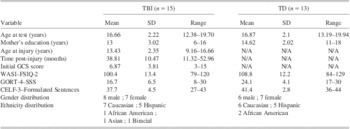
In addition, 13 typically developing (TD) adolescents matched for age, gender, and parental education served as a comparison group. Controls were recruited from the Dallas and Houston communities and via advertising on an institutional website and on public bulletin boards. The same exclusion criteria applied. See Table 1 for group demographic and injury characteristics.
Demographic and injury characteristics of TBI and TD participants

Note. GCS = Glasgow Coma Scale; WASI–FSIQ-2 = Wechsler Abbreviated Scale of Intelligence, Full Scale; Intelligence Quotient-2 Subtest; GORT-4–SSS = Gray Oral Reading Test-4, Sum of Standard Scores; CELF-3 = Clinical Evaluation of Language Fundamentals-3, Formulated Sentences subtest raw score; TBI = traumatic brain injury; TD = typically developing.
A Wilcoxon test indicated no significant differences between the TBI and TD groups on demographic variables of age at test (median TD = 16.64; median TBI = 16.83; p = .891) or mother's education level (median TD = 15; median TBI = 14; p = .188). Additionally, a χ2 test for independence indicated no significant association between group and gender [χ 2(1, n = 28) = 0.1437; p = .705]. Additionally, as an index of the representativeness of the sample, in the previous overall project of 76 children with TBI, the mean mother's education was 13.0 years, and the mean GCS was 6.9. Age could not be compared with the overall project sample due to differing age ranges (the larger grant included children as young as 7 years old).
To provide estimates of the relative intellectual, expressive language, and reading functioning of the groups, Table 1 also includes scores for both groups on the Wechsler Abbreviated Scale of Intelligence (WASI; Wechsler, Reference Wechsler1999), the Clinical Evaluation of Language Fundamentals—3rd edition (CELF; Semel, Wiig, & Secord, 1995), and the Gray Oral Reading Test—4th edition (GORT; Weiderholt & Bryant, Reference Weiderholt and Bryant2001). Informed consent was obtained for all participants from a parent or legal guardian in addition to assent from each study participant, as approved by and according to the guidelines of the Institutional Review Boards of the Baylor College of Medicine, the University of Texas at Dallas, and the University of Texas Southwestern Medical Center.
Measures
Virtual Anticipating Consequences (VR-AC) Task
Procedure
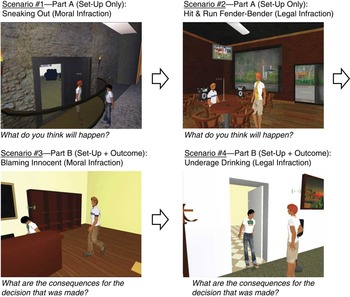
The VR-AC task used the same virtual microworld environment described in Hanten and colleagues (2011) but shifted the primary focus from conflict resolution to that of anticipating consequences of actions. In this task, participants viewed four brief (1–2 min each) videos of previously-recorded interactions. The videos portrayed the choice made by a character (i.e., avatar) when faced with a social dilemma that involved either a legal infraction or a moral infraction. Male participants viewed videos in which the primary avatar was male, and female participants viewed videos in which the primary avatar was female. Of the six possible scenarios, the three vignettes pertaining to legal infractions included: (1) using a fake I.D. to get into a club, (2) being involved in hit-and-run “fender-bender,” (3) participating in underage drinking at a party. The three vignettes pertaining to moral infractions included: (1) using a friend's answers to cheat on a test, (2) sneaking out of the house to hang out with a friend, (3) blaming an innocent classmate for something the individual did. In Part A (Set-Up Only) conditions, participants were shown only the set-up of a potential moral or legal dilemma, before a decision was made (e.g., an underage girl is offered a fake I.D. to get into a club). After each set-up scenario was viewed, participants were asked what they thought would happen next. Responses were audio-recorded and transcribed verbatim. For Part A, all participants viewed one legal set-up scenario and one moral set-up scenario.
Immediately thereafter, in Part B (Set-Up + Outcome) conditions, participants were shown two complete scenarios, including both the set-up of a moral or legal dilemma as well as the outcome, or the choice decided upon by the VR avatar (e.g., an underage girl is offered a fake I.D. to get into a club, and the girl decides to accept the fake I.D. and go to the club). After viewing the avatar's resolution of the dilemma, participants were asked what they thought the consequences would be for the decision that was made. Responses were audio-recorded and transcribed verbatim. For Part B, all participants viewed one entire legal scenario and one entire moral scenario (with each scenario presented in Part B differing from those presented in Part A), for a total of 4 distinct, randomly assigned scenarios presented to each participant. See Figure 1 for a graphical example of the task progression for a single participant.
Graphical example of the VR-AC task progression for a single participant (male).

Examples of both Part A and Part B conditions of a script for a single scenario (Sneaking Out) for a male participant are presented below:
Part A (Set-Up Only) Condition:
Scenario: Sneaking Out (two males converse through an open window/patio of a street-level apartment)
Mike: Hey, David. What's up?
David: Not much. I'm just trying to find something to watch on TV. There's nothing on.
Mike: Why don't you come over and hang out?
David: My parents are already asleep.
Mike: Wake them up and ask if it's okay. You're right down the street, so you could just walk over.
David: No, they get really mad if I wake them up.
Mike: Just sneak out. It's not a big deal. They'd let you come if they were awake, and you can go back in an hour or two.
David: I don't know….they'd be furious if they knew I snuck out.
Mike: They'd never know.
<Examiner asks>: What do you think will happen?
Part B (Set-Up + Outcome) Condition:
<Dialogue from Part A continuing on to the following>
David: I've got to get out of this house! I'm so bored! It still kind of makes me nervous, though.
Mike: It's just this one time, and you said yourself, they're sound asleep!
David: You're right. They'll never know. They're sound asleep.
Mike: Yeah, man. We're just hanging out at the house.
David: Okay, I'll be over in 10 minutes.
Mike: Great! I'll see you in a little bit. And don't worry, it'll be fine…
<Examiner asks>: What are the consequences for the decision that was made?
Scoring
The scoring for the VR-AC task focused on predictions of actions with corresponding reasons (Part A) or anticipation of short-term consequences and long-term consequences (Part B). Both quantitative and qualitative data were collected. Part A scenarios were scored according to two variables, number of actions predicted (e.g., “he's going to sneak out” or “he'll wake up his parents and ask if he can go”) and number of reasons given for those actions (e.g., “…because he doesn't think he'll get caught” or “…because he's afraid they'll find out if he doesn't ask first”). These two measures were included to index factors unrelated to the specific question at hand (i.e., ability to anticipate social consequences), but that might nonetheless affect the scores—namely, that being more verbally forthcoming may increase the likelihood of the youth hitting on a “good” response. Part B scenarios were scored according to three variables. The first two reflect quantitative aspects of the response: the number of short-term consequences given (e.g., “his parents will be mad”), and the number of long-term consequences given (e.g., “he might lose his parents’ trust”). The third variable, the Overall measure, reflected a qualitative judgment (on a scale of 1–4) of the participant's overall response. A score of 1–2 indicated that the participant's response did not reflect consideration of the long-term consequences of their/other's actions, whereas a score of 3–4 indicated that the participant's response suggested awareness of the full range of consequences of their/other's decisions and/or reasoning regarding the impacts of a poor decision. This measure allowed for a judgment of the quality over and above the quantity of short- vs. long-term outcomes given in the response.
Two blinded, trained raters independently scored the transcribed responses of the participants for both Part A and Part B scenarios, including both quantitative and qualitative ratings. Inter-rater reliability was 89%, reflecting good overall agreement between raters. Any disagreement between raters was resolved through discussion and consensus.
Analyses
Due to the small sample size in this pilot study, coupled with a skewed data distribution, a nonparametric method, namely, the Wilcoxon test, was used for analysis of group differences in performance for each separate condition. Additionally, since corrections for multiple comparisons were not feasible with this small sample, effect sizes were calculated using Cohen's d (Cohen, Reference Cohen1988) and are reported to inform the strength of the observed effects according to the following guidelines: small (d of .2 or lower), medium (d of around .5), and large (d of .8 or higher). The sample size did not allow inclusion in the model of other relevant variables, such as age and GCS, although, as noted above, the groups were closely equated for demographic variables.
Brain Imaging Measure: Volumetrics Using MRI
Procedure
For the majority of participants, brain imaging was conducted on the same day as behavioral testing. T1-weighted 3D sagittal images were collected on Philips Intera 3T whole body scanners. Parameters included 1.0-mm-thick slices, 0-mm slice gaps, echo time (TE) = 4.6 ms/repetition time (TR) = 15 ms, field of view (FOV) = 256 mm, and a reconstructed voxel size M/P/S(mm) = 1.0/1.0/1.0.
Analyses
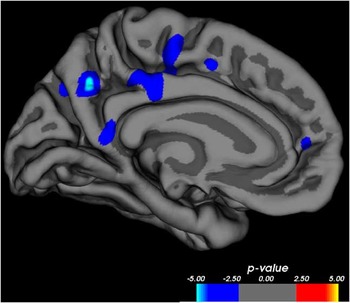
Cortical reconstruction and segmentation was accomplished with Freesurfer with procedures previously described (e.g., Dale, Fischl, & Sereno, Reference Dale, Fischl and Sereno1999; Han et al., Reference Han, Jovicich, Salat, van der Kouwe, Quinn, Czanner and Fischl2006; Jovicich et al., Reference Jovicich, Czanner, Greve, Haley, van der Kouwe, Gollub and Dale2006; Segonne et al., Reference Segonne, Dale, Busa, Glessner, Salat, Hahn and Fischl2004). This method uses intensity and continuity information from the whole three-dimensional MR volume in segmentation and deformation procedures to generate representations of cortical thickness. QDEC (Query, Design Estimate, Contrast) is a FreeSurfer application for performing inter-subject/group averaging and inference on morphometry data (cortical surface and volume). It was used to examine group differences in cortical thickness and to investigate the relation of cortical thickness to behavioral measures. Analyses were performed using general linear models with age controlled at each surface vertex. Statistical parametric maps of the cortical mantle were generated to show the relation of cortical thickness to behavioral variables and were overlaid on a pediatric template based on typically-developing adolescents (Figure 2). A statistical threshold of p < .01 was used, and values displayed are either positive relations (in blue) or negative relations (in red). The p-value shown is a –log(10) p-value, rather than a conventional p-value.
QDEC analysis demonstrating group differences (significance level = p < .01) in relation of performance on the VR-AC task (long-term consequences measure) to cortical thinning. The displayed p-value is a -log(10) value, rather than a conventional p-value.

Results
VR-AC Task (see Table 2 for Wilcoxon anayses results)
Part A
On the number of actions predicted in response to the set-up of a social dilemma scenario, TD adolescents did not differ from adolescents with TBI. Additionally, the difference between groups on the number of reasons provided for those predicted actions did not reach significance, although there was a trend for the adolescents with TBI to have lower scores.
Results of Wilcoxon analyses for VR-AC task

*p < .05.
+p < .10, trend.
Part B
For the outcome condition, TD adolescents and adolescents with TBI provided similar numbers of short-term consequences. However, TD adolescents provided significantly more long-term consequences than did adolescents with TBI. Moreover, for the Overall qualitative score, TD adolescents were more likely to provide answers that reflected well-thought-out, long-term impacts of the decision made in the scenario than were adolescents with TBI.
Legal versus moral
We found no differences on moral versus legal scenarios for the prediction scores or the scores for short-term or long-term consequences. However, in the Overall score, we found that adolescents with TBI had marginally lower scores than TD adolescents for the moral conflicts [mean for TD = 3.18; median for TBI = 2.57 (Z = 1.6158; p = .053; d = 0.71)] but not for the legal conflicts.
Brain Imaging Volumetrics
Groups differed most notably in the relation of the Overall measure to the right medial prefrontal cortex (PFC)/frontal pole and the precuneus, with much stronger relations apparent for the TD group. On the number of long-term consequences provided, there was a group difference in the relation of performance to the posterior cingulate, the superior medial frontal region, and the precentral region, and to a lesser extent, the middle temporal region (see Figure 2), with stronger relations shown for the TBI group than the TD group.
Discussion
Virtual Social Cognition Task
Preliminary results from the Virtual Reality-Anticipating Consequences task are consistent with the broad pattern of differences demonstrated by adolescents with TBI as compared to typically developing adolescents in showing few differences on concrete, short-range tasks, and larger differences on tasks that require more executive-level processing. First, on the quantitative measures of number of actions predicted and reasoned by adolescents with TBI and TD adolescents, there were no significant differences, suggesting that group differences observed in other measures were not the result of the TD group being more verbally forthcoming. Second, when asked to give the possible consequences of a potentially risky decision for a social dilemma made by a character (i.e., avatar) in a virtual vignette, children with TBI offered as many short-term outcomes and reasons for those outcomes as did typically developing adolescents. Of interest, however, adolescents with TBI were less likely to think beyond the immediate consequences of the actions or provide reasoning that took into account the full range of consequences, especially long-term, for a given resolution to a social problem than were their TD counterparts, but primarily for social dilemmas of a moral nature. On social dilemmas concerning legal infractions, task performance of children with TBI was similar to TD children. As a possible explanation to these findings, we suggest that children with TBI may not have surpassing difficulty in remembering concrete rules (and laws), but may be less able to flexibly apply moral reasoning to novel situations (e.g., Walsh, Reference Walsh1978). An expanded sample and analysis of age-at-test and age-at injury effects would inform whether older adolescents or those injured at an older age are more familiar with the legal infractions portrayed and/or have more experience with moral dilemmas, influencing the responses.
Brain-Behavior Relationships
In the VR-AC task, brain-behavior relationships differed between groups in the relation of the Overall (qualitative) measure to the medial PFC/frontal pole and the precuneus (bilaterally), with stronger relations apparent for the TD group than the TBI group. The VR-AC task assesses the ability to understand the future consequences of particular social actions, which is measured both in quantitative dimensions (number of short-term or long-term consequences that come to mind) and qualitative dimensions (the comprehensiveness of the evaluation of consequences) of anticipating consequences of one's actions. The prefrontal system is highly relevant to assessment of reward or penalty for future consequences (Bechara, Reference Bechara2005), with an immature or impaired prefrontal system being more likely to correspond with decisions favoring immediate rewards (Chein et al., Reference Chein, Albert, O'Brien, Uckert and Steinberg2011; Van Leijenhorst et al., Reference Van Leijenhorst, Moor, de Macks, Rombouts, Westenberg and Crone2010).
Consistent with our findings of the mediation of social cognition by memory (Hanten et al., Reference Hanten, Wilde, Menefee, Li, Lane, Vasquez and Levin2008), the precuneus has been shown to support episodic memory retrieval for concrete and abstract stimuli (Krause et al., Reference Krause, Schmidt, Mottaghy, Taylor, Halsband, Herzog and Müller-Gärtner1999) and is central to recognition memory (Dörfel, Werner, Schaefer, Von Kummer, & Karl, Reference Dörfel, Werner, Schaefer, Von Kummer and Karl2009). In addition, and relevant to the current study, a recent report has shown the precuneus to be involved in the ability to view and evaluate social/emotional stimulus from the perspective of detachment or distance (Koenigsberg et al., Reference Koenigsberg, Fan, Ochsner, Liu, Guise, Pizzarello and Siever2010).
There were few group differences in the relation of cortical thickness to the number of actions predicted or in the number of short-term consequences predicted. However, on the number of long-term consequences, there was a group difference in the relation of performance to the posterior cingulate, the superior parietal region, and the precuneus region, with stronger relations shown for the TBI group than the TD group. Of interest, the posterior cingulate is a part of the “default network” and is reported to be abnormal in children with Autism Spectrum Disorder, with poorer-than-normal default network connectivity associated with poor social function and increased restrictive and repetitive behaviors, but greater-than-normal connectivity in the network associated with poorer verbal and non-verbal communication skills (Weng et al., Reference Weng, Wiggins, Peltier, Carrasco, Risi, Lord and Monk2010). Furthermore, studies of microstimulation of the posterior cingulate in non-human primates (Hayden, Nair, McCoy, & Platt, Reference Hayden, Nair, McCoy and Platt2008) reveal its involvement in the evaluation of actions in situations of dynamic change. Especially interesting is that stimulation of the posterior cingulate is associated with a preference for a safer choice option as compared to a risky choice (Hayden et al., Reference Hayden, Nair, McCoy and Platt2008). Finally, in concert with the above findings, the medial superior frontal gyrus has been reported to be involved in selection of action sets and, when integrated with the cingulate's role in relating actions to consequences, guides decision-making (Rushworth, Walton, Kennerley, & Bannerman, Reference Rushworth, Walton, Kennerley and Bannerman2004).
We acknowledge that due to the small sample size and relative heterogeneity (e.g., wide range of time post-injury) in this preliminary study, firm conclusions cannot be drawn. However, several of the reported effect sizes are reasonably large, and it is likely that the inclusion of more data may result in additional significant differences for the conditions that currently suggested a trend, such as in the fewer number of reasons provided by the TBI group for the predicted responses to a social dilemma. Nonetheless, due to the lack of Type 1 error correction, the current results warrant cautious interpretation. It is possible that even with an increased sample size, correction for alpha slippage may reduce the significance. Moreover, the distribution in the current sample is skewed, which is typical for studies of TBI. That, coupled with the small sample size, precluded valid analysis of potential interactions, such as the effects of age-at-injury or time since injury, as well as contributions of other cognitive factors, such as language processing or memory, which could be addressed within a larger study. Nonetheless, we find the strength and specificity of the current findings to be encouraging. Taken together, the preliminary data motivate further study using an integrated approach of advanced behavioral and neuroimaging methodologies to inform the specific processes involved in social decision-making and the neural mechanisms underlying such impairment after pediatric TBI.
Conclusion
The behavioral and imaging results from this pilot study provide possible characterization of social decision-making deficits in adolescents with moderate to severe TBI. Clinically, to develop interventions for youth with brain injury that improve social functioning in everyday life, it is critical to assess key social decision-making skills, including the ability to consider the long-term impacts of a decision. Targeted assessment using virtual reality environments may serve a valuable role in capturing the complex, environmentally sensitive nature of social cognition impairments. Further understanding of possible deficit patterns in more ecologically valid assessment has the potential to elucidate how to provide meaningful, effective remediation for youth with brain injury at each developmental stage.
Acknowledgments
This work was supported by the National Institute of Neurological Disorders and Stroke (NINDS) Grant 2R01 NS 21889-16. The authors report no conflicts of interest.