Carbapenem-resistant Enterobacteriaceae (CRE) are important healthcare-associated pathogens with high mortality rates. 1 , Reference Rock, Curless and Cantara 2 CRE recovery from the patient environment may be informative for the evaluation of efficiency of cleaning and disinfection in routine and outbreak settings as well as infection prevention research studies.Reference Galvin, Dolan, Cahill, Daniels and Humphreys 3 Although the rayon-tipped swab method has better sensitivity than the cellulose sponge (CS) method for detecting Acinetobacter in the near-patient environment, the ideal sampling method for CRE detection from high-touch surfaces (HTSs) in the patient room is unknown.Reference Thom, Howard and Sembajwe 4 We compared 2 sampling methods (nylon-flocked swab [NFS] and CS) and 2 culturing methods (qualitative and quantitative) for the detection of CRE, non-CRE carbapenem-resistant organisms, and all other gram-negative organisms in rooms where the occupant harbored CRE.
Methods
At the Johns Hopkins Hospital, a 1,145-bed tertiary-care academic center in Baltimore, Maryland, we prospectively identified patients with recent (past 3 days) clinical or surveillance culture(s) growing CRE who had occupied the same hospital room for the most recent 2 days. High-touch surfaces (HTSs) from patient rooms were sampled. One half of each HTS was sampled using an NFS (eSwab, Copan Diagnostics, Murrieta, CA) dipped in neutralizer buffer (Hardy Diagnostics, Santa Maria, CA) using a previously published method.Reference Thom, Howard and Sembajwe 4 , Reference Hodges, Rose, O’Connell and Arduino 5 An individual NFS was used per half of the HTS. The other half of the HTS was sampled using CS with neutralizer (3M, Maplewood, MN), and up to 5 HTSs were sampled with each side of the CS (eg, a composite).Reference Thom, Howard and Sembajwe 4 , Reference Shams, Rose and Edwards 6 Due to right-hand dominance, bacteria may have been more likely to be removed from that side of the HTS during cleaning. To avoid introducing a systematic bias, alternating sides of the HTS were sampled by each method.
For qualitative cultures, PBS with tween broths were held for up to 3 days and subcultured if turbid. For quantitative cultures (including positive and negative controls) CDC protocols were followed, using MacConkey agar for selection of gram-negative organisms, incubated overnight at 35°C.Reference Hodges, Rose, O’Connell and Arduino 5 , Reference Shams, Rose and Edwards 6 Identification of recovered organisms was performed using matrix-assisted laser desorption ionization time-of-flight mass spectrometry (Bruker Daltonics) and antimicrobial susceptibility testing was performed using the BD Phoenix Automated Microbiology System (Becton Dickinson, Franklin Lakes, NJ).Reference Thom, Howard and Sembajwe 4 Enterobacteriaceae resistant to at least ertapenem were identified as CRE. If a CS was culture positive, then all HTSs of the composite were deemed positive. The limit of detection was determined by preparing a 0.5 McFarland standard, plating 100-µL aliquots of 10-fold dilution series of Klebsiella pneumoniae carbapenemase(KPC)-producing Klebsiella pneumoniae ATCC BAA-1705 onto sterile Formica slabs, and by CS and NFS sampling in a similar manner to HTS sampling.
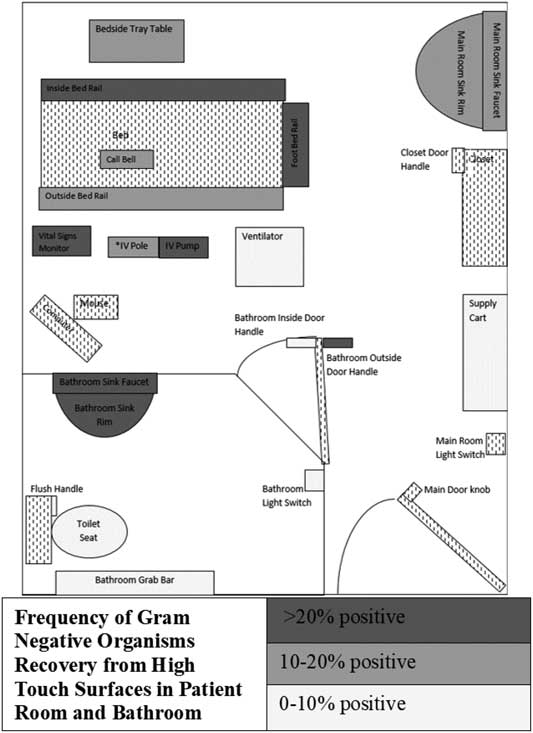
The frequency of gram-negative organism recovery for each method was compared to a gold standard, defined as recovery using either the NFS or the CS method. Each HTS was categorized according to the frequency of gram-negative organism recovery by either method: 0–10%, 10%–20%, or >20%. A descriptive statistical analysis was conducted using SAS version 9.4 software (SAS Institute, Cary, NC).
This study was acknowledged by the Johns Hopkins University institutional review board as nonhuman subjects research.
Results
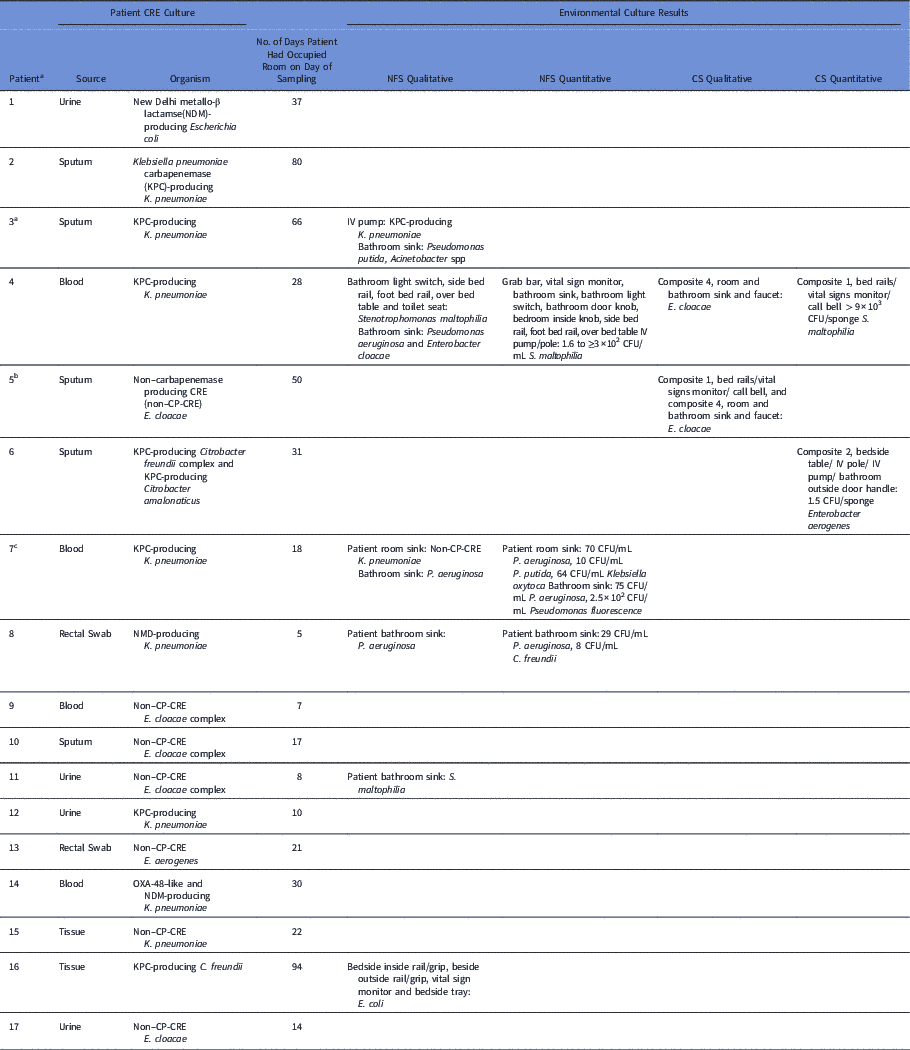
In total, 229 HTSs were sampled in 17 unique patient rooms from May to December 2016. Of 17 patient rooms, 8 (47%) had gram-negative bacteria detected from at least 1 HTS by either method, 2 (12%) had CRE recovered, 2 (12%) had a non-CRE carbapenem-resistant organism recovered, and 7 (41%) had other or additional gram-negative organisms (Table 1). For the 2 rooms where CRE was detected, 1 was detected using the NFS method and 1 was detected using the CS method (Table 1, patients 3 and 5). Due to low overall recovery of CRE and non-CRE carbapenem-resistant organisms, we grouped these with all other gram-negative organism recovery to define the gold standard. The sensitivity for detection of any gram-negative organism in the environment was 100% for the NFS method and 21% for the CS method. Of the 8 positive rooms, 7 (88%) were identified using qualitative culture and 4 (50%) were identified by quantitative culture. The limit of detection for the NFS and CS methods was ~2×10⁷ CFU/mL. Figure 1 shows the frequency of gram-negative organism recovery from HTSs in patient rooms and bathrooms.
Frequency of gram-negative organism recovery from high-touch surfaces in patient rooms and bathrooms.

Patient Carbapenemase-Resistant Enterobacteriaceae (CRE) Culture and Environmental Culture Results for Nylon-Flocked Swab (NFS) and Cellulose Sponge (CS) Methods

a Patient 3: The clinical and environmental KPC-producing K. pneumoniae were identical strains confirmed by pulsed-field gel electrophoresis.
b Patient 5: The clinical carbapenem-resistant E. cloacae and environmental carbapenem-susceptible E. cloacae were identical strains confirmed by pulsed-field gel electrophoresis.
c Patient 7: The clinical and environmental K. pneumoniae were different strains confirmed by pulsed-field gel electrophoresis.
Discussion
We infrequently recovered CRE in the rooms and bathrooms of inpatients known to be infected or colonized with CRE. Although we were unable to ascertain whether the NFS method or the CS method was superior at CRE recovery from environmental surfaces, we did find some practical advantages of the NFS method. With the NFS method, the specific positive HTS is known, rather than the CS composite, where detected organisms could have been recovered from up to 5 HTSs. In addition, the NFS method requires less microbiologist time and expertise and less specialized equipment (ie, a stomacher or large centrifuge) than the CS method, making it less costly. Although, it took less time to process a single NFS (~8 mins) compared to a CS (~35 mins), the additional NFSs per patient room (up to 23) were more time intensive than the CS approach (up to 5 CS per room) due to the higher number of samples collected. Qualitative cultures had a higher sensitivity for gram-negative organism recovery than quantitative cultures. The NFS method is likely readily available in many healthcare facilities where they are used for patient multidrug-resistant organism (MDRO) surveillance programs, making it a feasible option when sampling the environment in a CRE outbreak situation or in research studies assessing cleaning practices. Some studies have favored different sampling methods over the NFS method for CRE recovery. An Israeli group compared recovery of Klebsiella pneumoniae carbapenemase and carbapenemase-producing Enterobacteriaceae in the hospital setting using contact plates and NFSs with either direct plating to Klebsiella pneumoniae carbapenemase selective agar or broth enrichment. They found enhanced recovery with contact plates: contact plate (32%) versus NFS with direct plating (24%) versus NFS with broth enrichment (16%).Reference Lerner, Adler, Abu-Hanna, Meitus, Navon-Venezia and Carmeli 7 However, these researchers did not use neutralizer prior to sampling with NFS. The use of NFS with neutralizer rather than phosphate-buffered saline has been found to be superior at recovery of Staphylococcus aureus, and neutralizer used with the NFS method in this study may have helped with bacteria recovery.Reference Hedin, Rynbäck and Loré 8 Another potential strength of our study design was accounting for the important confounding variable of right-hand dominance during cleaning, whereby we alternated which half of the HTS was sampled by each method.
In this study, the environments of patients known to harbor CRE were frequently contaminated with other gram-negative organisms. We are not aware of any other studies investigating all gram-negative organism recovery; however, gram-negative MDRO recovery can range from 1.8% to 30% of surfaces.Reference Sbarra, Harris and Johnson 9 , Reference Torkar and Ivić 10 Shams et alReference Shams, Rose and Edwards 6 found 34% of HTSs to be contaminated with MDROs after daily cleaning, although these were mostly gram-positive MDROs.
Our study has some limitations. The limit of detection for CRE was ~2×10⁷ CFU/mL. Therefore, it is possible that HTSs with a lower gram-negative organism burden may have given negative results using these sampling methods. Although we sampled a small number of patient rooms, this study supports the use of NFSs when recovering gram-negative organisms in the patient environment. The NFS method is more feasible due to decreased cost, increased availability, and less lab expertise necessary, and it may be advantageous during outbreak investigations because the specific contaminated HTS is identified.
Acknowledgments
Financial support
This work was supported by funding from The Sherrilyn and Ken Fisher Center for Environmental Diseases and the National Institutes of Health (grant no. R21-AI130608) awarded to P.J.S., and from the Centers for Disease Control and Prevention (CDC) Epicenters Program to C.R., V.S., A.M.M., L.L.M., and P.J.S.
Conflicts of interest
All authors report no conflicts of interest relevant to this article.