INTRODUCTION
During a recent investigation of drifting seaweeds of non-native origin along the coast of the island of Helgoland in the German Bight, North Sea, viable Watersipora subtorquata (d'Orbigny, 1852), an encrusting cheilostomatid bryozoan, was detected growing on the base of the brown fucalean macroalga Himanthalia elongata (Linnaeus) S.F. Gray. Floating Himanthalia is frequently occurring as entangled masses drifting at the surface of the English Channel (La Manche), regularly reaching Belgium and The Netherlands (den Hartog, Reference den Hartog1959; De Blauwe, Reference De Blauwe2000, Reference De Blauwe2008, Reference De Blauwe2011; Wolff, Reference Wolff2005). Himanthalia is, however, absent from the eastern part of the English Channel and the east coast of England (Hardy & Guiry, Reference Hardy and Guiry2006; Dizerbo & Herpe, Reference Dizerbo and Herpe2007). Large Himanthalia populations constitute one of the major structuring components of the seaweed communities along sheltered rocky coasts (Lüning, Reference Lüning1985). Emerging from a small button-like structure representing the vegetative part are thong-like receptacles extending up to several metres in length (Moss, Reference Moss1952). An important feature of Himanthalia living in the intertidal or shallow subtidal is the positive buoyancy despite the lack of any pneumatocysts to keep the photosynthetically active receptacles within the water column during high tide. If detached as mature plants, Himanthalia thalli easily float, carrying with them any epiphytic organisms (van den Ende & Linskens, Reference van den Ende and Linskens1962; De Blauwe, Reference De Blauwe2000, Reference De Blauwe2003; Vanhaelen et al., Reference Vanhaelen, Jonckheere and De Blauwe2006). Depending on the surface currents, the rafting community might eventually be transported over very long distances, occasionally as far as Helgoland in the German Bight, North Sea (Kornmann & Sahling, Reference Kornmann and Sahling1977; Thiel et al., Reference Thiel, Hinojosa, Joschko and Gutow2011). This small island is the only place with a significant extent of natural hard substrata providing a stable bottom for diverse macroalgal vegetation within the long reach of coastal sediments between France and northern Denmark (Bartsch & Kuhlenkamp, Reference Bartsch and Kuhlenkamp2000). Himanthalia, however, had only rarely appeared as very few non-fertile individuals (basal buttons only) in a subtidal concrete basin outside a harbour pier (Kornmann & Sahling, Reference Kornmann and Sahling1977; Bartsch & Kuhlenkamp, Reference Bartsch and Kuhlenkamp2000).
There are no records of W. subtorquata growing in the North Sea (Buschbaum et al., Reference Buschbaum, Lackschewitz and Reise2012) and its actual eastern limit of distribution seems to be about midway into the English Channel while colonies attached to floating objects had appeared on beaches in The Netherlands or Belgium (Ryland et al., Reference Ryland, De Blauwe, Lord and Mackie2009; de Ruijter & Faase, Reference de Ruijter and Faasse2010; De Blauwe, Reference De Blauwe2011; Dewarumez et al., Reference Dewarumez, Gévaert, Massé, Foveau, Desroy and Grulois2011). Watersipora subtorquata is regarded as a highly invasive species of a genus whose native range is uncertain despite several genetic studies (Mackie et al., Reference Mackie, Keough and Christidis2006, Reference Mackie, Darling and Geller2012; Láruson et al., Reference Láruson, Craig, Messer and Mackie2012). First found in European Atlantic waters in the Bassin d'Arcachon (France), W. subtorquata is supposed to have arrived around 1970 with shells of the intentionally introduced oyster Crassostrea gigas (Thunberg, 1793) (d'Hondt, Reference d'Hondt1984; Ryland et al., Reference Ryland, De Blauwe, Lord and Mackie2009). Due to their fouling ability on ships and other floating objects, species of the cosmopolitan genus Watersipora are widespread mainly in the tropical and subtropical regions around the world (Cohen, Reference Cohen2011; Global Invasive Species Database, 2012). Of the three European species, W. subtorquata was only recently described from a few places in France, Great Britain and Ireland (De Blauwe, Reference De Blauwe2005; Ryland et al., Reference Ryland, De Blauwe, Lord and Mackie2009; Kelso & Jackson, Reference Kelso and Jackson2012), whereas W. subovidea (d'Orbigny, 1852) is more common in the Mediterranean (Ryland et al., Reference Ryland, De Blauwe, Lord and Mackie2009) and the northern limit of W. complanata (Norman, 1864) seems to be around the Scilly Islands, England (Hayward & Ryland, Reference Hayward and Ryland1998), although it was also found on Himanthalia drift in Belgium (De Blauwe, Reference De Blauwe2003, Reference De Blauwe2009).
Watersipora species are inherently difficult to identify morphologically on a species level due to the lack of easily discernible features like avicularia, ovicells, spines or other structurally distinct characters (Ryland et al., Reference Ryland, De Blauwe, Lord and Mackie2009). As pointed out explicitly by those authors, careful microscopic investigations are indispensable in order to identify species in this genus due to the very fine diagnostic features to be resolved, in particular of the orifice and operculum. Instead of the scanning electron microscope (SEM) technique usually applied in the identification of Bryozoa, we carefully prepared specimens for light microscopical observations and used commercial immersion-oil as a mounting medium when observing the calcified skeleton in order to reduce light refraction at the specimen's surface and to enhance the image quality. A similar method was described by Ryland et al. (Reference Ryland, De Blauwe, Lord and Mackie2009) who had embedded specimens in Canada balsam for the same reason. Using our simple but carefully employed method, we successfully visualized all important characteristic features like the fine structure of the condyles and were able to positively identify W. subtorquata based on the excellent diagnostic description by Ryland et al. (Reference Ryland, De Blauwe, Lord and Mackie2009).
Here we report for the first time on the arrival of the non-native bryozoan W. subtorquata in German coastal waters, providing thereby the evidence for a long distance transport with the help of a natural dispersal vector. Further investigations will have to verify if W. subtorquata was successful in permanently extending its range into the North Sea and became established at Helgoland or other coastal locations.
MATERIALS AND METHODS
Between 30 July and 4 August 2012, Himanthalia elongata thalli were sampled around the island of Helgoland situated about 55 km off the German coast in the North Sea (54° 11.02416′N 7°53.13054′E). The algae had arrived in the German Bight as floating masses during periods of strong westerly wind and material was collected from an inflatable or directly on beaches where the algae had been washed ashore.
Generally, only the button-like basis of Himanthalia was covered by epibionts and only this part was detached from the remaining thallus for further inspection. In total, 120 basal structures were collected and the material was immediately transported to the laboratory in fresh seawater. If required, sampled material was kept in small aquaria with running ambient seawater for up to three days. The occurrence of the bryozoan Watersipora subtorquata was recorded as simple absence or presence of any colony for each Himanthalia thallus (button). Microscopical observations were performed on live material, on colonies preserved in 70% ethanol or on parts of a colony prepared with dilute hypochlorite acid (bleach) destroying the organic material and revealing the calcified skeleton. Very fine details were observed under the transmitted light microscope in bleached and air-dried portions of a colony embedded in commercially available immersion-oil used for high-aperture objectives.
Microscopic observations and photographic imaging used an Olympus SZX12 (1–12 × zoom) stereomicroscope with a 1.2 × Planapo objective and 10 × eyepiece or 2.5 × photo-eyepiece. Higher magnifications were achieved with an Olympus BH2 microscope with 2.6–20 × objectives and a 10 × eyepiece. Digital images were obtained with an attached Sony NEX-5 camera system on both microscopes. In cases with difficulties of depth of field at higher magnifications, the PICOLAY stacking software (free software by H. Cypionka, www.picolay.de) was applied in order to superimpose images of different observation layers. In some images, contrast and resolution was moderately enhanced using Adobe® Photoshop® CS2 imaging software for improved visualization of the important details of the operculum without modifying the structures of the object. Voucher copies of the sampled species were deposited in the authors' collection either preserved in 70% ethanol or as dried specimens. Extended morphometric measurements, usually included in the description and identification of bryozoan species, were only applied to a limited extent, since Ryland et al. (Reference Ryland, De Blauwe, Lord and Mackie2009) found them insufficient in discriminating related Watersipora species. Following their method, length and width were measured in twenty randomly chosen adult zooids of three different colonies while measurements of the width and height of the orifice were done in ten bleached zooids.
RESULTS
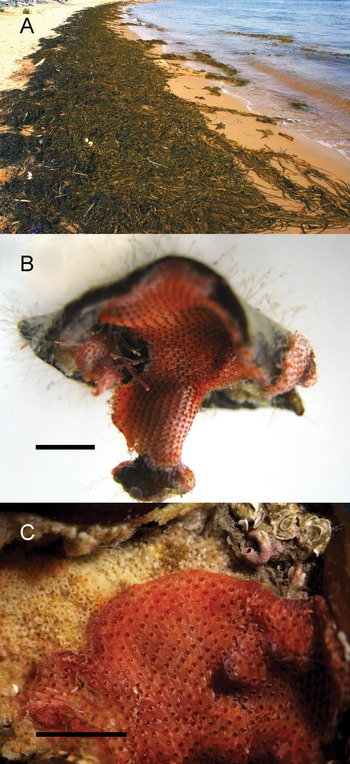
Numerous thalli of Himanthalia elongata were found to be in a healthy, even fertile condition floating around Helgoland and drifting along with the surface currents according to wind direction and tides. Since Helgoland does not harbour any native populations, drifting mats of Himanthalia were definitely of foreign origin and more than likely travelled at least 700–800 km considering their nearest source populations in France or England (Hardy & Guiry, Reference Hardy and Guiry2006; Dizerbo & Herpe, Reference Dizerbo and Herpe2007). Depending on suitable beaches and wind direction, large amounts of Himanthalia were also found ashore and were easily accessible for collection (Figure 1A). Many of the Himanthalia plants still possessed their basal button-like structure and when floating, the button was submerged 5–10 cm below the water surface, especially in cases with additional weight by attached organisms like barnacles or mussels. Many Himanthalia buttons were colonized by a diverse assemblage of organisms, some obviously not of local origin, like Watersipora subtorquata, which occurred on 10 buttons corresponding to 8.3% of the 120 Himanthalia samples investigated. Colonies of W. subtorquata were growing exclusively on the stem or underneath the shield-like top of the button (Figure 1B) as reported for most epibionts of Himanthalia (van den Ende & Van Oorschot, Reference van den Ende and Van Oorschot1963; Kitching, Reference Kitching1987).
(A) Drift macroalgae Himanthalia elongata, Ascophyllum nodosum and Sargassum muticum piled up on a sandy beach on Helgoland; (B) prominent red-orange colony of Watersipora subtorquata on the holdfast or button (vegetative base) of a Himanthalia plant; (C) detail of same colony showing its growth pattern and overgrowth of the neighbouring bryozoan Celleporina caliciformis. Scale bars: B, C, 5 mm.

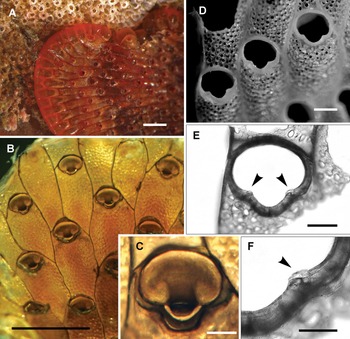
Colonies of W. subtorquata showed the unilaminar encrusting, sometimes folding growth pattern and a dark red to orange coloration (Figure 1C) similar to specimens found in southern England (Ryland et al., Reference Ryland, De Blauwe, Lord and Mackie2009), Ireland (Kelso & Jackson, Reference Kelso and Jackson2012) and on floating Himanthalia in Belgium and The Netherlands (De Blauwe, Reference De Blauwe2011). Colonies had attained a size of up to three cm in length, limited obviously by the maximal size of the Himanthalia buttons which usually do not reach more than four cm in diameter. Material derived from floating thalli of Himanthalia was mostly viable as indicated by the extrusion of tentacles during microscopical observation and by the intact hyaline cells at the edge of the colonies representing growing young zooids (Figure 2A). Other organisms like the bryozoan Celleporina caliciformis (Lamouroux, 1816) were often overgrown by W. subtorquata (Figure 2A), a common fouling behaviour reported frequently by other authors. Typical for W. subtorquata was the dark, even blackish pigmentation of the borderlines between zooids (Figure 2B) and of the operculum covering the oval to roundish orifice (Figure 2C).
Watersipora subtorquata as found on drifting Himanthalia buttons: (A) live colony with typical formation of hyaline young zooids at the circumference of the colony (overgrowing Celleporina caliciformis); (B) zooids with characteristic concave dark band of the operculum (material preserved in 70% ethanol); (C) detail with concave and dark central band visible between two round lateral structures of the operculum (material preserved in 70% ethanol); (D) calcified skeleton with round orifice and circular sinus typical of W. subtorquata; (E) orifice with condyles (arrowheads); (F) close-up of the orifice showing shoulder like right condyle (arrowhead). Scale bars: A, B, 1 mm; C, 100 µm; D, 200 µm; E, 100 µm; F, 50 µm.

All features and measurements of our samples were identical to those described for the red-orange morphotype of W. subtorquata found in southern England and the English Channel Islands. Individual zooids had a mean length of 908 µm ± 80 µm (standard deviation) with a maximum of 1.1 mm and a mean width of 411 µm ± 57 µm. The orifice measured in bleached specimens yielded a mean width of 287 µm ± 7 µm and a mean height of 241 ± 8 µm, corresponding to an oval shape of the orifice typical in W. subtorquata (Figure 2D) in contrast to the more roundish shape seen in the closely related species W. subovidea (Ryland et al., Reference Ryland, De Blauwe, Lord and Mackie2009). The shape of the sinus was parabolic rather than an exact half-circle (Figure 2D) and the condyles were shoulder-like without tooth-like protrusions (Figure 2E, F). In live specimens the operculum showed a dark concave band centrally situated between the two lateral sclerite depositions and a thick proximal rim of the sinus (Figure 2C). Even the comparatively narrow width of the central dark band, a diagnostic feature of the red-orange type of W. subtorquata, was clearly discernible in our samples. The central band was only as wide as the sinus and about one-third of the width of the operculum (Figure 2C). This feature can be distinguished, therefore, from the broad central band about half as wide as the operculum present in the black colonies of W. subtorquata from France.
DISCUSSION
Detailed examination of the non-native drift algae which had reached Helgoland in summer 2012 and subsequent microscopical observations identified a relatively high abundance of the epibiont Watersipora subtorquata on the basal buttons of Himanthalia. Careful preparation of the material revealed subtle details like the pattern of the operculum or the fine structures of the condyles, unambiguously identifying this species despite the use of light microscopy as the only means of observation. The simple immersion of specimens in commercial immersion oil was, however, a prerequisite in achieving the high resolution necessary for observation and photographic imagery of the condyles similar in effect to mounting specimens in Canada balsam (Ryland et al., Reference Ryland, De Blauwe, Lord and Mackie2009). Our method was easily applied and reduced the technical effort to that of light microscopy. This might be of additional importance since the increased spread of non-native species requires appropriate monitoring methods including fast identifications at a high accuracy. Comparable to the world-wide situation, the German Bight is an area with increasing numbers of alien species, mainly due to intentional mussel introductions and very high shipping traffic (Gollasch & Nehring, Reference Gollasch and Nehring2006). Consequently government supported programmes were implemented, like the German Rapid Assessment Programme, to better and faster identify non-indigenous marine organisms in the North Sea (Buschbaum et al., Reference Buschbaum, Karez, Lackschewitz and Reise2010, Reference Buschbaum, Lackschewitz and Reise2012). Within this scope we see our methodology as a contribution to a fast and reliable detection of invasive bryozoan species.
Transported by the Himanthalia buttons were many more non-native marine species (personal observations) which will be dealt with in future studies. They all reached the German Bight on floating Himanthalia due to the pattern of residual or surface currents driving floating objects from the English Channel into the eastern North Sea (Becker et al., Reference Becker, Dick and Dippner1992; Pohlmann, Reference Pohlmann2006). Not all epibionts need to be of the same local origin as Himanthalia, since a secondary colonization by pelagic stages throughout the long journey of the floating thalli is very reasonable. In the case of W. subtorquata, however, it most likely had colonized Himanthalia already at the original habitat in France or England. As a natural rafting vector, Himanthalia provided a slow transportation for colonies of W. subtorquata and other marine epibionts, sustaining their small populations over 700–800 km of open water. Several factors might have contributed to a successful long-distance dispersal, like the shade provided by Himanthalia preventing exposure of settled organisms to direct sunlight. Watersipora subtorquata was described to obviously require low light conditions since it grew mostly in shaded conditions like on the underside of rock overhangs in Brittany (Ryland et al., Reference Ryland, De Blauwe, Lord and Mackie2009) or on the shaded side of pontoons in Ireland (Kelso & Jackson, Reference Kelso and Jackson2012). Correspondingly, all epibionts were attached on the stem or the underside of the shield-like top of the Himanthalia buttons, thereby minimizing the impact of direct sunlight. For this advantage to come to effect, the basal parts need to occupy the natural vertical position and indeed, the buttons in the drifting Himanthalia at Helgoland were always observed to be submerged (up to ten centimetres in the water column) instead of floating horizontally at the surface like the rest of the buoyant thallus. Furthermore, the submerged position of the holdfasts alleviated especially the likely impact by ultraviolet-radiation which is one fraction of the solar radiation attenuating most rapidly when entering the water column. Next to avoiding high surface radiation, W. subtorquata most certainly had an ecophysiological advantage in rafting via slow drifting Himanthalia, since they only gradually experienced changing environmental conditions like salinity or temperature gradients when being moved viz. from Brittany to Helgoland.
De Blauwe (Reference De Blauwe2011) already suggested that floating Himanthalia could support future colonization of areas further east than the actual distribution of W. subtorquata, although he and most other authors regarded ship fouling or shellfish imports as more important in providing the range extension of invasive species into the North Sea (Gollasch, Reference Gollasch2002; Minchin, Reference Minchin, Davenport and Davenport2006). For Helgoland, however, we consider slow transport of W. subtorquata via a natural vector to be more reliable since arriving as viable colonies is a prerequisite for a successful range expansion. Carried by Himanthalia into the intertidal of suitable natural habitats directly and at multiple sites simultaneously might be also advantageous for subsequent colonization of new areas compared to cases of human-mediated introductions on hulls, either of pleasure craft or commercial ships, which arrive only in harbours with little natural habitat or very low salinity as in Germany. Besides, many buttons of Himanthalia already support a diverse community of different benthic organisms at the original location (van den Ende & Oorschot, Reference van den Ende and Van Oorschot1963; Kitching, Reference Kitching1987) and after detachment carry exactly this community further to other places. During the journey, there might be changes in species composition and new ones could secondarily colonize the buttons or some are lost, but it is most likely that the original species have a high chance to persist in their initial system. The species of the Himanthalia community bypass all the steps species need to undergo when rafting on other substrata like plastics or ship hulls, since they do not require to find a transportation vehicle, attach to it after searching the right substratum and then grow to mature individuals or colonies in order to reproduce and finally colonize new terrain at the end of the journey. Ready for transportation at any point, the Himanthalia communities just need appropriate circumstances for the dispersal trip. Transport in the context of a naturally developed community might therefore be of increased significance when extending distribution ranges, not only for an invasive species like W. subtorquata, but for all organisms carried by Himanthalia. Although large quantities of floating Himanthalia are rarely arriving directly on Helgoland (the last known incidence was in 1999: R. Kuhlenkamp, personal communication), they periodically reach the surrounding waters together with other brown algae and floating objects of local and foreign origin (Thiel et al., Reference Thiel, Hinojosa, Joschko and Gutow2011).
Since a continuous inflow of non-native species through natural vectors (Wolff, Reference Wolff2005) and through anthropogenic transportation (Gollasch, Reference Gollasch2002) is expected to persist for the German Bight, we anticipate future arrivals of viable W. subtorquata. Once W. subtorquata has expanded its former range, the high propensity to settle on very different man-made structures like hulls, pontoons, harbour walls, pilings or coastal protection structures as an early successional species (Glasby et al., Reference Glasby, Connell, Holloway and Hewitt2007) and its tolerance to certain antifouling paints (Ng & Keough, Reference Ng and Keough2003) characterize it as a highly invasive species (Floerl et al., Reference Floerl, Pool and Inglis2004). Besides the natural hard substrata at Helgoland, the German North Sea coast provides the mussel or oyster beds of the Wadden Sea and numerous artificial structures (harbours and protection walls) as attractive habitats for the colonization of W. subtorquata despite the long stretches of otherwise unsuitable soft sediment bottoms. At a location in Brittany (France), the black variety of W. subtorquata exhibited its highly invasive character when it became the most common bryozoan covering up to 80% of the substrata within just five years (De Blauwe, Reference De Blauwe2005) indicating its rapid expansion capability once it has settled in a favourable environment. The onset of the spreading of W. subtorquata into cold-temperate regions of the North Atlantic documented by Ryland et al. (Reference Ryland, De Blauwe, Lord and Mackie2009) was continued in that viable colonies rafting on Himanthalia had moved a large step further into the eastern North Sea. In future, we will investigate if W. subtorquata had finally been capable of colonizing suitable substrata at Helgoland and if it will survive future seasons despite adverse winter conditions.
ACKNOWLEDGEMENTS
We gratefully appreciate the scientific research service provided by the Alfred Wegener Institute for Polar and Marine Research in the Helmholtz Association at their Biological Institute Helgoland and the invaluable support by their staff. The comments by the referees were beneficial to this manuscript, in particular those by Hans De Blauwe, who also was very helpful with providing important references and information.