INTRODUCTION
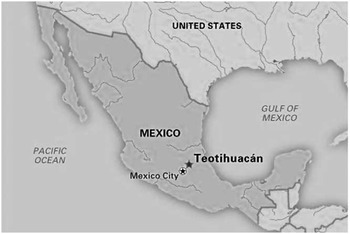
Located 50 km northeast of Mexico City, Teotihuacan (Figure 1) belongs to the Classical Mesoamerican period (1st to 6th century AD). The city was a macroregional exchange center and the capital of the state. It housed different ethnic groups and trades because of its strategic location and natural resources; no other place of its time reached its density, area, and degree of planning, and as a result, it was one of the most important urban centers in Mesoamerica (Millon et al. Reference Millon, Drewitt and Cowgill1973; Manzanilla Reference Manzanilla2001). Although Teotihuacan is one of the most studied archaeological sites, the discovery of the tunnel under the Temple of the Feathered Serpent provides an unprecedented opportunity to know more about the earliest occupation stages and rituals that would change the world view of the people from Teotihuacan.
Teotihuacan location (source: http://lahistoriamexicana.com/antiguo-mexico/cultura-teotihuacana).

Pyramids in Mesoamerica are a representation of sacred mountains, a repository of caves, and providers of water and food. Teotihuacan was not the exception, but unlike the tunnel under the Pyramid of the Sun built from a natural cave, the tunnel under the Temple of the Feathered Serpent is completely artificial and excavated in an almost straight line 103 m toward the center of the pyramid. It remained hidden and intact until its discovery in 2003.
Since the discovery of radiocarbon dating by Willard F Libby and collaborators in 1946 and their first studies in several archaeological sites in Mexico (Arnold and Libby Reference Arnold and Libby1951; Libby Reference Libby1955), the archaeological community in Mexico has included 14C dating in their studies. Currently, the application of 14C analyses has been reinforced with the installation of an accelerator mass spectrometry (AMS) facility, the National Laboratory of AMS (LEMA) at the Institute of Physics at UNAM in Mexico City. The system is based on a 1MV Tandetron accelerator manufactured by High Voltage Engineering Europe (HVEE) (Solís et al. Reference Solís, Chávez-Lomelí, Ortiz, Huerta, Andrade and Barrios2014). One of the main goals of this laboratory is to provide full capability in 14C dating with AMS to the archaeology community. In this paper, we report the results from the characterization and dating of some of the materials recovered from the tunnel discovered in Teotihuacan.
THE TUNNEL
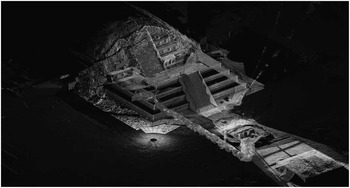
Occupation of Teotihuacan began between AD 1 and 150, with a series of streets parallel and perpendicular to a main axis (Gazzola Reference Gazzola2009; Gómez Chávez and Gazzola Reference Gómez Chávez and Gazzola2015). The Temple of the Feathered Serpent was built about AD 220, facing the large square of the Ciudadela (Citadel), a big plaza located in the center of Teotihuacan and one of its oldest parts. It was built over a long timespan, and it is believed that the Citadel was the site where the funeral rites of rulers took place, and even probably incinerations. In addition to the rituals through which the new rulers acquired their divine endowment and the gifts that allowed them to govern, the Citadel had a political use in which the rulers and power structures were legitimized (Gazzola Reference Gazzola2009). Much has been speculated about the meaning of the ornamentation in the Temple of the Feathered Serpent (Figure 2). More recently, feathered serpents have been associated with the mythical beginning of time and space, while the temple itself would be a representation of the sacred mountain emerging from the primeval waters. According to this interpretation, the tunnel under the temple was probably conceived as a representation of the underworld and used to deposit offerings and maybe as funeral chambers of governors and other high status individuals. More than a thousand years ago, the people of Teotihuacan sealed this tunnel with soil, objects, and debris to destroy and conceal the access.
View of the tunnel under the Temple of the Feathered Serpent using a laser scanner (image courtesy INAH).

During the work related to the conservation of the Temple of the Feathered Serpent in 2003 (Gómez Chávez and Gazzola Reference Gómez Chávez and Gazzola2003), a shaft of 0.83 m in diameter was found, through which an excavation was discovered carved into the natural tepetate (limestone) soil between 12 and 15 m below today’s surface. In 2005, ground-penetrating radar (GPR) measurements established the length of the tunnel between 100 and 120 m with the same axis of the temple. The explorations in the tunnel recovered a large number of objects left by the people of Teotihuacan, perhaps at the time of the closing ritual, which, according to dating of the ceramics found, happened between AD 170 and 200. The first explorations of the tunnel suggest it was never looted or altered. The examination revealed that the people of Teotihuacan placed transverse walls 3 m thick blocking access to the most secret, sacred, and deepest part of the underground tunnel.
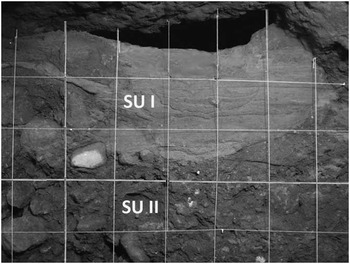
Although the filling material of the tunnel was very heterogeneous, from the stratigraphic analysis a sequence of events was proposed: construction, use, two closures with the construction of walls, placement of offerings, filling, definitive closure, and a recent incursion. Also, since Teotihuacan ceramics have been extensively studied and their chronological sequence is well established, the ceramic remains found allowed the classification of the filling material of the tunnel in 14 layers: with XIV being the oldest, to layer I, being the newest (Figure 3).
Photograph of a profile from the tunnel showing the stratigraphic location of layers I (SUI) and II (SUII). Layers XIV to III are at the interior of the tunnel and are not shown in this profile.

Together with the ceramic remains, a great variety of offerings containing inorganic and organic materials were found as well as fireplaces along the tunnel. In this work, some of the organic materials were selected, dated by AMS 14C, and used in combination with the ceramic, in order to establish the absolute temporal chronology of the events registered during the excavation of the tunnel: when it was built, how long it was used, when the various offerings were placed, and when different closures occurred.
MATERIALS AND METHODS
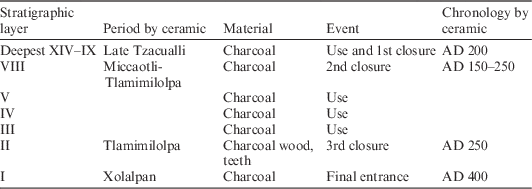
A careful selection of materials was required for 14C dating with their precise identification and characterization to choose the best samples for each layer. These chosen samples were submitted to a protocol that included cleaning, optical examination, Fourier transform infrared (FTIR), and X-ray fluorescence (XRF) spectroscopic characterization to obtain information about the raw materials before the pretreatment for 14C dating. Once all these steps were completed, the 14C dating was carried out if it was applicable. A summary of samples, type, and the provenance layer is shown in Table 1.
Material recovered and dated from each one of the layers.

Fourteen layers were classified and based on the absolute dating of samples of charcoal, wood, animal teeth, and seeds found among the deposited offerings, a sequence of events was proposed for each one. The samples belonging to the same layer or associated with a particular material (soil, debris, etc.) were analyzed using optical microscopy, FTIR, and XRF in order to obtain more reliable results. Among the variety of materials found in the tunnel, balls with diameters ranging between 50 and 70 cm were recovered; these were white-yellowish and had a slight elastic trait. Dark brown pieces of different shapes and sizes were also found, some heavily impregnated with soil and also exhibiting an elastic behavior. All samples were 14C dated by AMS, and some charcoal samples previously dated at the Federal Institute of Technology in Zurich (ETH) were analyzed again at LEMA for intercomparison purposes.
In order to perform 14C analyses, all the recovered materials (except for teeth) were cleaned using the acid-base-acid (ABA) method: 0.5M HCl, followed by 0.1M NaOH to remove carbonates adsorbed to the surface and humic acids, and then treated with a 0.2M HCl (to remove modern atmospheric CO2 absorbed). Samples were washed with deionized (Milli-Q™) water after each acid or base treatment and dried (Hajdas Reference Hajdas2008). In the case of teeth, collagen was extracted from dentine following a protocol that included an ultrafiltration step (Hajdas et al. Reference Hajdas, Bonani, Furrer, Mäder and Schoch2007).
Mid-infrared spectra were collected on a Vector 33 Bruker spectrometer equipped with a reflection diamond horizontal ATR, at 4 cm–1 resolution in the 4000 to 650 cm–1 spectral region. Many pieces of wooden objects were found between the samples; one of these was selected for 14C analysis, but during the cleaning process a bright red sediment was found, which was separated and analyzed by XRF.
For AMS 14C analyses, the carbon was converted to graphite via reduction with H2 using iron as a catalyst in the Ionplus Automated Graphitization Equipment, AGEIII (Wacker et al. Reference Wacker, Němec and Bourquin2010). Routine preparation of 1 mg carbon of some IAEA reference materials including NIST 4990C oxalic acid (OXAII) were performed for standard normalization and correction for isotope fractionation. Dead carbon blanks (Pocahontas blank from Argonne and phthalic acid blank) were prepared in the same way for blank subtraction. Measuring standard reference materials supplied by the International Atomic Energy Agency (IAEA) helped to assess the accuracy of the 14C analyses. The performance of the 14C preparation laboratories was tested through the analysis of samples from the Fifth International Radiocarbon Intercomparison (VIRI) supplied by Marion Scott from the University of Glasgow.
Corresponding 14C dates were calculated using computer codes developed at LEMA (Solís et al. Reference Solís, Chávez-Lomelí, Ortiz, Huerta, Andrade and Barrios2014). Calendar ages were obtained with OxCal (Bronk Ramsey Reference Bronk Ramsey2009; Bronk Ramsey and Lee Reference Bronk Ramsey and Lee2013). The purpose of this computer program is to convert 14C ages to calendar ages. The program, developed at Oxford University, uses the calibration curves generated by the IntCal group (IntCal13 and Marine13 calibration curves; Reimer et al. Reference Reimer, Bard, Bayliss, Beck, Blackwell, Bronk Ramsey, Buck, Cheng, Edwards, Friedrich, Grootes, Guilderson, Haflidason, Hajdas, Hatté, Heaton, Hoffmann, Hogg, Hughen, Kaiser, Kromer, Manning, Niu, Reimer, Richards, Scott, Southon, Staff, Turney and van der Plicht2013), which are essential for calculating the calendar ages and to compare with those predicted for any site.
RESULTS AND DISCUSSION
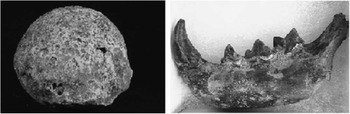
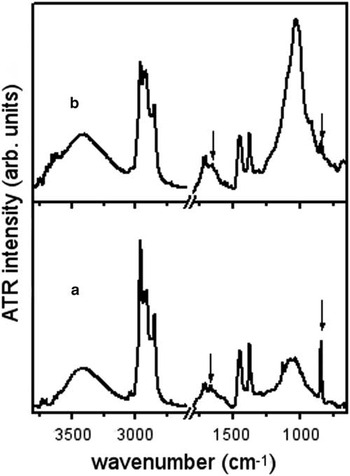
Some representative materials from the Tunnel under the Temple of the Feathered Serpent in Teotihuacan are shown in Figure 4. Small fragments of one of the yellowish balls were taken for infrared analyses. Infrared data identified them as natural rubber, from the spectrum shown in Figure 4a, while the slightly elastic dark pieces were found to have also the molecular signature of rubber, so these were identified as processed rubber (Figure 4b). Natural rubber consists of long chains of recurring isoprene units, observed in both specimens. In Figure 5, the band at 1667 cm–1 corresponds to the C=C stretching mode of the isoprene unit and is characteristic of the natural rubber infrared spectrum; the band at 842 cm–1 is also characteristic of the isoprene unit and is assigned to an out-of-plane bend of =CH. Besides the infrared bands corresponding to rubber, there are also bands indicating oxidative processes. For the processed rubber samples, the very strong band at 1003 cm–1 corresponds to the S=O stretching mode of sulfoxide type structures (Figure 5). The relative intensities of the bands changed from sample to sample, as well as the samples themselves since some were more brittle while others more elastic, but the sulfoxide band was always present. This band can come from contamination of the soil where these materials had been buried, due to sulfur-containing minerals, which are abundant there. It is known that antique Mesoamerican cultures processed rubber to produce dense but elastic materials, through a type of vulcanization process. Hosler et al. (Reference Hosler, Burkett and Tarkanian1999) reported that the sulfur needed for this process came from the plant Ipomea alba, after crushing its vine and mixing its juice with the latex obtained from a rubber tree, possibly Castilla elastica. Since rubber trees are not found in Teotihuacan or its immediate surroundings, the findings of natural rubber and rubbery materials are indicative of commercial trade between different antique populations.
Some materials recovered in the tunnel: yellowish sphere identified as rubber (left) and animal jaw (right)

Infrared spectra from 3700 to 650 cm–1: (a) antique natural rubber; (b) processed rubber. Both spectra show characteristic rubber bands at 1667 and 842 cm–1 as explained in the text.

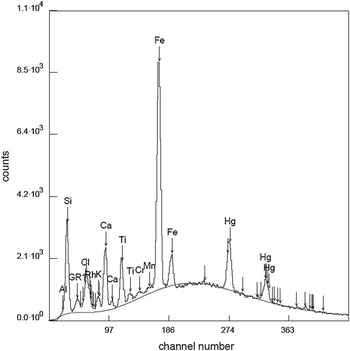
Concerning the wood specimen, a small fragment was subjected to a cleaning process in which a red pigment was found in the associated sediment. XRF was used to determine the elemental composition of the red sediment associated with the wood. Figure 6 shows the XRF spectrum with the typical soil elements Al, Si, K, Ca, T, Mn, S, and Fe. The characteristic Hg lines unambiguously led to the identification of cinnabar. It is not surprising that the red pigment associated with the wood is made of cinnabar. This material was highly valued in ancient cultures in Mesoamerica especially in ceremonial objects (Gazzola Reference Gazzola2009). At the end of the tunnel, very recent excavations revealed the presence of liquid mercury. Previously found in Mayan cities in small amounts, this is the first time that this substance is found in Teotihuacan.
XRF spectrum of a red pigment associated to a wooden object. The peak of Hg indicates the presence of cinnabar.

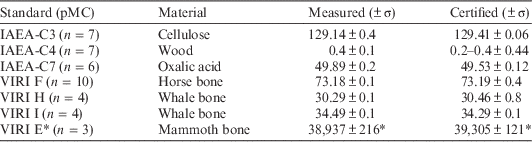
The AMS system performance for dating measurements was tested by analyzing some selected IAEA and VIRI reference materials prepared at LEMA. Results are shown in Table 2. In general, the 14C concentrations show good reproducibility and the obtained results agreed well with certified values of different reference materials. Analysis of Teotihuacan’s ceramics allowed us to locate different processes in time. The absolute dating of charcoal samples, which were deposited after fireplaces and offerings took place, could associate these events with the chronology proposed based on the chronology of production of the ceramic found in the different layers that filled the tunnel.
Radiocarbon concentration (expressed as pMC, % of modern carbon), of selected IAEA and VIRI reference materials analyzed at LEMA, with average uncertainty.

* in yr BP.
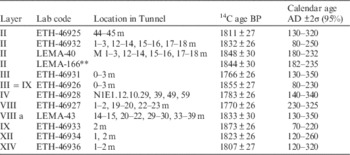
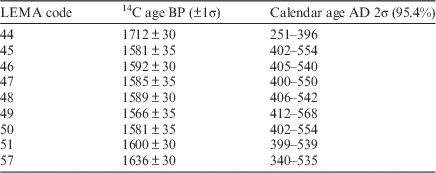
Table 3 shows the results obtained for charcoal and other materials recovered from various layers filling the tunnel, while Table 4 presents the AMS 14C dates for the samples recovered from the chamber at the end of the tunnel. The samples show very similar ages, indicating that these materials were left in approximately the same event of entrance to the tunnel, between AD 430 and 440.
AMS 14C results at LEMA and ETH for samples collected at different phases. The last column shows the calendar ages obtained with the OxCal v 4.2.3 program.

AMS 14C results at LEMA and calendar ages obtained with the OxCal v 4.2.3 program for samples collected at the Chamber (layer I) at the end of the Tunnel.

The dating of the materials has not allowed the determination with absolute certainty when the tunnel was built. At the beginning of the exploration of the tunnel, marks of the tools used to dig it were observed. These marks were found on the walls and their shape indicated that the tools employed in the construction were made of wood and stone hammers. We had hoped that in some of the hundreds of holes we would find fragments of some of the tools that had accidentally been broken, which would then have allowed us to determine with great accuracy the construction date of the tunnel.
A small fragment of charcoal located inside one of the holes showed a more recent date; therefore, it was probably part of a torch employed to illuminate the tunnel. No other wood fragment was found in any of the holes, so that the only way to get an approximate construction date is to use information from later events. In very general terms, we can summarize the most significant events registered during the excavation process. After the construction was finished, the tunnel remained open and was used during a 50- to 100-yr period.
Several walls blocking access in one part of the tunnel were built at a later time (first closure). Later, these walls were partially demolished by the same Teotihuacan people in order to enter and deposit or remove some things from the tunnel. After this intrusion, new walls were built from the inside out; this time they were thicker than the former ones, reaching up to 3 m thick. As the tunnel was being closed again, some offerings were placed in some of the intermediate spaces. The vertical large access apparently was left open, leaving perhaps only a short space between the access and the first enclosing wall.
After some time, the top half of the wide walls was again partially demolished, covering with rubbish the offerings that had been placed before between walls at the time of their construction. Possibly, the reason was to deposit the extraordinary offerings discovered in the chamber at the end of the tunnel. After that, the tunnel was completely filled with dirt and stone. The main access shaft was closed for the third time, its walls were destroyed, and the access shaft was filled.
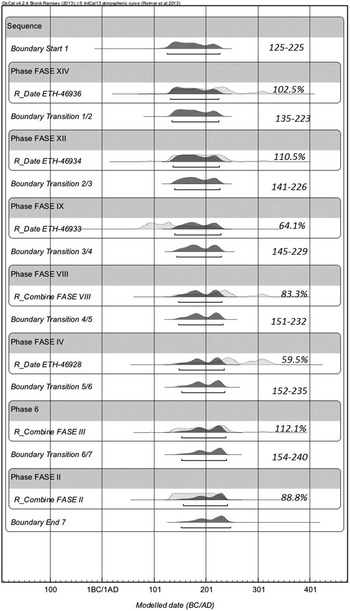
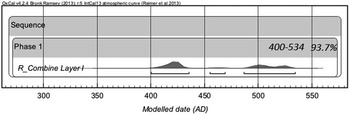
It appears that the last activity that occurred in pre-Columbian times was the opening of a small vertical entrance 0.83 m wide, which was used to access the tunnel all the way to the deepest chamber. Along this path, a series of fireplaces was left in the last stretch of the tunnel, identified in this work as layer I (Figure 3 and Table 4). During this intrusion, none of the previous deposited offerings were disturbed. They were already covered by the rubbish and sediment formed during the destruction of the adobe walls. These walls lined the north and south antechambers located at meter 63, as well as the three chambers at the end of the tunnel, between meters 90 and 103. The 14C dates of charcoal and other organic samples from different layers, as well as the calendar ages obtained with the OxCal program are shown in Tables 3 and 4 for the Tunnel and the deepest chamber, respectively. Bayesian analysis using the OxCal program was applied to 14C dates in order to establish low and high age limits for each layer. The modeled dates are shown in Figures 7 and 8 for the tunnel and chamber, respectively. An index that indicates the agreement (in %) between measured and simulated ages is included in the figures.
Radiocarbon ages of samples collected along the tunnel, shown in Table 3, calibrated with OxCal v 4.2.4. The age ranges at the right were obtained with a Bayesian model combining the dates of the same layer. The agreement index is included.

Radiocarbon ages of selected samples collected at the layer I (chamber at the end of the tunnel), calibrated with OxCal v 4.2.4. The age ranges at the right were obtained with a Bayesian model combining the dates of the layer I. The agreement index is included.

The layers closest to the original tunnel floor may be associated to the construction date. Samples found in layer XIV, very close to the original floor, yield 14C dates of AD 120–320, with 95% certainty. Layer XII corresponds to AD 120–260, while layer IX corresponds to AD 70–220. An interesting sample is ETH-46926 from layer III (whose modeled age is AD 80–230), which stratigraphically correlates with layer IX, at AD 70–220. The results allow us to infer that the tunnel may have been built between AD 1 and 100, during the Tzacualli phase.
The absolute dating results present a clear correspondence with those obtained from the analysis of ceramic objects and correlate well with the dating results obtained for the buildings predating the Citadel. The tunnel appears to have been contemporary with a monumental building, the first temple-pyramid, which must have existed precisely above the tunnel, as suggested by Sugiyama (Reference Sugiyama1998) and Gazzola (Reference Gazzola2009). This first temple was likely part of the most important sanctuary that existed in the same place, prior to the construction of the Citadel complex and of the Temple of the Feathered Serpent, as we know them today. Indeed, the frieze fragments found inside the tunnel show the body of a serpent gliding on water and could have belonged to this first temple. The latter could have been demolished during a large-scale construction project that modified the urban design.
Sample data from layers VIII and VIIIA yielded ages of AD 230–325. During the second closure, which occurred from AD 144 to 230, several offerings were deposited in the empty spaces between the walls. If one compares the results from layer VIII with those from layers IX, XII, and XIV, it appears that several events (use, closure, opening, new closure) occurred during a relatively short period of less than 50 yr. It is interesting to note that Sugiyama (Reference Sugiyama1998) has suggested that the Temple of the Feathered Serpent was being built by AD 210, which is the time of the second closure of the tunnel.
The third closure was dated from samples taken from the hundreds of tons of rubbish used to seal the tunnel completely. In addition to dirt and stones, fragments of engraved stones, friezes, and bird (guacamaya) sculptures were found. One of the samples from layer III, which corresponds precisely to the rubbish from the vertical access, yields an age of AD 130–350. This large uncertainty, when the 14C age is converted to calendar ages, results from wiggles on the calibration curve.
The Temple of the Feathered Serpent was still in construction at that time, while most of the buildings of the Pre-Citadel were in use. We have proposed that during the Miccaotli to early Tlamimilolpa transition (AD 150–250), a radical transformation of the urban complex occurred: the original temple and other civil and ceremonial structures were demolished in order to build a new vast complex. The new orientation of the whole complex was changed by 4° approximately. The original orientation of the complex was changed from 11 to 15° to the east of the magnetic north, the present layout of the Citadel. At this time, tezontle (highly oxidized volcanic rock) was introduced as construction material.
Different samples from layer II yield ages of AD 130–225, 90–245, 118–232, and 182–235 (Table 3). This suggests that the third closure may have occurred around AD 235. A last incursion occurred much later. The samples shown in Table 4 correspond, in all cases, to charcoal located in the last stretch of the tunnel. The results include a rubber sample found in the same place. Several wood fireplaces were found in the stretch of the tunnel closest to the surface (Layer I), so that when we were able to enter the tunnel in 2013, they were visible to the naked eye. They were dated from AD 325 to 537.
CONCLUSION
Validation of the sample preparation protocols and 14C analyses using IAEA and VIRI reference materials showed pMC values close to the certified values. Protocols of inspection of raw materials before pretreatment for 14C analysis allowed us to identify some interesting materials as cinnabar by XRF, material associated with the wood sample belonging to one of the wood objects found as offerings in the tunnel. The presence of cinnabar (HgS) in Teotihuacan has been reported to be used in rituals and funeral scenarios.
14C dates obtained for the charcoal recovered from the tunnel provided valuable information that can help determine the chronology of the different construction layers of the place. Other recovered materials (such as wood, rubber, jaw bone, teeth), which are the preferred materials for 14C dating, were also analyzed in order to find the association of the antiquity of the recovered materials, with the use and known historic facts of the site over time. The presence of rubber in this site is indicative of the commercial trade of commodities in the past, establishing relations with distant communities, the Chiapas and Veracruz states of modern Mexico, hundreds of kilometers apart.
In order to reduce the range of uncertainty of the 14C measurements, some samples of teeth and bones, which have a short lifecycle, were included in the 14C analyses. However, due to the high variability of 14C wiggles on the calibration curve between AD 100 and 250, this resulted in a wide range of calendar ages. AMS 14C dating provided important results to reconstruct the sequence of events that occurred in the tunnel over several centuries. The time sequence was obtained with absolute dating considering the archaeological information available and particularly the context. It was then possible to apply a Bayesian model using the OxCal program.
The deepest and oldest strata thus yield calibrated dates between AD 120 and 320, which allows us to infer that the construction of the tunnel could have happened between AD 1 and 100. The first two closures of the tunnel may have occurred in a relatively short period between AD 170 and 200, keeping the main entrance open. The third closure has been dated to around AD 220–235.
On the surface, the construction of the Temple of the Feathered Serpent had begun while the tunnel was almost completely filled with lots of soil and stones. About 200 yr elapsed before someone reentered through a small vertical entrance 0.83 cm in diameter. The dating of the fireplaces that were lit in the last section of the tunnel indicate that this would have happened between AD 420 and 430. Absolute dating has established a first general sequence that suggests the events occurred in the tunnel up to the last intrusion. Some results need still to be processed in order to temporarily locate other events during the time that the tunnel was used. The use of different experimental techniques, as in this case, AMS 14C dating as well as infrared and XRF spectroscopies, led to better results. This work is a first approach with an absolute dating technique applied to establish the chronology of the events that took place in the Temple tunnel.
ACKNOWLEDGMENTS
The authors thank L Wacker and I Hajdas, from the Federal Institute of Technology in Zurich (ETH), for performing some 14C analyses. I Hajdas and an anonymous reviewer are acknowledged for suggestions that helped to improve this manuscript. Acknowledgement is also due to A Huerta for maintenance and operation of the AMS system, J C Pineda for XRF analyses, and G Hernández-Padrón for FTIR analysis. This project was supported by CONACyT grants 232718 and 205317 and DGAPA-UNAM grants IG100313 and IG100216.