Drilling fluids are of great importance in well drilling because they are responsible for maintaining the stability of the well, carrying rock cuttings to the surface, keeping rock cuttings in suspension and, by being inert, not damaging the reservoir rock (Bourgoyne Jr et al., Reference Bourgoyne, Millheim, Chenever and Young1991).
Viscosifiers have the function of increasing the viscosity of the drilling fluid to improve well cleaning and rock-cutting suspension. Among the viscosifiers used in drilling fluid are polymers and clay minerals (Hughes et al., Reference Hughes, Jones and Houwen1993; Christidis et al., Reference Christidis, Katsiki, Pratikakis and Kacandes2010; Chemeda et al., Reference Chemeda, Christidis, Khan, Koutsopoulou, Hatzistamou and Kelessidis2013; Dino & Thompson, Reference Dino and Thompson2013; Caenn et al., Reference Caenn, Darley and Gray2016; Zhang et al., Reference Zhang, Li, Liu, Li, Guo, Cui and Zhou2016). With the use of viscosifiers, it is possible to increase apparent and plastic viscosities and decrease filtrate volume (FV). Carboxymethylcellulose (CMC) is an example of a polymer that has the ability to improve viscosity and decrease FVs (Fagundes et al., Reference Fagundes, Luz, Fagundes and Balaban2018).
The clay minerals kaolinite, smectite, palygorskite (Plg) and sepiolite are among the world's most important and useful industrial minerals (Murray, Reference Murray2000; Zhang et al., Reference Zhang, Xu, Christidis and Zhou2020). Plg is a clay mineral that can be used as a viscosifier in salted water-based drilling fluids because its rheological properties depend on mechanical interference among long ribbons, overcoming any electrostatic interactions among particles (Caenn et al., Reference Caenn, Darley and Gray2016). In the literature, a number of works have characterized Plg for use as a viscosity enhancer in water-based drilling fluids (Neaman & Singer, Reference Neaman and Singer2004; Baltar et al., Reference Baltar, Luz, Baltar, Oliveira and Bezerra2009; Santanna et al., Reference Santanna, Silva, Silva and Castro Dantas2020). Some works have also reported the organophilization of Plg for application as a viscosity enhancer in oil-based drilling fluids (Zhuang et al., Reference Zhuang, Wu, Zhang, Zhang, Zhang and Liao2017a, Reference Zhuang, Zhang, Jaber, Gao and Peng2017b; Silva et al., Reference Silva, Gois, Ramme, Castro Dantas, Barillas and Santanna2021, Reference Silva, Castro Dantas, Barillas and Santanna2023).
During well drilling, the contamination of drilling fluid represents a major problem. This type of contamination can be caused by drilling solids, anhydrite/gypsum, cement, salt formations/saltwater flows, carbonates and bicarbonates and hydrogen sulfide (Trotter et al., Reference Trotter, Trenery, Estes, Jardiolin, Alford and Shank2015). Portland cement is made up of the four major clinker minerals: tricalcium silicate (C3S), dicalcium silicate (C2S), tricalcium aluminate (C3A) and tetracalcium aluminoferrite (C4AF; Broni-Bediako et al., Reference Broni-Bediako, Joel and Ofori-Sarpong2015). The hydration of silicates releases calcium hydroxide (Ca(OH)2), which, when solubilized in water, leads to an ionic dissociation, releasing hydroxyl ions (OH–; Jardiolin et al., Reference Jardiolin, Trotter, Alford, Trenery, Shank and Estes2015). To check for contamination in the fluid by Ca(OH)2, it is necessary to measure the phenolphthalein alkalinity of the filtrate (P f) and the phenolphthalein alkalinity of the drilling fluid (P m; Darley & Gray, Reference Darley and Gray1988). The contamination of drilling mud with salts can derive from a formation water influx or during the drilling of salt beds (Darley & Gray, Reference Darley and Gray1988). This contamination can cause flocculation and even the formation of aggregation structures from the drilling fluid's clay minerals. As a result, changes to drilling fluid properties such as its density, rheology and filtration cause several operational issues, including circulation and frictional loss, wellbore swelling, formation collapse and pipe sticking (Li et al., Reference Li, Wu, Han, Mei, Lei, Lee and Gwon2020).
An important property of the drilling fluid is the cutting-carrying capacity, obtained from the transport ratio (Elgaddafi et al., Reference Elgaddafi, Ahmed, George and Growcock2012; Muherei, Reference Muherei2016; Agwu et al., Reference Agwu, Akpabio, Alabi and Dosunmu2018; Epelle & Gerogiorgis, Reference Epelle and Gerogiorgis2019; Sun et al., Reference Sun, Zhang, Chen, Li and Qu2020; Abbas, Reference Abbas2021). Among the correlations used to evaluate cutting-carrying capacity, the procedure proposed by Moore (Reference Moore1974) presented the smallest average error. Skalle et al. (Reference Skalle, Backe, Lyomov and Sveen1999) has pointed out that the correlations of Chien (Reference Chien1994) and Walker & Mayes (Reference Walker and Mayes1975) are also valuable in the petroleum industry.
In the literature, numerous studies are limited to investigating the influence of the physical chemistry properties of Plgs on the rheology of water-based drilling fluid. This present study innovates by verifying the cutting-carrying capacity and the effects of contaminants on the properties of a water-based drilling fluid with Plg and comparing them with a polymeric drilling fluid used within the petroleum industry.
Materials and methods
Materials
The preparation of drilling fluids used xanthan gum (XG; 4.2 × 10⁵ g mol–1), sodium CMC (3.0 × 10⁵ g mol–1), hydroxypropylamine, anionic polycellulose, a cationic polymer, triazine, magnesium oxide (MgO) and a lubricant donated by Petrobras. Sodium chloride (NaCl), potassium chloride (KCl) and Ca(OH)2 were purchased from Synth, and calcium carbonate (CaCO3) was purchased from Dinâmica. The Plg used came from the São Pedro mines in the state of Piauí (Brazil). All products were used without any prior purification.
Characterization of Plg
The chemical composition of Plg includes silica, alumina and hematite as the main constituents. It also has a low concentration of calcium oxide (Silva et al., Reference Silva, Gois, Ramme, Castro Dantas, Barillas and Santanna2021). The mineralogical composition and thermogravimetric analyses of Plg can be seen in the work of Silva et al. (Reference Silva, Gois, Ramme, Castro Dantas, Barillas and Santanna2021). The morphology and surface charge of Plg from the São Pedro mines were given by Baltar et al. (Reference Baltar, Luz, Baltar, Oliveira and Bezerra2009), where the samples show a large number of particles of acicular habit and isoelectric points at pH 3.3. Plg also has a specific area of ~113 m2 g–1 (Araújo et al., Reference Araújo, Santana, Cavalcante, Nunes, Bertolino and Brito2020).
Preparation of drilling fluid
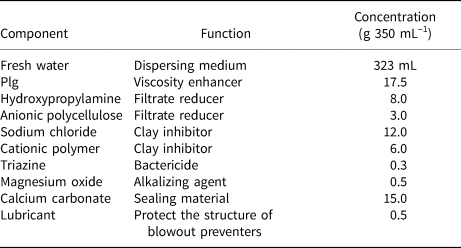
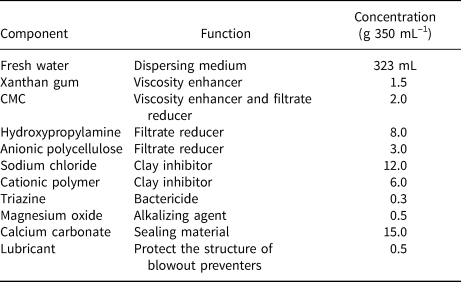
Drilling fluids viscosified with Plg (Plg fluid) and polymers (XG and CMC) contaminated with Ca(OH)2 and brine were formulated. Plg was used at a concentration of 17.5 g 350 mL–1 to prepare the water-based drilling fluid, as defined by Baltar et al. (Reference Baltar, Luz, Baltar, Oliveira and Bezerra2009) and Santanna et al. (Reference Santanna, Silva, Silva and Castro Dantas2020). In the water-based drilling fluid with polymers, XG and CMC were used at concentrations of 1.5 and 2.0 g 350 mL–1, respectively. These polymer concentrations are used often in the oil industry (Soares et al., Reference Soares, Scheid, Marques and Calçada2020; Borges et al., Reference Borges, Oechsler, Oliveira, Andrade, Calçada, Scheid and Calado2021). The fluids were contaminated with 0.5 g 350 mL–1 Ca(OH)2 and with 10% brine (71 g L–1 NaCl and 40 g L–1 KCl solution). Low concentrations of contaminants were used, as there is limited literature addressing the action of contaminants, especially in fluids with Plg. The compositions of the fluids studied are shown in Tables 1 and 2.
Composition of the salted water-based drilling fluid with Plg (Plg fluid).

Composition of the salted water-based drilling fluid with polymers (polymeric fluid).

A Hamilton Beach stirrer (Fann, TX, USA) was used to prepare all fluids (API Specification 13A, 2010). After adding each component, as listed in Tables 1 and 2, the fluid was stirred at 17,000 rpm for 10 min. Then, each fluid was aged in a Fann Roller oven (model 704ES) for 16 h at 180°C. After ageing, the properties of each fluid were measured, and, prior to each characterization, the fluid was stirred again at 17,000 rpm for 10 min.
Characterization of the drilling fluid
Following API Recommended Practice 13B-1 (2009), the drilling fluid samples were prepared and their parameters measured following previously established specifications and standard procedures (API Specification 13A, 2010). Apparent viscosity (μa), plastic viscosity (μp), yield point (YP) and gel strength (GS) were measured with a rotational Ofite viscosimeter (model 800) and calculated according to Equations 1–4, following API Recommended Practice 13B-1 (2009):


where L 600 = dial reading at 600 rpm of the rotational viscometer and L 300 = dial reading at 300 rpm of the rotational viscometer.


where lbf is pounds of force, G initial is the initial GS after 10 s of suspension not under shear, obtained from the initial dial reading of the rotating viscometer at 3 rpm after 10 s of suspension and G final is the final GS after 10 min of suspension not under shear, obtained from the final dial reading of the rotating viscometer at 3 rpm after 10 min of suspension. GS refers to the strength of shear thixotropy or shear thinning of the drilling fluid at a low shear rate.
The pH of each sample was determined initially by means of a commonly used digital pH meter. The densities of all fluids were determined on a Halliburton Service pressurized densimetric balance. An Ofite API press filter was used to measure fluid FV. A pressure of 100 psi was applied and the test period began at the time of pressure application. At the end of 30 min, the volume of filtrate collected was measured. All experiments were performed at room temperature (~25°C).
Alkalinity and salinity tests were performed using titration. The P f and P m values were determined using 0.02 N sulfuric acid (H2SO4; purchased from Dinâmica) as a titrant. P f represents the number of millilitres of 0.02 N acid required per millilitre of filtrate. P m is the number of millilitres of 0.02 N acid required per millilitre of drilling fluid. Fluid salinity was obtained using 0.282 N silver nitrate (AgNO3; purchased from Vetec) as a titrant. The NaCl concentration of the filtrate (mg L–1) was calculated according to Equation 5:

where V sn is the volume of 0.282 N silver nitrate solution (mL).
Cutting transport ratio
The correlations of Moore (Reference Moore1974), Chien (Reference Chien1994) and Walker & Mayes (Reference Walker and Mayes1975) have also been used for characterizing particle slip velocity (Jafarifar et al., Reference Jafarifar, Dehkordi, Abbasi, Schaffie and Ranjbar2020). In the correlations of Moore (Reference Moore1974) and Chien (Reference Chien1994), particles are considered as spheres. The particle's Reynolds number (N Re) is calculated as a function of apparent viscosity, as described mathematically in Equation 6:

where ρf = density of drilling fluid (lb gal–1), v sl = cutting slip velocity (ft s–1), d s = cutting diameter (in) and μa = apparent viscosity (cP).
In Moore's correlation (Bourgoyne Jr et al., Reference Bourgoyne, Millheim, Chenever and Young1991) the apparent viscosity is calculated considering that the fluid presents power-law behaviour, as per Equation 7:

where v a = annular fluid velocity (ft s–1), d 2 = outside diameter of the inner pipe (in) and d 1 = inside diameter of the outer pipe (in). The values of K (consistency index, mPa s–n) and n (flow-behaviour index) are obtained from Equations 8 and 9:


For N Re > 300, the flow around the particle is fully turbulent and the particle slip velocity can be described by Equation 10 (Bourgoyne Jr et al., Reference Bourgoyne, Millheim, Chenever and Young1991):

where ρs = density of cutting (lb gal–1).
For N Re ≤ 3, the flow is considered to be laminar and the particle slip velocity can be described by Equation 11:

For transitional flow (3 < N Re < 300), the particle slip velocity can be obtained using Equation 12:

Bourgoyne Jr et al. (Reference Bourgoyne, Millheim, Chenever and Young1991) recommended computing apparent viscosity using Equation 13 for polymer-based drilling fluids using Chien's (Reference Chien1994) correlation:

where μp = plastic viscosity (cP) and τs = shear stress (lbf 100 ft–2).
According to Bourgoyne Jr et al. (Reference Bourgoyne, Millheim, Chenever and Young1991), Chien's (Reference Chien1994) correlation is similar to Moore's (Reference Moore1974) in that it obtains the apparent viscosity of non-Newtonian fluids for use in N Re. For clay suspensions, it is recommended to use plastic viscosity (μp) as the apparent viscosity (Bourgoyne Jr et al., Reference Bourgoyne, Millheim, Chenever and Young1991). Under these conditions, the apparent viscosity is obtained using Equation 14 (Bourgoyne Jr et al., Reference Bourgoyne, Millheim, Chenever and Young1991):

The slip velocity for Chien's (Reference Chien1994) correlation to N Re < 100 (transitional flow) is given by Equation 15 (Bourgoyne Jr et al., Reference Bourgoyne, Millheim, Chenever and Young1991):

In the correlation of Walker & Mayes (Reference Walker and Mayes1975), according to Bourgoyne Jr et al. (Reference Bourgoyne, Millheim, Chenever and Young1991), the particle is considered a circular disc in flat fall (i.e. falling flat side down, which represents the condition of the greatest terminal settling velocity). For the calculation of apparent viscosity one needs to obtain the shear stress (τs) and shear rate (γs) according to Equations 16 and 17:


where h = thickness of the disk (in), θ = dial reading, γs = shear rate (s–1) and N = rotor speed (rpm).
Thus, calculating the apparent viscosity is done according to Equation 18:

For N Re > 100, the flow is turbulent and the particle slip velocity is given by Equation 19 (Bourgoyne Jr et al., Reference Bourgoyne, Millheim, Chenever and Young1991):

For N Re < 100, transitional flow is given by Equation 20 (Bourgoyne Jr et al., Reference Bourgoyne, Millheim, Chenever and Young1991):

Equation 21 shows the transport velocity (Bourgoyne Jr et al., Reference Bourgoyne, Millheim, Chenever and Young1991). The rock cutting advances towards the surface when there is a difference between the annular fluid and particle slip velocities:

where v T = transport velocity (ft s–1).
According to Bourgoyne Jr et al. (Reference Bourgoyne, Millheim, Chenever and Young1991), the cutting transport ratio (F T) is an excellent measure of the carrying capacity of a drilling fluid, and it is determined by dividing the transport velocity by the annular velocity as per Equation 22:

Results and discussion
Properties of fluids
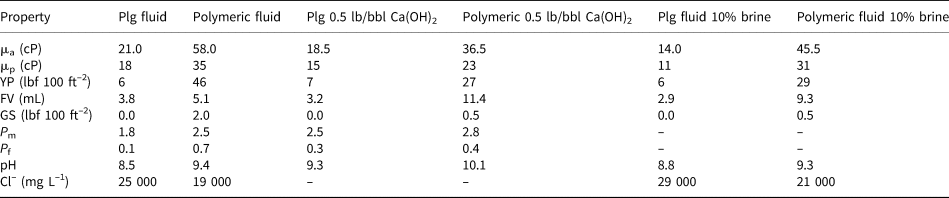
The results of the drilling-fluid properties analysed are given in Table 3.
Properties of the fluids studied (contaminated and non-contaminated).

bbl = oilfield barrel (1 bbl = 0.159 m3).
Silva et al. (Reference Silva, Costa, Menezes, Ferreira, Neves and Ferreira2013) stated that, according to Petrobras standard EP-1EP-00011-A/2011, clay suspensions must present apparent viscosity (μa) greater than the minimum specified apparent viscosity of 15.0 cP, plastic viscosity (μp) cannot be <4.0 cP and FV cannot be >18.0 mL. Based on this, together with the results shown in Table 3, we observe that only the Plg drilling fluid contaminated with 10% brine does not have adequate apparent viscosity, and this fluid will not carry out adequate cleaning in a drilling well. The salts compete with the polymer for hydration by water; without sufficient water the polymer cannot hydrate and the fluid becomes less viscous. In the case of Plg, according to Santanna et al. (Reference Santanna, Silva, Silva and Castro Dantas2020), when the salt concentration increases, there are insufficient Plg channels available for interaction with sodium cations, and so μa does not increase. Therefore, the use of a greater concentration of Plg could make the fluid more resistant to salt contamination and so maintain the high apparent viscosity, as seen in Santanna et al. (Reference Santanna, Silva, Silva and Castro Dantas2020).
Analysing the polymeric drilling fluid, one can verify that contamination with Ca(OH)2 causes significant changes to the properties of this fluid. This is because the behaviour of the polymer is different from that presented by the clay mineral. In the presence of Ca(OH)2, the polymeric drilling fluid viscosity decreases as the pH increases, probably due to greater ionization of the carboxylate group and interaction with cations. Thus, after obtaining a greater FV value, it is believed that the high alkalinization of the media ionized the polymers significantly and affected the organization of the filter cake, increasing its permeability (Madruga et al., Reference Madruga, Câmara, Marques and Balaban2018). In the Plg fluid, the Ca2+ ions entered the channels of the clay mineral particles and caused shrinkage of the electrical double layer. The shrinkage of the electrical double layer led to face-to-face aggregation. This was observed by Zhang et al. (Reference Zhang, Li, Liu, Li, Guo, Cui and Zhou2016) when they added MgO to a drilling fluid with Plg. The aggregated clay minerals reduced the apparent viscosity of the drilling fluid and formed a mesh with an elongated particle mass and a more consistent filter cake, resulting in low filtrate loss. The same result occurred with the Na+ ions dissociated from NaCl. Sulaiman & Al Zubaidi (Reference Sulaiman and Al Zubaidi2020) determined that a low concentration of caustic soda caused a decrease in μa and poor dispersion (aggregation) in a drilling fluid with Plg due to Na+ ions. Plg and sepiolite particles do not flocculate because of the reduced settling of the elongated crystals, thereby maintaining a constant volume capable of reducing permeability (Murray, Reference Murray2000, Reference Murray2006). Therefore, the results from the current study show that the Plg drilling fluid was more resistant to Ca(OH)2 contamination.
Regarding GS, the Plg fluid, as a non-thixotropic fluid, can affect the cleaning of a drilling well. Zhang et al. (Reference Zhang, Li, Liu, Li, Guo, Cui and Zhou2016) obtained GS > 0 in suspensions with 6.4% Plg. Therefore, the use of this concentration of Plg can be used to obtain a thixotropic fluid. Plg particles can be considered as charged particles with zones of positive and negative charges. The bonding of these alternating charges allows them to form gel suspensions (thixotropic fluids) in salt water and fresh water (Zhang et al., Reference Zhang, Li, Liu, Li, Guo, Cui and Zhou2016).
Regarding alkalinity, Table 3 shows that in the polymeric drilling fluid contaminated with Ca(OH)2 there is a decrease in the concentration of OH– ions present in the filtrate (Pf) when compared to the base polymeric drilling fluid. This possibly occurs because there is adsorption of the contaminant (Ca(OH)2) in the solid fraction of the fluid.
Cutting transport ratio
Table 4 presents the rheological parameters of the drilling fluids with an increase in polymeric fluid properties when compared to those of the Plg fluid. In the three correlations, the N Re is calculated as a function of apparent viscosity (μa), and N Re is shown to be inversely proportional to μa. In Moore's (Reference Moore1974) correlation, μa is directly influenced by K (consistency index). As K was greater for the polymeric fluid, μa was high and N Re was low. In Chien's (Reference Chien1994) correlation, μa is considered to be plastic viscosity (μp) for the Plg fluid because the fluid is clay-based.
Mean values of the rheological parameters of the drilling fluids (standard deviations are given in parentheses).

For the purposes of calculating empirical correlations, in addition to drilling-fluid data, drilling well data from Bourgoyne Jr et al. (Reference Bourgoyne, Millheim, Chenever and Young1991) were used (Table 5).
Data used for the calculations of the empirical correlations.

Note: Equivalences in SI: lb gal–1 = 0.1 g cm–3; ft s–1 = 30.48 cm s–1; 1 in = 2.54 cm.
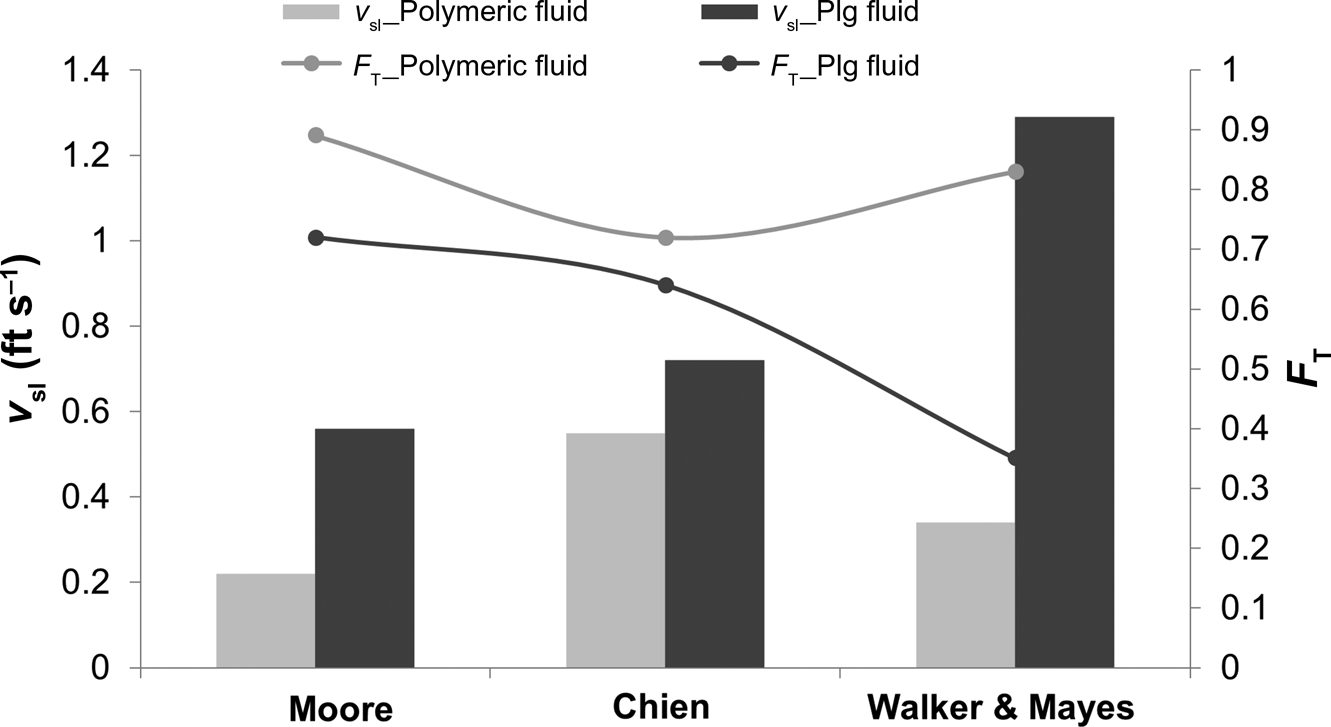
Using fluid rheology data, the correlations of Moore (Reference Moore1974), Chien (Reference Chien1994) and Walker & Mayes (Reference Walker and Mayes1975) were used to estimate the cutting slip velocity and transport ratio values (Fig. 1).
Cutting slip velocities and cutting transport ratios of the drilling fluids.

As Fig. 1 shows, in relation to cutting slip velocity, the Plg fluid presented greater velocity than the polymeric fluid. This occurs because polymeric fluid has greater affinity for the aqueous phase of the fluid. Therefore, the polymeric fluid has a greater cutting carrying capacity. The difference between the Moore (Reference Moore1974) and Chien (Reference Chien1994) correlations is that the Moore correlation employs power-fluid model parameters (K and n) to determine apparent viscosity, while the Chien correlation uses the Bingham model parameter (μp). The Walker & Mayes (Reference Walker and Mayes1975) correlation defines the particles as circular discs in flat fall rather than as spheres.
With respect to the transport ratio, Fig. 1 shows that the polymeric fluid presented a greater transport ratio than the Plg fluid. A greater transport ratio is beneficial. The cutting transport ratio can be increased by increasing the annular fluid velocity or by adjusting fluid properties such as viscosity or density (Bourgoyne Jr et al., Reference Bourgoyne, Millheim, Chenever and Young1991). According to Bourgoyne Jr et al. (Reference Bourgoyne, Millheim, Chenever and Young1991), the lower the transport ratio, the greater the well damage will be. For example, increasing the cutting concentration in the annular region on the way to the surface increased the fluid density, which will cause an increase in the circulation pressure at the well bottom, decreasing the perforating rate of the drill.
Conclusion
The results from this investigation show that the Plg drilling fluid was more resistant to contamination with Ca(OH)2 and brine, resulting in a decrease in FV. The Plg fluid contaminated with 10% brine does not have adequate apparent viscosity (>15 cP). Therefore, in future work, it will be important to study drilling fluids with greater concentrations of Plg. Applying empirical correlations, it was shown that the Plg fluid presented slip velocities that were 23.61–73.64% greater than those of the polymeric fluid. Regarding the transport ratio, as the values obtained were positive and >0, the Plg fluid has a good cutting-carrying capacity. These results represent an important contribution to the field as they highlight the advantage of using Plg in drilling operations, such as its resistance to contaminants and good cutting-carrying capacity, contributing to the advancement of clay mineral science and technology.
Conflicts of interest
The authors declare none.
Appendix
Conversion factors: US Field units to metric units.