Introduction
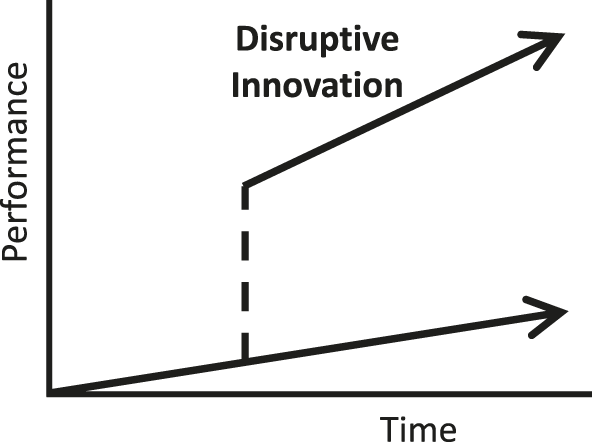
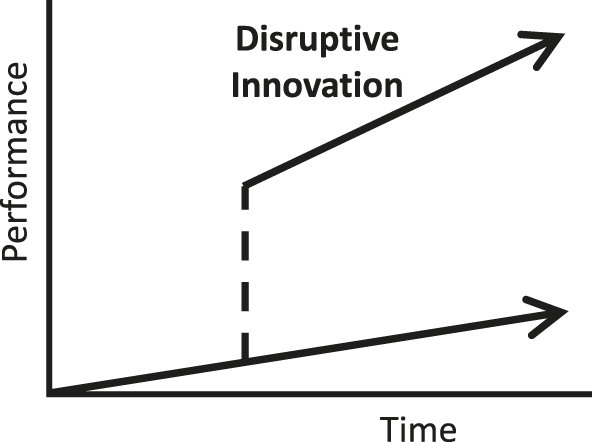
In order to be disruptive and impactful, innovation must transit the complete path, from initial question to discontinuous or revolutionary improvement to yield application at scale (Figure 1). We focus on innovations that have led to large-scale application because if one wants to change the world, reshape an entire industry, or move the needle of a large corporation, then scale is everything. Many organizations would like to be more innovative.
Disruptive innovation. We define disruptive innovations here as discontinuous or revolutionary advancements, not incremental improvements.
The present work is focused on Stanford University and identifies approaches and factors that appear to be correlated with successful innovation in the areas of materials science, energy, and the environment. Researchers at Stanford have a long history of innovations that have led to broader impact.Reference Alalwany, Koshak and Ibrahim1,Reference Eesley and Miller2 In 1970, Stanford established the Office of Technology Licensing,3 and in the four decades since then, Stanford has generated more than 8000 patent disclosures and more than 3000 technology licenses. While many organizations excel at innovation, this article will only briefly describe illustrative innovation programs at a few institutions (see the sidebar on Other research institutions).
Currently, the subject of innovation is receiving much attention. A recent issue of MRS Bulletin 4 was devoted to materials, engineering, and innovation. Our goal in the present study is to explore what successful innovation looks like by examining the experiences of innovators. We hope to advance the understanding of innovation and shed light on how all organizations can be more innovative. This is a preliminary study based on synthesizing interviews with a small number of successful researchers at Stanford University. This article also draws upon the authors’ experiences in corporate leadership, venture capital, government, and university research administration.
Each researcher we spoke with has a unique vantage point and a particular mode of problem solving that we have tried to categorize and describe. Regardless of their particular characteristics, all innovators operated within a gap between the state of the art today and a vision of what could be. Within this gap, they maneuvered to find new ideas and used rigorous and methodical approaches to test the efficacy of the ideas and build toward the envisioned result. While researchers varied in how they identified the gap, sourced new ideas, and tested solutions, all innovators sought to bring about a new vision by applying novel sets of tools and ideas. We propose a framework for understanding modes of innovation that may be useful to managers seeking to promote entrepreneurial risk taking and innovation inside organizations, such as within research and development groups.
While university–industry collaborations are observed in many of our interviews, our intent is to take a wide view on innovation at Stanford. Prior studies (see LeeReference Lee5 and Wright et al.Reference Wright, Drivas, Lei and Merrill6) have examined university–industry collaboration in more depth, and have identified the benefits for academia and industry (see the sidebar on Different roles of univerisities, corporations, government, and foundations).
Methodology
The research culture at Stanford University is highly decentralized and pragmatic. It is decentralized in that professors set their own research agendas with little top-down coordination. Furthermore, most PhD students choose their own research topics. It is pragmatic in that the dominant culture seeks to impact the real world.
We identified successful examples of disruptive innovation and accessed the investigators who led those efforts. The subjects are listed in Table I.Reference Chang, de Ridder and Biondi7–Reference Schwede, Bargatin, Riley, Hardin, Rosenthal, Sun, Schmitt, Pianetta, Howe, Shen and Melosh17 The selection process was anecdotal and susceptible to bias. The small sample size and presence of personal bias in selecting subjects means that our results are not statistically significant and might not be representative; however, the results are indicative of models for innovation that have worked at one research university and, we believe, are likely to be useful elsewhere.
Descriptions of the eight Stanford professors interviewed for this article.

We conducted a total of nine face-to-face interviews in this initial stage of research. To maintain a focus on Stanford, one interview was eliminated, because the subject described a project that had been conducted while he was employed at a corporation. We used a standard script to guide the interviews, but we often went off script to pursue an interesting comment or gain further insight. Interviews were typically 30 to 60 minutes in length. The interview questions are listed in a sidebar (The study).
The interviewees were selected because they had successfully seen an idea of theirs from inception to initial commercialization; they had done so in the domain of energy, environment, or materials science, and the research was conducted while they were faculty at Stanford University. Energy, environment, and materials innovation may differ from innovation within other fields because these domains are capital-intensive, highly regulated, and often less driven by the needs of the end-user than other more consumer-facing industries. The researchers selected were primarily from the Stanford School of Engineering and the School of Earth, Energy & Environmental Sciences. These factors or others might bias our conclusions about innovation in general, and our conclusions may be best applied to domains similar to materials, energy, and environment. All of the research examples are of the type that are typically called use-inspired research, action research, or practical inquiry.Reference Goldkuhl18
Classes of inquiry
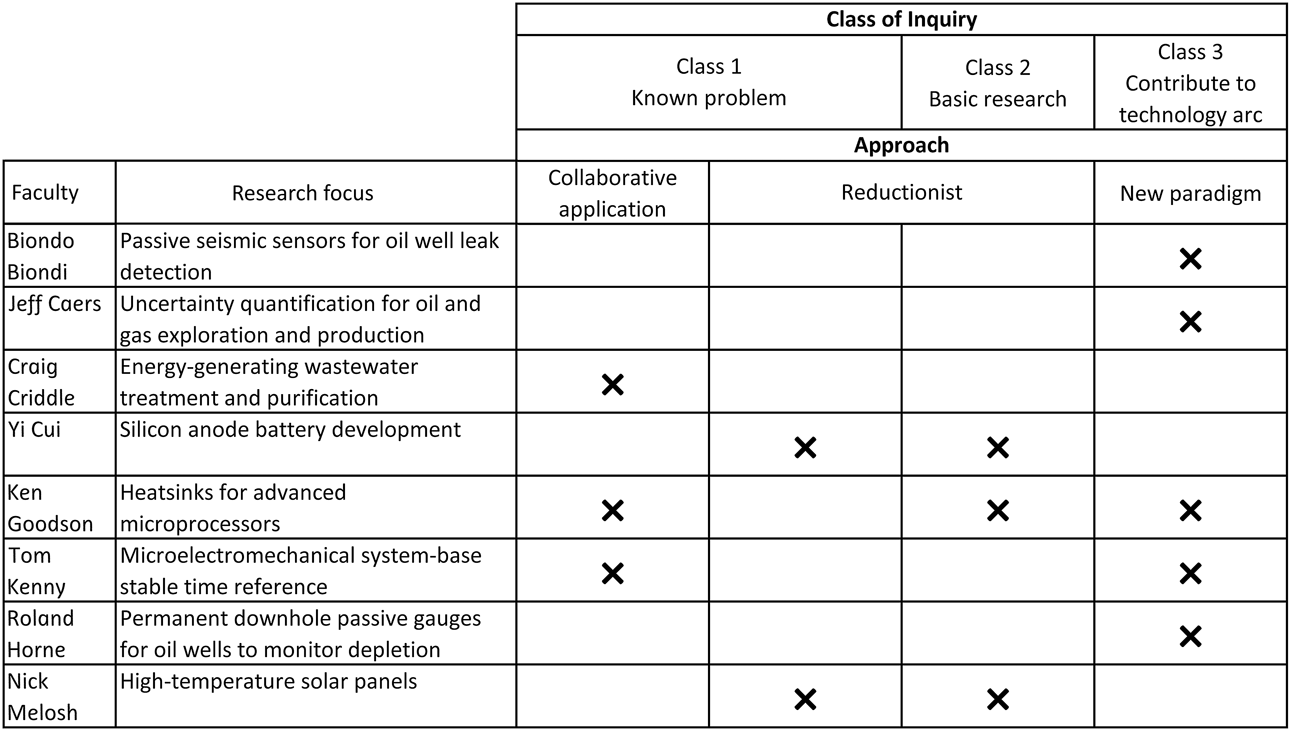
At the highest level, we observed several different classes of inquiry, which we categorized into three groupings. In the first type, Class 1, researchers seek improved solutions to well-known and understood problems. Researchers Craig Criddle, Yi Cui, Ken Goodson, Tom Kenny, and Nick Melosh fell into this category (Figure 2). Aspects of the research by Cui, Goodson, and Melosh also fell into the second category of inquiry, Class 2 basic research, defined here as an improved understanding of basic phenomena. In a different vein, researchers Biondo Biondi, Jeff Caers, Goodson, Roland Horne, and Kenny all worked on new categories of products or services that anticipated, contributed to, and built upon an arc of technology evolution, Class 3. The arc of technology evolution is similar to the wave ventures described in the World Economic Forum Report.19 While we provide a simplified framework for innovation, we both expected and observed researchers who fell into more than one category or used several approaches simultaneously. Other types of innovation, such as business model innovation,Reference Girotra and Netessine20 were not represented in our sample, largely because of the academic context of our work.
Interview summary of the categorization of the researchers’ work within a specific framework.
Approach
For each type of inquiry, we found that there were common tools used by the interviewees to conduct their research (Figure 2). Solving a known problem was often associated with a collaborative approach, which leveraged the needs and interests of several institutions. We found that collaboration does much more than motivate the need for a solution; collaborators actually contribute to the research. We observed this approach with researchers Criddle, Goodson, and Kenny. In describing collaboration, Kenny spoke of the “power of the inventive conversation.”
Basic research generally demanded a reductionist approach, in which researchers broke down processes to the most basic level and then redesigned the system at this level. A reductionist approach was also used for known problems. Researchers Cui, Goodson, and Melosh demonstrated aspects of this methodology. Finally, we found that researchers contributing to the evolution of a technology in order to arrive at a new product or service would often create a new paradigm that restated an existing process, reused or scaled existing tools, or used new methods for interpreting existing tools or data. Researchers Biondi, Caers, Goodson, Horne, and Kenny all used new paradigms in their innovation process.
The phrasing of the initial research question is critically important. If the goal is “out-of-the-box” thinking, then it is important to pose the question in a way that does not presume the form of the solution. In other situations—particularly corporate innovation—the goal might be a solution that is subject to constraints, leading to a different problem statement. One of the interviewees (Horne) talked about the importance of “solving the right problem.” If, for example, the goal is a disruptive new energy-storage technology that will enable electric vehicles with a 500-mile range or an electric grid that can store energy from intermittent wind and solar generators, then the research question must be posed accordingly. This goal—and the ensuing research task—are entirely distinct from, for example, the evolutionary development of a battery that is 10% better than existing batteries.
Factors
Subsequent to the interviews, we identified several factors that appear to enhance innovation. We grouped these factors into several categories: researcher traits, institutional factors, and types of research questions that seem to be most compelling and fruitful.
We found that researchers often held a conviction that the problem they were working on could be solved, and exercised what Melosh called a “constructive suspension of disbelief” when brainstorming possible new approaches to hard problems. Caers spoke of the need to persevere in the face of his colleague expressing “natural skepticism in seminars” initially. The researchers we spoke to often used an interdisciplinary approach where they demonstrated an interest in working with experts in other fields, eagerness to learn new subject matter outside of their core field in order to develop a competence in an area that is critical to their current inquiry, and adeptness at applying ideas from other problems to a new domain. Researchers often saw a path to success that they were able to articulate to their graduate students while simultaneously allowing students to pursue ideas and interests of their own, thus demonstrating risk tolerance. Criddle talked about asking “what problem is worth solving?” rather than “what can I do?” Faculty were well versed in their own field and thoughtful about current and long-term trends, their own work, and the work of their mentors or other influential researchers in the field.
In the institutional environment, several factors seemed to enable researchers to be successful. Flexible funding mechanisms, such as unrestricted or seed funding, allowed researchers to explore new areas of interest before they necessarily knew what the outcome or deliverable would be. Similarly, programs to fund graduate student cohorts without narrowly defining their research agenda allowed students more leeway in exploring their natural areas of interest. The collaborative environment of the institution also seemed to be a strong enabler of innovation. Within the University, it was valuable for researchers to be able to reach out to experts in related fields; beyond the University, having strong connections to companies enabled rich interactions and leveraged resources for inquiry. Unexpectedly, we found that the researchers often did not have access to all the tools they might have assumed they needed to solve the problem, but the collaborative environment allowed them to access additional resources and innovate in the absence of self-sufficiency. See the sidebar on Best practices for innovation in corporations for the extension of these concepts to the corporate environment.
Finally, there are the traits of the research problem itself, which seemed to make inquiry around that particular problem more or less fruitful. Researchers were more motivated to solve big, hard, and important problems, which they felt were pivotal to society or humanity. The dominant culture encourages seeking solutions that are disruptive and impactful, not incremental. Frequently, the problem was also framed as a specific and well-defined need.
Three narratives
Each of the professors interviewed in this study tended to fall into one of three composite archetypes: the interdisciplinarian, the diligent scientist, and the futurist. The interdisciplinarian tends to tackle known problems with a collaborative approach. The diligent scientist tends to conduct basic research with a reductionist approach. The futurist develops new products or services from evolving technology using new paradigms.
The researcher archetypes observed appear to match the classes of inquiry and approaches in the following manner:
interdisciplinarian ↔ well-known problems ↔ collaborative approach
diligent scientist ↔ basic research ↔ reductionist approach
futurist ↔ arc of technology ↔ new paradigm.
The personal narratives and examples provide a comprehensive view into the whole process of innovation and the type of people who engage in the various forms observed.
The interdisciplinarian
The interdisciplinarian is known across his or her organization as a go-getter and embodies a mode of innovation that has gained significant traction in the 2000s. S/he consistently finds time to talk to people outside of her/his subject area and seeks to fully understand the challenges they face. The interdisciplinarian brings together people from different domains to attain common goals and champions ideas that bridge seemingly disparate approaches in new ways. They enjoy learning new topics, but are also comfortable relying on the subject expertise of others when it is nonessential but relevant to the area of inquiry. The interdisciplinarian typically engages in Class 1 inquiry, solving known problems. Using the collaborative approach, the interdisciplinarian is intent on seeing real-world impact from her/his efforts and applying her/his approach at scale.
In order to be successful, the interdisciplinarian needs an organization that enables and encourages collaboration. Open-format offices and other organizational structures that break down silos and encourage cross-departmental collaboration would likely help enable the interdisciplinarian’s success. S/he also needs incentive structures that reward her/him for broad efforts rather than bind her/him to narrow departmental goals.
Criddle (professor, environmental engineering and science) exemplifies many traits of the interdisciplinarian, though he also exhibits some aspects of the futurist profile. Criddle’s research focuses on wastewater treatment. Current techniques for wastewater treatment consume significant energy. Nitrogen removal is particularly energy intensive, and future nitrogen regulations are expected to become increasingly more stringent. Criddle and his colleagues have developed a new method for nitrogen removal that efficiently removes nitrogen from wastewater while recovering energy from the nitrogen.Reference Scherson and Criddle9 Criddle has taken a collaborative approach to scale up this technology, establishing productive relationships with the Delta Diablo Sanitation District, the Stanford Woods Institute for the Environment, and the US National Science Foundation. This is one example of the different technologies Criddle’s group is developing to enable energy-positive wastewater treatment.
To accelerate adoption of these emerging technologies, Criddle is directing the establishment of the William and Cloy Codiga Resource Recovery Center at Stanford, a novel facility designed for pilot-scale testing. For Criddle, it is all about doing what he calls “solving meaningful problems at scale.” The aim of this Center is to move technology from bench to commercially viable scale. The rate at which water is treated is increased by three orders of magnitude over bench scale, setting the stage for full-scale deployment and an additional three orders of magnitude increase in flow rate.
The diligent scientist
The diligent scientist is perhaps the most well-known and readily identifiable archetype. S/he approaches research in a methodical fashion, breaking systems down to component pieces in order to gain insight into the fundamentals that can lead to breakthroughs. The diligent scientist takes a long-term perspective and has a high risk tolerance, as s/he recognizes that it takes many failed trials before a successful insight. The diligent scientist typically engages in either Class 1 or Class 2 inquiry, solving known problems or conducting basic research. For both of these types of inquiry, the diligent scientist employs a reductionist approach.
In order to be successful, the diligent scientist needs to have the freedom and flexibility to pursue her/his research agenda. Funding and other resources need to be available to support open-ended inquiry. The organization’s incentives should reward a long-term and patient approach, and cannot be tied to particular outcomes or designed to encourage short-term success.
Cui (associate professor, materials science and engineering) fits the model of the diligent scientist in many respects, although he also displays traits of the interdisciplinarian. One of Cui’s research projects focuses on silicon anodes for lithium-ion batteries. Cui was originally drawn to this area by a desire to work on meaningful problems, and became interested in battery technologies as a way to enable climate and energy solutions. Cui began looking into silicon nanowires in lithium-ion batteries, but noticed that the solid electrolyte interphase of nanowires kept breaking as the battery was charged and discharged. At roadblocks such as this, Cui paused to learn the fundamentals of the system, sought out experts and others who could help teach him critical information, and outlined a methodical path to the next step. This led to his discovery that coating the silicon nanowires with silicon oxide and making nanowires into hollow tubes would keep the interphase from breaking.Reference Wu, Chan, Choi, Ryu, Yao, McDowell, Lee, Jackson, Yang, Hu and Cui10 By articulating what he calls “big questions and hard problems,” Cui is highly effective at enlisting the support of others. He has raised $100 million for his new company, Amprius, which sells batteries based on silicon nanomaterials technology. In 2014, Amprius produced almost one million batteries and planned to produce 10 million batteries in 2015.
The futurist
The futurist is a big-picture thinker who inspires others and often spots trends before his or her colleagues. The futurist frequently positions her/his work to take advantage of these new trends, applying the trajectory s/he has identified to a foreign domain. The futurist articulates big visions and feels that many aspects of the future are readily identifiable from the vantage point of today’s trends. The futurist typically engages in Class 3 inquiry, developing new products or services that build upon an arc of technology evolution. The futurist also uses a new paradigm approach.
In order to be successful, the futurist needs support from leadership in the organization to see the big picture and the willingness to take a leap of faith to find game changers. Top management must be aware of emerging trends, be confident enough to address needs that are not top-of-mind, and be contrarian so as to adopt new ideas before others.
Biondi (professor, geophysics) displays many of the traits of the futurist. Biondi noticed that sensor technology was improving rapidly. Costs were falling, and temporal data rates were increasing. Biondi saw this as an opportunity to transform oil field monitoring. Previously, monitoring depended on a small number of active sensors, but now a large number of passive sensors could be used to provide continuous monitoring over a fine grid. As Biondi said, “it was obvious that it had to work,” despite the fact that no one else saw and was willing to pursue the opportunity. Biondi realized that if he could find a way to make the concept work, then passive sensors would enable leak detection and the potential to prevent geomechanical failures through constant monitoring. Biondi collaborated with the oil giant BP to gather passive sensor data for his lab to analyze. Biondi drew on prior Stanford research on the interferometric effect as applied to passive seismometry and used new methods of low-frequency analysis to interpret the new passive sensors’ data. His work has resulted in improved failure detection at oil fields that reduce the occurrence of accidents resulting in explosions. His approach of building on an existing technology development pathway and collaborating to test at scale defined his success.
Process flowchart for effective innovation
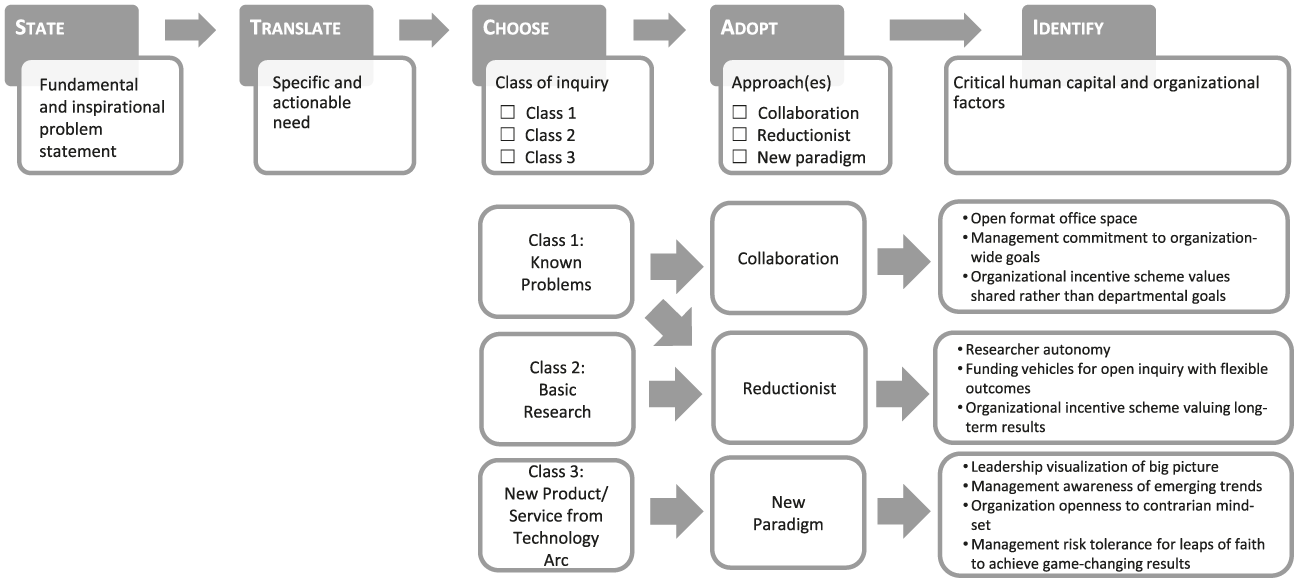
Across our interviews, we were able to find recurring themes, which we organized into an innovation framework that includes classes of inquiry, approaches used for this type of inquiry, and both human and organizational factors necessary in order to facilitate this approach. Figure 3 provides a process flowchart for organizations interested in enabling innovation through one of these modes. The process is composed of five steps.
1. State the problem. The process begins with a fundamental and inspirational problem statement. The goal is to state the problem in a manner that does not presume the form of the solution, yet still retains relevant constraints. Often, the creativity and give-and-take of a small team is needed to strip away implicit assumptions.
2. Translate to an actionable question. The initial problem statement might be too abstract to be actionable, in which case the next step is to identify a specific and actionable need.
3. Choose the inquiry class. Often, the problem itself will suggest one of the three classes of inquiry described in the present work (Figure 2). (An additional important inquiry class, business model innovation, was not observed in the present study.) It is important to consider external factors, such as the competitive business environment for new products and services as well as industry dynamics, and internal factors, such as the organization’s resources, core competencies, and corporate culture.
4. Adopt an approach. As described in the present work, each class of inquiry matches one or more approaches that are likely to be most effective and productive.
5. Identify key factors. There are several human capital and organizational factors that enhance the chances of successful disruptive innovation.
Summary of the innovation process and proposed framework. First, state the problem in such a way that it is open ended and allows for innovative answers. Second, translate the problem statement into a problem that is specific and actionable. Based on the question or problem, choose an appropriate class of inquiry, and adopt the approach matched with the class of inquiry. Finally, identify the organizational best practices to promote the type of innovation desired.
Next steps
Our preliminary investigation into the innovation process at Stanford University suggested similar threads across different individual stories of innovation. We found distinct types of inquiry, approaches that enabled success in these categories, and factors that enhanced the likelihood of success. Our initial approach was purposefully open and anecdotal and should not be read as rigorous social science research. This preliminary work will provide useful insights for those endeavoring to innovate and may be a useful starting point for further inquiry.
The present work could be beneficially expanded to include a larger number of researchers in different academic and technical areas, at other universities, or at corporations and other institutions. The study could be expanded to include research that leads to publications in scholarly journals but not to large-scale commercial impact, in order to compare and contrast the characteristics of types of research leading to commercial impact with successful research where the primary contribution is to advance knowledge and scholarship. Significantly and unfortunately, all of the subjects in the present study are men. Future studies should be more representative and incorporate both men and women.
Conclusions
We have presented results and synthesis from a series of interviews designed to shed light on the process of innovation, factors that enable it, and approaches that are successful at bringing new ideas to commercial application. We found several classes of inquiry: basic research, the search for new solutions to well-known problems, and exploitation of the evolutionary arc of technology to develop fundamentally new products or services. Each class of inquiry is matched with an approach that is commonly used in that type of investigation: a collaborative application that leverages several partners and is used for well-known problems, a reductionist approach that explores the basic phenomenon of systems for basic research and known problems, and the creation of a new paradigm where the researcher is inverting conventional wisdom about the challenge to forge a new path along the arc of a new technology.
Several factors enhance the ability of researchers to be effective in shepherding the idea from conception to commercial success, including characteristics of the researcher, the institutional environment, and the problem itself.
This work suggests that these modes of innovation occur organically in the academic environment. Explicitly identifying and pursuing these particular modes of innovation in accordance with our process flowchart (Figure 3) may create additional alignment and lead to an enhanced innovation ecosystem for all organizations. The innovation pursuit is widely viewed as open and unstructured, which, as a result, can be challenging to embody. By identifying the particular type of innovation sought, organizations can be more thoughtful about providing the most essential cultural and human elements for that approach. By applying our framework, we hope that organizations can bring new focus and precision while maintaining values around open inquiry that underpin all modes of innovation.
The study
The interview subjects are all professors at Stanford University. They all have large and successful research programs in energy, environmental, or materials science. Each interview began by introducing the project and explicitly selecting a specific research project. Each interview was roughly 30 to 60 minutes in length and consisted of the following questions:
1. What was your initial research question? When or how did you become aware of this problem/opportunity? What was the source or interaction? Were there specific and detailed constraints or requirements that were important?
2. What was the implicit underlying need you were trying to address, if any?
3. Tell us the story of conducting your research.
4. During the research process, what were the surprises?
a. Were there “moments of truth,” that is, critical decision points that determined the direction or ultimate success?
b. Were there crises that led you in new directions?
c. Were there unexpected conversations that changed your direction?
5. Research outcomes
a. What was the initial outcome of your research (invention, publication, etc.)? Is this what you expected?
b. What have been the subsequent outcomes: patents, licenses, commercialized, scaled, startup, large company? Why or why not?
6. What is the path to commercialize your invention at scale?
a. Have you pursued this?
b. What is the current status?
7. Is there any point at which you looked into market dynamics, competitive issues, customers, etc.?
8. Unique enablers
a. Could someone else or would someone else have done the same thing?
b. What critical or unique factors about you and/or your team led to your success?
c. Is this a case of “solving a problem because you didn’t know it couldn’t be done?”
All interviews were conducted in person, most by both of the authors of this article. All interviews were recorded by contemporaneous written notes.
Best practices for innovation in corporations
Each organization is unique, and culture change is notoriously difficult; however, we observed five successful techniques for encouraging innovation that recur with such frequency that we have identified them as best practices.
1. Co-locate people. Innovation often requires new approaches and access to diverse resources. Moreover, it is often interdisciplinary. As a result, many organizations see benefits from co-locating people who might contribute to innovative problem solving. It remains to be seen if virtual interactions can supplant physical co-location.
2. Seed research funding. Employees need to be given time and resources in order to find innovative solutions.
3. Boot camp. Some organizations lack successful examples and role models. In these organizations, it can be helpful to establish innovation boot camps that provide training in topics, such as customer-centric design and the development of new business models. Innovation boot camps can be combined with seed research funding; for example, recipients of seed funding could be required to attend a series of workshops.
4. Just tell them! Corporate leaders often neglect the easiest and most effective tool of all, which is to simply ask your employees to be more innovative in the development of products, services, and business models. To achieve maximum benefit and avoid unintended consequences, it is important for leaders to define what they mean by innovation, provide examples, tell employees how to be more innovative, and explain why innovation is important to the company.
5. Reinforce the message. A comprehensive approach is the most effective. For example, awards and other recognition can be used to identify and encourage successful innovators.
Other research institutions
Research institutions throughout the world serve as centers of innovation, sometimes enabled by self-organized structures and open academic inquiry. Different institutions, however, have fostered radically different cultures around research agendas and, as a result, around innovation. A systematic study of other organizations is beyond the scope of this article, but a few examples are illustrative.
The Massachusetts Institute of Technology (MIT) has an impressive record of scholarship, innovation, and entrepreneurship.Reference Hsu, Roberts and Eesley1 The MIT Industrial Liaison Program2 is an important part of the MIT innovation ecosystem, established in 1948 to facilitate relationships between MIT and corporations. Industrial Liaison Officers work closely with companies to arrange meetings with faculty, organize workshops, enable collaborations, provide information on inventions, and enhance recruiting.
Harvard University opened an Innovation Lab3 in 2011 that has already helped start more than 75 companies. Harvard’s Innovation Lab focuses on entrepreneurship, cross-disciplinary research, innovation, and learning. The Venture Incubation Program at the Innovation Lab is a 12-week program designed to help current Harvard students make progress on their entrepreneurial ventures. It is a community where the diverse skills and backgrounds of the students, mentors, and staff are leveraged.
Lawrence Berkeley National Laboratory (LBNL)4 established the Cyclotron Road5 program to give entrepreneurial researchers access to critical technology development, business models, partners, and financing mechanisms. This program comprises financial support, lab and office space, as well as access to LBNL researchers and a network of advisors, mentors, partners, and investors.
The Fraunhofer Institute,6 located in Germany and worldwide, conducts applied technology research to benefit private and public enterprise, the local economy, and society as a whole. Contract research is the most important business of the Fraunhofer Institute.
Different roles of universities, corporations, government, and foundations
Different organizations are best suited for different roles in a global innovation ecosystem. Universities excel at education, intellectual scholarship, and workforce development. Many universities also excel at out-of-the-box thinking and developing innovative solutions.
Industry is in the best position to identify real-world opportunities, challenges, and constraints. Industry can also enable large-scale impact by commercializing technologies and developing sustainable business models. Many companies also provide valuable financial support to university research programs.
Government organizations can act as bridging institutions,Reference Clark and Holliday1 facilitating knowledge transfer between those who conduct research and those who apply the results of research. Governments are uniquely suited to impose policies, standards, and incentives. They are also a major source of research funding.
Foundations are playing an increasingly important role in attacking some of society’s most difficult and intractable problems, particularly humanitarian problems that impact the planet’s poorest and most disadvantaged people. Foundations are able to take the long view, freed from short-term perspectives imposed on corporations and politicians.
Acknowledgments
We gratefully acknowledge the Stanford faculty who participated in this study: B. Biondi, J. Caers, C. Criddle, Y. Cui, K. Goodson, R. Horne, T. Kenny, N. Melosh, and H. Tchelepi. We also acknowledge discussions with S. Bernstein, N. Ardoin, and P. Matson. We are grateful to R. Dasher for a review of the manuscript.
Stephen J. Eglash is with the School of Engineering at Stanford University and is executive director of programs on big data, artificial intelligence, and the Internet of Things. He obtained his PhD and MS degrees from Stanford University and a BS degree from the University of California, Berkeley, all in electrical engineering. He is chair of the Leadership Board of the College of Arts & Sciences at Santa Clara University. He is a Fellow of the International Society for Optics and Photonics, a former board member of MRS, and a member of the Institute of Electrical and Electronics Engineers, The Optical Society, and the Association for Computing Machinery. Eglash can be reached by email at seglash@stanford.edu.
Sarah M. Rizk is on the founding team of Azevtec, an autonomous electric trucking startup. She holds MBA, MS, and BS degrees, all from Stanford University. She has worked in entrepreneurship and clean energy, founding early-stage startups at Stanford University and developing curriculum at the Stanford Graduate School of Business to expand resources in this area. She has also performed diligence on clean-energy companies for venture capital, has been a consultant on clean technology, and worked in government at the US Environmental Protection Agency focusing on climate change and energy. Rizk can be reached by email at smrizk@gmail.com.