Forty-five years ago, a young man called John started working as a construction worker. He soon realized that, due to the high physical demands, he would not last long in this job and so he went back to school to get additional diplomas next to working in construction. Over the following years, he climbed the hierarchy of the organization until he became head of construction sites. Later, he started his own construction advisory company and is still working at the age of 67.
A few years ago, an older woman called Theresa worked as a practicing nurse at the clinic of a general medical practitioner. She generally liked her job but did not want to expand her skill sets and handle new patients anymore. In addition, she wanted to have more free time. To restore the fit between her needs and her work, she started to focus on a few diseases and her existing patients and reduced the number of workdays. She recently decided to continue working instead of retiring.
These examples suggest that person–environment (P-E) fit-seeking behavior of employees is pivotal when it comes to aging successfully at work. In this article, we develop a process model that outlines the individual and contextual factors that influence such behavior and, in turn, enhance employees’ fit with their work environment and their successful aging at work. Successful aging at work is an important topic for everyone who is working to earn a living, as getting older is inevitable. In addition, successful aging at work is an important issue for organizations and society as a whole. Due to continuously low or falling fertility rates, the aging of the baby boomer cohorts, as well as increasing life expectancy and retirement ages, populations and workforces are aging worldwide. The proportion of the world’s population older than 60 years will nearly double from 12% to 22% between 2015 and 2050 (WHO, 2015). Demographic change poses serious practical challenges for societies, organizations, and individuals (Hertel & Zacher, Reference Hertel, Zacher, Ones, Anderson, Viswesvaran and Sinangil2018). For example, workforce growth is slowing and starting to lag behind the total employment growth, leading to long-term worker shortages. The U.S. workforce is expected to increase by 7.7 million employees between 2014 and 2024, while 9.8 million job positions have to be filled in that same period (Bureau of Labor Statistics, 2015). Since labor market participation traditionally decreases from age 50 onwards (Eurostat, 2017), it is increasingly important to retain and motivate older workers. At the same time, older workers face a number of physical and mental challenges, such as decreasing physical health and fluid cognitive abilities (e.g., information processing; Salthouse, Reference Salthouse2012), suggesting that it is equally important to maintain a high ability to meet work demands. In sum, to address workforce shortages, it is important to facilitate successful aging at work by helping employees maintain, or recover to, high levels of ability and motivation to continue working in their late careers.
However, very little research has focused on successful aging at work (e.g., Abraham & Hansson, Reference Abraham and Hansson1995; Kooij, Reference Kooij2015a; Olson & Shultz, Reference Olson, Shultz, Baltes, Rudolph and Zacher2019; Zacher, Reference Zacher2015a) and, hence, governments, organizations, and individual workers have little guidance on how to facilitate it. In addition, researchers and practitioners do not agree on what it means to age successfully at work. Among the sparse research, authors have generated rather diverse conceptualizations of successful aging at work, which are often broad and difficult to operationalize in practice (Zacher, Reference Zacher2015a). For example, Robson and Hansson (Reference Robson and Hansson2007) conceptualized it as maintaining or developing one’s status in five areas (i.e., intellectual abilities, adaptability, positive relationships, personal security, and occupational growth). However, it is unclear how these areas should be operationalized and whether these five areas indeed capture successful aging at work. In addition, although researchers have proposed some antecedents of it, a theoretical model that integrates the individual and contextual factors that might influence successful aging at work does not exist (Zacher, Reference Zacher2015a). Therefore, to advance research and practice, we offer a specific and practical conceptualization that can readily be applied to government labor policies and human resource (HR) practices at the workplace. We also draw on prior research in organizational psychology and lifespan development to develop a process model, specifying antecedents and theoretical mechanisms underlying successful aging at work. These antecedents and mechanisms could be addressed in government- or employer-sponsored programs and interventions to enhance successful aging at work.
Thus, the present article contributes to research and practice on successful aging at work in three ways. First, we offer a specific and practical conceptualization of successful aging at work, which can help guide researchers and practitioners in this area. Second, we identify predictors of successful aging at work at multiple levels, including not only individual factors, but also contextual factors at the level of the job, the work group, the organization, and the larger society (e.g., retirement laws and regulations). We integrate research in both lifespan developmental psychology and organizational psychology to identify factors that facilitate or hinder successful aging at work. The lifespan psychology literature provides a broad conceptual framework for understanding individual aspects of aging at work (Rudolph, Reference Rudolph2016; Zacher et al., Reference Zacher, Hacker and Frese2016), but needs to be complemented with insights from organizational psychology and its more specific focus on the complexities of the job and work group, as well as organizational and societal contexts. Integrating these literatures enables a multilevel view on the critical individual and contextual antecedents of successful aging at work. Third, we explain on which psychological processes these individual and contextual antecedents may have an influence. Converging with the notion that P-E fit-seeking behavior is a key aspect of individual development, we emphasize a self-regulation perspective for aging at work and utilize a P-E fit approach. In particular, building on Heckhausen et al.’s (Reference Heckhausen, Wrosch and Schulz2010, Reference Heckhausen, Wrosch and Schulz2019) work on motivational self-regulation across the lifespan, we argue that the fit between the aging employee and the changing work environment both influences and is affected by a self-regulation process consisting of two modes of agency, that is, goal engagement and goal disengagement. To develop our process model, we first discuss extant research on successful aging in general and at work in particular. Next, we introduce our process model on successful aging at work, elaborating on its conceptualization, as well as proposed behavioral processes and antecedents. Finally, we present a roadmap for future research and practical applications based on our model.
Research on successful aging
Research on successful aging began in the fields of gerontology and developmental psychology with the introduction of three influential theories in the 1950s and 1960s. Disengagement theory argues that aging is inevitably linked to reduced social activity and that older adults’ withdrawal from society is natural, voluntary, and acceptable, thus, enables successful aging (Cumming & Henry, Reference Cumming and Henry1961). In stark contrast, activity theory proposes that successful aging is the result of older adults staying socially active and engaged with society (Havighurst, Reference Havighurst1961). The theory assumes that maintaining life roles, personal relationships, and activities leads to subjective well-being in old age. Continuity theory was developed to extend activity theory (Atchley, Reference Atchley1971). The theory suggests that most older adults maintain the same level of activity and social relationships as in earlier life stages and that the use of strategies to enable such continuity provides the basis for successful aging.
In the 1980s and 1990s, medical researchers Rowe and Kahn (Reference Rowe and Kahn1987, Reference Rowe and Kahn1997) defined successful aging as the simultaneous presence of three outcomes: a low probability of disease and disability, maintenance of high physical and cognitive functioning, and continued engagement in social and productive activities. They argued that “usual aging” was present when individuals followed an average or normative age-related trend in these outcomes, whereas those following a more positive than average age-related trend were aging successfully and those following a less favorable trend were aging unsuccessfully. Based on the observation that older adults vary considerably in these three successful aging outcomes, Rowe and Kahn (Reference Rowe and Kahn1987) suggested that these differences could be explained by genetics and lifestyle habits. They particularly emphasized the importance of human agency in successful aging. Critics have argued that this approach to successful aging is based on neoliberal thinking and neglects the importance of structural factors (e.g., socioeconomic status; Martinson & Berridge, Reference Martinson and Berridge2015; Rubinstein & De Medeiros, Reference Rubinstein and De Medeiros2015; see also Zacher & Rudolph, Reference Zacher, Rudolph, Profili, Sammarra and Innocenti2017).
In the 1990s and later, lifespan developmental psychologists developed two influential and related models of successful aging. First, the selection, optimization, and compensation model (SOC) offers a broad, meta-theoretical perspective on successful aging and development (Baltes & Baltes, Reference Baltes, Baltes, Baltes and Baltes1990). The model proposes that the orchestrated use of three strategies leads to successful aging and effective life management. Selection involves goal setting, prioritization, and revision, either to achieve desired outcomes (i.e., elective selection) or to manage resource losses (i.e., loss-based selection). Optimization refers to various strategies that facilitate the acquisition and use of goal-relevant means (e.g., investing additional effort, training). Compensation entails the acquisition and use of alternative means to maintain functioning (e.g., using tools, adjusting one’s work station). A meta-analysis provided evidence for the effectiveness of overall SOC strategy use with regard to work-related outcomes, including job satisfaction and engagement, as well as task and contextual performance (Moghimi et al., Reference Moghimi, Zacher, Scheibe and Van Yperen2017).
The second model of successful aging is the motivational theory of lifespan development by Heckhausen and colleagues. Extending the SOC model and their earlier lifespan theory of control (Heckhausen & Schulz, Reference Heckhausen and Schulz1995; Schulz & Heckhausen, Reference Schulz and Heckhausen1996), Heckhausen et al. (Reference Heckhausen, Wrosch and Schulz2010, Reference Heckhausen, Wrosch and Schulz2019) developed a comprehensive theory of action regulation across the lifespan. This theory posits that striving to exercise personal agency over their environment (i.e., primary control) is a continuous priority for people across the lifespan. In particular, individuals use various control-related strategies to maximize primary control across the lifespan. Control striving is organized into cycles of goal pursuit, such as when individuals try to enter a career, achieve a promotion, or perform a certain task. These goal cycles are composed of goal selection, goal engagement, and goal disengagement.
Control strategies can be directly aimed at achieving primary control for goal attainment, including investing time, effort, and other resources in goal striving (i.e., selective primary control) or asking other people for help and using technical aids to achieve the goal (i.e., compensatory primary control). Alternatively, secondary control strategies make use of self-regulation of motivation and emotion, and can be used either in phases of goal engagement or goal disengagement. During goal engagement, selective secondary control strategies help the individual to maintain or enhance motivational commitment to the chosen goal. During goal disengagement, compensatory (self-protective) secondary control helps to downgrade the goal value or perception of control to facilitate goal disengagement or to help protect the self-esteem and future optimism after a loss of control.
In the work context, more specifically, selective primary control strategies entail investing time and effort into work- and career-related goal pursuit aimed at meeting one’s personal needs (e.g., enrolling in a leadership development program to gain career advancement opportunities). Compensatory primary control strategies comprise the use of external resources at work, such as assistance from others or technical aids (e.g., soliciting help from a coworker), for goal pursuit. These strategies often come into play when the typical resources of selective primary control striving are insufficient for work-related goal attainment. In the work context, selective secondary control strategies typically aim at intentionally enhancing one’s motivational commitment to a work-related goal. Examples of such strategies include increasing and/or focusing on the anticipated value of a goal (e.g., “I tell myself how happy I will feel when I solve this problem at work”), enhancing perceived control (e.g., “I remind myself that I can accomplish this task”), or avoiding attention to attractive alternatives (e.g., “I avoid being distracted by other non-work related activities”). Finally, individuals use compensatory secondary control strategies at work to deactivate a work-related goal, withdraw effort, and self-protect from the negative effects of work-related failure or treatment. These strategies can include self-protective cognitions, such as downward social comparison (e.g., “I think of my coworkers who have to deal with even worse supervisors”) and external attributions of failure (e.g., “I remind myself that it is not my fault that I failed to meet the deadline”).
For the model presented in this article, we build on the motivational theory of lifespan development of Heckhausen et al. (Reference Heckhausen, Wrosch and Schulz2010) because, in contrast to earlier theories of successful aging, it focuses on specific processes of individuals’ goal engagement and disengagement in social settings where contextual opportunities and constraints coexist and change with age. This focus seems particularly well suited for considering the psychological processes in the context of the workplace. Accordingly, this theory provides a specific and process-focused conceptual framework for understanding how self-regulation is involved in maintaining and restoring fit between aging individuals and their work environment.
Research on successful aging at work
Rapidly aging and increasingly age-diverse workforces require that older workers remain employed as long as possible, and that they are able and motivated to continue working. Thus, organizational researchers and practitioners have become more and more interested in the notion of successful aging and its operationalization in the work context (see Zacher & Rudolph, Reference Zacher, Rudolph, Profili, Sammarra and Innocenti2017, for a review). Based on the general literature on successful aging, and particularly the SOC model, Abraham and Hansson (Reference Abraham and Hansson1995) first introduced the concept of successful aging at work, which they conceptualized as competency maintenance (i.e., ability/performance maintenance compared to their same-aged peers and goal attainment). They demonstrated that engaging in SOC strategies is more important for competency maintenance of older workers compared to middle-aged workers because it helps older workers to deal with age-related losses in, for example, physical health or fluid cognitive abilities. Robson et al. (Reference Robson, Hansson, Abalos and Booth2006) proposed five criteria that were related to self-perceived successful aging at work (compared to similar-aged employees; see also Robson & Hansson, Reference Robson and Hansson2007): adaptability and health, positive relationships, occupational growth, personal security, and continued focus on and achievement of personal goals. Cheung and Wu (Reference Cheung and Wu2012, Reference Cheung and Wu2013, Reference Cheung and Wu2014) used these five criteria to measure successful aging at work with self-report questionnaires in a number of studies focusing on predictors of successful aging at work. However, the predictors did not have consistent associations with the different criteria, and there was no unifying theoretical account to explain those diverse findings. Therefore, apart from the studies by Cheung and Wu, Robson et al.’s (Reference Robson, Hansson, Abalos and Booth2006) measure has not been widely used in the literature to study successful aging at work.
More recently, Zacher (Reference Zacher2015a) reviewed the literature on successful aging and identified four key elements in this literature: (a) criteria for successful aging (e.g., objective versus subjective criteria); (b) age-related explanatory mechanisms (e.g., improved socioemotional functioning); (c) facilitating and constraining factors (e.g., personal resources and adaptive behavior); and (d) a developmental perspective (e.g., rate of age-related changes over time). Based on this review, Zacher (Reference Zacher2015a) conceptualized successful aging at work from a comparative perspective as positive deviations from the average intra-individual age-related trajectory of certain work outcomes, which is consistent with Rowe and Kahn’s (Reference Rowe and Kahn1987) conceptualization of successful aging. Kooij (Reference Kooij2015a) proposed a complementary P-E fit perspective to highlight the importance of an active role of employees in successful aging at work. She defined successful aging at work as the maintenance of high levels of health, motivation, and work ability among older workers. Work ability refers to the perceived job-related functional capacity to continue working in the current job, given the challenges or demands of the job and personal resources (McGonagle et al., Reference McGonagle, Fisher, Barnes-Farrell and Grosch2015). A discussion of the conceptual differences and complementary nature of Kooij’s (Reference Kooij2015a) and Zacher’s (Reference Zacher2015a) theoretical frameworks of successful aging at work is provided in two commentary articles by Zacher (Reference Zacher2015b) and Kooij (Reference Kooij2015b).
In summary, Zacher (Reference Zacher2015a) focuses on individual and contextual factors that, over time, lead to differences between older workers aging successfully versus unsuccessfully. Thus, this perspective does not explain the process of successful aging at work. In contrast, Kooij (Reference Kooij2015a) focuses on older workers’ active behavioral attempts to enhance their P-E fit and, in turn, indicators of successful aging at work, such as motivation, health, and work ability. However, this perspective does not explain which specific active behavioral strategies contribute to successful aging at work through P-E fit. Interestingly, in a recent editorial on empirical and methodological advancements in research on successful aging at work, Zacher et al. (Reference Zacher, Kooij and Beier2018) observed that empirical studies that primarily aim to identify and compare subgroups of workers on aging outcomes have adopted Zacher’s (Reference Zacher2015a) comparative view (e.g., Beier et al., Reference Beier, LoPilato and Kanfer2018; Taneva & Arnold, Reference Taneva and Arnold2018; Thrasher et al., Reference Thrasher, Zabel, Bramble and Baltes2018). In contrast, studies with a focus on the active regulation of psychological experiences and behavior, person–job fit, or specific work outcomes, such as motivation, health, and work ability, used Kooij’s (Reference Kooij2015a) P-E fit approach (e.g., Hanscom & Cleveland, Reference Hanscom and Cleveland2018; Müller et al., Reference Müller, Angerer, Becker, Gantner, Gündel, Heiden, Herbig, Herbst, Poppe, Schmook and Maatouk2018; Toomey & Rudolph, Reference Toomey and Rudolph2018).
A process model of successful aging at work
Our brief literature review reveals different conceptualizations of successful aging at work, thus highlighting the lack of an integrated and, thus, practically relevant conceptualization. Without such a conceptualization, it is unclear how successful aging at work should be measured as a construct and how to best compile and reconcile the existing findings on this topic to consolidate the knowledge foundation for future research and practical applications. Our review also shows that the field could benefit from an integrated theoretical model specifying the major factors that influence successful aging at work and offering a proper understanding of how and why these antecedents influence successful aging at work. Such a model would further enable organizations to design programs and interventions to enhance successful aging.
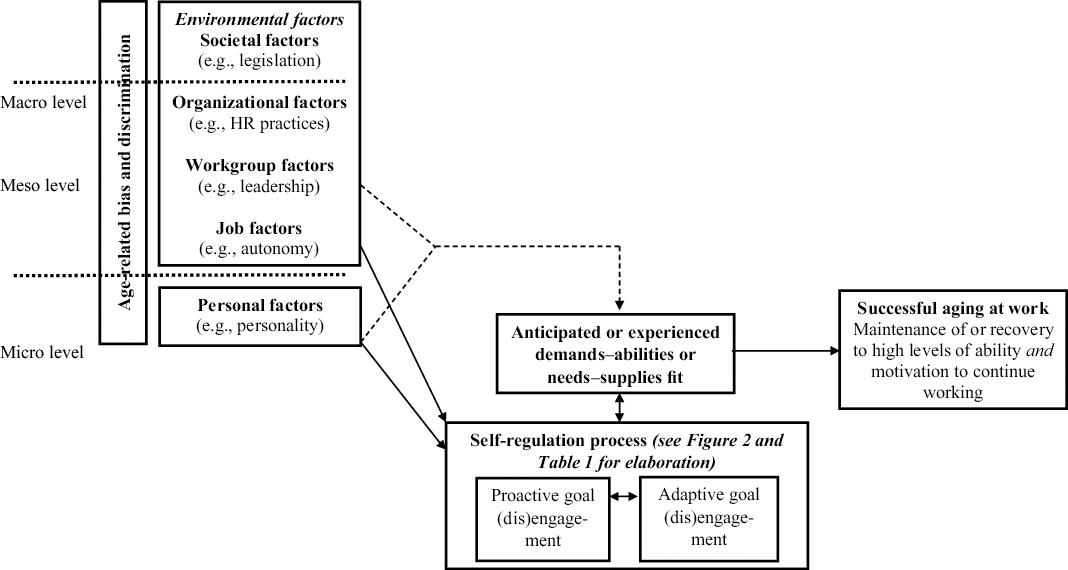
In this section, we propose such a process model of successful aging at work. Specifically, as illustrated in Figure 1, we argue that successful aging at work results from maintaining or restoring P-E fit at work by engaging in self-regulation behaviors. Here we particularly focus on demands–abilities and needs–supplies fit as distinguished by Edwards (Reference Edwards, Cooper and Robertson1991). Demands–abilities fit refers to the match between employees’ knowledge, skills, and abilities and the requirements of the job, work group, or organization. At the beginning of this article, we described the case of John, who anticipated that his physical abilities would not match the requirements or demands of the job in the long term. Needs–supplies fit refers to the fulfillment of employees’ needs, desires, or preferences by the resources offered by their job, work group, or organization (Edwards, Reference Edwards, Cooper and Robertson1991). In our example, Theresa adapted to a needs–supplies misfit when her needs for existing relationships and stability were no longer met by the organization. A misfit between the person’s abilities or needs and the demands imposed or resources provided by the work environment, respectively, can function both as a trigger for self-regulation behaviors and may undergo change as an outcome of self-regulation behaviors (proactively or in response to environmental changes). A continued good P-E fit requires active self-regulation on the part of the employee because both the individual employee and the work environment likely undergo continuous change.
Process model of successful aging at work. Note. Dashed lines refer to the interplay between work environment and personal factors; dotted lines separate the different levels.

We argue that self-regulation behaviors related to maintaining and restoring high levels of P-E fit are likely to result in maintenance of, or recovering to, high ability and motivation to continue working. Further, we propose that (mis)fit can result from (age-related) changes in the person at the micro level and from changes in the work environment at the macro (i.e., broad societal factors) or meso (i.e., the direct work environment) levels. Specifically, societal factors at the macro level; organizational, work group, and job factors at the meso level; personal factors at the micro level; and age-related bias and discrimination operating at each level function as antecedents of the self-regulation process. We should note here that proactive action and adaptation could, of course, also occur at the level of the organization (e.g., company or employer) or at the level of the society (e.g., governments or trade unions), but this is not the focus of the present article.
A specific and practical conceptualization of successful aging at work
Refining earlier research on successful aging at work (e.g., Abraham & Hansson, Reference Abraham and Hansson1995; Kanfer et al., Reference Kanfer, Beier and Ackerman2013; Kooij, Reference Kooij2015a; Zacher, Reference Zacher2015a) and drawing on the lifespan psychology literature (e.g., Heckhausen et al., Reference Heckhausen, Wrosch and Schulz2010), we define successful aging at work as the proactive maintenance of, or adaptive recovery (from decline) to, high levels of ability and motivation to continue working among older workers. According to Baltes (Reference Baltes1997), maintenance (including recovery) is one of three major goals of developmental adaptation and refers to maintaining high levels of functioning in the face of new challenges, such as declining physical health or information processing abilities. Since many aging employees increasingly experience these challenges, they tend to allocate more of their resources, such as time and energy, to this important goal (Ebner et al., Reference Ebner, Freund and Baltes2006). An important maintenance goal could be to stay healthy despite challenging job demands or to keep up the current level of job performance. Indeed, both the maintenance of ability and the regulation of motivation are critical outcomes of exerting primary control throughout the lifespan (Heckhausen et al., Reference Heckhausen, Wrosch and Schulz2010, Reference Heckhausen, Wrosch and Schulz2019).
Building on this existing literature and the relevance of both ability (e.g., to keep up with environmental changes) and motivation (e.g., to continue working) in the work context, we propose that successful aging at work implies the proactive maintenance of or adaptive recovery to high levels of ability and motivation to continue working among older workers. Ability to continue working refers to being physically and psychologically able to work, often resulting from the compatibility or fit between the requirements and/or demands of the work environment and the capacities of the employee (i.e., demands–abilities fit). For example, when the work environment is too demanding in terms of physical demands for older workers (i.e., physical demands are greater than physical abilities), their physical health might deteriorate, potentially resulting in a physical inability to continue working. On the other hand, when the work environment does not require the use of knowledge, skills, and abilities of older workers, cognitive capacities (e.g., working memory) may decline, potentially resulting in a psychological inability to continue working (e.g., Hertzog et al., Reference Hertzog, Kramer, Wilson and Lindenberger2008). Some example variables that have been used to operationalize the ability to continue working in the literature are physical and cognitive capacities (e.g., Leijten et al., Reference Leijten, van den Heuvel, Ybema, van der Beek, Robroek and Burdorf2014; Trevisan & Zantomio, Reference Trevisan and Zantomio2016). Motivation to continue working refers to wanting to work (Kanfer et al., Reference Kanfer, Beier and Ackerman2013), often resulting from the fit between what the work environment offers and employees’ motives (i.e., needs–supplies fit). When the work environment fulfills the motives of older workers, they likely will be more attracted to continue working. In the literature, typical examples of variables operationalizing the motivation to continue working are work engagement and job satisfaction (e.g., Demerouti et al., Reference Demerouti, Bakker, Nachreiner and Schaufeli2001).
Our conceptualization of successful aging at work offers a number of advantages over the existing literature. First, using ability and motivation to continue working to conceptualize successful aging at work provides clarity. For example, Zacher (Reference Zacher2015a) did not elaborate on the specific constructs capturing successful aging at work, but mainly focused on the idea of positive deviations from the average aging trajectory in the workplace. Kooij (Reference Kooij2015a), on the other hand, did not separate P-E fit in terms of ability and motivation to continue working and broadly referred to motivation, health, and work ability when defining the construct of successful aging at work. By advocating the importance of both ability and motivation to continue working, we provide clarity about which indicators with well-established measures to include in studies on successful aging at work.
In addition, ability and motivation to continue working are important outcomes to consider when trying to assess successful aging at work from employees’, organizations’, and society’s perspectives. Previous conceptualizations did not capture these different perspectives. For example, Robson et al. (Reference Robson, Hansson, Abalos and Booth2006) focus only on the individual employee’s perspective. In addition, although Zacher (Reference Zacher2015a) included worker outcomes important from multiple perspectives, in his conceptualization he focused on deviations from the average intra-individual age-related trajectory in these worker outcomes. This implies that an individual employee with decreasing job performance ages successfully at work if his or her decrease in job performance is less strong than the average decrease in job performance. From an organization’s perspective, this may not be considered successful aging at work.
Finally, our conceptualization is more comprehensive in terms of measurement than previous approaches. Maintenance of, or recovering to, high ability and motivation can be operationalized in various ways, including both subjective and objective measures, and allows for a temporal focus and tracking of changes in worker outcomes over time (Zacher, Reference Zacher2015a). Although a temporal focus on change is very important when assessing successful aging at work (which is by definition a temporal process characterized by changes), previous conceptualizations of successful aging at work did not properly capture this.
The behavioral processes involved in successful aging at work
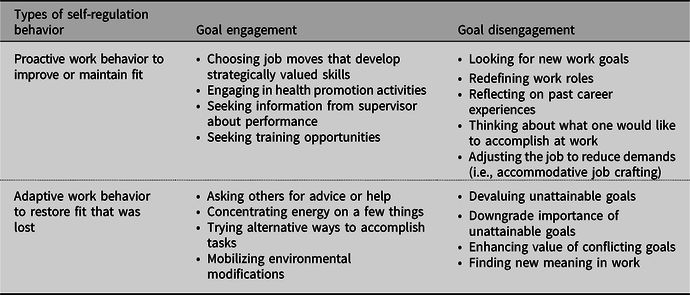
Converging with the literature on lifespan and organizational psychology, our process model of successful aging at work is anchored at the fit between a person and his/her work environment, and the consequences that has for the person’s self-regulation behavior (i.e., the middle part of Figure 1). The literature on lifespan psychology relates these self-regulation behaviors to goal engagement and goal disengagement (Heckhausen et al., Reference Heckhausen, Wrosch and Schulz2010). In the organizational psychology literature, related concepts are proactive and adaptive work behaviors, respectively (Bindl & Parker, Reference Bindl, Parker and Zedeck2011; Jundt et al., Reference Jundt, Shoss and Huang2015). Based on these four behaviors distinguished in previous studies (i.e., goal engagement, goal disengagement, proactive work behaviors, and adaptive work behaviors), we can identify four types of self-regulation behavior that are outlined in Table 1 (and are part of the self-regulation process in Figure 1).
Examples of self-regulation behavior

First, proactive goal engagement refers to self-initiated, anticipatory action aimed at goal pursuit (Grant & Ashford, Reference Grant and Ashford2008; Heckhausen et al., Reference Heckhausen, Wrosch and Schulz2010; Parker et al., Reference Parker, Williams and Turner2006). This type of behavior does not require prior change in the self or the work environment. The employee anticipates possible future changes in the self (e.g., John who anticipated decreasing physical health; part of personal factors in Figure 1) or work environment (e.g., technological changes that might make certain skills redundant; part of the societal factors in Figure 1). Subsequently, the employee acts on these potential changes by considering opportunities and accompanying consequences and finally by engaging in goal pursuit. As such, this type of behavior is focused on maintaining high fit or avoiding misfit between the person and the environment in the future (e.g., Parker & Collins, Reference Parker and Collins2010). It involves, for example, choosing job moves that develop strategically valued skills, engaging in health promotion activities, practicing certain skills that may otherwise deteriorate with the aging process, seeking information from the supervisor about performance or, like John, developing new knowledge and skills by going back to school in addition to his day job.
Second, proactive goal disengagement refers to self-initiated, anticipatory action aimed at protecting motivational resources (Grant & Ashford, Reference Grant and Ashford2008; Heckhausen et al., Reference Heckhausen, Wrosch and Schulz2010; Parker et al., Reference Parker, Williams and Turner2006). Similar to proactive goal engagement, this type of behavior does not require prior change in the self or the work environment; rather, the employee anticipates possible future changes in the self (e.g., changing work motives; part of the personal factors in Figure 1) or the work environment (e.g., changes in the opportunities offered by the organization; part of the organizational factors in Figure 1). Subsequently, the employee acts on these potential changes by deactivating a goal and withdrawing effort, and by self-protection. This type of behavior is also focused on maintaining fit or avoiding misfit between the person and the environment in the future (e.g., Parker & Collins, Reference Parker and Collins2010), but instead of pursuing goals to maintain fit or avoid misfit, this type of behavior involves for example looking for new work goals, reflecting on past career experiences, and thinking about what one would like to accomplish in work. For example, instead of learning new knowledge and skills to enrich his job, John could have looked for a new job in a different occupation that would not be physically demanding.
Third, adaptive goal engagement refers to coping or dealing with or effectively responding to already experienced changes in personal resources and the work environment by engaging in goal pursuit (Heckhausen et al., Reference Heckhausen, Wrosch and Schulz2010; Pulakos et al., Reference Pulakos, Arad, Donovan and Plamondon2000). The employee acts on these experienced changes by considering opportunities and accompanying consequences and finally by engaging in goal pursuit. As such, this type of behavior is focused on restoring P-E fit after the employee has already experienced a misfit and involves, for example, asking others for advice or help, concentrating energy on a few things (like Theresa did), trying alternative ways to accomplish tasks, and following a training to update outdated skills. For example, imagine a former colleague of John who is still working as a construction worker and who experienced a misfit between his physical abilities and the requirements of the job. In order to still perform his job at higher ages, he teamed up with a younger colleague who can help with the physically more demanding tasks.
Finally, adaptive goal disengagement refers to coping or dealing with or effectively responding to already experienced changes in personal resources and the work environment to protect motivational resources (Heckhausen et al., Reference Heckhausen, Wrosch and Schulz2010; Pulakos et al., Reference Pulakos, Arad, Donovan and Plamondon2000). The employee acts on these experienced changes by deactivating a goal, withdrawing effort, and self-protection. As such, this type of behavior is also focused on restoring P-E fit after the employee has already experienced a misfit. However, instead of pursuing goals to restore P-E fit, this type of behavior involves, for example, devaluing unattainable goals, enhancing the value of conflicting goals, and finding new meaning in work. For example, the former colleague of John could have told his manager that he was no longer able to complete the physically demanding tasks of his job and asked for other, more suitable tasks that do not draw on physical abilities.
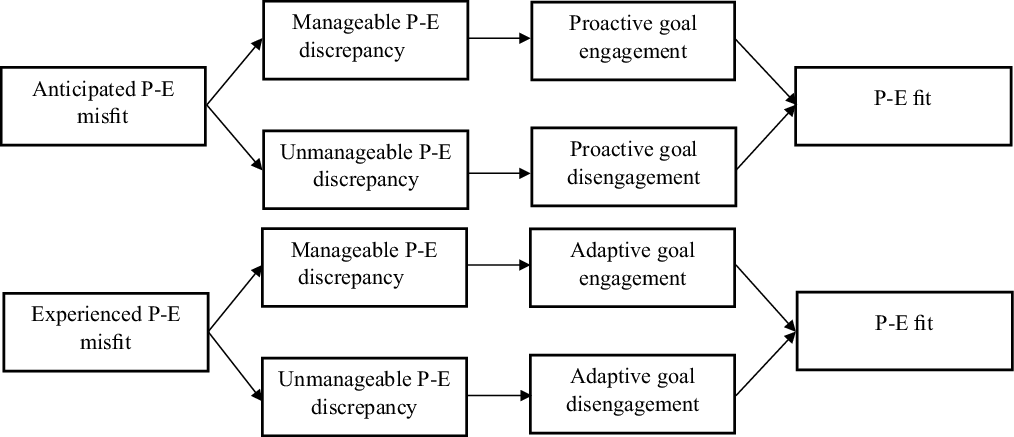
The self-regulation process is thus anchored by either the anticipated or the experienced fit between the person and his or her work environment. If an employee can anticipate changes in her or his own needs or abilities or in the supplies and demands of the work environment, the employee can be proactive in her or his self-regulation behavior. Given an anticipated divergence of P and E, two scenarios are possible. P and E can diverge to a lack of fit that the individual perceives to be manageable (controllable) or beyond his or her capacity to match job demands with own abilities (i.e., unmanageable). In the case of manageable/controllable anticipated change, the individual employee can use proactive goal engagement strategies. In the case of unmanageable anticipated change in P-E fit, the individual employee should find ways to proactively disengage and use compensatory secondary control strategies accordingly. The other set of scenarios pertains to changes in P-E fit that were not anticipated by the employee. In these cases, the individual employee will experience the negative implications of a deteriorated P-E fit, and then react with attempts to adapt to this situation. Again, there can be two scenarios, one of manageable P-E discrepancies resulting in adaptive goal engagement, and another one of unmanageable discrepancies resulting in adaptive goal disengagement.
We outline these processes in Figure 2. These processes might unfold as follows. An older teacher notices that her knowledge, skills, and experience related to mentoring insecure children are not fully used. She thus anticipates a misfit between her abilities and the requirements of her job. She deems this a manageable misfit and engages in proactive goal engagement (i.e., career planning behavior; Claes & Ruiz-Quintanilla, Reference Claes and Ruiz-Quintanilla1998) with the goal to take on a new role of mentoring insecure children of the whole school to make sure she fully uses her knowledge, skills, and experience. To try to achieve this goal she will also seek career guidance from her manager. By engaging in these goals, she tries to maintain the fit between her increased knowledge, skills, and experience (a changing personal factor) and her work environment (particularly at the job level). Consider another scenario in which the older teacher notices that her knowledge, skills, and experience related to managing the school’s work and her colleagues are not fully used. Since optimally using these knowledge, skills, and experience would imply a promotion to a manager role and opportunities for promotion are very scarce in the organization (particularly for older workers), she deems this an unmanageable misfit and she engages in proactive goal disengagement by looking for a new work goal that does fit her job. Finally, consider a scenario in which the older teacher experiences a sudden backache that limits her ability to stand for a long period of time. Since standing in front of the classroom is one of the requirements of her job, she experiences a misfit. However, she considers the misfit manageable and engages in proactive goal engagement by requesting a tall chair for her to sit on in front of the class. If she would have deemed the misfit unmanageable, she could have downgraded the importance of standing in front of the class and perform most of her job sitting on a chair.
Process model of proactive and adaptive goal engagement and disengagement.

In sum, as illustrated in the middle part of our conceptual model, we argue that self-regulation processes involving goal engagement and goal disengagement influence and are influenced by P-E fit (the double arrow in Figure 1). Since the work environment changes continuously over time (e.g., due to restructuring and technological developments) and the individual changes continuously as well (e.g., with respect to abilities and work motives), employees are continuously motivated to engage in self-regulation behaviors to counter the effects of changes in the individual and work environment on anticipated P-E misfit (the dashed arrows in Figure 1). In addition, unforeseen changes in the work environment or self can result in experienced misfit, also motivating self-regulation behaviors. These self-regulation behaviors, in turn, lead to successful aging at work, because a continuous fit means that employees fulfill present needs and optimally use current abilities without compromising the fulfillment and use of future needs and abilities (Kooij, Reference Kooij2015a). Supporting this line of reasoning, P-E fit has been shown to be beneficial, for example in terms of predicting career satisfaction, innovative work behaviors, objective performance, turnover, and general employee well-being (e.g., Kristof-Brown et al., Reference Kristof-Brown, Zimmerman and Johnson2005; Rauvola et al., Reference Rauvola, Rudolph, Ebbert and Zacher2020; Wang et al., Reference Wang, Zhan, McCune and Truxillo2011; Zacher et al., Reference Zacher, Feldman, Schulz, Perrewé, Halbesleben and Rosen2014).
Antecedents of successful aging at work
Heckhausen and Schulz (Reference Heckhausen and Schulz1993) distinguish age- and time-based opportunities and constraints that motivate the use of strategies to age successfully. These opportunities and constraints are part of the aging process (e.g., biological maturation) and social institutions (e.g., fixed retirement ages). Similarly, Baltes (Reference Baltes1987) offered a taxonomy of contextual influences on individual development. He distinguished age-graded normative influences, such as biological maturation and age-graded socialization events (similar to the opportunities and constraints mentioned above), history-graded influences associated with a certain historical period (e.g., industrialization), and non-normative influences that do not follow a general and predictable pattern (e.g., idiosyncratic life events such as accidents). Although these frameworks identify individual and societal factors that may trigger particular strategies (e.g., primary control and selection) to age successfully, these frameworks do not necessarily identify factors relevant in a work setting, nor do they identify factors that stimulate or enable these self-regulation behaviors.
Moving to the left side of the model in Figure 1, we integrate both theoretical frameworks in the adult development literature and the literature on organizational psychology (e.g., Kozlowski & Klein, Reference Kozlowski, Klein, Klein and Kozlowski2000; Wang & Shultz, Reference Wang and Shultz2010; Zacher et al., Reference Zacher, Feldman, Schulz, Perrewé, Halbesleben and Rosen2014) and adopt a multilevel framework to identify factors that enable self-regulation behaviors at work by increasing the ability or motivation to engage in these behaviors (normal arrows between environmental and personal factors and self-regulation process) or trigger self-regulation behaviors at work by leading to misfit between the person and the environment (dashed lines between environmental and personal factors and fit). In addition, since age-related bias and discrimination manifest across all levels (i.e., macro, meso, and micro levels), we consider these factors as general influences that cut across all conceptual levels. As illustrated in Figure 1, when these factors lead to P-E (mis)fit, they trigger self-regulation processes. For example, many organizations lack HR practices aimed at motivating older workers, which might lead to a misfit between what the organization supplies to the aging employee and what the aging employee needs. In addition, these factors can play a role in enabling self-regulation processes as we detail below.
Societal factors
Factors at the macro level are based on sociological theories (e.g., Mayer, Reference Mayer2009) and refer to factors at the societal level. These are national institutions, cultural values, and legislation, as well as regulations and policies that influence attitudes and behaviors of the employers and employees within a certain country. For example, a pension policy with incentives to retire early accelerates the endpoint of a career, possibly mitigating the need for proactive goal engagement aimed at maintaining P-E fit, and instead triggering proactive goal disengagement and with it a devaluation of work goals. On the other hand, equal employment opportunity (EEO) laws, which are prevalent in many Western countries, prohibit discrimination against older workers during recruitment, selection, training, and development, and thus enable certain self-regulation behaviors (e.g., skill development and career change). In addition, cultural values influence the extent to which people from different countries focus on goal engagement strategies (Kreiser et al., Reference Kreiser, Marino, Dickson and Weaver2010). For example, employees in countries scoring high on uncertainty avoidance or collectivism are less likely to engage in self-regulation behaviors, such as skill development and networking behaviors (Claes & Ruiz-Quintanilla, Reference Claes and Ruiz-Quintanilla1998).
Organizational factors
Organizational factors at the meso level are based on organizational and management theories (e.g., Kozlowski & Klein, Reference Kozlowski, Klein, Klein and Kozlowski2000; Peccei et al., Reference Peccei, Van De Voorde, Van Veldhoven, Paauwe, Guest and Wright2013). In particular, organizational climate and HR practices are important factors here. For example, a work climate in which employees support and trust each other stimulates employees to engage in self-regulation behavior (e.g., Parker et al., Reference Parker, Williams and Turner2006). Hence, in organizations with an age-diversity climate (i.e., “shared perceptions of the fair and nondiscriminatory treatment of employees of all age groups with regard to all relevant organizational practices, policies, procedures, and rewards”; Boehm et al., Reference Boehm, Kunze and Bruch2014, p. 671), employees will feel trusted and supported, and are thus more likely to engage in self-regulation behavior (Bindl & Parker, Reference Bindl, Parker and Zedeck2011).
Further, organizational psychology literature points to the importance of high involvement management (HIM; Parker et al., Reference Parker, Wall and Cordery2001) for enabling self-regulation behavior at work. HIM refers to HR practices that encourage greater proactivity, flexibility, and collaboration among workers (Wood et al., Reference Wood, Van Veldhoven, Croon and de Menezes2012). HIM thus includes practices such as extensive training, teamwork, decentralized decision making, information sharing, flexible job descriptions, career development, feedback, and job rotation (Vandenberg et al., Reference Vandenberg, Richardson and Eastman1999; Wood et al., Reference Wood, Van Veldhoven, Croon and de Menezes2012). Earlier studies indeed demonstrated that these practices result in psychological empowerment (e.g., self-efficacy and self-determination; Messersmith et al., Reference Messersmith, Patel, Lepak and Gould-Williams2011), also among older workers (Kooij & De Lange, Reference Kooij and De Lange2017). In addition, HIM is likely to increase the zone of acceptance (i.e., the array of decisions or actions accepted as part of a job; Simon, Reference Simon1997), and thus enables employees to adjust the job to personal abilities and motives. Indeed, previous research has also found that particular HR practices (i.e., job re-assignment, promotion, providing flexibility in when, where, and for how long older workers engage in work-related tasks, and career customization combined with high manager support) increased the motivation and ability to continue working for older workers (Bal & De Lange, Reference Bal and De Lange2015; Bal et al., Reference Bal, Van Kleef and Jansen2015; Nekola et al., Reference Nekola, Principi, Švarc, Nekolová and Smeaton2018).
Workgroup factors
Organizational HR practices and climate can be very different from HR practices and climate at the workgroup level (e.g., Nishii & Wright, Reference Nishii, Wright and Smith2008), particularly in large organizations. Workgroup factors are based on social psychological theories about norms, modeling, and contagion (e.g., Ilies et al., Reference Ilies, Wagner and Morgeson2007). Here the workgroup or unit manager plays an important role in implementing HR practices and establishing close relationships with workgroup or unit members in order to instill an age-diversity climate (Boehm et al., Reference Boehm, Kunze and Bruch2014). A positive age diversity climate signals that older workers’ contributions are appreciated and creates a climate of trust, which are likely to stimulate self-regulation behavior at work. In addition, a high-quality exchange relationship between leaders and their employees also promotes a climate of trust and thus enables self-regulation behaviors aimed at maintaining or restoring P-E fit (Bindl & Parker, Reference Bindl, Parker and Zedeck2011). Similarly, leadership is an important factor to consider at the workgroup level. Research demonstrates that participative leadership (i.e., leaders that involve subordinates in decision making) and transformational leadership (i.e., leaders that motivate subordinates to go beyond standard expectations) enable self-regulation behavior among employees (Bindl & Parker, Reference Bindl, Parker and Zedeck2011; Den Hartog & Belschak, Reference Den Hartog and Belschak2012). Similarly, Hansen (Reference Hansen, Dik, Byrne and Steger2013) proposes that leadership and management practices, such as promoting autonomy, encouraging participative decision and policy making, and displaying confidence in employees, will increase employee empowerment.
Job factors
Other important factors at the meso level are job factors (Nishii & Wright, Reference Nishii, Wright and Smith2008; Peccei et al., Reference Peccei, Van De Voorde, Van Veldhoven, Paauwe, Guest and Wright2013) that are based on work design theories, such as the job characteristics model (Hackman & Oldham, Reference Hackman and Oldham1976) and the job demands-resources model (Demerouti et al., Reference Demerouti, Bakker, Nachreiner and Schaufeli2001). Job characteristics are of profound importance for enabling employees to engage in self-regulation behaviors. The organizational psychology literature demonstrates that particularly job resources, such as job autonomy, job complexity, and job enrichment, are likely to stimulate self-regulation behavior (Bindl & Parker, Reference Bindl, Parker and Zedeck2011; Parker et al., Reference Parker, Williams and Turner2006). Indeed, studies demonstrate that high job resources lead to higher motivation and ability to continue working (e.g., Havermans et al., Reference Havermans, Boot, Hoekstra, Houtman, Brouwers, Anema and van der Beek2018; Henseke, Reference Henseke2018; Pak et al., Reference Pak, Kooij, De Lange and Van Veldhoven2019). However, these studies also demonstrate that high job demands lead to lower motivation and ability to continue working. Particularly, physically demanding jobs are detrimental for older workers (e.g., Neupane et al., Reference Neupane, Virtanen, Luukkaala, Siukola and Nygård2014). On the other hand, challenging as opposed to hindering job demands, such as workload and time pressure, can also trigger self-regulation behavior (Lepine et al., Reference Lepine, Podsakoff and Lepine2005; Ohly & Fritz, Reference Ohly and Fritz2010). In line with this reasoning, Kooij et al. (Reference Kooij, Nijsen and Bal2018) found that active jobs (characterized by high autonomy and high work pressure) stimulate older workers to engage in job crafting behavior (i.e., self-initiated changes in the job to improve person-job fit; Wrzesniewski & Dutton, Reference Wrzesniewski and Dutton2001).
Personal factors
Personal factors refer to factors and characteristics at the individual or micro level. Besides influencing fit by interacting with the work environment, personal factors also enable self-regulation behavior. Here we take a resource-based approach and focus on personal resources that enable self-regulation behaviors. These can include personality traits (e.g., conscientiousness, optimism, and proactive personality), knowledge, skills, and abilities, motivations (e.g., work centrality and career attachment), and lifestyle factors (e.g., nutrition, exercise, and health habits). The literature reveals a number of personal resources that enable self-regulation behaviors at work. For example, cognitive abilities and job-specific expertise are likely to increase self-efficacy and control beliefs and thus to enable self-regulation behavior at work (Dutton et al., Reference Dutton, Ashford, O’Neill and Lawrence2001; Kanfer et al., Reference Kanfer, Wanberg and Kantrowitz2001; Lachman & Weaver, Reference Lachman and Weaver1998). Furthermore, studies have shown that the personal resources of personal mastery, perceived health, cognitive functioning, and an open-ended future time perspective (or people’s beliefs and perceptions that much time is left in their future life; Carstensen, Reference Carstensen1995) led to an increase in one’s ability to continue working (Kooij & Van de Voorde, Reference Kooij and Van de Voorde2011; Müller et al., Reference Müller, De Lange, Weigl, Van der Heijden, Ackermans and Wilkenloh2015; Stynen et al., Reference Stynen, Jansen and Kant2017). These personal resources are particularly important for older workers who have to deal with age-related losses. In addition, earlier studies show that conscientious employees and those with a proactive personality are more likely to engage in network building, proactive job search, career initiative, and career planning (e.g., Kanfer et al., Reference Kanfer, Wanberg and Kantrowitz2001; Seibert et al., Reference Seibert, Kraimer and Crant2001).
Age-related bias and discrimination
Age-related bias and discrimination can manifest at the macro, meso, and micro levels. Here, age-related bias refers to the cognitive component of stereotyping older workers and discrimination refers to the behavioral component of making decisions based on these stereotypes (McCarthy et al., Reference McCarthy, Heraty, Bamberg, Baltes, Rudolph and Zacher2019). Research shows that many older employees are still faced with widespread negative age stereotypes regarding their motivation, performance, flexibility, and learning (Posthuma & Campion, Reference Posthuma and Campion2009). At the macro or societal level, age bias means that there might be negative attitudes toward older workers in society. At the meso level, age bias and discrimination can trigger an age-discrimination climate (e.g., Kunze et al., Reference Kunze, Boehm and Bruch2011) that might influence organizational, workgroup, and job-related practices, such as providing less support and fewer opportunities to older workers than to younger workers. At the micro level, age bias means that older workers might internalize negative age stereotypes (Kornadt & Rothermund, Reference Kornadt and Rothermund2012), with detrimental physical and cognitive effects (Levy, Reference Levy2003). In addition, older employees tend to react more negatively than young employees to the feeling of being negatively stereotyped (Finkelstein et al., Reference Finkelstein, King and Voyles2015; Von Hippel et al., Reference von Hippel, Kalokerinos and Henry2013). As such, age-related bias and discrimination will limit behavior choices. On the other hand, research suggests that reactions to negative stereotypes depend on whether the situation is perceived as a challenge or as a threat (Vick et al., Reference Vick, Seery, Blascovich and Weisbuch2008; Von Hippel et al., Reference von Hippel, Kalokerinos, Haanterä and Zacher2019). When older workers perceive stereotypes as a threat, this is likely to diminish goal engagement and increase goal disengagement. When older workers perceive stereotypes as a challenge, this is likely to increase goal engagement aimed at invalidating the age stereotypes and thus diminish goal disengagement. Research on the relationship between age bias and discrimination and successful aging at work is scarce, but suggests that perceived age discrimination will lead to a decrease in the motivation and ability to continue working (Griffin et al., Reference Griffin, Bayl-Smith and Hesketh2016; Marchiondo et al., Reference Marchiondo, Gonzales and Williams2017).
Roadmap for future research and practice
In this last section, we offer a roadmap guiding scholars in conducting future research on successful aging at work and guiding practitioners and policy makers in facilitating successful aging at work. First, researchers can use our conceptualization to operationalize successful aging at work. We propose a specific and practical conceptualization of successful aging at work: the proactive maintenance of or adaptive recovery to high levels of both ability and motivation to continue working among older workers. Following our conceptualization, variables with well-established measures can be used to capture successful aging at work. For example, physical and psychological capacities can reflect the ability to continue working, and work engagement and job attitudes can reflect the motivation to continue working. Further, following our conceptualization, future studies on successful aging at work should adopt a longitudinal design to capture the maintenance of these variables (Wang et al., Reference Wang, Beal, Chan, Newman, Vancouver and Vandenberg2017). Since we know of no studies that focus on successful aging at work as maintained or stable worker outcomes, we urge researchers in this field to conduct longitudinal studies in which they model the stability in worker outcomes and identify multilevel factors and self-regulation behaviors that are associated with such stability in addition to recovery (i.e., short-term growth).
Second, in line with our process model, future research should examine the roles of self-regulation behaviors in maintaining or recovering to high ability and motivation to continue working and how they relate to misfit. In particular, qualitative studies are needed to examine the specific self-regulation behaviors that older workers engage in to maintain or restore their P-E fit. Although the literature on organizational and lifespan psychology (e.g., Heckhausen et al., Reference Heckhausen, Wrosch and Schulz2010; Kooij, Reference Kooij2015a; Parker & Collins, Reference Parker and Collins2010) offers some potentially relevant self-regulation behaviors, we currently lack knowledge about which of these behaviors employees use to age successfully at work. Subsequently, experience sampling studies could be very valuable in furthering our understanding of these behaviors. For example, adopting a daily diary research design to examine older workers’ behavioral responses to day-to-day stressors rooted in the work environment, such as work demands or age-related bias, may advance our understanding about how their self-regulation behaviors develop and interact at the workplace.
Third, future research should examine the enabling factors identified in our multilevel process model. Although previous research has examined enabling factors of proactive behavior at work (e.g., Bindl & Parker, Reference Bindl, Parker and Zedeck2011), this research did not focus on self-regulation behaviors aimed at maintaining or restoring P-E fit during workers’ aging process. To examine the enabling factors at the societal level, cross-national studies comparing self-regulation behaviors of older workers in countries with different cultural values and socioeconomic policies are needed. At the organizational, work group, and job levels, intervention studies can help identify which factors (e.g., high involvement HR practices, supportive climate, participative leadership, or autonomy) stimulate older workers’ self-regulation behaviors. For example, Kooij et al. (Reference Kooij, Van Woerkom, Wilkenloh, Dorenbosch and Denissen2017) demonstrated that a job crafting workshop was particularly beneficial for older workers, stimulating them to craft their jobs and thereby increasing their person-job fit.
Of course, enabling factors at these different levels does not work in isolation; potential cross-level interactions and bottom-up processes can occur. For example, individual perceptions of whether employees of all age groups are treated fairly and nondiscriminatory with regard to organizational practices may aggregate into an age-diversity climate at the work group or organizational level. Future research should thus take into account that an intervention carried out at one level might have implications at other levels as well. For example, an intervention at the organizational level stimulating an age-inclusive climate might trickle down to the workgroup level if lower-level managers copy senior managers’ practices and behavior. Similarly, future research should consider the possibility that age-related bias and discrimination at different levels may hinder the enabling factors at the corresponding levels and constrain their beneficial effects.
Finally, future research should examine the personal factors that influence older workers’ self-regulation behaviors. One fruitful research endeavor would be to identify distinct subgroups of older workers that adopt unique patterns of self-regulation strategies and of successful aging at work (e.g., Thrasher et al., Reference Thrasher, Zabel, Bramble and Baltes2018). Although most studies treat older workers as a homogeneous group, they are heterogeneous (e.g., Nelson & Dannefer, Reference Nelson and Dannefer1992), because inter-individual differences increase with age (e.g., Light et al., Reference Light, Grigsby and Bligh1996). Similarly, there is much variability in how older adults respond to the aging process and, thus, the extent to which they age successfully (e.g., Baltes & Baltes, Reference Baltes, Baltes, Baltes and Baltes1990; Kooij, Reference Kooij2015a; Morack et al., Reference Morack, Ram, Fauth and Gerstorf2013). Future research can build on these insights and try to identify subgroups of older workers, for example based on their successful aging trajectories, and examine which personal resources (e.g., educational level, personality, retirement expectations, and occupation) may determine subgroup membership. Another fruitful venue for future research is to examine how our process model applies to employees with low levels of personal resources and interventions that can help these employees to age successfully at work.
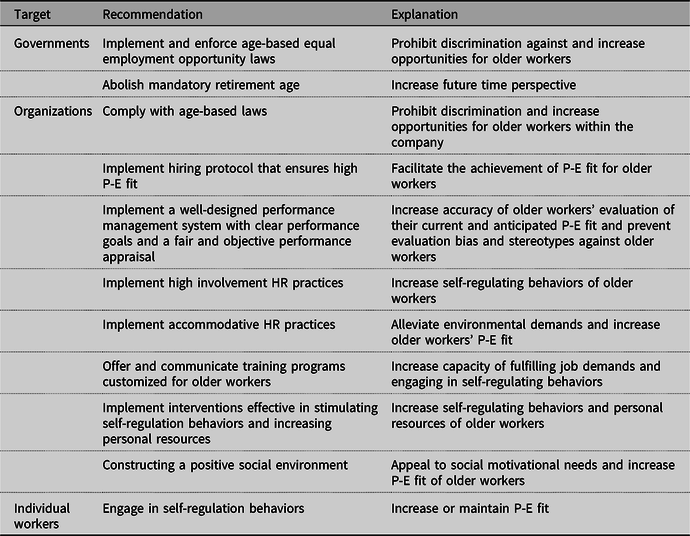
Our process model also serves as a useful and concrete guide to practitioners. It is important to note that our focus on self-regulation behaviors does not mean that we propose that employees are solely responsible for their own successful aging at work. As we emphasize by outlining the enabling factors in the societal and organizational context, governments, organizations, and managers play important roles in improving employees’ self-regulation behaviors. Our practical recommendations our summarized in Table 2. First, governments can promote successful aging at work by implementing and enforcing age-based equal employment opportunity laws. These laws prohibit discrimination against older workers during recruitment, selection, training, and development, increasing employment-related opportunities for older workers (e.g., the Age Discrimination in Employment Act, ADEA). Governments can also shape the future time perspective of older workers by abolishing mandatory retirement age, which in turn is likely to increase older workers’ perceived ability and motivation to continue working.
Practical implications

Second, organizations also play an important role in enabling and stimulating older workers’ self-regulation behaviors to maintain or recover their P-E fit. In particular, apart from complying with the above-mentioned age-related regulations by ensuring equal opportunities for training and promotion, organizations can also implement other general HR practices to support older workers’ successful aging (De Lange et al., Reference De Lange, Kooij, Vander Heijden, Finkelstein, Truxillo, Fraccaroli and Kanfer2015; Von Bonsdorff et al., Reference Von Bonsdorff, Zhou, Wang, Vanhala, von Bonsdorff and Rantanen2018). For instance, from a recruitment and hiring perspective, a hiring protocol that ensures employees’ P-E fit should help reduce the obstacles that older workers may face in the process of pursuing P-E fit. In addition, as older workers’ motivation to continue working is largely determined by whether they believe they can fulfill organizations’ performance requirement, a well-designed performance management system should be particularly essential for successful aging (Cleveland et al., Reference Cleveland, Huebner, Anderson, Agbeke, Baltes, Rudolph and Zacher2019; Wang et al., Reference Wang, Olson and Shultz2013, Reference Wang, Burlacu, Truxillo, James and Yao2015). Specifically, older workers’ accurate evaluation of their current and anticipated P-E fit requires organizations’ clear and consistent communication of qualitative and quantitative performance goals, as well as a fair and objective performance appraisal system that prevents evaluation bias and stereotypes against older workers. With these performance management practices, older workers are likely to have a better understanding of what organizations need from them and what they are actually capable of achieving, which should enhance the chance of successful regulatory processes. Furthermore, organizations can also motivate older workers’ self-regulation behaviors by implementing high involvement HR practices such as decentralized decision making, flexible job descriptions, and career development to offer a supportive work environment (Kooij & De Lange, Reference Kooij and De Lange2017).
Third, apart from the above-mentioned general HR practices, older workers’ successful aging may also benefit from age-specific HR practices. For example, due to older workers’ decreasing physical and cognitive ability, their occupational health and safety often stand out as serious concerns for both older workers themselves and organizations (Schmitt & Unger, Reference Schmitt, Unger, Baltes, Rudolph and Zacher2019). Accordingly, accommodative HR practices such as reducing workload, changing job design, and providing special safety protection for older workers may prove particularly useful in alleviating environmental demands and increasing older workers’ P-E fit (van Dalen et al., Reference van Dalen, Henkens and Wang2015). Further, older workers’ low motivation to increase P-E fit sometimes arises from their low awareness of training and development opportunities (Taneva & Arnold, Reference Taneva and Arnold2018; Wang et al., Reference Wang, Olson and Shultz2013). Hence, in addition to offering training and development programs customized for older workers, organizations should also try to promote older workers’ awareness of available resources. In doing so, older workers may perceive higher capacity of fulfilling job demands and be more motivated to proactively engage in self-regulation behaviors.
Fourth, organizations and managers can implement certain interventions that have been proven effective in stimulating self-regulation behaviors and increasing personal resources. For example, Kooij et al. (Reference Kooij, Van Woerkom, Wilkenloh, Dorenbosch and Denissen2017) tested the effects of a job crafting intervention and found that it helped increase job crafting behavior among middle-aged workers, who in turn perceived a higher person–job fit. In addition, Strijk et al. (Reference Strijk, Proper, van der Beek and Van Mechelen2012) found that a vitality intervention in the workplace increased older worker health indicators. Similarly, Hughes et al. (Reference Hughes, Seymour, Campbell, Shaw, Fabiyi and Sokas2011) found positive effects of a health promotion intervention on health indicators of older workers (see also Truxillo et al., Reference Truxillo, Cadiz and Hammer2015).
Fifth, apart from implementing formal regulations and HR practices, managers can also encourage older workers’ self-regulation behaviors via constructing a positive social environment that appeals to older workers’ social motivational needs. For instance, managers may help fulfill older workers’ need for support by engaging in participative leadership, offering mentoring opportunities, and providing day-to-day informal feedback (Buckingham & Goodall, Reference Buckingham and Goodall2015; Martin et al., Reference Martin, Guillaume, Thomas, Lee and Epitropaki2016). Further, coworkers’ support and respect may also help cultivate a social environment desired by older workers and thus reduce their perception of personal resources deficit (Charles & Carstensen, Reference Charles and Carstensen2010).
Finally, highlighting an agency view, it is important to note that employees themselves can decide to engage in self-regulation behaviors aimed at maintaining a fit between themselves and their work environments (Von Bonsdorff et al., Reference Von Bonsdorff, Zhou, Wang, Vanhala, von Bonsdorff and Rantanen2018). Like our exemplar cases John and Theresa, employees should be (made) aware of, anticipate, and act on future personal and situational changes to enhance their likelihood of aging successfully at work.
Taken together, successful aging at work requires a collective effort of all relevant stakeholders, including governments, organizations, managers, and workers themselves. With our process model we hope to provide guidance for researchers and practitioners as they attempt to understand and promote successful aging at work.