That fine, out-stepping fellow on the other side? A bishop, stranger, who'll stand no nonsense. When a City Council and its architect chose a site for a new school, a site he didn't like and thought unsuitable, he soon and short told them to build it on a site of his choosing; and when the Council decided to keep to their own selection, he soon and short told them they were behaving in the Continental manner of disrespect for their priests; a gentle warning that sent them running to vote as one man, bar the architect, for the holy bishop's choice. The bishop's ring rang the bell.
—Seán O'Casey, Autobiographies II Footnote 1“Imagine,” bellowed the Unionist politician Walter Topping at a rally in Belfast in 1949, “the local Roman Catholic bishop being allowed to dictate the policy of the Belfast Corporation on matters which involved only traffic safety and public health.”Footnote 2 Topping here referred to a town-planning dispute known as the Galway “school site controversy.”Footnote 3 For the playwright Seán O'Casey in his enigmatic Autobiographies, the outcome was all too predictable: “the bishop's ring rang the bell.”Footnote 4 Yet O'Casey's recollections are rather selective and fail to capture the complexity of the issues involved, and his was a hackneyed view of clerical power in modern Ireland. In this article, I use the Galway dispute to draw out two key arguments: first, that existing scholarship on the Catholic Church in Ireland in the mid-twentieth century overstates the church's hegemonic power, particularly in urban contexts; and second, following Joks Janssen, that histories of town planning in Europe more broadly are overly focused on state and supposedly “rational” agendas at the expense of how religious entities “(re)shaped the urban landscape” and forged parallel paths of urban modernity and urban governance.Footnote 5 I thus add an Irish and an urban-planning dimension to existing debates within religious history about urbanization and secularization, showing how adaptive the Irish Catholic Church was to high modernity.Footnote 6 In so doing, I make use of the private papers of Bishop Michael Browne held at the Galway Diocesan Archives, to which I was granted access in 2016. An academic before he became bishop, Browne was a leading European expert on canon law; his papers include extensive theological, philosophical, and historical writings on the nature of Western government in an era of ascendant liberalism, the social democratic state, totalitarianism, and communism.Footnote 7
Modern Irish urban history, in which religion has played so crucial a role, provides an avenue for exploring intellectual and cultural aspects of European modernity.Footnote 8 To understand the distinctive experience of Ireland in this time is to build on an unconventional—and perhaps iconoclastic—assumption: that the power of the Irish Catholic Church was always on shaky foundations and greatly contested. Contra the polemical writings of Paul Blanshard—whose 1954 treatise, The Irish and Catholic Power, portrayed Ireland as one cassock short of a theocratic state—or O'Casey's anti-clericalism, the precipitous and catastrophic collapse of the Catholic Church in Ireland since the 1980s suggests that historians need to reassess their claims of its overarching power in its supposed heyday of the 1930s to the 1950s.Footnote 9 The church's rise and fall over the 120 years from the “Devotional Revolution” of post-famine Ireland to the emotional revulsion of clerical sexual abuse scandals appears an increasingly narrow window in the long run of Ireland's modern history.Footnote 10
Furthermore, we should question narratives that stress an institution's total dominance followed, within forty years, by its complete capitulation. We should reject simple narratives of dominance or decline; in reality, the church appears more unstable and fractured. Writing to Bishop Michael Browne in February 1939, the editor of the weekly Irish Catholic newspaper the Standard, gave a frank and honest appraisal: “Being a Catholic journalist often means sadly laying aside a scoop or a trenchant leader in favour of maintaining, by silence, the façade of Catholic unity.”Footnote 11 By and large, existing writings on the Catholic Church and how it worked in an urban context tend either to downplay contestation and disagreement or to imply absolute—almost colonial or conspiratorial—power. Neither approach gives an accurate sense of the reality of urban governance. Robert Proctor, writing about the Catholic Church in postwar Britain, presents a surprisingly congenial relationship between bishops and town planners, working in broad agreement to allocate prominent sites in new towns and housing estates for churches and schools. How the church actually purchased or was offered sites is overlooked.Footnote 12 Ellen Rowley, by contrast, sees the archbishop of Dublin, John Charles McQuaid, as a modern prince-bishop, “a type of medieval God-with-compass figure, carving out the former green fields of Dublin's urban/rural edge.”Footnote 13 The title of John Cooney's biography, John Charles McQuaid: Ruler of Catholic Ireland, speaks volumes.Footnote 14 However, James S. Donnelly's study of Bishop Browne's “public morality” crusade in postwar Galway shows that any absolute urban power was at best illusionary, and the citizens of Galway were more than able to defy the bishop on a range of social issues.Footnote 15 Janssen, in an important recent study of Catholic urban development in the southern Dutch cities of Eindhoven and Roermond, highlights conflicting yet parallel conceptions of urban modernity. He shows in particular how the church in Eindhoven undermined the modernist proposals of the planner J. M. de Casseres in the 1930s.Footnote 16
Indeed, the focus on the Catholic Church in Ireland is something of a red herring. In terms of institutions accumulating and exercising urban power in mid-twentieth-century Europe, it is not the Catholic Church or any church that comes out on top—rather, it is the state. When historians of Ireland look at the postwar years, what is striking is not the rise and fall of the Catholic Church but the rise and rise of secular, bureaucratic authority. Yet the rise of state power remains, with some notable exceptions, under-theorized in Irish studies. Within this debate, town planning offers a critical nexus for understanding how the state transformed urban governance in these years. As with many national histories, the conservatism of Irish history writing is a by-product of the academy's close relationship with the state-building project; all too often existing histories of the Irish civil service, for example, celebrate too easily and in a Whiggish fashion its “achievements” and “rational” development.Footnote 17 Studying religious groups, and in particular Catholic opposition to the growth of state power, offers an avenue for a fresh critique of modern Irish history. The hegemonic power of the state not only challenged the Catholic Church but, as I argue below, forced the church into an adversarial and defensive position.Footnote 18 The formative debates concerning town planning, then, are a stage for understanding both state and clerical power and Ireland's distinctive engagement with modernity.Footnote 19 In turn, the Irish experience enriches existing scholarship on European town planning by firmly bringing religion back into both state-led debates on “rational” urban futures and parallel debates on heritage and conservation in the city.Footnote 20
I
Galway, the largest city in the western province of Connacht with a rich architectural heritage stretching back to the medieval period, was the site of a major Irish town planning dispute of the 1940s, concerning the location for a new boys’ primary school.Footnote 21 The drama had three key actors: the town planner, Dermot O'Toole (1910–1970); the local government manager, Clement O'Flynn (d. 1992); and the Catholic bishop, Dr. Michael Browne (1895–1980). The controversy grew out of the building of Ireland's last Catholic cathedral, planned by Browne during his long tenure as bishop from 1937 to 1976. The Catholic Cathedral of Our Lady and St. Nicholas, stone-clad, with a great copper dome, was designed by the Dublin architect J. J. Robinson and opened in 1965.Footnote 22 It is so closely attached to Browne's legacy that it is widely known in Galway—somewhat affectionately, somewhat in jest—as “Taj Micheál.” Its building had a long history. A first bequest came in 1876, and some thirty years later, the diocese acquired a site earmarked for the new cathedral, adjacent to O'Brien's Bridge and then occupied by the “Old Shambles” military barracks.Footnote 23 The Catholic diocese of Galway after the Reformation had continued without a cathedral for many centuries and from 1825 had relied on a rather undistinguished building in the city center to serve as a “Pro-Cathedral.”Footnote 24 Yet only a few years after becoming bishop, Browne decided to abandon the O'Brien's Bridge site and build his new cathedral elsewhere. The shift came with the closure of Galway Jail in May 1939 and the opening up of this much larger site for redevelopment. Browne successfully lobbied to secure the jail site for his new cathedral; he thought it more attractive with its axial vistas, its island location amidst rivers, the lack of nearby buildings, and the political and cultural capital of its troubled “colonial” history, and in particular the memory of the “Maamtrasna murders” case of the 1880s.Footnote 25
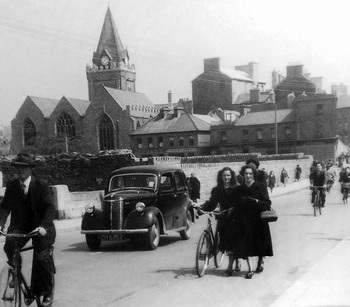
The move to the former jail site precipitated a debate over what to do with the derelict plot at O'Brien's Bridge. Galway County Council, under Clement O'Flynn—then secretary, later county manager—believed (and was quoted in the local papers as saying) that if the O'Brien's Bridge site remained unused, Browne would be willing to “negotiate for its disposal on favorable terms to the [Galway] Corporation” for a new Town Hall—something that, as is discussed below, the bishop later denied.Footnote 26 The O'Brien's Bridge site, adjacent to the city market and the medieval Protestant church of St. Nicholas—originally of course a Catholic church converted to Anglicanism in the seventeenth century—lay empty for decades after the demolition of the old barracks. Photographs from the time show it as forlorn and neglected (figure 1). A local man, without the bishop's permission, used part of it to put up billboard posters for the nearby Savoy Cinema;Footnote 27 Browne reluctantly allowed them to stay, though he thought the posters “an eye-sore and … in conflict with the solemn purpose for which the site was intended.” He insisted that the man not put up any posters advertising films that the bishop considered “objectionable.”Footnote 28
—O'Brien's Bridge, with the derelict former Shambles Barracks site and St. Nicholas (Church of Ireland) in the distance, ca. 1950. From Peadar O'Dowd, Galway in Old Photographs (Dublin, 2003), 69.

Similar to many Irish Catholic leaders, Browne was a strong supporter of private property rights. This position was very much in step with a population that keenly remembered the colonial confiscation of land, the Great Famine, and the Land War. As bishop, Browne acquired sites for his diocese like any other landlord; his authority in the city was ecclesiastical, but it was also political and economic. The diocese had a significant portfolio of tenanted properties in the city center, many of which it leased at reduced rates to poorer (Catholic) families and pensioners.Footnote 29 Despite the generous offer of the jail site for the future cathedral, Browne was ill-inclined to give up the O'Brien's Bridge site for a town hall or any other civic use—especially as he had already earmarked it for a new school. His belief in property rights was very much underpinned by the Irish Constitution of 1937, but this protection was threatened in these same years by the emerging discipline of town planning. Closely following British precedents, the Irish Town and Regional Planning Act of 1934 encouraged local authorities to develop plans for their urban centers. Once a council voted for such a plan, they could exercise “interim powers” to prevent unauthorized building work.Footnote 30 While in practice, private-property rights had long been moderated by state needs—for example, in the work of Dublin's eighteenth-century Wide Streets Commissioners or in the 1890 Housing of the Working Classes Act—formal national town planning was a significant new encroachment.Footnote 31 Dublin was the first city in Ireland to commit to a town plan, and Patrick Abercrombie, Sydney Kelly, and Manning Robertson—who, back in the 1920s, had proposed a radical reshaping of the capital city—published more modest plans in 1941.Footnote 32 Cork and Waterford soon followed, each proposing a “thinning out” of central precincts, new axial streets and ring roads, widespread demolition, and the reconstruction of housing.Footnote 33
None of these plans were ever adopted. Each faced sustained opposition from politicians and propertied interests, and the legal powers granted in the legislation were insufficient to enforce planning decisions. More importantly, central government in Ireland was, at best, lukewarm to the whole idea of planning—something it thought better suited other countries with denser urban populations, such as Britain. Diarmaid Ferriter has shown how Taoiseach (prime minister) Éamon De Valera warned Douglas Hyde, the president, that being seen to give patronage to the high aspirations of the National Planning Exhibition might bring his position into “ridicule.”Footnote 34 Perhaps more surprisingly, these views were shared north of the border: Basil Brooke, the Northern Ireland prime minister, thought planning a “socialist menace.”Footnote 35 The Irish Times quoted a skeptical De Valera in 1944 saying that planners’ proposals often “look better on paper than [they do] when you try to put them into practice.”Footnote 36 And in an important and neglected speech to architecture students at University College Dublin in May 1946, Seán MacEntee, the Fianna Fáil minister for local government—the man in charge of town planning in Ireland—set out his strident opposition to big government and to what he saw as the “restrictive and narrowing” policy of town planning. With characteristically Catholic and apocalyptic imagery, he set forth his views:
Unfortunately, that is the trouble with most enthusiastic planners: they don't know where to stop … How regular and happy and secure all our lives would be, if only the ordinary citizen, the common man—who has no time to dream our magnificent dreams—would conform to our plan? It only remains for the planners then to strive to make man to their own image and likeness. But the image and likeness to which they would make him is not that of his Creator, for they would make him to the pride and vain-glory of themselves; and he would perish, as the Egyptians under Pharaoh, or, as those forgotten races, the ruins of whose planned civilisations are found buried in equatorial jungles.Footnote 37
Historians of Irish town planning have tended to downplay or overlook the rich debates of these formative years. Often their analyses are rooted uncritically in the myth of Ireland as a rural society that had no need for urban planning policy, and assume a public that most of all valued property rights. Arguably, this lacuna has arisen because of an undue focus in much of the existing historiography (as Frank Mort has similarly noted in British planning studies) on the physical “achievements” of town planning—admittedly, sparse in these years—at the expense of a serious analysis of the rich intellectual debates that these unexecuted schemes sparked in provincial towns and cities.Footnote 38
However cautious De Valera was of embracing the revolutionary world of town planning, he had no qualms about reshaping Irish local government. His most important reform was the City and County Management System—which he had initially opposed as undemocratic when it was imposed on Cork in 1929—but which he readily adopted for other local authorities in the 1930s.Footnote 39 This system, imported from America, took away much of the powers of the local elected councilors and vested them in an unelected county manager. The Cork solicitor John Horgan, a keen promoter of the system, endorsed it somewhat paradoxically as “an expert bureaucracy under democratic control.”Footnote 40 By contrast, one critic writing in 1945 thought it “a rather awesome admission of failure, an admission that [Ireland was] not, in some respects, fit for self-government.”Footnote 41 But Irish governments of the 1930s were perennially frustrated by local councils’ financial incompetence and perceived corruption.Footnote 42 They even flirted with the idea of abolishing local government outright.Footnote 43 De Valera's compromise, the County Management Act, which took effect in 1942, was a great bureaucratic centralization of power, appointing a manager to every council.Footnote 44 The trajectory and reception of one such manager is indicative of these trends. Clement O'Flynn worked for Limerick County Council in the 1920s and came to Galway in 1931 as county secretary. The manner of his appointment, his generous salary, and his lack of proficiency in the Irish language (a sensitive matter in the west of Ireland) did little to endear him to Galway's councilors, and he was welcomed with a boycott.Footnote 45 Nonetheless, in 1942, he was promoted to county manager, and he remained in charge for more than twenty years. In terms of urban agency, he was arguably the most powerful, if sometimes unpopular, official in the city.
For Browne, as one of leading intellectuals within the Irish Catholic Church, the prospect of O'Flynn as an unelected county manager bringing into force a town plan drawn up by an outside expert posed a significant new threat to his urban diocesan authority. In response, he penned an extensive memo criticizing the new county management system and the nature of Irish local government.Footnote 46 For the bishop, central state power was synonymous with bureaucracy, lack of local knowledge, waste of resources, and incompetence. In a more abstract sense, he considered a strong state a danger to a free (and Catholic) society—views that closely aligned with the anti-totalitarianism ideas of many leading continental Catholic intellectuals in the 1930s.Footnote 47 Browne's correspondence with the Office of Public Works in 1940 gives a sense of his skepticism: he ridiculed their selection of a site for a new rural school in his diocese near Gort, writing “Your officials did select a nice soft swamp.”Footnote 48 However, at the same time, he chaired the government's Commission on Vocational Organisation, which published its final report in August 1944. Its chief recommendation—a corporatist agenda for undermining central state bureaucratic authority with vocational committees—received little support from government, and one member later commented that its findings were a “monumental essay in fatuous research.”Footnote 49 As Joe Lee has pointedly remarked, “The failure of the Catholic Church in Ireland … to provide a sufficiently robust body of social doctrine to challenge the power of bureaucratic centralisation, remains one of the great lost opportunities of Irish intellectual endeavour.”Footnote 50 This centralization and bureaucracy—the “managerial revolution” that the rural Catholic group Muintir na Tíre railed against in the 1930s and ’40s—was manifested in the new doctrine of town planning and of county management.Footnote 51 Furthermore, the Report on Vocational Organisation, in a section overlooked by other historians, discussed the issue of town planning (inexplicably wedged between paragraphs on the boot and bacon industries). In it one can hear Browne's voice: the thinning out of the city center risks leaving the poor in distant suburbs without transport, schools, and churches; the speculation and blight that came with draft planning schemes threatens the conservation of the city center; the “undue delays” in obtaining government approval for new public buildings harms builders; and the lack of accountability of planners affects the essence of property rights. Interestingly, his proposed solution, a “National Construction Council” with local subcommittees, did not include any role for a town planner.Footnote 52
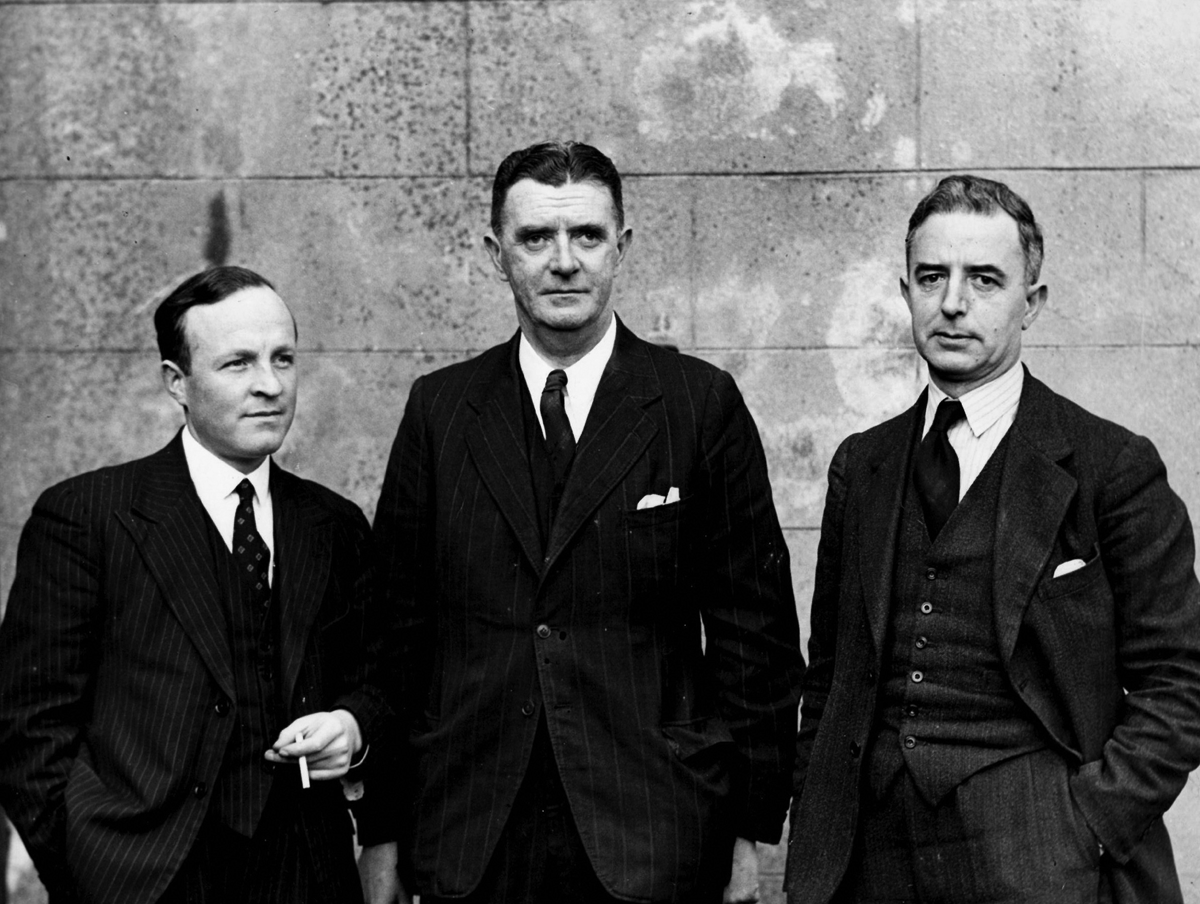
For those of a more secular outlook, town planning offered the promise of a more “efficient” and “rational” urban future. In Galway, O'Flynn was quick to align himself with this optimistic new world. An Irish branch of the British Town Planning Institute was formed in 1940 (professional bodies for architects and engineers in both jurisdictions had long maintained close connections). Manning Robertson, centrally involved, championed town planning as a common problem that would unite north and south in Ireland in the “reconstructed world” after the war.Footnote 53 For Patrick Tuite, a young architecture student at University College Dublin in May 1946, the need for strong town planning was obvious. His tone was utopian, forceful, and patrician: “The ordinary citizen … is increasingly aware that much of the background of his existence is a meaningless heritage,” and his “old existence” has been “uprooted” by “gigantic” forces.Footnote 54 In Galway, an article in the Connacht Tribune promised all the “fantasies of metropolitan life”—an urban oasis of swimming pools, amusement centers, tennis courts, and flower gardens—but its subtitle cautioned that a “Town Planning Scheme Must Come First.”Footnote 55 O'Flynn appointed the young Dublin planner and architect Dermot O'Toole as the town planning consultant for Galway (figure 2) in the spring of 1944.Footnote 56 O'Toole came with good credentials: he had been employed as an architect by the Office of Public Works and the Department of Local Government, and at the time he was the president of the Architectural Association of Ireland.Footnote 57 Speaking in 1943, he shared his colleagues’ optimism, confidence, and sense of intergenerational shift:
All are aware that revolutionary changes in social and physical structure are to be expected on the termination of hostilities … It is not sufficient, however, to extend the education of the planners, we must also extend that of the planned. There is no need to emphasise that the greatest handicap to the appreciation and practice of architecture is the deplorable lack of culture obtaining with regard to the public at large … The public must be made more aware of our existence, they must be courted and harangued … All that we ask is the permission to plan, the money, and the machinery to put our schemes into operation.Footnote 58
—From left to right: Dermot O'Toole (planner), Alderman J. Costello (mayor), and Clement O'Flynn (county manager), 10 February 1944. Reproduced courtesy of Paul O'Toole.

As O'Toole set about beginning his survey, relations between Browne and Galway County Council were rather benign compared with what came later. Browne arranged for the old jail buildings to be demolished, along with some old houses near the O'Brien's Bridge site. Both projects, preparing the ground for future building work, won him public support by providing employment for local men during the lean war years.Footnote 59 At O'Brien's Bridge, he initially delayed demolition work to allow the council's surveyor time to prepare plans to widen an adjacent road junction, and gave over some land free of charge in return for the council's building a new boundary wall.Footnote 60 However, from May 1944 onward, relations between Browne, the planner, and the council deteriorated rapidly. There were no fewer than six major clashes between the bishop and the manager-planner alliance of O'Flynn and O'Toole, all focused on the question of who would decide the future of the O'Brien's Bridge site. These disputes can be read as demonstrating the shifting urban power relations between church and state.
II
O'Toole's Sketch Development Plan for Galway, completed by the end of 1944, was a brief document of some twenty pages. In it he noted the dense medieval character of the city center and criticized the more recent “indiscriminate” building work, such as businesses building over their back yards and encroaching onto the street. “The central area,” he argued, “is patently overbuilt.” This free-for-all “endangered the health and life” of Galway's citizens “through lack of breathing space and intensification of fire risk.”Footnote 61 Infant mortality, TB, and cancer were all on the increase.Footnote 62 O'Toole's view was backed up by the census: in 1936, 160 families still lived in one-room tenements in the city.Footnote 63 And Galway, after a long economic and demographic decline from the mid-nineteenth century onward, was undergoing its most rapid expansion in almost a hundred years, with the population rising from 14,227 in 1926 to 20,370 in 1946, an increase of almost 40 percent.Footnote 64 Much of this increase was the result of migration from rural areas: the percentage of city dwellers stating places of birth in rural Ireland rose over the same period by a third.Footnote 65 O'Toole's solution, inspired by British and American theories, was more open spaces—what he referred to as the “breathing lungs” of the city.Footnote 66 The population of the medieval core would have to be reduced, slums demolished, and Garden City satellite settlements built beyond a well-defined greenbelt.Footnote 67 Continuing his anatomical urban metaphor, O'Toole turned his attention to transportation:
The heart represents Old Galway within the walls, the lines of communication the arteries and the traffic corresponding to the blood stream. The city like the human body must be well regulated if efficiency … is to be achieved. Galway, to say the least, is not efficient … [Its] road and street system [are] hopelessly inadequate to serve modern traffic requirements.Footnote 68
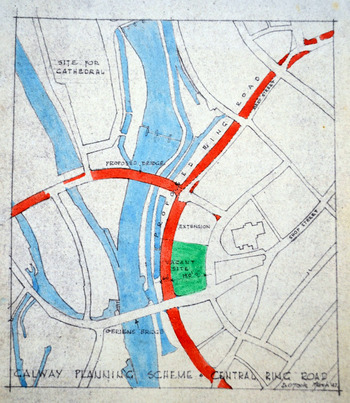
Foremost among O'Toole's concerns were the three bridges across the River Corrib dividing the city east-west. The Claddagh Bridge was only twenty feet wide; the Salmon Weir Bridge had “dangerous ‘cork-screw’ approaches” around the courthouse and former jail. Only O'Brien's Bridge was “suitable for modern traffic,” but its effectiveness was “nullified” by both approaches, the “morass of narrow canal bridges” to the west and the medieval “bottle-necks” to the east.Footnote 69 Forecasting a tripling of vehicular traffic after the war, O'Toole called for “drastic measures” to be adopted. What he meant was an outer bypass road with a series of roundabouts to cater for satellite development and through traffic, and an inner ring road to solve congestion in the city center.Footnote 70 The building of this inner ring road would require widespread demolition of the medieval core (figure 3), but O'Toole cited as precedent a town improvement act from 1853. Half of the road already existed, he argued, and the “recent clearances in the vicinity of O'Brien's Bridge”—Browne's demolition of the old barracks—made possible the completion of the scheme. Aware that his suggestion would cause friction, not least with the bishop as the owner of the site, O'Toole argued that the O'Brien's Bridge site was too small for the cathedral and would be “very much further reduced” by the proposed ring road, “which is essential to the relief of traffic congestion.” Furthermore, he maintained, a cathedral on this site would conflict with the scale, character, and architectural style of the adjacent medieval Protestant church.Footnote 71
—Dermot O'Toole, “Galway Planning Scheme: Central Ring Road,” March 1947, Michael Browne Papers, Galway Diocesan Archives, B/6/12. The ring road is marked in red, the O'Brien's Bridge site in green.

In seeking to counter O'Toole's status as an “expert,” Browne had his own knowledge-gathering systems, operating in parallel but along parish divisions. O'Toole's strengths—maps, statistics, plans—would be the exact means by which Browne challenged his claim to urban authority. Echoing Janssen's comments on Catholic leaders in mid-century Holland, Browne used “modern weapons” to “fight the modern world.”Footnote 72 For example, when Browne was considering the site for his future cathedral in 1938, he appointed a committee of four priests to record pedestrian and car movements across the city's bridges over three Sundays in November. Standing with their clipboards, the men counted movements east and west between parishes and compared these figures with their own census of the Catholic populations of each street and district. They submitted to the bishop a report with tables and appendices.Footnote 73 Furthermore, in private reflections on O'Toole's report, Browne used his street-by-street knowledge of his city to criticize the proposed location of new factories and to list the many streets that were scheduled for partial or complete demolition—including many properties owned by the diocese.Footnote 74 The production of such documents emphasizes the extent to which multiple jurisdictions overlapped in the governance of the city.
O'Toole's report made no mention of provision for city-center schools, nor did it acknowledge that Browne might have an alternative use for the O'Brien's Bridge site.Footnote 75 At a public meeting between O'Toole and the Galway Corporation, councilors were concerned about the proposed “thinning out” of the city center and about the inner ring road; O'Flynn responded by downplaying the value of Browne's site, commenting that he understood that it had remained vacant for so many years because of a “stench from a nearby chemical factory.”Footnote 76 O'Flynn's position as county manager required careful negotiation with the somewhat overlapping urban agency of the Galway Corporation. In private correspondence with the bishop, he adopted a more diplomatic tone in explaining his scheme for an inner ring road: the vacant site would be “ideal” for such a road, along with a car park and a “small planted open space.” He argued that preserving the site as a “breathing lung”—however noxious—for the city center would create an attractive vista to the proposed new cathedral, and “betterment” of the area would increase the value of nearby properties owned by the church.Footnote 77 In reply, Browne explained that he could not dispose of such a valuable site without approval from Rome, and he could not ask for this until he was sure that the jail site would be adequate for his new cathedral. Bringing up the issue for the first time, he hinted that he might need the site for a school in the future, as “the present [city-center] schools at Market Street are not suitable.”Footnote 78 O'Flynn sought to avoid any serious disagreement at this early date, writing to Browne that the issue could be resolved once the diocese was “more definite” regarding its plan for school building, while at the same time requesting that Browne allow the planner to explain safety concerns with a school on this site and suggest alternatives.Footnote 79
However, with the publication and discussion of the draft planning scheme, it was hard to contain public speculation about the site's future, and some prominent businessmen, members of the Chamber of Commerce, were quoted in the local press endorsing the site as a convenient car park and an extension for the market. These interventions troubled the bishop, who wrote privately to warn the men about getting involved in the diocese's affairs: “I see by the local press that you wish to have me deprived of some property … I have not advocated the taking of your property.”Footnote 80 In another letter, he drew on Ireland's long history of religious and land struggles and ended with a rather pointed threat:
I am sure that you do not put temporal interests, such as a market, before the needs and interests of religion … The Church only seeks to acquire [property] for the good of the people, and in a Catholic country, where she has suffered so much spoliation, it might be expected that she would receive help rather than hindrance. This is all the more true in the fact that [Protestant] St. Nicholas’ Church, of which she was deprived of by violence and confiscation, stands where it does. I have not suggested that you should be deprived of any of the property which you hold in Galway or any of the grazing land which you hold, e.g. in Ballinderreen.Footnote 81
Browne was quick to instrumentalize Irish history; he was also acutely aware of his own political importance as a religious and political leader. As well as planning a new cathedral for his diocese, and many new parish churches, he was, by the early 1940s, in the midst of a huge program of building new primary schools.Footnote 82 While the city's population increased 11 percent between 1936 and 1946, the number of children under the age of fourteen increased by almost 15 percent, the fastest rate of growth for almost a century.Footnote 83 Yet compared with the appalling condition of many of Galway's rural schools—with rotten window frames, leaking roofs, and decrepit furniture—the old city schools were by no means at the top of Browne's priorities. (They did not, for example, feature in his “top ten.”Footnote 84) Rather, his plans for the future school site were important at a broader, philosophical level—the issue of control of the city—and by the end of 1944, it is clear that he was ready for a major battle.Footnote 85 The dispute was about much more than simply a new school: it became the stage for a protracted conflict over the changing power of church and state, and the nature of private property rights, in the new era of town planning.
III
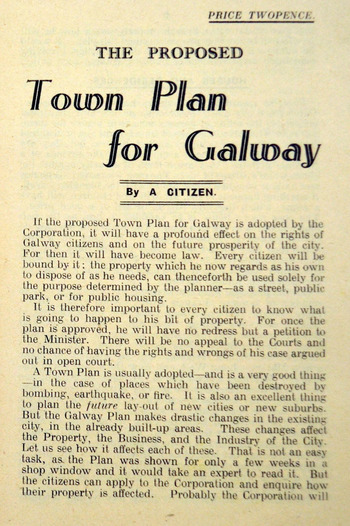
In an attempt to undermine the draft town plan for Galway, in the summer of 1945 the bishop embarked on a clandestine pamphleteering campaign organized with the Catholic Truth Society of Ireland. The episode marked an extraordinary—and hitherto unnoticed—moment in the history of church and state relations in Irish cities. It began with a talk given by the planner, O'Toole, on the merits of his Galway scheme at the annual general meeting of the Irish branch of the Town Planning Institute in Dublin in February 1945. O'Flynn, concerned at hostility for the scheme from some local councilors, arranged for O'Toole to travel to Galway to give a public lecture at University College Galway in July 1945 to sell his vision for the city's future.Footnote 86 In a counteroffensive against this publicity, Browne attempted to turn local opinion against the planner's proposals. He did this with the help of the Dublin-based Catholic Truth Society of Ireland, with which he had been intimately involved for many years.Footnote 87 The society primarily distributed Catholic literature but also had a strong anti-communist agenda.Footnote 88 In the 1940s, its secretary was a prominent Dubliner, Dr. Francis O'Reilly (d. 1957), much involved in organizing the 1932 Eucharistic Congress.Footnote 89 Browne and O'Reilly, both members of the society's publications committee, worked together to print a pamphlet (anonymously authored) criticizing the draft town plan and to distribute it throughout Galway in the weeks before O'Toole's public lecture.Footnote 90 The intention can only have been to discredit both the plan—as an affront to the interests of the city—and the planner—as an outsider who was unfamiliar with the nature of urban authority in Galway. The pamphlet (figure 4), which survives only in the diocesan archives, is an important source for analyzing Irish clerical opposition to the principles of town planning and for understanding the mechanics of urban power.
—[Bishop Michael Browne], “The Proposed Town Plan for Galway: By A Citizen,” undated [May 1945], Michael Browne Papers, Galway Diocesan Archives, B/12/32.

In April 1945, O'Reilly wrote to Browne:
I have arranged about the pamphlet. It is now being printed by The Free Press, Wexford … It will carry no imprint. The title will be “The Town Plan for Galway,” by A. Citizen. Eason & Sons [booksellers] will be asked to send it to the local traders in Galway, on sale or return. The negotiations … will be carried out by … a friend of mine. He does not know who wrote the article, and he does not care. He knows Galway, and he says he agrees with the pamphlet. It would be well if, quietly, some arrangements could be made to have the pamphlet sold through the streets of Galway. Once the pamphlet has appeared in the shops, some of the local people should put newsboys selling it. I have ordered 1,000 copies.Footnote 91
In further correspondence, O'Reilly arranged for the daily and provincial press to be given copies for review, remarking that “from the propaganda point of view,” it “would be well worth while; and propaganda is, I think, what [we] are aiming at.”Footnote 92 Browne was uneasy with this plan, perhaps concerned that the newspapers could generate adverse publicity—or perhaps speculate on the identity of the author.Footnote 93 As the project developed, O'Reilly clarified that they would rely on the “newsboys who sell the morning papers … It is a question of getting them contacted … I am not sure what the arrangement is in Galway but possibly [your secretary] could find out through some of the priests.”Footnote 94
The plan hit an obstacle when Easons refused to be involved unless the text carried a publisher's imprint, as required by law. O'Reilly again wrote to Browne,
They quoted the law, which I know exists, but I do not think they had any reason for being so “snooty,” except that they realise that there is nothing in the matter for them … I think the best plan would be to try an arrange for street sales in Galway, the booklet being given to the boys on sale or return. They will easily sell out the edition on one Sunday … It might be well worth giving the booklet free to the newsboys and telling them that they must sell it at 2d each. The youngsters will do well on the transaction; and the profit would probably get each of them clothes or some ice-cream.Footnote 95
The legal issue of a publisher's imprint was clearly not a significant obstacle. O'Reilly commented, “the regulation about putting on an imprint is honoured as often in the breach as in the observance.”Footnote 96 To ensure the anonymity of the pamphlet, he arranged for a friend to negotiate with Easons. He was equally careful in his distribution plans after Easons withdrew from the project: he proposed instead to bundle the pamphlets into different packages and post them discreetly to different addresses in Galway: “There will be no name of the sender on the envelope, and I shall arrange to have them posted in various places like Dún Laoghaire, Bray, etc., so that all will not have the same postmark.”Footnote 97 The pamphlet then appeared on the streets of Galway at the end of May 1945 and sold around 250 copies before O'Toole's lecture. Later that summer, Browne began to worry that the lack of an imprint might bring legal action from government and sent the unsold pamphlets—around seven hundred—for pulping.Footnote 98
The printing and distribution of the pamphlet was a clever, if not very effective, method of changing public opinion, colored with a certain schoolboy intrigue. It also indicates a degree of nervousness on the bishop's part in his relations with Galway's citizens and with the local press. The pamphlet was eight pages of polemic, easily identifiable as being in Browne's distinctive hand with its many literary allusions and staccato rhythm. An anonymous yet illuminating rejoinder in the Galway Observer, “Fifth Columnist” (which says much for how dissent could be aired publicly at the time), ridiculed the bishop's thinly veiled identity. “Like a shattering bomb-shell,” the columnist wrote, the pamphlet, “printed by a firm who preferred to omit even their initials, scattered like wild-fire among the less intelligent sections of our community.” Calling it little more than an “uninformed and harmful distortion of facts,” the writer wished that the “unknown snake-in-the-grass who is obviously one of the few on whose corns the proposed development scheme might tread, held their horses until they have heard the other side of a long story from the mouth of one of the most reputed planners in the country.”Footnote 99 The veiled reference to O'Brien's Bridge—and thus to Browne—was all too obvious.
However, this grandstanding should not detract from a serious analysis of the intellectual argument put forward in the pamphlet. “If the proposed Town Plan for Galway is adopted,” Browne argued, “every citizen will be bound by it: the property which he now regards as his own … can henceforth be used solely for the purpose determined by the planner.”Footnote 100 The most obvious threat to the social democratic citizen's private property was the proposal for widespread demolition of houses on Eyre Street, Mary Street, and Bowling Green to make way for the new inner ring road. Evoking the Land War of the 1880s, Browne declared that “fixity of tenure is what the farmer fought for: the townsman needs it too, and for the same deep, human reasons.” Highlighting the risk of planning blight, he asked, “Who will buy a house which is doomed for extinction at the will of some public official?”Footnote 101
Compensation for property and new roads and bridges would bankrupt rate-payers in the city, Browne maintained, and the inner ring road would divert shoppers from the city center: cars would move “so fast that [they] will not see the view on each side.” The remaining medieval core, after the construction of the ring road and O'Toole's hollowing out of densely populated areas, would be little more than “a museum-piece,” without the “busy colourful Gaelic life and sounds” that gave the city its character. Adopting a conservationist tone, Browne asked “who would keep the old buildings of the centre in repair and from falling down?” He concluded by pleading, “This plan must be rejected. If adopted, all security is gone … [A] plan should be made with the greatest prudence, local knowledge, and sense of economic realities … It is … the people of Galway who should decide.”Footnote 102 Browne's critique of the town plan, and in particular his use of “A Citizen” as his nom de plume, demonstrates the uneasy relationship between ideas of social democracy and religious authority in the city—and who was defending whose interests.
It is hard to measure the pamphlet's exact impact. O'Toole spoke before a “large and thoroughly enthusiastic crowd” at University College Galway, outlining his vision for the city's future, but the questions that followed indicated the resistance of some local elected officials to such an ambitious scheme.Footnote 103 Writing privately to Browne, a member of the Chamber of Commerce poured cold water on the plan, saying it was “impracticable and had no regard to the financial commitments involved.” While calling for more “modest” proposals, he was, predictably, enthusiastic about providing an “adequate market place” and supported the requisitioning of the O'Brien's Bridge site for a car park and an extension to the market.Footnote 104 In reply, Browne again went on the attack, terming the proposed town plan a “new spoliation,” comparing it to Cromwell's actions in Ireland, and objecting to “an attitude of mind which seems to regard purely secular objects as of greater value than [those] religious, educational or charitable.”Footnote 105 It must have deeply frustrated the bishop that the Chamber of Commerce's official response to the plan—deeply skeptical and in some respects openly hostile—nevertheless praised many of O'Toole's ideas and specifically endorsed the idea of public ownership of the proposed school site.Footnote 106 For their part, the local newspapers supported the town plan, especially the Connacht Tribune, which led, in classic “fantasies of metropolitan life” manner, with the headline “The Galway of the Future.”Footnote 107
The pamphlet failed to stop the progress of the draft town plan, which was adopted in early 1946 with minor revisions. After this date, O'Flynn, as county manager, had “interim powers” over planning decisions in the city.Footnote 108 Frustrated by the inefficacy of his private correspondence and the pamphleteering project, Browne adopted a new strategy to defeat what he saw as a dangerous growth of bureaucratic and unelected power. His approach was two-pronged. First, he simply ignored O'Flynn and opened up direct negotiations for obtaining a grant for a new school with the Department of Education in Dublin; second, he launched public attacks on O'Flynn as the county manager. By the spring of 1946, relations between the two men had completely collapsed.
As Galway Corporation prepared to meet to discuss O'Toole's plans, O'Flynn and Browne entrenched their positions. When asked for his plans, Browne bluntly replied, “The answer … is that my intention is to build a Cathedral … on the Jail site and to build a Central Boys’ national school on the O'Brien's Bridge site.” Property was hard to acquire in the city, he argued, and he simply wished to “be allowed to use the site which my predecessors acquired lawfully and at great cost.” He warned, “If [you] deprive me and the Catholic people of Galway of this site then [you] must incur before God and the people the responsibility of such a very serious action.” Failing to provide schools and churches would be “more likely to produce savages than Christian citizens” and opposing the church would be typical more of “modern Russia” than modern Ireland. Asking for his legal rights to be protected, Browne cautioned that the corporation must either “work with me in my efforts for the moral and spiritual welfare of the people or against me.”Footnote 109 O'Flynn intervened to highlight what he saw as the potential for an “ornamental car park with provision for flower beds and seating accommodation along the river bank [that] would greatly enhance the appearance of the city,” adding that it was “unreasonable” to claim that the Christian welfare of Galway's children—98 percent of whom were Catholic—was “entirely dependent upon the school [being built at] a particular site.”Footnote 110
The question of the city's future governance, from this time onward, was monopolized by the bishop and the duo of county manager and planner. The Church of Ireland community of nearby St. Nicholas, for example, appears not to have intervened, and—unlike planning debates from the late 1950s onward—there were few if any protests or letters from civic society or community groups.Footnote 111 Instead of a truly public debate, the controversy played out in the meeting room of the Galway Corporation, where Browne made an incendiary speech in February 1946, attacking both the manager and the planner. He dismissed O'Flynn's claim that the site was not suitable for a school, saying that this assessment was not within the competency of the county manager and was instead “a matter for those in charge of education.” O'Flynn's alternative site would be “most unsuitable and would not be approved by [government].” Browne continued, “He thinks a car-park more useful and ornamental than a school … [An] ornamental car-park is a contradiction in terms—such places become very untidy, littered with rubbish and to say the least will not conduce to the cultivation of flower-beds.” Browne took issue with the informal promise to hand over the site that he was supposed to have made to O'Flynn in 1940: “That is entirely false … [O'Flynn] got no authority from me to bind me … I gave no promise.” Furthermore, he dismissed, again with reference to Irish history, the notion that the site would provide an attractive view of the Protestant church from the river, which O'Flynn had promoted:
This is the church which belonged to the Catholic people, was taken from them by force and in the name of the civil law, and has never been restored. It is bad enough that we must still suffer the loss of this our rightful property, but it is adding insult to injury when persons now come along and want to despoil us of what we have since lawfully acquired in order to enhance the view of the original usurpation.Footnote 112
Browne's rhetoric had its intended effect: the corporation rolled over and voted unanimously to allow the new central school to be built at O'Brien's Bridge.Footnote 113 Quickly realizing the implications for his proposed inner ring road, O'Toole wrote to Browne to restate his objections: the 1853 Act of Parliament had called for such a road; moreover, a school would suffer intolerably from traffic and noise pollution, which would affect the “minds of the children psychologically.”Footnote 114 The bishop declined to change his mind; neither concerns for the city's Church of Ireland community nor the health risks to future schoolchildren outweighed his desire to proceed with building the school.Footnote 115
IV
A key part of Browne's strategy was to bypass local government entirely and seek approval directly from national government. He assumed, correctly, that they would know or care little for the local politics in Galway. He submitted his proposal in January 1946—before the Galway Corporation had even voted. Later, when the Department of Education replied, approving the scheme and enclosing a grant application, another major episode erupted.Footnote 116 The dispute was now a classic central-local three-way affair between O'Flynn, Browne, and central government in Dublin.Footnote 117 At first, O'Flynn asked his secretary to write to the Department and tell them that the “Town and Regional Planning Act is in operation in Galway City” and that they should consult with him before approving new schools. When this approach appeared ineffective, O'Flynn warned that he might “feel obliged” to exercise his powers as “Interim Control Officer to make a Prohibition Order,” which could only be overturned on appeal to the minister for local government.Footnote 118
Browne requested a copy of all of the manager's correspondence from government, which was sent to him by a sympathetic official, and he used this inside knowledge to his advantage when he lobbied ministers on the issue.Footnote 119 He was also friendly with the minister for education at this time, Thomas Derrig, a Fianna Fáil TD (member of Parliament) from Browne's home county, Mayo.Footnote 120 Hearing of O'Flynn's intervention, Browne wrote that he was “very much surprised” and that the matter of a new school “has given me a considerable amount of trouble.” He questioned O'Flynn's legal powers to block the school and commented that O'Flynn believed “that a car-park is more important and that an inferior site will do for the school.”Footnote 121 Browne also lobbied the local government minister, Seán MacEntee, claiming that O'Flynn's actions had been “gravely discourteous” to him and were “ultra vires and illegal”; “Mr. O'Flynn seems to think that he is bound by no law or principle of honour.” Referring again to an existential threat, Browne played to MacEntee's well-known skepticism for expanding the role of the state and for the usefulness of town planning, adding that O'Flynn's actions threatened “the foundation of democracy” and risked “totalitarianism with all its dangers.”Footnote 122
By the spring of 1947, the stakes were considerably higher than in 1944. Irish town planners felt emboldened by the British Planning Bill of 1947, which became the Town and Country Planning Act. Termed “revolutionary” by an editorialist in the Irish Builder and Engineer, who considered that “its principles cannot fail to be infectious” in Ireland, this British law essentially nationalized land by controlling development rights and providing for widespread compulsory purchase.Footnote 123 Both O'Flynn and Browne must have known what the act could mean for Ireland's constitutional protection of property rights for individuals (article 43) and for religious denominations (article 44).Footnote 124 Browne decided to make another public—and even more polemical—address to Galway Corporation, attacking both O'Flynn and O'Toole and in particular what he termed “the extraordinary mentality of the gentleman who acts as the Town Planning Consultant.” Highlighting the gulf between sacred and secular authority in the city, he claimed that O'Flynn “seems to regard himself as the supreme authority for everything in Galway and he treats your authority and mine in our respective spheres as non-existing.” Warning that what he saw as O'Flynn's autocracy might lead to “totalitarian tyranny completely subversive to the rights of citizens and of the Church,” he asked the corporation to reaffirm their vote of 1946.Footnote 125 O'Flynn's protests that the city was “already over-built” and that the resolution would be “contrary to the recommendations of the Council's technical advisers” went unheeded, and the vote was in favor of Browne's position by five to one.Footnote 126 The bishop turned down a last-minute compromise offer from O'Toole that would have seen both the ring road and the school built on the site and pushed on with making detailed plans for the new school, emboldened by MacEntee's comment that “I doubt if there is now any possibility that the decision of the Council will at some future time be revoked.”Footnote 127 To further solidify his position, Browne began corresponding with the cathedral's architect, J. J. Robinson, whom he wished to design the new school.Footnote 128
Despite the extensive central-government program of building new schools in Ireland from the 1930s onward, there was little doubt that Irish primary schools were architecturally inferior to those in Britain and many other countries.Footnote 129 The British Education Act of 1944 (the “Butler Act”) only widened this gulf, as an editorial in the Irish Builder and Engineer noted: “There still remain many city schools which by reason of their age, fail to accord with requirements today regarded as basic by scientists, educationalists, humanists and the medical profession.” A “gigantic task” of school construction lay ahead.Footnote 130 Browne was acutely aware of the problem posed by Galway's old city schools; his solution was a new central school under Catholic management on a site owned by the diocese. By 1949, he considered the long-running controversy settled, and he had successfully overcome the agenda set by increasingly powerful bureaucracy personified by the O'Flynn-O'Toole axis.
But in August 1949, soon after plans for the new school were announced in the Irish Builder and Engineer, O'Flynn tried once more to block the development. He pushed for a vote by the corporation on whether to seek the county medical officer's opinion on the healthiness of the site for a primary school.Footnote 131 The county medical officer was another powerful bureaucratic position in Irish local government—in place since the late nineteenth century—its role including annual inspections of all schools in the county.Footnote 132 Charles McConn, who held this position in Galway, was a respected medical doctor, and O'Flynn sought to use him to halt the school project. The councilors were unimpressed with what they saw as a last-minute intervention, but they gave in to O'Flynn's demands. The division was an even split, with McConn appointed by the mayor's casting a vote.Footnote 133
Incensed by what he saw as an underhanded move made in bad faith, Browne read a vitriolic sermon in Galway's Pro-Cathedral on 7 August 1949. His rhetoric was similar to that satirized in Breandán Ó hEithir's 1976 novel on life in 1940s Galway, Lig Sinn i gCathú (Lead us into temptation), where crowds relish the unpredictable invective of the fictional “Bishop Mullins”—Bishop Browne.Footnote 134 The actual sermon, worth quoting at some length to see how exactly Browne used both history and contemporary world events to make his case, began with a moral and ethical view on the origins of the dispute: “[They] wanted to take the site over as a car park: others wanted to use it for shops and a cinema. I leave you to judge which is more important for the ordinary working men of Galway: a Catholic school for their children, or a car park, or shops and cinema and dance hall for the making of money.”Footnote 135
Concerning O'Flynn's plans to have McConn reconsider the case, Browne turned to history: “This is a gross and flagrant breach of faith and a grave injustice to me … I thought they were men of honour, men of their word … Limerick is already known as the place dishonoured by broken Treaty [of 1691] and breach of faith: Galway should not rival it in dishonour.”Footnote 136 Browne was equally as comfortable invoking contemporary politics as he was Irish history: “If this happened in Northern Ireland or in Czechoslovakia, there would be an outcry from Catholics here … The Communists also use the excuses of health and traffic. They are never against religion, of course: they always have an alibi … What difference is there between their objects and methods and those of the Manager, Mayor, and these five fickle Corporators?”Footnote 137
He called on Catholics to stand up against O'Flynn and O'Toole, undermining them in class terms:
I want the best site for a school: they want a car park, or shops and a cinema … What do they care for the education of the children of the poor? Where do they send their own children—to expensive schools for the upper class? … What alternative sites have they? … You will hardly believe it, but the “Town Planner” has suggested sites now occupied by back gardens at Sickeen, Bohermore, and beyond the Railway Station … Any old out-of-the-way place will do for a school in their view.Footnote 138
He finished with a further attack—and a threat—focused on O'Flynn in particular:
Is there no liberty, are there no rights left in this country, that a paid official can prevent us from using our own property for the good of the people? I protest against the tyranny of the Manager—it reeks more of Communist Russia than of [scribbled out in an early draft] it is entirely alien to this free Catholic land … Those who obstruct me in the discharge of my episcopal duties incur a heavy responsibility before Almighty God.”Footnote 139
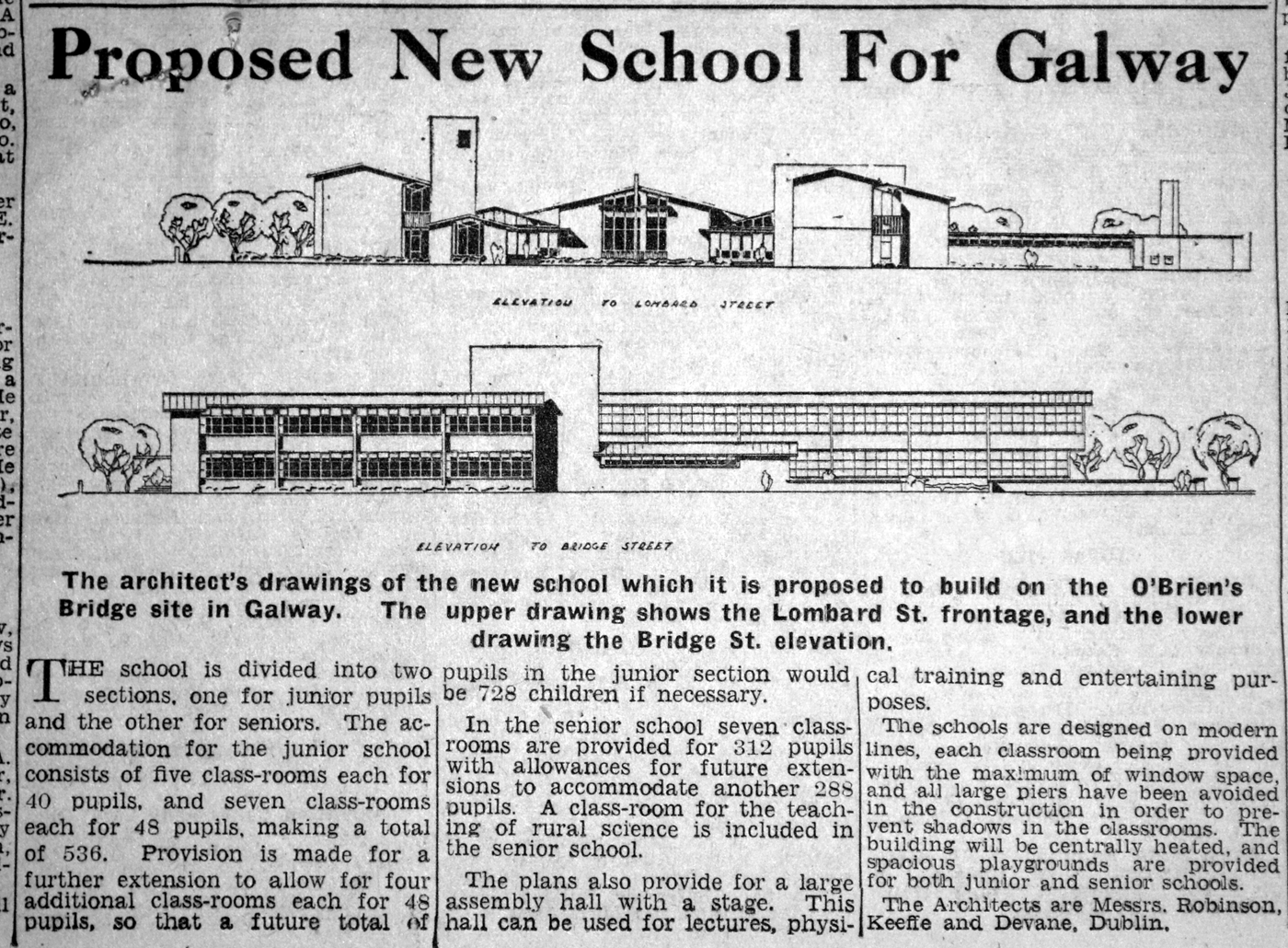
John Fitzgerald, the editor of the Connacht Tribune, deemed large portions of Browne's sermon so libelous that he refused to print it without substantial redactions.Footnote 140 O'Flynn in turn demanded a hard copy from Browne to discuss with his solicitor, but Browne claimed this did not exist and that he had spoken from “rough notes”Footnote 141—yet among his papers are several handwritten drafts with extensive reworkings. And in such a small and interwoven city, this excuse was easily exposed: O'Flynn learned that “prior to the delivery of your sermon, you gave a transcript copy … to a press reporter who informed [you] that it could not be published as it was libellous.”Footnote 142 O'Flynn also met with the archbishop of Tuam, Joseph Walsh, to protest, and threatened to take the case to the Vatican unless Browne offered an apology.Footnote 143 The mayor, who had cast the deciding vote, publicly regretted his decision and the controversy it had stoked, but he was critical of the tone adopted by Browne in his Pro-Cathedral address.Footnote 144 The public division encouraged local Catholic charities and societies, including the Legion of Mary, the Convent of Mercy, and the Catholic Young Men's Society, to offer their support to Browne.Footnote 145 One supporter summed up what were radically different perspectives on power and governance in the city by expressing his sympathies at “the grave discourteousness you have been subjected to by those in temporary authority.”Footnote 146 The reassurance of Catholic civil society was welcome to Browne, but he was keen to win over broader public opinion, and to do so he arranged for his architect, Robinson, to send drawings for the attractive, modernist school (figure 5) to the Irish Press and the Irish Independent. He was frustrated when the Press printed only the plan and not the more visually appealing elevation sketches.Footnote 147
—An unidentified newspaper clipping, ca. August 1949, “Proposed New School for Galway,” Michael Browne Papers, Galway Diocesan Archives, B/6/12.

The robust exchanges between Browne and O'Flynn in 1949 say as much about urban governance as they do about distinctive traditions of public performance, political rhetoric, and belligerent displays of masculinity; the two men were informally referred to as “Muscles” Browne (the bishop had been an amateur boxer in his schooldays), and “Cast Iron” (Clement Ignatius) O'Flynn.Footnote 148 Furthermore, as Donnelly has shown, Browne was no stranger to major public interventions, no matter how controversial or at times ineffective. He made a reputation for his forthright statements of Catholic social teaching on issues such as dance halls, drinking at the Galway races, and mixed bathing on the city's beaches.Footnote 149 In the case of his attack from the pulpit, he arguably overplayed his hand. This interpretation is reinforced by a lengthy handwritten memo that he penned at the time, in which he questioned O'Flynn's religious devotion: Was he “a Catholic and presumably one who accepts the law and teaching of the Catholic Church”?Footnote 150 As a noted expert in canon law and a regular contributor to the journal Irish Ecclesiastical Record, Browne set out what he considered his powers as bishop.Footnote 151 He listed the particular code of canon law that would allow him to bring “censures and other penalties” against anyone who disobeyed his orders. This code, he added, would cover “excommunication and interdict.” He concluded, “I would therefore have been within my right in proceeding to enforce this law in this case … I think that the Manager's conscience should have taken account of these serious laws of the Church which bind in conscience on every Catholic.”Footnote 152 This viewpoint, of course, undermined the very foundations of secular town planning, and indeed of all secular authority. Furthermore, the degree to which Browne's rhetoric in his sermon was ill-judged is apparent in a letter from a neighboring bishop, John Dignan of Clonfert, who wrote to Browne to give advice: “Everybody is speaking about [the controversy]. I think I should in friendship tell you this—many think your language [is] altogether too strong, and if in your ‘righteous indignation’ you felt bound to speak strongly it should have been done at a meeting in the Town Hall and not in the Church. Note, I am telling you the gossip in this part of the county.”Footnote 153
If Dignan's advice was well intended, the liberal and Protestant press in Dublin and Belfast were actively hostile to Browne's intervention, as indeed was O'Casey in his autobiography. The Irish Times, Belfast Telegraph, and Belfast Newsletter carried leaders and many letters and responses on the controversy (“The Bishop put his foot down, so Council obeys”), all commenting on what it might mean for religious freedom in a future united Ireland.Footnote 154 An editorial in the Irish Builder and Engineer at the same time, without making direct reference to the Galway controversy, nostalgically looked back to the “high hopes” of the National Planning Exhibition of 1944 and the “vast amount of time and energy embodied in its creation”; five years later, the attempts to “interest the average citizen in the potentialities of the future, if wisely planned,” were “disappointing.”Footnote 155 The early utopianism of the mid-1940s had settled into a pragmatic reality; poetry had turned to prose.
Browne's public assault on the manager and planner concealed the importance of the medical officer's report, which appeared in the spring of 1950. McConn rejected the proposed site. Quoting British and American guidelines on school design, and, in particular, the progressive provisions of the Butler Act, he argued that he could see “no reason … why a lesser standard should prevail in this country.”Footnote 156 Echoing contemporary newspaper concerns about the traffic congestion near the site, he argued it was simply inadequate for a large school, the playground and classrooms were too small, the number of bathrooms insufficient, and the corridors awkwardly placed.Footnote 157 O'Flynn summarized his colleague's findings to the diocese by noting that while the corporation had approved of “a school” on the O'Brien's Bridge site, the size and design of that school remained an open question, and again he urged the diocese to rethink their position and consider an alternative site.Footnote 158
McConn's reliance on British and American regulations gave Browne an easy rebuttal.Footnote 159 Penning a final memo on the controversy, he invoked Irish nationalist history to his advantage, writing that O'Flynn and McConn did not “seem to be aware that Ireland is an independent republic and that the regulations of England and America, however excellent, do not bind here.”Footnote 160 His impatience is evident in a comment he made to his architect, Robinson, at this time: “I think it necessary to show that we are in deadly earnest and in fighting mood, for we have suffered from these obstructive tactics too long.”Footnote 161 Frustrated by Galway's local bureaucracy, Browne followed through on this threat, writing in April 1950 to three Dublin ministers. McConn, he claimed, “seems to think that he can interfere with the rights of citizens of this Republic … as if we were still a colony.”Footnote 162
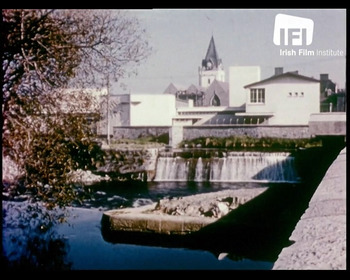
Ironically, it was only by appealing directly to central government that Browne was able to proceed with his school plans. His victory over O'Flynn and his associated bureaucracy, which Browne condemned—however improbably—as akin to communist regimes in Eastern Europe, came at the same time that he presided over a conference that led to the end of Galway's longest-ever labor dispute, the strike of more than 350 workers at McDonogh's and Corbett's for fourteen weeks in the spring and summer of 1950.Footnote 163 With permission granted to build the new Central Boys’ School, he moved quickly to seek tenders, and the school was built by 1954 (figure 6).Footnote 164 Some of the first pupils were the sons of the city's laborers and dockworkers, the children of the strike of 1950. The school, known as St. Patrick's, is still in use today, and Galway's rapid postwar suburbanization now means that most pupils are driven to school each morning, causing more congestion and pollution than McConn could ever have imagined in the 1940s. Furthermore, the school playground, ironically, now serves as a public car park outside of school hours. Dermot O'Toole, for his part, failed to build any part of his inner ring road, but today the politics of building a bypass is once again a concern in the city. The corporation decided, unanimously, not to reappoint O'Toole in 1950, with one councilor saying that his ratepayers saw no reason whatsoever to continue the post.Footnote 165 Despite this, O'Toole did some other municipal work in Galway in the 1950s, including designing a new fire station in the city center.Footnote 166
—Galway Central Boys’ School (St. Patrick's). From Bord Fáilte [Irish Tourism Board], “Glamour of Galway” (1957). Courtesy of the Irish Film Institute.

V
The Galway school site controversy illustrates that the Catholic Church was, even in the mid-1940s, in a position of profound political weakness. It was forced into an adversarial stance in response to the growing agenda of central state bureaucracy, seen through the county management system and the implementation of town planning schemes. The fact that Browne ultimately succeeded in his mission to build a new primary school in the center of Galway should not be mistaken for an assured demonstration of political power. The agenda throughout the entire controversy was set always by the state and not the church. The church was instead responding to the secular, “rational” agenda of town planning. If Browne had been in a truly powerful position, the controversy would have ended at the first hurdle. But the secret pamphleteering project, the grandstanding speeches, the sermons from the pulpit, his uneasy relationship with the press, and his lobbying of central government ministers all show weaknesses in the church's negotiating position. If Browne had been able to mobilize public opinion to his cause, he surely would have had no need to distribute an anonymous pamphlet without an imprint. He would not have considered the prospect of excommunicating O'Flynn. And he would not have so publicly abandoned a cordial relationship with the local bureaucratic officials with whom he might have struck a compromise. His actions suggest that mobilizing public opinion was easier said than done and that the relationship between the church and local political elites was not as close-knit as often suggested. On both sides of the dispute, we gain an insight into the process of political lobbying in mid-century Ireland and the remarkable absence of broader public interaction in urban decision-making. In these formative years of town planning, a different rapprochement between religion and planning—between church and state—might have been possible.
At the core of the controversy was a division over ownership and authority in the city, and who was in charge—Robert Dahl's question of “who governs?” and who they are governing for.Footnote 167 Browne's objections to the Galway town plan were fundamental in nature and questioned the intellectual framework that gave the state increased power over the ownership and development of land. Yet his objections appear to have been distinctly urban: the state appropriation of land in rural areas from former “big houses” at the same time, through the post-1922 Irish Land Commission, was less of a concern, as “redistribution” (a helpful euphemism) benefited many Catholic small farmers.Footnote 168 The battleground was instead the city. When, for example, in later years, O'Flynn requested Browne to change the orientation of his new cathedral to better facilitate traffic, Browne simply ignored his request. He refused to engage with the bureaucratic system and regarded the planning of his new cathedral as solely his concern. Whether its main entrance faced north or south was none of O'Flynn's business.Footnote 169 For Browne, there were aspects of the governance of the city that did not fall under the remit of town planning, and furthermore he was always able to draw on a wide range of resources including direct lobbying with national political leaders. But while he astutely defended the church's interests, he did so from a weaker political position than suggested in much of the existing historiography, and, arguably, he rarely controlled the agenda.
It must not be overlooked that at the core of the controversy was a school and the education of young children. This article shows that we need to know more about the building of schools in mid-century Ireland. Tom Garvin's News from a New Republic (2010) has a chapter on “the education wars” in Ireland, but in it we learn little about the physical or architectural aspects of education policy in Ireland—classroom, playground, environment. Garvin's focus and those of D. K. Akenson and Seán Farren are almost entirely on issues of staffing, sectarianism, and the curriculum.Footnote 170 Irish historians should follow the lead of Tom Hulme's study of British schools to understand what the process of new school design meant for children's health and who was controlling the agendas.Footnote 171 McConn's and O'Toole's objections to the Galway site for health, safety, and “psychological” reasons offer many interesting avenues for further investigation.
Schools, along with churches, meeting halls, and other public buildings, were conceived within the framework of town planning from the mid-twentieth century onward. The history of European town planning stands to be enriched by including the perspectives of religious groups who maintained distinct—sometimes parallel, sometimes opposing—concepts of urban governance. Nowhere was this more clearly the case than in mid-century Irish cities. Secular ideas of “rational” urban futures are too often intellectually monopolistic in analyses of the fundamental underpinnings of town planning; bringing back the parish and the diocese (or other “sacred” divisions of the city) into these debates offers a new perspective that disrupts existing paradigms. While Janssen in his study of Dutch cities argues, “Catholics accepted modernization in the organizational sphere while resisting it ideologically,” it is also true that Catholics forged parallel but different concepts of modernity.Footnote 172 Richard Schaefer makes a convincing case for “Catholic modernity” in late nineteenth-century Europe, as Charlotte Wildman does for Manchester and Liverpool in the interwar years. This article shows that it was similarly evident in mid-twentieth century Ireland.Footnote 173
In arguing the case for a Catholic school in the center of Galway, Browne exposed the myth that O'Toole and O'Flynn's proposed town plan was—to quote Liam Lanigan and Helen Meller—the fruit of “rational knowledge” that was “neutral,” “autonomous, context-free and objective.”Footnote 174 Browne showed that an alternative was also possible, deploying his own carefully gathered statistics and his own (in Gillian Rose's term) “masculinist geographical imagination.”Footnote 175 O'Toole and O'Flynn's at times cavalier rhetoric rarely invoked history or saw the need to do so. They were sometimes hostile to its sobering limitations, preferring instead to instrumentalize the potential of the future. Browne's Catholic modernity, perhaps not unrepresentative of national trends at this time, relied on an explicit use of the rhetoric of the past to argue for a different future. One notable side effect was Browne's early interest in urban conservation—of protecting the medieval core to save the historic urban parishes. His opposition, for example, to the demolition of historic buildings, street widening, surface car parks, and planning blight has more in common with secular, progressive politics of later decades than of a Catholic bishop in the 1940s.Footnote 176 The conservation aspect of the school site controversy demonstrates in a salient way Ireland's distinctive engagement with modernity and the position of Catholic power in the Irish city.