The pine needle scale, Chionaspis pinifoliae (Fitch) (Hemiptera: Diaspididae), is a native insect species of North America commonly reported as a pest on several ornamental conifer species, some of which are cultivated as Christmas trees (Pinaceae) (Tooker and Hanks Reference Tooker and Hanks2000; Fondren and McCullough Reference Fondren and McCullough2005; Miller and Davidson Reference Miller and Davidson2005). Identification of the pine needle scale is complex, mostly due to its close proximity with another species of the same genus, Chionaspis heterophyllae Cooley (Hemiptera: Diaspididae). Both species often share the same hosts and overlap in geographical distribution (Philpott et al. Reference Philpott, Berlocher, Mitchell and Hanks2009). Several cryptic species may exist within these two morphologically recognised species, thus complicating proper identification (Gwiazdowski et al. Reference Gwiazdowski, Vea, Andersen and Normark2011; Vea et al. Reference Vea, Gwiazdowski and Normark2012).
The life cycle of the pine needle scale is geographically variable. In Canada, it is believed to be univoltine, whereas in the United States of America, a second generation has been observed (Cumming Reference Cumming1953; Stimmann Reference Stimmann1969; Nielsen and Johnson Reference Nielsen and Johnson1973). Both sexual and parthenogenetic forms of the scale have been documented (Brown Reference Brown1959, Reference Brown1965; Stimmann Reference Stimmann1969; Luck and Dahlsten Reference Luck and Dahlsten1974).
Among its known natural enemies are several specialist micro-Coccinellidae (Coleoptera: Coccinellidae: Sticholotidinae: Microweisini) (Luck and Dahlsten Reference Luck and Dahlsten1974; Cooper and Cranshaw Reference Cooper and Cranshaw1999). A complex of relatively specialised Hymenoptera parasitoids, most of which belong to the Chalcidoidea, is also associated with the pine needle scale (Luck and Dahlsten Reference Luck and Dahlsten1974; Burden and Hart Reference Burden and Hart1993; Cooper and Cranshaw Reference Cooper and Cranshaw1999; Gwiazdowski and Normark Reference Gwiazdowski and Normark2014).
The scale was reported by Martel and Sharma (Reference Martel and Sharma1968) to develop on indigenous red pine trees Pinus resinosa Aiton (Pinaceae) in Québec, but mentions on balsam fir, Abies balsamea (Linnaeus) Miller (Pinaceae), and Fraser fir, Abies fraseri (Pursh) Poiret (Pinaceae), grown as Christmas trees are relatively recent. Although C. pinifoliae is not known to cause any significant damage, it can be an obstacle for exportation to certain Christmas tree markets where scale insects are strictly regulated. Thus, the objective of this study was to acquire new knowledge about this emerging pest in Christmas tree plantations of Québec. This involved properly identifying C. pinifoliae, studying its phenology by regular monitoring throughout the summer, and searching for potential natural enemies. Based on the current sporadic reports of scale insects in Christmas trees in Québec, we hypothesised that C. pinifoliae infestations in Christmas tree plantation landscapes could originate from tree nurseries rather than from wild conifers.
Sampling was conducted from May to October 2014 in a commercial Fraser fir plantation located in Saint-Évariste-de-Forsyth, Québec, Canada (45.950°N, 70.923°W). An experimental plot of 20 rows of 60 fir trees free of insecticide treatment was established, where systematic screening of trees for presence of scale insects was carried out. Each week, 10 infested shoots were randomly collected from different trees within the plot and examined in the laboratory. Each scale was identified according to development stage and dissected to determine the presence of parasitism or signs of predation. Any indigenous conifers species located on the borders of the plantation were similarly screened for the presence of scales. Prior to retaining our experimental site, sampling was performed in 10 Christmas tree plantations and their surroundings, located within a 50 km radius in the Estrie region. For each site, 50 trees were randomly screened in a plot of 15 rows of 45 trees. Scales were found in only two of those sites: Saint-Évariste-de-Forsyth and Weedon (see below).
Scale identification was based on morphological characteristics according to Vea et al. (Reference Vea, Gwiazdowski and Normark2012). Validation was performed by experts from the Canadian National Collection of Insects, Arachnids, and Nematodes, Agriculture and Agri-Food Canada (Ottawa, Ontario, Canada) for both the scales and natural enemies and voucher specimens were deposited in this institution. Molecular typing was also carried out when possible, using the 28S rDNA gene (see Morse and Normark (Reference Morse and Normark2006) and Gwiazdowski et al. (Reference Gwiazdowski, Vea, Andersen and Normark2011) for methods), as a reliable alternative to the cytochrome oxidase 1 mitochondrial gene in scale insects (Campbell et al. Reference Campbell, Lawrence, Hudspath and Gruwell2014).
Identification based on morphological characteristics confirmed that the scale specimens collected on all cultivated and indigenous conifer hosts were indeed the pine needle scale C. pinifoliae. This diagnosis was confirmed by molecular typing (GenBank accession number MH032862), showing up to 99% similarity with available C. pinifoliae sequences (Gwiazdowski et al. Reference Gwiazdowski, Vea, Andersen and Normark2011).
Pine needle scales were observed on about 21% of Fraser firs in the plantation (n=996) and also regularly on naturally growing balsam fir; white spruce, Picea glauca (Moench) Voss (Pinaceae); and black spruce, Picea mariana (Miller) Britton (Pinaceae) surrounding the plantation, but not on eastern white-cedar, Thuja occidentalis Linnaeus (Cupressaceae). Pine trees were absent in the study site, but they are known as hosts of the scale in Québec (Martel and Sharma Reference Martel and Sharma1968).
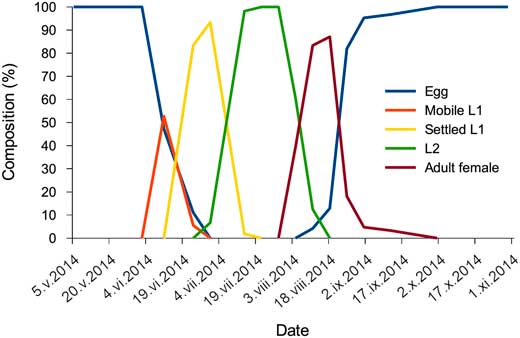
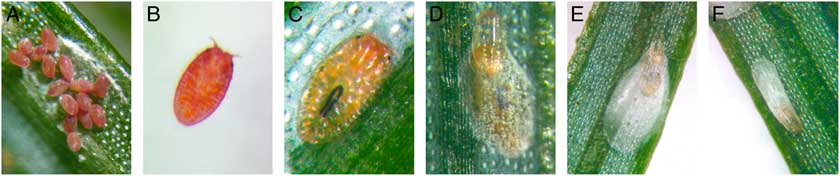
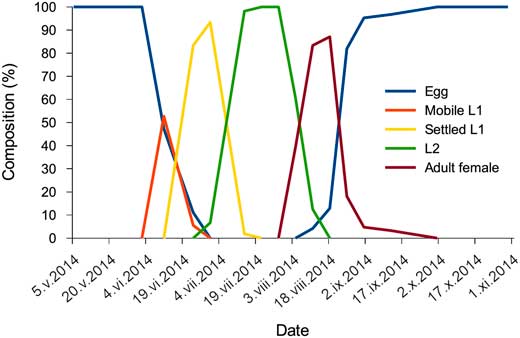
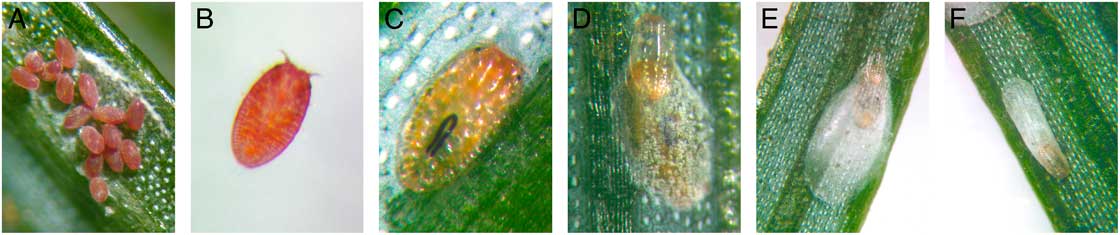
The life cycle observed at Saint-Évariste-de-Forsyth in 2014 on cultivated Fraser fir was that of a single-generation parthenogenetic form (Fig. 1). The hatching of overwintering eggs (Fig. 2A) occurred around mid-June, after which the mobile larvae stage 1 or crawlers (Fig. 2B) settled on fir needles (Fig. 2C). The transition to the larvae stage 2 (Fig. 2D) began in early July. At the beginning of August, the first female adults appeared (Fig. 2E). Oogenesis, followed by egg laying, began in mid-August and continued until late September, with an average of 27 eggs per female (SE±0.69; n=237) on Fraser fir. A sexual form of C. pinifoliae with males (Fig. 2F; GenBank accession number MH032863) with a comparable phenology with that of the parthenogenetic form (Cumming Reference Cumming1953) was observed at Weedon but not at the Saint-Évariste-de-Forsyth site, confirming the occurrence of both reproductive forms in Québec. In Weedon, scales were observed on Fraser fir and on wild conifers surrounding the plantation, but very low occurrence (only a few trees were infested) did not allow for the implementation of a similar sampling setup as in our main site.
Phenology of pine needle scale Chionaspis pinifoliae, as observed on Fraser fir, at Saint-Évariste-de-Forsyth, Québec, Canada, in 2014. L1, larval stage 1; L2, larval stage 2.
Development stages of pine needle scale Chionaspis pinifoliae. A, Eggs; B, mobile larval stage 1; C, settled larval stage 1; D, larval stage 2; E, adult female; F, adult male (sexual form only).
Dispersion of mobile larval stage 1 was apparently limited to adjacent needles and shoots, with nymphs of the new generation sometimes developing directly below scales of adults of the previous generation (8.62% of cases; n=2632), thus creating stacks of up to three scales. Observed mortality of immature stages was very high, with an overall estimate of 62.21% of settled immatures dying before reaching the adult stage (settled larval stage 1 and larval stage 2; n=3075).
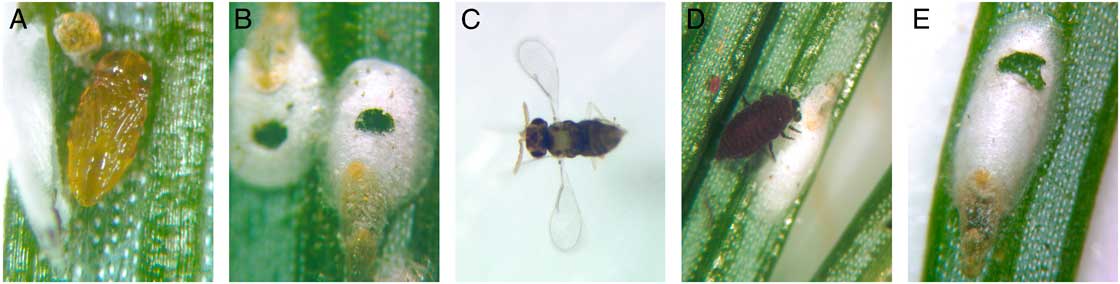
A parasitoid belonging to the genus Encarsia Förster (Hymenoptera: Aphelinidae) (most likely Encarsia bella (Gahan); GenBank accession number MH032865) was observed at low incidence, with 4.16% of adult scales (n=2859) being parasitised (Fig. 3A–C). Encarsia bella has been reported several times on C. pinifoliae (see Cooper and Cranshaw Reference Cooper and Cranshaw1999) and its close relative C. heterophyllae (Fondren and McCullough Reference Fondren and McCullough2005). Predation by micro-coccinellids was observed on 1.12% of adult scales (n=2859) (Fig. 3D–E). Larvae were sometimes present among samples, though no adults were observed for species identification. Molecular typing of immature larvae allowed us to identify them to the tribe Microweiseini (GenBank accession number MH032864). Martel and Sharma (Reference Martel and Sharma1970) reported the presence of Coccidophilus marginata (LeConte) (previously Microweisea marginata) as a predator of C. pinifoliae in Québec.
Natural enemies of pine needle scale Chionaspis pinifoliae. A, Encarsia pupa; B, emergence holes of a parasitoid wasp; C, Encarsia wasp; D, micro-coccinellid larva; E, predation traces caused by a micro-coccinellid.

The presence of well-established specialist natural enemies of C. pinifoliae in Christmas tree plantations does not support the hypothesis of sporadic and recent introductions from local nurseries when a plantation is first established. Previous reports of C. pinifoliae associated with multiple natural enemies in a nearby locality (Sherbrooke) (Martel and Sharma Reference Martel and Sharma1968, Reference Martel and Sharma1970, Reference Martel and Sharma1975) also indicate that it has long been established in southern Québec on pine and possibly other conifer trees. Its presence on several wild conifers in landscapes surrounding Christmas tree growing areas could explain its sporadic presence on Christmas trees, since passive wind dispersal of the mobile larval stage 1 at distances of up to 3 km has been reported (Brown Reference Brown1958). Phoretic dispersal of the crawlers by other insects is also possible (Magsig-Castillo et al. Reference Magsig-Castillo, Morse, Walker, Bi, Rugman-Jones and Stouthamer2010). Increased reports in Christmas tree plantations of southern Québec probably result from improved monitoring techniques for this pest, but genetic susceptibility of fir trees (species and varieties) or local adaptation of the scale could also play a role in its spreading (Nielsen and Johnson Reference Nielsen and Johnson1973; Eliason and McCullough Reference Eliason and McCullough1997; Glynn and Herms Reference Glynn and Herms2004). It should also be noted that our findings are limited in spatial scale and time, and could differ from other sites in Québec, especially for natural enemies.
Specialist natural enemies such as parasitoids and predators could theoretically help control the pine needle scale in Christmas tree plantations. However, based on our study and in accordance with previous works (Cumming Reference Cumming1953; Nielsen and Johnson Reference Nielsen and Johnson1973; Martel and Sharma Reference Martel and Sharma1968, Reference Martel and Sharma1975), they apparently inflict only a tiny fraction of the high mortality observed for immature stages. Other biotic or abiotic factors, such as water availability (Eliason and McCullough Reference Eliason and McCullough1997), could play a role in pre-adult scale mortality. Moreover, in the case of parasitoids, control potential could be limited due to the low dispersal rate of Aphelinidae wasps, as opposed to Coccinellidae predators (Tooker and Hanks Reference Tooker and Hanks2000). A strategy to increase natural enemy abundance and impact requires modifying current farming practices, including weed control, to promote the establishment of native plants as additional food sources and shelters (Tooker and Hanks Reference Tooker and Hanks2000).
The phenology of C. pinifoliae on pine trees, as described 50 years ago in Québec (Martel and Sharma Reference Martel and Sharma1968), is similar to the one observed here on Christmas trees. Hatching of overwintering eggs in late spring and egg laying by new adult females in late summer are consistent with relatively high heat requirements for this species, as we reported in a parallel study (Doherty et al. Reference Doherty, Guay and Cloutier2018). High heat requirements to complete adult development limit the possibility of a second generation in southern Québec latitudes in the near future, in the context of climate change. Further work is, however, needed to address C. pinifoliae natural enemies and how their conservation could benefit Christmas tree growers in their efforts to control this pest while limiting the use of chemical insecticides.
Acknowledgements
This project was made possible by Natural Sciences and Engineering Research Council of Canada financial participation through the Engage programme grant 463754-14, Ministère de l’Agriculture, des Pêcheries et de l’Alimentation du Québec, Innov’Action agroalimentaire programme grant IA113043, and the involvement of the partner company, Québec Balsams Export. The authors thank Dominique Choquette from the Ministère de l’Agriculture, des Pêcheries et de l’Alimentation du Québec (Direction régionale de l’Estrie) and Émilie Turcotte-Côté (Club agroenvironnemental de l’Estrie) for their collaboration throughout the project, and the students who helped in field sampling (Simon-Charles Blouin and William Champagne-Cauchon). The authors also thank Julie Turgeon (Département de biologie, Université Laval) for allowing us to perform molecular work in her laboratory.