Introduction
Haloxylon ammodendron (C. A. Mey.) Bunge (Chenopodiaceae) is an important, widely distributed and dominant perennial psammophyte that mainly grows in arid and semi-arid areas. This species has multiple functions including pharmaceutical, livestock feed, and firewood, especially in wind prevention and sand consolidation (Li et al., Reference Li, Zhao, Zhu, Li and Wang2007). As the dominant constructive species in the desert of Central and Eastern Asia, H. ammodendron in Xinjiang covers 70% of China, and 68% of them are concentrated in the Junggar basin (Wang et al., Reference Wang, Guo, Tan, Shi and Ma2005). This plant has a crucial role in the stability of the desert ecosystem in Northern Xinjiang.
Haloxylon forests have been degraded rapidly due to the development of the local economy and population explosion (Niels et al., Reference Niels, Walter and Buras2013). Previous research suggested that H. ammodendron was damaged by various pests that mainly belong to Hemiptera, Lepidoptera, Orthoptera, Diptera and Coleoptera (Mohammadi, Reference Mohammadi2003; Nagima et al., Reference Nagima, Bagdavlet, Dimitar and Harizanova2016a, Reference Nagima, Bagdavlet and Harizanova2016b; Mombaeva et al., Reference Mombaeva, Taranov, Harizanova and Kadyrbekov2017). Among them, the distribution area, population density and damage of lepidopteran defoliators are more serious. They feed on the young twigs, flowers, seeds and roots of H. ammodendron, developed inside the branches, roots, and flowers caused the hindered growth, ultimately resulting in an irreversible effect on the desert ecosystem. Thirty-eight species of lepidoptera defoliators have been recorded that damage Haloxylon forest in the world (see Table S1) (Chapman, Reference Chapman1911; Kugler and Wollberg, Reference Kugler and Wollberg1967; Zang, Reference Zang1986; Xue et al., Reference Xue, Shi, Xing and Han2006; Tumenbayeva et al., Reference Tumenbayeva, Taranov and Harizanova2016), they prefer the young saxaul leaves of H. ammodendron, three species of them were more widely distributed and densely populated (Nagima et al., Reference Nagima, Bagdavlet, Dimitar and Harizanova2016a, Reference Nagima, Bagdavlet and Harizanova2016b), such as Orgyia dubia Tauscher (Lymantriidae), Hysterosia subfumida Flkv. (Tortricidae) and Pseudohadena immunda Eversmann (Noctuidae). These species were first found in Kazakhstan that feeds on the young twigs and seeds of Haloxylon. In China, four species of leaf-eating moths have been recorded in Ganjiahu lake saxaul nature reserve, including O. dubia Tauscher (Lymantriidae), Scrobipalpa sp. (Gelechiidae), Anydrophila imitatyix Chyistph (Noctuidae) and Coleophora sp. (Coleophoridae). Desertobia heloxylonia Xue (Geometridae) had a large population in the south edge of Junggar basin (Xue et al., Reference Xue, Shi, Xing and Han2006) while Lacydes spectabilisc (Tauscher) (Arctiidae) distributed in Northern China, with one generation per year (Yang et al., Reference Yang, Wang and Xiong2010). Orgyia ericae Germar (Lymantridae) is distributed in Northern China, Central Asia, and Europe, damaging various Haloxylon plants (Cui et al., Reference Cui, Sheng, Luo and Xiang2011). Consequently, the researches related to Haloxylon defoliators were sporadic, while the biological characteristics and management strategies of lepidopteran pests are a critical biotic factor limiting Haloxylon growth and quality, although they have rarely been investigated comprehensively.
From our subsequent investigation together with the above research studies, O. dubia Tauscher, 1806 (Lepidoptera: Lymantridae) (Riotte revised it as Teia dubia Tauscher, 1806 in 1979 (Riotte, Reference Riotte1979)) feed on the leaves and shoots of various desert plants (Populus euphratica Olivier, Elaeagnus angustifolia Linn, Halimodendron halodendron (Pall.) Voss and others). T. dubia is a deadly poison for camels when they eat their larvae along with saxaul, which leading to a severe effect on camel farming. It was more widely distributed (Northern China, Central Asia, Europe and Northwestern coast of Egypt (Halperin, Reference Halperin1986; Kyrylo, Reference Kyrylo2014; Imam and Amany, Reference Imam and Amany2019)) and have larger populations among the above defoliators. A large-scale outbreak of T. dubia was first reported in Israel (Aharoni, Reference Aharoni1926; Bodenheimer, Reference Bodenheimer1935; Kugler and Wollberg, Reference Kugler and Wollberg1967). The morphological characteristics of its pupa and larva have been described in detail (Kugler, Reference Kugler1961;Patočka and Turčáni, Reference Patočka and Turčáni2008), which provide the reference for subsequent accurate identification. However, its specific distribution and biological characteristics still lacking systematic study.
At present, the prevention and control measures for leaf-eating moths in saxaul forests are mainly dependent on chemical applications (Abd et al., Reference Abd, Saleh and Asmaa2012), causing pesticide residues and insect resistance problems, which will severely affect the ecological balance of desert and semi-desert. The physical control measures, such as light traps, require a tremendous amount of human and material resources while still unable to control the pests effectively. Forestry enclosure could increase the coverage and diversity of desert plants and decrease anthropogenic disturbances and extraneous pest input (Zhou and Song, Reference Zhou and Song2013). Still, these physical controls cannot cope with a massive outbreak of pests.
Parasitoids have been extensively explored as an ecologically acceptable biological control agent for a variety of agricultural and forest pests. Based on previous research studies, the parasitic natural enemies of the Haloxylon defoliators, including Ichneumonidae, Braconidae, Eulophidae, Pteromalidae, Torymidae, Tachinidae, have been summarized (see Table S2). Four species of Hymenopteran parasitoids were reported to attack the T. dubia, including Agrothereutes tunetanus Haber (Ichneumonidae) (Kugler and Wollberg, Reference Kugler and Wollberg1967), Cotesia judaicus (Papp) (Braconidae), Cotesia rubripes (Haliday) (Braconidae) and Apanteles sp. (Halperin, Reference Halperin1986), they were all ectoparasitoids of T. dubia larvae. Besides, three Dipteran species belonging to Tachinidae were also reported to parasitic in T. dubia larvae: Exorista segregata Rond (Tachinidae), Linnaemyla settfrons Zimin(Tachinidae), Strobliomyia tibialis R.D(Anthomyiidae) (Kugler, Reference Kugler1963). A total of eight species of parasitoid natural enemies of O. ericae Germar were found in Northern China (Cui et al., Reference Cui, Sheng, Luo and Xiang2011). Previous studies have found some parasitic natural enemies of saxaul defoliators. However, the species resources of saxaul forest defoliators' natural enemies are still lack of systematic and comprehensive research in Northern Xinjiang, where the H. ammodendron is centrally distributed.
Based on the information presented above, the research about indigenous saxaul forest defoliators and their biological control is still in the preliminary stage. Therefore, understanding the pattern of the lepidopteran defoliator's community attacking saxaul and associated parasitoids is essential to develop appropriate biological control strategies. The aims of our study: (a) to investigate the lepidopteran defoliators of H. ammodendron in Northern Xinjiang; (b) to determine the biological characters of dominant pests and their potential distribution area; (c) find out the parasitoid assemblages of dominant defoliators and their biological characteristics. To provide primary data for the technology development in biological control of saxaul defoliators such as artificial propagation and field releasing of their parasitic natural enemies, and eventually maintained the ecological balance of the desert ecosystem and sustainable forestry development.
Materials and methods
Experiment sites and sampling
This study was conducted from 2017 to 2018 in the saxaul forest of Junggar basin (scanning latitudes of 44.367°N to 47.167°N; and longitudes of 83.305°E to 88.968° E) (table 1). Insect collection sites mainly including Beishawo Desert, Fukang (altitude 380 m), Fukang desert station (altitude 374 m), these sites were investigated at regular intervals of 7–10 days from March to October. The general survey sites included: Ganjia lake in Wusu City (altitude 307 m), Aibi lake in Jinghe County (altitude 254 m), Fuhai County (altitude 445 m), Fuyun County (altitude 643 m), and 19th village of 148th town in Shihezi City (altitude 296 m), these sites were investigated at regular intervals of 30 days from March to October each year. A quadrat (100 m × 100 m) was set in each general investigating site. The random five-point sampling method was adopted to collect the defoliators and the number of pests on branches of each plant were also counted to assess the damage rate.
Survey site of in Haloxylon ammodendron Northern Xinjiang

Insect culturing and observation
Lepidopteran larvae were collected in the field and placed into white plastic bottles covered with gauze individually. Adequate water and young saxaul shoots were provided during the rearing process. The lepidopteran adults were sampled by light trap (6 V, 5W, 320–F580 nm) at night and immediately put into a poison bottle with ethyl acetate in it for other specimen making.
Seven hundred T. dubia larvae were collected in 2018 from Haloxylon forest in Fukang desert (44°22′26.4″N, 87°53′6″ E). Adult parasitic natural enemies reared from T. dubia provide with honey water (15%) in a glass tube (3 × 10 cm) and maintained in the growth chamber (RXZ–280B) at a temperature gradient (20, 26, 32, 38 °C), 75% relative humidity, under a photoperiod of 14:10 h L:D. The daily observation was carried out every 2 h to record the eclosion of parasitoids. Five couples of newly hatched parasitoids were paired in a glass tube (3 × 10 cm) at an optimal temperature to observe their mating behavior. The mated parasitoids and unparasitized first to the fifth instar larvae were reared in the same Petri dish to observe the preference of the parasitoids to different host instars. Ten such pairs were set up and repeated three times.
The natural parasitism rate, parasitism rate at different larval instar and emergence rate of all parasitoids are calculated as follows:
 $$\eqalignno{{\rm Natural\ parasitism\ rate\% } &= \displaystyle{\matrix{{\rm Number\ of\ parasitoids} + \cr {\rm Number\ of\ parasitoids\ died\ in\ larvae}} \over {{\rm Number\ of\ hosts}}} \cr&\times 100&( 1 )$$
 $$\eqalignno{&{\rm Parasitism\ rate\ of\ larvae\ at\ different\ larval\ instar\% } \cr&\quad= \displaystyle{{{\rm Number\ of\ parasitoids} + {\rm Number\ of\ parasitoids\ died\ in\ larvae}} \over {{\rm Number\ of\ hosts\ at\ certain\ stage}}} \cr&\qquad\times 100 &( 2 )}$$
 $$\eqalignno{{\rm Emergence\ rate\% } &= \displaystyle{{{\rm Number\ of\ emerged\ parasitoids}} \over \matrix{{\rm Number\ of\ parasitoids\ died\ in\ larvae}\,{\rm} + \cr {\rm Number\ of\ emerged\ parasitoids}}} \cr&\quad\times 100&( 3 )$$
Taxonomic classification
The morphological features of the collected defoliators were photographed with Nikon SMZ25 stereomicroscope. We use Zhao (Reference Zhao1978) and Zhao (Reference Zhao1994) keys to identify the collected defoliators.
Parasitoid specimens were preserved in 100% ethanol, subsequently air-dried, point-mounted, and examined with a Nikon SMZ745 T stereomicroscope, and photographs were taken with Nikon SMZ25 system. All the obtained specimens were deposited in the Insect Collection of the College of Life Science and Technology, Xinjiang University, Urumqi, Xinjiang, China (ICXU).
Model performance for potential T. dubia distribution
The occurrence data of T. dubia (O. dubia) were derived from the Global Biodiversity Information Facility databases (http://www.gbif.org) and related articles. A total of 36 records that reflected T. dubia's current distribution. The environmental variables were obtained from the WorldClim database (http://www.worldclim.org/) with a spatial resolution of 2.5 arcminutes, and the occurrence points within 4 km or less from one another were excluded to ensure the accuracy of the modeling process. Then we selected nine variables by considering their contribution rate (percent contribution<1%) and spatial correlation (Pearson<0.8). These nine climate variables were annual mean temperature (Bio1), monthly mean temperature range (Bio2), isothermality (Bio3), maximum temperature of the warmest month (Bio5), precipitation of the wettest month (Bio13), precipitation seasonality (Bio15), precipitation of the warmest quarter (Bio18), mean temperature of wettest quarter (Bio 8) and precipitation of the coldest quarter (Bio19).
In this study, we used default MaxEnt (version 3.4.0) parameters (convergence threshold = 10−5, maximum number of iterations = 500). The habitat suitability for T. dubia was reclassified into four different levels with default parameters of the classification method of natural breaks (Jenks) (ArcGIS 10.6).
The models were fitted using and then applied to the world map to predict the potential distributions of 75% of points were used to fit the model; the remaining 25% were used for model evaluations based on the receiver operating characteristic, the accurancy of the model was evaluated with the area under the curve (AUC index).
Statistical analysis
One-way analysis of variance and Student's t test was used to compare the differences in longevity and the emergence rate of parasitoids at different temperatures. NIS-Elements D was used to record the morphology of T. dubia larvae of various instars. Microsoft Excel and GraphPad Prism 8 were used to conduct statistical analyses. All the figures were manipulated with Adobe Photoshop CC 2017 and Adobe Illustrator CC 2017.
Results
Lepidopteran defoliator species and the characteristics of T. dubia
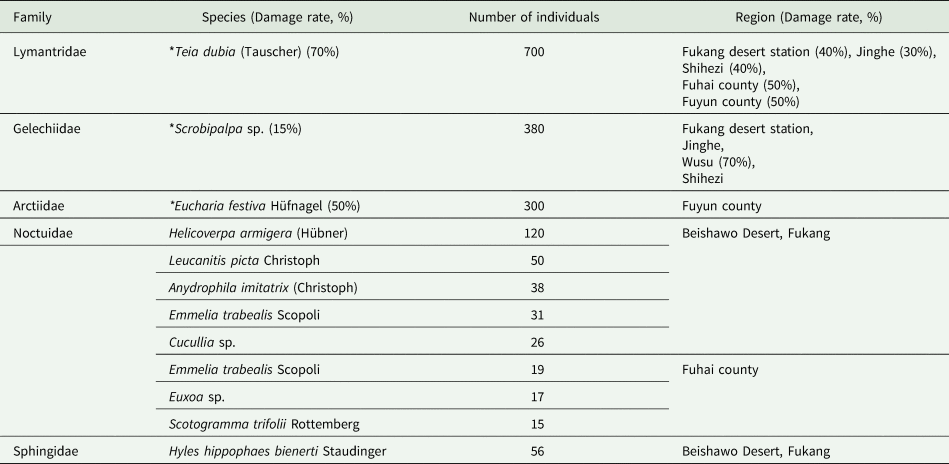
Twelve species of defoliators have been found in Junggar basin, Northern Xinjiang (table 2 and fig. S1), and seriously damaged the H. ammodendron trees in the southern margin of Junggar basin. T. dubia (70%) is the most harmful among these defoliators and is widely distributed in the southern and Northern edge of Junggar basin. Scrobipalpa sp. (15%) and Eucharia festiva Hüfnagel (50%) are the second harmful pests to the Haloxylon trees.
Species of lepidopteran defoliators in the H. ammodendron forest from Northern Xinjiang

*Indicates the dominant lepidopteran defoliators of Haloxylon.
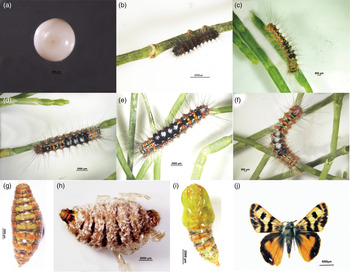
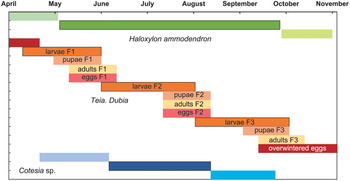
We have observed that the generation length of T. dubia takes about 39 ± 3.51 days (larval stage 28 ± 2.52 days). There are five instars in one generation (fig.1) and three generations per year in the Fukang desert. The occurrence period of T. dubia larvae is from May to October (fig. 2). We also observed that the pupal stage of T. dubia females (7 ± 2.08 days) is shorter than the male (9 ± 2.65 days), but the female's adult stage (9 ± 1.53 days) is longer than that of the male (3 ± 1.15 days). The female adults of T. dubia are apterous and usually emerged before the males, maintaining a relatively long oviposition period (5 ± 1.15 days) and lay a maximum of 163 eggs after mating, then shrivel and die within a short period. They can also exhibit parthenogenesis, which causing shrivel and death of the unfertilized eggs before hatching.
The morphology of T. dubia at different instar. (a) Egg (b) 1st instar larva; (c) 2nd instar larva; (d) 3rd instar larva; (e) 4th instar larva; (f) 5th instar larva; (g) Early pupa (♀); (h) Adult (♀); (i) Early pupa (♂); (j) Adult (♂).

Phenological fitting based on the dynamic changes of growth period of H. ammodendron, T. dubia and parasitism rate of Cotesia sp. Three colors of H. ammodendron indicate three stages (from left to right): development stage, growth stage, and withering period. Three colors of Cotesia sp. (from left to right): indicate three different peak periods of parasitism.

Potential distribution of the dominant defoliators T. dubia
We analyzed its potential habitable environment across the globe for future specimen identification and prevention. Our model showed high predictive accuracy with high AUC values (training AUC value = 0.962) (fig. S9), indicating that they perform better in predicting the habitat suitability for T. dubia (Swets, Reference Swets1988). The variables were maximum temperature of the warmest month (30.6%), precipitation of the warmest quarter (25.9%), annual mean temperature (12.7%), monthly mean temperature range (8.9%), mean temperature of wettest quarter (7.3%), precipitation seasonality (5.8%), isothermality (3.6%), precipitation of the wettest month (3.5%), and precipitation of the coldest quarter (1.8%).
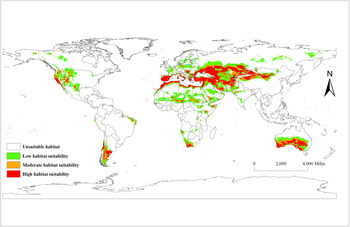
The results showed that the suitable habitats for T. dubia were mainly concentrated in Mediterranean coastal areas, Central Asia, Southwest Russia, Mongolian region, and Southern Australia (fig. 3). In China, the suitable area mainly restricted to the Northern Xinjiang and Inner Mongolia was consistent with the H. ammodendron widely distributed area. The analyzed results showed that Bio 5 (maximum temperature of the warmest month) is the most important environmental factor influencing T. dubia distribution (fig. S10).
Potential global habitat suitability map for T. dubia.

Parasitic natural enemies of T. dubia
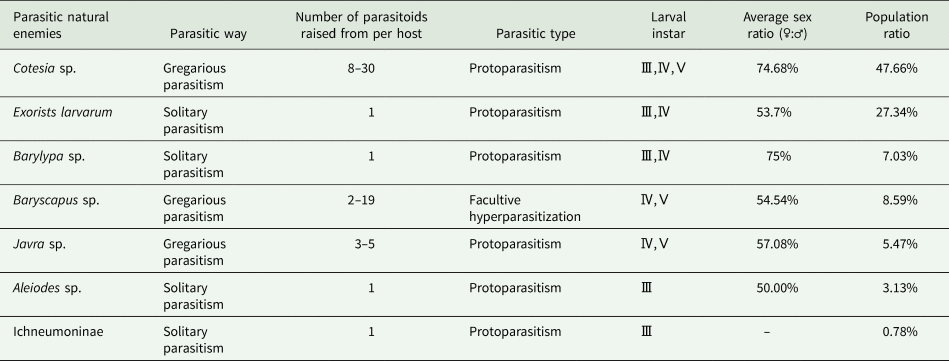
A total of seven species of parasitoids were identified by examining 532 parasitoid specimens that emerged from various larval stages of T. dubia (see figs S2–S8). However, the taxonomic status of parasitic natural enemies is not completely resolved, only Cotesia sp., Baryscapus sp. and Javra sp. are gregarious parasitoids. All the parasitoids are koinobiont and endoparasites (table 3), and they are usually parasitic in third–fifth instar larvae. The number of progeny and population of Cotesia sp. is the most abundant.
Parasitoids of dominant lepidopteran defoliators T. dubia

Cotesia sp. was the dominant parasitoid of T. dubia due to its largest population (47.66%). It has three generations per year from early May to late September, which corresponds with the larval stage of T. dubia (fig. 2). E. larvarum and Barylypa sp. were the earliest to parasitic, but their occurrence period is short, and the parasitism rate is low (fig. 4), E. larvarum is the second abundant parasitoid (27.34%), and mainly parasitic in the third instar larvae of T. dubia (fig. 5). Barylypa sp. was mostly parasitic in the third-fifth instars larvae and its parasitism rate is the highest in the third instar larvae. Javra sp. mainly parasitic in the fourth and fifth instar larvae, and the parasitic period is relatively short. We have also observed that its overwintering adult is in the host's pupae at Fuhai county. Baryscapus sp. is the parasitoid of T. dubia and hyperparasitoid of Cotesia sp. We have observed Baryscapus sp. forms cocoon in the pupa of Cotesia sp. and fed on its larvae. The low parasitic rates of Javra sp. and Baryscapus sp. (fig. 4) and population quantity (table 3) make them unsuitable as effective biological agents of T. dubia.
Dynamic variation of parasitism rate of each T. dubia parasitoid natural enemies. The bar at each point indicates the standard error.

Variation of parasitism rate within different instar of host. The numbers on the horizontal axis indicate different instar in each generation of T. dubia. The bar at each point indicates the standard error.

According to phenological simulation (fig. 2), the stage of three generations of T. dubia larvae was all during the vigorous growth period of H. ammodendron. The second generation of Cotesia sp. has the longest emergence period and mainly parasitic in the fifth instars larvae. In contrast, the second-generation host larvae were more likely to be parasitized by Cotesia sp. (23.08%) (fig. 5). The total parasitism rate is the highest at the third generation of T. dubia larvae (17.13%).
Biological characteristics of dominant parasitoid Cotesia sp
The total longevity of adult Cotesia sp. is the longest (43 ± 4.51 days) and can lay more than one egg into the first-fourth and seventh-ninth abdominal segments of T. dubia larvae one time with an average of 15.8 ± 5.84 eggs in a larva. The life expectancy of adult Cotesia sp. is the longest (5.57 ± 0.2 days) at 20 °C, and the longevity decreased with increased temperature (table 4). The adults can mate and parasitize on the first day after emergence and prefer the third and fifth instar larvae. They can parasitize in an already parasitized larva called superparasites, but the T. dubia larva will die in minutes after parasitized more than five times. The emergence duration is about 15 min and lasts for 4 days. The eclosion peak is usually in the morning at 9:00–11:00 (63.33%) during the first 2 days after the emergence begins (87.94%). There was no significant difference in the emergence rate between different temperatures (P > 0.01) and the emergence rate is 0 at 38 °C.
Adult longevity and emergence rate of Cotesia sp. at different temperatures

Note: the letter behind the number indicates whether there is a significant difference between different temperature, capital letter indicates the difference is extremely significant (P < 0.01), lowercase indicates significant difference (P < 0.05); ‘*’ indicate significant difference between male and female at same temperature (P < 0.05).
Discussion
In this study, a total of 12 species of defoliators and seven species parasitic natural enemies of dominant pests were found in the H. ammodendron forest in Northern Xinjiang. Our results indicated the high suitability habitats of dominant pest T. dubia are mainly distributed in the desert around the Mediterranean Sea, Central Asia, Northern Xinjiang and Mongolia. Seven species of larval parasitoids of T. dubia were recorded but only one dominant species Cotesia sp. appears to be good candidate for natural biological control agent.
Due to the gregarious larval endoparasitoid has a strong reproductive ability and significant parasitism rate, Cotesia sp. is tending to be the most promising one among seven species parasitoids. The tachinid Exorists larvarum, a gregarious larval idiobiontic parasitoid, was the second most abundant parasitoids and having a widespread presence in the world, but the parasitic rate is less than Cotesia sp. and the occurrence time mainly concentrated in May and September. An interesting phenomenon found in this part is the parasitism rate of Cotesia sp. was the highest in July, while the parasitism rate of E. larvarum dropped to the lowest of the year, there may be parasitic competition between them. The Baryscapus sp. is hyperparasitic in the dominant parasitoid Cotesia sp., and the parasitism rate of Baryscapus sp. increased with the outbreak of Cotesia sp. Whether there is interact with each other remains to be determined.
There were no egg parasitoids emerged during our investigation and no information is available on the parasitic natural enemies during its egg and pupal stage, probably because its eggs and pupae are wrapped in the cocoon, which provide a shelter for the host and increase the difficulty for the parasitic natural enemy to search for it. Among them, the host larvae parasitized by E. taruarum, Aleiodes sp., and Ichneumonidae will develop to mature larvae. The larvae parasitized by Cotesia sp., Barylypa sp. and Javra sp. died in the cocoon and pupation stage. Combined with the development regularity, we presumed that the release of those parasitoids in the early stage may reduce the reproduction rate of T. dubia in coming generations, while interspecific competition between natural enemies remains to be studied. The most promising candidate appears to be Cotesia sp. due to its strong reproductive ability and large population group.
The species of lepidopteran pests in Northern Xinjiang is similar to those of Kazakhstan (Table S1). Among them, T. dubia is a more harmful, widespread species with strong migration ability (Kugler and Wollberg, Reference Kugler and Wollberg1967; Tumenbayeva et al., Reference Tumenbayeva, Taranov and Harizanova2016). It can be assumed that the high migration ability and the widespread distribution of their host plant H. ammodendron, may cause a wide-scale outbreak. The prediction model to inferring the potential invasion areas of T. dubia were spanning range from arid desert region of Asia, Europe, to South Australia and parts of North America and southern South Africa. We also found that the annual mean temperature (Bio 1) was the most vital contributing driver for T. dubia, and the max temperature of warmest month (Bio 5) also has a significant effect on its distribution (Fig. S4). Based on our field observation and previous historical data, we found the annual generations of T. dubia are disparate in different seasons. In 1994, T. dubia occurred one generation a year in Xinjiang, two generations a year around 2010, while three generations in the year after 2018, it indicated that global warming posing an increasing trend in reproduction and growth rate of the Lymantriid. As a matter of fact, temperature is the key indicator to affect the life history, survival, and resource utilization of defoliators (Khadioli N et al., Reference Khadioli, Tonnang and Muchugu2014; Ntiri et al., Reference Ntiri, Calatayud and Van Den Berg2016; Cui et al., Reference Cui, Zhu and Bi2018). Whether temperature and other environmental factors affect its biological characteristics are still not fully understood. The mechanism of environmental factors will provide a basis for population monitoring of T. dubia, and can be applied to improve pest management programs of H. ammodendron.
During this research, we have observed that the T. dubia female adult lacks flight capability, and their unfertilized eggs will dry up and die, so we assume that trapping and killing the male adult of T. dubia is also an effective physical control method. Based on the phenology of H. ammodendron (Huang et al., Reference Huang, Chen and Hou2012) and the life cycle of T. dubia and Cotesia sp. (fig. 3), we can find that the larval stage of T. dubia goes through the bloom stage of H. ammodendron and the period that Cotesia sp. developed. In that case, the control of T. dubia overwintering eggs will help to effectively inhibit the occurrence of the F1 generation. The total parasitism rate of third-generation larvae is the highest (17.13%), perhaps because the second generation occurs between mid-June and early-August, the hottest period of the year, and the high-temperature cause decrease of the natural enemies' population. Meanwhile, the third generation of the host is the largest population, which provides good parasitic conditions for its parasitoids. As a result, the control of the female population and growth conditions of T. dubia will be sufficient for its prevention.
The density of T. dubia on H. ammodendron was significantly high, while it also reported feeding on other plants like Polygonum equisetiforme Sibth. (Polygonaceae), Atriplex halimus L.(Amaranthaceae), Chenopodium quinoa Willd (Chenopodiaceae) (Imam and Amany, Reference Imam and Amany2019), and also found in Tamarix chinensis Lour. (Tamaricaceae), Elaeagnus angustifolia Linn. (Elaeagnaceae), Hedysarum scoparium Fisch. et Mey. (Leguminosae). In summary, it shows apparent bias towards the H. ammodendron, the more vigorously branches of H. ammodendron provides T. dubia with more sufficient nutrients for growth and development. From another point of view, many studies have indicated that the antennal receptors (Malo et al., Reference Malo, Castrejon-Gomez and Cruz-Lopez2004, Reference Malo, Rojas and Gago2013), olfactory system and chemosensory genes are the keys to their feeding preference (Qiu et al., Reference Qiu, He and Tan2020). Plant volatiles were responsible for the attraction of T. dubia, structure of antenna receptor, related genes and changes in enzyme activity will be further studied for the comprehensive management of them. Understanding the physiological and biochemical mechanism of how T. dubia feeding on Haloxylon shoots will provide new, environmentally friendly strategies for integrated pest management.
According to the above basic experimental data, some useful experience for the artificial propagation of Cotesia sp. were obtained. The optimal development temperature of Cotesia sp. is 20 °C, its life expectancy decreased as the temperature increased and higher temperature is not suitable for its emergence, we suggest that the lower temperature is beneficial to the growth and development of Cotesia sp. Parasitoids are ectotherms, their growth, development, emergence, and sex ratio are all closely correlated with temperature, and different species also have different optimal temperature (Qiu et al., Reference Qiu, Zhou, Luo and Xu2012; Spanoudis and Andreadis, Reference Spanoudis and Andreadis2012; Skovgard and Nachman, Reference Skovgard and Nachman2015). Therefore, further laboratory experiments are imperative to determine the effects of temperature on the reproduction and growth capacity of the dominant parasitoid of T. dubia and how to propagate the parasitoid by expanding the host larvae. Meanwhile, the toxicity of villi and body fluids of T. dubia has caused severe allergies in the experimenters, making the rearing process of the larvae very difficult. In that case, if there is a host switching phenomenon in Cotesia sp., it will be useful to achieve artificial propagation.
Conclusions
This study of lepidopteran defoliators and associated parasitoids in H. ammodendron is truly unprecedented in China. The findings provide insights on parasitoid populations that are important to the major saxaul pests. Early releasing of those parasitoids will reduce the saxaul damage caused by the second and third generation of T. dubia larvae. The control of female population and overwintering eggs of T. dubia might be crucial to its prevention. The present study will help in predicting the damage and occurrence period of T. dubia.
Supplementary material
The supplementary material for this article can be found at https://doi.org/10.1017/S0007485321000705.
Acknowledgements
This research was funded by National Natural Science Foundation of China (Project Number, 31672338) and Tianshan Talent Project of the Autonomous Region (Project Number, 10020000220). We would like to thank our reviewers Jinjiang Zhou and Wen Zhong who improved this manuscript. We also thank Maoling Sheng and Tao Li for defoliators identification.