Joyous life-cycle events celebrated by American Ashkenazic Jews, especially those belonging to the more liberal denominations, invariably conclude with the singing of the words siman tov u-mazal tov, yehei lanu u-lekhol yisra'eil (May it bring good luck to us and to all Israel).Footnote 1 Whether after the long anxious minutes of the berit milah, the struggle of the youngster through the Hebrew text and trope of the haftarah, the calling up of the bridegroom (and the bride as well in most non-Orthodox synagogues) at an aufruf, or the breaking of the glass at a wedding, the spontaneous singing serves as a catharsis to relieve the built-up tensions of the communal ritual event as well as to express an outpouring of joy.
The celebration and commemoration of the Jewish life cycle (in Hebrew, maḥazor ha-ḥayyim) has attracted the interest of modern historians, liturgists, and anthropologists. The musical dimension of these ceremonies, however, has often been underplayed by scholars in these disciplines.Footnote 2 Ethnomusicologists, by contrast, have long recognized the centrality of music in Jewish life-cycle celebrations and have contributed to a growing body of scholarly literature on the subject.Footnote 3 The vital role of music in such ceremonies was well put by Amnon Shiloah:
A person's lifetime, from birth to death, is filled with a succession of outstanding occasions, many of which are celebrated in song and dance. In the past, when means of entertainment were limited, if a family or ethnic group had extensive social ties, the celebration of various ceremonies would extend over several days. … Songs sung at those times reflected the life and happenings in the community; they mirrored the people's character, culture, way of thinking, beliefs, aspirations, and longings. At such times folk song reaches its fullest expression.Footnote 4
Ethnomusicologists have primarily researched the rich life-cycle musical traditions of Sephardic Jews and the ‘eidot ha-mizraḥ. Yet if we direct our attention to the ceremonies celebrated by Ashkenazic Jews, if the contemporary American scene is our standard, we might legitimately ask whether life-cycle song exists in any meaningful sense. The past, however, reveals a far different story, examination of which shows that Ashkenazic Jewry once developed a rich body of song associated with rituals of passage.
This body of song was first expressed through piyyutim that, before the advent of printed prayer books, ḥazzanim almost certainly sang aloud in their entirety. Ezra Fleischer countered the widespread impression that early Ashkenazic synagogal poetry only gave voice, through kinot and seliḥot, to national tragedy, collective suffering, and personal sin. He revealed how various types of piyyut, inserted into fixed texts of the liturgy, also gave expression to praise, joy, and celebration.Footnote 5
More recently, Menahem Schmelzer, in his study of a manuscript collection of Ashkenazic piyyutim, expanded on Fleischer's fresh perspective.Footnote 6 Many of the piyyutim in this collection were recited in the synagogue when the bridegroom was called to the Torah on the Sabbath following his wedding (Shabbat Nisu'in), as in the early Middle Ages marriages were conducted on Fridays.Footnote 7 A number of piyyutim were also recited at circumcisions.Footnote 8
Ashkenazic life-cycle songs were primarily limited to the synagogue, in contrast to those of Sephardim and ‘eidot ha-mizraḥ, whose conduits for life-cycle song were paraliturgical piyyutim sung in Hebrew and folk piyyutim sung in the vernacular.Footnote 9 Ashkenazic synagogue life-cycle song was never eclipsed, at least not in Western and Central Europe, by the later development of folk songs in the Yiddish vernacular.Footnote 10
The following study of life-cycle songs in the Ashkenazic synagogue focuses on the early modern period. By that time, a number of commonly held practices had coalesced in much of Europe, and one can trace the performance of synagogue-centered liturgical–musical customs within specific communities and regions. The piyyut component became relatively modest, largely because of the cessation of the Sabbath wedding with its special liturgy.Footnote 11 What gained in importance was the Ashkenazic synagogue practice of elaborating fixed liturgical texts (matbe‘a ha-tefillah) by singing them to special melodies.
The focus on the early modern period also reflects the availability of historical sources. Jewish musical traditions are overwhelmingly oral; the notation of Ashkenazic synagogue chants began sporadically only in the late eighteenth century, continuing more systematically in the mid- and late nineteenth century, particularly in Western and Central Europe. For evidence before this time, the historian must draw on literary sources. A particularly and surprisingly useful genre is the minhag book, collections of community and synagogue customs, most of which emanated from German-speaking lands.
One such minhagbuch, hitherto little exploited by musicologists, comes from seventeenth-century Worms, composed by Yiptha Yuspa Shamash (1604–78). It constitutes perhaps the most significant source for documenting West European Ashkenazic musical practices in the pre-emancipation period.Footnote 12 Judah Löw Kirchheim (d. 1632) also compiled a collection of Worms customs, but provided considerably less information than did Shamash with respect to musical practices.Footnote 13 Yuspa Shamash's minhagbuch gives us a convenient starting point for tracing the historical development of many musical aspects. By virtue of the geographic locale of this minhag source, and that of several others, too, the following study largely reflects the musical practices of the western Germanic lands, coterminus with the liturgical (and musical) rite of minhag ’ashkenaz.
From Birth to Death
Birth
Some four weeks following the birth of a child, as soon as the mother or yoledet regained strength following her confinement, she attended the synagogue on the Sabbath, a folk custom referred to as shabbat yeẓi'at ha-yoledet. Footnote 14 On this occasion, the child's father was called to the Torah. While a boy would already have been named at the berit milah, the day the yoledet came to the synagogue was the occasion for a girl to receive her Jewish name. In addition, both boys and girls were given a secular name on this day, an event that took place at home following the Shabbat afternoon meal, with a ceremony known as Hollekreisch.
In most German communities, the attendance of the yoledet was an occasion for musical celebration. This embellishment occurred at the end of ’eil ’adon, the second of two poetic sections of the expanded yoẓer blessing recited on the Sabbath.Footnote 15 Ordinarily, during the winter, to avoid lengthened services in the generally unheated synagogues, these piyyutim were not recited aloud, whereas in the summer, they were chanted responsively, often led by two ḥazzanim. Footnote 16 However, as Shamash described, on the Sabbath when the yoledet came to the synagogue, irrespective of the season, the ḥazzan would sing the concluding verses of ‘eil ’adon, commencing at semeiḥim be-ẓeitam, to a special festive melody.Footnote 17
The text depicts the heavenly bodies as animated beings rising and falling to serve their Creator's will:
שְֹמֵחִים בְּצֵאתָם וְשָֹשִֹים בְּבוֹאָם,
עוֹשִֹים בְּאֵימָה רְצוֹן קוֹנָם
Rejoicing in rising, gladly setting,
They rush to obey their Creator's Will.Footnote 18
At some stage in minhag ’ashkenaz, the text was personalized to refer to the rising of the yoledet from her confinement.
Later historical sources attest to the widespread practice of this musical custom. For example, according to the statutes of Hamburg-Altona of 1726, the singing of this Lobgesang (Hymn of Praise) was regarded as obligatory, and required the payment of a fee to the ḥazzan. Footnote 19 A similar stipulation, also mentioning remuneration, was included in the statutes of the Hungarian community of Mattersdorf.Footnote 20 Testimony to the diffusion in Germany of this liturgical–musical custom are references in several early and mid-nineteenth-century synagogue regulations.Footnote 21
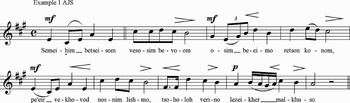
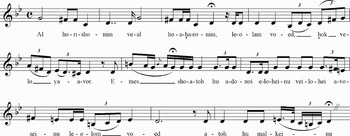
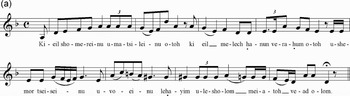
While only two musical notations of semeiḥim be-ẓeitam appear to be extant, many additional melodies were certainly in use. The first notation is present in the short handbook of life-cycle melodies compiled by Wilhelm Flamm, a ḥazzan in Prague.Footnote 22 Flamm harmonized the melody for choral rendition so that it could be fit for the sophisticated musical tastes of Prague's Jews in the 1860s. A second melody was published in 1912 in the compendium of south German ḥazzanut by Selig Scheuermann (1873–1935); here, the author provided the rubric beim Ausgang einer Wöchnerin (On the Coming Out of the Birth Mother).Footnote 23 In both examples, the melody was set to the verse quoted earlier and to the verse cited here in example 1:Footnote 24
Selig Scheuermann's Semeiḥim be-ẓeitam. Selig Scheuermann, Gottesdienstliche Gesänge, 21, section 1/E, no. 14 (Frankfurt: J. Kauffmann, 1912)

Berit Milah on Weekdays. The birth of a male child was an occasion for great festivity, especially, but not exclusively, on the day of the berit milah. Footnote 25 In medieval Europe, it became the norm for circumcision to take place in the synagogue following the shaḥarit service.Footnote 26
Both Shamash and Kirchheim discussed the widespread custom of the moheil, rather than the ḥazzan, leading the chanting of the shaḥarit service.Footnote 27 If the moheil were not capable of this task, he would at least lead the closing prayers, starting at la-menaze'aḥ (Psalm 20).Footnote 28 In Frankfurt, however, the moheil was only permitted to lead from la-menaze'aḥ on.Footnote 29 The tradition of the moheil leading shaḥarit was widespread also in Poland, where Moses Isserles (1488–1575) mentioned the custom in his glosses to the Shulḥan ‛arukh. Footnote 30
At the end of the introductory pesukei de-zimrah, both the moheil and the sandak were called upon to recite va-yevarekh david and shirat ha-yam responsively.Footnote 31 This practice began, appropriately enough, at the verse ve-kharot ‘imo ha-berit (You made a covenant [of the flesh] with him [Abraham]). Shamash described how, in Worms, the moheil would chant one verse and the sandak the next, up until yishtabaḥ. If neither could chant or follow these customary divisions, the ḥazzan or shamash would stand in their stead.Footnote 32
Although Joseph Yuspa Kosman of Frankfurt (d. 1758) was of the opinion that the responsorial singing of these verse by the moheil and the sandak was the custom throughout Germany (medinot ’ashkenaz),Footnote 33 its strongest hold was in the south and southwestern parts of the country.Footnote 34 Even in Frankfurt, where, as we have noted, the ḥazzan led all or most of the service, the tradition became rooted in the early eighteenth century.Footnote 35 In northeast Germany, including Berlin, the chanting was often led by the moheil alone, with the congregation responding. This was still the practice at a leading Orthodox synagogue in Berlin in the late 1930s.Footnote 36 Responsorial chanting by the moheil and the sandak was also known in parts of Poland.Footnote 37
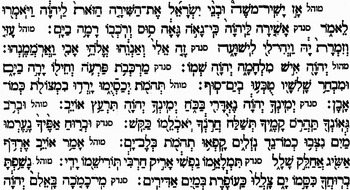
Originally a fluidity prevailed with regard to the division of the verses,Footnote 38 but a uniform practice soon coalesced, testified to first by R. Ya'ir Bacharach of Worms (1638–1702). Custom soon saw the dividing of verses at every sof pasuk (full close) and every ’etnaḥta (half close).Footnote 39 This standardized practice of dividing the recitation between the moheil and the sandak is reflected in ‘Avodat yisra'eil, the authoritative edition of the daily prayer book of Seligmann Baer (1825–1897; see example 2).Footnote 40
Divisions between moheil and sandak in Seligmann Baer's ‘Avodat yisra'eil (Roedelheim Verlag, 1868)

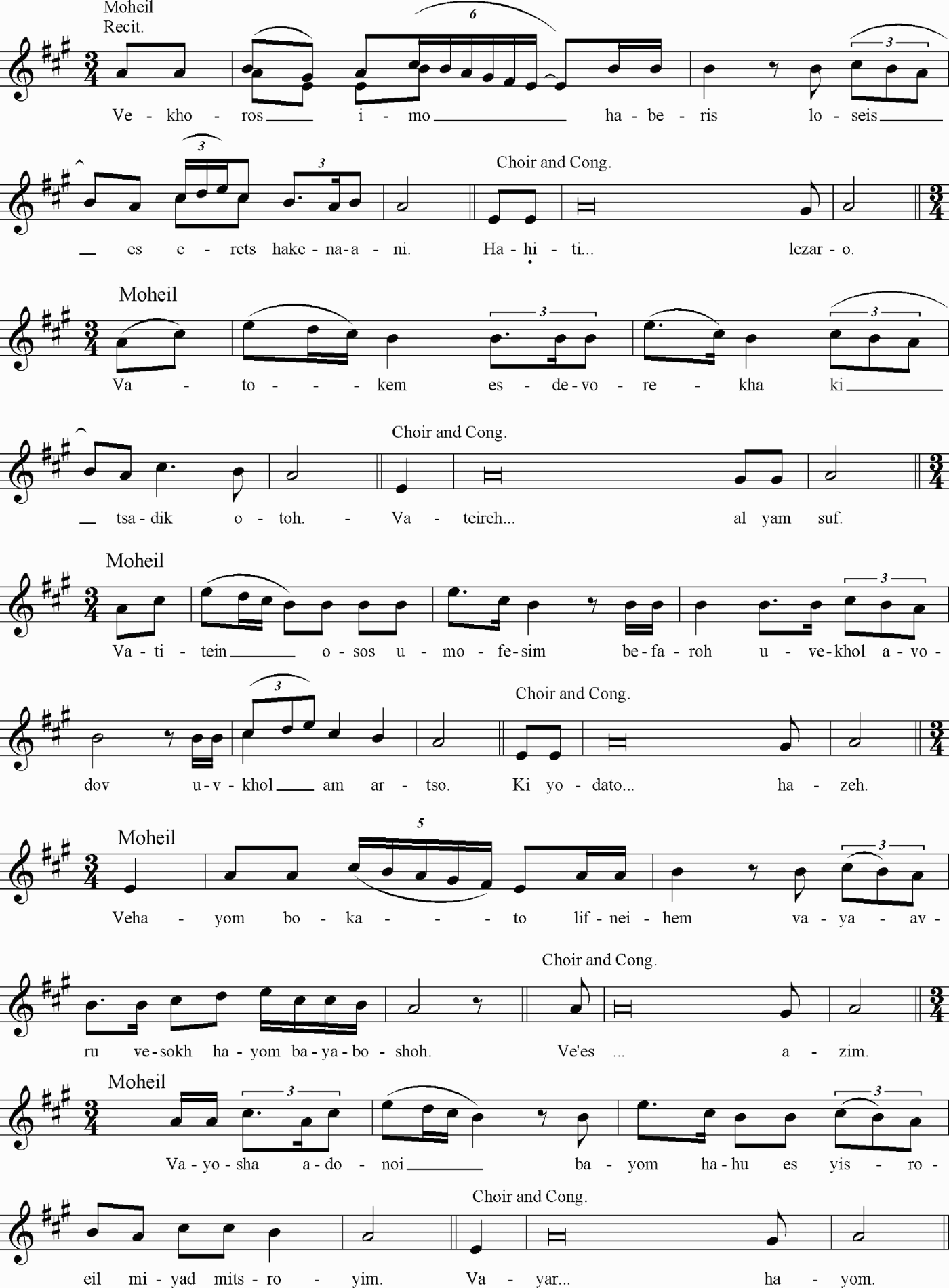
The divisions were somewhat different in the northeast, in Berlin, and in western Poland, as is evident in the cantorial compendium of Abraham Baer (1834–1894; see example 3).Footnote 41
Divisions between sandak/moheil and choir/congregation in Abraham Baer's Baal T'fillah: oder der practische Vorbeter, 2nd ed. (Gothenberg: privately printed, 1883; reprinted by Sacred Music Press, Out of Print Classic Series, Vol. 1, 1953), nos. 30–32.

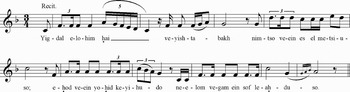
Kirchheim emphasized that the moheil and sandak were to sing ve-kharot and shirat ha-yam in a beautiful melody (niggun yafeh).Footnote 42 This melody replaced the regular chant pattern and, in the case of shirat ha-yam, use of the melody of the te‘amim. Footnote 43 Transcriptions reveal that a number of texts in the shaḥarit service were singled out for special musical performance. In south and southwest Germany, a core group of texts was sung to the special berit milah melody, and included not only ve-kharot and shirat ha-yam but also shirah ḥadashah and ẓur yisra'eil at the conclusion of the ge'ulah prayer. In more eastern territories (but also in Hürben, Bavaria),Footnote 44 this practice was expanded to include the opening hymns ’adon ‘olam (Eternal God) or yigdal (Praise the Living God; see example 4).Footnote 45
The opening hymn, Yigdal, sung to the special berit milah melody. Abraham Baer, Baal T'fillah: oder der practische Vorbeter, 71, no. 257.

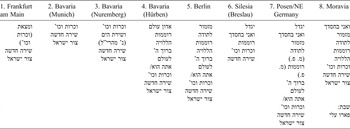
Additional portions of the pesukei de-zimrah, such as romemot ’eil (High Praises of God; Psalm 149:6)Footnote 46 and halleluyah (Psalm 150),Footnote 47 were sometimes added. Mizmor le-todah (A Song of Thanksgiving; Psalm 100) was also included, a custom, according to Baer, of minhag polin. Cantorial compendia from the mid-nineteenth to the early twentieth century show the expansion of texts selected for special singing (see Table 1):Footnote 48
Texts sung to a special berit milah melody (left to right)Footnote 49

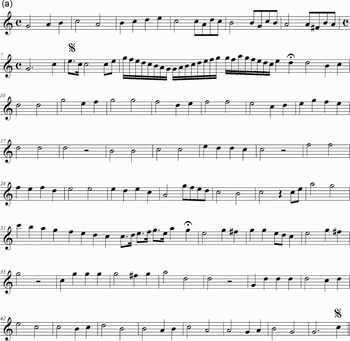
The differences between the musical notations in these texts are essentially only variations of a melody pattern built on a basic musical structure and similar motives. This pattern was also used for chanting the prayers of the berit milah ceremony itself, whence, it would seem, it was transferred to the shaḥarit service. Shamash's statement that shirah ḥadashah was sung to the niggun berit milah would seem to confirm this tradition.Footnote 50 Even though notations of shirah ḥadashah reveal a more elaborate, metrical melody, incorporating new thematic material of later provenance,Footnote 51 the core niggun berit milah melody pattern returns in the concluding ẓur yisra'eil. The shirah ḥadashah melody seems to have been especially popular. It was first transcribed in 1809 by Löb Wolf, a cantor in Berlin, whose setting is elaborate, but lacks text underlay (example 5a–b).Footnote 52
Elaborate setting of Shirah ḥadashah by Löb Wolf. Published in 1933. Reprinted by Ktav in 1973. This comes from Idelsohn's Thesaurus volume, The Synagogue Song of the German Jews in the 18th Century, 213, no. 36.

The berit milah melody in Shirah ḥadashah and Ẓur yisra'eil (Abraham Baer). Abraham Baer, Baal T'fillah: oder der practische Vorbeter, 13, nos. 49–50.

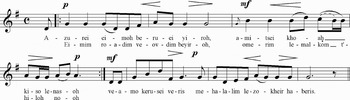
Berit Milah on the Sabbath. The addition of piyyutim provided textual and musical enrichment when a berit milah took place on the Sabbath.Footnote 53 Shamash described these additions, largely repeating information detailed by R. Jacob Moellin of Mainz (the Maharil; d. 1427), the most influential late medieval authority on minhag. Footnote 54 In the ensuing centuries, a number of these piyyutim continued to be recited, as evidenced by their inclusion in Baer's ‘Avodat yisra'eil. Footnote 55 One such poem, inserted before the ḥatimah (conclusion) of the yoẓeir blessing, was ’azurei ’eimah ([The angels] girded with fear). There are four extant musical notations, three from south, southwest, and west-central Germany, and one from eastern France, the last dating from as recently as 1951.Footnote 56 Each stanza concludes with a varying pizmon refrain (see example 6):
.וְעַמּוֹ כְּרוּתֵי בְרִית, מְהֲלְלִים לְזוֹכֵר הַבְּרִית.
But God's people, cut with the sign of the Covenant
Praise the One who remembers the Covenant.
The ’ofan ’Azurei ’eimah for Sabbath of a berit milah. Selig Scheuermann, Gottesdienstliche Gesänge, 18, section 1/E, no. 3 (Frankfurt: J. Kauffmann, 1912)

Some ḥazzanim also used the occasion of a berit milah to include a special extended melody while singing the passage ‘al ha-rishonim ([Incumbent] upon the Early Generations) within the ge'ulah (Redemption) blessing that follows the shema‘ and leads into the ‘amidah of shaḥarit. ‘Al ha-rishonim was only recited elaborately when a piyyut belonging to the category of a zulat was inserted within the ge'ulah blessing. On the occasion of a berit milah the zulat ’ot berit (Sign of the Covenant) was added—hence the special treatment of the ‘al ha-rishonim text that had led into it (see example 7).Footnote 57
Elaborate ‘Al ha-rishonim on the Sabbath of a berit milah. Abraham Baer, Baal T'fillah: oder der practische Vorbeter, 127, no. 529.

An expanded kedushah was sung during the musaf service. Following the congregational response, אני ה’ אלהיכם (I am the Lord, your God), a short poem belonging to a group of piyyutim with the opening word ’eloheikhem was inserted.Footnote 58 It begins ’eloheikhem ’ani zokher berit (Your God, indeed, am I, who remembers the covenant).Footnote 59 This poem was included in JTS Library MS 8972; its chanting was referred to by Jacob Moellin, Yuspa Shamash, and the eighteenth-century minhagbuch of Fürth, Bavaria.Footnote 60 Traces of the musical performance of this piyyut remain in a partial notation by Abraham Baer, but by that time, the ḥazzan only sang, in a minor mode, the concluding words.Footnote 61
In eastern Germany and Central Europe, on the occasion of a Sabbath day circumcision, certain verses in the brazenly anthropomorphic ’an‘im zemirot (Hymn of Glory) were sung responsively to the berit milah melody.Footnote 62 This occurred in the stanza starting at pe'eiro ‘alay (His glory is upon me), where, in the second line, the word ’adom (red) appears three times, an obvious allusion to the blood of the circumcision:
צַח וְאָדוֹם לִלְבוּשוֹ אָדוֹם,
.פּוּרָה בְדָרְכוֹ בְּבוֹאוֹ מֵאֱדוֹם.
Radiant and bloody, with garments red as wine
God punishes sinning nations [Edom] like grapes pulled from a vine.Footnote 63
The piyyut yom le-yabashah was especially associated with berit milah; its authorship is ascribed to Judah Halevi (1085–1145), and was customarily read at the end of the ge'ulah prayer on Shabbat beshalaḥ and on the seventh day of Passover, when shirat ha-yam was read from the Torah. In some regions, however, it was also recited at a Sabbath day circumcision. The opening words of the piyyut connect immediately to the verse “The children of Israel walked into the dry land [va-yabashah]” of shirat ha-yam (Exodus 15:19), while the ensuing verse, shirah ḥadashah shibbeḥu ge'ulim, quotes the closing section of the ge'ulah prayer:
יוֹם לְיַבָּשָׁה / נֶהֶפְכוּ מְצוּלִים
שִׁירָה חֲדָֹשָה / שִׁבְּחוּ גְאוּלִים:Footnote 64
The day the depths turned into dry land
Your redeemed people praised You
And sang a new song.
The recitation of yom le-yabashah in the synagogue on the occasion of a berit milah can be easily explained. A condition for the full celebration of the first Passover in Egypt and its subsequent observance was circumcision (Exodus 12:44–48), a requirement referred to in the following stanza of the piyyut:
הַבָּאִים עִמְּךָ / בִּבְרִית חֹתָמְךָ
וּמִבֶּֽטֶן לְשִׁמְךָ / הֵמָּה נִמּוֹלִיםFootnote 65 : שִׁירָה חֲדָֹשָה שִׁבְּחוּ גְאוּלִים
Those who come with You with the covenant of Your seal
And from the womb are circumcised for Your name's sake.
Recitation of yom le-yabashah for a berit milah was mentioned first by Abraham Klausner (late fourteenth century) in his collection of Austrian customs,Footnote 66 and thereafter, it became a custom of minhag polin rather than minhag ’ashkenaz. Footnote 67 While Seligmann Baer gave the impression that yom le-yabashah, in both its liturgical and life-cycle contexts, was normative in German congregations,Footnote 68 a contrary opinion was given by Wolf Heidenheim (1757–1832), who published innumerable editions of German prayer books, and more recently, by Yonah Fraenkel.Footnote 69 Furthermore, Abraham Baer inserted a liturgical–musical rubric in his Baal T'fillah, explicitly classifying recitation of yom le-yabashah for a circumcision as minhag polin. Footnote 70
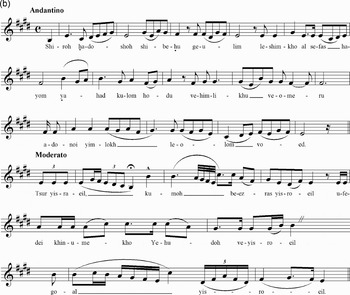
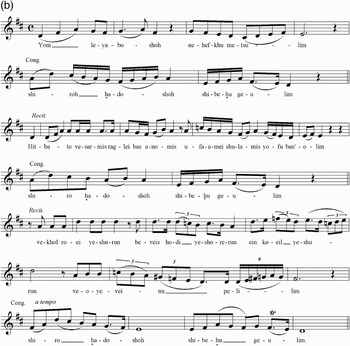
Musical settings of yom le-yabashah in various cantorial compendia are, not surprisingly, of eastern German and Central European provenance. They range from a simple one notated by Abraham Baer, in which the ḥazzan sang each stanza in a joyous melody in major (example 8a),Footnote 71
Baer's joyous setting of yom le-yabashah for ḥazzan alone. Abraham Baer, Baal T'fillah: oder der practische Vorbeter, 150, no. 647.

to more elaborate pieces transcribed by Moritz Deutch (Breslau), Aron Friedmann (Berlin), and Maier Wodak (Moravia), each based on various traditional prayer modes of the Ashkenazic synagogue. Similar or recurring refrain lines in the more complex pieces, melodic elements of which were shared in common by Deutsch and Friedmann (whose version is cited here), invited congregational participation at every strophic recurrence of the closing words, shibbeḥu ge'ulim (“the redeemed ones sang”: example 8b).Footnote 72
Aron Friedmann's yom le-yabashah. Printed in 1902 under the auspices of Deutche-israelitischer Gemeindebund (Berlin). Source: Schir Lisch'laumau, no. 249.

Bar Mitzvah
The emergence of the bar mitzvah ceremony was a comparatively late development. It was of German origin but only coalesced and became widespread in the late Middle Ages or the early modern period.Footnote 73
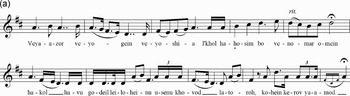
Despite the relatively late emergence of the ceremony, two musical traditions developed. Yuspa Shamash mentioned that in Worms, a special attractive melody was sung for the reshut (invocation) “May God shield and protect,” ve-ya‘azor ve-yagein, recited in the Torah service immediately before the Torah reading. Normally sung by the ḥazzan or the Torah reader as a preface to the first ‘aliyah to the Torah,Footnote 74 on the occasion of a bar mitzvah, it was recited by the boy himself. In Worms, the same melody was used for this prayer text on Simhat Torah (example 9a):Footnote 75
Ve-ya‘azor ve-yagein melody for a bar mitzvah boy (Frankfurt: J. Kauffmann, 1930). Source: Fabian Ogutsch, Der Frankfurter Kantor: Sammlung der traditionellen Frankfurter Gesänge, 54, no. 159.

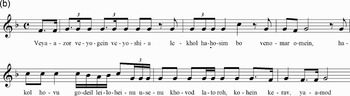
This special ve-ya‘azor ve-yagein melody was the custom in Frankfurt as well,Footnote 76 and it appears to have been restricted to western and southwestern Germany.Footnote 77 On every other occasion, ve-ya‘azor ve-yagein was chanted in a modal chant of considerable antiquity (based on High Holy Day cantillation), the same mode used in minhag ’ashkenaz for the weekday evening (ma‘ariv) service and the shema‘ and its blessings in the weekday morning (shaḥarit) service (see example 9b).Footnote 78
Modal chant for Ve-ya‘azor ve-yagein sung on a regular Sabbath. Abraham Baer, Baal T'fillah: oder der practische Vorbeter, 28, no. 104a.

There was further musical elaboration in Frankfurt on those Sabbaths when a bar mitzvah ceremony occurred. After the seventh ‘aliyah and before the maftir portion when the boy would be called up to the Torah, the “Kaddish over the Torah” (kaddish ‘al ha-torah) was recited. The ḥazzan sang the first part, as on a regular Sabbath,Footnote 79 but to mark the distinctiveness of the day, he departed from the usual melody in the second part of the text, singing it to one of the more recent “popular melodies.”Footnote 80
Marriage
The wedding ceremony was the pinnacle in a cycle of ritualized community festivities both preceding and following it. Perhaps because of the protracted stages involved in contracting marriage and the complexity of the rituals surrounding it, over time, there occurred more far-reaching musical changes than with berit milah. A major factor influencing these developments was the change of the day of the traditional wedding ceremony.
Engagement. The cycle leading to marriage began with the engagement (tena'im), known in western Ashkenazic communities as k'nas (legen), and involved a financial settlement (k'nas) incumbent should the wedding be cancelled. On the Sabbath following the k'nas, the ḥazzan called up the bridegroom to the Torah with a festive ya'amod (“let [the bridegroom] arise”), and the latter made a charitable contribution.Footnote 81 This special calling up “with a loud voice” (be-kol ram) was regarded as praiseworthy and customary by Yehudah Zelichover, a seventeenth-century ḥazzan from Amsterdam.Footnote 82 The same tune was used on other occasions, such as the Sabbath before (or after) the wedding, for the calling up of a bar mitzvah, and for announcing the ḥatan Torah and ḥatan Bereishit on Simhat Torah. The melody of the festive ya‘amod, according to the musical notation of Isaak Lachmann (1838–1900), was trumpet-like (see example 10).Footnote 83
Festive melody for Ya‘amod, notated by Isaak Lachmann. From the Birnbaum Collection, Hebrew Union College–Jewish Institute of Religion (Cincinnati).

“Shabbat Weddings” or Shabbat Breilaft. An older medieval custom, in both ’ashkenaz and polin, from at least the time of the First Crusade in 1096, had been for the ḥuppah ceremony to be conducted on Friday, even close to the onset of Shabbat, as was the case in Worms.Footnote 84 In Germany, these “Sabbath weddings” extended into the Sabbath proper. Such weddings were often known as Shabbat Breilaft, although Jacob Moellin did not use, or was unfamiliar with, this name.Footnote 85 Almost all the special wedding piyyutim included in JTS Library MS 8972 were connected to the ceremonies of Shabbat Breilaft. In the early modern period, however, the day for weddings was transferred to Wednesday, as had been talmudic practice.Footnote 86 In Frankfurt, Shabbat Breilaft was discontinued around the year 1660, despite a short-lived attempt in 1701 to revive it.Footnote 87 In Worms, the older practice had already ceased by the time Shamash wrote down his minhagim,Footnote 88 although he described the former practice in detail.
On Saturday morning, when the bridegroom, followed by the bride, was escorted to the synagogue, a special musical elaboration occurred. In Frankfurt, the escorting was even accompanied by music played by Gentile musicians.Footnote 89 In Worms, the precentor (menagein) of the pesukei de-zimrah halted the shaḥarit service before mi yidmeh lakh, “who is like You,” in the nishmat hymn, to permit the escorting of the bridegroom.Footnote 90 Once the latter had been brought into the synagogue, the precentor would sing mi yidmeh lakh with special emphasis (be-kol ram)—a personalization of the text to “who, indeed, is like you.”Footnote 91
There was a fairly logical reason why the break for the escorting occurred at mi yidmeh lakh: at this juncture, a piyyut opening with the same words וּמִי יִ ۟ שְוֶה-לָּךְ / מִי יִדְמֶה-לָּך had once been inserted. This piyyut was included in JTS Library MS 8972.Footnote 92 Shamash and Kirchheim apparently did not know this particular piyyut, which, had it once been sung in Worms, had long been discontinued. Nevertheless the escorting on Shabbat Breilaft remained, and the final section of nishmat was given musical emphasis.Footnote 93
Wedding-related piyyutim inserted into the service listed by Shamash and Kirchheim, and somewhat earlier almost identically by Jacob Moellin, belonged to a smaller and different repertory. These might have represented minhag reinus (Rhineland) as against minhag oystraikh (Austria) represented by JTS Library MS 8972.Footnote 94 A piyyut from both repertories was ’ataneh shevaḥei, sung after the bridegroom had been called up to the Torah by a special reshut (the same as that sung on Simhat Torah). The piyyut includes references to the ḥatan and quotes God's blessing to Adam and Eve and the commandment and hope for children (Genesis 1:28). According to Moellin, the opening stanza was sung together by the ḥazzan and shushvinim, his close friends also “obligated” to be called up on this occasion, indicating that the text and the melody were familiar.Footnote 95
The Later Mid-Week Wedding. With the transfer of the marriage ceremony to Wednesday, the shaḥarit service on the day of the wedding now occasioned far less musical enrichment. The cessation of the Sabbath wedding enabled the avoidance of rabbinic opposition to removing piyyut. Of all the piyyutim once sung on Shabbat Breilaft, by the nineteenth century, only a special ’eloheikhem inserted in the kedushah of the musaf service generally continued to be sung.Footnote 96
Nevertheless, in Worms, several fixed liturgical texts in the morning service on the day of the wedding received musical embellishment. As with the berit milah, shirah ḥadashah, and ẓur yisra'eil, the concluding sections of the ge'ulah prayer, were sung to special melodies. Despite a lack of clarity in Shamash's description, it is clear that at least one melody was used exclusively for marriages.Footnote 97 If, for some reason, the marriage ceremony took place on Thursday, even though the “supplication” was omitted, the short passage ’eil ’erekh ’appayim was sung to a “pretty melody.”Footnote 98 In addition, the bridegroom was called to the Torah.Footnote 99
Pre-Marriage Rite: Spinholz. The Sabbath before the wedding was known as Spinholz (שפינהולץ), a rather obscure term whose etymology remains unresolved.Footnote 100 Then, as now, the bridegroom was called to the Torah, although the term aufruf (calling up) is of later origin.Footnote 101 Such importance was given in Mainz to the festive character of Shabbat Spinholz that up until the year 1743, kabbalat shabbat was celebrated on this occasion with instrumental music (kelei zemer).Footnote 102 In the ma‘ariv service, in order to bring attention to the forthcoming wedding, the ḥazzan sang two liturgical texts to special melodies. The first was malkhutekha in the ge’ulah prayer, following the mi khamokha response of the congregation.Footnote 103 This was a popular text for cantors to embellish. For example, the Berlin ḥazzan Aaron Beer (1738–1821) composed a different malkhutekha for each Sabbath of the year, although, as far as can be ascertained, none was specifically for a life-cycle event.Footnote 104
On Shabbat Spinholz, the opening words מלכותך ראו בניך (Your children beheld Your sovereignty) were taken out of context and personalized, with vanekha (your children) directed toward the bridal couple rather than (or in addition) to the Israelites. Unfortunately, no musical transcriptions of this special malkhutekha appear to be extant. According to Scheuermann, it was sung to the same melody as semeḥim be-ẓeitam. Footnote 105 The second text receiving emphasis was hashkiveinu, the second blessing after the evening shema’. In Worms, this special musical treatment began two-thirds of the way through, at ki ’eil shomereinu (For God watches over us), which was also the custom in Alsace and Baden.Footnote 106 In Amsterdam, while the older practice was to begin at ki ’eil shomereinu, it later became customary for cantors to compose a setting of the entire prayer in honor of the celebration, a practice found also in Frankfurt.Footnote 107 The similarity between a melody used in Frankfurt for ki ’eil shomereinu on Hanukkah and that of a south German kallalied (bridal song) suggests that this melody might originally have been used on Shabbat Spinholz (see examples 11a–b).Footnote 108
Fabian Ogutsch's notation of Ki ’eil shomereinu. Fabian Ogutsch, Der Frankfurter Kantor, ed. J.B. Levy (Frankfurt: J. Kauffmann, 1930).

Maier Kohn's notation of a South-German kallalied. Published in 1933. Reprinted by Ktav in 1973. Source: Idelsohn, Thesaurus volume, The Traditional Songs of the South German Jews, 112, no. 325.

The next day, almost everywhere (but not, for example, in Fürth),Footnote 109 the bridegroom would be called to the Torah with the special ya’amod melody at shaḥarit. In Worms, however, the bridegroom was called up at minḥah, possibly so as to be honored at a time closer to the wedding.Footnote 110 At the musaf service, the ḥazzan sang the closing lines of the kaddish shaleim (yehei shelamah rabbah and ‘oseh shalom) to a special melody referred to by Shamash as “the melody for the bridegroom and the bride” (niggun ḥatan ve-kallah), suggesting a well-known traditional tune.Footnote 111
Following the midday se‛udah (obligatory meal), the bride and bridegroom proceeded to the Braut Haus (wedding hall) or the Tantz Haus (dance hall). The bride was accompanied from her parent's home with instrumental music played by non-Jewish musicians (leiẓanim). In medieval ’ashkenaz, music played by Gentiles on the Sabbath during the seven days of feasting after the wedding had been quite widespread, and in the early modern period, employment of such musicians was still not uncommon.Footnote 112
Pre-Wedding Rite: Mayen. If the bride had not previously been married and was a virgin, a special festivity commenced early in the morning of wedding day. This ceremony was known as the mayen (מאיין), derived from May Day customs relating to courtship and fertility.Footnote 113 Before the shaḥarit service, the bride and groom were escorted with torches and instrumental music to the mayen, the location of which, in most German communities, was the entrance to the synagogue,Footnote 114 though in Worms it was held in the Braut Haus. Footnote 115 There, the people threw wheat (a symbol of fertility) at the bridal couple and called out to them, פְּרוּ וּרְבוּ, “be fruitful and multiply” (Genesis 1:28).Footnote 116 Then the bridegroom was escorted to the synagogue.
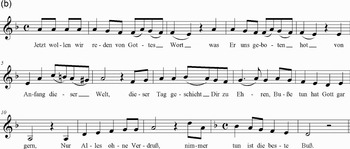
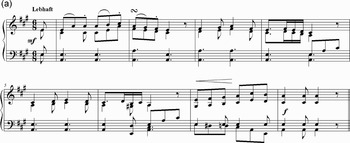
One melody (dating from the late eighteenth century) played at the mayen was, in the following century, transferred into the synagogue when marriages were again performed there.Footnote 117 This melody was known in the Judeo-Deutsch of Alsace as the kale-lid or khuppe-lied, and in Bavaria as the maan (a corruption of mayen) niggun; Footnote 118 it became one of the most popular folk songs of nineteenth-century German-speaking Jews. A number of transcriptions of the melody are extant, the first dating from 1832 (see example 12a).
Maan-niggun for a wedding processional arranged by Moritz Rosenhaupt. Privately printed in Germany, 1895. Source: Schire Ohel Yaakov, vol. 3, 16.

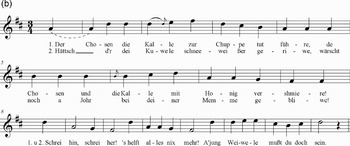
A second transcription of the mayen shows that it acquired a text in Alsatian Judeo-Deutsch and German (see example 12b).Footnote 119
Kale-lid with Alsatian Judeo-Deutsch and German text (unattributed). From Jahrbuch für jüdische Volkskunde, 1923.

The Paraliturgical Song: ’Eḥad yaḥid u-meyyuḥad. Most embellishments did not survive the discontinuance of the Shabbat wedding. Nevertheless, the rabbinic ideal of mezamerim ’oto, the obligation to provide song for the couple, helped to prevent the complete eclipse of festive singing.Footnote 120 Consequently, the tradition of singing a piyyut after the bridegroom was called to the Torah still continued. Rabbi Abraham David Warhman (1771–1841) of Buczacz, Galicia, in his commentary to the Shulḥan ‛arukh, alluded to the singing of a pizmon at this time as if it were a fairly common occurrence.Footnote 121 He was quite probably alluding to a piyyut that had gained almost universal popularity and survived into modern times: ’eḥad yaḥid u-meyyuḥad by Avigdor Karo of Prague (d. 1439).
Written in Hebrew, but also with a variant in Yiddish, early printings of the Hebrew piyyut, often with the heading zemer na'eh le-ḥatan (A Fitting Song for a Bridegroom), were included in publications of the birkat ha-mazon for use at the wedding feast, the earliest dating from 1580.Footnote 122 Every indication shows, however, that eḥad yahid u-meyyuḥad was not sung at the wedding feast, but rather after the ḥatan had been called up to the Torah.Footnote 123 This usually occurred on the Sabbath before the wedding, though in some places it occurred on the Sabbath after the wedding or even following the betrothal (tena'im), while in some communities it was sung on all three occasions.Footnote 124
אֶחָד יָחִיד וּמְיֻחָד אֵל.
נִדְרָֹש לְבַר לֵבָבשֹוֹאֵל.
אַךְ טוֹב אֱלֹהִים לְיִשְֹ רָאֵל.
.הַלֲלוּיָה.
God, the One and Unique,
Sought by the pure in heart who seek,
That God acts kindly to Israel,
Halleluyah.
Textually, the piyyut has no connection whatsoever with marriage, but deals, instead, with strengthening one's trust in God, observance of the 613 commandments, invoking God's blessing on Israel, and inviting anyone of the three monotheistic faiths (יהודי-נוצרי-ערבי)Footnote 125 to experience the purity of Judaism's fidelity to the oneness of God. The purely theological character of the piyyut was stressed by Juspa Kosman, who considered the song one of “great praise and a testimony to the principles of the religion.”Footnote 126 Entry into marriage was a time for forgiveness of sins of the past and for devotion not only to one's beloved, but also to God. This factor also explains the singing at wedding celebrations of other piyyutim that had no outward connection to marriage, such as yigdal, the poetic paraphrase of the Maimonides’ Thirteen Articles of Faith.Footnote 127
There are many historical references to the singing of the piyyut. For example, Judah Leib Zelichover extolled the singing of ’eḥad yaḥid for the bridegroom (on shabbat k'nas, the Sabbath after the betrothal) among other customs “in these lands,” the reference being to Amsterdam and the Republic of the United Provinces.Footnote 128 Rabbi Joseph Juspa Kosman (d. 1758) detailed how, in Frankfurt, the Sabbath before the wedding was a time “to increase joy … to call him [the bridegroom] to the Torah … and sing on this behalf (u-mezamrim lo) ’eḥad yaḥid.”Footnote 129 In Frankfurt, meshorerim, the vocal assistants to ḥazzanim, played an active role,Footnote 130 as they did in PragueFootnote 131 and undoubtedly elsewhere. In post-emancipation times, references to singing ’eḥad yaḥid u-meyyuḥad for the bridegroom were frequently made in descriptions of traditional Jewish life in Western and Central Europe, as well as in autobiographical reminiscences.Footnote 132
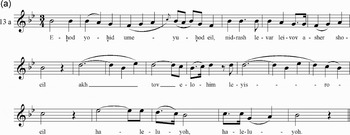
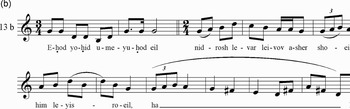
Remarkably, for centuries, ’eḥad yaḥid u-meyyuḥad was never printed in a standard Ashkenazic prayer book. The only siddur that appears to have eventually included it (and then only the opening stanza) was the Festival prayer book edited in 1866 by Rabbi Michael Sachs of Berlin.Footnote 133 Seligmann Baer included the entire piyyut in his handbook for Torah readers published that year,Footnote 134 as did Lion Wolff in his 1914 handbook for cantors.Footnote 135 The first published musical transcription of the piyyut, like the text itself, emanated from Prague.Footnote 136 Several notations were included in the collections of nineteenth-century ḥazzanim, and Idelsohn provided three versions in his Thesaurus volume of south German melodies (examples 13a–b).Footnote 137
Examples 13a.

Two versions of ‘Eḥad yaḥid included by Idelsohn in his Thesaurus volume of south German Jewish melodies. Published in 1933, Reprinted by Ktav in 1973. Source: The Traditional Songs of the South German Jews, 126, nos. 356 (a) and 358 (b).

The absence of ’eḥad yaḥid u-meyyuḥad from printed siddurim underscores that it functioned as a paraliturgical text transmitted orally by ḥazzanim. As a result, much of the text was forgotten, especially in eastern regions of Europe.Footnote 138 Even in Western Europe, just the opening stanza (or two) was generally sung.Footnote 139 This process of reduction was noted by Juspa Kossman of Frankfurt, who held that all the stanzas should be sung, “unlike some ḥazzanim who sing only one or two.”Footnote 140 In Central and Eastern Europe, even the first (and only) stanza was corrupted through textual deletions, substitutions, additions, or paraphrasesFootnote 141 to such an extent that among ḥaredim in Jerusalem before the Shoah, only a wordless niggun was sung, the melody of which had formerly carried the words of ’eḥad yaḥid. Footnote 142
Death
For mourners, absence of song was an effective means to enable the community to share an individual's personal loss. In minhag ’ashkenaz, and even in some western regions of minhag polin, such as in Berlin, the ḥazzan or ba'al tefillah commenced the morning service with the recitation of the hymn ’adon ‘olam. On ordinary weekdays, this was usually a simple chant. In Frankfurt, following the death of a member of the community (older than one year of age) and burial had not yet taken place, the chanting of ’adon ‘olam was omitted.Footnote 143 In this way, without any formal verbal pronouncement of sad news, the community was informed of a person's death.
The Emancipation and Life-Cycle Song
In the early nineteenth century, there was a drive in Germany to eliminate, reduce, or at least regulate the singing of melodies associated with life-cycle events in the synagogue. Several factors contributed to this downplaying. The presentation of Judaism as a faith rather than as a way of life led to a minimization of the folk and peoplehood aspects of Jewish life. Attention to individual semaḥot (celebrations) was viewed as a digression from a liturgy whose purpose was to express the universal truths of Judaism. Increased sensitivity to the image of Jews and Judaism in German society influenced attitudes toward the suitability of music for divine worship; an attendant lack of formality surrounding life-cycle song and rituals offended a changed aesthetic on the part of many German Jews who sought something “more akin to ecclesiastical formality” rather than the former “more improvised expression of Jewish worship.”Footnote 144
Efforts to eliminate or regulate life-cycle folk customs found concrete expression in many Synagogen-Ordnungen, or synagogue regulations, drawn up by German rabbis, and were sometimes authorized by state authorities. They were introduced, mainly in the 1830s and 1840s, by Reformist-leaning rabbis and, for the most part, tended to avoid fundamental halakhic changes. Life-cycle synagogue melodies and piyyutim were brought under especially sharp scrutiny and regarded unfavorably.Footnote 145
The first Synagogue Regulation issued in 1810 by the Consistory of the Kingdom of Cassel, headed by the early Reform leader Israel Jacobson, ruled that the calling up of a bridegroom should no longer be accompanied by special singing. The special singing of semeiḥim be-ẓeitam for a bridegroom or a yoledet was also no longer allowed.
The Synagogue Regulation of Mittelfranken, Bavaria (1836), issued similar rules, prohibiting special singing when calling up a bar mitzvah or a bridegroom to the Torah and forbidding the singing of semeiḥim be-ẓeitam and malkhutekha for a bridegroom and for women after confinement.Footnote 146 The Synagogue Regulation of Bamberg, Bavaria, specified that ’eḥad yaḥid u-meyyuḥad could no longer be sung when a ḥatan torah or a bridegroom was called up to the Torah.Footnote 147 On the other hand, the Synagogue Regulation of the Duchy of Saxe-Weimer continued to permit its singing, if the bridegroom specifically requested it.Footnote 148 In Württemberg, “inappropriateness” of the melodies was the motivating force in opposing the singing of malkhutekha for the bridal couple, ’eḥad yaḥid u-meyyuḥad for the bridegroom, and semeiḥim be-ẓeitam for a woman after confinement.Footnote 149 Even so, the new legislation intimated that if suitable melodies could be composed, they might be acceptable.Footnote 150
These various regulations are useful in revealing how, by the nineteenth century, the texts and their melodies had become disconnected from the life-cycle events with which they had been originally associated. Semeiḥim be-ẓeitam (yoledet) was sometimes also sung for the bridegroom,Footnote 151 and malkutekha was sometimes sung for a yoledet. It was also not uncommon for eḥad yaḥid to be sung for a bar mitzvah,Footnote 152 as well as for the ḥatan torah and ḥatan bereishit. The words of the texts that connected to the life-cycle ceremonies lost their specificity and became generic.
By the second part of the century, there were indications of a more positive reevaluation of these practices. For example, the Regulation of Hannover of 1870 sanctioned the recital of ’eḥad yaḥid and, on a Sabbath when there was a berit milah in the synagogue, encouraged the singing of a special piyyut. Footnote 153 Furthermore, it permitted the special recitation of ve-kharot ‘imo ha-berit, suggesting the continuance of responsive singing of shirat ha-yam, as well as eloheikhem in the kedushah of musaf. Footnote 154
Examination of the publications of several cantor-composers shows that some degree of life-cycle song in the synagogue not only was retained, but even was sometimes presented in more stylized forms. Three leading nineteenth-century composers of synagogue music, Louis Lewandowski (1823–94), Salomon Sulzer (1804–90), and Samuel Naumbourg (1815–80), composed choral settings for the wedding ceremony.Footnote 155 Naumbourg, however, also created a choral arrangement of the “traditional” Western European melody of shirah ḥadashah and ẓur yisra'eil for a berit milah when it occurred on the Sabbath.Footnote 156 His melody line for these two pieces continued to be sung in France well into the twentieth century.Footnote 157
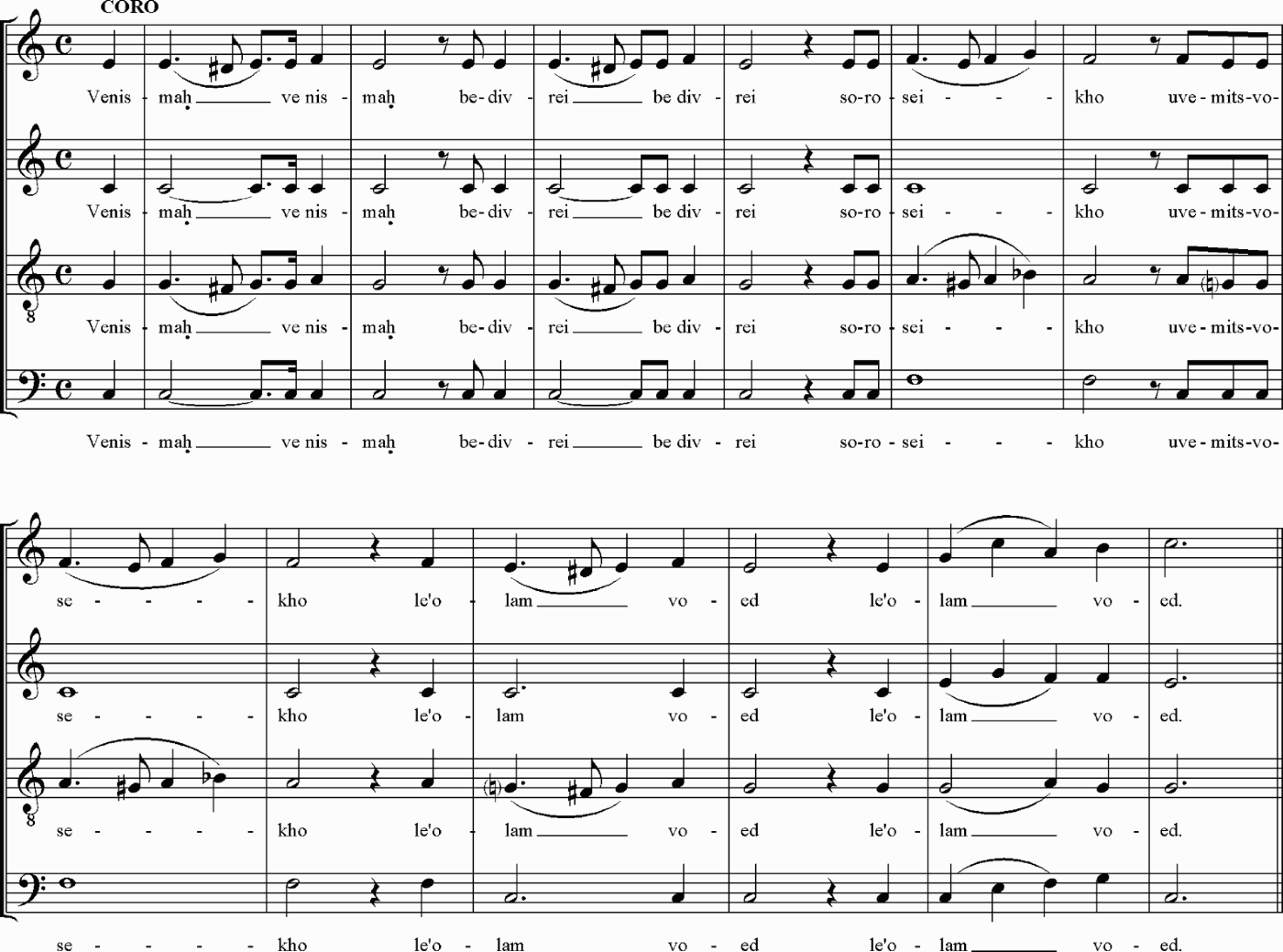
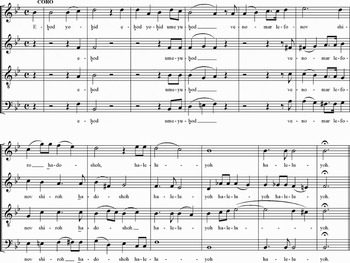
On the other hand, the gifted and eclectic cantor-composer Hirsch Weintraub (1811–81) of Königsberg wrote new melodies specifically for life-cycle ceremonies. These were published in his Schire Beth Adonai (1859) and included choral settings for berit milah, bar mitzvah, the new ceremony of confirmation, and weddings. For the Sabbath preceding marriage and for a bar mitzvah, he composed a new setting of ’eḥad ỵahid u-meyyuhad (examples 14–15).Footnote 158
Hirsch Weintraub's chorale Ve-nismaḥ be-divrei toratekha u-vemiẓvotekha for the evening service of a Sabbath over which a bar mitzvah is being celebrated. Hirsch Weintraub, Schire Beth Adonai oder Tempelgesänge für den Gottesdienst der Israeliten, vol. 1 (Leipzig: Breitkop & Härlel, 1859; reprinted by Sacred Music Press, Out of Print Classic Series, Vol. 19, 1954), 21, no. 10.

Weintraub's ’Eḥad yaḥid u-meyyuḥad with a modified text, for a bar mitzvah or marriage ceremony. Hirsch Weintraub, Schire Beth Adonai oder Tempelgesänge für den Gottesdienst der Israeliten, vol. 1, 21, no. 10.

The second of these pieces is of particular interest because the text has been modified. Only the three opening words have been retained, and, most notably, the word אֵל, has been omitted. The text now reads,
אֶחָד יָחִיד וּמְיֻחָד, וְנֹאמַר לְפָנָיו ֹשִירָה חֲדָֹשָה, הַלְלוּיָהּ
The one and unique,
Before him let us recite a new song,
Halleluyah.
Without question, “the one and unique” refers directly to the bar mitzvah or the bridegroom, before whom “a new song was sung.” Weintraub's setting of ’eḥad yaḥid provides concrete evidence for the personalization of liturgical texts for use at maḥazor ha-ḥayyim celebrations, a customary practice that has been documented throughout this article.
Conclusion
The revival of synagogal life-cycle song by Hirsch Weintraub was short-lived. It represented the endpoint of many centuries of liturgical and musical creativity in this genre within the European Ashkenazic synagogue. Yet the need to respond to the spiritual needs of the individual within the larger communal context continues. In many contemporary American synagogues, the prayer on behalf of the sick (mi-sheberakh) is no longer hurried through in an undertone, but is often sung to new musical settings, often by the entire congregation, extending for several minutes.Footnote 159 This American practice seems to be responding to deeply felt personal needs not adequately met in the past. It has become—in addition to the singing of siman tov u-mazal tov—a peak individual “life-cycle” moment supported by the community. Yet the rich development of life-cycle song in the European Ashkenazic synagogue shows that innovations were not primarily for life's woes, but for life's celebrations.