In order to improve the nutritional value of process foods, manufacturers increase the use of polyunsaturated fatty acids (PUFA), rich in omega-3 fatty acids in their formulations. However, these ingredients are prone to oxidation reactions leading to the development of undesirable ‘off-flavors’ (rancidity) and potentially toxic products. During lipid oxidation, a number of reactions occur simultaneously, leading to the formation of a complex mixture of end-products, including aldehydes, ketones, alcohols, and hydrocarbons (Frankel, Reference Frankel2005). Synthetic antioxidants currently used in foods such as butylated hydroxytoluene and butylated hydroxyanisole inhibit lipid peroxidation by trapping peroxyl radicals and preventing peroxyl radical chain propagation. However, synthetic additives are perceived as unfriendly ingredients by consumers who are looking for natural and healthy food. Recent investigations in the field of antioxidants have focused on naturally occurring molecules to address consumers’ concerns over safety and toxicity of food additives. Among natural antioxidants, polyphenols were shown to exhibit various antioxidant properties (Bravo, Reference Bravo1998; Brown et al. Reference Brown, Khodr, Hider and Rice-Evans1998). For example, herbs and spices, rich in polyphenols, have been used for many years to prevent lipid oxidation in foods (Madsen & Bertelsen, Reference Madsen and Bertelsen1995).
Plant lignans are polyphenolic compounds (Stopper et al. Reference Stopper, Schmitt and Kobras2005) that possess a range of biological activities in animals and in in vitro systems, including antioxidant, antitumor, weakly estrogenic, and anti-estrogenic properties, and they inhibit some enzymes involved in the metabolism of sex hormones (Adlercreutz et al. Reference Adlercreutz, Mazur, Bartels, Elomaa, Watanabe, Wähälä, Landström, Lundin, Bergh, Damber, Åman, Widmark, Johansson, Zhang and Hallmans2000; Bloedon & Szapary, Reference Bloedon and Szapary2004). Flaxseed (Linum usitatissimum L.) is one of the richest sources of the plant lignan secoisolariciresinol diglucoside (SDG; Thompson et al. Reference Thompson, Robb, Serraino and Cheung1991), which exist as oligomers, linked by 3-hydroxy-3-methylglutaryl esters (Johnsson et al. Reference Johnsson, Peerlamp, Kamal-Eldin, Andersson, Andersson, Lundgren and Åman2002). Plant lignans are metabolized to the mammalian lignans enterodiol (ED) and enterolactone (EL) in the colon by the gastrointestinal microflora in monogastric animals (Eeckhaut et al. Reference Eeckhaut, Struijs, Possemiers, Vincken, De Keukeleire and Verstraete2008). In ruminant animals, the ruminal microbiota plays an important role in the metabolism of flaxseed lignans (Gagnon et al. Reference Gagnon, Côrtes, da Silva, Kazama, Benchaar, dos Santos, Zeoula and Petit2009a) and enterolactone concentration in milk increases linearly with the amount of flaxseed meal in the diet of dairy cows (Petit & Gagnon Reference Petit and Gagnon2009).
Antioxidant properties of SDG and mammalian lignans ED and EL were observed at low concentrations in in vitro systems. Inhibition of linoleic acid peroxidation was demonstrated at concentrations of 10 and 100 μm (Kitts et al. Reference Kitts, Yuan, Wijewickreme and Thompson1999). The SDG, ED, and EL showed higher antioxidant activity than vitamin E (Prasad, Reference Prasad2000) and high blood concentration of EL was linked to a lower incidence of cardiovascular diseases in human (Vanharanta et al. Reference Vanharanta, Voutilainen, Lakka, Van der Lee, Adlercreutz and Salonen1999). These results suggest that using lignans derived from flaxseeds could prevent oxidation in dairy beverages enriched with PUFA and provide the consumers with dairy products with improved health benefits.
In order to increase the antioxidant properties of dairy products, flaxseed extracts are commercially available and can be added to dairy product formulations. Alternatively, dairy cows can be fed with flaxseed meal in order to naturally increase the EL concentration in milk and use this milk in product formulation. The objective of this work was to investigate both approaches for the protection of dairy beverages enriched with PUFA. Dairy beverages were formulated with added SDG extract or from natural milk with increased EL concentration and the resistance to light-induced and heat-induced oxidation were monitored.
Materials and Methods
Dairy Beverage Preparation
Formulations with added lignans
Low heat skim milk powder from Agropur (Granby, QC, Canada) with 353 g protein/kg dry matter was dispersed in Millipore water to a total solid concentration of 100 g/kg. Sodium azide (0·2 g/kg) was added to prevent microbial growth. Milk dispersions, fortified with iron as FeSO4 at 0·01 g/kg, were supplemented with various concentrations of SDG extract (20 % purity; donated by AMA Industries Inc., La Puente, CA, USA) or EL (98% purity; Cayman Chemical, Ann Arbor, MI, USA) and stirred for 30 min before storing at 4°C overnight. Dispersions were enriched with flaxseed oil (Orphée, La Maison Orphée Inc., Quebec City, QC, Canada) containing 60 mg β-carotene/kg (Colarôme Inc., Saint-Hubert, QC, Canada) at 20 g/kg. Antifoam (Mazu DF 204) was added at 0·1 g/kg and dairy beverages were pre-emulsified at 40°C using an Ultra-Turrax T25 homogenizer (IKA, Staufen, Germany) fitted with a S25KV-25F dispersing tool for 2 min at 8000 rpm. Homogenization was performed with a single-stage Emulsiflex-C50 homogenizer (Avestin, Ottawa, ON, Canada) operating at 3000 psi for three passes and 500 psi for the fourth pass.
Formulations with milk from feeding experiment
Control milk and milk with naturally high concentration of EL were produced at the Dairy and Swine Research and Development Centre through feeding experiments. One cow was kept in an individual stall with free access to water and was fed for ad libitum intake (10 % refusals) twice a day (08.30 and 14.30). The cow was cared for according to the guidelines of the Canadian Council on Animal Care (1993). The cow weighed 677 kg and was 17 days in milk at the start of the experiment. No antibiotics were given for at least 16 weeks before initiation of the experiment. The cow was fed a control diet with no flaxseed meal for seven days to obtain EL baseline level in control milk (Gagnon et al. Reference Gagnon, Côrtes and Petit2009b). From days 8 to 14, the cow was fed a total mixed diet with 150 g flax meal/kg dry matter. The cow was fed 1·5 kg hay once a day at 08.30 for the whole experiment. The cow was milked twice a day at 08.00 and 20.00. Milk obtained from the morning milking was collected and kept on a daily basis for days 6 and 7 (control diet) and from days 8 to 14 (flax seed meal diet). EL concentration in milk from control and flaxseed meal diet was determined according to Gagnon et al. (Reference Gagnon, Côrtes, da Silva, Kazama, Benchaar, dos Santos, Zeoula and Petit2009a) and was respectively 0·03 and 0·18 mg/kg. Milk was immediately skimmed, 0·2 g sodium azide/kg was added and milk was frozen at −40°C. Skimmed milk samples from the feeding trails were thawed and used to produce dairy beverages using the procedure described in the previous section. Beverage formulation and processing conditions were the same except that no lignans was added.
Oxidative Stress
Light oxidation
Dairy beverages were exposed to fluorescent light (warm white, 60 W fluorescent lamps, General Electric, Cleveland, OH, USA) at +4°C for 6 days and analyzed after 1, 2, 3 and 6 days. The screw-cap glass test tubes (12 ml) with 1 ml of headspace were horizontally spread at 30 cm from the light source. Analyses were performed on different tubes to prevent sample and headspace contamination.
Thermal oxidation
Ten millilitres of dairy beverage were placed in screw-cap glass tubes (14 ml) specially designed to resist to heat and pressure. Tubes were tightly sealed, covered with aluminium paper, heated at 90°C (±0·1) in a water bath and maintained at that temperature for 10, 20, 30, and 40 min. Thereafter, they were cooled to room temperature with iced water.
Analytical methods
Dissolved oxygen
Dissolved oxygen concentration was determined using an Orion dissolved oxygen meter (Orion 850Aplus, Thermo Electron Corp., Beverly, MA, USA) equipped with an Orion probe (model 083005D). The electrode zeroing was performed with a 60 g sodium bisulphite/kg solution as described in the supplier's manual.
Redox potential
Redox potential was measured with a combined Pt-ring electrode (Metrohm model 6.0451.100; Herisau, Switzerland) connected to a pH-meter (Corning model 140; Acton, MA, USA) set to mV mode. Calibration was performed against a Metrohm redox standard solution of 255±5 mV (at 25°C versus an Ag/AgCl/KCl 3 M reference electrode). The reading was recorded after 1 min of stable measurement.
Lipid oxidation
Two volatile secondary oxidation compounds (propanal and hexanal) were selected as indicators of flaxseed oil oxidation and extracted from milk by solid-phase micro extraction (SPME). Three ml of sample were sealed in a 10 ml amber vial. The SPME fiber (85 μm Carboxen/PDMS, Supelco, Oakville, ON, Canada) was inserted into the headspace of the vial for 44 min at 40°C. The SPME operations were automated using an MPS2 multipurpose sampler (Gerstel Inc., Baltimore, MD, USA). Volatile compounds were desorbed by inserting the fiber into the injection port of a Varian CP-3800 gas chromatograph (Palo Alto, CA, USA) in split less mode for 3 min at 300°C. The GC system was fitted with a Varian CP-Sil 8CB-MS capillary column (30×0·25 mm; 25 μm film thickness) and a Saturn 2000 mass spectrometry detector (Varian Inc.). Helium was used as carrier gas at a flow rate of 1·0 ml/min. The column oven was set initially at 35°C for 3 min, heated to 80°C at a rate of 6 deg C/min, increased to 280°C at a rate of 20 deg C/min, and then held at 280°C for 2 min. The total time of analysis was 22·5 min. The mass spectrometer was operated in the mass range from 30 to 200 at a scan rate of 1·00 s/scan. Calibration curves were done using standards of hexanal and propanal (Sigma-Aldrich, Oakville, ON, Canada). The quantification was realized by selective ion monitoring (SIM) mode. The selected ions were 57 for propanal and 83 and 99 for hexanal.
Statistical analysis
Each dairy beverage oxidation experiment was repeated 3 times. Resistance to oxidative stress was determined according to a split-plot factorial design with lignan concentration in the main plot and stress exposure time in the subplot. Variance analysis was used to determine the significant effects of lignans on the measured parameters (SAS Institute Inc., Cary, NC, USA).
Results and Discussion
The effect of SDG on the oxidative degradation of milk enriched with flaxseed oil was studied. Flaxseed oil is rich in PUFA and oxidation produces many hydroperoxide isomers that are decomposed into a complex mixture of volatile secondary products (Frankel, Reference Frankel2005). The SDG was added to the formulation of dairy beverages and resistance to light-induced and heat-induced oxidation was monitored.
Resistance of dairy beverages enriched with SDG to photooxydation
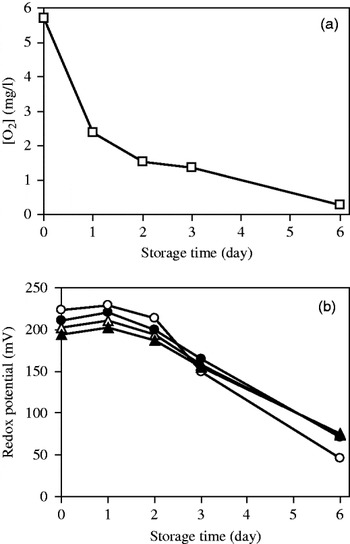
Fig. 1a shows the changes in dissolved oxygen concentration during light exposure of dairy beverages enriched with flaxseed oil. Initial concentration of dissolved oxygen in milk was 5·7±0·16 mg/l and rapidly decreased with time (P<0·0001), reaching 27 % its initial value after 2 days. The decrease in oxygen concentration was not affected by SDG concentration (P=0·3825). At the end of the storage period (6 days), concentration of dissolved oxygen in milk averaged 0·3 mg/l. Apparently, oxygen was consumed by fat oxidation reactions until exhaustion. It has been shown that oxygen is activated in the presence of photosensitizers such as metals (iron and copper) or riboflavin and that it initiates oxidation either by formation of free radicals or singlet oxygen (Frankel, Reference Frankel2005). Fink & Kessler (Reference Fink and Kessler1986) observed a drop in the concentration of oxygen in UHT milk stored for 60 days at 5°C. Similar results have been observed by Giroux et al. (Reference Giroux, Acteau, Sabik and Britten2008).
Effect of light exposure on (a) dissolved oxygen and (b) redox potential in dairy beverages enriched with flaxseed oil. SDG concentrations in dairy beverages were (○) 0; (●) 50; (▵) 100 and (▲) 200 mg/kg. Standard errors from statistical models were respectively 0·16 mg/l and 10 mV for oxygen concentration and redox potential.
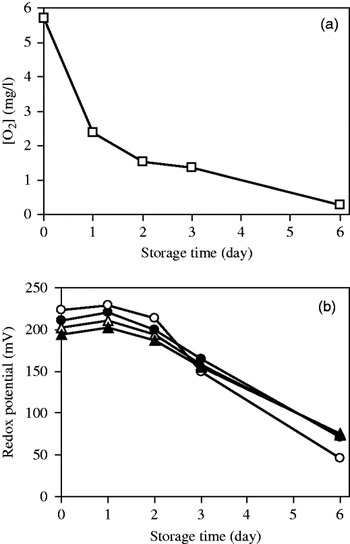
Redox potential can be used to estimate milk oxidation and a positive correlation between oxidized flavour and milk redox potential has been previously observed (Sindhu & Roy, Reference Sindhu and Roy1974; Nicoli et al. Reference Nicoli, Toniolo and Anese2004). Changes in redox potential in dairy beverage enriched with flaxseed oil during light exposure are displayed in Fig. 1b. Initial redox potential of the dairy beverage enriched with flaxseed oil was 208±10 mV. The redox potential of dairy beverage remained stable for the first two days of exposure, but then decreased gradually to 30% of original value after 6 days (P<0·0001). Adding SDG to the dairy beverage slightly decreased dairy beverage redox potential (P=0·0413). A 30 mV difference was observed between the control beverage and the beverage containing 200 mg SDG /kg and this difference was stable for the first two days storage.
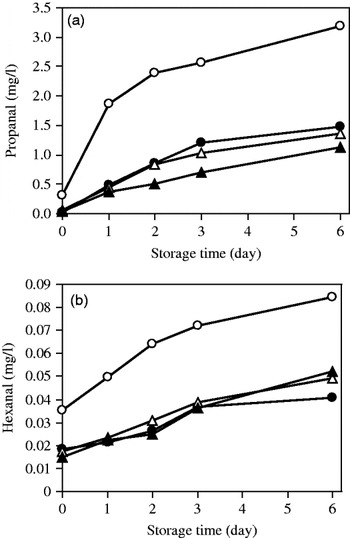
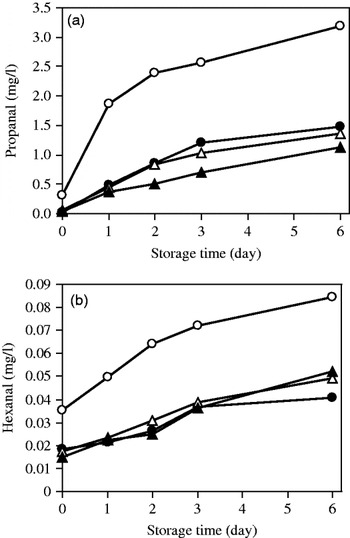
Propanal and hexanal are secondary products (aldehydes) from oxidation of polyunsaturated fatty acids and are characterized by intense aroma and flavour at very low concentrations. They were selected to evaluate the evolution of oxidation in dairy beverages enriched with flaxseed oil. The changes in propanal and hexanal concentrations during photooxidation of dairy beverages enriched with flaxseed oil are presented in Fig. 2. Initial propanal and hexanal concentrations in control dairy beverages (without SDG) were 0·32±0·14 and 0·036±0·005 mg/l, respectively. On average, the initial propanal and hexanal concentrations in dairy beverages with SDG were respectively reduced by 87 and 58 % in the presence of SDG (P<0·001), which indicates that SDG provided protection against oxidation during the preparation of dairy beverages enriched with flaxseed oil. Homogenization and pasteurisation treatments are considered oxidation promoters in food processing and SDG clearly reduced their negative effect on dairy beverage quality. Light exposure increased both propanal and hexanal concentrations in control dairy beverages (P<0·0001), but the effect was reduced in the presence of SDG (P<0·0001). Oxidation of PUFA is accelerated by light exposure, which is explained by both photolytic autooxidation and photosensitised oxidation (Frankel, Reference Frankel2005). Photolytic autooxidation is a result of free radicals production by light irradiation, which catalyses the decomposition of hydroperoxides. Photosensitised oxidation involves exposure to light and to sensitizer such as metal or riboflavin. The sensitizers can proceed by two pathways. The type I sensitizer serves as a photochemically activated free radical initiator while the type II sensitizer interacts with oxygen by energy transfer to give nonradical singlet oxygen. The type II reaction could be responsible for the lower dissolved oxygen concentration following light exposure (Fig. 1a).
Effect of light exposure on concentrations of (a) propanal and (b) hexanal in dairy beverages enriched with flaxseed oil. SDG concentrations in dairy beverages were (○) 0; (●) 50; (▵) 100 and (▲) 200 mg/kg. Standard errors from statistical models were respectively 0·14 and 0·005 mg/l for propanal and hexanal concentrations.
Resistance of dairy beverages enriched with SDG to thermooxidation
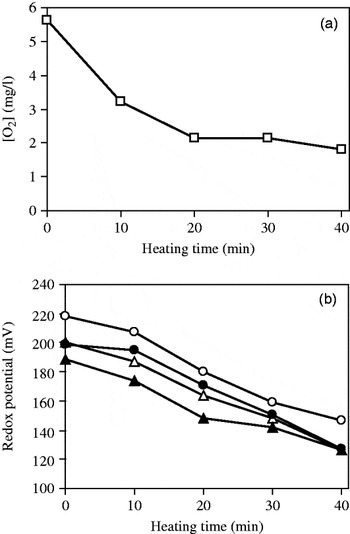
Heat treatments decreased (P<0·0001) oxygen concentration in dairy beverages enriched with flaxseed oil (Fig. 3a). Dissolved oxygen concentration decreased from 5·5 to 2·1 mg/l after 20 min heating at 90°C and then it remained constant. This result suggests that oxygen was involved in heat-induced reactions with other milk components or that oxygen was released into the headspace because of lower solubility at higher temperature. Adding SDG to dairy beverage formulation had no effect (P=0·8185) on oxygen loss during heating.
Effect of heating time at 90°C on (a) dissolved oxygen and (b) redox potential in dairy beverages enriched with flaxseed oil. SDG concentrations in dairy beverages were (○) 0; (●) 50; (▵) 100 and (▲) 200 mg/kg. Standard errors from statistical models were respectively 0·16 mg/l and 6 mV for oxygen concentration and redox potential.
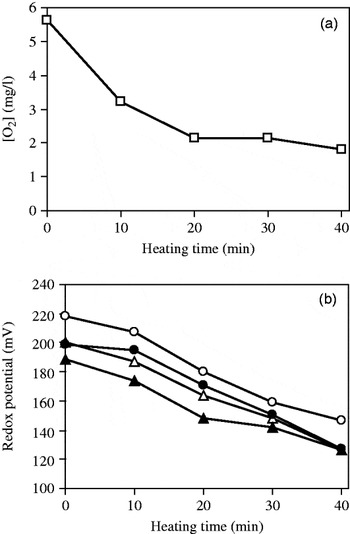
Heating dairy beverages at 90°C gradually decreased (P<0·0001) the redox potential (Fig. 3b) with a rate of change of −2 mV/min. According to Walstra & Jenness (Reference Walstra and Jenness1984), the unfolding of globular proteins and exposure of thiol groups (cysteine residues) at temperatures above 60°C are responsible for the decrease in redox potential. Heating also promotes Maillard reactions between lactose and amino groups of milk proteins with the production of enediol-type reductants (Walstra & Jenness, Reference Walstra and Jenness1984). Importance of these reactions depends on heating time and temperature. As previously indicated, the redox potential in dairy beverages was reduced with increasing concentration of SDG (P<0·0001). The differences between samples remained constant during heating and averaged 26 mV between the control (without SDG) and the beverage containing 200 mg/kg SDG.
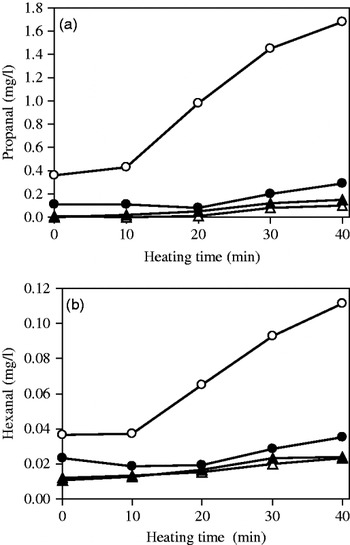
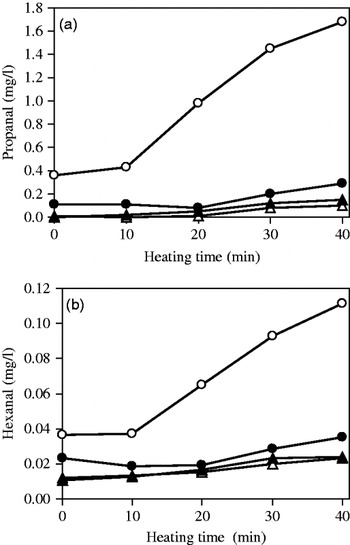
Propanal and hexanal concentrations in dairy beverages enriched with flaxseed oil during thermal treatment are reported in Fig. 4. Initial concentrations of propanal and hexanal in the control dairy beverage (without SDG) were 0·36±0·08 and 0·036±0·007 mg/l, respectively. As previously mentioned, initial propanal and hexanal concentrations in dairy beverages containing SDG were lower than those in control dairy beverages, indicating protection against oxidation during beverage preparation. Concentrations of propanal and hexanal in the control beverage increased during heat treatment (P<0·0001). The PUFA are susceptible to oxidation during heating (Giroux et al. Reference Giroux, Acteau, Sabik and Britten2008). Calligaris et al. (Reference Calligaris, Manzocco, Anese and Nicoli2004) suggested that heat treatment, depending on time-temperature combinations, can increase pro-oxidant activity of milk, probably as a consequence of both the loss of natural antioxidants and the formation of novel oxidative molecules. However, SDG provided a strong protection against heat-induced oxidation. Increasing the concentration of SDG in dairy beverage significantly reduced the concentrations of propanal and hexanal during heat treatment at 90°C (P<0·005). All SDG concentrations tested showed similar effect and almost prevented propanal and hexanal production during heat treatment. This result suggests that optimal SDG concentration to prevent heat-induced lipid oxidation in dairy beverages might be lower than 50 mg/l.
Effect of heating time at 90°C on concentrations of (a) propanal and (b) hexanal in dairy beverages enriched with flaxseed oil. SDG concentrations in dairy beverages were (○) 0; (●) 50; (▵) 100 and (▲) 200 mg/kg. Standard errors from statistical models were respectively 0·08 and 0·007 mg/l for propanal and hexanal concentrations.
Effect of EL on dairy beverage oxidation
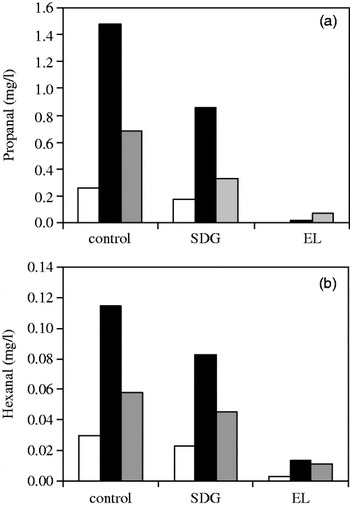
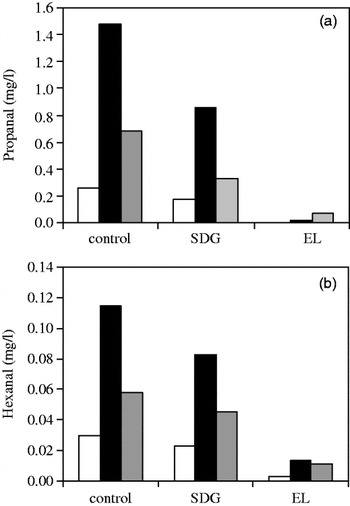
Enterolactone is a metabolite formed from SDG by gastrointestinal microorganisms (Eeckhaut et al. Reference Eeckhaut, Struijs, Possemiers, Vincken, De Keukeleire and Verstraete2008). The antioxidant activities of SDG and EL were compared in dairy beverages enriched with flaxseed oil. The antioxidants were used at a concentration of 25 mg/kg and both propanal and hexanal concentrations were determined before and after oxidative stress (Fig. 5). For beverages containing EL, the propanal and hexanal concentrations before oxidative stress were close to zero, suggesting that EL was very efficient at prevention of oxidation degradation during beverage preparation. SDG had no significant effect on initial propanal and hexanal concentrations (P>0·05). Compared with the control, beverages containing SDG (25 mg/kg) showed lower concentrations of propanal and hexanal following light-induced and heat-induced oxidation. However, EL used at the same concentration showed much higher antioxidant capacity.
Effect of adding 25 mg/kg SDG or EL to dairy beverages enriched with flaxseed oil on concentrations of (a) propanal and (b) hexanal measured before (□) and after photooxidation (▪) and thermooxidation ( ) treatments. Control beverages were formulated without SDG or EL. Photooxidation: light exposure for 6 days at 4°C; thermooxidation: heating at 90°C for 40 min. Standard errors from statistical models were respectively 0·07 and 0·001 mg/l for propanal and hexanal concentrations.
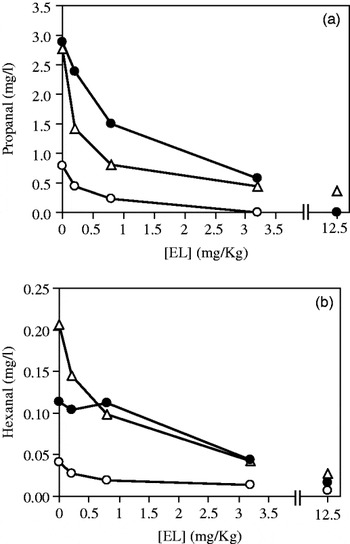
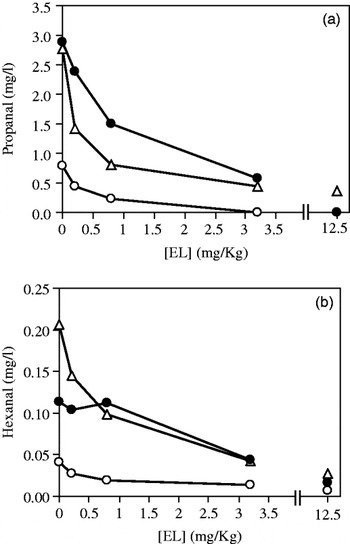
Antioxidant activity of EL at concentrations lower than 25 mg/kg (0 to 12 mg/kg) was also determined (Fig. 6). The effect of EL on propanal and hexanal concentrations after light exposure for 6 days or heating at 90°C for 40 min are presented in Fig. 6. Enterolactone strongly inhibited (P<0·001) lipid oxidation at low concentration. Similar results were obtained by Kitts et al. (Reference Kitts, Yuan, Wijewickreme and Thompson1999) on the effect of enterolactone on the oxidation of linoleic acid in in vitro systems. In the present experiment, EL was more effective than SDG at prevention of lipid oxidation and concentration as low as 3·2 mg/kg provided maximal protection against light- and heat-induced oxidation in dairy beverages.
Effect of EL added to dairy beverages enriched with flaxseed oil on concentrations of (a) propanal and (b) hexanal measured before (○) and after photooxidation (●) and thermooxidation (▵) treatments. Photooxidation: light exposure for 6 days at 4°C; thermooxidation: heating at 90°C for 40 min. Standard errors from statistical models were respectively 0·21 and 0·008 mg/l for propanal and hexanal concentrations.
Antioxidant activity in dairy beverages made from feeding experiment milks
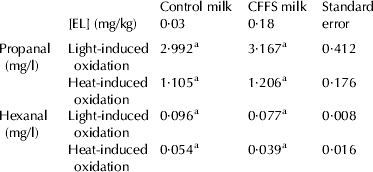
Significant antioxidant activity of the lignans SDG and EL in dairy beverages enriched with flaxseed oil has been observed in the present study. According to Petit & Gagnon (Reference Petit and Gagnon2009), dairy cows fed flaxseed meal produce milk with detectable concentration of EL. Therefore, oxidative stability of dairy beverages formulated with milk obtained from a cow fed flaxseed meal (CFFS) was compared with that of dairy beverages produced with control milk, made from the same cow on a control diet (Table 1). Feeding cows with flaxseed meal increased EL concentration in milk from 0·03 to 0·18 mg/kg. Resistance to light-induced or heat-induced oxidation in beverages made from control and CFFS milks were similar (P>0·05), which suggests that EL concentration in CFFS milk was lower than the minimum concentration required to prevent oxidative degradation in dairy beverages. This result is surprising since the lowest EL concentration (0·20 mg/kg) added to dairy beverages provided slight but significant protection against heat-induced oxidation (Fig. 6). Propanal and hexanal concentrations after heat treatment were reduced, respectively, by 48 and 30 % (P<0·001). It should however be noted that control dairy beverages made from reconstituted skim milk powder were more sensitive to heat-induced oxidation than beverages made from milk obtained from feeding experiment. After heat treatment, propanal and hexanal levels in dairy beverages made from reconstituted milk powder were respectively 2·95 and 0·21 mg/l (Fig. 6), while they were, respectively, 1·105 and 0·054 mg/l in beverages made from milk from the feeding experiment (Table 1). At low concentrations, EL activity in beverages made from raw milk could be masked by other antioxidants naturally present in raw milk, which might be lost during spray drying process. This would explain the positive effect of EL on the prevention of heat-induced oxidation in dairy beverages made from skim milk powder and the lack of response in those made from raw milk.
Oxidative stability of dairy beverages formulation made with control skim milk powder and from milk produced by cow fed flaxseed meal (CFFS)
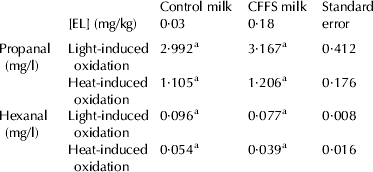
Means with different superscripts in the same row differ significantly (P<0·05). Light exposure: 6 days at 4°C; Heat treatment: 90°C for 40 min.
Conclusion
The results of the present study showed that the addition of SDG or EL to dairy beverages enriched with PUFA in the form of flaxseed oil significantly reduced oxidative degradation. Moreover, EL was more efficient than SDG at prevention of light- and heat-induced oxidation of dairy beverages. However, the concentration of EL detected in raw milk produced by a dairy cow fed flaxseed meal was too low to result in any observable protective effect. The SDG showed effective antioxidant properties and could be used to substitute for synthetic antioxidants.