INTRODUCTION
The Zoantharia, an order within the class Anthozoa, is characterized by a colonial form of life, two rows of tentacles in each polyp and one ventral siphonoglyph (Haddon & Shackleton, Reference Haddon and Shackleton1891). Each polyp distinctly protrudes from the coenenchyme (liberae or intermediae polyps) or is immersed in a fully developed coenenchyme (immersae polyps) (Pax, Reference Pax1910).
The suborder Brachycnemina is distributed worldwide in marine ecosystems and found particularly on hard substrates of sub-tropical and tropical shallow coral reef environments (Burnett et al., Reference Burnett, Benzie, Beardmore and Ryland1994, Reference Burnett, Benzie, Beardmore and Ryland1995). As with many other invertebrate communities on coral reefs, some zoantharian species harbour symbiotic dinoflagellates of the genus Symbiodinium (LaJeunesse, Reference LaJeunesse2002; LaJeunesse et al., Reference LaJeunesse, Thornhill, Cox, Stanton, Fitt and Schmidt2004) that play a significant role in host nourishment (Muscatine & Porter, Reference Muscatine and Porter1977). The need for solar energy in zooxanthellate zoantharians leads to their existence in photic zones (Swain, Reference Swain2010).
Accurate identification of species is the key to our understanding of biological systems (Swain, Reference Swain2009). Zoantharians are morphologically difficult to identify at the species level due to their plastic morphology, intraspecific colour variation and the lack of accurate morphological markers for proper discrimination of species (Reimer & Todd, Reference Reimer and Todd2009). Moreover, sand and detritus are embedded in the mesoglea of the majority of zoantharians to help strengthen their structure. Therefore, their internal morphological examination is not feasible without potentially dangerous hydrofluoric acid treatment (Reimer et al., Reference Reimer, Nakachi, Hirose, Hirose and Hashiguchi2010).
Molecular techniques are currently being applied to determine the differences between marine invertebrate species. Genetic studies on such species resulted in the synonymization of species previously assumed as being discrete because of minor morphological differences in their characteristics (Knowlton, Reference Knowlton2000). Over the past two decades, molecular techniques involving allozyme analyses (Burnett et al., Reference Burnett, Benzie, Beardmore and Ryland1994, Reference Burnett, Benzie, Beardmore and Ryland1995, Reference Burnett, Benzie, Beardmore and Ryland1997) and phylogenetics of standardized DNA markers (Reimer et al., Reference Reimer, Ono, Fujiwara, Takishita and Tsukahara2004, Sinniger et al., Reference Sinniger, Montoya-Burgos, Chevaldonne and Pawlowski2005, Reference Sinniger, Reimer and Pawlowski2008) have been proven to be useful in zoantharian taxonomy. The results of such studies verified the morphological flexibility of certain species (Reimer et al., Reference Reimer, Ono, Fujiwara, Takishita and Tsukahara2004) and introduced new species (Sinniger & Haussermann, Reference Sinniger and Haussermann2009), new genera (Reimer & Fujii, Reference Reimer and Fujii2010; Sinniger et al., Reference Sinniger, Reimer and Pawlowski2010, Reference Sinniger, Ocana and Baco2013) and new families (Reimer et al., Reference Reimer, Sinniger, Fujiwara, Hirano and Maruyama2007; Sinniger et al., Reference Sinniger, Reimer and Pawlowski2010). Those results also suggested other combinations of genera (Reimer et al., Reference Reimer, Ono, Takishita, Tsukahara and Maruyama2006b) and species (Burnett et al., Reference Burnett, Benzie, Beardmore and Ryland1997; Reimer et al., Reference Reimer, Ono, Fujiwara, Takishita and Tsukahara2004).
The Persian Gulf is a semi-enclosed shallow sea situated in the subtropical north-west of the Indian Ocean to which it is linked by just a narrow waterway, the Strait of Hormuz. Limited water exchange via this mouth of the Gulf (Pous et al., Reference Pous, Carton and Lazure2004) in combination with high salinity, large seasonal fluctuations of sea temperature (14–34 °C) and extremely low tides generally result in extreme conditions in the Persian Gulf (Coles & Fadlallah, Reference Coles and Fadlallah1991; Sheppard & Sheppard, Reference Sheppard and Sheppard1991). These factors have a profound effect on coral reefs (Wilson et al., Reference Wilson, Fatemi, Shokri, Claereboudt and Wilkinson2002), which are the most biologically diverse and economically significant ecosystems on earth, mainly found in the islands situated in the northern parts of the Persian Gulf (Rezai et al., Reference Rezai, Samimi, Kabiri, Kamrani, Jalili and Mokhtari2010). The Iranian reefs attract international scientific attention due to their development under such extreme environmental conditions (Coles & Fadlallah, Reference Coles and Fadlallah1991).
There are 17 islands off the Iranian coastline of the Persian Gulf with fringing reefs (Sheppard & Sheppard, Reference Sheppard and Sheppard1991). Of these, Hengam, Larak, Qeshm and Hormuz Islands are situated in the Strait of Hormuz and greatly influenced by the less saline and nutrient-rich oceanic waters originating from the Oman Sea, especially during the summer monsoon upwelling. Subsequently, reefs around these islands are characterized by relatively high species diversity and richness and differ from those in the inner part of the Persian Gulf (Bauman et al., Reference Bauman, Feary, Heron, Pratchett and Burt2013).
To date, the biodiversity of order Scleractinia (Rezai & Savari, Reference Rezai and Savari2004; Rezai et al., Reference Rezai, Samimi, Kabiri, Kamrani, Jalili and Mokhtari2010; Samiei et al., Reference Samiei, Dab, Ghezellou and Shirvani2013) and Alcyonaria (Namin & van Ofwegen, Reference Namin and van Ofwegen2009) have been the focus of most Persian reef studies. However, despite being the third largest order of Hexacorallia, few studies have been conducted on Zoantharia so far (Noori Koupaei et al., Reference Noori Koupaei, Ghavam Mostafavi, Fallah Mehrabadi and Fatemi2014).
The current study examines the diversity of shallow water zoantharians in the Hengam and Larak Islands. The application of mitochondrial markers, cytochrome oxidase subunit [COI] and 16S ribosomal DNA sequences [16S rDNA] throughout this study is an attempt to identify zoantharian species. Molecular data provided by these markers as well as some morphological characteristics and colouration notes of all collected samples can assist in the identification of zoantharians in the northern parts of the Persian Gulf.
MATERIALS AND METHODS
Sampling
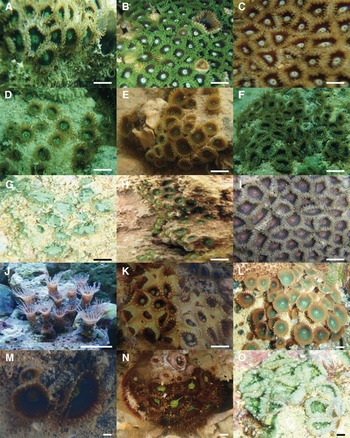
Sixty-three colonies of zoantharians representing all observed morphotypes were collected between November 2011 and March 2013 from several sites in the Hengam and Larak Islands by wading in intertidal zones and snorkelling or scuba diving in subtidal zones (Figure 1, Table 1). Photographs were taken on site at the same time as sample collection (Figure 2) to assist with the collection of morphological data. Some morphological characteristics of each specimen including sand encrustation, polyp shape and colour, oral groove, oral zone and oral disc colours as well as tentacle number and colour were recorded and initial identification was carried out by comparison with published literature (Burnett et al., Reference Burnett, Benzie, Beardmore and Ryland1997; Ryland & Lancaster, Reference Ryland and Lancaster2003; Reimer et al., Reference Reimer, Ono, Iwama, Takishita, Tsukahara and Maruyama2006a; Reimer, Reference Reimer2007). Specimens were then stored in absolute ethanol at −20°C for further analyses.
Map of the Persian Gulf showing the position of the sampling locations (dots) in Hengam and Larak Islands.

In situ images of zoantharian specimens collected in this study. Each image is representative of one morphological group listed in Table 2. Scale bar = 1 cm.

Sample sites, depth of sampling, collector, accession numbers and final molecular identification of each specimen.

NA = not available.
All specimens were finally deposited in the marine biology laboratory of Islamic Azad University, Science and Research branch.
DNA extraction, PCR amplification and sequencing
Parts of the specimens weighing 5–10 mg were crushed in DNAB buffer (0.4 M NaCl, 50 mM EDTA, pH 8.0). DNA was extracted from the obtained slurries using the Cetyl Trimethyl Ammonium Bromide (CTAB) method of Baker (Reference Baker1999).
Mitochondrial 16S ribosomal DNA (mt 16S rDNA) was amplified using a set of zoantharian-specific primers provided by Sinniger et al. (Reference Sinniger, Montoya-Burgos, Chevaldonne and Pawlowski2005). PCR amplification was performed under the following thermal profile: 2 min at 94°C; 30 s at 94°C, 1 min at 52°C, 90 s at 72°C (35 cycles); and 7 min final extension at 72°C.
The mitochondrial cytochrome oxidase c subunit I (COI) was amplified using the primers described by Folmer et al. (Reference Folmer, Black, Hoeh, Lutz and Vrijenhoek1994). The thermal cycle conditions included an initial denaturing step at 95°C for 5 min followed by 30 cycles of 95°C for 30 s, 43°C for 1 min, 72°C for 90 s and a final extension at 72°C for 5 min.
mt 16S rDNA and COI amplification products were visualized by 1.5% agarose gel electrophoresis. Original PCR products from zoantharians specimens were sent to the Macrogen Company in South Korea and directly sequenced with an ABI- 3730XL analyser by the capillary system method.
Phylogenetic analysis
Sequences obtained from this study were deposited in GenBank and their accession numbers are shown in Table 1. The nucleotide sequences obtained in this study were aligned with 16S rDNA and COI sequences available from GenBank (accession numbers shown in Figures 3 & 4) using the software CLUSTALW (Thompson et al., Reference Thompson, Higgins and Gibson1994). The outgroup sequence for both 16S rDNA and COI tree belonged to the genus Parazoanthus. Consequently, two alignment datasets were generated: (1) 965 sites of 81 sequences (mt 16S rDNA) and (2) 655 sites of 44 sequences (COI). The alignment data are available on request from the first author (atoosa.noori.koupaei@gmail.com).
Maximum likelihood tree of 16S rDNA sequences for zoantharian specimens. Values at branches represent maximum likelihood bootstrap percentages from 1000 trees/maximum parsimony bootstrap percentages from 1000 trees/Bayesian posterior probabilities.

Maximum likelihood tree of COI sequences for zoantharian specimens. Values at branches represent maximum likelihood bootstrap percentages from 1000 trees/maximum parsimony bootstrap percentages from 1000 trees/Bayesian posterior probabilities.

The alignment dataset was analysed using maximum likelihood (ML), maximum parsimony (MP) and Bayesian methods. Maximum-likelihood inference was implemented in RAxML HPC-2 (Stamatakis, Reference Stamatakis2006; Stamatakis et al., Reference Stamatakis, Hoover and Rougemont2008) on the CIPRES Science Gateway V. 3.3 (Miller et al., Reference Miller, Pfeiffer and Schwartz2010) by means of the general time-reversible model of nucleotide substitution that is fixed in RAxML and gamma distributed rates across sites. The rapid bootstrapping algorithm was used to obtain clade support values in a maximum likelihood framework performing 1000 replicates. Maximum parsimony analysis was conducted using the PAUP beta version 4.0b10 (Swofford, Reference Swofford2002). For MP, a heuristic search was carried out with 100 random additions of taxa, followed by tree-bisection-reconnection (TBR) branch-swapping rearrangements with a maximum of 100 optimal trees kept in each replicate. MP clade support was assessed by non-parametric bootstrapping with 1000 replicates and the same heuristic-search parameters. The Bayesian analysis was implemented in MrBayes 2.3 (Ronquist & Huelsenbeck, Reference Ronquist and Huelsenbeck2003) and was based on the model selected by MODELTEST. The most appropriate model selection for Bayesian analyses were performed using Akaike Information Criterion (AIC) in MODELTEST 2.3 (Nylander, Reference Nylander2004). The general time-reversible model (Rodriguez et al., Reference Rodriguez, Oliver, Marin and Medina1990) with invariable sites and gamma parameter (GTR + I) gave the best fit to the 16S rDNA data. The Hasegawa-Kishino-Yano model (Hasegawa et al., Reference Hasegawa, Kishino and Yano1985) with gamma parameter (HKY) gave the best fit to the COI data. Starting from random trees, four Markov chains (with one cold and three heated chains) were run simultaneously to sample trees using the Markov Chain Monte Carlo (MCMC) principle which approximates the posterior probability (PP) of trees. After the burn-in phase (the first 5 million generations was discarded), every 100th tree out of 206 was considered.
RESULTS
In situ external appearance observation
All morphological characters are summarized in Table 1. Figure 2 shows images of some specimens, one sample of each morphotype.
From images taken in situ (Figure 2), specimens were categorized in four morphological groups. Two groups were identified as belonging to the genus Palythoa due to their heavy sand encrustation and light or dark brown exterior. Of these two groups, one is Palythoa tuberculosa Esper, 1805 that is easily recognized by its densely packed embedded polyps (immersae) while the Palythoa mutuki (Haddon & Shackleton, Reference Haddon and Shackleton1891) group, is characterized by its elongated, free-standing polyps extending above the underdeveloped coenenchyme (Liberae form), green or brown oral disc and visible white radii. These polyps were joined basally but their closeness and flaring columns obscure the bases (Figure 2, Table 2).
Summary of morphological characteristics of collected zoantharians and final molecular identification.

Another group with their smooth, non-encrusted polyps attached to rocks or dead corals, clearly belonged to the genus Zoanthus. Since during the present study only chromatic variability of each specimen was recorded, species level assignment was very difficult and they were just identifiable at the genus level. Consequently, the present study placed all Zoanthus samples (N = 30) in one group, recording their chromatically morphological characters in Table 2.
The last group, Neozoanthus genus, was observed in one sample; only HeSu6. The specimen which was itself quite small in size was encrusted with relatively large particles. Unlike the rest of the column, however, the oral end of the closed polyp was not encrusted. With cone-shaped short tentacles, the specimen was a light pink except for its oral opening which was white (Figure 2, Table 2).
PCR amplification
Amplification of 16S rDNA and COI yielded single compact bands of ~1000 and 700 bp nucleotides in length, respectively.
DNA sequence and phylogenetic analysis
MT 16S RDNA
The resulting phylogenetic tree for the aligned mitochondrial 16S ribosomal DNA sequences is shown in Figure 3. The current study placed mt 16S rDNA sequences from specimens in three large genus-level clades: Zoanthus, Palythoa and Neozoanthus. All Zoanthus spp. sequences were identical to JF419761, DQ997871 and also to a sequence from Qeshm Island (KF733286), pertaining to Zoanthus sansibaricus Carlgren, 1900, very well-supported by this clade (ML = 95%, MP = 92%, PP = 0.86). Sequence from putative Neozoanthus specimen were found to be closely linked to the Neozoanthus uchina Reimer et al., Reference Reimer, Irei and Fujii2012 from Japan and Neozoanthus caleyi Reimer et al., Reference Reimer, Irei and Fujii2012 from Australia (ML = 100%, MP = 96%, PP = 1.0). Sequences used in the phylogenetic tree together with the two large clades formed one well-supported large Zoanthus–Neozoanthus monophyly (ML = 99%, MP = 98%, PP = 0.86). An insertion of 25 base pairs (at position 531–555 in the mt 16S rDNA alignment) distinguishes the Neozoanthus mt 16 S rDNA sequences from the Zoanthus and Palythoa which do not pose such characteristics.
The genus Palythoa was a well-supported clade (ML = 85%, MP = 92%, PP = 0.92). Despite not being highly supported (ML = 72%, MP = 62%, PP = 0.68), putative Palythoa tuberculosa specimens all formed a monophyletic clade with reference sequences (DQ997860-AB219218) and previously reported Palythoa tuberculosa sequence (KJ472920) from Qeshm Island. The sequences from LaSu4 and LaWi12, two green polyps from Palythoa mutuki morphological group, matched exactly with Palythoa mutuki 2 (DQ997841) and formed together a well-supported monophyletic clade (ML = 83%, MP = 68%, PP = 0.96). The remaining Palythoa sequences had two and three base pair differences from Palythoa mutuki 1 and Palythoa mutuki 2, respectively. These sequences were identical to sequence KJ472909 from Palythoa cf. mutuki from Qeshm Island and clustered into strongly supported (ML = 90%, MP = 90%, PP = 0.87) monophyly which was seen to be basal to the Palythoa mutuki-Palythoa tuberculosa clade.
COI
Similar to the mt 16S rDNA phylogenetic tree, the resulting tree from the COI alignment (Figure 4) showed that Zoanthus spp. clustered with high support (ML = 100%, MP = 98%, PP = 1.0) with Zoanthus sansibaricus species.
Sequence from HeSu6 specimen formed a very well-supported clade (ML = 99%, MP = 99%, PP = 1.0) with Neozoanthus uchina and Neozoanthus caleyi sequences. The Neozoanthus clade was again sister to the Zoanthus clade, and these two clades formed a highly supported monophyly (ML = 100%, MP = 100%, PP = 1.0), obviously distinct from Palythoa sequences.
The genus Palythoa was moderately supported (ML = 75%, MP = 70%, PP = 0.72). Putative Palythoa tuberculosa specimens formed a moderately supported monophyletic clade (ML = 68%, MP = 61%, PP = 0.64). The sequences from these specimens, HeSu1, HeSu10, HeWi3, HeWi5, LaSu2, Lasu6, LaWi1 and LaWi10, were identical to AB219198 from Palythoa tuberculosa and AB219217 from Palythoa mutuki 1. Similar to mt 16S rDNA results, the two acquired COI sequences from specimens LaSu4 and LaWi12 were identical to Palythoa mutuki 2 sequence (AB219212). However, a COI sequence from Palythoa sp. sakurajimensis (KF499720) was also seen within this group.
The seven sequences from remaining specimens in the Palythoa mutuki morphological group, HeSu18, HeSu19, HeSu13, HeWi2, LaSu1, LaSu7 and LaSu14, had one or two base pairs differences from Palythoa mutuki 1 and Palythoa mutuki 2, respectively and these formed together a distinct well-supported monophyletic clade (ML = 86%, MP = 73%, PP = 0.98). Therefore, we designated these specimens as Palythoa aff. mutuki (Figure 4).
DISCUSSION
Previously three species of zoantharians were reported from Qeshm Island based on one mitochondrial marker, 16S rDNA (Noori Koupaei et al., Reference Noori Koupaei, Ghavam Mostafavi, Fallah Mehrabadi and Fatemi2014). The present study clearly demonstrated the presence of five species groups in the islands located in the vicinity of the Strait of Hormuz, Persian Gulf. The zoantharians found in this study were Zoanthus sansibaricus, Palythoa tuberculosa, Palythoa aff. mutuki (also reported in Noori Koupaei et al., Reference Noori Koupaei, Ghavam Mostafavi, Fallah Mehrabadi and Fatemi2014), Palythoa mutuki and Neozoanthus sp. Iran. Of these five species, Palythoa tuberculosa was the only one with genetic data that matched its morphology. Despite the lack of ambiguity in identifying Palythoa tuberculosa, all samples within Palythoa aff. mutuki group were initially misidentified as Palythoa mutuki due to their morphological appearance. However, molecular examination of two mitochondrial markers (16S rDNA and COI) showed that they were not conspecific with this known species. These specimens were seen to be closely related to a specimen previously reported from Qeshm Island which was identified as Palythoa cf. mutuki based on mt 16S rDNA phylogeny.
While the mitochondrial markers are very conservative in anthozoans (Shearer et al., Reference Shearer, van Oppen, Romano and Worheide2002), a low level of variation indicates species level differences in Palythoa species. For example, Palythoa mutuki and Palythoa tuberculosa can be distinguished by one or two base pair of differences over the mt 16S rDNA dataset. (Reimer et al., Reference Reimer, Ono, Takishita, Tsukahara and Maruyama2006b; Sinniger et al., Reference Sinniger, Reimer and Pawlowski2008). Although COI sequences are unable to distinguish between Palythoa tuberculosa and Palythoa mutuki 1 (Reimer et al., Reference Reimer, Ono, Takishita, Tsukahara and Maruyama2006b), this marker made a clear distinction between Palythoa aff. mutuki and Palythoa tuberculosa.
Results obtained from the sequencing of mitochondrial markers indicated that all Zoanthus morphotypes were entirely conspecific despite variation in colour. The previous published data (Burnett et al., Reference Burnett, Benzie, Beardmore and Ryland1997; Reimer et al., Reference Reimer, Ono, Fujiwara, Takishita and Tsukahara2004, Reference Reimer, Ono, Iwama, Takishita, Tsukahara and Maruyama2006a, Reference Reimer, Ono, Takishita, Tsukahara and Maruyama2011b) demonstrate extreme difficulty or inability to identify proper species of the genus Zoanthus based on morphological characters. The Zoanthus sansibaricus species, in particular, comes in a wide variety of colourful types.
Based on external appearance, the HeSu6 specimen, a unique specimen collected in this study, corresponds morphologically to the genus Neozoanthus. The Neozoanthus in this study is morphologically characterized by partially encrusted particles of various sizes (i.e. lacking encrustation on the oral part of closed polyps) and 38–40 relatively short and conical tentacles which match the typical characteristics of Neozoanthus (Herberts, Reference Herberts1972). Colour was the only morphological characteristic that did not fit with the three previously defined species of this genus (Herberts, Reference Herberts1972; Reimer et al., Reference Reimer, Irei and Fujii2012), which has been shown to be highly variable in many zoantharian species (Burnett et al., Reference Burnett, Benzie, Beardmore and Ryland1997; Reimer et al., Reference Reimer, Ono, Fujiwara, Takishita and Tsukahara2004).
Zoantharians do not have accurate morphological markers to find out inter-species differentiation. However, the two mitochondrial molecular markers (i.e. mt16S rDNA and COI) are successfully used to identify most zoantharian species (Reimer et al., Reference Reimer, Ono, Iwama, Takishita, Tsukahara and Maruyama2006a, Reference Reimer, Sinniger, Fujiwara, Hirano and Maruyama2007, Reference Reimer, Hirose, Irei, Obuchi and Sinniger2011a, Reference Reimer, Hirose, Yanagi and Sinniger2011b; Sinniger et al., Reference Sinniger, Reimer and Pawlowski2008; Swain, Reference Swain2009). Similar to previous studies (Burnett et al., Reference Burnett, Benzie, Beardmore and Ryland1997; Reimer et al., Reference Reimer, Ono, Fujiwara, Takishita and Tsukahara2004), data presented in this study indicated that while morphological markers were not adequate to properly clarify the status of species, the genetic method was a useful tool for correctly placing all specimens within a species group and discerning phylogenetic relationships.
Similar to Qeshm Island (Noori Koupaei et al., Reference Noori Koupaei, Ghavam Mostafavi, Fallah Mehrabadi and Fatemi2014), the most commonly seen species in this study were Zoanthus sansibaricus, Palythoa tuberculosa and Palythoa aff. mutuki. Since these three studied islands are located in the Strait of Hormuz, the similarity in zoantharian diversity is not surprising.
As mentioned earlier, there is an overall lack of data on the Persian Gulf zoantharians. However, based on the worldwide distribution patterns of zoantharians, the Persian Gulf zoantharians diversity observed in this and the recent study followed the same patterns of zoantharians observed in shallow subtropical and tropical waters (Herberts, Reference Herberts1972; Burnett et al., Reference Burnett, Benzie, Beardmore and Ryland1997; Ryland & Lancaster, Reference Ryland and Lancaster2003; Reimer & Todd, Reference Reimer and Todd2009). Zooxanthellate zoantharians of the genera Palythoa (family Sphenopidae) and Zoanthus (family Zoanthidae) are common in infra-littoral and shallow subtropical and tropical waters, particularly coral reef ecosystems. Zoanthus sansibaricus, Palythoa tuberculosa and Palythoa mutuki, three reported species here, are previously described as widely distributed in the western and eastern Pacific Ocean; i.e. Great Barrier Reef (Burnett et al., Reference Burnett, Benzie, Beardmore and Ryland1997; Ryland & Lancaster, Reference Ryland and Lancaster2003), New Caledonia (Sinniger, Reference Sinniger, Payri and Richer de Forges2006), Japan (Reimer et al., Reference Reimer, Ono, Fujiwara, Takishita and Tsukahara2004, Reference Reimer, Hirose, Irei, Obuchi and Sinniger2006a, Reference Reimer, Hirose, Yanagi and Sinnigerb; Reimer, Reference Reimer2007), Galapagos (Reimer et al., Reference Reimer, Sinniger and Hickman2008), Singapore (Reimer & Todd, Reference Reimer and Todd2009) and the Indian Ocean (Herberts, Reference Herberts1972). Conversely, Palythoa aff. mutuki was shown to have significant phylogenetic differences with Palythoa mutuki and other described Palythoa species indicating that it might be an undescribed species.
During the present study, one specimen of an unknown zoantharian fitting the morphology of Neozoanthus was collected from Hengam Island. The monotypic genus Neozoanthus, a single genus in the third shallow water zoantharian family, Neozoanthidae, represents a unique evolutionary step in the zoantharian phylogeny as the only partially encrusted group of zoantharians (Reimer et al., Reference Reimer, Hirose, Yanagi and Sinniger2011b). The Neozoanthus specimen from this study showed unique oral disc colouration and patterns. Additionally, its mt 16S rDNA sequences did not match with published sequences (HM991243 and HM991257) and phylogenetic analysis placed this specimen in a different clade. However, species identification based on COI marker could not distinguish between Neozoanthus species. COI sequences of specimen HeSu6 were identical to Neozoanthus uchina from Okinawa Island, Japan and Neozoanthus caleyi from GBR, Australia. Overall, it is concluded that the specimen HeSu6 represents an undescribed species within Neozoanthus, preliminarily designated as Neozoanthus sp. The genus Neozoanthus was described in 1972 from specimens found in Madagascar (Herberts, Reference Herberts1972), and was reported again nearly 40 years later from Japan and Australia (Reimer et al., Reference Reimer, Hirose, Irei, Obuchi and Sinniger2011a, Reference Reimer, Irei and Fujii2012, Reference Reimer, Irei and Naruse2013). Finding this genus for the first time in the Persian Gulf, which is located between Madagascar, the Great Barrier Reef and Japan with thousands of kilometres distances, demonstrates the wide distributional range of this genus.
In this study, three families, three genera and five species of zoantharians, including potentially two new species, were found in the Persian Gulf. Molecular identification techniques combined with morphological observations have been proved to be functional in identifying collected zoantharian specimens.
Concerning the existence of at least two undescribed species in the waters of the studied islands, it appears that more research may result in finding more species in the region.
Undoubtedly, future research should be conducted on zoantharians in other parts of the Persian Gulf and also the surrounding area. Since little information exists on zoantharians from this region, it is not clear whether these two potentially new species are endemic to this area or originated in the Oman Sea and Indian Ocean.
ACKNOWLEDGEMENTS
The authors are grateful to Dr Frederic Sinniger, Japan Agency for Marine–Earth Science and Technology (JAMSTEC) for his useful advice and his answers to all our questions during this study and Dr James D. Reimer, University of Ryukyus, Japan for his useful comments. We also thank Mahmoud Ghayyem Ashrafi for map drawing.