


Why do some individuals engage in high-risk mobilization, while others escape the fighting in conditions of imminent threat against their group? The question of mobilization has occupied a prominent place in the civil war literature. Scholars have analyzed individual motivations for participation and recruitment strategies employed by armed groups to motivate participation.Footnote 1 Studies have demonstrated the roles of collective grievances (Gurr Reference Gurr1970; Horowitz Reference Horowitz1985); selective incentives and social sanctions (Humphreys and Weinstein Reference Humphreys and Weinstein2008; Weinstein Reference Weinstein2007); social networks and norms (Parkinson Reference Parkinson2013; Petersen Reference Petersen2001; Staniland Reference Staniland2012); emotions, identities, and ideological commitments (Gutiérrez and Wood Reference Gutiérrez and Wood2014; Viterna Reference Viterna2013; Wood Reference Wood2003); and security-seeking drives (Kalyvas Reference Kalyvas2006; Kalyvas and Kocher Reference Kalyvas and Kocher2007). These determinants have been shown to variously affect individual paths to participation (Viterna Reference Viterna2013) and roles (Parkinson Reference Parkinson2013; Petersen Reference Petersen2001) adopted by individuals at different stages of conflict (Gates Reference Gates2002) and across different types of armed groups (Gutiérrez and Giustozzi Reference Gutiérrez and Giustozzi2010).
Yet mobilization decisions depend not only on individual motivations for participation and armed group recruitment tactics but also on the ways in which individuals come to perceive the threat involved in civil war. Without an understanding of who is threatened, by whom, and to what extent, individuals have no basis on which to make difficult choices about whether to risk their lives fighting for the group or to pursue alternative options, such as defection or flight. How threat perceptions emerge and influence individual mobilization decisions, however, has not been explored in the current civil war research. Left unanswered are critical questions about mobilization: Where do individuals seek information on threat? Who provides such information? How does it affect mobilization decisions?
Drawing on the case of Abkhaz mobilization at the beginning of the Georgian-Abkhaz war (August 14–18, 1992), this article argues that actors across social structures, within which potential participantsFootnote 2 are embedded, collectively frame the threat posed by civil war and shape individual threat perceptions and mobilization decisions. In the mass confusion surrounding the first days of the war in Abkhazia, collective threat framing was central to Abkhaz mobilization. Abkhaz men and women relied on the familiar social structures of family, friendship, local relation, and national authority for essential information on how to understand the threat presented by the war and how to act in response across a range of combatant, support, and nonfighter roles that existed at the war's onset.
The information filtered from Abkhazia's national leaders through respected members of local communities, to be reinforced and acted on within the quotidian networks of relatives and friends. Invoking shared understandings of the Georgian-Abkhaz conflict, these actors produced a joint view of the Georgian armed forces as threatening Abkhazia's autonomy and the Abkhaz as a group. The emergence of collective threat framing affected how Abkhaz men and women perceived threat—as directed toward the self or the group—and their mobilization decisions, from individual attempts to flee or defect to collective mobilization to fight on the weaker, Abkhaz side in the war.
By tracing the process of collective threat framing at the onset of Abkhaz war mobilization, this article highlights the variable and socially constructed nature of threat perceptions in civil war. It demonstrates how shared conceptions of threat emerge and what role social structures play in this process. The argument centers on a simple but overlooked function of social structures in the midst of the uncertainty inherent in civil war: to provide access to and consolidate information based on preexisting notions of conflict. Individual instrumental and normative motives for mobilization and self- to other-regarding mobilization decisions are situated in this embedded social context.
The article first presents the puzzle of Abkhaz mobilization and the contributions of this study. I then turn to my research design and develop the argument on collective threat framing by looking closely at the Abkhaz case. The article concludes with the implications of this analysis for research on social mobilization.
THE PUZZLE OF ABKHAZ MOBILIZATION
Mobilization of ordinary people to fight in the face of severe state repression and physical harm, often against superior state and nonstate forces, has been widely recorded in studies of civil war.Footnote 3 The puzzle of high-risk mobilization is found in the Abkhaz case, which is a case of immediate mass mobilization for war against a stronger opponent. The conflict in Abkhazia, a breakaway territory of Georgia, has continued over the Soviet period, but in different forms.Footnote 4 Although Abkhazia enjoyed the status of a Soviet Socialist Republic in the opening decade of the USSR, it was formally incorporated into Georgia as an Autonomous Republic in 1931. Political, economic, and cultural repression of the Abkhaz and mass Georgian resettlement followed the 1931 status change, dramatically altering the area's demographic composition and intensifying Georgian-Abkhaz tensions in Abkhazia. The Abkhaz elite appealed to the Soviet center in Moscow in an attempt to restore the region's rights. Public protests occurred periodically (1931, 1957, 1965, 1967, 1978, 1988, and 1989), culminating in violent clashes in the late 1980s—the last to be dispersed by the Soviet Army as the USSR was falling apart—and the Georgian-Abkhaz war of 1992–93.
Existing models poorly predict mobilization in this case: “One would have predicted a .13 probability that a group with the structural characteristics. . . of the Abkhaz would have engaged in separatist mobilization” (Beissinger Reference Beissinger2002, 222). The Abkhaz side was at a significant disadvantage in manpower and arms at the war's onset. Ninety-three thousand Abkhaz had little chance against 240,000 Georgians living in Abkhazia and the five million in Georgia.Footnote 5 Militarily, Georgia inherited the majority of the Soviet weapons in the area (Tashkent Agreement, May 15, 1992); the Abkhaz did not have comparable access to arms (Zverev Reference Zverev and Coppieters1996).Footnote 6 With this capacity, Georgia's forces entered Abkhazia through the administrative border in the east on August 14, 1992, and, on the following night, advanced from the Black Sea in the west, effectively encircling the territory in the span of a day.
The capacity of the Georgian forces was evident earlier in July 1989, when Georgians from Abkhazia and Georgia clashed with the Abkhaz in the capital Sukhum/i.Footnote 7 The violence stopped only after Soviet troops intervened, an investigation into the clashes was launched in Georgia, and participating Abkhaz officials were removed from office (Hewitt Reference Hewitt2013, 85). Despite this precedent, the Abkhaz did not expect war to break out and were unprepared for the advance of the Georgian forces in August, 1992. In December, 1991, Abkhaz leaders formed the Special Regiment of Internal Forces (SRIF) of Abkhazia modeled on and incorporating some of the former officers of the so-called 8th Regiment of the Soviet Army that had dispersed the Georgian-Abkhaz clashes prior to the USSR's collapse. Within a year, the SRIF had 1,000 fighters, including 100 regulars equipped with arms and uniforms and stationed across Abkhazia. However, the majority of the 900 or so reservists had been dismissed before the 1992–93 war.Footnote 8 Moreover, mandatory registration and collection of weapons from the population preceded it, limiting access to arms on the Abkhaz side.Footnote 9
Greatly outnumbered, poorly armed, and surprised by the Georgian advance into Abkhazia, at least 13%Footnote 10 of the Abkhaz population still mobilized to fight on the Abkhaz side—a substantial proportion compared to other civil wars of the time (Lacina Reference Lacina2006, 279). Two fighter trajectories emerged at the war's onset. Regular soldiers and reservists formally recruited into the SRIF before the war adopted what I call an organized fighter trajectory. However, most of those who mobilized did not do so through a formal recruitment process. In contrast, ordinary Abkhaz mobilized voluntarily in a spontaneous fighter trajectory.Footnote 11 Beyond this male-dominated fighter body, men and women with medical, engineering, and logistical skills engaged in supportive roles. As an Abkhaz commander describes the Abkhaz force, “Fighters f[ou]ght, everyone else help[ed],” following a commonly gendered pattern of civil war participation (Interview 127, Sukhum/i, Winter 2011; Parkinson Reference Parkinson2013). Yet others who were able to fight took a nonfighter trajectory and escaped the fighting by hiding, fleeing, or, in rare cases, defecting to the Georgian side. The analysis of the processes leading to these divergent mobilization trajectories can help us understand why some—but not all—individuals assume incredible risks by mobilizing to fight for their group when alternative options are available.
SOCIAL STRUCTURES AND MOBILIZATION
The significance of social structures for civil war mobilization has been widely recognized. Social structures facilitate the recruitment of participants (Aspinall Reference Aspinall2009; Fujii Reference Fujii2009), generate pressure to mobilize by sanctioning nonparticipants and rewarding participants (Petersen Reference Petersen2001; Weinstein Reference Weinstein2007), shape the nature of war-time organizations as they form and adapt to new circumstances (Parkinson Reference Parkinson2013; Staniland Reference Staniland2012), and evolve in the course of war so as to produce new forms of organization in society (Wood Reference Wood2008). By placing the complex processes of individual decision making in civil war in their sociostructural context through an in-depth, local-level analysis of mobilization in the case of Abkhazia, this article makes three contributions to the study of social mobilization.
Theoretically, this article broadens the scope of analysis from a recent organizational focus to include both micro-level social structures of quotidian family and friendships and macro-level structures of national authority (Parkinson Reference Parkinson2013; Staniland Reference Staniland2012). This theoretical move is motivated by the observation that individuals whose social networks do not overlap with the formal organizations of rebellion still mobilize for violence (Aspinall Reference Aspinall2009; Fujii Reference Fujii2009). The extended focus on quotidian, local, and national structures allows me to gauge how information is transmitted across society to affect socially embedded actors. The filtering of information through society is an innovative addition to social mechanisms that drive individuals to participate (Petersen Reference Petersen2001; Weinstein Reference Weinstein2007).
In assessing the impact of social structures on mobilization, this article shifts attention from the nature of ties that bind individuals to their content. The strength of ties is central to the diffusion and consolidation of information in society, but the shared understandings of history and identity underlying social structures are what shape mobilization decisions (Granovetter Reference Granovetter1973). Informed by constructivist theories of identity, this article shows that social structures enable mobilization when information that they transmit relates individual actions as part of the group to shared experiences of conflict, that is, to a relevant collective identity (Gould Reference Gould1995; Polletta and Jasper Reference Polletta and Jasper2001; Viterna Reference Viterna2013; Wood Reference Wood2003). Attention to shared notions of conflict helps me link distinct collective identities to self- to other-regarding individual actions. The coexistence of instrumental and normative bases for these actions is an important insight for theories of individual motivations in civil war (Gutiérrez and Wood Reference Gutiérrez and Wood2014; Humphreys and Weinstein Reference Humphreys and Weinstein2008; Kalyvas Reference Kalyvas2006; Kalyvas and Kocher Reference Kalyvas and Kocher2007).
Methodologically, this article adds to the growing scholarship based on immersive studies of mobilization (Aspinall Reference Aspinall2009; Fujii Reference Fujii2009; Parkinson Reference Parkinson2013; Viterna Reference Viterna2013; Wood Reference Wood2003). The detailed individual-level data, when contextualized with archival and secondary materials generated by my field-intensive research on mobilization in Abkhazia, enable me to identify individual mobilization trajectories and situate them in their broader social and historical environment. These data allow me to go beyond approaches to mobilization from the view of actors as isolated from the social context and driven to civil war participation by stable preferences and cost-benefit calculations to gain insight on how socially embedded actors come to perceive and act on the dilemmas of civil war. The approach to complex individual choices as informed by their sociostructural position contributes to the study of individual decision making in civil war (Blattman and Miguel Reference Blattman and Miguel2010; Wood Reference Wood, Porta and Diani2015).
Empirically, this article brings an understudied case of Abkhaz mobilization to the tradition of scholarship on high-risk, violent mobilization in contexts of deep social conflict. Mobilization in these conditions spans Lithuania in the Soviet period (Petersen Reference Petersen2001), El Salvador in the 1970s–1980s (Wood Reference Wood2003), Lebanon in the 1980s (Parkinson Reference Parkinson2013), Sierra Leone in the 1990s (Humphreys and Weinstein Reference Humphreys and Weinstein2008), and, most recently, Ukraine (Beissinger Reference Beissinger2013). The Abkhaz case is an important addition to this scholarship. A deeply integrated prewar society, as reflected in high levels of intergroup interaction in family, neighborhoods, education, and employment, the Abkhaz case has implications for the study of violence in diverse societies (Fujii Reference Fujii2009; Habyarimana, Humphreys, and Weinstein Reference Habyarimana, Humphreys and Weinstein2009; Straus Reference Straus2006; Varshney Reference Varshney2002). It illuminates the processes of formation of conflict identities, escalation of intergroup violence, and the effect of different social relations on war-time mobilization.
RESEARCH DESIGN
Capturing the underlying processes of civil war mobilization—“what kinds of noncivil war contention they come from and how they evolve internally”—requires a grounded research design, based on sustained, face-to-face interaction with the actors involved in mobilization (Tarrow Reference Tarrow2007, 592). Immersion in the field allows researchers to develop the trust and knowledge needed to gain access to and evaluate sensitive mobilization data in politicized civil war environments, in a manner that is not possible through formal interview or survey methods. In-depth interviews and participant observation shift attention from macro-structural factors to individual paths as they are situated in broader social and organizational contexts (Parkinson Reference Parkinson2013, 420; Schatz Reference Schatz and Schatz2009, 11; Viterna Reference Viterna2013). Combined with archival and secondary sources, this data collection strategy provides access to beliefs and meanings that individuals attribute to their present conditions and past experiences and helps researchers understand how the present influences responses about the past (Fujii Reference Fujii2010, 231; Wedeen Reference Wedeen2010; Wood Reference Wood, Joseph, Mahler and Auyero2007, 127).
To explore the internal processes of mobilization, this article draws on eight months of field research carried out primarily in Abkhazia, but also in Georgia and Russia, between 2010 and 2013. Focusing on the single, understudied Abkhaz caseFootnote 12 allows me to leverage the variation in localized context and individual trajectories of mobilization, while holding constant macro-structural factors identified in the cross-national literature on civil war (Collier and Hoeffler Reference Collier and Hoeffler2004; Fearon and Laitin Reference Fearon and Laitin2003). These factors include a shared geography characterized by mountainous terrain and an absence of lootable resources; similar levels of political, economic, and social development—a legacy of the Soviet past; and comparable urbanization and ethnic compositionFootnote 13 across the districts of Abkhazia. Controlling for these factors eliminates a number of competing macro-structural explanations and permits unit disaggregation and comparison within the case (Chenoweth and Lawrence Reference Chenoweth and Lawrence2010; Snyder Reference Snyder2013, 35).
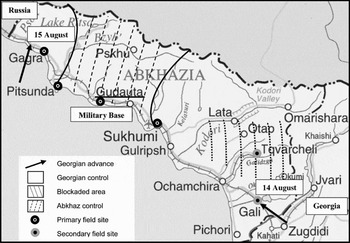
I selected for study two sites of Abkhaz mobilization marked by local-level differences at the war's onset that could have produced distinct processes of mobilization. I compared Abkhaz mobilization along the main road taken by the Georgian forces from Abkhazia's eastern border to the capital Sukhum/i to that along the route of the Georgian advance from the sea to the major western city, Gagra. Abkhaz mobilization initially was concentrated in these two areas, with individuals located in central Abkhazia joining one or the other site of mobilization. These sites were marked by spatial differences at the war's onset (see Figure 1). Proximity to the Russian border, across which individuals could escape with relative ease and outside help could come, and to the Gudauta military base, where weapons could be sought in western Abkhazia, contrasted with the situation in the east, where the border with Georgia facilitated the immediate establishment of Georgian control and blockade of the area. The sites varied not only spatially but also temporally, because the Georgian advance in the west took place a day later than that in the east. The sources of spatial and temporal within-case variation allowed me to probe how differently positioned individuals learned about the Georgian advance, what shaped their understanding of the situation across space and time, and how different social structures, with which individuals interacted on a regular basis before the war, affected their fighter and nonfighter trajectories when the war began.
Spatial and Temporal Variation at the Georgian-Abkhaz War Onset

The analysis of the processes underlying the mobilization trajectories in eastern and western Abkhazia was based on 150 semi-structured interviews with 142 participants and nonparticipants in mobilization and on additional primary and secondary materials.Footnote 14 To capture local-level differences in the selected mobilization sites and ensure representation across the mobilization trajectories, I conducted these interviews in four locations across three of the seven districts of Abkhazia (see Figure 1).Footnote 15 The interviews in Sukhum/i examined mobilization from Abkhazia's eastern border to the capital. Secondary materials on eastern mobilization were collected on Tqvarchel/i and Gal/i—the former immediately blockaded by Georgia, the latter predominantly populated by Georgians. I explored mobilization in the west in Gagra, Pitsunda, and Gudauta. The Abkhaz from these locales mobilized in response to the Georgian advance from the sea, with Gagra soon captured by Georgia, while the tourist town of Pitsunda and the military base in Gudauta remained under Abkhaz control.
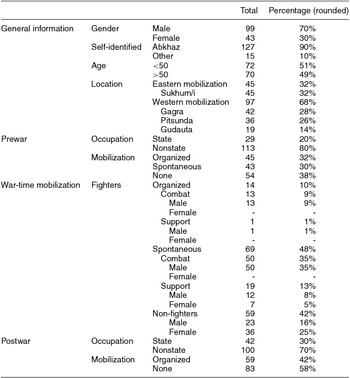
In each of these locales, I sought individuals recruited before the war, those who mobilized spontaneously, and those who did not fight. My decision to stay unaffiliated during field researchFootnote 16 and my long-term, engaged presence in the locales facilitated these interviews, as I gained trust and access to respondents from multiple networks of local residents, authorities, and nongovernmental staff and was able to avoid institutional and personal referral biases (Fujii Reference Fujii2008, 576). I devised a private snowball sampling strategy, whereby I selected those contacts from my multiple network referrals who fit my research purposes (Cohen and Arieli Reference Cohen and Arieli2011). When referrals did not provide the needed respondent categories, I made appointments or approached respondents in these categories, when acceptable, at their location of employment. This strategy was critical to increasing the representativeness of respondents (see Table 1).
Summary of Interview Data

My interviews followed a semi-structured format, starting with a detailed informed consent procedure and moving through the respondents’ prewar, civil war, and postwar life histories. The major part of the interview focused on the events of August 14–18, 1992, including the ways in which respondents learned about and reacted to the Georgian advance. The discursive mode of the interviews allowed me to explore sensitive questions of conflict participation with great flexibility and my respondents to reveal their nuanced positions on the conflict. The combination of event and narrative accounts I used in the interviews and my attention to “meta-data” (Fujii Reference Fujii2010), or stories, silences, and physical gestures, helped address the issues of memory and to reconstruct, step by step, individual mobilization trajectories and understandings of conflict as they evolved over the pre- to the postwar period.Footnote 17
The resulting interviews were similarly distributed across the four locales, with nearly the same number of interviews in Sukhum/i and Gagra—the key sites of eastern and western mobilization, respectively. The percentage of fighters (58%) and nonfighters (42%) was balanced across the interviews, with respondents in support roles (14%) allocated between the organized and spontaneous fighter categories based on their prewar recruitment. Organized and spontaneous fighters constituted 17% and 83% of respondents, respectively, which reflected actual mobilization patterns. The male (70%) to female (30%) ratio captured the gendered nature of mobilization, with combat dominated by men and women represented in support and nonfighter roles. To account for age and status in mobilization, I distinguished young adults under the age of 30 (49%) at the war's onset from individuals over 30 years old (51%) with families and jobs.
This war-time data were situated in the context of respondents’ pre- and postwar occupations and mobilization. I interviewed respondents with a broad range of backgrounds to control for prewar factors that could shape war-time decisions and postwar allegiances that could influence how people viewed the conflict. To ensure that the interviews captured perspectives other than the master narrative of the war, respondents included those in state and nonstate positions in both the prewar (20% to 80%) and postwar (30% to 70%) periods. Varied pre- and postwar mobilization experiences help ensure that the interviews are not homogeneous across respondents due to similar organizational affiliations.
My analysis combined the interview data with field notes on informal interactions and textual materials, each focused on distinct aspects of the conflict (Davenport and Ball Reference Davenport and Ball2002). The primary data related fighters’ and nonfighters’ pre- to postwar life events, choices, and actions to their social environment. Official documents—national and local government resolutions—shifted attention from life histories to the ways in which the conflict was framed across the state hierarchy. I used media transcripts to capture how official narratives were transmitted across the society. Secondary interview archives substantiated these sources and confirmed conclusions based on my interviews (Khodzhaa Reference Khodzhaa2003, Reference Khodzhaa2006, Reference Khodzhaa2009). These multilevel data allowed me to trace individual mobilization trajectories in detail within their broader sociostructural context.
COLLECTIVE THREAT FRAMING AND MOBILIZATION IN ABKHAZIA
Why did individuals mobilize to fight on the Abkhaz side at the beginning of the Georgian-Abkhaz war? The Abkhaz were at a significant disadvantage in manpower and arms and could not offer material rewards for participation, which are often associated with joining the fighting (Humphreys and Weinstein Reference Humphreys and Weinstein2008; Weinstein Reference Weinstein2007). Georgia established control over most of Abkhazia at the war's onset, and looting was soon reported on the Georgian side.Footnote 18 The Abkhaz in general were unprepared for the Georgian advance and could not provide fighters with access to skills and resources that would promote survival relative to nonparticipation (Kalyvas Reference Kalyvas2006; Kalyvas and Kocher Reference Kalyvas and Kocher2007). Fighters across the four locales selected for this research consistently reported having to mobilize without weapons and witnessing immediate casualties in the fighting on the Abkhaz side.Footnote 19 Their high-risk mobilization, especially striking given the availability of alternative options of hiding, fleeing, or defecting to the Georgian side, was therefore rooted in processes other than material rewards and security maximization. As Gutiérrez and Wood (Reference Gutiérrez and Wood2014, 221) write, “Mobilization in high-risk circumstances despite the opportunity to free ride. . . [is] difficult to explain with self-regarding, material preferences.”
Petersen (Reference Petersen2001, 15) argues that high-risk mobilization is affected by the social context in which it takes place:“Strong communities produce mechanisms that are able to drive individuals into these dangerous roles.” Those who do not fight for the community can be punished by it later or, vice versa, rewarded for participation (Humphreys and Weinstein Reference Humphreys and Weinstein2008; Taylor Reference Taylor1988; Weinstein Reference Weinstein2007). “[T]he norm that one should forgo self-interest and act in the interests of the collectivity,” or reciprocate actions of its other members taken for its sake, is the basic prescriptive norm (Coleman Reference Coleman1988, 104). Given these considerations, Petersen (Reference Petersen2001, 53) argues, “community members are faced with a question: how much risk should I accept?” Sanctions over future status and norms underlying strong communities, such as found among the Abkhaz, are among these mechanisms and reflect instrumental and normative social motives for mobilization.
Potential participants’ knowledge of risk, even if limited, is assumed in this willingness to fight and is a common assumption in the literature on civil war (Kalyvas Reference Kalyvas2006, 207; Kalyvas and Kocher Reference Kalyvas and Kocher2007, 184). Yet reports across Abkhazia suggest that risk was not well understood at the war's onset and that this understanding had to be shaped to generate mobilization.Footnote 20 I argue that the effect of social mechanisms on mobilization depends on the ways in which individuals perceive anticipated risk or threat.Footnote 21 “When threat is not perceived, even in the face of objective evidence, there can be no mobilization of defensive resources” (Cohen Reference Cohen1978, 93). Threat can be perceived without being shaped as such, for example, through prior knowledge of imminent violence or being in the midst of an attack. However, in the context of uncertainty that is characteristic of civil war, when “everyday routines and expectancies” are disrupted and violence can have different meanings, individuals rely on familiar social structures for information on threat—whether factual or not—and to make the appropriate response (Snow et al. Reference Snow, Cress, Downey and Jones1998, 2). Confused by the Georgian advance, nearly all fighters and nonfighters in Abkhazia said they called on their families and friends and local and national authorities to make sense of the threat and mobilization alternatives.Footnote 22 As Granovetter (Reference Granovetter1985, 487) argues, “Actors do not behave or decide as atoms outside a social context. . . . Their attempts at purposive action are instead embedded in concrete, ongoing systems of social relations.”
One implication of this argument is that, in the context of uncertainty presented by civil war, social structures provide access to information that is critical for making difficult choices about whether to fight for the group, escape the fighting, or defect to the other side. This information centers on three basic issues: what the nature of the threat is, who threatens, and who is threatened.Footnote 23 By responding to these questions in formal and informal interactions with potential participants, actors in relevant social structures frame, or construct, particular narratives of threat.Footnote 24 “Depending on how threats are constructed,” Jasper (Reference Jasper2008, 101) finds that “individuals [can become more] open and willing to [mobilize in] protest[s].” To mobilize support in civil wars, “recruiters frame conflicts as threats that require defensive mobilizations” (Malet Reference Malet2013, 55). One way to interpret the Georgian advance was as an act of securing Abkhazia's railroad from rampant illegal activity—a dominant narrative among the Georgian elite; this interpretation would have led to a different mobilization outcome and potentially averted a war. Instead the Georgian advance was widely framed and perceived as a threat to Abkhazia's political status and the existence of the Abkhaz as a group, which required defensive mobilization in response.Footnote 25
Threat framing involves a range of actors, whose narratives compete and interact with one another. Social structures filter threat narratives based on shared understandings of conflict. Whereas norms provide a general prescription for action, shared understandings of history and identity that emerge in the course of conflict fill in the content of what the interests of a collectivity are and how to act in support of these interests (Viterna Reference Viterna2013; Wood Reference Wood2003). To resonate with potential participants, threat-framing actors appeal to this common history and the relationships that it affects. As Gould (Reference Gould1995, 18) says, mobilizing appeals “succeed to the degree that the collective identity [they] invoke classifies people in a way that. . . corresponds to their concrete experience of social ties to others.”Footnote 26 The Georgian elite's narrative on the advance did not resonate with most Abkhaz precisely because of their collective view of the history of Georgian-Abkhaz relations as being about the suppression of Abkhazia's autonomy and the Abkhaz as a group, substantiated by their own and their families’ and friends’ lived experiences.Footnote 27
Yet neither was the Abkhaz elite's interpretation accepted as given. Threat narratives do not succeed in shaping people's threat perceptions by merely invoking common notions of conflict; they are negotiated across social structures and can shift in translation. Because potential participants are embedded in multiple social structures with varying saliences for mobilization, elite threat framing—a focus in the conflict literature—can provide insufficient motivation for them to act on or even accept the idea of threat.Footnote 28 “The creators of th[e] script are usually threatened elites in the capital” (Fujii Reference Fujii2009, 12–13), but their narratives are adapted by local leaders “to fit local needs and requirements.” The filtering of national threat narratives through local structures was evident in Abkhazia, where respondents reported initially receiving the televised messages of threat from the Abkhaz government, but then corroborating these messages with local administration and organization leaders; this local filtering frequently shifted the emphasis from the defense of Abkhazia to that of villages, towns, and cities.Footnote 29 In this way, “[p]rewar political parties, students’ and veterans’ groups, and religious organizations, among others, are repurposed for rebellion” at the threat-framing stage of mobilization (Staniland Reference Staniland2012, 17).
Political and social leaders are not the only actors framing threat, however. Individuals can be linked to local leaders and organizational recruiters through indirect ties of acquaintance. These “weak ties,” in Granovetter's (Reference Granovetter1973, 1361) term, are critical for the diffusion of information in the national-to-local filtering of threat narratives, but lack “the amount of time, the emotional intensity, the intimacy (mutual confiding), and the reciproc[ity]” that individuals draw on in the context of uncertainty. The reputations of and respect for national and local leaders are important to the credibility of their messages (Benford and Snow Reference Benford and Snow2000). Yet it is “strong, quotidian ties” of family and friends, which “allow for trust” (Parkinson Reference Parkinson2013, 422–23, emphasis in original), that consolidate their messages into collective notions of threat. Most participants and nonparticipants in Abkhaz mobilization reported that their view of the Georgian advance as threatening was reinforced and then deciding how to respond to this threat with their family members and friends in neighborhoods, universities, and workplaces. Both those who mobilized to fight and those who escaped the fighting often did so together with their family members and friends as a result.Footnote 30 As Aspinall (Reference Aspinall2009, 16) finds, “kinship networks, ties of locality and friendship” serve as major social settings for high-risk mobilization.
The emergence of collective notions of threat influences how individuals come to perceive threat and what mobilization decisions they make. Collective threat framing “guides perception. . . allowing [individuals] to build defined expectations about what is to happen” (Donati Reference Donati, Diani and Eyerman1992, 141–42). Many participants reported that they initially interpreted the Georgian advance as a clash, such as the one in 1989, but then came to view it as a war once threat-framing messages spread across the society.Footnote 31 Although collective notions of threat urge potential participants to perceive threat in general, it is individuals’ ties to the collectivity and shared understandings of conflict invoked in threat framing that differentiate how they perceive threat and decide to act on threat narratives. Individuals, whose lived experiences as part of the group resonate with collective notions of threat, perceive the collectivity to be threatened and join the fighting on its behalf, even if it is a significantly weaker actor in the war. In contrast, those, whose ties to the collectivity are severed by alternative group obligations, perceive personal security to be as the greatest risk and attempt to remain neutral, hide, flee, or join the fighting on the side that can provide greater security (Kalyvas Reference Kalyvas2006). The Abkhaz who mobilized on the Abkhaz side consistently reported that they did so because they were convinced that Abkhazia and the Abkhaz as a group were threatened by the Georgian advance; in contrast, those who feared for their own security or that of close family and friends escaped the fighting, alone or together.Footnote 32
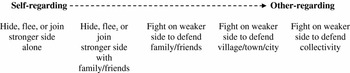
In this way, threat framing interacts with instrumental and normative motivations that drive individuals to mobilize against superior state and nonstate forces when the exit option exists. Individuals who perceive threat as directed primarily toward the self or close family and friends act in attainment of personal or kin security. Their nonfighting trajectories reflect their security-maximizing motivation. If they do mobilize to fight on the weaker side, it is to protect their families and friends, rather than the broader collectivity. I place these actions on the self-regarding end of the mobilization continuum (see Figure 2). In contrast, individuals who perceive threat as directed toward their collectivity act to defend the collectivity at the local and national levels of aggregation. Some fighters stay to defend their villages, towns, or cities, whereas others go to the sites of fierce fighting. As the weaker side, their collectivity offers little prospect of security or success. Their fighter trajectories reflect normative commitments and are placed toward the other-regarding end.
Self- to Other-Regarding Mobilization Continuum

This distinction between self- and collectivity-oriented threat perceptions is one way in which instrumental and normative motives coexist in mobilization. Gutiérrez and Wood (Reference Gutiérrez and Wood2014, 200, 222) argue, “Not all combatants fight for instrumental reasons: some join for normative reasons. . . [and] act on sincere beliefs and other-regarding preferences.” The farther one moves away from the self-regarding end of the continuum, the more possibility exists for noninstrumental motivations. However, even this other-regarding behavior may be driven by instrumental concerns, including community rewards for participating and punishment for not doing so. My argument thus is not about whether norms matter. For example, individuals concerned with personal security can be said to be following the norm of self-protection. Neither is it about whether individuals follow norms for purely instrumental or normative reasons. For example, individuals who flee with family or friends may do so for both self- and (kin) other-regarding reasons. As Fearon and Wendt (Reference Fearon, Wendt, Carlsnaes, Risse and Simmons2002, 62, emphasis in original) suggest, “There is little reason to think that human behavior toward norms is either always self-interested or always a function of perceived legitimacy.” Rather, what matters is to what extent individual threat perceptions and associated actions concern the broader group.
THREAT FRAMING AT THE GEORGIAN-ABKHAZ WAR'S ONSET: AUGUST 14–18, 1992
On the morning of August 14, 1992, troops of the Georgian National Guard—the Georgian nascent army—crossed the Ingur/i Bridge from Georgia to the east of Abkhazia.Footnote 33 According to the Abkhaz de facto Defense Ministry, the troops were equipped with tanks and artillery and were supported from the air (Pachulija Reference Pachulija2010, 27). They “advanced on Sukhumi and shelled the parliament, forcing the Abkhaz leadership to retreat to Gudauta in the northwest of the republic” (Cornell Reference Cornell2000, 159). The following morning, Georgian marines landed in Gantiadi (Tsandrypsh) in Abkhazia's west.Footnote 34 They “block[ed] Abkhazia's border with Russia” and advanced on Gagra with support of the Mkhedrioni (Horsemen)—the Georgian paramilitary group that became active in Abkhazia after the clashes of July 1989 (Baev Reference Baev, Zürcher and Koehler2003, 138; Darchiashvili Reference Darchiashvili1997). Within three days, the Georgian forces controlled Sukhum/i and Gagra, with the adjacent territory to their east and west, respectively, part of which was blockaded, leaving the area surrounding Gudauta under the Abkhaz control (see Figure 1).
Today the events of August 14–18 have a clear meaning in Abkhazia. They are remembered as the first days of what became known as the Patriotic War of Abkhazia—a culmination of the long struggle for Abkhaz political, economic, and cultural self-determination.Footnote 35 Political tensions around the status of Abkhazia, which preceded the war, were part of this struggle.Footnote 36 Achugba (Reference Achugba2010, 256–57) summarizes the issues that the Abkhaz raised in public letters and gatherings in the Soviet period:
The ending of the demographic expansion of Georgians in Abkhazia, protection of the ethnic Abkhaz history, restoration of the native Abkhaz toponymy, preparation of Abkhaz national cadres. . ., liberation of Abkhazia from Georgia's dictatorship—this is an incomplete list of issues raised by the Abkhaz. . . before the central authorities of the Soviet Union.
Most Abkhaz view the war of 1992–93 against this background. “This war went down in history as Patriotic,” a speech at the 10-year anniversary of the war proclaimed. “Everyone understood well: the fate of Abkhazia was being decided in a fierce struggle—should our people be free or dependent, should we have national statehood, language and culture, or lose everything” (Enik Reference Enik2002, 58–59).
In 1992, however, these events were not as well understood. There was intense uncertainty and confusion over the meaning of the Georgian advance. Witnesses reported the following: “Tanks entered all of a sudden on August 14” (Interview 42, Pitsunda, Fall 2011), and “no one understood what was going on: how serious it was, how long it would last, whether it was a war” (Interview 72, Gagra, Fall 2011). Most Abkhaz did not expect a war and interpreted the events as a clash similar to that of July 1989, anticipating protection from the crumbling Soviet structures. “We did not believe that a war could start, felt that we were protected by the powerful Soviet Union” (Interview 49, Pitsunda, Fall 2011); “we thought it would be over right away, that it was another clash” (Interview 38, Pitsunda, Fall 2011). In other words, ordinary men and women in Abkhazia, many of whom shortly mobilized to fight on the Abkhaz side, were shocked by the Georgian advance, but did not perceive it as a threat.
Neither was the Georgian explanation convincing. The advance took place amid the internal conflict that ousted President Zviad Gamsakhurdia from Tbilisi and persisted as the new leadership struggled to control his supporters, the Zviadists (Driscoll Reference Driscoll2015). Georgia's elite in this context asserted that the Georgian forces were “securing road and rail links [in Abkhazia]. . . in the hunt for the security officials taken hostage” by Zviadists (Fuller, Reference Fuller1992).Footnote 37 This message did not find support among potential participants in Abkhazia. “They said that they came to guard the railroad, but how can you guard the railroad with tanks?” was the question that was commonly asked (Interview 29, Pitsunda, Fall 2011; Interview 8, Gudauta, Fall 2011; Interview 78, Gagra, Fall 2011; Interview 107, Sukhum/i, Fall 2011).
In the confusion over the Georgian advance, the threat that it posed had to be perceived for Abkhaz mobilization to take place. Individuals who did not view the advance as threatening did not mobilize in response. The reaction of the SRIF reservists in the east of Abkhazia who were the first to face the Georgian forces and were immediately imprisoned as a result corroborates this argument:
Six reservists were on duty at the Okhurej post [near the Ingur/i Bridge]. A car with soldiers came by. . . . The Abkhaz fighters did not have time to understand the situation, as they were captured and. . . placed in custody of the Gali police department. . . . As the surviving fighters said, they did not expect a battle, thinking that Zviadists wanted to sneak through the post or that some car did not comply (Pachulija Reference Pachulija2010, 29–30, emphasis added).
Mobilization of SRIF fighters at the nearby Okhurej garrison began after they heard the first shots. Similarly, whole villages did not mobilize until the threat posed by the Georgian advance was perceived. The recollections of a fighter who later mobilized in the eastern village of Merkula illustrate this concept:
On the first day of the war, Georgian soldiers came in and out of our village. . . . It was quiet and calm for a month [and] no one organized village defense. . . . Georgians began burning homes of local Abkhaz and Russians, and after that killing them. . . . But [mobilization] began after the arrival of [a local villager informed in] the west (Interview in Khodzhaa Reference Khodzhaa2003, 123, emphasis added).
The timing of mobilization suggests that threat perception was in part situational: Organized fighters at the Okhurej garrison came to view the Georgian forces as threatening by virtue of being positioned on the route of the Georgian advance. This pattern characterized the initial resistance to the Georgian forces by organized fighters in the east of Abkhazia. In response to further organized and spontaneous mobilization, however, threat came to be framed, as the Merkula villager's arrival and subsequent mobilization indicate. By focusing on the organized fighter, spontaneous fighter, and nonfighter trajectories in the east and west of Abkhazia, the following sections address in detail the questions of how potential participants in Abkhaz mobilization came to perceive threat and how threat framing shaped their mobilization decisions. Despite the spatial and temporal variation, mobilization in these sites followed a typical pattern. Threat-framing appeals were filtered and consolidated across society to produce a collective notion of threat and influence threat perceptions and mobilization decisions.
ORGANIZED MOBILIZATION: SITUATIONAL THREAT PERCEPTION AND THE CHAIN OF COMMAND
How did the Abkhaz come to perceive the Georgian advance as threatening? Some drew on prior knowledge about potential violence. The sister of an Abkhaz activist reported, “My brother felt that there would be a war. He was even called an extremist for it” (Interview 59, Gagra, Fall 2011). Yet even informed individuals, such as military commanders and leaders of the Abkhaz movement, did not immediately perceive a threat when the Georgian advance began. The SRIF commander who inspected the Ingur/i Bridge on its eve was startled by the advance. A witness described his reaction:
August 14, 1992, was a regular day on duty. . . . Suddenly, [the commander] looked out of the window. . . [and] gave a command, “Alarm.” Not understanding what was happening, I said that everything was in order. But he repeated, “[A]larm.” Realizing that [he meant] combat alert, I told him to turn on the siren, the button was in his office. As he came to his senses, he gave the signal [to mobilize] (Khodzhaa Reference Khodzhaa2003, 17, emphasis added).
The commander's threat perception was situational, just as it was for the SRIF regulars and reservists who were not demobilized before the war and were located in the midst of the advance—along the single road crossing the territory of Abkhazia from east to west. Organized fighters in the east offered initial resistance once they heard or saw “a column of Georgian. . . tanks and troops [e]ngaged in gunfire” (Khodzhaa Reference Khodzhaa2003, 57, emphasis added). As they were approached by the Georgian forces, a few fighters at the Okhurej garrison and nearby Gudava post opened fire with the limited weapons that they were assigned, but had to retreat to the west and clashed with the Georgian forces midway to Sukhum/i (Pachulija Reference Pachulija2010, 30, 34; Interview in Khodzhaa Reference Khodzhaa2006, 158).
The chain of command played a major role in organized mobilization thereafter. Organized fighters of the Agudzera unit farther along the road were ordered to block the bridge on the outskirts of the capital. A SRIF regular reported, “The deputy commander called. . . and gave the order. . . to set out to close the Kelasuri Bridge” (Interview in Khodzhaa Reference Khodzhaa2003, 56, emphasis added). This task was impeded by the first battle that broke out. A participant recalled, “[One fighter blocked] the road with an armored vehicle and took the fight. [He w]as shot, but caused [the Georgian forces] losses” (Interview in Khodzhaa Reference Khodzhaa2003, 56). Up to 40 regulars and reservists joined in the fighting, but were overwhelmed and received the order to retreat. These and other fighters were instructed to defend the Red Bridge at the entry into the capital, where they were assisted by spontaneous fighters, many of whom were unarmed, and were able to hold the Georgian forces until the standoff ended and negotiations ensued.
The role of command in the organized mobilization was evident in the west of Abkhazia, where the Georgian marines landed on August 15. A local SRIF commander recalled the order he received: “Head of the Gagra administration called and passed the order of the [SRIF] command to take guard of the Psou-Gagra road. . . . I [took] regulars and a large number of unarmed reservists” (Interview in Khodzhaa Reference Khodzhaa2009, 437–38, emphasis added). These men were similarly joined by spontaneous fighters and “stood along the main road. . ., blocked it with a truck [and] sand bags” (Interview 27, Pitsunda, Fall 2011); and “mined a rock slope and left a roadblock on the way to Gagra” (Interview in Khodzhaa Reference Khodzhaa2009, 440). However, only a minority of fighters had access to the organized structure of command.
SPONTANEOUS MOBILIZATION: COLLECTIVE THREAT FRAMING
Most men and women in the east and west of Abkhazia, including discharged reservists and spontaneous fighters who mobilized outside of the SRIF structure, did not have prior knowledge or situational awareness of the Georgian advance, but sought information from social structures that they interacted with in daily life and trusted as a result. A schoolteacher who mobilized spontaneously in the west summarized the sense of uncertainty, mistrust of the Georgian narrative, and collective threat framing at the time:
Train raids were common. . . . Georgia used this as a pretense.. . . It all happened unexpectedly in August. We suspected something, but even that day when we saw ships we could not tell: a ship is a ship. . . . An hour later, my friend found me and said that [Georgian] marines were landing. . . . By then there was the [state] message on TV about the beginning of aggression.. . . We moved toward Gagra. Here [the head of] administration gathered the people. . . . He said, “There are battles, shootings, the aviation. . .” We decided, given our small numbers [and] lack of weapons. . ., to retreat and organize city defense (Interview 78, Gagra, Fall 2011).
Threat framing proceeded from the national elite messages to the local level, often shifting to focus on city, town, and village defense, as endorsed by quotidian networks of family and friends.
“Attack and Aggression”: From Elites to Family
Threatened by the Georgian advance and displaced from Sukhum/i by the Georgian forces, the national Abkhaz elite served as the primary source of threat framing in Abkhazia. Soon after the Georgian advance began on August 14, Chairman of the Supreme Council of Abkhazia Ardzinba appealed in an emergency address to the citizenry:
I appeal to you at this difficult time. Our land was invaded by the armed formations of the State Council of Georgia. . . that spread death and destruction.. . . The Abkhaz and the entire population of our long-suffering Motherland are being added to. . . the blood spilled by the [Georgian] leadership. . . . I think that we have to resist. . . [and] defeat those who bring hostility (Ardzinba Reference Ardzinba2004, 5, emphasis added).
This formal address answered the questions of who was threatened, by whom, and to what extent. It presented the advance as an attack (the nature of threat) by the Georgian aggressor (the agent of threat) threatening not only the Abkhaz but also the entire population of Abkhazia (the subject of threat), and it advocated defensive mobilization in response. Other statements of the Abkhaz national leadership reaffirmed Ardzinba's threat narrative. For example, the Resolution of the Supreme Council of August 14, “On mobilization of the adult population and arms transfer,” urged all citizens 18 to 40 years old to mobilize in defense due to the “real threat that appeared to. . . Abkhazia [and] the life of the population” (Ardzinba Reference Ardzinba2004, 6, emphasis added).Footnote 38 These threat-framing messages were broadcast on television and widely publicized in the print press across Abkhazia.
Such elite messages resonated with many Abkhaz. In their appeals, the national elite drew on the shared history of Abkhazia as a “long-suffering Motherland” and a state—“every citizen, according to all constitutions, must defend their state,” as Ardzinba explained (Reference Ardzinba2004, 5; Zantaria Reference Zantaria2010, 43).Footnote 39 They furthermore invoked the intimate and familiar ties that were disrupted by the Georgian advance. “It is not easy to speak,” Ardzinba stressed in his speech, “when perhaps right now. . . our homes are robbed, people are beaten, and life itself is not guaranteed” (Ardzinba Reference Ardzinba2004, 5, emphasis added). Ardzinba's reputation as a fervent defender of Abkhaz rights, long respected in the society, added credibility to elite messages.Footnote 40 Respondents in the east and west of Abkhazia consistently reported that they learned about Georgia's advance and understood it as an attack requiring defensive mobilization from these messages: “I came back from work and learned that the war began on TV” (Interview in Khodzhaa Reference Khodzhaa2003, 63, emphasis added); “Ardzinba [told] us that an armed attack was carried out against Abkhazia and that we will resist” (Interview 84, Gagra, Fall 2011).
Yet elite threat framing was insufficient for most to decide how to act on the information about the Georgian advance. Political and social actors at the local level, including highly regarded administration and Abkhaz movement leaders, further advanced elite threat framing.Footnote 41 After seeing Ardzinba's televised address, crowds poured to local administrations across Abkhazia. These city, town, and village centers have historically served as places of assembly for the Abkhaz population. Men and women knew that they would get more information from actors in this social setting. My interviews confirm these centers’ role at the war's onset: “When the war began, I. . . went to the administration. Everyone gathered there and expected a message from the leaders” (Interview 117, Sukhum/i, Fall 2011). “People stood by the village council. . ., debat[ing] what happened. . . . When [a local activist] approached, they exclaimed, ‘He will tell us something serious!’” (Interview 64, Gagra, Fall 2011).
Local actors corroborated the national narrative, but adapted it to the purposes of city, town, and village defense. The address of head of the administration of Tqvarchel/i—an eastern blockaded city—is exemplary. It began by framing the threat posed by Georgia to the whole of Abkhazia. “The republic [(the subject of threat)] is in danger! Today. . . troops of the State Council of Georgia, accompanied by tanks [(the agent of threat)]. . ., invaded the territory of Abkhazia in order to occupy it [(the nature of threat)]” (Cherkezija Reference Cherkezija2003, 84, emphasis added). The address went on to suit the particular needs of this city's defense. “Due to the state of emergency in Tqvarcheli, general mobilization of men 18 to 45 years of age is declared. . . . Get ready for city defense” (Cherkezija Reference Cherkezija2003, 84, emphasis added). This speech was immediately aired on local television. Similar filtering of the national narrative took place in the west of Abkhazia. As a participating fighter said, “‘Gagra is a pearl,’ [the head of administration] told us, ‘We may not have battles in the city. . .’ So we had to retreat back to the old [part of the] city and take defense positions [there]” (Interview 20, Pitsunda, Fall 2011).
Threat framing was often substantiated by Georgian statements and actions at the local level. On August 15, for example, Sukhum/i TV channels aired the Georgian leader Shevardnadze's warning that “in the struggle for preservation of the territorial integrity of [Georgia]. . . we are willing to die, but also eliminate anyone” (Brojdo Reference Brojdo2008, 53, emphasis added).Footnote 42 The images of looting showed the Georgian forces’ brutality. “We went to the homes where people were tortured, robbed; aired this in Gagra,” a local reporter said (Interview 85, Gagra, Fall 2011). The images and local threat framing in general reassured the Abkhaz that a war had begun: “Now we understood what we faced—weaponry, tanks, marauding” (Interview 75, Gagra, Fall 2011); “I was assured that a war really began, that the Georgian forces occupied a part of Abkhazia” (Interview in Khodzhaa Reference Khodzhaa2003, 216, emphasis added).
However, it is within the quotidian networks of family and friends that this information was typically consolidated into collective notions of threat and transformed into mobilization decisions. A spontaneous fighter in the east captured this process of consolidation across the social structures:
On August 14. . ., I was at work. . . . At 10 a.m. we went outside due to noise. . . Not understanding anything, all family gathered by the TV. . . [We saw] Ardzinba's address [(national)] on the start of aggression. . . [and] formation of battalions to defend the motherland. Right after, the Abkhaz population of Tamysh gathered [(local)], where a village defense group was formed. . . . [My relative]. . . took a couple of friends [(quotidian)], went to the [SRIF] unit. . ., brought [back weapons]. . ., [and o]n his initiative we began shooting at [Georgia's] military convoy moving along the main road (Interview in Khodzhaa Reference Khodzhaa2003, 85–86, emphasis added).
In the east and west of Abkhazia, relatives and friends in neighborhoods, schools, and workplaces alerted one another of the threat based on the information that they received from the national and local actors: “My son was studying in Russia. . . . I told him about the war [and] he left it all to come here. . . . I sent him to [fight]” (Interview 11, Pitsunda, Fall 2011); “I was home picking tea. . . . [My] neighbor called urgently and said that the war began” (Interview in Khodzhaa Reference Khodzhaa2009, 690, emphasis added).
Informal interactions with family members and friends offered the level of validation of the idea of threat and the need to mobilize in response that is only possible in this private social setting. Threat framing in this setting often took the form of a blessing for both organized and spontaneous fighters. For example, “My father [told me] what happened. . . . He gave me his rifles, cheese, [and] a loaf of bread and said, ‘Go where your friends are!’ [and] I went” (Interview 27, Pitsunda, Fall 2011). “You only try to return!” a mother blessed her daughter as she went to fight in the war (Interview 39, Pitsunda, Fall 2011).
As the collective notion of threat of the Georgian advance consolidated, difficult mobilization decisions were made at the quotidian level: “First I was in shock, then we began gathering with friends, relatives, deciding what to do” (Interview 72, Gagra, Fall 2011); “we began calling all our [sports team] boys by phone. . ., gathered at the sports ground to discuss what to do. . ., [and] formed around close ones” (Interview 75, Gagra, Fall 2011). The resulting narodnoe opolchenie (people's force) “was formed on the basis of location and friendship ties” (Interview 47, Pitsunda, Fall 2011).
“Narodnoe Opolchenie”: For Families, Villages, and the Nation
Why did threat framing resonate with the Abkhaz? The shared understandings of history and identity invoked by the national, local, and quotidian actors were related to individual experiences as part of the Abkhaz group. Fighters came to view the Georgian advance as an attempt to eliminate Abkhazia as a separate political entity and the Abkhaz as its core cultural unit. This notion drew on the political, economic, and cultural repression in the Soviet Georgian state that fighters shared in directly, through family history, or collective memory. This excerpt was a typical fighter's response:
I participated in the war because since childhood, we lived in the society where the Abkhaz were humiliated, eradicated. Our language, last names were changed to Georgian. . . [so] that there would be no Abkhaz. . . [or] Abkhazia—the land that [Georgians] considered to be their own. But it is our, Abkhaz land.. . . [Thus] we had to struggle (Interview 114, Sukhum/i, Fall 2011).
That their land and people, the constituent parts of the collective Abkhaz identity, were threatened meant to potential participants that mobilization was required in defense: “We realized that we had to seriously resist, we had no other motherland” (Interview 118, Sukhum/i, Fall 2011). The duty to Abkhazia and the Abkhaz was reported as the key motivation to fight across the interviews: “Whether we remain alive or not, it is our duty to defend our native land” (Interview 12, Pitsunda, Fall 2011). All fighters who mobilized on the Abkhaz side characterized the war as Patriotic as a result.
However, some fighters mobilized to defend their homes and localities, whereas others left their native villages, towns, and cities to mobilize in the sites of intense fighting, specifically near Sukhum/i and Gagra. The differences in the roles that individuals adopted suggest that they viewed the threat posed to their collectivity at its different levels of aggregation. Attacks on houses “created . . . a core of fighters determined to regain lost homes” (HRW 1995, 23). As fighters explained, “They cleared my house, killed my dog, offended my father—all this boiled up and I united people around me to fight” (Interview 53, Gagra, Fall 2011); “it was not only the Abkhaz who fought. Everyone was defending their families, elders, and children” (Interview 12, Pitsunda, Fall 2011).
The majority of fighters sought to defend their localities. They recalled, “How [could] I leave my city and people whom I worked with closely for many years, now that they are in danger?” (Interview in Cherkezija Reference Cherkezija2003, 105, emphasis added); “we knew that every village had to defend itself” (Interview 64, Gagra, Fall 2011). In the east of Abkhazia, local-level mobilization took the form of village defense, prompted by threat framing in the local social structures.Footnote 43 Spontaneous fighters confirmed this response: “The Administration was notified that the [Georgian] forces were [near] in Okhurej. . . . That evening the whole village gathered. . . and organized village defense” (Interview in Khodzhaa Reference Khodzhaa2003, 100, emphasis added). “My nephew. . . urged me to go to the east. . . where it was very difficult due to the blockade. Soon I. . . was in my native Mokva” (Interview in Khodzhaa Reference Khodzhaa2003, 64, emphasis added). Village defense groups formed similarly in the west, but were complemented by shoreline patrols made possible by proximity to the sea.Footnote 44 Fighters described these forms of local mobilization: “When Georgians occupied Abkhazia, we immediately formed a Pitsunda group. We were 15 boys from the village.. . . Others started to join. . . . We only had 12 rifles and a grenade launcher. . ., but guarded [our] bridges [from intrusion]” (Interview 33, Pitsunda, Fall 2011); “people without weapons began organizing into groups in their villages to patrol the shoreline. Our [group] was in the school. We all knew each other and tried keeping close to one another” (Interview 36, Pitsunda, Fall 2011).
Some Abkhaz left their localities to defend Sukhum/i and Gagra, the sites of intense fighting at the war's onset. “You are most dear to me,” a spontaneous fighter in the west explained to his wife, “but my motherland is dearer” (Interview 104, Sukhum/i, Fall 2011). A Tqvarchel/i fighter recalled, “My younger brother ran away to [Sukhum/i] to fight for the Motherland together with his [SRIF] friends” (Interview in Khodzhaa Reference Khodzhaa2009, 736, emphasis added). As did this fighter, many joined organized mobilization units in Sukhum/i and Gagra once the threat was framed nationally. “When Ardzinba announced general mobilization,” a Gudauta fighter reported, “I said, ‘Everyone, go to [the military headquarters]!’ They separated us into groups” (Interview 97, Gagra, Fall 2011). The Gudauta group of 140 fighters formed there assisted SRIF fighters in Sukhum/i (Pachulija Reference Pachulija2010, 39).
Yet most mobilized outside of the SRIF structure, either gaining access to weapons at the Gudauta military base and from locals or going unarmed into battle. Fighters described these typical mobilization scenarios: “We gathered the boys we knew. . ., took some weapons from the Russian barracks (with some they helped, other we just took). . ., [and] right away went with one bullet to [Sukhum/i's] Red Bridge” (Interview 81, Gagra, Fall 2011). “Everything was arranged spontaneously.. . . We collected weapons and those who managed to get these weapons went toward [Georgia's marines by Gagra]. . . . Of course, tens [of us] who got the weapons were not enough” (Interview 72, Gagra, Fall 2011).
That many Abkhaz joined “the armed struggle in spite of the apparent futility of resistance” implies that noninstrumental motives coexisted with instrumental concerns in Abkhaz mobilization (Brojdo Reference Brojdo2008, 51). Certainly, status considerations played a role. A mother captured the importance of community sanctioning: “Both sons were sick but both were not sent [to be treated in Moscow] not to be seen as traitors” (Interview 102, Sukhum/i, Fall 2011). However, the more that individual threat perceptions and associated actions were directed toward the broader collectivity, the stronger the possibility existed for normative motivations in mobilization decisions. Three indicators support these motivations.First, that poorly armed and unarmed Abkhaz mobilized suggests that security seeking or expectation of rewards were not the primary drivers. Local mobilization in the areas where Georgia established control is a critical observation in this regard. The continuing poorly armed mobilization after Georgia's forces blockaded villages, towns, and cities in the east is exemplary: “On the second day [after Adzuzhba was blockaded], the youth of the village began gathering, arming themselves with whatever they could: made bottles with incendiary mixtures, got [explosives] from Tqvarcheli, and put up a barricade. . . with watch duties” (Interview in Khodzaa Reference Khodzhaa2009, 615, emphasis added).
Second, the record of human losses among the Abkhaz and the continuing mobilization despite these losses, especially in Sukhum/i and Gagra, is a strong indicator of normative motivations. For example, spontaneous fighters “taken captive [in the first Sukhum/i battle] were all brutally killed” (Interview in Khodzhaa Reference Khodzhaa2009, 888, emphasis added). Fighters learned about or observed casualties in the fighting, yet continued to fight. The recollections of a participant in the fighting in Sukhum/i illustrated this pattern: “When the Abkhaz went into counterattack the first day of the war, one had a gun, two were unarmed, running behind. . . to take the guns of [those]. . . injured or killed” (Interview 127, Sukhum/i, Winter 2011).
Third, mobilization despite the exit option reflects normative motives. As a fighter explained, “People died voluntarily for Abkhazia, no one forced them: they could leave for Russia” (Interview 127, Sukhum/i, Winter 2011). Not only was escaping the fighting generally feasible at the war's onset (see the next section) but exit options also existed for select groups. General mobilization exempted youths under 18 years old. Single sons and intellectuals were ordered not to fight. Many mobilized despite these alternatives and reported duty-based motives: “[I] perform[ed] the duty to our people at a difficult time,” a young fighter said (Interview in Bebia Reference Bebia2011, 345, emphasis added); “I could not do otherwise in the situation of aggression against my ethnos,” a professor explained (Interview 117, Sukhum/i, Fall 2011).Footnote 45 Combat deaths and injuries in these groups were systematically reported.Footnote 46
NONFIGHTERS: FEAR AND SELF- AND KIN PROTECTION
Although collective threat framing made most potential participants aware of Georgia's threat, the extent to which threat toward the broader group was prioritized differentiated fighters from nonfighters. Fighters mobilized to defend their families, localities, and Abkhazia as a whole, moving toward the other-regarding end of the mobilization continuum in each scenario. Nonfighters, even if they empathized with the cause, did not see their participation as meaningful in the unlikely conditions of Abkhaz success and hid, fled, or, in rare cases, defected to the Georgian side. Pursued for self- or kin protection reasons, these actions were situated toward the self-regarding end of mobilization.
Hiding was the dominant nonfighting strategy. Depending on who controlled their locality, nonfighters hid in their villages, towns, or cities or fled to safer areas in Abkhazia. These included Tqvarchel/i in the east and Gudauta in the west—“the only areas that did not suffer [from fighting]” (Interview 10, Gudauta, Fall 2011). “Over the course of a few weeks, most Abkhaz fled Sukhumi” to these safer areas (HRW 1995, 23). In the east, remaining neutral was possible until the Georgian forces entered villages under their control. Thereafter, nonfighters who hid in these villages fled to Tqvarchel/i and surroundings that were blockaded but inaccessible to the Georgian side. “Tqvarchal was occupied, but Georgians could not take it because of the partisan fighting in its nearby villages” (Interview 110, Sukhum/i, Fall 2011). A nonfighter described a typical pattern in the area: “On August 16, the [M]khedrioni entered our village Tamysh. . . . Abkhaz residents were forced to save ourselves by fleeing. . . through villages. . . to Tqvarcheli” (Letter in Cherkezija Reference Cherkezija2003, 89, emphasis added). In the west, the Abkhaz-controlled Gudauta district served as the hiding area. The Georgian roadblocks were set up, but the guards were lenient at the war's onset. A nonfighter from Gagra reported, “There was a post in Kolkhida. . . . They sifted. . . the Abkhaz. . ., but still looked through the fingers.. . . My relative came to take his sister and children [and we fled] to the Gudauta district” (Interview 83, Gagra, Fall 2011).
The second widespread nonfighting strategy was fleeing outside of Abkhazia. In the east, a helicopter from Tqvarchel/i flew to Russian Teberda: “My husband [and son were in the east], went to. . . Tqvarchal through non-occupied area. . ., from there by helicopter to Teberda” (Interview 83, Gagra, Fall 2011). Access to this option was difficult, especially for men, most of whom hid instead. In the west, individuals fled to Russia by sea or along the main road. A nonfighter describes these scenarios: “A boat carried all those who wanted to leave from Gudauta to Sochi. . ., many left by cars. . .. [T]here had been tens [already in Russia] when we arrived [by boat]” (Interview 59, Gagra, Fall 2011).Footnote 47
Finally, a small number of individuals defected to the Georgian side. Respondents criticized this option: “There were also others who went to fight on the other side” (Interview 5, Gudauta, Fall 2011). The defectors were known by name, as traitors, and often came from the organized pool of potential mobilizers (Pachulija Reference Pachulija2010, 32–33). The Georgian leadership admitted after the war that the Abkhaz population rarely supported them (Kvarandzija, Reference Kvarandzija1996). Of the nearly 100 SRIF regulars, only two fled and three defected (Khodzhaa Reference Khodzhaa2006, 190–92), although one defector was a commander: “When the Georgian tank approached, our battalion commander. . . ordered personnel to stand right before the tank. . . [and] disappeared” (Interview in Khodzhaa Reference Khodzhaa2006, 58, emphasis added).
The actions of individuals in the nonfighter trajectory indicate that they perceived personal or kin security to be at greatest threat. The underlying theme of fear for their own life or for the lives of close family and friends supports their security-based motives. As nonfighters consistently explained, “I was afraid. . . [and so] went to Gudauta and hid. There was fear for your life and your close ones.. . . We could be killed any time” (Interview 149, Sukhum/i, Winter 2011). “We were in fear, we could have died.. . . I now regret. It would have been better if I had gone to fight” (Interview 42, Pitsunda, Fall 2011).Footnote 48 “The Abkhaz population thus lived in terror” and escaped to protect themselves (HRW 1995, 23).
Depending on whether they escaped the fighting on the Abkhaz side together with family and friends or alone, the nonfighter roles were toward the self-regarding end of the mobilization continuum. The actions of those who hid, fled, or defected alone strongly align with self-regarding motives because these acts commonly compromised the security of others. An organized fighter recounted his commander's defection: “Our deputy commander. . . betrayed us, giving in part of our personnel” (Interview in Khodzhaa Reference Khodzhaa2003, 45, emphasis added). Parents driven by fear hid their sons so others could fight in their stead:
My son was [in the Gudauta barracks]. He did not like it: “I am 20 years old, the war is ongoing but I am laying here. . .” I told him, “Stay. . ., like everyone.” [Many] hid their sons there. . . . If volunteers came, they were taken to fight. These ones were not volunteers, so they remained [in the reserve] and lived (Interview 11, Pitsunda, Fall 2011).
Those who escaped together prioritized the security of close family and friends, even when doing so posed difficult dilemmas of mobilization. Nonfighters report, “We had no doubt that we could not stay in Abkhazia [due to] casualties.. . . My husband [took me] with children to Majkop” (Interview 59, Gagra, Fall 2011); “my mother-in-law. . . told her son, ‘Take your child, go to Tkuarchal!’ [My husband] was a 40-year-old man [able to fight, but]. . . had to take [our son] because otherwise they would be killed” (Interview 83, Gagra, Fall 2011); “I did not want to, but was persuaded. . . to take the children away from the village. . . to Moscow” (Interview 39, Pitsunda, Fall 2011).
Family and other alternative obligations formed through intermarriage or employment and education outside of Abkhazia overwhelmed these individuals’ duty to the broader collectivity. As respondents explained, “My brother's wife was Georgian. . . They went to Moscow as soon as the war began” (Interview 5, Gudauta, Fall 2011); “as a parent, it is not the state that punishes my son, but I. . . . There is a notion of shame here, of which there is none in Moscow [where many went to study or work]” (Interview 122, Sukhum/i, Fall 2011). As a result, fighters who mobilized were driven by the duty to their collectivity at the quotidian, local, and national levels, which they perceived to be threatened. Nonfighters feared for their own or kin security. Self- or kin protection was their primary concern, reflected in their decisions to hide, flee, or defect, alone or together with close family and friends.
CONCLUSION
Using local-level data on Abkhaz mobilization at the onset of the Georgian-Abkhaz war in mid-August 1992, this article argued that social structures, within which individuals are embedded, provide access to essential information on threat that individuals draw on to make difficult mobilization decisions in the context of uncertainty characteristic of civil war. This information is filtered from the national through local levels of society and is consolidated into collective notions of threat with quotidian networks based on shared understandings of history and identity. The emergence of collective notions of threat shapes the ways in which individuals view threat. The difference between self- and other-regarding roles that individuals adopt is based on who the other is in their threat perception.
Framed as threatening across social structures in Abkhazia, the Georgian advance prompted mobilization by both armed and poorly armed or unarmed fighters, even in the areas where Georgia established control. Those whose understanding of conflict resonated with collective threat framing perceived a threat to their collectivity and mobilized to defend their families, localities, and the nation. The more their actions concerned the broader group, the more they reflected normative commitments beyond self-regarding concerns, because their group—outnumbered and militarily weak at the war's onset—offered little prospect of security or success in the war. Others prioritized threat to themselves or close family and friends and hid, fled, or defected to the stronger, Georgian side. Whether they escaped the fighting alone or together reflected the self- or kin-protection motives behind their actions.
The implication of this analysis is that distinct mobilization trajectories cannot be viewed as a result of stable preferences or cost-benefit calculations based on a preexisting knowledge of threat. Although these considerations play a role, they are situated in a complex social context, where threats are not given, but are rather constructed or filtered through and consolidated by the social structures that individuals interact with in daily life. It is the resultant perception, rather than the fact of threat, that drives individual mobilization decisions. This article relates the differences in threat perception to lived experiences as part of the group and suggests that alternative group obligations influence the ways in which individuals process the information on threat. Future research should focus on how social structures interact with instrumental and normative motives in shaping mobilization across a broader range of micro-level variations in combatant, support, and nonfighter roles as they relate to collectivities at their different levels of aggregation. This research can provide further insight into the coexistence of instrumental and normative motivations and specific mechanisms of other-regarding mobilization—a novel and promising area of research on individual decision making in civil war.
SUPPLEMENTARY MATERIAL
To view supplementary material for this article, please visit http://dx.doi.org/10.1017/S0003055416000277




Comments
No Comments have been published for this article.