The Office for National Statistics confirmed that in 2001 cohabiting couple families comprised 13·2 per cent of all families in the United Kingdom with the figure in Scotland at 11·5 per cent.Footnote 1 The trend for couples to cohabit is expected to continue to rise and it is estimated that for the United Kingdom as a whole, the figure will double by 2031.Footnote 2
Although cohabitation is frequently presented as a relatively new phenomenon, with some commentators attributing it to a uniquely liberal social ethos and as a cause and consequence of family breakdown,Footnote 3 historians have long argued that informal unions and cohabitation have a long history.Footnote 4 However, Scotland was unique in Europe in that irregular marriage was recognized as legally valid until 1939 and marriage by cohabitation with habit and repute remained legally valid until 2006.
By the end of the eighteenth century, most Western, and indeed Eastern, European countries had adopted a restrictive definition of legally valid marriage. In 1563, the Council of Trent had decreed that to be legally valid the marriage ceremony had to be presided over by a Catholic priest. Over the course of the next two hundred years or so, Protestant nations such as England and Germany extended legal regulation of private relations and eventually adopted equally restrictive definitions of what constituted a legally valid marriage.
Marriage laws continued to vary from country to country. For example, many countries recognized civil marriage as well as religious marriage, whilst in France from 1792 and Germany from 1875, civil marriage was obligatory and religious marriage optional. Although civil marriage was not possible in Scotland until 1939, it was in relation to irregular marriage that Scotland's marriage laws departed significantly from other European countries, although the situation in Scotland shared similarities with the common law marriages that existed in many of the states of America. By the end of the nineteenth century almost two-thirds of the federal states of America recognized informal unions, based on simple exchange of consent without formal solemnization, as fulfilling the basic requirements of legal marriage.Footnote 5 How significant was this apparently more relaxed and tolerant legal attitude towards irregular unions in Scotland in terms of shaping popular practices and attitudes? Did it remove any social stigma which might otherwise have been associated with these unions and did political, religious, and legal authorities demonstrate an acceptance and lack of censure towards them?
This article draws on the evidence given to the various government enquiries into the marriage and divorce laws of Scotland by churches and other bodies, as well as by legal and Poor Law officials, in order to establish official attitudes to irregular unions. Poor Law records for the parish of Glasgow, the largest Poor Law Board in Scotland and the one with the greatest number of claimants, have been used to examine both the attitudes and practices of Poor Law officials to claimants who were not regularly married but who were either cohabiting or irregularly married. These sources in conjunction with government statistics, census reports, and local government reports are used to establish the incidence and popularity of irregular marriage and cohabitation amongst the populace. The period covered, 1855 to 1939, marks the introduction of civil registration on the one hand and the abolition of legally valid irregular marriage on the other. It is only from the introduction of civil registration in 1855 that it is possible to chart with any degree of accuracy marriage rates in Scotland, and only from 1856, with Lord Brougham's Act, is it possible to chart the incidence of irregular marriage. Therefore, the period 1855 to 1939 provides us with a unique opportunity to explore the incidence, significance, and meanings of a practice which had long disappeared in other European countries.
Three forms of irregular marriage existed in Scotland marriage per verba de praesenti, which required ‘some present interchange of consent to be thenceforth man and wife, privately or informally given’; marriage per verba de futuro subsequente copula, which was constituted ‘by a promise of future marriage without any present interchange of consent to be husband and wife, followed at a subsequent time by carnal intercourse’; and marriage by cohabitation with habit and repute.Footnote 6 The latter form of marriage was often popularly defined as ‘living together’.
Despite the durability of legal irregular marriage in Scotland, there is a good deal of evidence that the authorities were at best ambivalent towards irregular marriage with many amongst the legal, religious, and political establishment manifestly hostile. This was demonstrated by the number of attempts to introduce legislation banning irregular marriage after Hardwicke's Act had been introduced in England.Footnote 7 Whilst this is evidence that there was significant opposition to irregular marriage, one might conclude that the failure to abolish it, despite repeated attempts, indicates that there was also significant support for irregular marriage amongst influential interest groups. Indeed, Dempsey has argued that irregular marriage remained on the statute books in Scotland until 1939 because the Church of Scotland did not become sufficiently exercised about it until after the First World War.Footnote 8
The task of the Royal Commission on Marriage Law (RCLM) which reported in 1868 was to introduce simplicity, clarity, and certainty into the proceedings involved in contracting a legally valid marriage in the United Kingdom. The evidence to the commission provides the most comprehensive discussion of contemporary views on Scotland's marriage laws. With a few exceptions, the organizations and individuals consulted were critical of the existing marriage laws and made a number of suggestions for amendments, foremost amongst them were measures that would discourage irregular marriage. The various local authorities consulted were unanimous in their recommendations for changes that would increase the proportion of regular marriages and discourage irregular marriage. The Corporation of Edinburgh and the Parochial Board of North Leith both argued that the cost of the Proclamation of Banns ‘induced irregular marriage, concubinage and illegitimacy’.Footnote 9 James Stark, superintendent of statistics and assistant census commissioner, made similar observations and argued that three amendments should be made to the existing laws that would allow irregular marriages to ‘die a natural death for they are not now regarded as respectable’, namely that proclamation of banns should become a civil process, that the fees for this should be substantially reduced, and that the residential qualification should be reduced from six weeks to three weeks.Footnote 10 Stark believed that the problem was the obstacles that existed to regular marriage and therefore the solution was to remove these obstacles rather than to abolish irregular marriage. In fact, he recommended no change in the laws relating to irregular marriage because ‘it is far better that even an irregular marriage should occasionally occur than that the parties should live in a state of concubinage and fornication’.Footnote 11 Even those who were reluctant to abolish irregular marriage believed that every effort should be made to discourage it and that any obstacles to the formation of regular marriage should be removed. Norman Macpherson, Professor of Law at the University of Edinburgh, and one of the few staunch advocates of retaining irregular marriage, nonetheless maintained that ‘I would discourage irregular marriage, and I think penalties for non-registration would be a quite proper discouragement.’Footnote 12
One might have expected that the churches would have been vehemently opposed to irregular marriage given that it required no religious ceremony. Indeed, the representative of the Roman Catholic church who gave evidence before the commission was unequivocal in his condemnation of irregular marriage which was deemed to be sinful. However, the responses of the Presbyterian churches were more circumspect and echoed the views expressed by Stark that the problem was the obstacles to regular marriage. The United Presbyterians and the Free Church of Scotland reserved their criticisms for the length of residence required for a regular marriage, the fact that banns had to be proclaimed in the established church and the ‘exorbitant’ fees charged by session clerks.Footnote 13 The Free Church also argued against the abolition of irregular marriage as they thought ‘the practical [my emphasis] tendency of the Scottish law of marriage is to remedy many of the evils resulting from illicit connextion between the sexes, and as such is favourable to morality and good order’.Footnote 14 Its view was that the law of promise subsequente copula protected women who had ‘yielded’ on the promise of marriage by giving her the ‘rights of a lawful wife, and her children the status of lawful children’.Footnote 15 Irregular marriage of this kind was regarded as the lesser of two evils, the greater one being concubinage. Although the Free Church unreservedly condemned irregular marriage as sinful, even if legally valid, it asserted the right of marriages constituted in this way to be established by competent and sufficient evidence.Footnote 16
The evidence given by the Church of Scotland appeared to suggest that not only did it tolerate irregular marriage but that it condoned it. In a fairly terse letter to the commissioners, the Moderator of the General Assembly of the Church of Scotland, the Rev. James Macfarlane, stated that there was a consensus amongst the committee set up to discuss the matter that there were no ‘practical evils that had resulted…from the Law of Marriage as it now exists in Scotland’.Footnote 17 However, rather than being a ringing endorsement of irregular marriage, this was more likely to signify support for the existing arrangement for regular marriage which placed the established church at the centre of the process and provided them with a lucrative income from the fees for proclamation of banns. The commissioners certainly interpreted any positive response of the various Presbyterian churches to the existing arrangements as evidence of their support for the system of regular marriage rather than support for irregular marriage. The report concluded that:
the churches' favourable views of the existing marriage laws were chiefly founded upon the experience of the beneficial and satisfactory operation (since the change made in 1834) of the system of regular marriage; and that we cannot attribute to them decisive weight upon the very different question, whether the specific effects of the present law of irregular marriage are salutary, or otherwise.Footnote 18
Amongst the legal establishment, there was no consensus about either the legal status of irregular marriage or whether or not it should be abolished. Some lawyers took the view that there was no place for irregular marriage and that it should be abolished. George Seton, secretary in the general registry office of births, deaths, and marriages in Scotland, and an advocate, favoured not only the abolition of irregular marriage, but the introduction of compulsory religious service,Footnote 19 whilst James Muirhead, Professor of Civil Law at the University of Edinburgh, also argued that solemnization should be compulsory, but was content for this to be either a civil or a religious ceremony.Footnote 20 Other legal luminaries argued that the problem with irregular marriage was the uncertainty of status it engendered and thus the need for a system that required more formalities, whilst Norman McPherson, Professor of Scots Law at the University of Edinburgh, was in favour of the retention of irregular marriage. However, in common with the Free Church, his definition of irregular marriage was by promise subsequente copula which he argued promoted regular marriage ‘among the lower classes’ and afforded protection to women who were pregnant or already had a child by a man:
In the more populous rural districts when parties appear before the clergyman to be married, the woman either is already a mother or is in the family way. There can be no doubt that in those circumstances it is right and honourable in the father of the child born or in utero to marry the mother. The law points in the same directions, and tells him that if he has promised to marry the girl it is his obligation in law as well as honour to do so. The law helps him fulfil his moral obligations…it is very rare in any class of life for the parties to allow the marriage to rest on promise subsequente copula without having it followed by celebration in facie ecclesiae.Footnote 21
More frequently, the arguments propounded by legal authorities on marriage laws hinged on complex and arcane legal points rather than moral questions. Despite the conflicting opinions on the status and desirability of irregular marriage, it is clear that there was a consensus that simple exchange of consent, whilst in theory fulfilling the basic requirements of a valid marriage, was in practice not sufficient to be accepted as marriage by religious, political, or legal authorities. Even those who were most favourably disposed to retaining irregular marriage had a very restricted definition of what was acceptable. Like Norman McPherson, James Moncrieff, the lord advocate of Scotland, argued strongly in support of retaining irregular marriage because it encouraged regular marriage. However, he scotched the view that the ordinary mode of contracting marriage in Scotland was by verba de praesenti or promise subsequente copula, claiming this was ‘utterly erroneous’ and that marriages so constituted were ‘so rare as hardly to be appreciable’.Footnote 22 In order to illustrate his point, he cited the statistics of irregular marriage compiled by the registrar general showing that there had been only 25 such marriages compared with 20,000 regular ones. However, the statistics cited by Moncrieff referred to registered irregular marriages. These were informal unions which had been registered after payment of a fine before a magistrate or a justice of the peace.
This system had been introduced contemporaneously with the beginning of civil registration in 1855 and was an attempt to formalize and record the incidence of irregular marriage. By 1916, couples no longer needed to pay a fine and they could register their marriage on a sheriff's warrant.Footnote 23
When questioned about what constituted a valid irregular marriage, Moncrieff was unequivocal: ‘[They] cannot be legally married without making a declaration to the sheriff. Otherwise the marriage is not legal under the statute.’Footnote 24 Moncrieff's definition of irregular marriage was obviously far removed from the archetype of simple exchange of consent. In his view, irregular marriage was one constituted by exchange of consent, without proclamation of banns, without ceremony but which had been registered. His interpretation suggests that if the marriage became the subject of a legal dispute, only registered irregular marriages would be recognized without need for further proof. Nor was he alone in this narrow interpretation of irregular marriage. When questioned by the committee on whether an irregular marriage required to be registered, Norman Macpherson responded that ‘they are not compelled [to register within three months], only they must come into court in some shape if they do not’.Footnote 25 Whilst legal opinion accepted that mutual consent was sufficient to constitute marriage, there were a number of legal luminaries who were of the view that it was proof of consent that proved the marriage and in practice that required registration or a declarator in the Court of Session. John Inglis, the lord justice general of Scotland (who would dissent from the majority view of the commission) was of the view that irregular marriage was relatively rare and was ‘already effectually condemned by public opinion’.Footnote 26
The report of the RCLM contained a number of recommendations, the essence of which was to bring the marriage laws of Scotland more into line with those of England and Ireland. The most significant recommendation was that ‘the official celebrant or witness of marriage should henceforth…be either an authorised minister of religion, or an authorised civil officer’.Footnote 27 This effectively meant the abolition of irregular marriage and the introduction of civil marriage. It may seem surprising that the most robust and important recommendations of the RCLM were not translated into legislation until seventy-one years later. However, again this cannot be interpreted as evidence of strong support for irregular marriage. Rather, the legislation that was introduced in 1878 dealt with the main concerns of those who gave evidence to the royal commission, namely, the need to remove the significant barriers to regular marriage by introducing a civil alternative to publishing banns, reducing the residence qualification and the cost. Further regulations were introduced over the years that served to regulate more tightly the process of legally valid marriage. As I have argued elsewhere, the procedures that evolved over the next fifty years in relation to registered irregular marriage were akin to those required to contract a civil marriage in England, although having no legal sanction.Footnote 28
Nonetheless, there remained considerable disquiet about the legal ambiguities surrounding the procedures of irregular marriage, the lack of notice and of compulsory registration, and the increasing commercialization which was attributed to the activities of marriage agencies which had become more popular in the first three decades of the twentieth century. This disquiet came to a head in the interwar period with the increased incidence of irregular marriage, which peaked during the war, and renewed alarm about Gretna marriages. After considerable lobbying by different interest groups, a departmental committee was set up in 1935 to review the marriage laws, under the chairmanship of the Rt Hon. Lord Morison. Most of those who provided evidence to the Morison Committee expressed concern about the legal ambiguities surrounding irregular marriage. Indeed, the lack of certainty of status was one of the key reasons offered for abolishing irregular marriage or at least introducing measures that would make it redundant.
Much of the discussion revolved around marriages that had been contracted at Gretna Green, a small town in Scotland on the borders with England. Gretna acquired a reputation for hosting ‘runaway marriages’ and was particularly attractive to young English couples as it was possible to marry in Scotland without parental consent and, until 1929, boys could marry aged fourteen and girls aged twelve. There were also concerns expressed about the extent of bigamy and divorce amongst those who were irregularly married. In relation to the former, the higher figure than for regular marriages was attributed to the ambiguities in status. The particular concern from government officials stemmed from the rising number of irregular marriages contracted in Gretna and the low rates of registration of these marriages.Footnote 29 Given that these marriages constituted less than 10 per cent of registered irregular marriages, it is likely that the disproportionate attention directed at Gretna marriages was a device to whip up support for the regulation of irregular marriage as Gretna marriages represented an egregious example of the ambiguities and uncertainties that surrounded such marriages. James Hutcheon, the assistant registrar of births, deaths, and marriages for the district of Gretna explained that most people who married at Gretna thought that they would be issued with a certificate after the ceremony and did not understand that they had to travel to Dumfries some twenty-five miles away in order to register their marriage. A further problem was the fact that the majority did not bring any witnesses with them and therefore would have to return to their home to get witnesses who knew them and return again to Dumfries to register the marriage. Hence, it was claimed that the majority of Gretna marriages, unlike those conducted by marriage agents, were very rarely registered.Footnote 30
The evidence of the registrar general, Andrew Froude, echoed the concern about the legal ambiguities surrounding Gretna marriages. Froude regarded them as problematic because ‘apart from serious consequences to many of the persons affected, [they] have undoubtedly caused trouble to my office and my Registrars’, mentioning, in particular, the difficulties of establishing maintenance, property, and pension rights.Footnote 31 An additional concern, which particularly exercised the Church of England representatives who gave evidence to the committee, was the fact that numbers of young English couples were attracted to Gretna to avoid the need for parental consent which was required in England before a marriage could take place.
The evidence given to the committee by representatives of various legal bodies also revolved around procedural and administrative issues rather than ethical or moral ones. For these organizations, the key issue was the lack of regulation of irregular marriage and the involvement in the process of ‘unqualified persons’ (my emphasis), namely marriage agents and those that conducted Gretna marriages.Footnote 32
The Church of Scotland had little to say about irregular marriage in previous debates. However, it was robustly critical of irregular marriage in its memorandum to the Morison Committee, singling out Gretna marriages for particular opprobrium, arguing that ‘The evils which result to-day from these irregular marriages are numerous. In particular, the spurious romance attached to Gretna Green has caused a peculiar form of scandal there.’Footnote 33
As has been argued, the Church of Scotland's indifference to the debate during the RCML in 1868 can probably be attributed to self-interest. Proposed changes to the marriage laws may have jeopardized the church's monopoly over the process of contracting a marriage at a time when registered irregular marriages were relatively rare and not perceived as a threat. The increasing incidence of registered irregular marriage from the beginning of the twentieth century seems to have engendered a moral panic on the part of the church leading to its volte face:
The Church of Scotland, in its deep concern for the moral welfare of the Scottish people, must regard with disfavour, and seeks to bring to an end, any practices which are calculated to do dishonour to the holy state of matrimony or to be prejudicial to the sanctity of that ordinance of family life whereon the structure of society is founded…the system of irregular marriage, as at present existing is fraught with many grave evils and ought to be so modified and governed as to be no longer a reproach to our nation.Footnote 34
Yet, despite the depth of criticism of irregular marriage, there was little support for its abolition. Even the Church of Scotland observed ‘That the basis of the Marriage Law of Scotland which is by mutual consent of parties declared before witnesses, should remain, but that there should be introduced, with appropriate penalties for any breach thereof, and as necessary for validity, [the following] safeguards.’Footnote 35
The overwhelming majority of witnesses to the committee advocated tighter regulation of irregular marriage, usually stipulating that a declaration be made before an official, preferably a registrar. There were differences in the details of the various proposals: the Law Agents Society favoured recognizing a fairly wide range of authorized celebrants, whereas others advocated a more restricted list; most proposals incorporated a period of notice, although the Society of Procurators argued that ‘there are occasions when it is in the public interest for marriage to take place without notice’,Footnote 36 but that such marriages should require a warrant of the sheriff to register it. There was a general consensus that there should be a penalty if the marriage was not registered.
The recommendations of the Morison Committee were enshrined in the Marriage (Scotland) Act 1939, which abolished two forms of irregular marriage: marriage de praesenti and promise subsequente copula (but retained irregular marriage by cohabitation, habit, and repute), introduced civil marriage before a registrar and made notice and registration compulsory. Although few of the witnesses had advocated abolition of irregular marriage, preferring tighter regulation of marriage de praesenti, and subsequente copula, they would have had little difficulty accepting the conditions of the 1939 Act which effectively gave them the regulation they asked for.
Working-class couples constituted the vast majority of those who had taken advantage of registered irregular marriage and for many of them, the reforms would have would have made little material difference. Most had been married before a marriage agent, a registrar, or a solicitor had given notice to them, and had registered their marriage. There was certainly some who, having married before one of these celebrants, had either not registered, not given notice, or both. ‘On the spot’ marriage was no longer an option and this probably did adversely affect those for whom speed was of the essence. On the other hand, the act simplified the process of registration which no longer required the couple to seek a sheriff's warrant in order to register, with the registrar having responsibility for processing all documents. It also reduced the cost of the formalities of marriage, particularly in comparison to the cost of marriage conducted by marriage agencies.
The act is generally seen as a major reform in marriage and family legislation that brought Scotland into line with the rest of Europe. This is undoubtedly the case in strictly legal terms in that simple exchange of consent no longer was sufficient basis for valid marriage, and the right of the Scottish people to contract marriage ‘on the spot’ without any preliminaries was dispensed with. In reality, the legislation introduced measures which closely resembled the practice of registered irregular marriage which had evolved since Brougham's Act of 1856. Indeed, many of those who gave evidence to the Morison Committee referred to registered irregular marriages as a form of civil marriage. In effect, the reforms gave legal compulsion to the informal practices that had characterized registered irregular marriages and hence regularized irregular marriage rather than abolished it.
Irregular marriage by cohabitation with habit and repute remained on the statute books until 2006. However, in common with most Western European countries, openly ‘living together’ had no legal validity and was generally regarded as morally reprehensible. In his evidence to the RCML in 1868, Patrick Fraser, advocate and sheriff of the County of Renfrew and a member of the Board of Supervision in Scotland for the control of the poor, was unequivocal that ‘living together’ was distinct from marriage by cohabitation with habit and repute:
I can find no difference whatever between the laws of the two countries (England and Scotland) re cohabitation. There seems to be a notion afloat that the law of Scotland tolerates this, that a man, by living for 20 years with a woman and recognizing her as his wife, going to Church with her and sitting at table with her where he speaks to her and treats her as his wife, he will thereby by these proceedings gradually slide into marriage with her. Now, there is not the slightest countenance for that notion in our law. If it be admitted that there never was the deliberate interchange of matrimonial consent, the length of cohabitation and repute is of no moment, and marriage will not be inferred from there.Footnote 37
The key distinctions were that the couple must have exchanged consent to marry and presented themselves to the world at large as married; hence the crucial elements were ‘repute’ and exchange of consent.Footnote 38
Cohabitation was generally viewed by the Poor Law authorities as sufficient reason to refuse relief and decisions could be made peremptorily on this basis.
The Poor Law authorities were notoriously careful with the public purse and whilst financial considerations loomed large in the decision to offer relief, they were also laden with moral judgements about the lifestyle and character of applicants and discourses of what constituted respectability and the ‘deserving poor’. James Clark, a traveller from Glasgow, applied for relief for his wife and two children. However, when the poor law authorities called at his home, they discovered that he was not married but was cohabiting with his partner and two children, only one of whom was his child:
It seems that they were getting married, but owing to differences in religion and the influence of her mother it was put off. Clark was on Govan Able Bodied roll but lately got started to work on relief work at Merryflats Road Scheme. He was working on 21st and 22nd January but had to knock off on Wednesday the 23rd and had therefore only 13/8 (2 days pay) to get on Saturday the 26th January. On the 28th January he applied to Govan in order to get this amount brought up to 29/6, claiming for himself, his wife and two children. This was done as they are not married and her settlement is Govan by residence, I refused liability.Footnote 39
The role of local state officials, philanthropic organizations, and semi-official organizations in attempting to regulate the social behaviour of the working classes in urban centres is well documented. Although these attempts at policing the working classes were not always successful, Glasgow's local officials had at least one instance where they managed to instil conformity to their moral standards. James R. Motion, inspector of the poor to Glasgow parish council reported that a woman who had been appointed guardian of a child by the local authorities had been cohabiting with her partner for seven years. However, ‘on the intervention of the Infant Protection Visitors, [she] was recently married before the Sheriff’.Footnote 40 Marital status was no bar to someone being appointed a guardian given that almost a quarter of guardians were lone women; however, the status of cohabitation and respectable parenthood was deemed to be mutually exclusive.
The privileging of marriage over cohabitation was clear from decisions about who should bear financial responsibility in claims for poor relief. In a number of cases, where female applicants were cohabiting, a spouse was deemed to be financially responsible irrespective of the existence of a ‘paramour’. Georgina Gray, forty, applied for relief during her time in the Royal Infirmary in 1923. She had previously been married to Thomas Whitelaw and they had six children but they separated in 1914 and she was cohabiting with another man, an upholsterer, with whom she had a child. Whitelaw had also been cohabiting since 1916. Despite it being stated that ‘applicant supported by paramour’, Whitelaw was deemed to be responsible for his wife's maintenance during her time in the asylum as he was earning a reasonable wage and his cohabitee was in receipt of a war widow's pension. Five years later, Georgina Gray entered Glasgow's poorhouse and Whitelaw was again charged for her full board.Footnote 41
Whilst cohabitation, defined in the popular sense, was routinely condemned by authorities, there could be a degree of acceptance when it came to establishing rights to benefits. During the First World War, an article in The Scotsman observed that there was probably no necessity for those who lived together as man and wife to go through a formal ceremony as ‘the law would in all probability have recognised such a union, after the lapse of so many years, as a marriage’.Footnote 42 Indeed, when the government realized the extent of these informal unions during the First World War, they decided to allow Separation Allowance to unmarried soldiers ‘who supported a dependent for a reasonable period up to the of his enlistment’.Footnote 43
Evidence from officials from the Department of Health to the Morison Committee also suggests that a non-judgemental approach could be adopted to those whose union was not regular. It was noted that the number of claims arising from unregistered irregular marriages was very small (3 per 1,000) and that proof in these cases was relatively easily established, concluding that ‘very few claims fail on the basis that the marriage is not recognised but it does delay claims’.Footnote 44
The practice of the Department of Health was to be fairly flexible in the evidence it accepted as proof for establishing rights to benefits. Miss Muriel Ritson, the controller of pensions and insurance in the Department of Health, advised that where there was no evidence of registration of a marriage, whether it was claimed that a ceremony had been gone through or that the couple had cohabited, the Department sought evidence such as a birth certificate indicating that the child had been registered as legitimate, census records showing that the parties had lived as married people, or interviewing neighbours and relatives, adding, ‘we exhaust every possible means of proving the marriage’.Footnote 45
The district examiner for the Western District, R. G. Gordon, recorded an instance of a sheriff upholding a marriage subsequenta copula in the high church district of Glasow. Gordon explained that the
Child [was] registered as legitimate. The mother subsequently applied to Registrar to have the Entry corrected to illegitimate, as she had never been married to the father, and did not live with him. The Assistant Registrar accompanied her to Sheriff Steele, with the view of having the Entry corrected, and during her Examination the Sheriff elicited from the mother, that, previous to cohabitation, the father had promised to marry her, and that, tho’ having no other evidence to offer, she could, if required, affirm the fact on oath, and on that ground, he held the child to be legitimate, and declined ordering the Entry to be altered.Footnote 46
Even the parsimonious Poor Law Boards could be charitable towards cohabitees. Robert Ramsay cited the case of a widow who had lived with a man for a number of years:
It was shown that at the time they commenced co-habitation the man's wife was still alive and she died shortly after he had left her…It was admitted in the case that no formal acceptance of each other as husband and wife had taken place; indeed, at the commencement of the cohabitation there was a bar to the marriage. Nevertheless, the Local Government Board held that the other evidence produced was sufficient to show that the parties were considered as man and wife by the church and by their neighbours, and they decided accordingly.Footnote 47
Even when the law had been broken, officials could turn a blind eye. In the case of Malcolm McLean, the applicant claimed benefit for his wife and child as he was unable to work following an accident which injured his spine. Despite admitting that the marriage was bigamous (and that his legal wife had also remarried bigamously), he was granted relief for both his ‘bigamous wife and child’.Footnote 48
The law may have been uncompromising in its definition of what constituted a legally valid irregular union, but the willingness of officials to be flexible about the nature of proof required to establish rights to benefit suggests a pragmatic acceptance of the practice of cohabitation. What is less clear is the extent to which there was a vibrant popular culture that conformed to the archetypal notion of informal unions that reflected an ambivalent attitude to dominant discourses and ideals. It is unlikely that the stringent legal definition of cohabitation by habit and repute was shared by the general populace. It was acknowledged by a number of authorities that in practice couples who lived together for a significant length of time generally regarded themselves as man and wife. Despite the numerous references to cohabitation in the myriad reports of various authorities, including Poor Law Reports, Registrar General Reports, and Government Reports, the extent of informal unions and cohabitation is impossible to quantify. The evidence of the representative of the Church of Scotland to the Royal Commission on Divorce and Matrimonial Causes (RCDMC), 1912, claimed that only 30 per cent of couples in lodgings in Glasgow were ‘lawfully married’.Footnote 49 However, this was obviously a purely speculative claim and perhaps was designed to make the case for changes to the divorce laws. More precise evidence was furnished by the district examiner of Perthshire district who claimed that of 137 cases of illegitimacy where paternity was acknowledged, almost one half of the couples were living together.Footnote 50 Indirect evidence of cohabitation is contained in the complaints of a number of Glasgow registrars about the cost of providing couples with an extract of registration of a marriage. They claimed the cost made couples reluctant to register their union and therefore they chose to cohabit rather than marry.Footnote 51
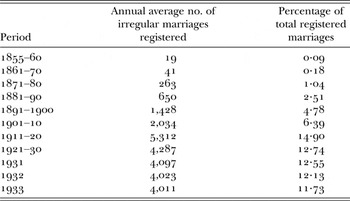
We can get some indication of the prevalence of non-registered unions from the dramatic increase in registered irregular marriages during the First World War.
Table 1 significantly underestimates the incidence of irregular marriage in the war years and in the cities. During the war, the figure peaked at 20·5 per cent of all marriages, although this masked the fact that in the major cities the figure was considerably higher.Footnote 52 For example, in 1915 the proportion of irregular marriages in St Giles, the busiest district of Edinburgh, was greater than regular marriage.Footnote 53 Although the incidence of irregular marriages registered peaked during the war, the proportion of these marriages in the post-war years in the two largest cities, Glasgow and Edinburgh, years fluctuated between approximately one fifth and one quarter of all marriages.Footnote 54 An obvious explanation for the increase during the war was the advantage of having to give no notice for an irregular marriage. Irregular marriage had an obvious attraction over regular marriage when numbers of men were leaving for the front and couples wanted to avoid the lengthy and time-consuming procedures required for a regular marriage ceremony.
Irregular marriage in Scotland

Source : Morison Report, evidence of Andrew Froude, registrar general for Scotland.
Yet speed was not the only factor accounting for the soaring incidence of registered irregular marriages. For this assumes that those who were registering their marriages were courting couples who were motivated by romantic reasons and wanted to tie the marital knot before their partners set off for the front. Robert Ramsay, the director of public assistance in Glasgow, was convinced that the steep decline in the number of cases of cohabitation and unregistered irregular marriages and the concomitant increase in registered regular marriages amongst Poor Law applicants was a direct consequence of the introduction of state benefits to the wives and widows of soldiers.Footnote 55 One of the key issues was that before paying out allowances, the authorities dealing with claims required proof that the union was legally valid. Ramsay's observations were echoed in an article in The Scotsman which reported that there had been a brisk business in marriages ‘before the Sheriff’ since the outbreak of war as couples required proof to make a claim for separation allowance.Footnote 56 The article claimed that a number of couples who had lived together as husband and wife had registered their irregular union when the husband joined the army so that they could obtain the separation allowance.Footnote 57
It is plausible therefore to argue that many of those who registered their marriages during the war and in subsequent years were couples who had cohabited, and who were prompted to register their informal union because of the financial benefits of registration. As T. C. Smout succinctly observed, the extension of the state's role in the provision of welfare and the need to establish proof of marriage in order to gain access to these benefits ‘increased convenience in the married state: it literally made respectability pay’.Footnote 58
We have no way of knowing the precise incidence of informal unions which can only remain a ‘dark figure’. However, this kind of evidence suggests that irregular unions were common before the First World War and that the small number of registered irregular marriages was only a fraction of those couples whose union did not conform to a regular marriage. The introduction of widow's pension and the soldiers' separation allowance and the extension of the state's role in the provision of benefits and public housing after the war were to accelerate the trend for couples to register an irregular marriage as registration became more financially advantageous.
This interpretation coincides with the view of Robert Ramsay who argued in his evidence to the Morison Committee that by the inter-war period cohabitation was on the decrease and occurred mainly where there was a bar to marriage such as differences in religion, one partner being divorced, or one or both partners already having a spouse.Footnote 59 Of the 66,000 cases on Glasgow's outdoor roll in 1936, there were 282 cohabiting couples and of these 246 were unable to marry, because they were already married, separated, or had been deserted.Footnote 60 Only in thirty-six cases were there no obvious barriers to marriage and the fact that the highest number was in the age range 61–70 suggested to Ramsay that it was a declining phenomenon. Of course, these figures underestimate the numbers cohabiting amongst claimants since there was a long-standing reluctance of Poor Law officials to support those ‘living in sin’. Moreover, there would have been more likelihood of elderly cohabitees being supported and younger claimants being refused benefit.
The records of the Criminal Prosecutions for Desertion for Glasgow lend some credence to the interpretation that the main reason for couples cohabiting was legal barriers to marriage. Of 604 cases prosecuted in the years 1910, 1920, 1930, and 1940, there were 94 instances of cohabitation and in 84 of these one of the parties was already married.Footnote 61 What is noteworthy is that those officials who remarked on the incidence of cohabitation did not usually attribute it to lax morals or the lack of a desire to be married but to financial, legal, and religious impediments which prevented couples marrying.Footnote 62 The representative of the Church of Scotland which gave evidence to the RCDMC was adamant that the cost of divorce was a major barrier to couples from poorer backgrounds seeking a divorce:
There are hundreds of poor persons irrevocably tied to the most profligate, wanton, and degraded spouse, simply because they cannot, and have no prospect of ever being able to gather together the sum of £10 to get their legal remedy. To numbers such as this, the cost might as well be put down at £1000, for all the liklihood [sic] there is of their ever being able to secure it.Footnote 63
Although Scotland's divorce laws were more liberal than England's and most European countries in that divorce had been available on equal grounds for men and women for adultery and desertion since the abolition of papal law in 1560, there still existed significant financial, social, and legal barriers to divorce which made it relatively rare. For example, in 1900 only 151 people sued for divorce in Scotland and whilst this figure increased in the first decades of the twentieth century, it never reached 1,000 before the Second World War.Footnote 64 Although divorce was cheaper in Scotland than in England, cost was still a factor for those with limited finances.
In Scotland, an uncontested action cost between £10 and £30.Footnote 65 However, the final cost varied according to the length of the trial, the number of witnesses, etc. Since divorce cases could be heard only in Edinburgh, this added to the cost for those who had to travel and take time off work. Social stigma was also an important impediment but even those who were willing to risk social opprobrium and seek divorce through the courts had to contend with limited grounds, the necessity of witnesses for some grounds and consent of the partner in others.
As late as 1970, when grounds had already been extended to include cruelty, fairly broadly defined, there were still factors preventing people obtaining a divorce. A firm of Scottish solicitors wrote to the secretary of state for Scotland urging Scotland to adopt the 1969 revision to the Divorce Law in England as this would allow many people who cohabited to marry:
We beg to write to you concerning the Laws of Divorce in Scotland [sic] which we see were brought before the House of Commons on 27th ult. by Mr Donald Dewar, Member of Parliament for Aberdeen South, and we would urge that a revision of the Law of Scotland should be made as quickly as possible, particularly in view of the recent revision of the Law of Divorce [sic] in England which is causing an obvious anomaly.
We would submit that if parties have not lived together or been on friendly relationship [terms] with one another for at least five years, legal procedure should be available to regularize the de facto position. As it is, many people shift to other parts of the country and live together as husband and wife although they are not married. This comes to light from time to time with great embarrassment to the parties concerned and hardship to any children of the association. One case which is common is where a man applies for a Council house and the embarrassing facts regarding his relationship with his so-called wife are revealed. This the writer can speak [about] from his own personal knowledge in his capacity as Town Clerk of this town. We would therefore urge that something should now be done to alleviate these matters.Footnote 66
Of course, there were couples who chose to cohabit even when there were no barriers to marriage, as is evident from poor law applications. Despite attempts by the authorities to police social behaviour by making relief dependent on complying with ‘respectability’, they were not always successful. Euphemia Legget aged thirty-three had cohabited with Joseph Keenan for a number of years and had two children by him. In 1927, she was awarded interim outdoor relief for two weeks and at the end of that time was told ‘to have all arrangements completed to be married’. When she was visited at her house two months later, she was found with Keenan but still not married and, according to the poor law inspector, they ‘seem to have no intentions of getting married’.Footnote 67
The Church of Scotland representative who gave evidence to the RCDMC claimed that it was often the men who were reluctant to take the step into matrimony and cited the case of a young woman who had just given birth and was cohabiting:
we told her that unless she got married, we could not allow her to keep the child. On this being represented to the man, he at once arranged for the marriage to be arranged by the Sheriff. A day or two later, the woman called to thank and thanked us for our intervention, and expressed her pleasure at being at last a married woman. Immediately after, another woman, an acquaintance of the last one called, and asked us to try to get the man she was living with to marry her.Footnote 68
In all probability the alacrity with which the couple married came from the threat to take away the child rather than a burning desire for matrimony. However, the woman may also have been telling the official what he wanted to hear. If there was a desire to be legally married rather than cohabit on the part of these two women, there is no way of knowing whether they were typical of female cohabitees.
The unique position of Scotland in Western Europe in regard to the legal recognition of irregular marriage belied a similarity in the interpretation of what constituted a legally valid marriage and parallels in the treatment of cohabitation. In practice, irregular marriage was narrowly defined as registered irregular marriage. In the absence of civil marriage in Scotland until 1939, the procedures for registered irregular marriages were in many ways similar to those required for civil marriage in England, although shorn of the necessity of notice. Therefore, the introduction of civil marriage by the Marriage (Scotland) Act 1939 might be more appropriately viewed as regularizing registered irregular marriage rather than introducing a completely novel practice.Footnote 69 Officials and the law applied similarly stringent definitions to marriage by cohabitation with habit and repute. Cohabitation, even when couples regarded themselves as married, was often treated as concubinage and regarded as morally reprehensible, although unlike in Germany and some American states, it was not a criminal offence.Footnote 70
There may have been a censorious attitude to cohabitation but the authorities could demonstrate pragmatism rather than rigid adherence to the letter of the law when it came to claims for benefit, compensation, and insurance. Local and state officials could sometimes be tolerant of such unions provided it was established that the relationship was long-standing. The government's willingness to extend separation allowance to the partners of unmarried soldiers during the First World War is illustrative of this flexibility. On occasions, even cash-strapped Poor Law Boards were willing to recognize informal unions for the purposes of relief, even when the law had been broken and the marriage was bigamous. This was similar to the practices of other countries such as England and many American states, although it is possible that other European countries, in addition to Germany, may have adopted a more punitive regime.Footnote 71 The recognition of irregular marriage by promise subsequente copula meant that Scottish authorities adopted a more tolerant attitude to a woman who had a child by a man and then claimed to be married to him. Although it required raising a declaratory in the Court of Session if disputed by the man, this form of union was sometimes recognized as a means of protecting the rights of ‘vulnerable’ women and avoiding the stigma of illegitimacy.Footnote 72
The incidence and the pattern of registered irregular marriage is easily established from the Reports of the Registrar General's Office. However, it is impossible to quantify with any degree of accuracy the incidence of cohabitation, given the absence of reliable statistics. The figures which do exist are speculative, fragmentary, and piecemeal. Nonetheless, it is possible to infer from contextual evidence that cohabitation was not infrequent amongst working-class communities. The financial, legal, religious, and bureaucratic barriers to regular marriage were considerable for much of the nineteenth and early twentieth centuries, and there was an absence of positive inducements to marry, other than social acceptance and religious conviction.Footnote 73 Urbanization, increasing mobility, economic and social changes, and the weakening of church control over local communities that began in the late eighteenth century and accelerated in the course of the nineteenth century created more space for both religious and moral nonconformity that often translated into the formation of irregular unions. This is not to suggest that there existed an extensive counter culture in opposition to the dominant discourse of religious monogamous marriage. However, it seems likely that informal unions were common amongst working-class communities, although by no means the norm.
The introduction of state welfare and public provision of services which began in the late nineteenth and early twentieth centuries and accelerated during and after the First World War, and which were often dependent on proof of a legally valid marriage, provided compelling incentives to marry. Coupled with the removal of some of the legal and religious restrictions that hedged regular marriage, it would seem likely that these pull factors made formal unions a more attractive option, either by registering an irregular marriage or choosing a regular marriage ceremony. Therefore, the apparatus to either enforce or encourage regular marriage ensured that during the interwar period, dominant ideals of monogamous marriage and popular practice were more likely to coincide. However, the barriers to divorce that persisted until the Divorce (Scotland) Act 1976 ensured that cohabitation remained the only option for many couples. The evidence of a variety of official and semi-official reports suggests that in the majority of cases couples cohabited because they were unable to marry for legal, religious, or financial reasons. Therefore, whilst popular views of marriage corresponded broadly with establishment views in theory, in practice people were willing to breach moral codes where they stood in the way of personal happiness. The willingness of neighbours and relatives to testify that they thought of cohabiting couples as husbands and wives suggests that they could be flexible and sympathetic to ‘immoral’ behaviour in circumstances where the law was perceived as rigid and inflexible. Local and community norms did sometimes diverge from the dominant discourse of monogamous stable regular marriage as the foundation of family life. However, the basis of divergence was often rooted in a practical accommodation and negotiation of official discourses rather than representing a concerted challenge to the hegemony of regular marriage.