


Introduction
The transmission of parasites from one host to the next is often temperature-dependent (Rohr et al. Reference Rohr, Dobson, Johnson, Kilpatrick, Paull, Raffel, Ruiz-Moreno and Thomas2011). This has been particularly well studied in trematode cercariae, the free-living infective stages between first and second intermediate hosts. An increase in temperature usually leads to an elevated release of cercariae from first intermediate hosts and a higher infectivity in second intermediate hosts (Morley and Lewis Reference Morley and Lewis2015; Poulin Reference Poulin2006). However, cercarial survival usually decreases with increasing temperature due to a faster depletion of the finite energy reserves of cercariae in the form of glycogen (Pechenik and Fried Reference Pechenik and Fried1995). The typical experimental approach to study temperature effects on cercarial stages is the exposure to different levels of constant temperature treatments (e.g. Koprivnikar and Poulin Reference Koprivnikar and Poulin2009; Studer et al. Reference Studer, Thieltges and Poulin2010). While this approach can be informative about the general thermal biology of cercariae (Morley Reference Morley2011; Morley and Lewis, Reference Morley and Lewis2013, Reference Morley and Lewis2015), it does not reflect short-term heat stress in the form of pulse warming such as heatwaves, which are becoming more frequent with climate change (Claar and Wood Reference Claar and Wood2020). Warming rates during heatwaves can be very rapid in habitats such as shallow pools in freshwater systems or intertidal habitats during low tide (Desforges et al. Reference Desforges, Birnie-Gauvin, Jutfelt, Gilmour, Eliason, Dressler, McKenzie, Bates, Lawrence, Fangue and Cooke2023; Helmuth Reference Helmuth1998; Jolma et al. Reference Jolma, van Leeuwen and Thieltges2026). During these rapid warming events, temperatures may potentially reach or exceed the upper thermal limits of cercarial stages. However, while upper thermal limits have been extensively studied in free-living species (e.g. Cereja Reference Cereja2020; Raby et al. Reference Raby, Morgan, Andreassen, Stewart, De Bonville, Hoots, Kuchenmüller, Metz, Rowsey, Green, Griffin, Martin, Reid, Ern, Åsheim, Cowan, Leeuwis, Blewett, Speers-Roesch, Clark, Binning, Sundin and Jutfelt2025), they have rarely been investigated in parasites.
Here, we use the critical thermal maximum approach (CTmax) to study the acute thermal limits of the cercarial stages of three marine trematode species. In this approach, organisms are experimentally exposed to a gradual temperature ramping (rather than constant temperature treatments) until a sublethal endpoint is reached, at which motor control is lost (loss of equilibrium, Becker and Genoway Reference Becker and Genoway1979; Desforges et al. Reference Desforges, Birnie-Gauvin, Jutfelt, Gilmour, Eliason, Dressler, McKenzie, Bates, Lawrence, Fangue and Cooke2023; Raby et al. Reference Raby, Morgan, Andreassen, Stewart, De Bonville, Hoots, Kuchenmüller, Metz, Rowsey, Green, Griffin, Martin, Reid, Ern, Åsheim, Cowan, Leeuwis, Blewett, Speers-Roesch, Clark, Binning, Sundin and Jutfelt2025). This approach can inform about short-term pulse warming effects but can also be used more generally as an indicator of the thermal limits of organisms and for comparisons among species (Bates and Morley Reference Bates and Morley2020). In habitats where temperature can rise rapidly during heatwaves, the temperature ramping approach may also realistically reflect the situation in the field (Desforges et al. Reference Desforges, Birnie-Gauvin, Jutfelt, Gilmour, Eliason, Dressler, McKenzie, Bates, Lawrence, Fangue and Cooke2023). The three trematode species studied here use the common periwinkle Littorina littorea as their first intermediate host. This host species is very common in the intertidal zone of our study area and lives on hard substrate structures such as dykes and mixed mussel and oyster beds. When the latter are exposed during low tide, temperature can increase very rapidly (>20°C h−1 in extreme cases) during heatwaves and reach up to 36°C (Jolma et al. Reference Jolma, van Leeuwen and Thieltges2026). By exposing cercariae to a temperature ramping rate similar to that observed in the field, we determined the acute temperature limits of cercariae of Cryptocotyle lingua, Himasthla elongata, and Renicola parvicaudatus (previously R. roscovita). The first species uses fish, while the latter two species use bivalves as second intermediate hosts; all three species use birds as definitive hosts (Werding Reference Werding1969). The aim of our study was to investigate whether the acute thermal limits of the three species might be exceeded during heatwaves and whether these differ among the three trematode species.
Materials and methods
Cercariae from three trematode species (Cryptocotyle lingua, Himasthla elongata, and Renicola parvicaudatus (previously R. roscovita)) originated from a stock of infected snails collected in Mokbaai, Texel, in November 2023 and were maintained in aquaria in a climate chamber at 15°C. For the experiment in September 2024, 43 snails (n = 16 for C. lingua, n = 14 for H. elongata, and n = 13 for R. parvicaudatus) were placed individually into 6-well plates with filtered seawater and kept in an incubator at 23–25°C for up to 180 minutes to induce shedding of the parasites. Every 30 minutes, the wells were checked for free-swimming cercariae and in total 48 cercariae of H. elongata and R. parvicaudatus (3–6 cercariae per snail, depending on shedding rates) were collected and individually pipetted into 24-well plates (n = 4 plates) filled with 2 mL of freshly filtered seawater. As the cercariae of C. lingua were prone to losing their delicate tails during the experiment, either during pipetting or as a stress response to the heating itself, which critically injured them, a larger number (n = 52) of cercariae of this species (1–6 cercariae per snail, depending on shedding rates) were used in the assay (n = 6 plates). All cercariae were acclimated to 16°C for 30 minutes before the experiment started.
The temperature ramping assay was conducted by increasing the temperature of an incubator (VEVOR Digital Thermoelectric Incubator) by 6°C per hour in steps of 2°C every 20 minutes, starting at 16°C. The temperature inside the cabinet was logged by loggers placed next to the well plates (Electric Blue EnvLogger T7.3). Every 20 minutes, the well plates were briefly removed from the incubator and observed under a microscope to record the status of the cercariae as either active (cercariae moving, i.e., actively swimming or crawling on the well bottom) or non-active (cercariae sunken to the bottom of the well and not moving, even after probing with a metal dissection needle). The temperature at which cercariae became non-active was recorded as critical maximum temperature (CTmax). To control for the capacity of the cercarial glycogen storage during each run, three cercariae of each species were kept at 16°C for the length of the assay (approx. 7 hours) and their activity was tested at the end.
Data analysis was conducted in R 4.3.2. using RStudio (R Core Team, 2023). Linear mixed models including snail identity and plate as random effects were used to compare the CTmax of the different species, using the package nlme for statistical analysis (Pinheiro et al. Reference Pinheiro and Bates2025). The package ggplot2 was used for visualization (Wickham Reference Wickham2016). All raw data are available in a public data repository (Zenke et al. Reference Zenke, Jolma, Born-Torrijos and Thieltges2026).
Results and discussion
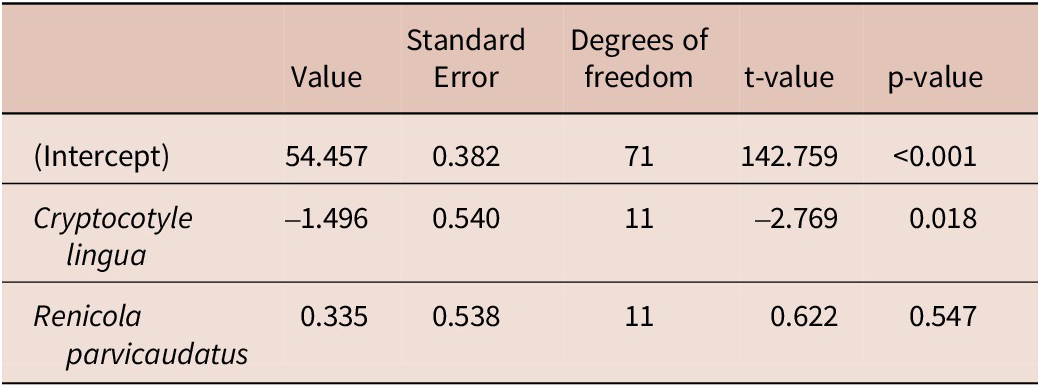
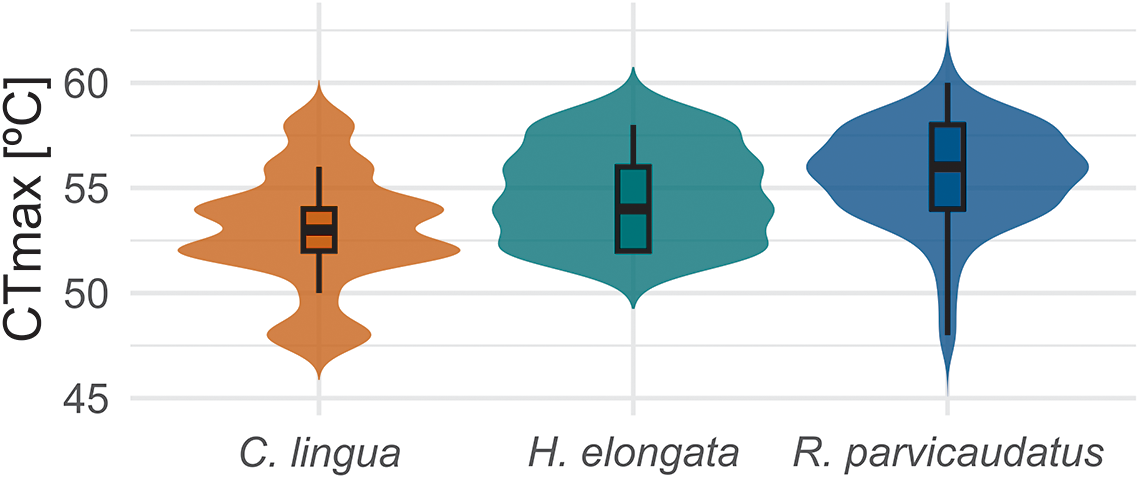
Due to tail loss, 32 cercariae of C. lingua had to be excluded from the analysis and three cercariae of R. parvicaudatus were unexpectedly lost, resulting in critical maximum temperature (CTmax) values being obtained for 24 C. lingua, 48 H. elongata, and 45 R. parvicaudatus cercariae. While the mean CTmax of R. parvicaudatus (mean ± SE (standard error): 54.8°C ± 0.54) and H. elongata (54.5°C ± 0.38) were similar, C. lingua (53.0°C ± 0.54) showed a significantly lower critical temperature (p <0.05) than the other two species (Table 1; Figure 1). All cercariae that were kept at 16°C remained active until the end of the experiment.
Linear mixed model output with the mean CTmax per species

Table 1. Long description
The table consists of six columns: Parameter, Value, Standard Error, Degrees of freedom, t-value, and p-value.
* The first row is the Intercept, representing the species Himasthla elongata, with a Value of 54.457, Standard Error of 0.382, 71 Degrees of freedom, t-value of 142.759, and p-value less than 0.001.
* The second row is Cryptocotyle lingua, with a Value of minus 1.496, Standard Error of 0.540, 11 Degrees of freedom, t-value of minus 2.769, and p-value of 0.018.
* The third row is Renicola parvicaudatus, with a Value of 0.335, Standard Error of 0.538, 11 Degrees of freedom, t-value of 0.622, and p-value of 0.547.
The intercept is the trematode species Himasthla elongata.
Violin boxplots showing critical maximum temperatures (CTmax) of cercariae of three trematode species. N = 24 for Cryptocotyle lingua, 48 for Himasthla elongata, and 45 for Renicola parvicaudatus.

Figure 1. Long description
A vertical violin plot with internal boxplots. The Y-axis is labeled C T max degrees Celsius, ranging from 45 to 60 in increments of 5. The X-axis lists three species from left to right.
* C dot lingua (orange): The distribution is centered around 53 degrees Celsius. The boxplot shows a median near 53, with the interquartile range between 52 and 54. The violin shape is widest at 54 and has a secondary bulb at 48.
* H dot elongata (teal): The distribution is slightly higher than the first species. The median is approximately 54 degrees Celsius, with the box spanning from 52 to 56. The violin is widest between 53 and 56.
* R dot parvicaudatus (blue): This species shows the highest thermal tolerance. The median is approximately 56 degrees Celsius, with the box spanning from 54 to 58. The violin shape is widest at 56 and tapers significantly toward 46.
The CTmax values recorded for all three trematode species in our experiment (53.0 to 54.8°C) were much higher than the temperature extremes observed during heatwaves in typical habitats of their first intermediate gastropod host, such as mixed oyster and mussel beds. In particular, in our study area, temperatures can reach up to 36°C during low tide in the tide pools on these beds (Jolma et al. Reference Jolma, van Leeuwen and Thieltges2026). Such tide pools can be hot spots of infections for trematode cercariae as the remaining water volume during low tide is small, increasing the exposure of second intermediate hosts to infective cercarial stages. Although the increased temperature of these pools during heatwaves could compromise the survival of cercariae, our experiment based on realistic temperature ramping suggests that the acute thermal limits of the three trematode species are not exceeded during typical temperature extremes experienced during heatwaves in our study area.
In contrast to the cercarial stages, the thermal limit of their first intermediate host, the periwinkle Littorina littorea, is much lower, at about 30°C (determined in snails collected from the field with unknown infection status; Clarke et al. Reference Clarke, Mill and Grahame2000). This is in line with experimental studies based on constant temperature treatments, which showed that the survival of L. littorea infected with H. elongata strongly declined above 28°C, suggesting an increased mortality of infected periwinkles (Díaz-Morales et al. Reference Díaz-Morales, Bommarito, Vajedsamiei, Grabner, Rilov, Wahl and Sures2022). Given the similar CTmax values of the three trematode species and their competence in having a higher thermal limit than that naturally reached in tide pools, it is thus likely that heatwaves may generally have stronger negative effects on parasites indirectly via increased first intermediate host mortality rather than directly via effects on cercarial survival.
Although the CTmax values of the three trematode species were very similar, we found significant differences among the three species. As a general rule, thermal limits are often higher in smaller organisms, likely due to higher metabolic rates or more efficient surface-to-volume ratios allowing for a faster acclimation compared to larger individuals (Cohen et al. Reference Cohen, Venesky, Sauer, Civitello, McMahon, Roznik and Rohr2017; Rohr et al. Reference Rohr, Civitello, Cohen, Roznik, Sinervo and Dell2018). Likewise, in our experiment, the species with the smallest cercaria, R. parvicaudatus (body and tail length: 240 μm, 148 μm; Werding Reference Werding1969), had the highest CTmax (54.8°C) compared to the larger species H. elongata (54.5°C, 632 μm, 577 μm; Werding Reference Werding1969) and C. lingua (53.0°C, 232 μm, 389 μm; Werding Reference Werding1969). However, in contrast to the expectation, the largest species (H. elongata) did not have a lower CTmax than the intermediate-sized species (C. lingua). Hence, the underlying mechanisms of the subtle but significant differences among the three species remain unclear. It also remains to be determined why the CTmax values of the three trematode species were generally higher than those of free-living species, which are usually well below 40°C in temperate species (Cereja Reference Cereja2020). Heat shock proteins may play a role, as they are known to be important in parasite-host interactions, sometimes leading to a high CTmax as a side effect (He et al. Reference He, Sun, Yang, Zheng, Li, Liu, Li, D-H and Zheng2023; Polla Reference Polla1991). It is also possible that the high CTmax values are, at least in part, methodological artefacts. The temperature loggers placed in the cabinet confirmed the temperature ramping, with variations of less than 1°C, and due to the small water volumes in the wells (2 mL) their temperature was presumably tightly following the cabinet temperature. However, it is possible that the short removal from the cabinet for observations led to a slight decrease in temperature in the wells. In addition, for the CTmax determination, the temperature at the end of a 20-minute 2°C ramping interval was used, while some individuals may have lost their mobility already at the beginning of the interval and thus at a 2°C lower temperature. This suggests that the actual CTmax of the three species may be a few degrees lower. While a potential overestimation of the CTmax does not compromise the main conclusions of our study, more precise temperature measurements would be desirable for comparisons among different studies.
Given its straightforward methodology and its potential for standardized comparisons of thermal limits among species and ecosystems (e.g., Ruthsatz et al. Reference Ruthsatz, Dahlke, Alter, Wohlrab, Eterovick, Lyra, Gippner, Cooke and Peck2024), the CTmax approach holds promise for ecological research on the thermal biology of parasites. Detailed recommendations on increasing the comparability of thermal limit measurements exist from studies on free-living species (e.g., Desforges et al. Reference Desforges, Birnie-Gauvin, Jutfelt, Gilmour, Eliason, Dressler, McKenzie, Bates, Lawrence, Fangue and Cooke2023, Raby et al. Reference Raby, Morgan, Andreassen, Stewart, De Bonville, Hoots, Kuchenmüller, Metz, Rowsey, Green, Griffin, Martin, Reid, Ern, Åsheim, Cowan, Leeuwis, Blewett, Speers-Roesch, Clark, Binning, Sundin and Jutfelt2025) and can easily be adjusted for parasitological research. As in free-living species, the approach may be useful for a variety of research questions, such as identifying the sensitivity of parasites to short-term thermal stress on small scales and exploring how thermal tolerances drive current and future distributions of parasites on larger scales.
Acknowledgements
We thank the two reviewers for their constructive comments.
Financial support
Financial support for the contribution of Ana Born-Torrijos was provided by the European Union’s Horizon 2020 Research and Innovation Programme under the Marie Skłodowska-Curie grant agreement No 101027941. Open access funding provided by University of Groningen.
Competing interests
The authors declare none.
Data availability statement
All raw data are available in https://data.4tu.nl/datasets/187e1f6a-8152-415f-8ff3-4ca9f15bb058 (Zenke et al. Reference Zenke, Jolma, Born-Torrijos and Thieltges2026).

 Open access

