Introduction
Suicide is a major cause of preventable death worldwide (Crosby et al. Reference Crosby, Han, Ortega, Parks and Gfroerer2011; Aleman & Denys, Reference Aleman and Denys2014) and deaths from suicide currently exceed deaths from motor vehicle accidents and homicide in the United States (Rockett et al. Reference Rockett, Regier, Kapusta, Coben, Miller, Hanzlick, Todd, Sattin, Kennedy, Kleinig and Smith2012). Rates of completed suicide have been increasing over the past decade, and research focused on suicide prevention and treatment development for suicidal thinking and behavior has been comparatively limited (Aleman & Denys, Reference Aleman and Denys2014). It is estimated that 90% of individuals who commit suicide suffer from a diagnosable psychiatric disorder (Cavanagh et al. Reference Cavanagh, Carson, Sharpe and Lawrie2003), most commonly major depressive disorder (MDD); however, the majority of individuals with MDD or other psychiatric disorders do not engage in suicidal behavior (Mann, Reference Mann2003, Reference Mann2005).
The treatment of MDD in suicidal patients with antidepressant medication is standard of care, although clear evidence supporting the anti-suicidal properties of conventional antidepressant agents is lacking (Griffiths et al. Reference Griffiths, Zarate and Rasimas2014). Lithium has demonstrated a unique protective effect against suicidality in mood disorders over time, but not acutely (Cipriani et al. Reference Cipriani, Hawton, Stockton and Geddes2013). Familial studies suggest that transmission of a diathesis towards suicide risk may be distinct from transmission of vulnerability towards mood disorders (Brent & Melhem, Reference Brent and Melhem2008). These data encourage a specific research focus on mechanisms of suicidal behavior and treatment development to prevent suicide, independent of co-occurring mental illness.
The glutamate N-methyl-d-aspartate (NMDA) receptor antagonist ketamine has shown rapid antidepressant effects (e.g. within 24 h) in patients with treatment-resistant MDD (TRD) (Zarate et al. Reference Zarate, Singh, Carlson, Brutsche, Ameli, Luckenbaugh, Charney and Manji2006; Mathew et al. Reference Mathew, Shah, Lapidus, Clark, Jarun, Ostermeyer and Murrough2012; Murrough, Reference Murrough2012; Murrough et al. Reference Murrough, Iosifescu, Chang, Al Jurdi, Green, Perez, Iqbal, Pillemer, Foulkes, Shah, Charney and Mathew2013a , Reference Murrough, Perez, Pillemer, Stern, Parides, aan het Rot, Collins, Mathew, Charney and Iosifescu b , Lapidus et al. Reference Lapidus, Levitch, Perez, Brallier, Parides, Soleimani, Feder, Iosifescu, Charney and Murrough2014; Wan et al. Reference Wan, Levitch, Perez, Brallier, Iosifescu, Chang, Foulkes, Mathew, Charney and Murrough2014) and bipolar depression (Diazgranados et al. Reference Diazgranados, Ibrahim, Brutsche, Ameli, Henter, Luckenbaugh, Machado-Vieira and Zarate2010a , Reference Diazgranados, Ibrahim, Brutsche, Newberg, Kronstein, Khalife, Kammerer, Quezado, Luckenbaugh, Salvadore, Machado-Vieira, Manji and Zarate b , Zarate et al. Reference Zarate, Brutsche, Ibrahim, Franco-Chaves, Diazgranados, Cravchik, Selter, Marquardt, Liberty and Luckenbaugh2012). Ketamine's rapid onset of therapeutic action makes it a potentially attractive therapeutic candidate for patients who require rapid treatment for suicidal thinking. Post-hoc analyses of ketamine studies in mood disorders provide initial support for the anti-suicidal ideation (SI) effects of ketamine (Price et al. Reference Price, Nock, Charney and Mathew2009, Reference Price, Iosifescu, Murrough, Chang, Al Jurdi, Iqbal, Soleimani, Charney, Foulkes and Mathew2014; DiazGranados et al. Reference Diazgranados, Ibrahim, Brutsche, Ameli, Henter, Luckenbaugh, Machado-Vieira and Zarate2010a , Reference Diazgranados, Ibrahim, Brutsche, Newberg, Kronstein, Khalife, Kammerer, Quezado, Luckenbaugh, Salvadore, Machado-Vieira, Manji and Zarate b ; Ballard et al. Reference Ballard, Ionescu, Vande Voort, Niciu, Richards, Luckenbaugh, Brutsche, Ameli, Furey and Zarate2014) and a single open-label proof of concept study of ketamine conducted in an emergency department setting demonstrated that a single intravenous (i.v.) administration of ketamine reduced the intensity of SI for up to 10 days (Larkin & Beautrais, Reference Larkin and Beautrais2011).
The current study was designed to assess the rapid effects of ketamine on SI in patients who presented for inpatient or outpatient treatment with clinically significant SI in the context of a range of psychiatric disorders. Patients were randomized to receive a single i.v. treatment of ketamine or the anesthetic benzodiazepine agent midazolam as a control condition in addition to standard of care. Severity of SI 24 h following treatment represented the primary study outcome.
Method
Study design and participants
In this single-site, randomized controlled trial (RCT), study participants were recruited through the inpatient psychiatric service or through an academic outpatient psychiatric clinic. Study inclusion was initially restricted to inpatients; the protocol was subsequently amended to allow outpatients in order to enhance study feasibility and generalizability. Men and women aged between 18 and 80 years with current clinically significant SI, operationalized as a score of ⩾4 on the suicide item of the Montgomery–Asberg Depression Rating Scale (MADRS-SI; range 0–6) (Montgomery & Asberg, Reference Montgomery and Asberg1979) at the time of screening, were eligible to participate. Outpatients were excluded if they experienced current intent to make a suicide attempt as reflected by a SI score on the Columbia Suicide Severity Scale (C-SSRS; Posner et al. Reference Posner, Oquendo, Gould, Stanley and Davies2007) of 4 or 5. Psychiatric co-morbidity was assessed using the MINI Interview (Sheehan et al. Reference Sheehan, Lecrubier, Sheehan, Amorim, Janavs, Weiller, Hergueta, Baker and Dunbar1998) and by review of available medical records. Exclusion criteria included a lifetime history of schizophrenia or other primary psychotic disorder, current psychotic or manic symptoms, substance use disorder within 1 month of screening, a positive urine toxicology at screening, any lifetime abuse of ketamine or phencyclidine, or any unstable medical illness. Physical examination, vital signs, weight, electrocardiogram, standard blood tests, and urinalysis confirmed absence of unstable medical illnesses. Women of childbearing potential were required to have a negative pregnancy test before enrollment and immediately before treatment. Participants were allowed to remain on stable doses of psychotropic medication, including antidepressant agents. All study treatments were performed at Mount Sinai Hospital between April 2012 and June 2014. The Icahn School of Medicine at Mount Sinai Institutional Review Board approved the study, and written informed consent was obtained from all subjects prior to participation. The authors assert that all procedures contributing to this work comply with the ethical standards of the relevant national and institutional committees on human experimentation and with the Helsinki Declaration of 1975, as revised in 2008. The study is registered at http://clinicaltrials.gov (NCT01507181).
Prior to treatment, SI was measured at screening and again on the morning of the intervention. The treatment day morning measurement assessed symptom severity during the preceding 24 h and functioned as the study baseline. Eligible participants received 0.5 mg/kg racemic ketamine hydrochloride or 0.045 mg/kg i.v. midazolam over 40 min by infusion pump under double-blind conditions. The randomization scheme was generated by the research pharmacy using permuted blocks of size six and all study investigators, anesthesiologists, and raters were blind to treatment assignment. An anesthesiologist was present for the duration of study drug infusion and patients were monitored for at least 1 h following infusion, including monitoring of vital signs (i.e. heart rate, blood pressure, and respiration). Subjects were assessed at 24, 48, 72 h and 7 days post-treatment.
Outcomes
The primary efficacy outcome was SI severity at 24 h post-treatment measured by the 21-item self-report Beck Scale for Suicidal Ideation (BSI; score range 0–42) (Beck et al. Reference Beck, Steer and Ranieri1988). The BSI asks patients to select one statement out of three for each question that best describes how he/she has been feeling during the specified interval. Constructs including wish to live, wish to die and active and passive suicidal desire are assessed. The suicidality item of the MADRS (MADRS-SI) was specified as the secondary measure of suicidality in the study. The MADRS-SI ranges from 0 to 6; a score of 2 corresponds to fleeting, passive SI; a score of 4 indicates that SI is frequent with at least moderate intensity but without specific plans or intention; a score of 6 corresponds to active intention and planning for suicide. Additional secondary outcomes included depression severity measured using the MADRS total score and the Quick Inventory of Depressive Symptomatology – Self Report (QIDS-SR; Rush et al. Reference Rush, Trivedi, Ibrahim, Carmody, Arnow, Klein, Markowitz, Ninan, Kornstein, Manber, Thase, Kocsis and Keller2003) and symptoms associated with SI measured using the Concise Health Risk Tracking Module (CHRT; Trivedi et al. Reference Trivedi, Wisniewski, Morris, Fava, Gollan, Warden, Nierenberg, Gaynes, Husain, Luther, Zisook and Rush2011a ) and the Concise Associated Symptoms Tracking (CAST) scale (Trivedi et al. Reference Trivedi, Wisniewski, Morris, Fava, Kurian, Gollan, Nierenberg, Warden, Gaynes, Luther and Rush2011b ). The CAST consists of 5 subscales designed to measure symptom domains associated with SI: irritability, anxiety, mania, insomnia, and panic.
Safety and tolerability were assessed using a 7-item subscale of the Brief Psychiatric Rating Scale (BPRS) assessing psychotic symptoms (Overall et al. Reference Overall, Gorham and Shawver1961), the Clinician-Administered Dissociative States Scale (CADSS; Bremner et al. Reference Bremner, Krystal, Putnam, Southwick, Marmar, Charney and Mazure1998), the mood item of the Young Mania Rating Scale (YMRS; Young et al. Reference Young, Biggs, Ziegler and Meyer1978), the Patient Rated Inventory of Side Effects (PRISE; Rush et al. Reference Rush, Fava, Wisniewski, Lavori, Trivedi, Sackeim, Thase, Nierenberg, Quitkin, Kashner, Kupfer, Rosenbaum, Alpert, Stewart, McGrath, Biggs, Shores-Wilson, Lebowitz, Ritz and Niederehe2004) and the C-SSRS. For additional safety monitoring, weekly phone calls were conducted by a study physician for up to 4 weeks following the end of the 7-day primary assessment period.
Statistical analyses
Baseline participant characteristics, safety and tolerability data were analyzed using descriptive statistics and t tests or χ2 as appropriate. The intention-to-treat sample included all participants who were randomized and completed at least one post-treatment assessment. SI severity at 24, 48, 72 h and 7 days post-treatment were compared between the treatment groups using separate analysis of covariance (ANCOVA) models, controlling for baseline SI level. Separate models were used to examine the effect of treatment on SI as measured using the BSI and the MADRS-SI and the effect of treatment on general depression severity as measured using MADRS and QIDS-SR total score. For models demonstrating a significant effect of treatment on outcome, the influence of setting (outpatient v. inpatient) was examined in follow-up analyses that modeled main effects of setting on outcome and interactions between setting and treatment. Additional secondary outcomes were analyzed in a similar manner. No correction was performed for multiplicity, as appropriate for early proof of concept studies. Sample size was based primarily on feasibility; we estimated 80% power to detect a standardized effect size of 1.2 assuming a two-tailed test and alpha set at 0.05 based on Zarate et al. (Reference Zarate, Singh, Carlson, Brutsche, Ameli, Luckenbaugh, Charney and Manji2006).
Treatment effects are quantified as mean differences between groups and associated effect sizes are based on standardized mean difference (Cohen's d). All statistical tests were two-sided with an alpha set at 0.05. All analyses were performed using SPSS v. 20 (SPSS Inc., USA).
Results
Participants
Twenty-seven individuals provided informed consent and were screened for eligibility between April 2012 and June 2014. Twenty-four individuals (10 inpatients, 14 outpatients) met all inclusion and no exclusion criteria and were randomized to ketamine or midazolam, constituting the intention-to-treat sample. All 24 patients completed all study visits during the primary 7-day assessment period; 19 patients completed the follow-up 5-week safety assessments (see Supplementary Fig. S1 for further information).
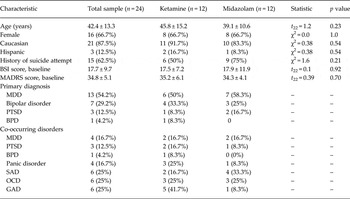
Demographic and clinical characteristics of study participants are summarized in Table 1. The two treatment groups had similar baseline characteristics. The most common primary psychiatric disorders were MDD (54%), bipolar disorder (29%) and post-traumatic stress disorder (PTSD) (12.5%). Participants had a high degree of co-morbidity and 62.5% had a history of a suicide attempt (Table 1). Baseline depression severity was in the moderate to severe range and did not differ between treatment groups (Table 1).
Characteristics of study sample

BPD, Borderline personality disorder; BSI, Beck Scale for Suicidal Ideation; GAD, generalized anxiety disorder; MADRS, Montgomery–Asberg Depression Rating Scale; MDD, major depressive disorder; OCD, obsessive compulsive disorder; PTSD, post-traumatic stress disorder; SAD, social anxiety disorder.
Values indicate mean ± s.d. or count (%).
Variables are compared between treatment groups using independent sample t tests or χ2 as appropriate. Statistical tests were not performed for diagnosistic variables.
Reported frequencies of co-occurring disorders are exclusive of the primary diagnosis in each case.
The majority of participants were taking antidepressants and other psychotropic medication at the time of randomization; frequencies of medication did not differ between the treatment groups (see Supplementary Table S1).
Efficacy
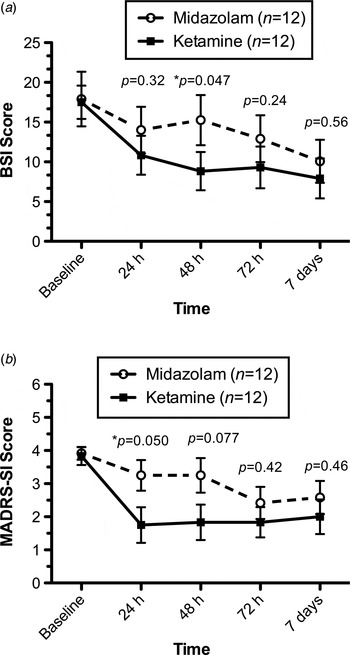
Twenty-four hours following treatment, BSI score was not significantly different between the treatment groups (10.8 ± 8.5 and 14.0 ± 10.2 for ketamine and midazolam, respectively, F 1,21 = 1.04, p = 0.32, Cohen's d = 0.34). A significant effect of treatment on BSI score emerged at 48 h following intervention (8.8 ± 8.3 and 15.3 ± 10.9, respectively, F 1,21 = 4.45, p = 0.047, Cohen's d = 0.67). This difference was no longer significant at 72 h or 7 days (Fig. 1). There was no main effect of setting on 48 h BSI score and no setting by treatment interaction.
Change in suicidal ideation (SI) severity during a randomized controlled trial of ketamine compared to midazolam. Figure depicts change in SI severity as measured using (a) the Beck Scale for Suicidal Ideation and (b) the SI item of the Montgomery–Asberg Depression Rating Scale. Error bars represent standard error of the mean (s.e.m.). BSI, Beck Scale for Suicidal Ideation; MADRS-SI, Montgomery–Asberg Depression Rating Scale – suicidal ideation item.

Twenty-four hours following treatment, MADRS-SI score was significantly lower in the ketamine group compared to midazolam group (1.8 ± 1.9 and 3.3 ± 1.6, respectively, F 1,21 = 4.3, p = 0.05, Cohen's d = 0.86). The effect was not significant at 48 h (1.8 ± 1.9 and 3.2 ± 1.8, respectively, F 1,21 = 3.56, p = 0.077, Cohen's d = 0.77), 72 h or 7 days (Fig. 1). There was no main effect of setting on 24 h MADRS-SI score and no setting × treatment interaction. General depression levels did not differ between the treatment groups at any time-point during the primary assessment period as measured by the MADRS or QIDS-SR total score.
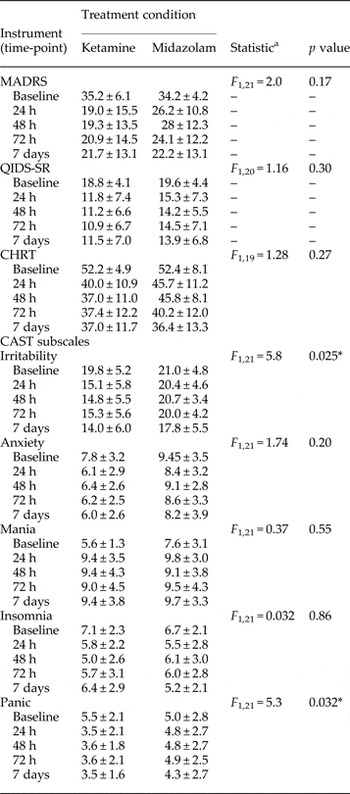
Additional secondary measures are summarized in Table 2. Ketamine was superior to midazolam in reducing levels of irritability (p = 0.025) and panic (p = 0.032) as measured by the CAST 24 h post-treatment. There was no significant treatment effect on the other three domains of anxiety, mania and insomnia.
Effects of ketamine compared to midazolam on secondary outcomes in patients with clinically significant suicidal ideation

CAST, Concise Associated Symptoms Tracking scale (the CAST is made up of the five subscales indicated).; CHRT, Concise Health Risk Tracking Module; MADRS, Montgomery–Asberg Depression Rating Scale; QIDS-SR, Quick Inventory of Depressive Symptomatology – Self Report.
Means ± s.d. are shown for baseline and 24 h post-treatment for each instrument.
a Statistics are calculated by comparing 24-h scores on each instrument using separate ANCOVAs and controlling for baseline severity.
* p values significant at alpha < 0.05.
In order to examine the relationship between change in suicidality and change in general depression we performed a linear correlation between the BSI change score (BSI at 24 h – BSI at baseline) and MADRS change score (MADRS at 24 h – MADRS at baseline) and found a non-significant positive association (r = 0.29, p = 0.18). At 48 h, there was a stronger but still non-significant association (r = 0.39, p = 0.058). Total MADRS score was significantly associated with MADRS-SI score at 24 and 48 h.
Safety and tolerability
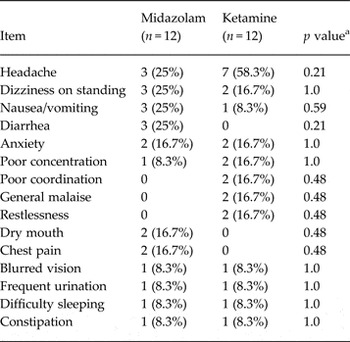
The treatment was generally safe and well tolerated and no participant had to discontinue the study drug. The most common patient-rated side-effects in the ketamine group were headache, dizziness on standing, anxiety, poor concentration, poor coordination, and restlessness. The most common patient-rated side-effects in the midazolam group were headache, dizziness on standing, nausea/vomiting, diarrhoea, and anxiety (Table 3). Patients in the ketamine group experienced transient dissociation that resolved within 240 min of drug administration; participants in both groups experienced very low levels of acute psychotomimetic effects or mood elevation (Supplementary Table S2). Five serious adverse events occurred in the course of the study; none were considered related to study participation. Four events involved hospitalization for worsening depression or suicidality during the study follow-up period. One serious adverse event was the death of a participant due to cardiorespiratory causes that were deemed unrelated to study participation.
Treatment emergent patient-rated side-effects

Itemized events are from the Patient Rated Inventory of Side Effects instrument. The instrument was completed at baseline, 40 min, 240 min, 24, 48, 72 h, and 1 week following study drug infusion. Only items representing a change from baseline and items with a total frequency of at least 5% (e.g. ⩾2 participants across both treatment groups) are included.
a p value based on Fisher's exact test.
Discussion
The current study examined the effect of a single dose of ketamine on severity of SI in inpatients and outpatients with clinically significant suicidality across a range of psychiatric diagnoses using a randomized controlled design and the anesthetic agent midazolam as a psychoactive control. We did not observe an effect of ketamine on the primary study outcome: BSI measured 24 h post-treatment. A significant effect of ketamine on BSI did emerge at 48 h. In addition, ketamine was superior to midazolam in reducing SI 24 h post-treatment as measured by the MADRS-SI. Ketamine was numerically superior to midazolam in reducing SI as measured by both instruments at each time-point over the primary 7-day assessment period, with effect sizes of 0.34–0.86. Although the pre-specified efficacy endpoint was not met, the findings in aggregate support the further study of ketamine for rapid reduction of SI.
Previous reports have suggested that ketamine may have rapid anti-SI effects. In two initial analyses of the effects of ketamine on levels of SI in patients with TRD, Diazgranados et al. (Reference Diazgranados, Ibrahim, Brutsche, Ameli, Henter, Luckenbaugh, Machado-Vieira and Zarate2010a ,Reference Diazgranados, Ibrahim, Brutsche, Newberg, Kronstein, Khalife, Kammerer, Quezado, Luckenbaugh, Salvadore, Machado-Vieira, Manji and Zarate b ) and Price et al (Reference Price, Nock, Charney and Mathew2009) both reported rapid reductions in SI when ketamine was administered in an open-label manner. A prospective open-label study conducted in an emergency department setting demonstrated long-lasting reductions in SI up to 10 days following a single ketamine infusion (Larkin & Beautrais, Reference Larkin and Beautrais2011). Subsequently, a secondary analysis of a large, two-site RCT of a single administration of ketamine compared to midazolam in TRD (Murrough et al. Reference Murrough, Iosifescu, Chang, Al Jurdi, Green, Perez, Iqbal, Pillemer, Foulkes, Shah, Charney and Mathew2013a ) found that ketamine had a large effect on SI at 24 h post-treatment, corresponding to the primary outcome time-point for the trial (Cohen's d = 0.82) (Price et al. Reference Price, Iosifescu, Murrough, Chang, Al Jurdi, Iqbal, Soleimani, Charney, Foulkes and Mathew2014). Finally, in a pooled analysis of four published clinical trials of ketamine in patients with TRD and bipolar depression, Ballard et al. (Reference Ballard, Ionescu, Vande Voort, Niciu, Richards, Luckenbaugh, Brutsche, Ameli, Furey and Zarate2014) found that ketamine significantly reduced levels of SI, even when controlling for change in general depression symptoms.
The present study adds to the current literature by utilizing a prospective randomized controlled design to examine the effects of ketamine in patients who expressed high levels of SI at enrollment. Our study tested the anti-SI efficacy of ketamine across a range of mood and anxiety disorders as the primary aim, in contrast to previous reports of the effect of ketamine on SI within the context of a clinical trial for depression (Price et al. Reference Price, Nock, Charney and Mathew2009, Reference Price, Iosifescu, Murrough, Chang, Al Jurdi, Iqbal, Soleimani, Charney, Foulkes and Mathew2014; DiazGranados et al. Reference Diazgranados, Ibrahim, Brutsche, Ameli, Henter, Luckenbaugh, Machado-Vieira and Zarate2010a , Reference Diazgranados, Ibrahim, Brutsche, Newberg, Kronstein, Khalife, Kammerer, Quezado, Luckenbaugh, Salvadore, Machado-Vieira, Manji and Zarate b ; Ballard et al. Reference Ballard, Ionescu, Vande Voort, Niciu, Richards, Luckenbaugh, Brutsche, Ameli, Furey and Zarate2014). We wished to examine the effects of ketamine on suicidality regardless of the co-occurring psychiatric disorder. Whether the anti-SI effects of ketamine can be separated from its antidepressant effects will require larger studies, permitting a formal mediation analysis or other analytic approach. We did not find a significant association between change in SI measured by the BSI and change in general depression following treatment (e.g. MADRS score), although change in MADRS-SI score was correlated with change in total MADRS score and our limited power precludes a definitive conclusion regarding these associations. It should be noted that the majority of patients in our study had a primary diagnosis of MDD or bipolar disorder. We did find a significant effect of treatment on irritability and panic using the CAST (Trivedi et al. Reference Trivedi, Wisniewski, Morris, Fava, Kurian, Gollan, Nierenberg, Warden, Gaynes, Luther and Rush2011b ), wherein patients treated with ketamine compared to midazolam had lower levels of irritability and panic symptoms 24 h following treatment. These findings raise the possibility that ketamine may reduce suicidal thinking in part by reducing irritability and panic. Larger studies with more diverse samples will be required in order to more fully characterize the impact of ketamine on SI independent from antidepressant effects and to characterize the role of other symptoms potentially mediating the relationship between ketamine and reduction in suicidality.
Despite the devastating costs of suicidal behavior to individuals, families and society, very few biological treatments for acute suicidality exist. Comprehensive treatment of co-occurring psychiatric disorders, along with vigilant monitoring for indicators of suicide risk, represents the mainstay of current treatment for suicidality (Mann, Reference Mann2005; Mann et al. Reference Mann, Apter, Bertolote, Beautrais, Currier, Haas, Hegerl, Lonnqvist, Malone, Marusic, Mehlum, Patton, Phillips, Rutz, Rihmer, Schmidtke, Shaffer, Silverman, Takahashi, Varnik, Wasserman, Yip and Hendin2005). Evidence for the protective effects of antidepressant medication against suicidal behavior is equivocal, for example selective serotonin reuptake inhibitors may decrease risk for suicidal behavior in older adults but may increase risk in adolescence (Barbui et al. Reference Barbui, Esposito and Cipriani2009). Lithium has demonstrated a unique protective effect against suicidality in mood disorders in some, but not all studies (Cipriani et al. Reference Cipriani, Smith, Burgess, Carney, Goodwin and Geddes2006, Reference Cipriani, Hawton, Stockton and Geddes2013; Griffiths et al. Reference Griffiths, Zarate and Rasimas2014). Likewise, the second-generation antipsychotic agent clozapine has demonstrated specific anti-suicidal properties in patients with psychotic disorders (Meltzer et al. Reference Meltzer, Alphs, Green, Altamura, Anand, Bertoldi, Bourgeois, Chouinard, Islam, Kane, Krishnan, Lindenmayer and Potkin2003). In particular, there is an absence of interventions for SI that work quickly. Gaps in knowledge concerning the mechanisms of suicidal behavior, in combination with the practical and regulatory issues inherent to treatment studies involving suicidal patients, have resulted in a dearth of urgently needed medical treatments to reduce suicide risk.
The current study, together with the existing literature, suggests that ketamine or other NMDA receptor modulators may hold promise for the rapid treatment of suicidality. Post-mortem studies show abnormalities in the NMDA receptor, as well as in other components of the glutamate system, in patients who die by suicide (Choudary et al. Reference Choudary, Molnar, Evans, Tomita, Li, Vawter, Myers, Bunney, Akil, Watson and Jones2005; Feyissa et al. Reference Feyissa, Chandran, Stockmeier and Karolewicz2009; Sequeira et al. Reference Sequeira, Mamdani, Ernst, Vawter, Bunney, Lebel, Rehal, Klempan, Gratton, Benkelfat, Rouleau, Mechawar and Turecki2009; Sowa-Kucma et al. Reference Sowa-Kucma, Szewczyk, Sadlik, Piekoszewski, Trela, Opoka, Poleszak, Pilc and Nowak2013; although see Serafini et al. Reference Serafini, Pompili, Innamorati, Dwivedi, Brahmachari and Girardi2013 for examples of conflicting results). Interestingly, higher baseline levels of glutamate within the cerebrospinal fluid is associated with higher levels of suicidal thinking in patients with MDD (Garakani et al. Reference Garakani, Martinez, Yehuda and Gorman2013). NMDA receptor-regulated neuroplasticity (Dwivedi et al. Reference Dwivedi, Mondal, Rizavi and Conley2005; Li et al. Reference Li, Lee, Liu, Banasr, Dwyer, Iwata, Li, Aghajanian and Duman2010; Duman & Aghajanian, Reference Duman and Aghajanian2012; Kang et al. Reference Kang, Kim, Lee, Kim, Bae, Kim, Shin, Kim, Shin and Yoon2013) and neuroinflammatory processes (Lindqvist et al. Reference Lindqvist, Janelidze, Hagell, Erhardt, Samuelsson, Minthon, Hansson, Bjorkqvist, Traskman-Bendz and Brundin2009; Erhardt et al. Reference Erhardt, Lim, Linderholm, Janelidze, Lindqvist, Samuelsson, Lundberg, Postolache, Traskman-Bendz, Guillemin and Brundin2013) may also represent important mechanisms by which NMDA receptor antagonists bring about anti-suicidal effects. Future research using molecular and brain-imaging tools will be required to further explicate the mechanisms of suicidal behavior and those of putative treatments.
Our study has several limitations. Our sample size is small, increasing the likelihood of a false negative finding due to limited power. We do not know if the lack of significant separation between the treatment and control conditions at 24 h represents a true null finding or a false negative. Patients remained on concomitant medication during the study, receiving the study drug as an augmentation to standard of care. While this design more closely resembles how ketamine or a similar therapy would be used in the future for suicidality, it precludes an estimate of the effect of ketamine on suicidality as monotherapy. Another limitation concerns the link between antidepressant effects and anti-SI effects per se. Although we did not restrict our sample inclusion to depression, the majority of patients did have a mood disorder as their primary diagnosis. Together with the limited sample size, our ability to estimate the effects of ketamine on SI distinct from the effects of ketamine on depression was limited. Finally, our study examined the effects of ketamine on SI, rather than on suicide attempts. Since the presence of suicidal thinking is a major risk factor of suicidal behavior, it stands to reason that reducing SI would be linked to reduced suicide risk. This assertion, however, requires prospective testing, particularly given that effects of a single infusion were not maintained for more than 48 h.
In conclusion, our proof of concept study provides initial support for the safety and tolerability of ketamine in addition to standard of care for the rapid treatment of SI. We observed a significant reduction in SI in the treatment compared to control group at 48 h but not 24 h following treatment. Taken together, our study adds to a growing body of literature investigating the rapid anti-SI effect of ketamine and encourages further research examining the potential of NMDA receptor modulators as novel treatments for suicidality. Larger studies with longer follow-up times will be required to more precisely estimate the effects of ketamine on suicidal thinking and, ultimately, on suicidal behavior and completed suicide.
Supplementary material
For supplementary material accompanying this paper visit http://dx.doi.org/10.1017/S0033291715001506.
Acknowledgements
This study was funded by the American Foundation for Suicide Prevention (Young Investigator Grant to Dr Murrough). Dr Murrough is supported by a Career Development Award from NIH/NIMH (K23MH094707). Additional support was provided by grant UL1TR000067 from the NIH National Center for Advancing Translational Sciences (Mount Sinai CTSA). The content is solely the responsibility of the authors and does not necessarily represent the official views of the NIH or other funding agency. We thank Mount Sinai inpatient psychiatry service and the Mount Sinai nursing team, in particular Ms Lorna Green and Mr Pablo Ramos, for their collaboration and assistance during the study.
Declaration of Interest
In the past 3 years, Dr Murrough has served on advisory boards for Janssen Research and Development and Genentech, has provided consultation services for ProPhase, LLC and Impel Neuropharma and has received research support from Janssen and Avanir Pharmaceuticals; he is named on a patent pending for neuropeptide Y as a treatment for mood and anxiety disorders, on a patent pending for the combination of ketamine and lithium to maintain the antidepressant response to ketamine, and on a patent pending for the combination of ketamine and lithium for the treatment of suicidal ideation. Dr Lapidus has received research support from NIH/NIMH (K23 MH104465), the Brain and Behavior Research Foundation, APIRE/Janssen, and the Le Foundation. He has received consulting fees from LCN consulting and serves on the advisory board for Halo Neuro Inc. Dr Iosifescu has consulted for Avanir, CNS Response, INSYS Therapeutics, Lundbeck, Otsuka, Servier, Sunovion and he has received grant/research support through Mount Sinai School of Medicine from Alkermes, AstraZeneca, Brainsway, Euthymics Bioscience Inc., Neosync, Roche and Shire. Dr Charney (Dean of Icahn School of Medicine at Mount Sinai), and Icahn School of Medicine at Mount Sinai have been named on a use patent on ketamine for the treatment of depression. The Icahn School of Medicine has entered into a licensing agreement for the use of ketamine as therapy for treatment-resistant depression. Dr Charney and Icahn School of Medicine at Mount Sinai could potentially benefit if ketamine were to gain approval for the treatment of depression. Dr Charney is named on a patent pending for ketamine as a treatment for PTSD and for neuropeptide Y as a treatment for mood and anxiety disorders; he has received funding from the U.S. Department of Defense, NIH, NIH/NIMH, NARSAD, USAMRAA; he has severed on the scientific advisory board for the Institute of Medicine Committee on DHS Workforce Resilience and on the editorial board of CNS Spectrums.