I. INTRODUCTION
François Quesnay’s Tableau Économique is well known and much studied (e.g., Kuczynski and Meek Reference Kuczynski and Meek1972; Vaggi Reference Usher1987). The figures given by Quesnay in the Tableau are illustrative and hypothetical. They were supposed to illustrate the economic mechanism taking a form of a circular flow such that at the end of each period, the economy and the agents return to the initial position. Hypothetical are various parameters assumed by Quesnay, as, for example, that for the equilibrium to be maintained, one-half of expenditures have to be made on agricultural and one-half on manufactured goods.
Less well known is that in a book by Honoré Mirabeau (Reference Mirabeau1763) entitled La Philosophie rurale, published in 1763—that is, five years after the Tableau ([1758] 2009a)—Quesnay wrote practically all of Chapter VII, in which he undertook to draw a broadly plausible picture of the French economy in the mid-eighteenth century and to describe a one-shot (static) functioning of the economy.Footnote 1 While the Tableau was a theoretical and illustrative piece, Chapter VII of Philosophie rurale was an attempt to show how Quesnay’s theoretical concepts fit into reality. In Philosophie rurale, Quesnay also contrasted the economies of France and England, although his depiction of England, in the amount of detail provided, falls far short of his depiction of France. A comprehensive numerical approach to the French economy justified the title of Grand Tableau Ėconomique that, according to Eltis (Reference Eltis1975) and Théré, Charles, and Perrot (2005, I, pp. 642), Quesnay and Mirabeau had in mind before they settled on the actual title.Footnote 2 The book itself was an ambitious project, perhaps the most ambitious ever undertaken by the économistes: it was “an exposition, pure and simple, magisterial and complete, of a ... superior truth, whose principles are to apply to all countries and all times” (Weulersse Reference Vaggi1910, p. 85; my translation). It was to be the Pentatheuque of the future “sect.”Footnote 3 Chapter VII was the key economic part of it.Footnote 4
In Chapter VII, Quesnay thus used broadly realistic, albeit stylized, figures for the production levels of seven agricultural sectors, then included rural commerce and non-agriculture as well, and discussed in detail the distribution of total income into wages, entrepreneurial income, interest on capital, and surplus. Considerable effort was expended in presenting for each sector of the economy its quantitative output, costs, utilization of labor, animals, and mechanical tools. This unique source therefore allows us to glimpse a picture of a large, predominantly agricultural, European economy as it was a few decades before the French Revolution and about half a century before the spread of industrialization.
Moreover, it allows us both to obtain the functional income distribution (between labor, capital, and land), and to create a social table, containing what Quesnay thought were the salient social classes at the time, and thus to address the issue of income distribution in a “rich agricultural kingdom.” A derivation of new functional and personal income distributions for mid-eighteenth-century France is therefore one of the objectives of this paper. This has not been done before using Quesnay’s numbers. Another objective is to compare such estimates, made with Quesnay’s numbers, with the estimates, derived both from old and modern sources. When we do this, it will become apparent that Quesnay’s estimates might have been somewhat too optimistic and that such optimism has its roots in Quesnay’s ambivalent empirical approach. On the one hand, he was driven by his own practical knowledge of agriculture to present a realistic picture of the French economy; on the other hand, he also wanted to convey to the reader a somewhat idealized picture of the economy as it would be under the Physiocrats’ economic stewardship. The tension between the two objectives suffuses the entire work. We have to keep this caveat in mind in all the comparisons presented in this paper.
II. PROCESS OF PRODUCTION AND FACTORAL DISTRIBUTION OF INCOME
Process of Production
In Philosophie rurale, the economy is divided into seven sectors: production of grains, wine making (viticulture), forestry, production of fields (prés), mining, livestock production, and rural commerce. There are four sources of income: wages of workers, compensation of agricultural entrepreneurs (tenant-farmers) for their management, interest on capital, and rent from property of land combined with taxes. In all sectors, tenant-farmers are also capitalists, so the class composition reduces to three: workers, tenant-farmers,Footnote 5 and property holders (propriétaires).Footnote 6 Property holders receive their income either because they own the land, and thus receive rent, or because they are an administrative or spiritual “elite” (the word never appears in Quesnay) and receive, respectively, taxes and tithes. Property income is, in principle, divided into 4/7, which belong to landlords; 2/7, which is a tax (impôt) presumably paid for government administration; and 1/7, which is a dîme or tithes paid to clergy (pp. 160, 171).Footnote 7 However, the three groups of proprietors can be, for simplicity, subsumed under the class of owners, and Quesnay does so. The term propriétaires is an interesting choice since it covers not only land-owners but also administrators and priests. With some justice, one can see these “owners” as really being the “owners” of the country itself, a ruling elite.Footnote 8
It is this property income that Quesnay labels “net product” (produit net), and its maximization is held to be the objective of economic activity of a country. Paying laborers (at, or close to, subsistence), compensating entrepreneurs for their management, and guaranteeing a “normal” return on capital are not considered part of net product. Furthermore, it is only agricultural activity that, according to Quesnay, produces net product: it represents in essence land’s natural “bounty.” But it is wrong to remain focused on what seems, from today’s perspective, Quesnay’s strange fixation on the productivity of land only and “sterility” of manufacturing.Footnote 9 The essential point, as Karl Marx already noticed, is the existence of a surplus; that is, of an income that is, strictly speaking, unnecessary to bring forth the output.Footnote 10 And, indeed, if we take a slightly more modern approach, and assume away the compensation of labor and capital at “normal” and “usual” rates, then the generation of surplus is indeed something that the economic process is all about.
The process of production takes place through short-term capital advances (avances annuelles), which are made by tenant-farmers. These advances are supposed to cover the cost of wage-labor and to defray compensation of tenant-farmers themselves. To understand them better, one can visualize advances as being in form of seeds, fertilizers, etc., but also food and wage goods that must be available both to the hired labor and to the tenant-farmers to cover their consumption while the process of production takes place. In addition to working capital, tenant-farmers also own fixed (long-term) capital in the form of livestock and some machinery (avances primitives). Thus, tenant-farmers act both as entrepreneurs and capitalists: they do not borrow capital or machinery from somebody else (see e.g., Rubin Reference Rubin1979, p. 119).
Quesnay frequently goes into very great detail in his discussion of capital and its use. For example, the output that can be attributed to a single plow in the production of grain is discussed in excruciating detail (pp. 168–173).Footnote 11 Or, in the production of wine where the production is done on owner-occupied plots of land, 150,000 “exploitants” are supposed, Quesnay writes, to own land whose average size is 10 arpents (about 5.1 hectares),Footnote 12 with working capital advances being on average 10 livres per arpent. Tenant-farmers receive, in all sectors, a return of 10% annually on the value of their capital. Thus, the income of tenant-farmers is composed of two parts: compensation for their work and management (where implicitly the return on working capital advance is included), and the return of 10% on their fixed assets (avances primitives).
Finally, workers are supposed in all sectors to be paid at the same rate. This is not explicitly stated by Quesnay, but emerges when we divide the total wage bill in every sector by the number of workers employed in it. Modern economists thus readily find in Quesnay the elements with which they are well acquainted: competition brings equality across sectors both to wages and interest rate.Footnote 13
Total value added (total product in Quesnay’s terminology) in sector i (VAi) can then be written as (1)
 $$VAi = wLi + Ci + rKi + Ri$$
where w = wage rate (equal across sectors), L i = labor employed, Ci = compensation of tenant-farmers for their work and management (including return on advanced working capital), r = rate of return on fixed capital (equal across sectors), K i = long-term fixed capital owned by tenant-farmers, R i = net product (rent, taxes, and tithes) which belongs to property-holders.
Three Additional Relationships
In addition, Quesnay imposes three additional relationships that will not directly have an influence on our estimation of income distribution across classes, but are important to understand the production side of the equation. First, Quesnay makes working capital advance (A i) equal to the sum of wages and compensation of tenant-farmers. The rationale for this is already explained. Thus,
 $$Ai = wLi + Ci$$
Then, he assumes that advances generate an equal amount of net product or rent (Quesnay 1763, p. 173). Quesnay needs this assumption to impose some “order” (rules) on the amount of surplus that would be generated by each sector. While the relationship (2) is definitional (the advance is needed for the process of production to take place), the relationship between capital advances and net product is technological and structural. For France, at her then-existing level of technical development and fertility of soil, Quesnay assumes that 1 livre of advance will, in general and in the key sector of grains in particular, generate 1 livre of surplus. (Note that the advances are made by tenant-farmers, while the rent accrues to property-owners, which leads to some confusion in the exposition.) In a more developed environment of England, with which Quesnay deals, albeit briefly, at the end of Philosophie rurale, the return will be 1.5 livres on each livre of advance. So, working capital advance and surplus are linked by a technological parameter β, which varies between countries in function of their level of development and fertility of soil.Footnote 14 Thus,
 $$Ai = \beta Ri$$
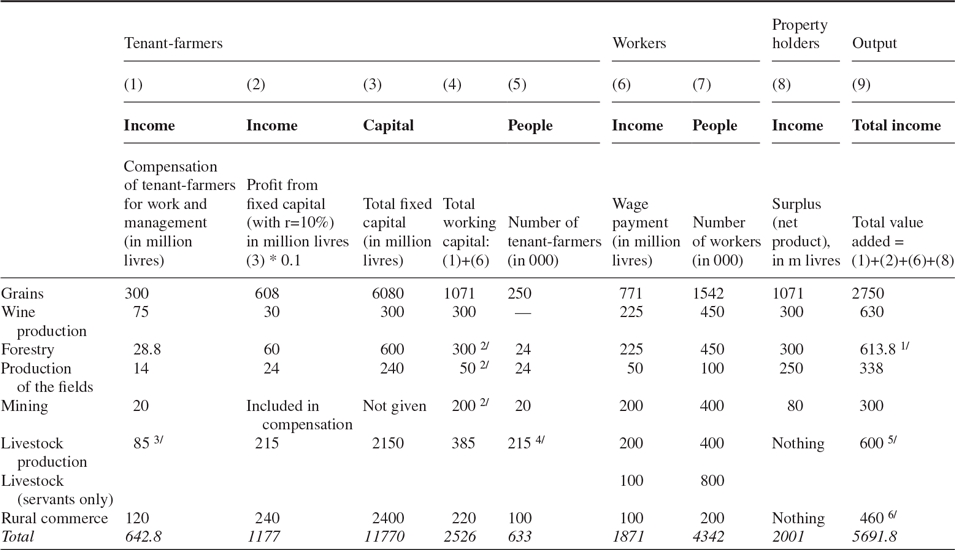
There is finally a third, less noticed, assumption: a relationship between fixed and working capital (advances). In his Tableau économique, Quesnay assumed the relationship to be a little over 4 to 1;Footnote 15 in Quesnay (2009c), “Analyse de la formule arithmetique du Tableau économique,” the relationship was 5 to 1.Footnote 16 In Philosophie rurale, the relationship is 4⅔ to 1, although, as shown in Table 1, its exact value depends on some assumptions and interpretations of Quesnay because the text is in parts murky and in a couple of instances even contradictory.Footnote 17 Denote that relationship by γ. We can then write the expression for the value added in (1) entirely as a function of working capital advances and three parameters:
 $$VAi = Ai + r\gamma Ai + \beta Ai = Ai(1 + r\gamma + \beta )$$
Production and distribution in Philosophie rurale (agricultural sector only)

Sources: Derivation of total fixed capital in column (3): Grain production: Not explicitly mentioned in the text, but obtained as column (2) divided by the rate of return of 10%. Wine production: Not explicitly mentioned in the text, but obtained as column (2) divided by the rate of return of 10%. The sector is composed of 150,000 propriétaires-exploitants possessing on average land the size of 10 arpents from which they gain a total profit of 15 million. (So the value of the land must be 150 million.) And, 300,000 independent vignerons (petites enterprises d’exploitation, p. 175) own as much land (implicitly, also worth 150 million) and receive also 15 million in return on their assets. Both of these classes are treated by Quesnay in the summary table (p. 188) as workers, and their total number (450,000) is thus included in column (7). Forestry: 24,000 tenant farmers owning each a capital worth 25,000 livres. Production of the fields: 24,000 tenant-farmers owning each a capital worth 10,000 livres. Livestock: Given as “more than 2,000 million.” Rural commerce: Obtained as interest (240 million) divided by the rate of return of 10% per annum.
Notes: 1. Quesnay gives output of 688.8 million but that number is impossible to obtain.
2. The advance does not exactly match the sum of wages and compensation of tenant-farmers.
3. Not mentioned in the text. Calculated so that total value added of 600 million is equal to wages (300 million), income from capital (215 million), and compensation of tenant-farmers (85 million). The last amount is obtained as a residual. Advances are then made equal to wages plus compensation of tenant-farmers.
4. Mistakenly given as 200,000 in Quesnay’s table (Quesnay 2009b, p. 183) but the correct number of 215,000 appears in the text (p. 184).
5. Total product is given as 900 million minus 600 million spent for the feeding of animals (intermediate consumption). However, the latter amount cannot be correct because the value added would be less than the sum of its components. It seems likely that the intermediate consumption should be 300 million, the same amount of intermediate consumption as assumed for rural commerce.
6. Excluding 300 million spent for the feeding of animals (intermediate consumption).
A given advance would result in greater value added, the greater general development of the country or fertility of its soil (β), the greater the rate of return (r), and the greater the available fixed capital γ. In addition, parameters γ and β may be also viewed as related: with more fixed capital (γ), productivity of the soil (β) will be greater.Footnote 18 This is basically capital-embodied technological progress.
Quesnay will not be always fully faithful to these relationships. For example, β will be seen to vary between the sectors, so it too should perhaps be subscripted. The overall β for France will be 0.8 (compare the totals of columns 8 and 4 in Table 1), not exactly 1, as we are led to believe by Quesnay himself. But as a very close shorthand to what Quesnay's thinking was, the equation (4) is correct: it highlights the key role of advances but also of β, which, as we have seen, reflects the level of economic development, and of γ, capital intensity of production.Footnote 19
These three relationships will prove useful in our reinterpretation of what Quesnay really meant by the “productive” sector.
Incomes of Various Social Classes
The variability of incomes, and thus the emergence of a distribution of incomes across social groups (and ultimately, across individuals), will come almost entirely from the variability in the economic position of tenant-farmers. They do, from sector to sector, own various amounts of fixed and working capital, and although they receive the same rate of interest, amounts received per capita (per tenant-farmer) will differ. Those in more capital-rich branches will have higher incomes. This part is very redolent of Karl Marx’s prices of production: an equilibrium is possible only if return per unit of capital is the same for all capitalists, but the fact that various capitalists are unequally capital-rich will introduce differentiation in their incomes.Footnote 20
The two other classes are homogeneous: workers are all paid the same wage rate (with one exception, discussed below) and so are property holders. The latter are unique in the sense that their total property income is “accumulated” (as it were) across sectors and then distributed equally to all. Their number is somewhat summarily assumed to amount to 1 million (Quesnay 2009b, p. 188). Quesnay does not go into income differentiation within the class of property owners. This is unfortunate for our purposes because the top class is clearly heterogeneous as it must have included very rich aristocrats but also rather modest or even poor bureaucrats and priests. This lumping together of the “elite” represents, as we shall argue below, the key reason for an overall underestimation of income inequality by Quesnay.
Total income is thus, in a very modern way, calculated from both the production and distribution sides. Value added of each individual sector will add up to the overall national value added; it would dissolve into factor incomes, and these factor incomes will ultimately devolve to individuals or, more exactly, representative individuals from every social class. This is shown in Table 1. As mentioned, the production covers six agricultural sectors and rural commerce. These sectors are assumed to be “productive”; that is, capable of producing a surplus. Total value added is 5,691.8 million livres (per year). It is produced by more than 4.3 million agricultural workers and 653,000 tenant-farmers. The overall ratio between fixed and working capital is 4.5 to 1, and it varies between the sectors. It is the lowest in wine production (1), and highest in rural commerce (6) and wheat production (5.7). The overall (fixed) capital-to-output ratio is 2.1. Again, it is the highest in commerce (5.2) and lowest in wine production (0.5). High capital intensity of commerce seems to be due to the high costs of vehicles needed for transportation of goods.
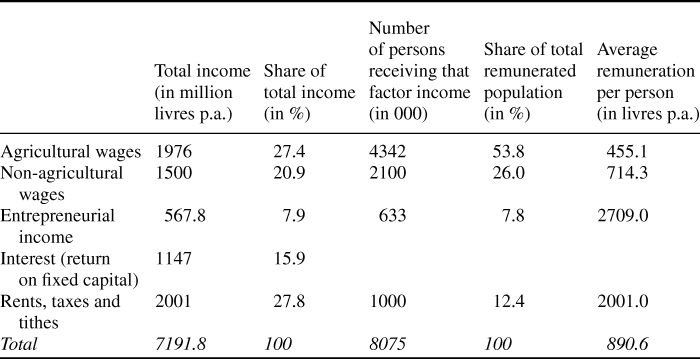
Workers are all paid at the same rate of 500 livres annually with the exceptions of female servants (servantes de basse-cour) engaged in livestock production. They number 800,000 persons, and are the only group assumed not to have families to maintain. These 800,000 female servants, combined with 400,000 shepherds (bergers), make livestock production the second most important sector in terms of employment, following grain production, which employs more than 1.5 million workers. In all sectors but wine production, this particular binary scheme, viz. tenant-farmers vs. workers, holds. Only in wine production does Quesnay assume that the production is done by worker-owners: they do receive remuneration for management and return on their capital like other tenant-farmers, but, in addition, they also receive wages. In the overall summation of his discussion, Quesnay (p. 188) opts to treat them as workers, and this is the approach we follow here. Thus, total income received by agricultural workers, as shown in Table 2 below, includes also 105 million livres that are in effect interest and entrepreneurial income.
Factoral distribution of value added and distribution of the remunerated population (agriculture and non-agriculture)
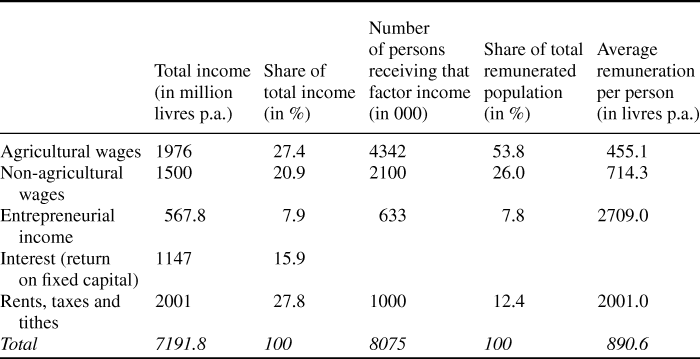
Note: Total is equal to agricultural value added from Table 1 (5,691.8 million) plus non-agricultural value added received by gagistes (1,500 million). Agricultural wages include also 105 million livres of entrepreneurial income and interest earned in viticulture.
What Is a “Productive” Sector?
After finishing with agriculture and rural commerce, and as if an afterthought, Quesnay introduces, in a summary table of all French population (p. 188), a new class: workers, artisans, and personal servants (domestiques) who work outside agriculture in the non-surplus-producing (or “sterile”) sector. They are shown with their incomes coming from the value added produced in the non-agricultural sector. It is this introduction of gainful non-agricultural occupations that allows Quesnay’s theory of surplus to be recast in a slightly different way. The non-agricultural sector does produce value added, even if it is not “productive” in Quesnay’s sense—where being productive means generating a surplus for property owners. The use of “productive” or “sterile” is thus not indicative of whether the sector produces value added or not, but whether the sector generates a surplus or not.
Now, going back to relations (2)–(4) will show us why Quesnay was interested only in the surplus-producing sectors. He viewed the working capital advance that would be simply used up to pay subsistence wages and compensate entrepreneurs, and the provision of a “normal” return on capital, as not adding anything to wealth, since no surplus emerges. The key to a growing economy is the emergence of a surplus; that is, the requirement that β be greater than 0. In French agriculture’s key activities (grain production, viticulture, and forestry), Quesnay assumed, as we have seen, β=1,21 in English grain production β is taken to be 1.5 (Quesnay 2009b, pp. 195, 198), and outside agriculture β is always 0. And indeed, if one takes that wages must be always equal to the subsistence and that owners of capital must receive a “normal” return on their capital, there is no additional value generated in the process. We are in a state of Marxian “simple reproduction.” In other words, there is no growth. It is only if there is an extra, a surplus, that is invested that the economy can grow. Why the return on capital cannot be used for savings from which to finance investment is never explained by Quesnay. It could be, as argued by Isaac Rubin (Reference Rubin1979), that Quesnay saw the return on capital basically as a compensation for depreciation and tear and wear, and not as a “net” additional income.
Similarly, Quesnay did not imagine that the surplus could be used either to increase wages above subsistence or to pay higher profit to capitalists. He saw it as by definition accruing to the residual claimants, the top classes—those who are often, but not always, landowners. They could also be government officials (like Quesnay himself) or priests. This last point emerges very clearly in his treatment of viticulture, the only sector where propriétaires-exploitants, in addition to owning fixed and working capital (and working themselves), also own land. Were the surplus to be received only by landlords, they would have received it in full. However, this is not the case: the sector generates net product for the proprietors as well (see Table 1), and this net product must have been distributed in the form of taxes and tithes (Quesnay 2009b, p. 175).
In his treatment of surplus as a residual income, Quesnay reaches the same point as David Ricardo, but draws entirely different conclusions.Footnote 22 While, for Ricardo, the point where more and more of surplus accrues to landowners is occasioned by the action of diminishing returns and is regarded as threatening further economic growth (because landowners, unlike capitalists, do not invest), Quesnay reaches that point by an institutional assumption that all surplus belongs to the class of owners. The existence of a large surplus, and large owners’ incomes, is thus not a negative, but a positive, development for Quesnay because the very existence of a surplus indicates that the economy has evolved beyond hand-to-mouth primitive production where it is merely able to pay incomes of workers and capitalists directly engaged in production. Indeed, the existence of a surplus is a sign of development. He writes: “In order to get an income from land, agricultural work must produce a net income above the wages paid to workers, for it is this net product that allows other classes to exist.”Footnote 23 Marx (1969, p. 68) saw this point very clearly: “agricultural labour thus forms the natural basis … not only for surplus-labour in its own sphere, but also for the independent existence of all other branches of labour, and therefore also for the surplus-value created in them.” In other words, without a sufficiently high productivity in agriculture, there cannot be development of manufacturing.
Now, to return to the non-agricultural classes: they consist of workers, worker-owners, and entrepreneurs, and are called gagistes (wage-earners). Quesnay divides them into two groups: the rich gagistes who make, on average, 2,000 livres annually (that is, four times as much as an agricultural worker); and poor gagistes who make exactly as much as agricultural workers (500 livres). The same wage rate across sectors is thus maintained even when non-agricultural labor is introduced.
Note finally that in Table 1, the equation (2)—namely, advances that exactly match workers’ wages and compensation of tenant-farmers—holds for grain production and viticulture. For the other sectors, the relationship is often close but not exact. Similarly, the relationship (3) with β=1 holds for grain, wine production, and forestry, but in field production, β is 5,Footnote 24 in mining β=0.4, while livestock and rural commerce do not generate any surplus, thus implicitly setting β to 0. In Quesnay’s terminology, they are “sterile.”
Factoral Income Distribution
Overall factoral income distribution that includes incomes from agriculture (from Table 1) and incomes outside agriculture is shown in Table 2. Labor incomes compose 48.3% of total value added; interest 15.9%; entrepreneurial income (combined with management wages) another 7.9%; and rent, taxes, and tithes take 27.8%. Of more than 8 million persons who are remunerated, just short of 80% are laborers.Footnote 25 Two-thirds of them are employed in agriculture and one-third outside it.
As expected, workers’ average income is lower than the overall mean. In agriculture, workers’ average income is 455 livres (less than 500 livres on account of the badly paid servants in livestock production, but recall that it includes also interest and entrepreneurial income earned in viticulture), while, outside agriculture, it is 714 livres.Footnote 26 Tenant-farmers earn on average more than 2,700 livres, and property owners (pell-mell: nobility, state functionaries, and clergy) make, on average, just a bit over 2,000.
In roughest terms possible, the socio-economic structure of France circa 1760 as presented by Quesnay is that of a three-class society. Nobility, clergy, and tenant-farmers, accounting for approximately 20% of the remunerated population, are rich with an average income in excess of two and a half times the mean. Non-agricultural workers and artisans (the bourgeoisie?), representing a quarter of the remunerated population, are in the middle with an average income slightly below the mean. Agricultural workers (more than half of all remunerated population) are on the bottom. This rough picture can be made more nuanced thanks to the differentiation within each of these classes that can be teased out of Quesnay’s tables. To this—the creation of a social table for France around 1760—we turn next.
III. TOWARDS PERSONAL INCOME DISTRIBUTION: CREATION OF A SOCIAL TABLE
Data displayed in Table 2 allow us to create a social table that has the estimated population sizes and average incomes by social class. In Quesnay’s picture of France, one can find twelve social classes with distinct average incomes: six types of tenant-farmers who, as explained above, will have different incomes in a function of how much capital they own; owner-workers from viticulture; two classes of agricultural workers; two classes of non-agricultural laborers/self-employed; and one class of property owners. For our purposes, it is unfortunate that this last class is undifferentiated because it clearly contains socially very heterogeneous couches (layers), from state functionaries to the nobility of various ranks and wealth to ecclesiastical orders who similarly covered vastly different portions of the income distribution (village priests being surely in a different position from that of bishops and cardinals).
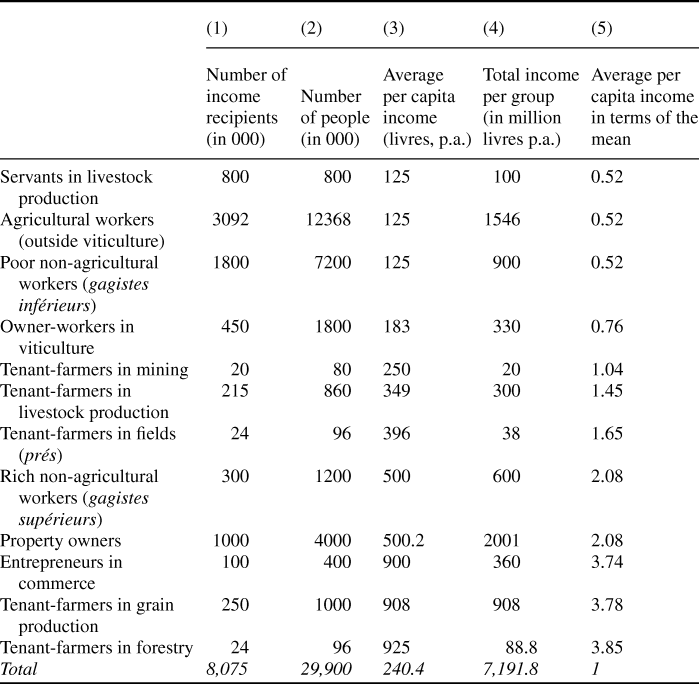
A social table is shown in Table 3. The first column shows the number of income recipients (remunerated population) from Table 2. The next column gives total population associated with each. Quesnay assumes a uniform family size of four, with only one earning head of the household. This is a very, perhaps excessively, simplifying assumption, which is abandoned only in the case of women servants who are supposed to be single. The implication of this assumption is that the employment rate is unrealistically low, at only 27% of the total population. Household per capita average incomes by group are shown in Column 3. The poorest three groups are all workers: servants, agricultural workers, and a group of non-agricultural gagistes each earning 125 livres per capita annually.
Social table for France around 1760, according to Quesnay
Note: Classes are ranked by per capita income. The number of people receiving income from a given sector is obtained by multiplying income recipients in column (1) by 4 (Quesnay’s uniform assumption about the family size) except for the (female) servants in livestock production (servantes de basses-cour), who are supposed to be single.
The next poorest group are owner-workers in wine production (183 livres per capita). It is interesting that they are assumed to be poorer than any other tenant-farmers: tenant-farmers' average incomes range from 250 to 925 livres per capita. The latter (tenant-farmers in forestry) are also the richest social group. Their size, however, is small: only 24,000 are supposed to be occupied in that activity. The bulk of tenant-farmers (those in grain production), 250,000, are quite well off, with an average family per capita income of 908 livres, similar to that of entrepreneurs engaged in commerce.
Somewhat surprisingly, property owners, both because of their heterogeneous nature, and perhaps of somewhat cavalier simplifying assumptions about their total income and particularly their numbers (1 million even), are estimated to make about 500 livres per capita annually, which is a little over twice the mean.
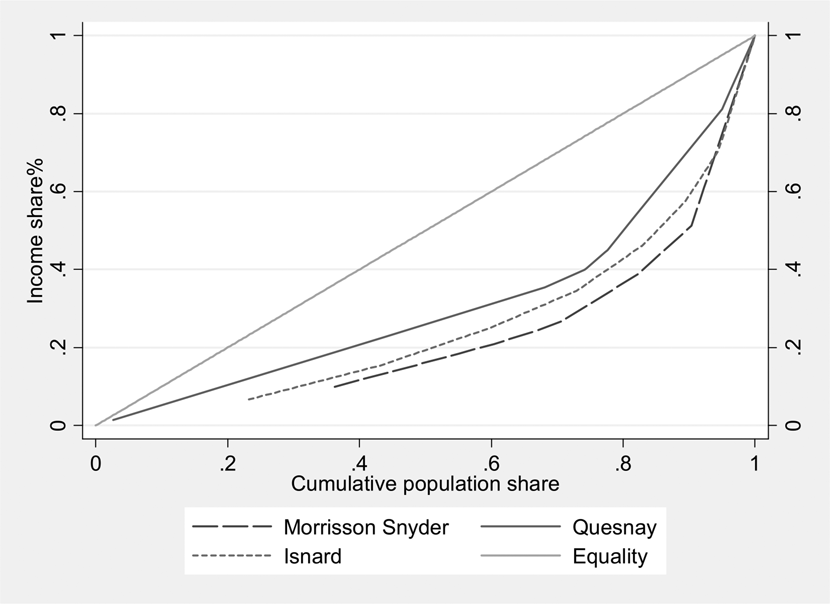
The overall range of incomes, expressed in terms of the mean, is from 0.52 to 3.85, so that the top-to-bottom ratio is 7.4 to 1. The Gini coefficient is 37.4. The Lorenz curve is shown in Figure 1.
Lorenz curves based on Quesnay’s, Morrisson and Snyder’s, and Isnard’s social tables
Sources: Quesnay: Table 3 above. Morrisson and Snyder (Reference Morrisson and Snyder2000, Table 3). Isnard from Morrison and Snyder (Reference Morrisson and Snyder2000, Table 5).
Overall per capita income works out as 240.4 livres per year. How much above subsistence was it? We take the bare-bones subsistence minimum per person to be around 400 kg of wheat-equivalent (see, e.g., Scheidel and Friesen Reference Scheidel and Friesen2009, Table 2).Footnote 27 Quesnay mentions that he assumes the price of wheat to be “the current price of wheat quoted between the trading nations” (pp. 169, 194), which was 21 livres for a setier of wheat. Footnote 28A setier contained 240 livres de Paris, the weight of each being about 490 grams. Therefore, a bare-bones subsistence requires, in money, 72 livres annually. It follows that the average income was 3.3 times the subsistence. We shall consider next how that amount compares with other estimates of French incomes made for around the same period.
IV. CONFRONTATION OF QUESNAY’S WITH OTHER ESTIMATES
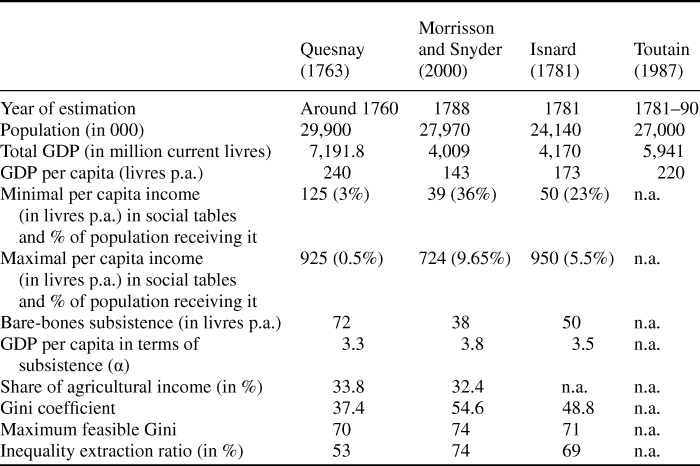
Table 4 contrasts Quesnay’s values with those of another contemporary writer (Reference IsnardAchille Isnard, writing around 1781), and two modern estimates of French pre-revolutionary incomes and/or income distribution: Jean-Claude Toutain (Reference Toutain1987) and Morrisson and Snyder (Reference Morrisson and Snyder2000). Before discussing the differences and similarities, a note of caution is in order. Quesnay’s figures represent in part an “embellished” reality of the French economy at the time, close to what could be its “potential” output if the Physiocrats’ policies were implemented. The other estimates aim to depict the French economy as it really was, even if they, as we shall see, make some important omissions. This epistemological difference has to be taken into account, in addition to other obvious differences that stem from different methodologies utilized by the authors.
Comparison between Quesnay’s and other estimates
Sources: Quesnay (previous tables). Morrisson and Snyder: the “high case” social table in Morrisson and Snyder (Reference Morrisson and Snyder2000, Table 3, p. 66). See also Milanovic, Lindert, and Williamson (Reference Milanovic, Lindert and Williamson2011, Annexes). Reference IsnardIsnard (1781) as reported in Morrisson and Snyder (Reference Morrisson and Snyder2000, Table 5, p. 68). The original data come from Reference IsnardIsnard (1781, vol. 2). Reference ToutainToutain (1987,Table 1, p. 56; and Table 12, p. 76).
Calculation of bare-bones subsistence: Quesnay: 400 kg of wheat-equivalent multiplied by the price of wheat, which is given as 21 livres per setier (1 setier = about 117.6 kg). Morrison-Snyder: French GDP per capita in the year 1800 was estimated by Maddison (2004) at $PPP 1,135. The Morrisson-Snyder (Reference Morrisson and Snyder2006) average income estimate of 143 livres per capita for the approximately same period implies that the current livre-equivalent for a subsistence minimum of $PPP 300 was 38 livres. This matches almost perfectly the income for the bottom class assumed in the Morrison-Snyder social table. Isnard: the average income of the bottom social class.
Share of income received by agriculture. Quesnay: includes income of all tenant-farmers and workers in agriculture but not rural commerce (see Table 3). Morrisson-Snyder: includes incomes of small-scale farmers, large-scale farmers, agricultural day laborers and servants, and one-half of income of mixed workers. (Note that, in general, the output produced in agriculture will be less than the output that “remains” among those working in agriculture because rents are paid to landlords who are not treated as part of agriculture.)
Maximum feasible Gini calculated as (α-1)/α where α is GDP per capita in terms of minimum subsistence. See Milanovic, Lindert, and Williamson (Reference Milanovic, Lindert and Williamson2011).
Thus, not surprisingly, we find that Quesnay’s GDP estimate tends to be on the high side, some 20% greater than the next one by Toutain. In part, this is due to Quesnay’s assumption of a greater population (almost 30 million), some 2 million in excess of what, according to Morrisson and Snyder (Reference Morrisson and Snyder2000, p. 68), seems the currently accepted number for the closing decades of the eighteenth century. But even Quesnay’s average per capita income is rather high. This is likely due to Quesnay’s embellished picture of France’s economy, and in particular its agriculture. Quesnay mentions that in his calculations he assumes that we are dealing with a rich, well-administered kingdom where prices (and hence nominal incomes) are high.Footnote 29 High prices were, according to the Physiocrats, a good thing—indicative of the overall wealth, as summarized in the famous dictum: abondance et cherté est opulence.Footnote 30 So Quesnay might have erred by intention, representing to his readers a French economy that could exist were the Kingdom ruled in the best possible manner, presumably by following Physiocratic policy principles.
Consistently with this high-income, high-prices approach, Quesnay’s bare-bones subsistence is also higher in nominal terms than what can be deduced from Morrisson and Snyder, and Isnard. The outcome of both high incomes and even higher (relatively to the other two authors) subsistence minimum is that, somewhat paradoxically, Quesnay’s estimate of French pre-revolutionary income in terms of the subsistence minimum turns out to be lower, although within the same general “ballpark” as Morrisson and Snyder’s, and Isnard’s. The three estimates range from 3.3 to 3.8 times the subsistence. For England and Wales, for approximately the same period (1759), Joseph Massie’s numbers imply an average income of 5.9 times the subsistence (see Milanovic, Lindert, and Williamson Reference Milanovic, Lindert and Williamson2011, Table 2), thus placing England’s per capita income some 70% to 75% percent above France's.Footnote 31
The same epistemological difference affects the comparison of inequality estimates. Quesnay’s social table produces a Gini coefficient of only 37.4. In a very detailed recent paper on French inequality over two centuries (eighteenth and nineteenth), Morrisson and Snyder (Reference Morrisson and Snyder2000), using a number of sources, produce a social table benchmarked in the year just before the revolution (1788). They divide the population in nine social classes, ranging from the poorest, agricultural day-laborers, to the richest, nobles and clergy. The Gini coefficient obtained from their social table is significantly higher, 54.6 Gini points.Footnote 32Reference IsnardIsnard (1781) divided the French population in eight income brackets, but, as pointed out by Morrisson and Snyder (Reference Morrisson and Snyder2000, p. 68), left out the poorest classes, probably because his interest lay in showing the effect that the introduction of a flat tax would have on royal revenues. He was not interested in the situation of the poorest, who, in any case, would not pay taxes. The Gini coefficient calculated from Isnard’s data is 48.8.Footnote 33 It is reasonable to hold that the main source of Quesnay’s underestimate of inequality comes from not having disaggregated the property owners into at least three classes that he explicitly mentioned as belonging to that large 1-million-strong group: landlords, government administration, and clergy. Furthermore, it is likely that the introduction of very rich aristocrats and financiers would have further pushed inequality up. This omission may not be accidental. It could be related to his “idealized” picture of French economy, where government policies favor the acquisition of real (landed) wealth compared to “fictitious” wealth of financiers.Footnote 34 Thus, unfortunately, both Quesnay’s and Isnard’s inequality estimates are fundamentally skewed: the former by his failure to disaggregate top incomes; the latter by his omission of the bottom of the income distribution. Using again as comparator Massie’s social table for England and Wales for the year 1759, we find English Gini to have been 46.Footnote 35 Now, it is highly unlikely, as argued by Morrisson and Snyder (Reference Morrisson and Snyder2000, p. 80), that France was at that time less unequal than England, and thus the reliability of Quesnay’s Gini of 37.4 is further undermined.Footnote 36
With these caveats in mind, Figure 1 shows the Lorenz curves obtained with Quesnay’s, Morrisson and Snyder’s, and Isnard’s social tables. The first contains twelve social classes; the second, nine; and the third, eight. Despite fewer groups (and thus possibly less granular social structure) than Quesnay’s, the Lorenz curve based on the Morrisson-Snyder data shows a significantly more unequal distribution, and particularly much lower income share of the bottom classes. Thus, the bottom quintile in Morrisson-Snyder data receives 5% of total income, while, according to Quesnay, its share is in excess of 10%. Isnard’s social table stands, both in terms of the overall inequality and the income share of the bottom, between the other two.
The estimate of income distribution and average income helps us situate the calculated Gini coefficient in its social context, viz., allows us to find out how much of the maximum feasible inequality (inequality that would exist if all population but a tiny elite lived at the subsistence minimum, and the elite kept the entire surplus above subsistence for itself) was “extracted” by the elite. This was termed by Milanovic, Lindert, and Williamson (Reference Milanovic, Lindert and Williamson2011) as the “inequality extraction ratio.” More intuitively, the inequality extraction ratio shows how close to the maximum feasible inequality is a society at a given point in time. With an average income of about 3.3 times subsistence (according to Quesnay), the maximum feasible Gini is 70,Footnote 37 and Quesnay’s Gini of 37.4 thus “extracted” only 53% of maximum inequality. This is sizeably less than what the other two estimates imply: their inequality extraction ratios are 69% and 74% (see Table 4). The English inequality extraction ratio, based on Massie’s social table for 1759, was only 55%, and thus noticeably lower than the French ratio.Footnote 38
The inequality extraction ratio magnifies the difference that existed between England and France because the higher English income implies a higher maximum feasible inequality. As English actual inequality, measured by the Gini, was probably less than the French inequality, the ratio (actual/maximum inequality) was even lower.
V. CONCLUSION
Mirabeau’s and Quesnay’s Philosophie rurale is a much less well-known work than Le Tableau économique (in its many different versions) or even Maxims of M. de Sully. Yet, all of them do compose a whole because the logic and spirit of the Tableau permeate Philosophie rurale. However, Philosophie rurale had an additional objective: to present the economy of France as it actually was, or, perhaps with a slight touch of embellishment, how it could be made if the policies of the Physiocrats were adopted. It thus sharply, and for us crucially, moves away from the illustrative and hypothetical arithmetic examples of the Tableau, from the income and money zigzags that have left puzzled and exhausted generations of the economists.
But the absence of the famous zigzags does not make Philosophie rurale an easy read, even if it had some advantages over the Tableau. For example, in Philosophie rurale, Quesnay gives simple, modern-looking tables that summarize his verbal discussion of each individual sector. Toward the end of the chapter (as will be recalled, Philosophie rurale is the seventh chapter in the eponymous book), he provides two summary tables with the key results from the agricultural sector, and, to the delight of the modern reader, even introduces the wages of those employed outside agriculture. It thus gives us an almost complete income distribution, broken into twelve social groups, of mid-eighteenth-century France.
Quesnay does this in a strikingly modern fashion, showing income from both distribution and production sides. The entire value added (both in agriculture and outside agriculture) is distributed between the factors of production, and then further to the rather well-diversified and precisely defined social classes. Perhaps the gravest omission in the definition of classes is Quesnay’s decision to treat the elite, the “proprietors,” as a single class, although they are composed of three functionally different “layers”—landlords, government administrators, and the clergy—and must have contained people with vastly different incomes. This omission biases downward the Gini coefficient that is obtained from his social table, and shows inequality in pre-revolutionary France some 10 to 15 Gini points less than it probably was. Yet, the factoral distribution where some 80% of the population are workers and the share of labor income is about half is plausible. So is the income gap of 1.5 to 1 between urban and agricultural workers. And so seems to be the share of income that accrues to landlords, administrators, and the clergy: almost 30%, even if they account for only 12% of the population. The overall output (value added) is also close both to the contemporary and modern estimates. Quesnay’s estimate is indeed at the upper range of the GDP per capita values that go from 143 to 240 livres for the period preceding the French Revolution, but it is less than 10% off the detailed estimate by Toutain (Reference Toutain1987). Moreover, in terms of the subsistence minimum, the estimates converge to the range of 3.3 to 3.8. Finally, the total population estimated by Quesnay seems also to be somewhat higher than the modern estimates, but again the discrepancy is within 10%.