Introduction
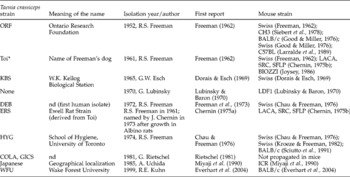
The metacestode of Taenia crassiceps (Zeder, 1800) is a cysticercus capable of exogenous asexual proliferation in tissues of naturally or experimentally infected vertebrate hosts, including humans (Loos-Frank, Reference Loos-Frank2000). Starting in the 1950s, several T. crassiceps strains have been isolated and sub-cultured by inoculation or implantation into the peritoneum of experimental mice (Mus musculus Linnaeus, 1758) (table 1). Nowadays, ORF, HYG and WFU T. crassiceps strains are maintained in mice by subsequent serial passages (Fragoso et al., Reference Fragoso, Meneses, Scuitto, Fleury and Larralde2008) and are used in the fields of behaviour (Gourbal et al., Reference Gourbal, Lacroix and Gabrion2002), immunology (Rodríguez-Sosa et al., Reference Rodríguez-Sosa, Saavedra, Tenorio, Rosas, Satoskar and Terrazas2004), anti-helminthic drug development (Palomares-Alonso et al., Reference Palomares-Alonso, González, Bernad-Bernad, Montiel, Hernández, González-Hernández, Castro-Torres, Estrada and Jung-Cook2010), physiology (Aceves-Ramos et al., 2013) and vaccination (Sciutto et al., Reference Sciutto, Fragoso, Hernández, Rosas, Martínez, Fleury, Cervantes, Aluja and Larralde2013).
Strains of Taenia crassiceps isolated since 1952 in mice used as experimental hosts.

* G.W. Esch, pers. comm.; nd, not defined.
During development, tapeworms obtained naturally or experimentally can develop abnormalities, such as an unusual number and position of hooks, suckers or reproductive organs (Foster, Reference Foster1915; Šlais, Reference Šlais1973; Fan et al., Reference Fan, Wang, Chung, Guo, Ma and Xu2001; Maipanich et al., Reference Maipanich, Sato, Pubampen, Sanguankiat, Kusolsuk, Thaenkham and Waikagul2011). Morphological changes can also be found in cestode eggs or metacestodes cultured in vitro (Šlais, Reference Šlais1973). Taenia crassiceps metacestodes have an exponential pattern of growth, restricted only by hosts' senescence (Everhart et al., Reference Everhart, Kuhn and Zelmer2004). However, parasite multiplication by continuous passages in intermediate hosts may also result in morphological abnormalities, which are considered to be an early indicator of asexual proliferation in cestodes (Šlais, Reference Šlais1973; Conn et al., Reference Conn, Galán-Puchades and Fuentes2010). For example, Dorais & Esch (Reference Dorais and Esch1969) recorded the development of aberrant hooks in ORF metacestodes after 13 years of asexual propagation; a few years later, the metacestodes ceased to produce scolices and lost any capacity to reach the adult stage. Schiller (Reference Schiller1973) reported more than 100 variants of T. crassiceps KBS cysts, with atypical number and shape of suckers and rostellar hooks, after 8 years of experimental inoculations in mice.
To the best of our knowledge, no metacestodes with morphological anomalies have been reported for T. crassiceps WFU strain. The aim of this work is to describe the morphological aberrations found in some metacestodes from infrapopulations of this strain after almost one decade of rearing in mice.
Materials and methods
Provided by the animal care house at the Faculty of Medicine, National Autonomous University of Mexico (UNAM), three inbred 6-week-old female BALB/c mice (M. musculus; 19–25 g) were each inoculated with ten T. crassiceps WFU cysts, as described in Zurabian et al. (Reference Zurabian, Aguilar, Jiménez, Robert and Willms2008). Worms have an 8-year history of serial propagations in mice hosts. Transparent contractile buds with body length 2–3 mm and with a barely visible scolex, were used for intraperitoneal inoculations. Hosts were provided with water and commercial pellets ad libitum. Six months later, rodents were anaesthetized by sodium pentobarbital intramuscular injection and euthanized by cervical dislocation. Metacestodes recovered from each BALB/c mouse were evaginated, fixed and stained. Contractile, transparent cysts, with well-developed scoleces were rinsed three times with phosphate-buffered saline (PBS; pH 7.4) and evaginated in RPMI 1640 medium supplemented with 25% porcine bile at 37°C and under 5% CO2 (Correa et al., Reference Correa, Laclette, Rodríguez del Rosal, Merchant and Flisser1987). After 24 h, worms were relaxed in PBS at 4°C, and fixed in 95% ethanol. Specimens were stained with Meyer's paracarmin and permanently mounted in Canada balsam (Lamothe-Argumedo, Reference Lamothe-Argumedo1997). The main traits of each metacestode were visualized on an Olympus 1x81 microscope through an ImagePro analysing system (Olympus, Miami, Florida, USA) and measured using a micrometer. Voucher specimens of T. crassiceps were deposited at the Colección Nacional de Helmintos (CNHE), Instituto de Biología, UNAM, México DF, accession number CNHE 9529-9530.
Differences in lengths among normal and aberrant hooks were determined using Kolmogorov–Smirnov (sample size >50) normal data distribution and Shapiro–Wilk (sample size < 50) tests. The Wilcoxon signed-rank test was used to compare normally distributed sizes of normal hooks against the abnormally distributed sizes of aberrant hooks. All tests were conducted with the program R version 3.1.2 (packages stats and nortest) (R Development Core Team, 2014).
Results
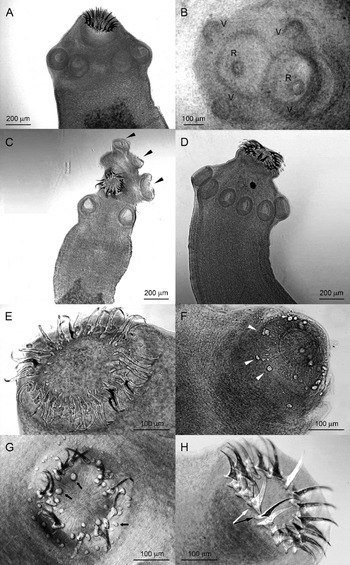
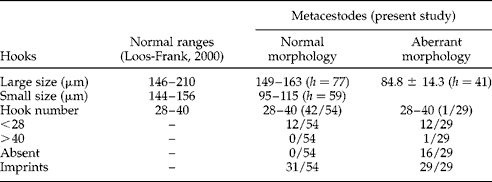
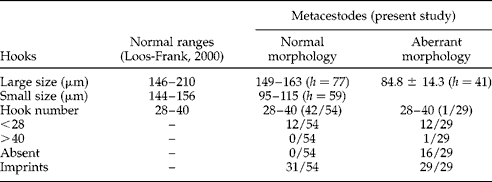
Several hundreds of individuals were obtained from each experimental mouse inoculated with T. crassiceps WFU cysticerci. Infrapopulations had a proliferative development and cysticerci were ovoid to elongate, with maximum length 4–5 mm and width 2–3 mm. A sample of 40 metacestodes with 2 mm invaginated scolex were selected randomly from each infrapopulation and evaginated in vitro (fig. 1A). Up to 71.2% of scolex evagination was reached in the sample comprised of 118 metacestodes; abnormalities were detected in 39.8% of evaginated worms, including a duplicated rostellum (n= 2; fig. 1B), supernumerary suckers (n= 2; fig. 1C, D), as well as aberrant (n= 14; fig. 1E, G) or absent hooks (n= 15; fig. 1F). The length of the aberrant hooks was compared with parameters described in the literature (table 2). Abnormal hooks (n= 41) were significantly smaller when compared to the large (n= 77; W= 0, P < 2.2− 16) and short hooks (n= 59; W= 301, P= 1.972− 10) from nine randomly sampled morphologically normal individuals. Furthermore, in 29 evaginated metacestodes with aberrant hooks, numerous structures resembling hook imprints were found, ranging from 20 to 50 per cysticercus (fig. 1G). Similar imprints (but fewer, 1–13) were also found in 54 metacestodes with morphologically normal hooks. Finally, in 28.9% of metacestodes, the hook core is transparent in contrast with the dark appearance observed in normal hooks, giving them a weak aspect (fig. 1E, H).
Abnormalities in the evaginated WFU strain of Taenia crassiceps metacestodes to show: (A) normal scolex with four suckers and hooks distributed in two rows; (B) scolex with two developing rostella and suckers; (C) scolex with aberrant hooks and five suckers: two showing the normal morphology and three with incomplete development (arrows); (D) six symmetrically arranged suckers; (E) rostellum with aberrant hooks of similar size; (F) and (G) rostellum with hook-resembling imprints (F, arrowheads; G, arrows); (H) transparent hooks (white arrow) and hooks with a dense consistency (black arrow) with normal morphology. R, rostellum; V, suckers.

Characteristics of rostellar hooks of the WFU strain of Taenia crassiceps experimentally recovered compared with the normal traits of this species; h, hook number.
Discussion
Strobilar abnormalities in cyclophyllidean cestodes are relatively common in contrast to anomalies of the scolex (Schiller, Reference Schiller1973). However, for T. crassiceps, morphological irregularities of scolex structures have been reported in two strains maintained in M. musculus by subsequent serial passages – ORF and KBS (Dorais & Esch, Reference Dorais and Esch1969; Schiller, Reference Schiller1973, respectively). These anomalies were initially recorded as irregularities in the shape of rostellar hooks in the ORF strain. It became difficult to find a fully developed scolex and impossible to find one with normal hooks after only 5 years of experimental inoculations, as reported by Dorais & Esch (Reference Dorais and Esch1969). For the KBS strain, after 8 years of intermediate host passages, Schiller (Reference Schiller1973) reported an atypical number (1–7) of suckers (0.38%), double rostellum (0.017%) and the presence of aberrant hooks (0.003%), as principal abnormalities of the scolex for this metacestode strain. This author also reported an increased frequency of aberrations between two consequent generations of the KBS strain from 0.42 to 0.66%. Morphological alterations observed in the WFU strain cysticercus after 8 years of experimental maintenance in mice, are similar to those described for the ORF or KBS strain. In the WFU strain, aberrant hooks and metacestodes that did not develop any hooks, was the most common abnormality (36.1%). However, the formation of structures resembling the imprint of a hook was seen in specimens with phenotypically normal and abnormal hooks. These structures could be interpreted as the basal region of the developing hook blade (see Mount, Reference Mount1970); their presence alongside morphologically normal and aberrant hooks on the same rostellum suggests a heterogeneous developing time of hooks.
In accordance with Verster (Reference Verster1969), rostellar hooks of T. crassiceps have a characteristic form, with the blade being markedly longer than the handle. Among the normal cysticerci of the WFU strain studied, this diagnostic trait is maintained, as well as the number and size of large and short rostellar hooks, which are in accordance with the data recorded for T. crassiceps by Freeman (Reference Freeman1962) and Loos-Frank (Reference Loos-Frank2000). However, abnormal hooks in WFU cysticerci lose their characteristic shape and it is even difficult to distinguish between long and short hooks; likewise, the size of anomalous hooks shows significant differences with respect to the normal ones.
Detection of morphometrical alterations in the main diagnostic features of this tapeworm species is important, considering the taxonomic implications involved, particularly when the observed differences among the length of normal and aberrant hooks are statistically significant. Moreover, the scolex anomalies found in strain WFU should be evaluated carefully and with a long-term experimental approach to determine their effect on the proliferative capacity of metacestodes and the development of adult worms in experimental models based on rodents.
Acknowledgements
This work is dedicated to the memory of M.D. Kaethe Willms. The authors would like to thank Professor Raymond Kuhn for the kind gift of WFU Taenia crassiceps, and MVZ Enrique Pinzón Estrada, Head of the Animal Care Facilities at the Medicine Faculty, UNAM, for technical assistance in animal care. Thanks also to Berenit Mendoza Garfias for assistance in obtaining micrographs.
Financial support
Financial support was provided by División de Investigación, Facultad de Medicina, UNAM.
Conflict of interest
None.
Ethical standards
Experimental procedures on animals were approved by the Ethics and Research Committee of the Faculty of Medicine, UNAM, based on Mexican Official Regulation NOM-062-ZOO-1999.