Introduction
Attention deficit hyperactivity disorder (ADHD) is a neurodevelopmental disorder characterised by a persistent pattern of inattention, impulsivity and hyperactivity beginning in early childhood and often persisting into adult life (Biederman et al. Reference Biederman, Faraone, Milberger, Guite, Mick, Chen, Mennin, Marrs, Ouellette, Moore, Spencer, Norman, Wilens, Kraus and Perrin1996; Kirley & Fitgerald, Reference Kirley and Fitgerald2002). The worldwide prevalence of ADHD in children 18 years of age or younger has been estimated to be 5.3% (Polanczyk et al. Reference Polanczyk, De Lima, Horta, Biederman and Rohde2007). Although there are a number of Irish publications in the area of ADHD (Fitzgerald et al. Reference Geller, Donnelly, Lopez, Rubin, Newcorn, Sutton, Bakken, Paczkowski, Kelsey and Sumner2007; Mulligan et al. 2013) there is little information on the prevalence rates in Ireland as little epidemiological research has been carried out. However, in a school-based sample of urban 12–15-year olds, an estimated 3.7% met DSM-IV criteria for ADHD (Lynch et al. Reference McGilloway, Ni Mhaille, Bywater, Furlong, Leckey, Kelly, Comiskey and Donnelly2004). In Northern Ireland, in a representative survey of English-speaking household residents aged 18 years or over, the lifetime prevalence of DSM-IV ADHD was 2.4% (3% for ages 18–34; 3.4% for ages 35–49; Bunting et al. Reference Bunting, Murphy, O’Neill and Ferry2012).
A small survey conducted by the Hyperactivity Attention Deficit Disorder Support Group (HADD, 2006) on Irish Children highlighted variation in the treatment and diagnosis of ADHD in children throughout Ireland. It found that although all general practitioners (GP) made an onward referral of suspected cases of ADHD, 45% referred to a psychiatrist, 54% to a psychologist and 30% to a paediatrician (there were multiple referrals in some cases). The average time to diagnosis was 4 years with an average of five visits to a secondary care professional before a diagnosis was confirmed (a survey of ADHD in Irish Children 2006). This is in comparison to the international average time to diagnosis 2 years (World Federation of Mental Health, 2005). The HADD survey further highlighted that treatment options offered varied with ∼60% of children managed with medication alone, 20% with a combination of psychological interventions and medication and 20% with psychological interventions alone.
The assessment and diagnosis of ADHD in Ireland is mostly managed by Child and Adolescent Mental Health Services (CAMHS) teams. Data from the fourth annual report of Child and Adolescent Psychiatry services 2011–2012 stated that ADHD remains the most frequent primary presentation in Irish CAMHS, accounting for 35.7% presentations. Currently, there are 56 sub-optimally resourced community teams providing psychiatric care throughout the country. This is less than the number recommended by Vision for Change (2006), a policy document outlining recommendations for a comprehensive mental health service in Ireland, which suggests that there should be 107 teams (based upon the 2011 census). Furthermore, staffing levels of the current teams are at 36.1% of recommended levels. There is variation of waiting list times for assessment depending on location within Ireland, with 40% of young people waiting more than 6 months for an assessment, 13% greater than a year. CAMHS teams strive to meet the demand of children presenting with ADHD with 80% of these teams having developed dedicated ADHD clinics, which are normally nurse and psychiatry led (CAMHS report 2011–2012).
Given the prevalence of ADHD and the limited resources in CAMHS, it is essential that assessment and treatment of ADHD in Ireland becomes more uniform with the introduction of standardised pathways for clinicians to provide an efficient and cost-effective service.
Worldwide, there have been a number of guidelines produced to aid clinicians in the diagnosis and management of people with ADHD. These guidelines vary in the countries in which they apply, the population of patients to which they are aimed and the treating clinicians they hope to guide. There are no guidelines available specifically for the Irish population.
It is the authors’ aim to review the available guidelines and discuss how they are relevant to the management of ADHD in Ireland and to explore where modifications may be warranted given the culture, healthcare system and increasingly difficult economic climate. This paper will concentrate on ADHD in children and adolescents. Adult ADHD services have not been well established in Ireland but it will be the focus of a subsequent paper. Table 1 gives an outline of the practice guidelines consulted in this review paper.
Outline of the practice guidelines included in this review paper

*Taylor, 2004.
Subcommittee on Attention-Deficit/Hyperactivity Disorder. Steering committee on Quality Improvement and Management, 2011.
Diagnosis of ADHD
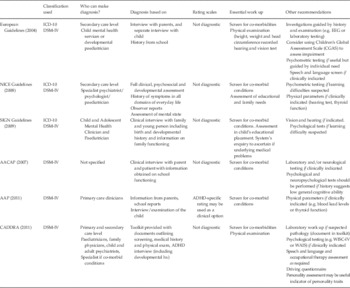
There are two international classification systems currently in use (ICD and DSM). The DSM has three subtypes of ADHD, predominantly hyperactive, impulsive subtype, predominantly inattentive subtype and combined type. This is in contrast to the ICD hyperkinetic disorder, which is similar to the DSM combined subtype of ADHD. The resultant effect is a higher rate of diagnosis using the DSM criteria. The guidelines in this review vary in their use of the different classification systems (see Table 2). It should be noted that there has been an update in the DSM classification system since the publication of most of these guidelines (now DSM 5). Essentially, there is little change in the diagnostic criteria used for children other than the age threshold that has gone from symptoms before age 7 years to now being before age 12 years. In Ireland both classification systems are used. Clinicians within a service use the diagnostic system of their preference. There is no data on which system is most commonly used.
Summary of assessment of children and adolescents with ADHD

American Psychiatric Association, 2000; World Health Organisation, 1992.
EEG, electroencephalogram; CGAS, Children’s Global Assessment Scale; NICE, National Institute for Health and Clinical Excellence; AACAP, American Academy of Child and Adolescent Psychiatry; AAP, The American Academy of Paediatrics; ADHD, attention deficit hyperactivity disorder; CADDRA, Canadian Attention Deficit Hyperactivity Disorder Resource Alliance.
Although the set of guidelines included in this review are based upon different classification systems and diagnosticians, there are broadly similar recommendations throughout. Core assessment includes clinicians eliciting a thorough history from parent, child and school with emphasis on ADHD symptoms, impairment in functioning and comorbidity. This may be supplemented by rating scales but these do not substitute for a thorough clinical history. Other assessments (psychometric, hearing tests, laboratory tests, speech and language assessment, etc.) are only required if clinically indicated. Physical examination including height, weight, blood pressure and heart rate are considered standard. See Table 2 for details of assessments that are recommended in each guideline.
The guidelines indicate that in different countries there are a range of primary and secondary care clinicians diagnosing and treating ADHD (outlined in Table 2). In Ireland, ADHD is primarily diagnosed by CAMHS teams led by a Consultant Child and Adolescent Psychiatrist. A survey of Irish paediatricians, however, revealed that 85% felt that they should have a role in assessment of children with ADHD and 76% thought they should be involved in the treatment (O’Keeffe & McNicholas, Reference O’Keeffe and McNicholas2011). This suggests that there is an interest and expectation that an integrated care model between child and adolescent psychiatrists and paediatricians in managing ADHD, which could be further developed. A suggested option is that paediatricians could have a role in the management of uncomplicated ADHD, whereas CAMHS teams manage ADHD with co-morbidities.
Comorbidity
Comorbidity in ADHD is very common; it is estimated to co-occur with other DSM diagnoses in at least 60% of cases depending upon the sample (Gilberg et al. Reference Gillberg, Melander, von Knorring, Janols, Thernlund, Hägglöf, Eidevall-Wallin, Gustafsson and Kopp1997; Jensen et al. Reference Jones, Daley, Hutchings, Bywater and Eames1997; Spencer et al. Reference Simonoff, Pickles, Charman, Chandler, Loucas and Baird2006). Follow-up studies of children with ADHD and comorbidity have shown this cohort have a worse outcome than children with ADHD alone signified by greater social, emotional and psychological difficulties (Spencer, Reference Spencer, Abikoff, Connor, Biederman, Pliszka, Boellner, Read and Pratt2006). This highlights the importance of screening and treatment of comorbidities as a routine part of an ADHD assessment.
Oppositional defiant disorder (ODD) and conduct disorder are the most common comorbid conditions and may be conceptualised as a complication of ADHD. Longitudinal studies indicate that hyperactive behaviour is a risk factor for conduct disorder in school-aged children (Taylor et al. 1996). Other comorbidities that are highlighted in the guidelines are anxiety disorders, mood disorders and learning difficulties. European Guidelines, Canadian Attention Deficit Hyperactivity Disorder Resource Alliance (CADDRA) and American Academy of Child and Adolescent Psychiatry (AACAP) advocate, in addition, screening for language disorders, tic disorders and substance misuse. With regard to pervasive developmental disorders (PDD), the DSM-V stipulates that ADHD can now be diagnosed as co-morbidly with ADHD. ICD-10, however, indicates that the diagnosis of PDD takes precedence over ADHD, although this may alter with the release of ICD-11 in 2014. There has been increasing evidence that the two disorders do co-occur in 20–50% of children with PDD also meeting criteria for ADHD (Farzin et al. Reference Fitzgerald, Bellgrove and Gill2001; Yoshida & Uchiyama, Reference Yoshida and Uchiyama2004; Simonoff et al. 2008; Carpenter et al. Reference Carpenter, Loo, Yang, Dang and Smalley2009). National Institute for Health and Clinical Excellence (NICE) guidelines specifically state that ADHD can be diagnosed in the presence of PDD highlighting the frequent of co-occurrence of these disorders.
Given the high frequency of comorbidity, a thorough clinical history at time of assessment should include systematic screening questions on the recognised comorbid conditions mentioned including other psychiatric conditions, speech and language development, motor development, presence of tics and any substance misuse, in addition to family history of ADHD. These disorders may have an impact on the management plan and subsequent response to treatment. CAMHS services consist of a multi-disciplinary team and children presenting with ADHD should have access to the relevant disciplines depending on the needs highlighted on initial assessment.
Treatment of ADHD
Psychoeducation should form the basis of any treatment plan for ADHD, a point that is advocated for in all guidelines, although mention is omitted in The American Academy of Paediatrics (AAP) guideline. Studies have shown that this intervention alone can have a positive role in the treatment of ADHD (Montoya et al. Reference Montoyaa, Colomb and Ferrinc2011). Written information should be supplied on the nature, course and treatment of the condition. Information on community supports and additional resources available in school should also be included.
In Ireland, there are a number of community and internet-based support agencies for patients and their families. These include: HADD Family Support Group and other locally based groups that can be found on the Irish National Council for AD/HD Support groups (INCADDs) website. With regard to educational supports, the Department of Education and Science has issued a circular, which sets out detail on how teaching resources for children who require additional support is allocated. With regard to any specific Individual Educational Plan, this falls under the remit of the National Educational Psychological Service. In addition, adolescents with ADHD can access third-level education courses via the Disability Access Route to Education programme.
Behavioural management and psychological interventions
There is less unanimity regarding the use of behavioural management and psychological interventions in the treatment of ADHD among the guidelines. The NICE guideline generally advocates for behavioural management for all patients with ADHD, as monotherapy in mild to moderate ADHD and in conjunction with medication for more severe cases. The European guidelines endorse a multi-modal approach based on individual needs and age of the child, behavioural management being first line in the under 6-year age group. Where the impairment is pervasive and severe, medication is first line. SIGN guidelines indicate behavioural management for the under 6 age group and for those with co-morbid disorders such as ODD and/or aggressive behaviour or anxiety. CADDRA and AAP guidelines also prefer a multi-modal approach but typically would include the use of medication. The AACAP guideline promotes pharmacological intervention as first line with behavioural management therapy alone only if symptoms are mild with minimal impairment, diagnosis is uncertain or in response to parental preference.
Behaviour management
Behaviour management, specifically parent training has been shown to have a positive effect on behaviour of children with ADHD and may reduce parental stress and enhance parental confidence (Zwi et al. Reference Zwi, Jones, Thorrgard, York and Dennis2011). Programmes used should be structured, have a curriculum informed by social learning theory, facilitated by a suitably qualified professional and should be 8–12 sessions in length according to the NICE guidelines. In Ireland, parent training programmes available for which there is evidence of efficacy include the Incredible Years Programme (Jones et al. Reference Jain, Segal, Kollins and Khayrallah2008; McGilloway et al. Reference Michelson, Allen and Busner2011) and Parents Plus Programme (Coughlin et al. Reference Coughlin, Sharry, Fitzpatrick, Guerin and Drumm2009; Griffin et al. 2010). The studies relevant to these programmes do not assess the effectiveness of parent training in ADHD specifically and further research is warranted.
Cognitive behavioural therapy (CBT) and social skills training
There is little evidence supporting the use of CBT in the treatment of children and adolescents with ADHD. Although the NICE guidelines mention its use as an adjunct to parent training, either in an individual or group setting this is based on a small number of studies and is not yet supported by randomised controlled trials. Similarly, there is little robust evidence in supporting social skills training alone in targeting the core symptoms of ADHD.
Combined treatment
There are multiple studies showing that combined therapy using medication and psychosocial interventions is the most effective way to deal with the core symptoms of ADHD and the resulting impairments. These psychosocial interventions include parent training and behavioural management in the school setting (Barkley, Reference Barkley2002; Chronis et al. 2006; Antshel & Barkley, Reference Antshel and Barkley2008). In contrast to this, the Multimodal Treatment of Attention Deficit Hyperactivity Disorder (MTA) study (The MTA Co-operative Group, 1999) found that pharmacological intervention for ADHD is more effective than behavioural treatment alone and there was no significant gain in core ADHD symptoms when combination treatment was used compared with medication treatment alone despite the intensive behavioural management strategies implemented during this study. It should be noted, however, that combined treatment was found to be superior on some measures including parent ratings of aggressive/oppositional behaviour, internalising symptoms and on standardised reading tests. In addition, the children assigned combined treatment group in the MTA study were maintained on lower doses of medication, which is likely to be more acceptable to parents.
The European, NICE and CADDRA guidelines generally suggest behavioural treatment should be offered with or without medication. The US guidelines are guided more by the MTA studies and generally advocate for medication alone. Considering these findings and taking into the account the current financial climate in Ireland, the more intensive combined treatment option as outlined by the MTA study including parent training, school intervention and attention training, if implemented in all cases of ADHD would be unlikely to be cost-effective. This level of intervention should be reserved for cases of ADHD with anxiety, oppositional or aggressive behaviour or family dysfunction.
Pharmacological treatment
With regard to commencing medication, all the guidelines agree that routine blood testing and electrocardiogram (ECG) examination is not required before the introduction of stimulant medication, although anecdotal evidence suggest this is often the case. The NICE and CADDRA guidelines specify that an ECG should be performed before treatment if a patient has a personal or family history of cardiac disease.
Choice of medication
Methylphenidate is generally accepted as first-line treatment, although the American and Canadian guidelines comment that other amphetamine preparations (dextroamphetamine, lisdexamphetamine and amphetamine mixed salts) are equally efficacious. Methylphenidate is the only first line licensed stimulant in Ireland with dexamphetamine available only on a named patient basis. Lisdexamfetamine has just recently been licensed for those who have not had an adequate response to methylphenidate. Modified release formulations of stimulants are equally effective as the immediate release forms (Spencer et al. Reference Simonoff, Pickles, Charman, Chandler, Loucas and Baird2006; Wilens et al. Reference Yoshida and Uchiyama2006). The dose of medication should be titrated until either a good response is achieved or adverse effects limit further titration. The maximum dose set out by the NICE guidelines for short acting methylphenidate is 2.1 mg/kg/day (up to a total of 90 mg/day or the equivalent dose of modified release preparations). If an individual does not respond to one stimulant a second one should be tried before moving on to second-line agents.
Atomoxetine is generally considered a second-line medication by the guidelines. It is a noradrenergic reuptake inhibitor that is superior to placebo in the treatment of ADHD (Michelson et al. Reference Montoyaa, Colomb and Ferrinc2004). The greatest effect in studies have been observed to be at week 6 indicating the young person should be maintained at the therapeutic dose for at least several weeks to reach full benefit (Michelson et al. Reference Michelson, Buitelaar, Danckaerts, Gillberg, Spencer, Zuddas, Faries, Zang and Biederman2002). Atomoxetine has been found to be particularly effective in the treatment of ADHD and comorbid anxiety disorder (Gellar et al. Reference Geller, Donnelly, Lopez, Rubin, Newcorn, Sutton, Bakken, Paczkowski, Kelsey and Sumner2007) and has been considered first-line treatment in this instance (NICE and ACCAP). In addition, it should be considered if tics are worsened by stimulants or with coexisting substance misuse. The maintenance dose of atomoxetine set out by the NICE guidelines for those under 70 kg is 1.2 mg/kg/day and 80 mg/day for those over 70 kg. If there is a poor response NICE suggests further titration to 1.8 mg/kg/day (to a maximum of 120 mg/day) following a consultation to a tertiary referral centre. There are, however, no tertiary centres in Ireland and so consultation with another colleague is often helpful.
Two α-2 adrenergic agonists, extended release guanfacine hydrochloride and extended release clonidine are also mentioned as second-line agents in the AAP guideline. These agents are now licensed in the United States for the management of ADHD and have been found effective in targeting the core symptoms (Biederman et al. Reference Biederman, Melmed, Patel, McBurnett, Konow, Lyne and Scherer2008; Sallee et al. Reference Sallee, Lyne, Wigal and McGough2009; Jain et al. Reference Kirley and Fitgerald2011). European studies are underway and should be followed by licensing soon in Ireland.
There are a number of third-line agents suggested by the guidelines, which include tricyclic antidepressants (TCA) such as imipramine or desipramine, buproprion and antipsychotics. Alpha agonists such as clonidine are considered third-line agents in Europe and United Kingdom where they are not licensed for ADHD. The use of these third-line agents require more rigorous monitoring and follow-up as a result of potentially hazardous side effects, for example, TCAs may be cardiotoxic, causing arrthymias requiring regular ECG monitoring. Before implementation of third-line agents all guidelines advise that the diagnosis is re-evaluated, co-morbid disorders are again screened for and behavioural management strategies implemented if not already done so.
Drug holidays
It is generally accepted that extended drug holidays should not routinely be practiced except when there is concern regarding growth retardation (Reeve & Garfinkel, Reference Reeve and Garfinkel1991; Graham et al. Reference Griffin, Guerin, Sharry and Drumm2011). The NICE and European guidelines advocate for periodic breaks from medication to assess the young person’s symptoms and need to continue medication. Although Summary Product Characteristics Form recommends the timing to be in the summer months, the authors believe that a short period off medication in February, which allows for teacher observations, at a time in school when academically challenged but without major holidays or exams, affords the best opportunity to review.
Monitoring
All guidelines recommend systematic follow-up of children being treated for ADHD. Follow-up visits should be scheduled at 3–6-month periods for stable patients but more frequently during the titration phase of medication. Follow-up visits should include evaluation of core ADHD symptoms from parents, young person and school using rating scales, for example, Conners rating scale (this requires purchasing) or the SNAP IV 26, which is a measure of ADHD and ODD symptoms (this is free to download on the internet, for example, on the CADDRA website – www.caddra.ca/pdfs/caddraGuidelines2011SNAP.pdf). Side effects should be monitored using a side effects questionnaire. Physical parameters of height, weight, body mass index, BP and pulse should be measured and plotted on appropriate centile charts. An objective measure of impairment caused by symptoms in multiple domains (school/home/peer interactions) may also be helpful at each review to ascertain response to treatment and whether further titration of medication is warranted. Some examples of rating scales that may be helpful include the Strengths and Difficulties questionnaire or the Children’s Global Assessment Scale (CGAS) both of which are available for download on the internet.
Proposed assessment and treatment pathway for ADHD in Ireland
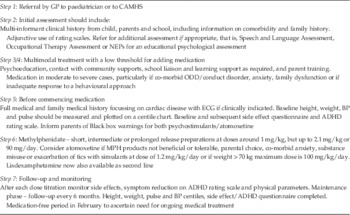
See Fig. 1 for a proposed pathway on the assessment and management of children and adolescents with ADHD in Ireland based on the summary of guidelines discussed and the structure of services for this group of patients in Ireland (see also Table 3 – quick reference guide).
Proposed pathway on the assessment and management of children and adolescents with ADHD in Ireland. ADHD, attention deficit hyperactivity disorder.

Proposed assessment and treatment algorithm for child and adolescent ADHD in Ireland

GP, general practitioner; CAMHS, Child and Adolescent Mental Health Services; ECG, electrocardiogram; ODD, oppositional defiant disorder; ADHD, attention deficit hyperactivity disorder; MPH, methylphenidate
Conclusion
Although ADHD represents a significant proportion of presentations to child and adolescent psychiatry teams in Ireland, there are no guidelines available to ensure standardised practice in the assessment and management of these patients. As a result of the economic decline, there has been a reduction in budgets and increase in pressure for individual teams to meet performance targets while providing good clinical care to their patients. This further highlights the need to manage the ADHD patients in an effective and cost-efficient manner.
This review paper has highlighted that there is consensus between the guidelines for the diagnosis of ADHD with a thorough clinical history remaining the gold standard. They further agree on the importance of identifying co-morbid disorders. When it comes to the treatment, the guidelines are not so unified, particularly in the area of psychosocial treatment options. The threshold for introducing medication also varies with the NICE and European guidelines reserving medication for the more severely impaired children and adolescents. Other ideas highlighted in this review, which require further exploration include the role of the paediatrician in uncomplicated ADHD and possibly shared care arrangements with the family GP, something they have expressed an interest in. This would likely require more training in child and adolescent mental health disorders during the course of specialist training in these disciplines. Families should be encouraged to avail of community supports that are available in many areas in Ireland including local parenting courses and community and internet-based support groups.
Availability of approved medications varies internationally for several reasons. There are limited medication choices for ADHD in Ireland, the only licenced medications are the various preparations of methylphenidate and atomoxetine. The licensing of lisdexamphetamine is a welcomed additional choice of stimulant as a second-line option. There is a European multi-site randomised controlled trial examining the safety and efficacy of guanfacine hydrochloride in the treatment of ADHD, which will be followed by a licensing application. These will hopefully offer clinicians a broader range of medication choice.
This review outlines a proposed standardised care pathway for the diagnosis and management of ADHD, which may aid clinicians working with these children and adolescents. In the future, formalised Irish Guidelines for those managing ADHD would be helpful in ensuring standardised, high quality care across Ireland.
Acknowledgments
The authors would like to thank Ms Angela Kearney, librarian in Lucena clinic for her help with locating articles as well as colleagues who proof read the paper.