





Introduction
General practice (GP) training produces physicians whose work is central to the delivery of health systems worldwide. It produces doctors to deliver continuous, person-centred, and community-based care across a spectrum of acute, chronic, and preventive presentations. In the United Kingdom, training is overseen by the General Medical Council and the Royal College of General Practitioners, with a curriculum designed to ensure readiness for independent practice (Kirby et al., Reference Kirby, Rushforth, Nagel and Pearson2014; McConville, Reference McConville2023). Similar structures exist internationally, although the scope and emphasis of training vary considerably. In Europe, the breadth of practice differs between urban and rural settings (Boerma et al., Reference Boerma, Groenewegen and Van der Zee1998; Schäfer et al., Reference Schäfer, Boerma, Spreeuwenberg, Schellevis and Groenewegen2016). In Australasia, longitudinal clerkships emphasize immersion in community settings, while in sub-Saharan Africa, family medicine training has been promoted as a means of workforce retention (Mandeville et al., Reference Mandeville, Hanson, Muula, Dzowela, Ulaya and Lagarde2017).
The training frameworks exemplify Kolb’s experiential learning cycle where trainees and trainers experience, reflect, apply theory and adapt practice through integration of formal curricula and participation (Wijnen-Meijer et al., Reference Wijnen-Meijer, Brandhuber, Schneider and Berberat2022). Despite this, GP training remains complex and often contested (Ogden et al., Reference Ogden, Kilpatrick and Elmer2023). Trainees and trainers alike describe pressures that extend beyond formal curricula. Supervisors carry responsibility for patient safety, a role that can generate significant anxiety (Ahluwalia et al., Reference Ahluwalia, Spicer, Patel, Cunningham and Gill2020). Trainees must manage steep learning curves while negotiating uncertainty and hierarchy. Bullying, intimidation, and poor workplace culture have been repeatedly reported: surveys indicate that 44% of trainees experience bullying in hospital placements, 36% in GP settings, and up to three-quarters report symptoms of burnout or anxiety (Strachan-Orr, Reference Strachan-Orr2022). These experiences affect not only individual well-being but also the wider challenge of recruitment and retention in GP.
The COVID-19 pandemic further amplified these issues. Rapid shifts to digital consultation, redistribution of workloads, and redeployment of trainees disrupted established training programmes (Grut et al., Reference Grut, de Wildt, Clarke, Greenfield and Russell2023; Jefferson et al., Reference Jefferson, Heathcote and Bloor2023). For some, these changes created opportunities for innovation and autonomy; for others, they heightened stress and reduced access to support (Scallan and Lyon-Maris, Reference Scallan and Lyon-Maris2020). Such divergent experiences underline the fragility of postgraduate training programmes and the difficulty of ensuring consistent quality in complex environments.
Much of the existing literature on GP training is fragmented. Studies have examined ‘the consultation’ as a site of learning, the role of interprofessional collaboration, the influence of workplace culture, and the motivations shaping career choices. However, these strands are rarely brought together. As a result, the overall complexity of GP training, including the way multiple actors interact to shape learning, remains under-theorized. Consequently, educational interventions risk being designed in isolation, without adequate attention to the dynamic systems in which training takes place.
We undertook a critical interpretive synthesis (CIS) of the literature on GP training between 2008 and 2023. Our aim was to collate evidence and interrogate underlying assumptions, examine contradictions, and build new conceptual insights. In doing so, we drew on frameworks from complex adaptive systems (CASs) and Cohered Emergent Theory (CET). CAS explains how outcomes emerge unpredictably from interactions among multiple actors, whereas CET offers mechanisms such as deferment, feedback, and coherence managing complexity and power relations in organizational system design (Nyame-Asiamah, Reference Nyame-Asiamah2020).
By synthesizing evidence through these lenses, we sought to answer two questions:
-
• What does existing research reveal about the complexity and benefits of GP training?
-
• How might these insights inform a conceptual model that both explains the dynamics of training and provides practical guidance for policy and practice?
In addressing these questions, we develop the Cohered GP Training Model which conceptualizes GP training as a complex adaptive system in which outcomes emerge from the degree of coherence between five interacting domains: trainee formation, educational relationships, patient care encounters, workplace and team ecology, and the wider primary care system. Coherence is strengthened through feedback, inclusion, adaptation, and appropriate redistribution of power; it is weakened by hierarchy, fragmentation, workload pressure, and organizational misalignment.
With this, the paper contributes to the growing literature on medical education as a complex system. It offers an integrated account of the evidence, develops a new conceptual model, and discusses its implications for educators, managers, and policymakers seeking to strengthen GP training in the face of global workforce challenges.
Methods
Review approach
We undertook a CIS to examine the literature on GP training. CIS is a review method that goes beyond description to critique assumptions, interrogate contradictions, and generate new conceptual insights (Dixon-Woods et al., Reference Dixon-Woods, Cavers, Agarwal, Annandale, Arthur, Harvey and Sutton2006). It was chosen because the evidence base for GP training is heterogeneous, spanning medical education, health services research, and social science, with wide variation in study quality. Unlike systematic reviews, which are best suited to assessing intervention effectiveness, CIS allows for interpretive synthesis across diverse forms of evidence. It also differs from scoping reviews by moving beyond mapping to theory building (Carboni et al., Reference Carboni, Wehrens, van der Veen and de Bont2022).
Search strategy
We searched Scopus, PubMed, Web of Science, and PsycINFO for studies published in English between January 2008 and December 2023. The start date of 2008 was chosen to capture research reflecting contemporary practice and policy following reforms in primary care education across Europe and the UK. Search terms combined ‘general practice’ or ‘general practitioner’ with ‘training’ or ‘education’, and ‘complex systems’ or ‘complex adaptive system’.
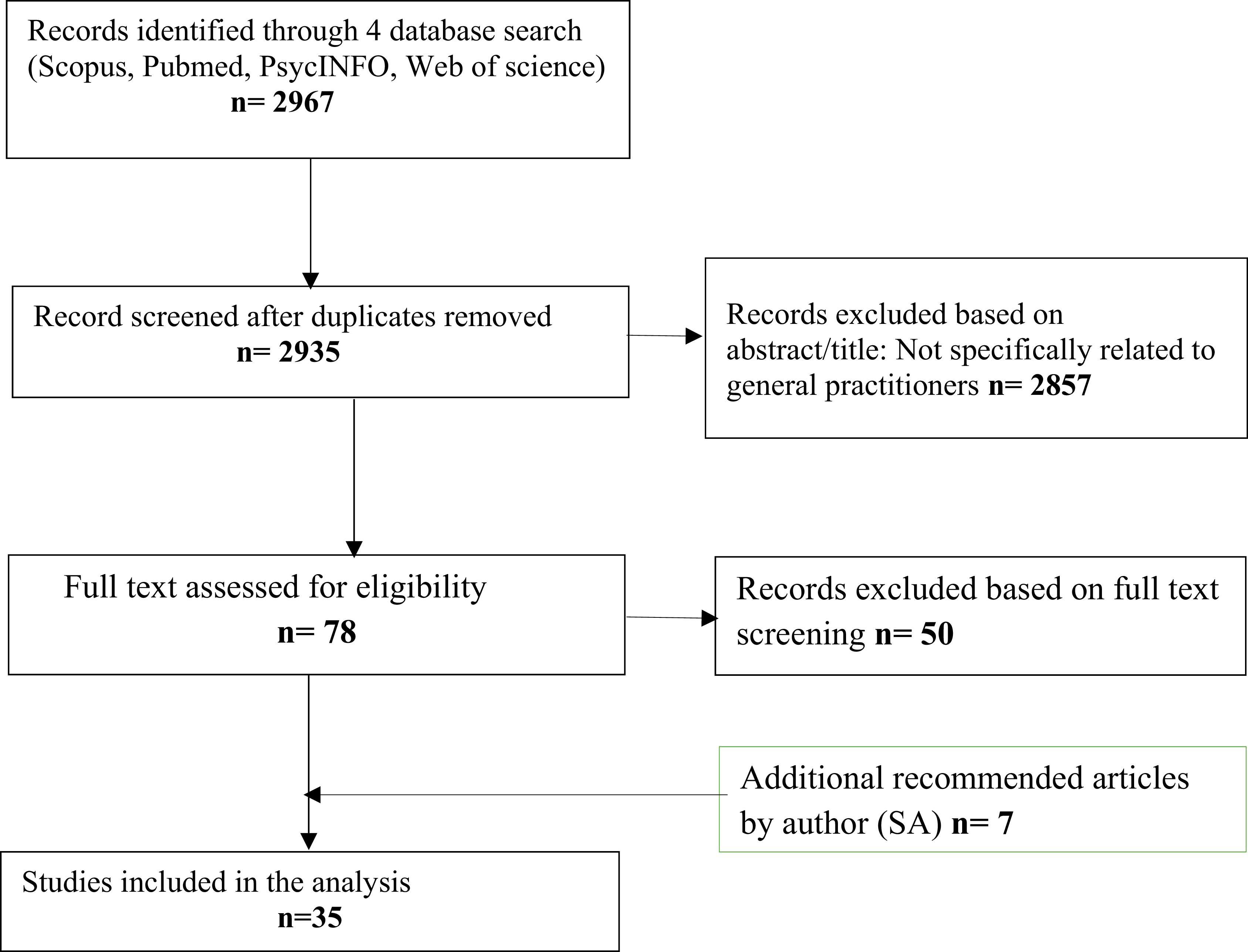
The initial search produced 2,967 records. After removing duplicates, 2,935 remained for screening.
Inclusion and exclusion criteria
We included studies that were peer-reviewed and published in English; were available as open access to ensure transparency; focused on GP training or education; examined GP interactions with patients, practice providers, or multidisciplinary team members.
We excluded conference abstracts, books, newspaper articles, and randomized controlled trials unless they specifically addressed GP training processes. Non-English language studies were excluded to ensure feasibility, though this may have limited coverage of international literature.
Screening and selection
The titles and abstracts were independently screened by two reviewers (TK and FN). Studies clearly unrelated to GP training or professional interactions were excluded (n = 2,857). Seventy-eight papers were retrieved for full-text review. Of these, 28 met the inclusion criteria. To minimize the risk of omitting relevant work, one author (SA) identified a further seven articles from key education journals (Education for Primary Care, Medical Teacher), bringing the final dataset to 35 studies.
A PRISMA-style flowchart (Figure 1) summarizes identification, screening, and selection.
Flowchart illustraring the selection process for studies included in the analysis.
Data extraction and synthesis
Through reading and re-reading of the articles, two reviewers (TK and FN) independently conducted data extraction using a structured template capturing the author, year, country, study design, focus, key findings, and future research, as shown by Table 1 (the supplementary material) and typified by CIS work (Benach et al., Reference Benach, Padilla-Pozo, Martínez-Herrera, Molina-Betancur, Gutiérrez, Pericàs and Zografos2022; Reynolds et al., Reference Reynolds, Egan, Renedo and Petticrew2015). Discrepancies were resolved through discussion and consensus. This enabled a critical appraisal of literature which underpinned our conceptualization of new GP training model as an adaptive system.
Analysis followed CIS principles. Rather than treating each study as a discrete unit of evidence, we sought to identify similar assumptions, patterns, and contradictions across the body of literature. For example, we compared how studies conceptualized empathy in consultations, how trainees described power relations with supervisors, and how organizational factors influenced training opportunities.
Through iterative synthesis, we generated higher-order constructs that brought together insights from diverse evidence to explain the complex nature of GP training. Three main themes emerged: (1) GP-patient interactions, (2) GP-professional interactions, and (3) training intricacies. These were then interpreted through the lens of CASs and CET to inform a new conceptual model of GP training. For instance, CET informed analysis by examining how coherence or misalignment across trainee, relational, organizational, and system domains, shaped by feedback and power relations, generated variation in GP training outcomes.
Reflexivity
The research team brought backgrounds in medicine, management, and social science. This positionality influenced how we engaged with literature, particularly in emphasizing complexity, workplace culture, and educational design. CIS values such transparency: acknowledging the standpoint of reviewers is part of ensuring interpretive rigour.
Results
A total of 35 articles published between 2008 and 2023 were included in the final synthesis. The studies spanned a wide range of contexts, including the UK, Europe, Australasia, and North America, and used a mix of qualitative, quantitative, and mixed methods designs. Their focus varied from consultations and trainer-trainee relationships to multidisciplinary collaboration, organizational influences, and career motivations. Taken together, they offered insight into the complexity of GP training as a lived, relational process rather than a linear transfer of competencies.
The analysis generated three broad themes:
-
1. GP-patient interactions;
-
2. GP-professional interactions;
-
3. Training intricacies.
GP–patient interactions
The consultation remains the central arena in which GP trainees learn. However, the studies reviewed highlighted that consultations are complex encounters, requiring not only clinical reasoning but also empathy, trust, and negotiation.
Empathy and trust
Empathy was consistently identified as a core learning challenge. Peters et al. (Reference Peters, Rogers, Salmon, Gask, Dowrick, Towey and Morriss2009) found that patients with medically unexplained symptoms often feared that physical complaints would be dismissed if they raised psychological concerns. Thompson et al. (Reference Thompson, Dowell, Hilder, Macdonald, Stubbe and Alchin2021) showed that expressions of pain were shaped by cultural background, past experiences, and subtle communication cues. For trainees, the challenge was not only recognizing these dynamics but responding appropriately under time pressure.
Empathy in this context is not simply an innate interpersonal skill but an adaptive process. Trainees must integrate biomedical reasoning with social and emotional awareness, balancing the demands of efficiency with the need to build trust. This aligns with CAS principles: outcomes emerge unpredictably from interactions between patient and doctor rather than from following clinical protocols alone.
Digital consultations
The expansion of digital consultations during the COVID-19 pandemic added further complexity. Studies found that while online and video platforms improved access, they also risked weakening therapeutic connection (Darley et al., Reference Darley, Coulson, Peek, Moschogianis, Van Der Veer, Wong and Brown2022; Wanderås et al., Reference Wanderås, Abildsnes, Thygesen and Martinez2023). Trainees reported difficulties in demonstrating empathy, managing silences, and interpreting non-verbal cues in virtual settings. Training that failed to explicitly address these skills left graduates feeling underprepared for modern practice.
Negotiation and power
Several studies showed that consultations often involved negotiation extending beyond clinical decision-making. Nilsen et al. (Reference Nilsen, Malterud, Werner, Maeland and Magnussen2015) described how GPs navigated requests for sick leave, balancing patient wellbeing, employer expectations, and medico-legal requirements. Murdoch et al. (Reference Murdoch, Salter, Ford, Lenaghan, Shiner and Steel2020) highlighted how such negotiations revealed hidden power dynamics, with GPs weighing fairness, empathy, and responsibility. For trainees, these encounters represented opportunities to develop professional judgement but also potential sites of conflict if supervisory support was lacking. Trainers faced their own dilemmas, having to balance patient needs, trainee development, and institutional expectations simultaneously.
The critical appraisal of these themes highlights the need for a deeper understanding of GP training models to reveal the intricate dynamics of empathy, trust, and the interplay between GPs’ power and patients’ priorities during consultations and interactions, ultimately to enhance the quality of patient care.
These studies suggest that the GP consultation is not simply the setting in which training occurs, but one of the main mechanisms through which learning is produced. Across varied contexts, trainees learn through managing uncertainty, negotiating expectations, and balancing biomedical, relational, and organizational demands in real time. The synthesis therefore suggests that patient care encounters are central to GP training not only as clinical activity, but as a formative site of professional learning.
GP-professional interactions
GP training is embedded in inter-professional and organizational contexts. Collaboration with other professionals was described as enriching but also fraught with hierarchy, role ambiguity, and competing demands.
Collaboration with multidisciplinary teams
Several studies emphasized the benefits of interprofessional learning. De Groot et al. (Reference De Groot, van den Broek, Fokkens, Witte, Damoiseaux and Zwart2021) found that supervisors employed pedagogical strategies to help interns engage with nurses, pharmacists, and allied health professionals, reinforcing collaborative skills. Druel et al. (Reference Druel, Gimenez, Paricaud, Delord, Grosclaude, Boussier and Bugat2020) showed that improved communication between GPs and oncologists enhanced care coordination and created valuable learning opportunities for trainees. Similarly, Damarell et al. (Reference Damarell, Morgan and Tieman2020) unfolded the need to learn about economic, social, cultural and political factors which impact the rising multimorbidity cases and help educate stakeholders to provide collective solution to the challenges of primary care systems. These examples demonstrate the potential of MDT involvement to broaden perspectives and reduce professional isolation.
Hierarchy and referral pressures
At the same time, hierarchy remained a source of tension. Thorsen et al. (Reference Thorsen, Hartveit and Baerheim2012) reported that junior GPs often felt pressured into unnecessary referrals, driven by fear of criticism or litigation. Crowe et al. (Reference Crowe, Clarke and Brugha2017) described how hierarchical cultures could generate anxiety and intimidation, leaving trainees reluctant to challenge decisions or admit uncertainty. Such dynamics highlight how power relations can undermine learning even in ostensibly supportive environments.
Organizational influences
Training was also shaped by organizational decisions and financial pressures. Thomson et al. (Reference Thomson, Anderson, Mara and Stevenson2011) found that practice partners and managers influenced how training resources were distributed, often balancing service delivery against educational needs. McDermott et al. (Reference McDermott, Spooner, Goff, Gibson, Dalgarno, Francetic and Sutton2022) observed the introduction of new professional roles, such as physician associates, reshaping team dynamics and altered learning opportunities for GP trainees.
Training therefore cannot be divorced from organizational context, nor should it be designed by only those in positions of power. For CAS, they exemplify how local interactions generate system-wide effects. For CET, they highlight the importance of incorporating MDT and trainee perspectives to achieve coherence in training design. The analysis suggests that deep understandings about GPs’ interactions with other professionals and medical cases can inform the type of training that GPs may need to be able to deliver quality care for patients.
Across these studies, professional relationships emerge not merely as contextual features of training, but as active shapers of what trainees are able to observe, attempt, reflect on, and become. The synthesis suggests that supervision, trust, hierarchy, and multidisciplinary interaction are not separate influences, but interdependent elements of the learning environment. In this sense, educational quality is closely tied to the relational organization of practice.
Training intricacies
Beyond consultations and professional interactions, studies identified broader intricacies that influence GP training, including career motivations, competencies, trainer characteristics, and systemic constraints.
Career motivations
Motivations for entering GP varied widely. Deutsch et al. (Reference Deutsch, Lippmann, Frese and Sandholzer2015) and Wesnes et al. (Reference Wesnes, Aasland and Baerheim2012) found that decisions were influenced by age, early exposure to GP, role models, and perceptions of work–life balance. Roos et al. (Reference Roos, Watson, Wensing and Peters-Klimm2014) reported cross-national variation: some trainees were attracted by autonomy, others by holistic care. Wesnes et al. (Reference Wesnes, Aasland and Baerheim2012) also highlighted gender differences, with women more likely to value family–career balance. These findings suggest that training pathways need flexibility to accommodate diverse aspirations while meeting workforce needs.
Required competencies
Studies underscored the breadth of competencies required. Beyond clinical acumen, trainees needed strong communication and consultation skills (Thompson et al., Reference Thompson, Dowell, Hilder, Macdonald, Stubbe and Alchin2021), confidence in independent decision-making (Correia et al., Reference Correia, Grierson, Allice, Siu, Baker, Panday and Vanstone2022), and cultural competence (Bridgwood et al., Reference Bridgwood, Park, Hawcroft, Kay and Tang2018). Mueller et al. (Reference Mueller, Preston, Mcfadyen Weir, Bennie and Newham2021) observed that pharmacists working in GP practices also required competencies in reasoning and collaboration, illustrating how interprofessional contexts blur traditional role boundaries.
Trainer characteristics were critical in shaping these competencies. Joffe et al. (Reference Joffe, MacLeod, Kedziora and Main2016) found that emotionally stable trainers with strong interpersonal skills provided better support. Von Below et al. (Reference Von Below, Haffling, Brorsson, Mattsson and Wahlqvist2015) emphasized the benefits of student-centred approaches, while McNab et al. (Reference McNab, Bowie, Ross and Morrison2016) highlighted the value of trainers helping learners to respond constructively when errors occurred.
Systemic constraints
Multiple studies pointed to systemic constraints. O’Shea (Reference O’Shea2009) argued that three-year programmes were insufficient for preparing GPs for independent practice. McDonnell et al. (Reference McDonnell, Williams, Chavannes, de Sousa, John Fardy, Fletcher, Stout, Tomlins, Yusuf and Pinnock2012) reported that rigid programme structures and reliance on lectures limited impact on patient outcomes. Wearne et al. (Reference Wearne, Brown, Kirby and Snadden2019) found that collaborative small-group learning was more effective but harder to sustain in pressured environments.
Sargent et al. (Reference Sargent, Taylor and Lowe2021) noted that GP involvement in research was limited by workload, restricting trainee opportunities. Aschim et al. (Reference Aschim, Lundevall, Martinsen and Frich2011) showed that time pressures hindered the use of innovative techniques such as cognitive behavioural therapy. Overall, there was a clear mismatch between the competencies demanded of trainees and the resources available to develop them.
Information-seeking behaviour
Finally, studies highlighted generational differences in information use. Le et al. (Reference Le, Pedersen, Riisgaard, Lykkegaard, Nexøe, Lemmergaard and Søndergaard2016) found that older GPs tended to rely on journals, while younger and female GPs used online resources and peer networks more frequently. These differences reflect evolving practice cultures and underscore the need for adaptable approaches to training.
Taken together, these findings show that variation in GP training is not adequately explained by individual learner characteristics alone. Rather, trainee development is shaped by the interaction between personal need, educational opportunity, workplace capacity, and wider service pressures. The review therefore suggests that GP training is best understood as structurally contingent as well as educationally designed.
Synthesis of findings
Beyond the three thematic domains, the synthesis identified four cross-cutting insights that cut across study settings and together represent the review’s principal interpretive contribution:
-
• Complexity is intrinsic. Consultations, professional interactions, and training systems are shaped by uncertainty, negotiation, and multiple actors. This suggests that GP training operates through overlapping and interacting demands rather than linear educational processes.
-
• Power dynamics are influential. Hierarchies affect both consultations (doctor–patient negotiations) and professional relationships (trainee-trainer, GP-specialist). This indicates that learning opportunities are shaped not only by curriculum and supervision, but by whose knowledge and participation carry authority within training settings.
-
• Diversity requires adaptability. Trainee motivations, learning preferences, and career aspirations vary widely. Training must be flexible to accommodate such variation highlighting the limits of standardized training assumptions and the need for responsiveness to differing learner trajectories and contexts.
-
• Systemic pressures constrain delivery. Programme length, funding, and workload limit the capacity to equip trainees with the full set of competencies expected. Educational experience is seen as inseparable from the operational realities of primary care service delivery.
These findings suggest that variation in GP training cannot be explained by curriculum content or supervisory intent alone. Rather, training emerges from the interaction of consultation-level learning, educational relationships, workplace and team conditions, trainee diversity, and wider system pressures. The four cross-cutting insights identified in this review indicate that the key issue is not merely the presence of these elements, but the extent to which they cohere in ways that support adaptation, participation, and development. This interpretation underpins the Cohered GP Training Model set out in the Discussion.
Discussion
Summary of findings
This review suggests that GP training is shaped not by curriculum and supervision alone, but by interactions across multiple layers of practice: consultations, educational relationships, team cultures, trainee identities, and wider system pressures. On this basis, we propose a Cohered GP Training Model, in which training quality depends on the degree of coherence between these interacting domains rather than on any single educational intervention in isolation.
Conceptualization of Cohered GP Training Model
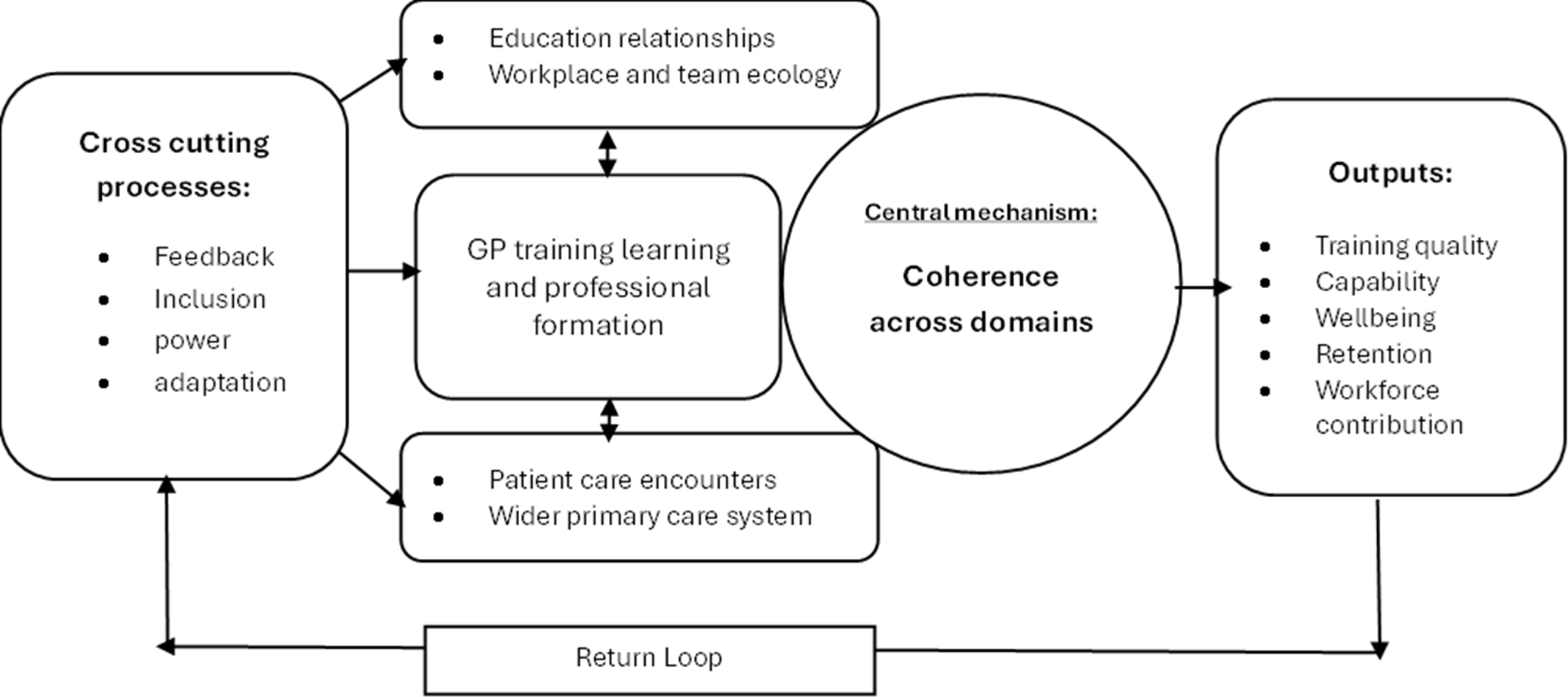
The findings of this review support the development of a Cohered GP Training Model. This model conceptualizes GP training not as a discrete educational programme delivered within stable organizational boundaries, but as a dynamic and relational system embedded within everyday primary care practice. It proposes that GP training outcomes emerge from the degree of coherence between five interacting domains: trainee formation, educational relationships, patient care encounters, workplace and team ecology, and the wider primary care system.
With trainee formation, learning is shaped by prior experience, motivation, confidence, identity, developmental need, and capacity to participate meaningfully in practice. Trainees do not enter GP training on equal terms, nor do they experience training in uniform ways. Their development is influenced both by individual attributes and by how well training environments recognize difference in need, aspiration, and support.
When it comes to educational relationships, training depends on the quality of supervision, trust, feedback, role modelling, and the balance between authority and responsiveness. Learning in GP training is not simply a matter of exposure to practice; it is mediated through relationships with trainers, peers, and other professionals. These relationships shape what trainees can observe, attempt, reflect on, and consolidate.
In GP trainees encounters with patient care, learning is grounded in the consultation itself. GP trainees develop through direct engagement with uncertainty, complexity, empathy, negotiation, continuity, and changing modes of communication, including digital consultation. Patient care is therefore not just the setting in which training occurs, but one of its central educational mechanisms.
In the context of the workplace and team dynamics, training is influenced by local culture, multidisciplinary working, hierarchy, staffing, workload, team inclusion, and the practical conditions available for reflection and support. The learning environment is shaped by more than the trainer-trainee dyad alone. It also depends on whether trainees can participate meaningfully within the broader life of the practice and the teams around it.
With regards to the wider primary care system, GP training is shaped by service demand, workforce pressures, organizational design, policy expectations, resource distribution, and local models of care. These wider conditions influence what kinds of supervision, participation, continuity, and flexibility are realistically possible. Training is therefore inseparable from the service context in which it is delivered.
The model is described as cohered because it focuses on the fit or relationship between these domains rather than treating them as separate influences. These domains are not additive or independent but rather they interact continuously, and it is their alignment or misalignment that shapes training in practice. Where they are well aligned, GP training is more likely to be inclusive, adaptive, educationally rich, and capable of supporting both learner development and service contribution. Where they are poorly aligned, training becomes fragmented, overly dependent on individual goodwill, and more vulnerable to hierarchy, workload pressure, and local instability.
The review findings do not simply show that GP training is complex and context dependent. They suggest a mechanism of coherence through which variation in training quality can be understood. The model therefore helps explain why similar curricular intentions may produce markedly different training experiences across settings, and why improving GP training requires attention not only to educational content, but also to relational, organizational, and system conditions.
Several cross-cutting processes run through the model. Inclusion is important because participation and development depend on how difference is recognized and supported. Feedback matters because adaptation depends on loops of information that allow practices, trainers, and training systems to respond to challenge and change. Expression of power in hierarchical terms influences whose knowledge is heard, what kinds of participation are valued, and how far trainees can act with confidence and agency. Adaptation in GP training unfolds within changing service conditions rather than within static settings. These processes do not sit outside the model; they are among the means through which coherence is created, sustained, or undermined over time.
The practical value of the model lies in its ability to connect educational experience with the realities of primary care delivery. It offers a way of understanding GP training as simultaneously educational, relational, organizational, and service facing. In doing so, it provides a clearer basis for interpreting variation, identifying leverage points for improvement, and designing training environments that are more responsive to both learner development and the conditions of contemporary primary care.
Relationship to existing literature
Our findings align with and extend existing scholarship in two key aspects. First, they confirm that complexity is intrinsic to medical education. Prior research has applied CAS to patient safety, chronic disease management, and health system reform (Braithwaite et al., Reference Braithwaite, Churruca, Ellis, Long, Clay-Williams, Damen, Herkes, Pomare and Ludlow2017; Sturmberg et al., Reference Sturmberg, Martin and Katerndahl2014; Thompson et al., Reference Thompson, Dowell, Hilder, Macdonald, Stubbe and Alchin2021). However, its application to postgraduate training has been limited. By showing how CAS principles of emergence, feedback, and non-linearity are evident in GP training, our review advances understanding of medical education as a dynamic system.
Second, by incorporating CET, we move beyond description to propose a practical mechanism for managing complexity. CET emphasizes deferment of managerial decisions to frontline perspectives, coherence across levels of the system, and responsiveness to emergent challenges (Nyame-Asiamah, Reference Nyame-Asiamah2020). These principles resonate with educational calls for participatory approaches that include trainees, MDT members, and patients in training design (De Groot et al., Reference De Groot, van den Broek, Fokkens, Witte, Damoiseaux and Zwart2021; Von Below et al., Reference Von Below, Haffling, Brorsson, Mattsson and Wahlqvist2015). Our analysis therefore extends the literature by demonstrating how CET can moderate power relations in GP training and offer pathways to greater inclusivity.
More markedly, our conceptual model makes an original theoretical contribution by advancing CET into the domain of professional training and workforce formation, an area where complexity has been widely acknowledged but weakly operationalized. The Cohered GP Training Model extends CET by identifying coherence as a generative mechanism through which learning outcomes emerge and power relations are addressed.
Importantly, our findings also reflect broader international challenges. Studies on career motivation (Deutsch et al., Reference Deutsch, Lippmann, Frese and Sandholzer2015; Roos et al., Reference Roos, Watson, Wensing and Peters-Klimm2014; Wesnes et al., Reference Wesnes, Aasland and Baerheim2012) echo workforce concerns reported across Europe, Australasia, and Africa (Mandeville et al., Reference Mandeville, Hanson, Muula, Dzowela, Ulaya and Lagarde2017). Similarly, reports of bullying and burnout (Strachan-Orr, Reference Strachan-Orr2022) parallel global discussions about wellbeing in postgraduate training. By synthesizing this diverse evidence, our review contributes to the international literature on medical education and workforce development.
Implications for research and practice
The Cohered GP Training Model has practical implications for educators, training providers, policymakers, and researchers because it suggests that training quality depends on the coherence of educational, relational, organizational, and service conditions rather than on curriculum design alone.
For educators, the model suggests that improving GP training requires more than refining curriculum content or supervisory technique in isolation; it requires attention to the relational and organizational conditions in which learning is embedded. Supervisory practices should balance authority with responsiveness, creating space for trainees to exercise judgement while safeguarding patient care. Training in digital consultation, negotiation, and interprofessional collaboration should be made explicit rather than assumed to develop incidentally.
For training providers and practices, the model highlights that educational quality is shaped by workplace and team ecology as well as by formal programme structures. This implies the need for protected supervisory relationships, supportive multidisciplinary cultures, and organizational arrangements that allow trainees to participate meaningfully in care while still having space for reflection and development. Financial pressures, service demands, and team composition all shape the quality of training. Recognizing training as part of a complex system highlights the need for structures that allow feedback from trainees and MDT members to influence programme design.
For policymakers, the model suggests that GP training should not be treated as a discrete educational activity separable from the service realities of primary care. Workforce development, training quality, continuity, and local service capacity are interdependent, and policy interventions are therefore more likely to succeed when they take account of workload, infrastructure, multidisciplinary practice, and local variation. Expansion of GP numbers will not succeed if training environments remain undermined by hierarchy, burnout, and resource constraints. Investing in supportive, inclusive, and adaptive training systems is therefore essential for workforce retention. At a global level, the model is relevant for countries developing family medicine training as a means of strengthening primary care (Mandeville et al., Reference Mandeville, Hanson, Muula, Dzowela, Ulaya and Lagarde2017).
For researchers, the model offers a framework for examining how training quality varies across settings and why similar curricular intentions may produce different outcomes in practice. It suggests the value of studying coherence and misalignment across trainee, relational, workplace, and system levels, including the role of feedback, hierarchy, and local adaptation. Empirical studies could examine how feedback loops operate within real training contexts, whether inclusive approaches improve trainee wellbeing, and how patient perspectives can be incorporated into training design. Comparative research across health systems could further explore how complexity manifests in different cultural and policy contexts.
Strengths and weaknesses
This review has several strengths. It applied CIS across 35 studies, enabling integration of diverse evidence from multiple contexts. By combining CAS and CET, it developed a conceptual model that both explains complexity and offers a practical mechanism for managing it. The inclusion of international studies enhances the generalisability of findings.
However, there are also limitations. First, we restricted inclusion to English-language, open-access journal articles. This may have excluded relevant research from non-English speaking contexts, particularly in regions where family medicine training is expanding rapidly. Second, CIS relies on interpretive judgement. While data extraction and synthesis were conducted independently by two reviewers and resolved by consensus, our backgrounds inevitably shaped interpretation. Third, the model is conceptual rather than empirical. It requires further testing through studies that explore its application in real training environments.
Overall interpretation
Despite these limitations, our review highlights the importance of conceptualizing GP training as a complex, adaptive process. The findings indicate that training cannot be divorced from the wider organizational and systemic contexts in which it takes place. Nor can it be understood solely as the acquisition of competencies: it is equally about managing power relations, responding to diversity, and adapting to emergent challenges.
By proposing the Cohered GP Training Model, we offer a framework that acknowledges this complexity and suggests practical ways of working with it. The model emphasizes inclusivity, adaptability, and feedback, encouraging educators, managers, and policymakers to view training as a ‘living system’ that requires ongoing adjustment.
This review has demonstrated that GP training is best understood as a complex adaptive process, shaped by the dynamic interactions of trainees, trainers, patients, practice providers, and the wider multidisciplinary team. By applying concepts from CASs and CET, we synthesized evidence from 35 studies into a conceptual framework that highlights the importance of feedback, inclusivity, and adaptability.
The review identified three central themes. GP-patient interactions emphasize empathy, trust, and negotiation as core yet challenging learning processes, particularly in the context of digital consultations. GP-professional interactions reveal the benefits of interprofessional collaboration alongside persistent hierarchical tensions. Training intricacies illustrate the diversity of trainee motivations and competencies, as well as the systemic constraints that limit training capacity.
Taken together, these findings underpin the Cohered GP Training Model (please see Figure 2 for a diagrammatic representation), which reframes training as a ‘living system’ rather than a static programme. The model offers practical guidance for educators, providers, and policymakers seeking to strengthen GP training in the face of workforce challenges. Future empirical research is required to test and refine this model, but its core principles provide an important step toward building more resilient, inclusive, and adaptive training systems.
Cohered GP training model.
Supplementary material
The supplementary material for this article can be found at https://doi.org/10.1017/S1463423626102011.
Data availability statement
No new data were generated or analyzed in support of this research.
Author contributions (CRediT roles)
FA and SA conceived of the project. Data collection and analysis was undertaken by FA and TK. FA, TK, and SA contributed equally to the writing.
Funding statement
The authors gratefully acknowledge financial support from Quality-related Research Funding through Anglia Ruskin University Faculty of Health, Medicine and Social Care [H5137].
Competing interests
The authors declare no conflicts of interest relevant to this work.


 Open access

