Introduction
Coping with information uncertainty is a major rationale of government formation in multi-party democracies (Strøm and Nyblade, Reference Strøm and Nyblade2007: 791–792; Müller et al., Reference Müller, Bergman and Strøm2008: 14–18). According to classical bargaining theory, governing coalitions are most likely to form if they command the smallest possible majority in parliament and are ideologically cohesive (Leiserson, Reference Leiserson1970; de Swaan, Reference de Swaan1973). However, such ‘optimal’ coalitions will produce the expected payoff only if the parties are confident that their joint government will perform accordingly (Franklin and Mackie, Reference Franklin and Mackie1984: 276). When information is missing or insufficient, considerations of risk avoidance may modify coalitional choices (Riker, Reference Riker1962: 77–89; Dodd, Reference Dodd1976: 44–46). For example, parties may create oversized coalitions to ensure the success of intra-governmental logrolling (Carrubba and Volden, Reference Carrubba and Volden2004). Similarly, parties may prefer coalition partners who are ideologically further away to those whose platforms are more uncertain (Wright and Goldberg, Reference Wright and Goldberg1985).
Uncertainty becomes an extraordinary challenge when completely new parties enter parliament. By their very nature, new parliamentary parties are less predictable in their behavior than established ones. If established parties (EPs) strive to minimize uncertainty, they should be hesitant to choose newcomers as coalition partners. Vice versa, new parties themselves may not wish to join a cabinet to avoid the risk of being ‘punished’ for government policies at the next elections (Deschouwer, Reference Deschouwer2008: 5).
A ‘newcomer handicap’ in government formation could considerably affect the functioning of parliamentary democracy. If larger parts of the electorate vote for newcomers that have no chance to set the government agenda, democratic inclusiveness would be compromised. Similarly, democratic effectiveness would be jeopardized if new parties inhibit the formation of ‘optimal’ coalitions in terms of parliamentary size and policy coherence. From the perspective of democratic theory, the performance of new parties in government formation is thus highly relevant.
The extant literature has not explored whether newness affects government formation in the hypothesized way. The reasons are obvious: new parties were quite rare in Western parliaments until the 1980s (Harmel and Robertson, Reference Harmel and Robertson1985), and although more have emerged in recent years, very few entered government immediately (Bolleyer et al., Reference Bolleyer, van Spanje and Wilson2012: 975). Relevant research has therefore concentrated on electoral success and organizational development (Hug, Reference Hug2001; Bolleyer and Bytzek, Reference Bolleyer and Bytzek2013), whereas studies of government coalitions have focused on ‘newly governing’ parties, that is, those having entered cabinet (but not parliament) for the first time (Dumont and Bäck, Reference Dumont and Bäck2006; Deschouwer, Reference Deschouwer2008).
In the postcommunist democracies of Central and Eastern Europe (CEE), however, several new parties ‘participated in the governing coalition shortly after their foundation’ (Tavits, Reference Tavits2007: 114). This seems to contradict the assumed newcomer handicap. However, a closer look reveals a more differentiated picture. In 2010, for instance, the Conservatives (ODS) in the Czech Republic formed a minimal-winning coalition with two new parties called TOP 09 and Public Affairs (Stegmaier and Vlachová, Reference Stegmaier and Vlachová2011). Almost simultaneously, Slovakia saw the new party Freedom and Solidarity entering a coalition with three EPs (Deegan-Krause and Haughton, Reference Deegan-Krause and Haughton2012). In Lithuania, on the other hand, an oversized government was formed in 2012 among EPs of different size and ideological orientation; the new party Path of Courage was not even considered as a potential partner (Vireliūnaitė, Reference Vireliūnaitė2012). Finally, Slovenia in 2011 saw a coalition of five parties that deliberately kept the winning newcomer Positive Slovenia out of cabinet (Haughton and Krašovec, Reference Haughton and Krašovec2013).
Overall, these cases suggest that parties in CEE deal with the uncertainty accompanying newcomers in a nuanced way. However, the region-specific literature has not systematically investigated this issue. While several studies have analyzed new parties in CEE at the electoral and parliamentary levels (Sikk, Reference Sikk2005, Reference Sikk2012; Tavits, Reference Tavits2007), executive-related research has focused on other features, such as the regime divide between communist successor parties (CSPs) and former opposition forces (Grzymala-Busse, Reference Grzymała-Busse2001; Druckman and Roberts, Reference Druckman and Roberts2007) or standard variables adopted from Western European coalition studies (Döring and Hellström, Reference Döring and Hellström2013; Savage, Reference Savage2014; Bergman et al., Reference Bergman, Ersson and Hellströmforthcoming).
Our paper explores what role parliamentary newcomers play in government formation in CEE. We generally argue that party newness brings an additional dimension of uncertainty to the bargaining environment. However, this does not imply that newness is a categorical handicap for government participation. In the dynamic political environments of CEE, parliamentary actors should evaluate newness in connection with other features of newcomers, first of all seat share. This implies differentiated coalitional choices because parliamentary size determines whether a newcomer generates more uncertainty in government than in opposition.
More specifically, newness aggravates the government handicap of small newcomers that are particularly unattractive partners for EPs and may not want to join a government that endangers their very survival after the next election. In contrast, newness promotes government participation of large newcomers as they seize the unique opportunity to come to power and EPs make coalition offers aiming to ‘contain’ the new competitor. Finally, being the largest party in parliament again reduces the likelihood of newcomers entering government because EPs avoid the high risk of joining such a coalition as junior partners.
The next section presents our argument about government participation of new parties in more detail. This is followed by an overview of newcomers in the parliaments and governments of 12 postcommunist democracies between 1990 and 2012. We then explore the interaction of newness with other party attributes in a multivariate approach and illustrate the relevant mechanisms with qualitative cases. The final section reflects on the implications of our findings for understanding CEE politics and for the study of government participation in general.
Party newness and coalition theory
Standard coalition theories primarily refer to structural attributes of parliamentary parties and party systems to explain the partisan composition of governments. The most common attributes are numeric, such as number and size of relevant parties, as well as ideological, such as programmatic intersections (Leiserson, Reference Leiserson1970; de Swaan, Reference de Swaan1973). Parties are expected to select their coalition partners according to those attributes that promise to maximize their utility in terms of public office, policy success, and electoral support (Müller and Strøm, 1999).
This approach is based on the fundamental assumption that the bargaining partners have ‘full information about their rivals’ true preferences, what the next election may bring, and a range of other matters’ (Strøm and Nyblade, Reference Strøm and Nyblade2007: 791). However, the more ‘information uncertainty’ increases the more ‘the coalitional status should depart from the maximally desirable status’ (Dodd, Reference Dodd1976: 47). Riker (Reference Riker1962: 88) already suggested that coalition-makers tend to create party governments larger than minimum size in view of increasing ‘incompleteness and imperfection of information.’ Likewise, Carrubba and Volden (Reference Carrubba and Volden2004) predict ‘minimum necessary coalitions’ including more partners than in the minimal-winning format to avoid intra-governmental stalemate in absence of credible commitments. Furthermore, Wright and Goldberg (Reference Wright and Goldberg1985) argue that parties opt for programmatically less compatible partners if the positions of ideologically closer parties are not clear enough. The reason is that uncertain preferences increase – in the language of the ‘events’ approach to government termination – the ‘probability of being subjected to a critical demand, i.e., one sufficient to produce dissolution’ (Browne et al., Reference Browne, Frendreis and Gleiber1986: 639). Limiting this probability is particularly relevant if parties dispose of what Warwick (Reference Warwick2006) calls a ‘policy horizon’ – a discrete limit to the policy concessions a party is willing to make in a coalition.
Uncertainty is aggravated when new parties enter parliament. As potential government allies, newcomers are generally less predictable than EPs. As new parties are less determined in ideological terms, they may change their positions more frequently and rapidly and thus sabotage joint government proposals. Furthermore, they lack experienced personnel to direct ministries while their parliamentary factions, consisting of novices, may shape up as less coherent. Given these risks and uncertainties, EPs should consider new parties problematic partners. Simultaneously, newness might prevent newcomers themselves from pursuing executive office because their parliamentary survival is uncertain. Especially if they have profited from an ‘anti-establishment’ image, they are in danger of losing their electorate when governing with EPs. Taken together, wary selection by other parties and hesitant self-selection of new parties should make newness a handicap in government participation, all else equal.
Our argument is complementary to earlier studies exploring the role of history in coalition formation (Franklin and Mackie, Reference Franklin and Mackie1984; Warwick, Reference Warwick1996; Tavits, Reference Tavits2008; Martin and Stevenson, Reference Martin and Stevenson2010). For EPs, history may be either an asset or a liability, depending on their past coalition behavior. New parties, however, have no reputation. In the face of uncertainty, rational actors would assume the newcomer to have average reliability. As long as there is an alternative partner with above-average reliability (which is the case by definition), this EP is preferred to the newcomer, all else equal. The newcomer handicap is reinforced if actors are risk-averse, that is, if they assume the reliability of new parties to be below average.Footnote 1
Identifying a newcomer handicap empirically requires a conceptual differentiation between new parties that ‘were formed “naturally” as completely new actors’ and those ‘formed by mergers of, or splits from, other parties’ (Harmel and Robertson, Reference Harmel and Robertson1985: 508). In this regard, the relevant literature on CEE distinguishes ‘genuinely new parties’ (GNPs) from ‘newly created parties’ (NCPs). According to Sikk’s (Reference Sikk2005: 399) definition, which we adopt for our study, GNPs are ‘not successors to any previous parliamentary parties, have a novel name and structure, and do not have any important figures from past democratic politics among their major members.’Footnote 2 In contrast, NCPs are only formally new organizations, generally having emerged out of splinters or mergers of existing parties – a common phenomenon in CEE (Tavits, Reference Tavits2007).Footnote 3
The two rationales of risk-aversion linked to the newness handicap – wary selection by EPs and hesitant self-selection of new parties – should only be associated with GNPs. Since NCPs are known in terms of program and personnel, their behavior should be as predictable as that of EPs. NCPs might not enter governments for other reasons,Footnote 4 but they are not distinct coalition players in terms of newness.
Hypothesis 1 GNPs have a lower likelihood of entering government than EPs or NCPs.
To the degree that the data show a handicap of GNPs in government formation, this is indicative of newness-induced uncertainty, but is not conclusive. Other factors may be at work that make newcomers unlikely coalition partners. Standard theory argues that party size is a major determinant of government participation. A large seat share is a critical contribution to a ‘winning’ coalition as generally predicted in the tradition of Riker (Reference Riker1962), and few large coalition partners might be preferred to many smaller ones to contain bargaining costs (Leiserson, Reference Leiserson1970) – reasons why, in an application similar to ours, Druckman and Roberts (Reference Druckman and Roberts2007) control for the parties’ seat share to explore the distinctive role of CSPs in postcommunist government formation. Another factor affecting a party’s chances of government membership is ideology. Most basically, extremist parties should be considered non-coalitionable by democratic parties because of their anti-system orientation (Budge and Keman, Reference Budge and Keman1990: 44). To the degree that newcomers are on average smaller and/or more extremist than EPs, these attributes may contribute to their coalition handicap. Our model will include appropriate controls.
So far we have assumed that newness is a handicap in government formation because it brings an additional dimension of uncertainty into the bargaining process. However, newness-induced uncertainty does not dissolve when a GNP joins the opposition. Under particular circumstances, relegating the newcomer to the opposition benches may be even more risky and thus compromise parties’ self-interests. A criterion likely to affect this possibility is parliamentary size. As outlined above, coalition theory proposes that seat share contributes to a party’s bargaining power. Beyond this general function, party size also comprises more distinct mechanisms that apply selectively to large or small parties, respectively. In particular, small parties may be particularly sensitive to the risks of cabinet participation because the ‘cost of governing’ readily threatens their parliamentary existence (Bolleyer, Reference Bolleyer2007). In contrast, larger parties are in a particularly comfortable situation because they are advantaged for formateur status (Warwick, Reference Warwick1996: 473; Martin and Stevenson, Reference Martin and Stevenson2001). We propose that the general and distinct logics captured by party size affect the coalition rationales of both EPs and newcomers when dealing with newness-induced uncertainty. The two ‘ideal’ scenarios, depending on the size of the newcomer, are explained in the following.
As for small GNPs, the two rationales making newness a government handicap will be equally aggravated. On one side, EPs will not invest the extra costs, in terms of bargaining and stability, of including a ‘loose cannon’ into a cabinet which is unlikely to provide the coalition with a formal (or even stable) majority. The value of a long-term alliance with such a partner is equally uncertain, while relegating a small challenger to the opposition should be a safer choice. On the other side, newcomers having just passed the threshold of parliamentary representation will primarily fight for their uncertain survival after the next elections and avoid compromising their ‘innovative’ image in a government whose policies they could only affect at the margin. This follows Strøm’s argument that parties will pursue votes, rather than office, the greater ‘the uncertainty of electoral contests’ (Reference Strøm1990: 588).
As for large GNPs, both rationales of avoiding newness-induced uncertainty should promote the government participation of newcomers. For a GNP, the mandate conveyed by a landslide victory should overcome its fears of electoral backlash and shift the focus to the unique opportunity to seize power, which is uncertain to recur in the future. Moreover, large newcomers should feel the urge to join a government to fulfill their policy promises vis-à-vis their broader (and thus more demanding) electorate. Simultaneously, EPs should now seek to include the GNPs into government. When large newcomers join the parliamentary opposition they could easily continue to attract protest votes and thus become a strong player in the middle run. As EPs risk durable losses in this scenario, they should, rather, share government responsibility with large GNPs to ‘disenchant’ them. This resembles the strategy of some West European parties to contain electorally powerful radical right-wing populists by including them in government (de Lange, Reference de Lange2012). Moreover, even if electoral containment fails, embracing large newcomers as partners is still preferable to leaving them susceptible to advances from ideological competitors.
In sum, small GNPs will neither seek immediate government participation, nor will they be courted by EPs. Large GNPs will be particularly eager to join the government, and will be welcomed with open arms. In either case, the strategies of both sides in coping with uncertainty should concur.
When thinking of our expectations in terms of party attributes, it becomes clear that we are theorizing an interaction of two variables: newness and party size. Size is an asset in government formation for any party. For newcomers in particular, we expect size to be a double-edged sword: large size gives them an extra bonus, small size inflicts an extra handicap. In other words, the sword is sharper for newcomers than for EPs.
Hypothesis 2 GNPs depend more on parliamentary seat share to get into government than other parties.
The logic that a large GNP can compensate or even overcompensate for the newcomer handicap should work well unless the GNP is larger than its potential coalition partners. Once it becomes the largest party, the rationales of newcomers and EPs to cope with uncertainty should diametrically diverge. As an uncontested election winner, a GNP may be even more eager to build a government, because it can legitimately claim to nominate the prime minister and to dictate the government agenda. Given this unique opportunity, voluntary opposition would be hard to justify and thus a high-risk strategy in view of the next elections. EPs, however, should refuse to join a GNP-led coalition as junior partners. Not only would they have to recognize the newcomer’s leadership claim and tolerate likely resentment over previous policies, but they would also place themselves at the mercy of an unpredictable formateur, for whose failures they may be penalized at the next polls. This is all the more risky as the government would be led by a rookie prime minister. In sum, keeping the winning newcomer out of government seems to be the best containment strategy for EPs. The initial rationale reemerges in this constellation and ultimately limits the degree to which the newcomer handicap is compensated by party size.
Hypothesis 3 Being the largest party in parliament decreases the likelihood of government participation for GNPs, all else equal.
Hypotheses 2 and 3 consider party attributes not in isolation but as part of larger constellations. This approach is particularly attractive in the CEE context, characterized by a variety of ‘difficult’ conditions (cf. Grotz and Weber, Reference Grotz and Weber2012). These inter alia include the repercussions of economic transformation (Gros and Steinherr, Reference Gros and Steinherr2004), the challenges of democratic constitution-building (Elster et al., Reference Elster, Offe and Preuss1998) and the pressures of Europeanization (Vachudova, Reference Vachudova2005). Moreover, CEE party systems have been characterized by the ‘regime divide’ between CSPs and former opponents (Grzymala-Busse, Reference Grzymała-Busse2001) and relatively weak cleavage structures (Lawson et al., Reference Lawson, Römmele and Karasimeonov1999). We expect that parties consider this complex environment in their coalitional choices and evaluate ‘difficult’ attributes of potential partners, not separately, but interactively.
Government participation of new parties
Our data set covers the postcommunist period until 31 December 2012, in the parliamentary democracies of CEE that are also EU member states: Bulgaria, Croatia, the Czech Republic,Footnote 5 Estonia, Hungary, Latvia, Lithuania, Poland, Romania, Slovakia, and Slovenia. In addition, we included Macedonia, which has been an EU accession candidate since 2005 and – just like the mentioned EU members – has continuously experienced competitive elections and parliamentary-based party governments since the 1990s.Footnote 6 Thus, within the postcommunist region these 12 countries form a set of ‘most similar cases’ that can be compared in a meaningful way as regards the determinants of government formation.
In each country, our data begin with the first election after an identifiable party system had developed.Footnote 7 Our dependent variable, government participation, is observed whenever a new government is formed. This is the case when (1) the partisan composition of the cabinet changes or (2) general elections are held.Footnote 8 Data were assembled from Grotz and Müller-Rommel (Reference Grotz and Müller-Rommel2011). An overview of the data set is available in the online appendix.
Parties and party newness were identified in due consideration of earlier codings (Sikk, Reference Sikk2005, Reference Sikk2012; Tavits, Reference Tavits2007) and updated accordingly. To ensure comparability, new parties are counted as new for the entire duration of their first term in parliament, that is, for all cases of government formation during this term.Footnote 9 All GNPs and NCPs are listed in the online appendix.Footnote 10
A first inspection of the data shows clear evidence for a newcomer handicap; 43% of the EPs represented in parliament enter government, compared with only 32% of new parties. When separating GNPs and NCPs, the latter figure is further differentiated: 35% of NCPs enter government, compared with only 28% of GNPs. Our expectation of the rank order of EPs, followed by NCPs and GNPs, is confirmed. In absolute terms, representation of new parties in CEE governments is surprisingly common; keeping in mind the high number of ‘eligible’ new parties in CEE parliaments, however, it is still relatively rare.
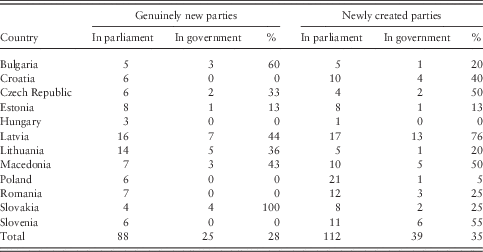
Table 1 shows the data by country. Most basically, GNPs and NCPs have been represented in all 12 CEE parliaments. Considerable variation between countries is just as obvious. GNPs are most frequent in Latvia and Lithuania, NCPs in Poland and Latvia. Hungary has the lowest scores in both respects, followed by Bulgaria and the Czech Republic. The other countries are located in between these poles. Overall, NCPs are somewhat more frequent than GNPs (112 vs. 88). A good part of parliamentary turnover is therefore not due to proper newcomers but due to ongoing mergers and splits of EPs.
New parties in parliament and government by country

On the governmental level, variation is even more pronounced. In five countries (Croatia, Hungary, Poland, Romania, and Slovenia) GNPs never participated in government, whereas they were always included in Slovakia. Another five countries (Bulgaria, Estonia, Hungary, Lithuania, and Poland) saw no, or only one, NCP entering cabinet, whereas this was quite frequent in Latvia, Macedonia, and Slovenia.
Overall, the various country differences suggest that the general pattern in the likelihood of government participation – EPs followed by NCPs and GNPs – requires nuanced explanations. Context features may play a role (cf. Grotz and Weber, Reference Grotz and Weber2012 for the case of government stability). Another possibility, as expressed by our hypotheses, is that characteristics of the new parties themselves differ between countries, and this explains the variance in government participation.
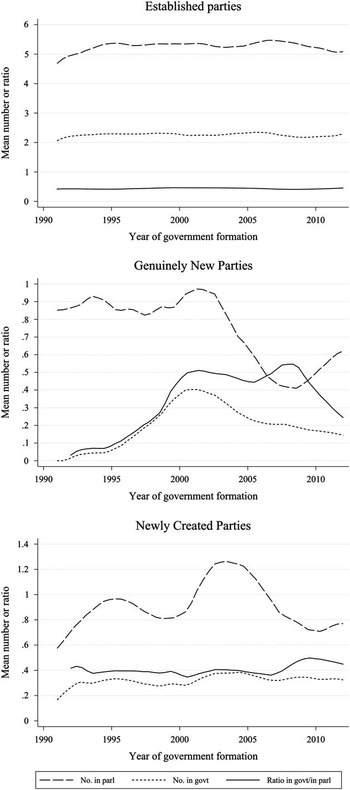
Variation over time is equally relevant. One might suspect that new parties were most common in the early years after regime change, but Figure 1 shows that this is not the case. At the top it displays smoothed graphs of the number of EPs in parliament and government as well as the ratio of government participation. These baseline figures barely change over the years. Things look different for the GNPs in the middle panel. From a high level of almost one GNP per legislature, parliamentary representation decreased sharply after 2002, but recovered in recent years. Government participation also peaked around 2002 and still remains higher than in the first years after democratization. The graphs for the NCPs in the lower panel are even more stable. In certain periods, GNPs (2000–2002, 2007–2008) and NCPs (2009–2011) even reached the participation ratio of EPs. New party presence is thus not easily explained as a ‘childhood disease’ of postcommunist democracy. More systematic factors must be explored to explain which new parties play a role in government formation.
Party types in parliament and government over time.

Variables
Our unit of analysis is the party represented in parliament at the time of government formation, and the dependent variable is a dummy denoting parties included in government. This approach stands in a tradition that is interested in individual government parties (e.g. Warwick, Reference Warwick1996; Druckman and Roberts, Reference Druckman and Roberts2007; Tavits, Reference Tavits2008; Döring and Hellström, Reference Döring and Hellström2013); it differs from methodology serving to predict whole coalitions (e.g. Martin and Stevenson, Reference Martin and Stevenson2001; Glasgow et al., Reference Glasgow, Golder and Golder2012).
The main independent variables are simple dummies for GNPs and NCPs. The effects of these predictors can be interpreted in relation to EPs, the reference category. A negative effect for the GNP dummy would thus mean that GNPs have a lower likelihood of government participation than EPs, all else equal.
‘Newness’ is certainly not the only party attribute that affects the likelihood of government participation. Three groups of variables stand out in the standard literature: numeric attributes, ideological attributes, and contextual factors.
Concerning the numeric attributes, larger parties in terms of parliamentary seat shares should have a higher chance of entering government.Footnote 11 Data for seat shares were taken from Stojarová et al. (Reference Stojarová, Šedo, Kopeček and Chytilek2007) and updated from the database of the Inter-Parliamentary Union. In addition, our model includes dummies for the largest party and for the occasional party with an absolute majority in parliament.
The ideological dimension of our model requires data on extremist (vs. non-extremist) orientation of parliamentary parties. For this purpose, we rely on an extant classification of party families that codes communist parties and right-wing/nationalist parties as extremist (Klingemann and Hofferbert, Reference Klingemann and Hofferbert2000). Similarly, CSPs are also less likely to participate in governing coalitions, given the salience of the ‘regime divide’ in the CEE context (Grzymala-Busse, Reference Grzymała-Busse2001; Druckman and Roberts, Reference Druckman and Roberts2007). We include a dummy for each of these party families, with mergers involving a CSP coded as 0.5.Footnote 12 Data are from Bozóki and Ishiyama (Reference Bozóki and Ishiyama2002), Armingeon and Careja (Reference Armingeon and Careja2008), and Grotz and Müller-Rommel (Reference Grotz and Müller-Rommel2011).Footnote 13
Context factors may include institutions (e.g. the electoral threshold, investiture requirements) or political culture (e.g. cleavage structures). Although such factors are important for government formation, they are not of direct interest for our study of party attributes. This is why we preferred to model context features using fixed country effects. We can thus exclude the possibility that new parties appear to be handicapped because they tend to get elected in countries with low general levels of inclusiveness in government formation.
Descriptive statistics for all variables are in the online appendix.
Statistical approach
Our dependent variable, government participation, is a binary measure that will be estimated using probit regression. Two statistical problems need to be addressed: potential selection bias due to new party success, and dependence of party observations within parliaments.
Concerning the problem of selection, 30 out of the 122 cases of government formation in our data set do not feature any new parties in parliament. Our research question is obviously not relevant for these observations. Simply dropping them, however, could introduce bias because electoral success of new parties is unlikely to occur randomly but, rather, under certain circumstances. To account for this selection effect, we use Heckman’s (Reference Heckman1976) two-stage correction method. In a first stage, we estimate a probit model of whether a parliament contains at least one new party. A transformed prediction of this model is then added as a control variable to the second-stage model of government participation.Footnote 14
To predict new party representation, we draw on several election-level variables: mode of government formation (after regular elections, after early elections, or during term), economic performance (growth, unemployment change, inflation), party-system turnover (mean seat share controlled by new parties in previous parliaments), turnout in the last election, a time trend, EU membership, and country dummies. Note, however, that we are not so much interested in these variables themselves but rather in their contribution to the Heckman correction. The first-stage regression table is included in the online appendix.
The second statistical problem, dependence of party observations within parliaments, reflects that the chances of government participation of each party are affected by the other parties in parliament. This implies that not all parties will be in government at the same time, and that certain parties are more likely to enter coalitions with specific partners rather than with others. Of course, strategic advantages and disadvantages even out in a large sample and we do not need to worry about possible bias given our government-level N of 122. However, statistical significance may still be overestimated due to possible within-parliament correlations. Cluster-robust standard errors are reported to correct for this.Footnote 15
To ease interpretation of the model parameters, we will report conditional marginal effects. These can be interpreted as the change in probability of government participation associated with a one-point change of the independent variable, estimated for those cases with at least one new party in parliament. Effects are averaged across the sample.Footnote 16
Multivariate results
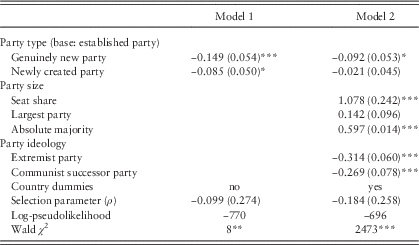
Table 2 shows the regression results for the second-stage (government participation) equation of the Heckman model. Model 1 just contains dummies for GNPs and NCPs. The differences in the likelihood of government participation reported above are substantially confirmed and statistically significant. EPs have the highest likelihood, followed by NCPs with a handicap of 8.5% and GNPs with 14.9% (Hypothesis 1 is confirmed).
Heckman models of government participation

Conditional marginal effects with robust standard errors clustered by formation in parentheses.
N=844 (second stage 680). 122 clusters. First-stage results are in the online appendix.
Significance: *<0.1; **<0.05; ***<0.01.
Model 2 adds the control variables. Their effects are as expected: extremist parties and CSPs have a handicap of 31% and 27%, respectively. Each percent of parliamentary seats increases the likelihood of government participation by a good percent, the largest party receives an extra bonus of 14% (although not significant), and the absolute majority comes with a bonus of another 60%.Footnote 17 Although the latter two variables depend on seat share, they express qualitative distinctions that the linear size effect cannot capture. The seat share effect is therefore controlled for these distinctions and can be interpreted independently of them, and, vice versa, largest party and majority status can be interpreted independently of raw seat share.
While the effects of the controls are satisfying, we are more interested in the consequences for the newcomer handicap. These are quite sizable: the handicap for NCPs vanishes almost entirely (Hypothesis 1 is further confirmed), and the handicap for GNPs is reduced by almost 40%. This means that a good part of the newcomer handicap is indeed not due to newness itself but due to other attributes. New parties are smaller on average and more often have an extremist ideology.Footnote 18 For NCPs this is the only source of the handicap, and for GNPs it almost matches the proper newness effect. Overall, these results mean that large, moderate newcomers have a decent chance of government participation, whereas extremist newcomers with few seats in parliament are disadvantaged. However, the same applies to EPs with comparable attributes: small and extremist parties are always disadvantaged when it comes to government formation, no matter whether they are new or established.
As yet we have assumed that the effects of the controls are the same for all party types. Our third model relaxes this assumption for seat share and largest party in parliament. Multiplicative interaction terms of each of these variables with the GNP and NCP dummies are added to Model 2. Through the interaction terms, the effect for new parties may deviate from the baseline effect for EPs.
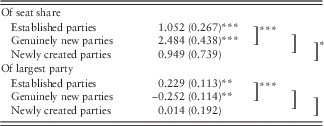
The challenges of interpreting raw interaction effects are well known in the discipline (Brambor et al., Reference Brambor, Clark and Golder2006). We calculated, for each of the three party types, the overall marginal effect of each of the two variables, as shown in Table 3.Footnote 19 Significance tests were run for each of the resulting figures and for all pairings.

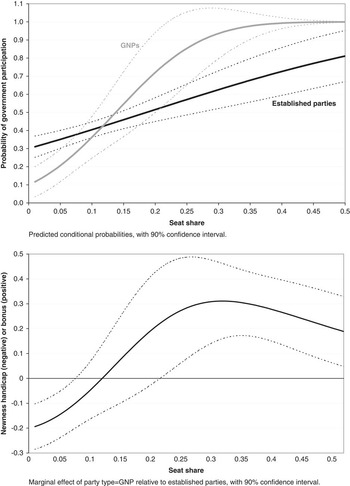
The results in Table 3 show clear differences between party types. The effect of seat share is almost three times higher for GNPs than for NCPs and EPs. Each percent of the seats increases the likelihood of government participation of a GNP by about 2.5%, as compared with 1% for the others.Footnote 20 This means that GNPs depend on parliamentary size to an exceptional extent (Hypothesis 2 is confirmed). Small GNPs have virtually no chance of being included in government. The larger the party, however, the more the size effect works in its favor.
The interaction of party type with seat share can also be viewed from the other side, by asking: how does the newness effect vary by party size? Figure 2 shows the full pattern. The upper panel compares predicted probabilities of government participation for EPs and GNPs, contingent on seat share (the graph for NCPs is omitted as it is virtually identical to that of EPs). The lower panel shows the marginal effect of GNPs relative to EPs (i.e. the difference between the two graphs in the upper panel). For GNPs with a seat share of <8%, we find a significant newcomer handicap of up to 20%. In contrast, GNPs >20% receive a significant newcomer bonus of up to 31%. The best estimate of the point where the handicap turns into a bonus is 11% seat share.
How the newness effect depends on seat share. GNPs=genuinely new parties.

The mechanisms behind this pattern can be illustrated with individual cases. Let us begin with the first example mentioned in the introduction. After the 2010 Czech elections, the Social Democrats (ČSSD) became the largest party with 28% of the seats. Nevertheless, the second-placed Civic-Democratic Party (ODS; 26.5%) succeeded in forming a minimal-winning coalition with two newcomers: TOP 09 (20.5%) and Public Affairs (VV; 12.0%). While the former was a splinter of the Christian-Democratic Party (KDU-ČSL) and regarded as the natural ally of the conservative ODS, the VV had entered parliament as a GNP on an anti-corruption platform. ‘Thus, it was hard to pinpoint their particular ideological placement and what type of coalition partner they would be’ (Stegmaier and Vlachová, Reference Stegmaier and Vlachová2011: 240). However, given the strong negotiating power due to its seat share,Footnote 21 the VV seized the opportunity to join a government with the two-center-right parties. This coincided with the aim of ODS and TOP 09 to keep the Social Democrats out of cabinet. Moreover, they obviously saw a chance to contain the new contender by ‘embracing’ it in a government coalition. In fact, the corruption scandals that emerged within the VV after the cabinet’s inauguration, and caused serious intra-party struggles, were allegedly promoted by ODS and TOP 09 politicians who ‘had intentionally worked on splitting the party’ (Linek, Reference Linek2012: 78). This strategy was eventually successful when in March 2012 some VV deputies seceded from their faction and founded a new party called LIDEM.
Another example of a large GNP entering government is the Slovakian case, also mentioned above. Here, a GNP called Freedom and Solidarity (SaS) had emerged before the 2010 elections on an anti-establishment platform and became the third largest party with 14.7% of the seats. As going into opposition would have meant ignoring this mandate, the SaS was inclined to remove the governing Social Democrats (SMER-SD) from office. This intention perfectly matched with the interests of the established center-right parties, that is, the SDKÚ-DS (18.7%), the KDH (10.0%), and the Hungarian minority party (Most-Híd; 8.0%). Including the SaS would not only provide them with a parliamentary majority against the dominant Social Democrats (41.8%), but also afford an opportunity to ‘disenchant’ the newcomer that had performed particularly well among liberal-oriented first-time voters and was thus considered a major challenger in the rightist spectrum (Malová and Učeň, Reference Malová and Učeň.2011: 1125). Given these converging interests, the four parties ‘were able to agree on cooperation even before receiving the formal presidential invitation to begin negotiations’ (Deegan-Krause and Haughton, Reference Deegan-Krause and Haughton2012: 224).
The handicap of small GNPs can be illustrated by an Estonian case. After the 2007 parliamentary elections, the victorious Reform Party (RE; 30.7% of the seats) under Prime Minister Ansip turned to the Social Democrats (SDE; 17.8%) and the Pro Patria and Res Publica Union (IRL; 9.9%) to form a minimal-winning coalition. This choice was quite obvious since it ‘essentially replicate[d] the center-right coalition that had governed Estonia from 1999 to early 2002’ (Pettai, Reference Pettai2008: 965). During the negotiations, Ansip pretended to enlarge the coalition with the Green Party (ER) that had entered parliament for the first time. Eventually, this plan was not realized because Ansip’s real intention had been to gain leverage against the Social Democrats (Pettai, Reference Pettai2008). The small newcomer (5.9%) was not sincerely considered an attractive partner but only used as ‘pawn’ in the coalition game.
In a similar vein, the 2012 government in Lithuania – the third case highlighted in the introduction – was negotiated exclusively among EPs. Here, the Social Democrats (LDSP; 27.1% of the seats) proposed a minimal-winning coalition with the populist Labour Party (DP; 20.7%) and the national-liberal Order and Justice Party (TT; 7.9%). Although the inclusion of the DP was heavily opposed by President Grybauskaitė, LDSP leader Butkevičius had the uneasy alliance approved by parliament after the Polish minority party (LLRA; 5.7%) was included to provide the government with a safety margin. According to political observers, this oversized coalition was the only viable choice for the LDSP since cooperation with other parties would have triggered ‘even more complications’ (Vireliūnaitė, Reference Vireliūnaitė2012). This especially applied to the anti-corruption party Way of Courage (DK): with even fewer seats than the LLRA (5.0%) the GNP was not considered a potential partner at any point.
Returning to Figure 2, note that the probability of government participation approaches 100% for very large GNPs. However, this is countered by the largest party effect hypothesized in Hypothesis 3. The interactions of party type with the dummy for the largest party are shown in the lower part of Table 3. For EPs we find the intuitive positive effect (now also statistically significant, unlike in Model 2). If an EP is the largest party in parliament, it is 23% more likely to enter government, over and above its basic seat share advantage. For GNPs, however, the effect is exactly reversed. If a GNP is the largest party, which happened on 12 occasions, it is 25% less likely to enter government (Hypothesis 3 is confirmed). For NCPs there is no effect.
When interpreting the largest party handicap for GNPs, one should keep in mind that the parties concerned benefit from the substantial size effect before the largest party handicap comes into play. For example, a GNP that commands 30% of the seats is about 57% more likely to enter government than a GNP with 10% of the seats (cf. the upper panel of Figure 2). If the former party is also the largest in parliament, this bonus is indeed reduced by 25%, but not completely erased. Still, the optimum position for a GNP to get into government is to rank second in size to one of the competing parties.Footnote 22
The overall pattern supports our expectations that a strong electoral mandate motivates GNPs to enter government immediately, and potential coalition partners strive to contain the new competitor in view of the next elections. Once a GNP dominates the party system, however, EPs will think twice before they put up with the uncertainty of joining a newcomer-led government as junior partners.Footnote 23
An illustration for the latter mechanism is found in Slovenia after the 2011 elections – the last case mentioned in the introduction. During the heavy economic and financial crisis, the incumbent government parties experienced a serious defeat, losing about two-thirds of their votes. The main winner was a GNP called Positive Slovenia that had been founded by capital mayor and successful businessman, Zoran Janković, only 2 months before the polls. As leader of the largest party (with 31.1% of the seats), Janković pursued building a coalition government. However, the other parties were not willing to join a cabinet led by PS, the more so as the charismatic businessman ‘lacked the necessary experience of deal-making and compromise’ (Haughton and Krašovec, Reference Haughton and Krašovec2013: 3). Finally the second-placed Slovenian Democratic Party (SDS) (28.9%) convinced four smaller parties of different ideological stances to form an oversized coalition without the victorious newcomer.Footnote 24
A slightly different case in point is the Estonian party Res Publica (ResP) that emerged before the 2003 elections. Tied with the Center Party (KeE) in terms of seats (27.7% each), ResP leader Parts, on the election night, seized the initiative to form a government. Since the KeE precluded any cooperation with the new competitor, the third-placed RE saw the opportunity of pushing its policy agenda in a coalition with the inexperienced ResP (Taagepera, Reference Taagepera2006: 82). Thus, a three-party government of ResP, RE, and the rural-based People’s Union (RL) was installed with Parts as Prime Minister. However, coalition governance was characterized by permanent tensions between ResP and RE that were mainly ascribed to ResP’s leaders behaving like ‘arrogant youngsters who often shifted course and acted as if all wisdom was contained in their heads’ (Taagepera, Reference Taagepera2006: 89). When RE supported a vote of no-confidence against a ResP minister, Parts took this as reason to step down. Thereafter, the RE allied with KeE for a remake of the pre-2003 government. Although having ‘diametrically opposing views’ on key policies (Pettai, Reference Pettai2006: 1096), this tried and tested coalition survived until regular elections. In sum, the early government exit of the victorious newcomer was driven by the major EPs, and by the new party itself, because continuing the joint cabinet would have been high risk for both sides in view of ResP’s heavily declining public support.Footnote 25
There are also cases in CEE where a GNP became the largest party in parliament and did enter government. However, even then, a closer look uncovers a newcomer handicap. A telling example is Lithuania after the 2004 elections, where the genuinely new Labor Party (DP) emerged as strongest party with 27.7% of the seats. EPs of different ideological stances, including the Social Democrats (LSDP), the Social Liberals, the Liberal and Center Union, and the Conservatives, at first intended to build a ‘rainbow coalition’ to prevent the victorious newcomer from taking over the government (Jurkynas, Reference Jurkynas2005: 775). In the end, however, the LSDP and the Social Liberals were wooed away by the DP to form a joint government – at an extraordinarily high price: with only half of the seats (14.2%), the LSDP received the same five portfolios as the DP and, additionally, got to nominate the Prime Minister; the Social Liberals (7.7%) were assigned two portfolios. Although a systematic examination is beyond our current scope, this case suggests that the newcomer handicap may be compensated when the specifics of the coalition agreement are taken into account.
Conclusion
Are parliamentary newcomers in CEE systematically handicapped when it comes to government formation? This question requires a differentiated answer. On the one hand, newness is not a categorical reason for exclusion from government. The fact that GNPs do not enter cabinets as often as EPs is not only due to their newness but also due to more ‘conventional’ party attributes, such as smallness and extremist orientation. On the other hand, newness-induced uncertainty significantly affects the mechanics of government formation in CEE countries. We found that coalition membership is particularly rare for small GNPs, but from a certain size on (about 11% of the seats in parliament) the newcomer handicap actually turns into a bonus. Then again, being the largest party in parliament is detrimental for the newcomers’ chances to enter government.
These findings have several important implications.
First, new party presence in CEE parliaments has substantially affected the governmental level. From the perspective of normative democratic theory, this is certainly good news. Since new parties account for almost one-fourth of all parties in CEE parliaments, their systematic exclusion would be detrimental to democratic inclusiveness and often require the formation of suboptimal coalitions among EPs. The young democracies of CEE appear to have largely overcome these perils.
Second, our findings demonstrate that the party classifications proposed in the literature on CEE party systems (e.g. Sikk, Reference Sikk2005; Tavits, Reference Tavits2007) have important implications for models of actual party behavior. We have shown that GNPs play a distinct role in government formation while NCPs do not systematically differ from EPs in that respect. Studies of coalition behavior in CEE, and of party politics more broadly, should continue to disentangle the concept of ‘new party,’ distinguishing between GNPs and NCPs.
The third implication is of a more theoretical nature. We have demonstrated that newness-induced uncertainty can lead either to a newcomer handicap or to a newcomer bonus, depending on the party’s parliamentary size and relative strength. In other words, ‘problematic’ newness and ‘favorable’ seat share interact in government formation. This is an intriguing parallel with a recent analysis of government stability in CEE: according to Grotz and Weber (Reference Grotz and Weber2012), the varying duration of CEE governments is not explained by the mere sum of ‘positive’ and ‘negative’ party attributes but rather by their specific constellations. Theoretically ‘optimal’ coalition features such as ideological homogeneity and limited numerical format promote government survival only up to a point, whereas theoretically detrimental features are most harmful when occurring in combination. Analogically, our analysis shows that sheer size compensates for the handicap of new parties in government formation only up to a point, and different handicaps – such as small size and newness – reinforce each other.
Analyzing party attributes in constellations might also pave the way for further research on new parties in CEE governments. For example, one could examine the interaction between newness of a party and its ideological proximity to (potential) coalition partners. We also need to understand how government participation of new parties is affected by further government and opposition characteristics. Interestingly enough, GNPs in CEE have been relatively often represented in oversized coalitions but not in minority governments (Grotz and Weber, Reference Grotz and Weber2013). This indicates that newcomers may also affect the type of government formed. Moreover, scholars could explore how the distinct role of new parties in coalition politics develops over time, as newcomers become established players and uncertainty vanishes.Footnote 26 And, finally, in-depth case studies and analysis of public opinion data could investigate in more detail to what degree the strategies of EPs determine new party inclusion and to what degree new parties themselves are sensitive to uncertainty in terms of office, policy, and votes.
Overall, our study shows that government access of new parties is filtered by the specific logic of coalition formation, but our normative ‘null hypothesis’ – that new parties have to become part of the political establishment before they get to decide on policy – was rejected. Given the often unusual levels of party-system volatility in CEE, the implications of these findings for democratic regimes elsewhere may still be considered limited. However, prominent cases such as the recent realignment in Israeli politics due to the new party Yesh Atid attest to the generality of our model.Footnote 27 Moreover, as volatility in Western Europe is on the rise (Lane and Ersson, Reference Lane and Ersson2007) and new parties become more common,Footnote 28 newness-induced information uncertainty, also there, will increasingly pose challenges to the protagonists of coalition negotiations as well as to scholars seeking to understand the mechanics of government formation. The lessons learnt in the CEE context may provide guidance in this process.
Acknowledgments
The authors are grateful for helpful comments from Raimondas Ibenskas, Olena Nikolayenko, Jennifer Smith, and the anonymous reviewers. Earlier version of this paper were presented at APSA 2013, MPSA 2013, Leuphana University Luneburg, and the University of Vienna.
Supplementary material
To view supplementary material for this article, please visit http://dx.doi.org/10.1017/S1755773915000120.