Introduction
Grammatical gender has been a long-recognized hurdle in L2 acquisition. Numerous research studies as well as classroom experience have revealed persistent difficulties with gender processing and acquisition even by advanced learners (e.g., Franceschina, Reference Franceschina2005; Hopp, Reference Hopp2016), especially in languages where word form properties do not represent reliable gender cues.
According to the assumption of present models of L2 gender acquisition (e.g., Bordag & Pechmann, Reference Bordag and Pechmann2007), grammatical gender is represented as a set of generic gender nodes at the level of grammatical encoding (Levelt, Roelofs & Meyer, Reference Levelt, Roelofs and Meyer1999; Dell, Reference Dell1986; Caramazza, Reference Caramazza1997; De Bot, Reference De Bot1992). Each noun lemma has to be connected to the corresponding gender node, so that the gender information can be retrieved when needed. L2 learners thus not only need to establish a gender representation network that corresponds to the L2 gender system, but also appropriate links to individual noun lemmas. Previous research (Bordag & Pechmann, Reference Bordag and Pechmann2007) indicates that learners use various types of available information (e.g., phonological word form or L1 gender if available) to derive the L2 gender. Since gender transparency of word forms is typically quite limited, it is especially the morphosyntactic information in the input that, if correctly interpreted, allows a reliable gender inference and thus plays a crucial role in its incidental acquisition.
However, earlier studies have shown that L2 learners are less sensitive than native speakers to gender agreement within noun phrases containing determiners or adjectives (e.g., Lew-Williams, Reference Lew-Williams2009; Guillelmon & Grosjean, Reference Guillelmon and Grosjean2001). Even the ability of near-native speakers to use the predictive function of gender agreement for highly familiar L2 words seems reduced when their L1 does not encode gender (e.g., Grüter, Lew-Williams & Fernald, Reference Grüter, Lew-Williams and Fernald2012, though see also Dussias, Valdés Kroff, Guzzardo Tamargo & Gerfen, Reference Dussias, Valdés Kroff, Guzzardo Tamargo and Gerfen2013, who show, in a visual world paradigm study, that highly proficient L1 English learners of L2 Spanish were able to use gender cues of an article to anticipate the upcoming noun in a manner similar to native speakers). To our knowledge, there has not been any study that would explore whether and how the limited sensitivity of L2 learners to gender agreement affects its incidental acquisition. Are L2 learners able to infer grammatical gender from a morphosyntactic context of an unknown noun and create a corresponding link between the newly established noun representation and the corresponding gender node after just a few occurrences in a text, or is extensive exposure and/or explicit learning required?
The current study explores the initial stages of incidental acquisition of grammatical gender during reading in L2 German. For advanced learners, reading represents one of the main sources for accumulating vocabulary knowledge, including its grammar components. However, most research on incidental grammar acquisition has focused on statistical grammar learning in artificial languages by beginning learners (e.g., Saffran, Reference Saffran2001; for an overview see Folia, Uddén, de Vries, Forkstam & Petersson, Reference Folia, Uddén, De Vries, Forkstam and Petersson2010). One of the few studies addressing incidental grammar acquisition by advanced learners is Bordag, Kirschenbaum, Opitz, Rogahn, and Tschirner (Reference Bordag, Kirschenbaum, Opitz, Rogahn and Tschirner2016). The authors used an adapted version of the self-paced reading-(SPR-)task to explore how advanced German learners acquire grammatical properties of novel verbs (subcategorization and (ir)regularity) from short texts. In the present study, we employed a similar methodology to address the ability of L2 learners to extract information about grammatical gender from the syntactic context (i.e., agreement) of novel nouns and to store such information in memory (Experiment 1). Furthermore, we also used the methodology to assess differences in the incidental acquisition potential of the three genders, masculine, feminine, and neuter (Experiment 2).
Gender in German
German has a threefold gender system and distinguishes between masculine, feminine, and neuter nouns. With respect to their frequency, feminine and masculine nouns make up roughly equal proportions among monomorphemic nouns, while neuter nouns are less frequent (42.2% feminine, 37% masculine, and 20.8% neuter nouns, cf. Hobert, 2005). Some authors report a bias towards assigning a masculine (or neuter) gender to nontransparent nonword forms (Fries, Reference Fries1997; Steinmetz, Reference Steinmetz, Rauch and Carr2001; Hohlfeld, Reference Hohlfeld2006), while others report overgeneralizations of the feminine gender in both L1 (Mills, Reference Mills1986) and L2 (Bordag, 2006) acquisition. Overall, there is neither clear evidence that there is a default gender in German, nor clear indications which one it would be.
In contrast to, e.g., Romance languages where the clear majority of regular nouns exhibits morphophonological gender cues (e.g., -a for feminine nouns), the German gender assignment system is often considered arbitrary (Maratsos, Reference Maratsos1982; Carroll, Reference Carroll1989) and German is described as a language with “covert gender”, i.e., a language where the gender of noun is not predictable from its form (Corbett, Reference Corbett1991).
Despite the general agreement on low morphophonological transparency of German nouns with respect to grammatical gender, there are also works that show that the German gender assignment system is not as arbitrary as sometimes claimed. Köpcke and Zubin (Reference Köpcke and Zubin1984), Wegener (Reference Wegener1995), Müller (Reference Müller and Meisel1990), and Mills (Reference Mills1986) argue that the assignment system is to some degree based on rules and German gender should thus be considered semi-covert. According to these views, gender assignment in German can be considered a mixed system, where semantic, morphological, and phonological cues or rules with varying strength, cue validity, and scope interact (Wegener, Reference Wegener1995). While semantic and phonological (Köpcke & Zubin, Reference Köpcke, Zubin, Lang and Zifonun1996; Köpcke, Reference Köpcke1982) cues are notoriously vague, with limited scope and many (often frequent) exceptions (e.g., all alcoholic beverages are masculine, except Bier ‘beer’ which is neuter; monomorphemic nouns ending with –e are typically feminine, but e.g., Käse ‘cheese’ is masculine and Auge ‘eye’ is neuter); morphological cues, in contrast, often exhibit stronger cue validity with fewer or no exceptions. This concerns, e.g., certain affixes such as –ung or –keit which unambiguously mark feminine gender or –us and –or marking masculine.
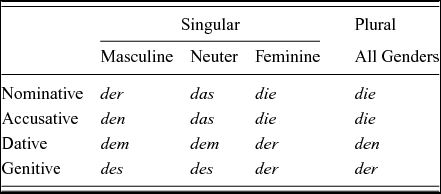
Rather than on the noun itself, German gender is primarily marked through agreement on indefinite and definite determiners, demonstratives, possessives, numerals and inflectional affixes on preceding adjectives. These syntactic gender cues are however not unambiguous either: The inflectional system of German is fusional, so that several grammatical functions typically accumulate on a single inflectional morpheme. One ending thus does not express solely gender, but also case and number (diesen Löffel – thismasc.sgl.acc spoon). In addition, there are also many instances of syncretism in the German inflectional paradigm: As an example, one form of the definite determiner can show up in distinct morphosyntactic configurations. As illustrated in Table 1, the form dem, e.g., is used in dative singular contexts for both masculine and neuter nouns whereas feminine nouns have a distinct form of the determiner, i.e., der, in dative singular contexts. The form der, however, is also used in masculine nominative singular, feminine genitive singular, and genitive plural contexts.
Paradigm of the German definite determiner

Current approaches to German morphology assume different degrees of feature specification for phrases containing nouns of the three genders based on the syncretism in the inflectional paradigm (cf. Blevins, Reference Blevins1995). In order to give an adequate account of the distributional patterns of syncretic forms in the paradigms, almost all current morphological frameworks make use of the concept of underspecification. The overall idea behind this concept is that traditional instances of grammatical categories, such as ‘feminine’, ‘neuter’, or ‘masculine’ can be replaced by combinations of more abstract, binary features such as [± feminine] and [± masculine]. The three genders in German could thus be described by using these two binary features as [+ feminine, - masculine] for feminine, [- feminine, + masculine] for masculine, and [- feminine, - masculine] for neuter.
Actual instances of feature specifications for, e.g., morphemes of the adjectival inflection in German, differ among alternative analyses (cf. Bierwisch, Reference Bierwisch1967, Blevins, Reference Blevins1995, Wunderlich, Reference Wunderlich, Dürscheid, Ramers and Schwarz1997, and Wiese, Reference Wiese1999). What is, however, common to all of them is that inflectional markers differ with respect to their specificity, i.e., the number of inherent features. Based on such decomposition-based analyses, differences can be identified between the three genders: The morphological markers appearing in the feminine inflectional paradigm display overall a smaller degree of specificity, i.e., they represent a relatively small set of features (such as the ending –e with no feature at all [ ]). In contrast, endings appearing in the neuter inflectional paradigm are more specific, i.e., they represent more features (such as the ending –(e)s with the feature [–feminine] in nominative and accusative or [–feminine, +oblique] in genitive singular). The neuter forms are again less specific than inflectional forms appearing in the masculine paradigm which are among the most specified markers, representing relatively large feature sets (such as the ending –(e)n [+masculine, –feminine, +object, –oblique] in accusative singular) (see Blevins, Reference Blevins1995 and Opitz, Regel, Müller & Friederici, Reference Opitz, Regel, Müller and Friederici2013 for more detail).
According to these assumptions, Opitz et al. (Reference Opitz, Regel, Müller and Friederici2013) and Opitz and Pechmann (Reference Opitz and Pechmann2016) argue that relatively more features are involved whenever agreement relations in phrases containing a masculine noun have to be processed, compared to the processing of feminine or neuter phrases. From this perspective, regardless of whether there is a default gender in German as such, the inflectional paradigm favors feminine (and to lesser degree neuter) over masculine agreement by means of computational complexity (see Discussion for more detail).
In sum, German gender is expressed through a rather complex system of morphophonological, semantic, and syntactic markings and despite various attempts to grasp them linguistically, from the learner's perspective German gender assignment is mostly viewed as arbitrary. The gender of the majority of German monomorphemic nouns thus has to be memorized and is typically learnt together with the noun in the L2 instruction. In a natural setting, where the gender feature needs to be extracted from the morphosyntactic context, its acquisition poses an even more complex and challenging task.
The present study: Empirical goals
The primary aim of the present study was to explore the ability of L2 learners to infer the information about grammatical gender from the syntactic context during reading and to store it in memory. Deficiencies in this ability could explain why L2 learners, contrary to L1 speakers, manifest continuous difficulties with gender acquisition and processing even at advanced stages (cf. Introduction).
Advanced German learners in our study read short passages that contained a novel noun (pseudowords replacing existing low-frequency nouns) presented in syntactic contexts that allowed an unambiguous inference of its grammatical gender. Each text was followed by several sentences, which participants read in a self-paced manner. One of them contained the novel noun in a gender-unambiguous syntactic context that was either congruent (i.e., compliant with the gender with which the noun was associated in the previous text) or incongruent. Reading times on the novel nouns in the two conditions were measured and compared. The rationale behind this approach was that if participants correctly inferred and at least temporarily stored the gender of the novel noun (i.e., established the link between the novel noun lemma and the corresponding gender node), they would respond to the gender agreement violation with longer reading latencies when compared to the congruent condition (gender incongruency effect, hereafter known as the ‘incongruency effect’).
In the following, we summarize the results of Experiment 1 and Experiment 2. In Experiment 1, we explore whether L2 learners are able to infer and store grammatical gender from just three occurrences in a text during reading in an L2. The null hypothesis was that L2 learners would not be sensitive enough to the morphosyntactic context of novel nouns to succeed in the incidental acquisition task. According to the alternative hypothesis, three occurrences of a novel noun within a gender unambiguous morphosyntactic context would be enough for advanced German learners to succeed in the initial acquisition stage. The alternative hypothesis was partially confirmed: The results of the SPR task revealed that participants correctly inferred and at least initially stored the grammatical gender of feminine (and tendentially neuter) nouns.
The materials in Experiment 2 were designed to specifically probe for acquisition differences between the three German genders. According to the null hypothesis, there is no difference in the acquisition potential between German masculine, feminine, and neuter genders and the differences observed in Experiment 1 were mere artefacts of the experimental design or task. The alternative hypothesis, which was confirmed by the results, stated that there is an acquisition advantage for feminine and neuter genders compared to the masculine gender, at least in an incidental acquisition setting.
Method
Participants
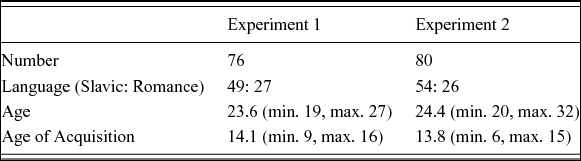
The participants’ data are summarized in Table 2. Most participants were exchange students at the University of Leipzig or students of German Studies at the Charles University in Prague. Their knowledge of German was at the B2 to C1 levels according to the European Framework of Reference for Languages (commonly C1 in the receptive skills and B2 in the productive ones).Footnote 1 Their native languages were Slavic (Czech, Russian, Polish, Ukrainian) or Romance (French, Spanish, Portuguese, Italian). All these languages have a grammatical gender system with gender agreement in the noun phrase. As mentioned in the introduction, L2 learners need to establish an L2 gender representation network that contains generic gender nodes that correspond to the genders of a given language. We assume that the establishment of the network as well as of necessary subroutines that operate on the level of grammatical encoding (e.g., to copy a gender feature from the head noun to a modifier, etc.) might profit from the existence of an analogical L1 system due to transfer. For this reason, we tested only participants whose L1s had a gender system.
Overview of the Participants in Experiment 1 and Experiment 2

Materials
Novel words
The novel word stimuli in our two studies (20 and 24 items, respectively) were created by first selecting existing low-frequency German words. These existing words were then replaced with pseudowords meant to have the same meaning as the existing words, but with a completely distinct, unknown phonological form. The selection of the low-frequency German words was thus necessary to obtain a collection of plausible meanings that could be inferred and around which we could base the experimental texts. The selected existing German nouns did not have any semantic properties that would bias towards a particular gender. Their average frequency-class was 16.2.Footnote 2 Post-tests revealed that the selected existing German nouns were mostly unknown to the participants and the participants were thus also unaware of their gender. Each noun was matched with a phonologically unrelated monomorphemic pseudoword, which was associated with two genders (e.g., Harke / i.e., ‘rake’ with “dermasc Zulst / diefem Zulst”) to create the novel words (see Appendix A). The associated genders were compliant with the phonological form of the pseudoword. The pseudowords were generated using the German software version of the Wuggy pseudoword generator (Keuleers & Brysbaert, Reference Keuleers and Brysbaert2010) or by analogy to existing nouns whose word form is compliant with two genders. None of the novel words contained a gender salient formal cue. In Experiment 1, eight masculine, eight feminine and four neuter novel words were employed (Σ=20) to reflect the actual proportion of noun genders in German. In Experiment 2, there were eight novel words for each gender (Σ=24) in order to have balanced data for all three genders.Footnote 3
Texts
Twenty short texts (ca. 100 words each) were constructed that allowed the inference of the meaning of each low frequency word, which was later replaced with a novel word. Each novel word appeared in the text three (Experiment 1) or four (Experiment 2) times, either in the nominative or in the accusative case singular, and always within an agreement context that reliably enabled gender identification (see Appendix B). The noun phrase in which the novel word was presented consisted of either a determiner + noun or a determiner + adjective + noun. Among the determiners were definite articles (der/den masc, die fem, das neut), indefinite articles (ein neut/masc, eine fem), demonstratives (e.g., dieser masc, diese fem, dieses neut), possessives, etc. The novel nouns appeared at least twice in the nominative case. The texts were written with the help of dictionary definitions of the low frequency words and their statistical co-occurrences using the Digitales Wörterbuch der Deutschen Sprache (DWDS)Footnote 4 corpus of the German language and the Leipzig Wortschatz Projekt.Footnote 5
Self-paced (SPR-) sentences
For each novel word, a pair of sentences was constructed, each containing a nominative or accusative noun phrase consisting of a definite article in its canonical form (der masc, die fem, das neut), an adjective, and the novel word. The sentences in each pair differed in that the definite article in the critical NP was either congruent with the gender of the novel word as presented in the text (congruent condition) or incongruent (incongruent condition). The gender assigned to the novel word in the incongruent condition was the one of the two compliant genders of the given pseudoword.
Example SPR-sentences for a text containing Zwep as a masculine noun:
a) congruent sentence
Die ganze Zeit lag der ekelige Zwep auf dem Teller neben den Kartoffeln.
‘The whole time themasc disgusting Zwep (i.e., gall bladder) was lying on the plate next to the potatoes.’
b) incongruent sentence
Die ganze Zeit lag das ekelige Zwep auf dem Teller neben den Kartoffeln.
‘The whole time theneut disgusting Zwep (i.e., gall bladder) was lying on the plate next to the potatoes.’
The novel word never appeared at the end of the sentence – it was always followed by at least three words. For each text, between zero and two filler SPR-sentences were constructed that were also related by topic, but only consisted of vocabulary typically known by the targeted learner group. Each participant read the SPR-sentence either in the congruent or in the incongruent condition.
Comprehension Statements
Comprehension statements referring to the content of one of the introductory texts or the SPR-sentences always followed the SPR-sentences and could be answered with a yes or no answer. Their purpose was to keep participants focused on the reading.
Procedure
Participants were given written instructions for the task they were asked to perform, explaining that they were to read the texts for comprehension and that comprehension statements would follow. They were also informed that the texts might contain unknown vocabulary from regional dialects or special registers but that they were to try to understand the text's meaning nonetheless. The experiment took about 35 minutes. The stimuli were presented using the E-Prime 2.0 software (Psychology Software Tools, Pittsburgh, PA).
The experimental session started with two practice trials. Each trial started with the presentation of an introductory text that included the novel word or a filler word. Participants read the text silently and pressed the space bar when they were finished. When pressing the space bar, a congruent, incongruent, or filler SPR-sentence appeared, initially with all words masked with Xs. When pressing the space bar further, the next word was revealed and the previous one was masked with Xs again (self-paced reading with a moving window; cf. Just, Carpenter & Woolley, Reference Just, Carpenter and Woolley1982).
Reading times were measured. The number of the SPR-sentences following each text varied between one to three. One of the sentences was always the critical sentence in the congruent or incongruent condition. After the presentation of the SPR-sentence(s), a comprehension statement referring to the introductory text appeared on the screen, and participants had to decide whether it was true or false by pressing one of the corresponding buttons. Each trial thus consisted of a text, the SPR-sentence(s) and a comprehension question. Six filler trials were also included at uneven intervals, and the first trial was always a filler trial. Each experimental list consisted of 20 trials and six filler trials in Experiment 1 and four more experimental trials in Experiment 2. The two gender conditions per novel word and the two congruency conditions in the SPR-sentences resulted in four complementary experimental lists. Each participant thus read each text only once in one of the four possible condition combinations, i.e., one of the experimental lists. Each list had two different randomizations. No more than three trials with the same answer to the comprehension statement or in the same congruency condition followed in succession.
Analyses
Reading times on the novel words in SPR-sentences were analyzed along similar lines as in Bordag et al. (Reference Bordag, Kirschenbaum, Opitz, Rogahn and Tschirner2016). ANOVAs with the factors Gender (masculine, feminine, neuter) and Congruency (congruent, incongruent) were performed for both Experiment 1 and Experiment 2. Values that deviated from participants’ mean reading times of the novel words by more than two standard deviations were removed from the analyses (3.8% in Experiment 1, 3.1% in Experiment 2). Because there were four different experimental lists, four participants with the same L1 and complementary experimental lists were analysed as a superparticipant.Footnote 6 The analyses were performed over the novel word and a spillover region comprising two following words. Since there were no significant effects (and also no systematic numerical tendencies) on the spillover regions, only the results for the novel words are reported below.
Results
Experiment 1
The ANOVAsFootnote 7 revealed a significant main effect for Gender: F1(2, 36) = 14.8, p < .001, η = .451; F2(2, 16) = 5.5, p = .019, η = .375 (see Figure 1). There was no significant effect for Congruency (F1(1,18) = 2.0, p = .174, η = .10; F2(1, 16) = 1.8, p = .197, η = .097). The Scheffé post-hoc test assessing differences between the three genders within the factor Gender showed that masculine nouns were read significantly faster (411.8 ms) than feminine (467.3 ms) and neuter ones (453.6 ms). Feminine and neuter nouns did not differ from each other. The most likely explanation for this effect is that there are differences between the pseudowords in the three gender groups, with masculines being the shortest (4.3 letter on average) and feminines longest (5.5 letters on average). The interaction between the factors Gender and Congruency was also significant: F1(2, 36) = 5.4, p = .009, η = .229; F2(2, 16) = 4.0, p = .039, η = .325). The subsequent t-tests revealed that the incongruency effect was only observed for feminine nouns (t1(1,18) = 2.290, p = .034; t2(7) = 2.649, p = .033), but not for masculine (t1(1,18) = 1.281, p = .216; t2(7) = 1.624, p = .148) or neuter ones (t1(18) = 1.644, p = .118; t2(3) = .692, p = .539). However, caution must be taken in the case of non-significant results for the neuter nouns, since there were only four in the experiment. The numerical differences indicate a similar pattern of results for feminine and neuter nouns (incongruency effect, i.e., slower RTs in the incongruent condition: 38.8 ms and 19.2 ms, respectively) as opposed to masculine nouns, which showed a numerical tendency in the opposite direction and were 17.5 ms faster in the incongruent condition.
Mean reaction times (in ms), corresponding standard deviation, and percentage of valid values (i.e. number of data points after cutoff), for each of the genders (feminine [F], masculine [M], neutral [N]) in Experiment 1.

Based on the data, we can reject the null hypothesis claiming that L2 learners are not sensitive enough to gender agreement cues to be able to acquire gender incidentally from just three occurrences in a text. However, the alternative hypothesis could be confirmed only partially. The data reveal that participants responded differently to the gender agreement violations of the three genders in the SPR-sentences, showing a reliable incongruency effect (and thus indications for an acquisition of gender) only for feminine nouns. Because the original focus of Experiment 1 was on the overall ability of the L2 learners to acquire gender incidentally from a syntactic context (and on the initial stages of this process, in particular), the materials were not completely balanced for the individual genders. There were only four neuter nouns, while there were eight masculine and feminine nouns. In addition, while the novel words were selected in such a way that they would meet the criteria described in Materials, no test was performed to validate this. In order to exclude the possibility that the differences between the genders were an artefact of the employed materials, we designed Experiment 2, in which all critical aspects were carefully controlled and subjective perceptions of the novel words’ gender were taken into account by a preceding rating study.
Experiment 2
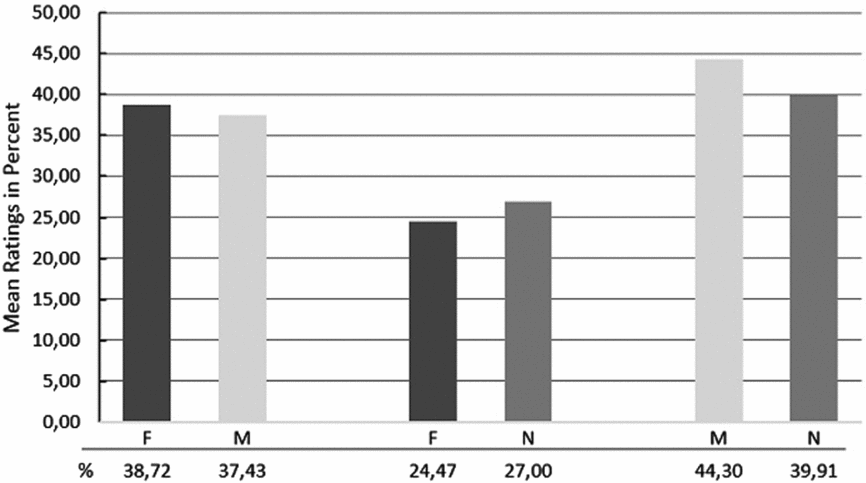
The primarily aim of Experiment 2 was to explore the differences in the acquisition potential of the three German genders in incidental acquisition. Experiment 2 differed from Experiment 1 in two respects. First, each novel word appeared four times, so that the text passages were slightly longer (M = 102.4 vs. M = 95.1 in Experiment 1). This was done to create better acquisition conditions under which the primary research question concerning the differences in the acquisition potential of the three genders could be more adequately assessed. Second, a different set of 24 novel words (vs. 20 in the previous study) was used. Their selection was based on a rating study with 30 L1 German undergraduate students, in which ratings on 48 pseudowords and 6 filler items (pseudowords with suffixes that act as transparent gender cues) were obtained. In German, there are some nouns with two permissible genders (e.g., der masc / das neut Mus - ‘mash’) and some word forms with two genders signifying two different meanings (e.g., der masc Kiefer - ‘jaw’, die fem Kiefer - ‘pine tree’). Where possible, pseudowords were modeled on the example of such existing German words (e.g., “Wark” was modeled on Mark: das neut Mark – ‘marrow’, die fem Mark – ‘Mark’ (currency); see Eisenberg et al., Reference Eisenberg, Peters, Gallmann, Fabricius-Hansen, Nübling, Barz and Fiehler2005, pp. 228 for other examples of words with multiple genders). Though phonological correlations with “multiple-genderdness” have not been described previously, the approach that we cautiously took guarantees that, if they existed, our pseudowords complied with them. Participants rated the gender they would assign to the pseudowords on a four-point scale without knowing any of the words’ meaning. From the 48 pseudowords, 24 were selected that had similar ratings (see Figure 2) for at least two genders (p > .05) to create the novel words.
Gender combinations and their ratings for pseudowords used as novel words.

To further eliminate possible word form effects, half of the participants saw each novel word e.g., as a masculine word in the text and as a neuter one in the incongruent condition in the SPR-sentence, while the other half of the participants saw the same novel word as a neuter noun in the text and as a masculine one in the SPR-sentence. This approach also raised the number of different items presented with each gender in the whole experiment (24 novel words, 16 presented for each gender in pairings of eight, e.g., 16 different masculine nouns (eight per participant) with half of them feminine and half of them neuter in the incongruent SPR sentences).
Results
The ANOVAsFootnote 8 revealed that the main factor Congruency was not significant (F1(1, 19) = 3.1, p = .096, η = .139, F2(1, 15) = 1.4, p = .249, η = .088) and also the factor Gender was significant only in F1 (F1(2, 38) = 5.6, p = .007, η = .228), but not in F2 (F2(2, 22) = 1.56, p = .227, η = .094). The Scheffé test for F1 indicated that masculine nouns tended to be read faster (514.6 ms) than feminine nouns (544.1 ms), while neuter ones were not significantly different from either of them (529.0 ms). The Scheffé test for F2 revealed no significant differences between the three genders. The lack of significance of the factor Gender compared to Experiment 1 is most likely related to the better match in length of the pseudowords assigned to the three genders (the average length in letters was 4.8 for masculine, 5.0 for feminine and 5.1 for neuter nouns).
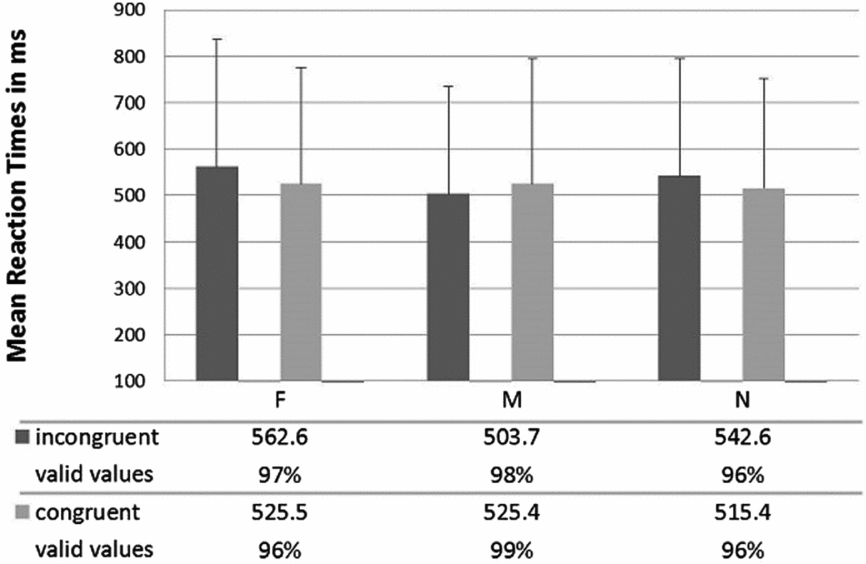
Crucially, the interaction between the factors Gender and Congruency was significant: (F1(2, 38) = 7.6, p = .002, η = 0.285; F2(2, 30) = 4.3, p = .023, η = .222). The subsequent t-tests confirmed that only feminine (t1(1,19) = 2.547, p = .026; t2(1,15) = 2.202, p = .041) and neuter nouns (t1(19) = 2.278, p = .037; t2(15) = 2.262, p = .042) exhibited the expected incongruency effect, while masculine nouns tended towards the opposite effect (i.e., incongruent < congruent), which however was significant only in t1 , but not in t2 (t1(1,19) = 2.167, p = .042; t2(15) = 1.092, p = .291)(see Figure 3).
Mean reaction times (in ms), corresponding standard deviation, and percentage of valid values (i.e. number of data points after cutoff), for each of the genders (feminine [F], masculine [M], neutral [N]) in Experiment 2.

The results of Experiment 2 with the carefully controlled new materials and design confirmed the tendencies in the findings of Experiment 1: Participants responded to gender agreement violations of feminine and neuter nouns, but no reliable differences were observed for masculine nouns. The null hypothesis claiming that there are no differences in the acquisition potentials between the three German genders could thus be rejected. The alternative hypothesis could be confirmed: Feminine and neuter nouns show better acquisition potential in incidental acquisition than masculine nouns.
In order to explore the lack of the incongruency effect for masculine nouns in more detail, we ran additional analyses for selected subgroups of masculine items. As described above, each text in the experiment included four NPs from which the gender of the novel noun could be reliably inferred. Since the NPs appeared both in nominative and accusative – and since masculine nouns have different determiner forms for these two cases (e.g., der vs. den) –, it could be the case that the difficulties with the acquisition of masculine nouns were related to the greater variance of determiner forms in the masculine NPs compared to the feminine and neuter ones. In order to test this hypothesis, we extracted two subgroups of masculine novel nouns that represented two extremes in the degree of the NP variance in the texts. Group 1 consisted of six novel masculine nouns that appeared in texts that contained at least three NPs in nominative and with the definite article der. Group 2 consisted of five novel masculine nouns that were presented in texts containing only two NPs in nominative from which both or only one contained the definite article der Footnote 9. Thus, the acquisition conditions for masculine nouns in Group 1 were equal to those of feminine and neuter nouns in Experiment 1 that appeared also three times.Footnote 10 If the acquisition difficulties would be due to the larger variance between determiner forms within the masculine NPs in our texts, we would expect that the acquisition potential of the three genders should be equal when context variables (such as determiner variance) were more balanced. The results of the additional analyses showed that this was not the case. The reversed incongruency effect for the masculine nouns from Group 2 was only by 8 ms larger than the reversed incongruency effect of masculine nouns from Group 1Footnote 11. These findings indicate that though input variance might play a role in the acquisition of the individual genders, it does not explain why learners do not manifest the same gender violation effect for masculine nouns acquired under comparable conditions like feminine and neuter nouns (see Discussion for more considerations about the tendency of masculine nouns towards a reversed incongruency effect).
In general, the results indicate that the advanced German learners in our studies were not only sensitive to gender agreement violations, but that their sensitivity to such violations already appeared after 3–4 exposures to a novel noun. At the same time the results also point to the fact that the inference and/or acquisition of grammatical gender information from the syntactic context during reading is gender specific: While clear gender violation effects were observed for feminine and neuter nouns, no such effects were observed for masculine nouns.
Discussion
This study contributes to previous discussions on the ability of L2 learners to acquire and process grammatical gender. The results reveal that advanced German learners with L1s that have a grammatical gender system are able to infer and acquire grammatical gender based on syntactic cues from just three to four occurrences of a novel noun in a text. Participants of our study showed corresponding responses to subsequent gender agreement violations under certain conditions and at least for feminine and neuter nouns. At the same time, it must be stressed that the present study focused only on the very initial stages of grammatical gender acquisition that include the inference of grammatical gender from the syntactic context and its subsequent initial storage in the memory. The incongruency effect that was observed for feminine and neuter nouns reveals that the first memory traces of the corresponding gender representation (e.g., in the form of weak links between the generic gender node and the lemma of the novel noun, cf. Bordag & Pechmann, Reference Bordag and Pechmann2007) had to be established. As a consequence, the incompatibility of the stored gender and the gender assigned to the novel noun in the gender incongruent condition could lead to the processing differences manifested through the violation effectFootnote 12. The advantage of the self-paced reading method is that it taps into the learners’ implicit knowledge – contrary to tests that would require explicit recall of particular grammatical features. It is thus able to discover evidence also for representation of knowledge that is not available (or not yet available) to the learner's consciousness. We can assume that this is the case for much of the initial knowledge that learners acquire incidentally during reading. With every subsequent exposure the memory trace grows stronger – if no next exposures appear, it again fades away from the memory.
To our knowledge, this study is also the first one that demonstrated differences in responses to gender agreement violations in L2 and, therefore, systematical differences in acquisition potentials of individual genders in the L2 incidental acquisition context. The different results for the three genders indicate that reduced sensitivity to syntactic violations might be gender-specific. In particular, masculine nouns exhibited different results from feminine and neuter nouns in terms of missing violation effects in the incongruent gender agreement and, in fact, a tendency towards a reverse effect.
Recently, first empirical evidence of differences in processing of masculine vs. feminine and neuter nouns has been reported also for L1 German. Seyboth, Blanken, Ehmann, Schwarz, and Bormann (Reference Seyboth, Blanken, Ehmann, Schwarz and Bormann2011) describe an aphasic native German speaker with a specific impairment of grammatical gender processing in masculine nouns but with largely preserved skills for feminine and neuter ones. This pattern occurred across a range of tasks in both oral and visual modalities. Opitz et al. (Reference Opitz, Regel, Müller and Friederici2013) report an ERP study that mirrors our results in that no LAN-effects (marking morphosyntactic violations) were observed for gender mismatches in phrases containing a masculine noun in contrast to the two other genders. Opitz and Pechmann (Reference Opitz and Pechmann2016) then report a series of behavioural experiments in which participants had to perform tasks such as grammaticality judgments, gender decisions and word category decisions. Their results in terms of reaction times and error rates indicate increased processing demands for masculine forms compared to feminine forms in L1 German.
The studies of Opitz and colleagues propose an interpretation of their L1 data that is theoretically grounded in morphological frameworks based on underspecification and which are also compatible with our L2 data. Following the reasoning along the underspecification approach, agreement relations in NPs containing a feminine or a neuter noun involve fewer features than those with a masculine noun as a head. Consequently, it can be assumed that the gender assignment should be easier for feminine and neuter nouns in incidental acquisition, because fewer features need to be processed in order to infer the gender from the syntactic context compared to the masculine nouns. Especially feminine NPs, in which feature specifications on their inflected forms are reduced to a minimum in German, should offer a particularly convenient condition for gender inference and/or acquisition, as manifested also in our study.
Several hypotheses can be formulated as to why the acquisition of a gender involving fewer agreement features might be easier, and more research is necessary to validate or reject them. We favor the assumption that successful feature processing precedes (and even is a condition for) the storage of the gender information. Yet, the more features that need to be processed, the greater the demands on the system processing capacity and the larger the chance that it will fail to process one or more of them. This scenario seems to be more likely at the very initial encounters with an unknown noun when additional processes (which might be prioritized) are involved as well, like the inference of the unknown word's meaning or storage of its word form. In addition, once the system is tuned to getting along with fewer features when processing feminine and neuter NPs, omitting a feature in contexts where more features are actually relevant seems more probable. Full or partial skipping of features during parsing can be also viewed as a manifestation of Shallow Processing (Clahsen & Felser, Reference Clahsen and Felser2006).
We hypothesize that the tendency towards faster reading times of masculine nouns in the incongruent condition compared to the congruent condition support these considerations too. It indicates that no gender information for these nouns (contrary to the neuter and feminine nouns) has been stored yet (by most participants) and therefore there is no conflict with the gender information on the inflectional affixes in the noun phrase. The reading times of masculine nouns thus reflect only the time needed to process the agreement features of the inflectional affixes (on an adjective and/or a determiner), not the incongruency effect. In the incongruent condition (feminine or neuter agreement) fewer features on the agreement affix need to be processed than in the congruent condition (masculine agreement) and the reading times therefore tend to be faster.
Alternatively, it could be argued that the differences between the three genders in processing or acquisition might be due to one gender being the default. As stated in the introduction, there is no clear evidence for a default gender in German. However, if some authors propose a default gender for German, then it is typically the masculine gender (Fries, Reference Fries1997; Steinmetz, Reference Steinmetz, Rauch and Carr2001). In that case, we would however expect the masculine gender to be acquired more easily and that agreement violations in the incongruent condition of the masculine novel nouns should lead to a stronger incongruency effect than with the other two genders. Since it is clearly the opposite of what we found, this proposal cannot account for our data.
Despite the appealing aspects of the underspecification theory for the interpretation of the data reported in our study, more research is clearly necessary to test its relevance in the L2 (and possibly also L1) incidental gender acquisition. For instance, the underspecification-based approach assumes that the asymmetries observed in our study arise from differently large feature sets of inflectional markers. Thus, similar effects for native speakers would be predicted. A direct comparison between L1 data and data of L2 participants of different proficiency levels could offer more information about the shape of the acquisition curve of the three genders and shed more light on the question whether (and when) L2 learners develop a gender system that is equivalent to that of L1 speakers on both a representational and procedural level. Of particular interest could be also the interplay between the general properties of the inflectional paradigms of the three gender classes and the particular inflected instances of the gender markers as they appear in the syntactic contexts of the target nouns. One of the limitations of the present study is that these aspects of the text material were not closely controlled. Once the first evidence for the relevance of the underspecification theory in L2 gender acquisition has been supplied by our study, series of experiments explicitly testing the individual predictions based on this theory need to follow.
Furthermore, in future research, the reported results should be expanded with additional research methods (e.g., eye-tracking or EEG) and specified for different groups of learners (e.g., L1s that do not have a gender system and different proficiency levels), including a comparison with German native speakers. Using brain imaging methods would be especially useful to explore to what degree activated brain regions overlap when masculine, feminine and neuter nouns are encountered for the first and subsequent times in gender cued syntactic context and of what nature are the differences in responses to agreement violations of the three genders.
Appendix A
Low Frequent German Nouns (and Translations) Used to Create Novel Words and Their Assigned Genders in Experiment 2.

Appendix B
Example Text for Novel Word “Zwep”[bolded] (Galle, i.e., gall bladder)
Auch in meiner Familie wird, wie es in manchen Ländern typisch ist, zu Weihnachten ein Fisch gegessen. Immer am 23.12. kaufen wir einen Karpfen, dessen Innereien wir dann zu Hause herausnehmen müssen, um aus ihnen später eine Fischsuppe machen zu können. Vor allem der Zwep muss sehr vorsichtig aus dem Bauch des Karpfens herausgenommen werden. Letztes Jahr haben wir das nicht geschafft und der Zwep ist geplatzt, ohne dass wir den grünen Saft, den der Zwep enthielt, bemerkt haben. Deswegen war dann der ganze Fisch bitter und konnte nicht gegessen werden. Es war recht schade, dass der kleine Zwep das ganze Essen verdorben hat! Dieses Jahr wird es besser.
English Translation
My family, too, as it is typical in some countries, eats fish for the Christmas dinner. Always on the 23rd of December we buy a carp, whose innards we have to take out at home to make fish soup from them later. Above all, the Zwep must be very carefully extracted from the belly of the carp. Last year, we did not manage it and the Zwep burst, without us noticing the green juice that the Zwep contained. Thus the whole fish was bitter and could not be eaten. It was a pity that the little Zwep spoiled the whole meal! This year it will be better.