They couldn't sell their shadows
So they sold the forests
They knocked down, closed down
Cinemas and squares
Covered in shopping malls
I don't feel like crossing this bridge
What happened to our city? (Tencere Tava Havası (‘Sound of Pots and Pans’), Kardeş Türküler, 2013)
The ‘Sound of Pots and Pans’ is the most popular song specifically composed for the biggest social movement of Turkish history, namely the Gezi Park Occupy movement (Bostan-Ünsal Reference Bostan-Ünsal2013; Gökay and Xypolia Reference Gökay and Xypolia2013; Inal Reference Inal2013; Bora Reference Bora2014; Cantek Reference Cantek2014; Özkirimli Reference Özkirimli2014; Tanıl Reference Tanıl2014; Atak Reference Atak, Della Porta and Mattoni2014; Atak and Della Porta Reference Atak and Della Porta2016). It was the evening of 26 May 2013 when a few people began to gather with the aim of stopping the felling of trees in Gezi Park's Taksim Square, the symbolic heart of the Republic of Turkey. Thousands of protesters occupied Gezi Park. They brought tents, built a library, organised a medical centre, free food distribution, activities for children, grass-roots media, a garden and a body for discussing actions (Taksim Solidarity) that included more than 100 associations. In the adjacent Taksim Square, political groups and parties put up a stage and organised speeches and rallies. Most activities took place after working hours when activists and students were joined by the majority of protesters coming back from work. Working life carried on as usual during the day, and after 6 p.m. employees turned into activists. Most people stayed at the park until 2 or 3 a.m.; some were sleeping overnight and just going home to shower before another work day. Taksim, the name of the square, means improvisation, a musical term that well describes the emergence of a protest that resonated in spontaneous rallies, performances and occupations in 79 of the 81 Turkish provinces where about 5,000 demonstrations were held. Other estimations talk about a participation of 3.5 million. The quantitative dimension of this mass protest was impressive: according to official data, in the early stages of the protest around 2 million people were involved.
The Gezi Movement was portrayed by international media as an opposition of the left(ish) elitesFootnote 1 to the government of Receep Tayip Erdoğan. Further data have disclosed popular participation in the movement at class level (Yörük and Yüksel, Reference Yörük and Yüksel2014). The few lines of the lyrics of ‘Sound of Pots and Pans’ (Kardeş Türküler 2013) quoted above help to understand the motives provoking the occupation. As with lyrics, the forest is not simply cut: ‘it has been sold’. This phrase points towards the neo-liberal urban policies of the government in charge; these fostered the gentrification of Istanbul, creating high social costs. It would suffice to mention the immense profit made in the area near Atatürk stadium built when Turkey was a candidate to host the 2020 Olympic Games and the social transformation that this brought. Its former inhabitants, poor with undeclared jobs or small shops or temporary occupations based in the area where they lived, became unemployed or beggars once they were relocated far away from their area on the outskirts of this global city (Sassen Reference Sassen1991) with a complicated and expensive public transport system. At the time of the occupation, a documentary was popular among cultural activists, namely Ekumenopolis: City Without Limits by Imre Azem (Reference Azem2012). This highlights the social costs of this gentrification process, as well as the immense profit that a lobby connected to the government made by investing in construction. The lyrics of ‘Tencere Tava Havasi’ further condemn this business in the verse: ‘they could not sell their shadows, so they sold the forests’. The trees of Gezi Park became a symbol of what was termed: ‘environmental injustices’.
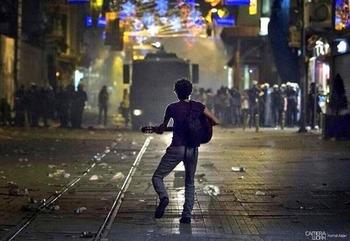
I was struck by how ‘musical’ this protest was, and decided to investigate further this presence of drums, dancing in the streets and the echoing of protest songs. Since its first days, the Gezi political movement framed itself in association with musical culture with political songs and images. In the first few days of the protest, the video of the ‘Sound of Pots and Pans’ went viral on social media. The members of a popular folk music band, Kardeş Türküer, are shown tapping on pots and pans while singing a song in pentatonic scale, typical of Turkish folk music. Banging on pots and pans is a traditional way of protesting in Turkey. The video shows open streets of Istanbul where the band sings and where street rallies take place within a tear gas mist; most of the song is sung by all of the members as a chorus. This choice stresses the collective dimension characterising the experience of protesters with which they could identify. In the first month about 30 new songs were specifically composed by famous groups active in the flourishing Turkish musical industry. One of the first iconic images of the Gezi movement was a guitar player pictured from the back facing the police (Figure 1).
Murat Öztür confronts the police with his guitar © Aslan, Kemal.
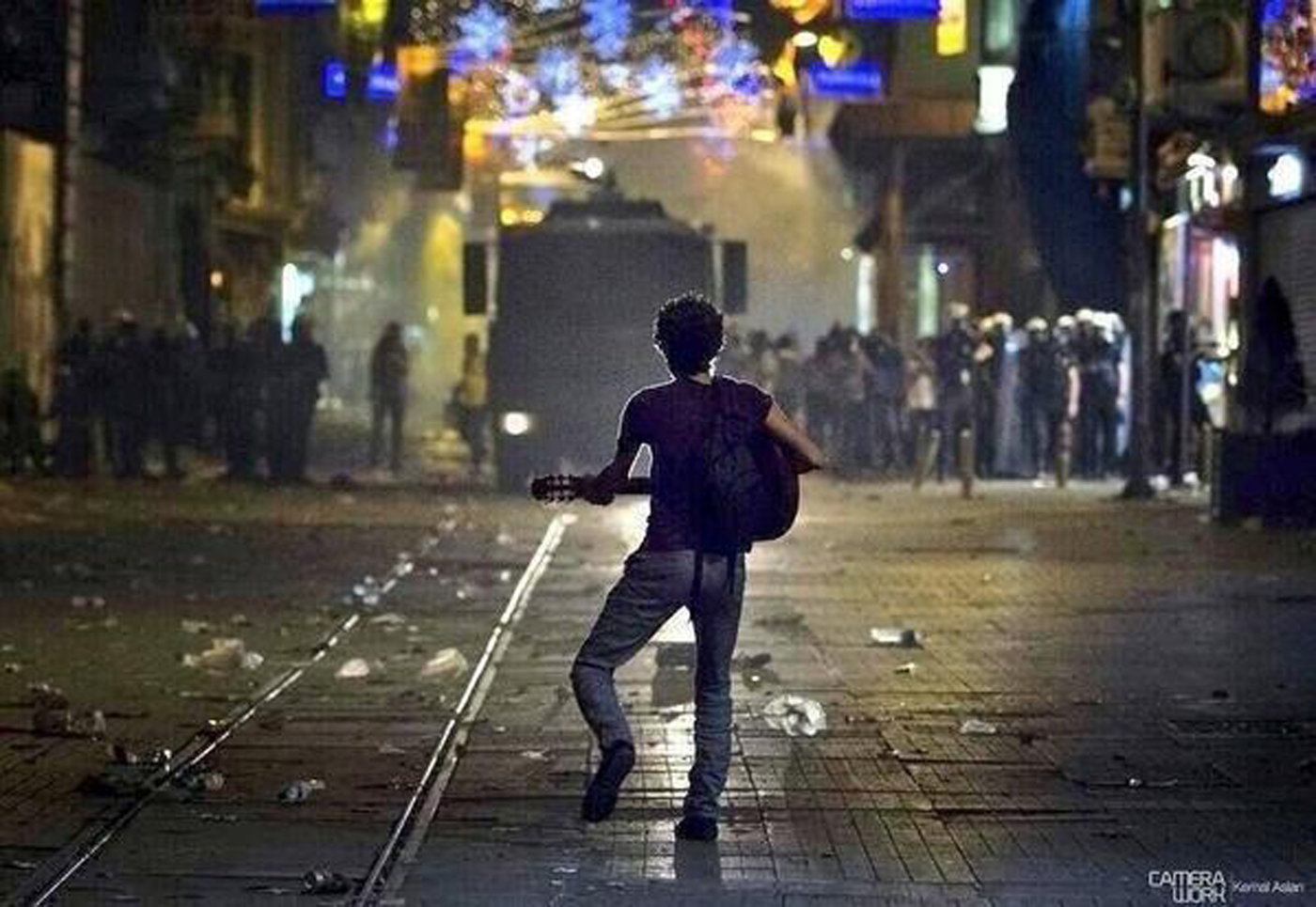
The photograph portrays the musician Murat Öztür, who confronts the police with his guitar while playing the song ‘Hayyam’, and was taken by the photographer Kemal Aslan during a street demonstration. This photo appeared in the progressive newspaper Radikal (Avtan Reference Avtan2013), as well as in several social media and blogs. In the first month of the protest, protesters felt very strongly that their actions should be peaceful and should be seen to be so. Music against weapons was a good metaphor to carry this message. In social movement studies, music is seen as an instrument to frame values, habitus, grammar and behaviour pertaining to social movements (Johnston Reference Johnston and Johnston2009). Recently, the engagement of established musicians in aid campaigns professionally orchestrated by the music industry (Street Reference Street2012, pp. 62–78; Street et al. Reference Street, Hague and Savigny2007) has encouraged scepticism about the transformative power of music. In addition, protest music is generally seen as an historical phenomenon linked, for example, to punk or to the 1960s and 1970s movements in the USA (Eyerman and Jamison Reference Eyerman and Jamison1998) – music of a generation that ‘had generally become affluent and uninterested in protest’ (Rodnitsky Reference Rodnitsky and Peddie2006, p. 24). However, more recently Steinberg (Reference Steinberg2010) has noted how music was relevant for the case of student protests in Serbia. I argue that the emergence of the new Occupy movement (Van Gelder Reference Van Gelder2011; Gitlin Reference Gitlin2012; Flesher Fominaya Reference Flesher Fominaya2014; Della Porta and Mattoni Reference Della Porta and Mattoni2014) and the presence of music in this movement points to a need to revise this treatment, particularly with reference to Turkey.
This article shows how for the case of Gezi Park movement there was a deep engagement with music. I suggest that this is due to two main reasons: the duration of political actions of the Gezi movement; and the political significance of music in the Turkish Republic. The occupation lasted about 15 days between 28 May and 15 June, but further activities of Gezi movement carried on for more than two years in platforms of discussions and organisations called ‘Forum’ (Gezi Forums 2013). In this lengthy period of time, music was widely performed, and took on a variety of functions (Nettl, Reference Nettl2005, pp. 247–55) as analysed in this article. Forums were territorially based: this was crucial for frequent participation in such a large city. The ‘big’ municipality of Istanbul counts between 17 and 20 million people, and is administratively organised in smaller municipalities (e.g. Adalar, Beyoğlu, Fatih, Kartal, Kadiköy). Activists decided to gather in parks in local areas, and in the cold seasons they carried on their meetings in cafés, bars, and in the case of the affluent neighbourhood around Maçka Park, in a rented apartment. As we will see below, in the second phase of protest during Forum, the function of music in the Gezi Park movement was also to foster what Flesher Fominaya terms collective antagonist identity, namely a collective identity characterised by heterogeneity and glued by political conflict (Flesher Fominaya Reference Flesher Fominaya2010).
By underlining different functions played by music in the case of the Gezi Park movement, this article problematises the relevance of music for social movements beyond ‘framing’. It is the result of three years of fieldwork I conducted triangulating musical and cultural analysis with ethnographic methods. I worked as Assistant Professor in Politics in two Turkish universities between 2010 and 2015. In 2013, I was working in Istanbul and had the opportunity to directly witness the vivacity of the society that led to the development of the Gezi movement, as well as the repression that followed. I worked for a university close to the Gülen movement where I understood how the Gezi movement created different responses inside the conservative intellectual milieux. Conversely, I lived in a diverse and alternative environment, and was already involved in the work of two grass-roots associations. Most of the activists became part of the Gezi movement. It was easy, then, to gain the trust of several groups of activists, and I was able to employ participant observation methods to explore performances which took place on a variety of stages and in various informal contexts.
Following John Street's epistemological considerations of the study of political and protest music (Street Reference Street and Peddie2006, Reference Street2012), I explored musicians’ agency. To do this, I conducted semi-structured qualitative interviews with musicians close to the Gezi movement with particular reference to the structure of Gezici Müzisyenler (Gezi/Nomadic Musicians). This was a grass-roots platform of musicians that I consider as an organic intellectual (Gramsci [1975] Reference Gramsci2001, pp. 1043–4) for the Gezi movement. I further explored its reception by contacting activists through snowballing. In particular, I conducted semi-structured interviews with 20 activists between March 2013 and March 2014, ensuring that there was a balance of gender, ethnic and political diversity among my interviewees. I used a mixed system of consent allowing activists to disclose their identities or to choose an acronym in order to protect them from political consequences. The aim of these interviews was to assess what meaning activists gave to the ancient protest music from Anatolia which was widely performed. Anatolian music has diverse ethnic and cultural identifications which are relevant in the political history of Turkey, thus the political meaning of its re-usage is not obvious. In terms of scale and identity politics, the Occupy movement was global, while different political contexts had also local and glocal (Lustiger-Thaler Reference Lustiger-Thaler, Hamel, Lustiger-Thaler and Maler2000, p. 46; Bauman Reference Bauman1998) aims, objectives and structures. Following Eyerman and Jamison's (Reference Eyerman and Jamison1998) methodology, I delved deep into the re-use of protest music traditions in order to highlight the specificity of the Occupy movement in the Turkish cultural and political context.
Exploring political change by analysing its musical culture is particularly important in a country like the Republic of Turkey. This is because, as we will see in the following part of this article, music traditionally marks the identification with the Eastern or the Western world and, in turn, with the political parties reflecting ‘Eastern’ or ‘Western’ values. I highlight changes in Turkish musical identity and party politics of the last 20 years which reshaped this traditional view in the section ‘Istanbul from bridge to Taksim's barricades’. This narrates how Turkey has shifted from being a symbolic bridge between two stereotypical versions of East and West, and is a complex melting pot of diverse identities. These include the large minorities of Kurds and AlevisFootnote 2 with their rich protest music traditions. Owing to the relevance of protest music performances, it would have been impossible to deal with the numerous spontaneous street performances or to analyse all of the songs specifically composed or associated with the movement. The third part of the article (‘Gas and new protest songs on social media’) focuses on the political use of the two among the most popular songs. However, presentational performances represented only one of the ways music was experienced; thus, the section ‘Dancing the Gezi Spirit …’ deals with some spontaneous participatory performances. These performances were various; the most popular re-used Anatolian music and dances. I believe that participatory performances in Forums and street rallies fostered the construction of an antagonist collective identity conceptualised by protesters as ‘Gezi Spirit’. Finally, the last part of the article about Gezici musicians, explores musicians’ agency, and is followed by brief conclusive considerations on how Gezi Park collective identity was mediated and its politics fostered through musical culture.
Istanbul between East and West: Kemalism vs. neo-Ottomanism
The popular film Crossing the Bridge (Akın Reference Akın2005) portrays Istanbul as a global musical venue, depicting musicians bridging the musical traditions of East and West, the style of several works by musicians produced by Doublemoon. The image of Istanbul as a bridge between East and West is a famous metaphor. Istanbul stretches across two continents. These two continents were also a symbolic representation of the traditional political cleavage – a vision of a society divided into two blocks mirroring the Cold War, the cultural separation between East and West, or the most recent duality of the clash of civilisations. This is also mirrored in Turkish politics where the West has been a positive model for reforms for nationalist parties; this has changed in the last 20 years. In the past two centuries, policies and music were reformed with an eye to Western culture. The process of the Westernisation of Turkish music went hand by hand with the Tanzimat reform period (Zürcher Reference Zürcher2010, pp. 50–70). For instance, during this period, the last years of the Ottoman Empire, the younger brother of the opera composer Gaetano Donizetti, Giuseppe Donizetti, became the musician of the Ottoman court. He composed military marches and was decorated with the honorific title of Paşa (Spinetti Reference Spinetti2010). Western influence remained and grew during the foundation of the Turkish Republic on the ashes of the Ottoman Empire, to the extent that Western classical music and opera are traditionally associated with nationalism and Kemalism (Bianchi and Coskun Reference Bianchi and Coşkun2009). Kemalism (Bora Reference Bora2008; Kushner Reference Kushner1977) is the main political ideology of the country, a compulsory subject at schools and universities. Its etymology is associated with the first political leader of Turkey, Mustafa Kemal, known as Atatürk (Father of Turks), who began the process of modernism of the new Turkish Republic on the French secularist model. CHP, the main party currently in opposition, has an ideology based on Kemalist principles.
In the construction of Turkish identity, music's role was officialised by Kemal himself in his famous speech on music to the National Assembly of 1 November 1938 (And Reference And and Landau1984; Stokes Reference Stokes2010, p. 16). The role of music in the construction of the nation was further developed by Ziya Gökalp, ‘the’ organic intellectual for Kemalism who reformed national Turkish music, orientating it to Turkish folk music and European modernity. Further, in the musical construction of the modern Turkish Republic, sanat (art) music associated with the Ottoman past was considered backward and was marginalised. The idea at the heart of the process was to differentiate Turkey from Ottoman culture. In particular, it was to jettison the musical identification with Islam, Arab civilisation and the cosmopolitan city life of Byzantium, Costantinopole and Istanbul (O'Connell Reference O'Connell, Cooper and Dawe2005). Turkish identity was to be rooted in Anatolia where the new capital, Ankara, was founded. As Martin Stokes notes (Reference Stokes and Sheperd2003, p. 236), ‘Turkish national identity has long depended upon the rejection of its “Arab” history’ (Stokes Reference Stokes, Akbar and Donnan1994, p. 25). As radio was instrumental in the dissemination of this new Turkish musical identity, in 1934 ‘Eastern’ music was banned from state radio (Stokes Reference Stokes, Akbar and Donnan1994). Egyptian films had been popular and had disseminated Arabic music. Between 1936 and 1948, 130 Egyptian films were shown in Turkey (Özgür Reference Özgür2006, p. 178). In 1948 the state banned Egyptian films and their broadcasting on the radio. Halk (folk) music was the only ‘real’ Turkish music, referring to the pre-Ottoman period of the Turkiç tribes, and to a sort of Pan-Turkist mythology. Traditional folk music was recorded and collected by specific local cultural institutions, dernek and cemiyet (De Zorzi Reference De Zorzi2010, p. 167). Bela Bartók, who researched the oral musical traditions of the Balkans and Hungary, was invited to the Halkevi (house of people) in Ankara to conduct research on the musical oral tradition of Turkey.
Arab music was not the only target of this process of construction of Turkish identity. In the early years of Turkish Republic some traditional Kurdish (Cemal Reference Cemal2003; Houston Reference Houston2008; Gunter Reference Gunter2010) and Armenian (Zekiyan Reference Zekiyan2010; Suny Reference Suny2009) songs collected in the Anatolian region were translated into Turkish and became part of the repertoire of Turkish folk music: Anatolia was the land where national identity was rooted and where Ankara, the capital of Turkey, was built. In the 1920s and 1930s because of an encyclopaedic effort to build a repertoire of Turkish music with which the Turkish Republic could identify, singing in languages other than Turkish was forbidden. Minority cultures were sacrificed on the altar of Turkishness. Music was so central for Turkish identity that this ban was lifted only in 2005 by Erdoğan's government. In the following decades, Anatolian music also became Westernised. Directly inspired by Mustafa Kemal's ideas, Anatolian rock's most celebrated musicians were Cem Karaca, Erkin Koray, Cahit Berkay and the bands Apaşlar, Kardaşlar, Moğollar and Dervişan. Initially close to Kemalist values, these musicians played Anatolian music with Western electrified instruments which they introduced to the country, and mixed these sonorities with saz, yaylı tambur, kabak and kemençe (Stokes Reference Stokes and Sheperd2003, pp. 273–8). These bands also received international recognition; Moğollar were awarded the Grand Prix du Disque in 1971.
Interestingly, the divide between Turkish halk (folk) music and Turkish sanat (art; Ottoman) music would come to represent the cultural divide between the secular Turkish Republic and the Ottoman Islamic past (De Zorzi Reference De Zorzi2010, pp. 24–8). In addition, classical music became a means of Westernising in the context of modernist reformism. The Atatürk Cultural Centre was built in Taksim Square, across Gezi Park at the core of a modernist looking square, and it became the venue where classical Western music and opera were performed. Attending these performances was a sign of being Westernised: a sign of distinction for Kemalist elites. Kemalist elites had been in power for almost a century before Recep Tayyip Erdoğan's AKP (Justice and Development Party) (Cizre Reference Cizre2007) seized power, and changed also cultural politics.
In contrast, Erdoğan supports cultural and musical projects connecting Turkey with its Ottoman past and:
Armed with the premise that culture is the zone of privilege for the disenfranchised sections of the society which it claims to represent, AKP has moved to attempt to demolish the Atatürk Cultural Centre. (Ada Reference Ada2013, p. 139)
Cutting down trees at Gezi Park was instrumental to former Prime Minister Erdoğan's project of restructuring Taksim Square where the Atatürk Cultural Centre is located; this was meant to remove modernist architecture. The plan included the building of a replica of the 19th century Ottoman barracks (Topçu Kışlası) and the construction of a shopping mall and a mosque.
The idea of re-establishing past imperial splendour of Ottoman times has been central to Recep Tayip Erdoğan's party. This began as a foreign policy aim; Turkey located itself as a mediator between East and West able to bridge between the two diplomatic cultures, and as a ‘natural’ leader of the international Islamic community. The ideologist of this doctrine, called neo-Ottomanism, was Foreign Affairs Minister Ahmet Davutoğlu. At the expiry of Erdoğan's mandate in 2014, he became Prime Minister and leader of AKP. In 2016, he was cast out from the party owing to his dealing with Europe on the Syrian refugees crises. Davutoğlu's pan-Islamism, his dream of enlarging Turkey's borders and international influence through diplomatic means, was outlined in his influential book (Davutoğlu Reference Davutoğlu2001). Neo-Ottoman fashion also became a trend for cultural policy, from architecture to music, passing through theatre (Öncü Reference Öncü, Drieskens, Mermier and Wimmen2008; Göktürk Reference Göktürk, Göktürk, Soysal and Türeli2010, p. 97; Aksoy and Şeyben Reference Aksoy and Şeyben2015). This cultural policy was also manifested in policies restricting the secular way of life, followed for example in subsequent educational reforms; a new ban on selling alcoholic beverages between 10 a.m. and 6 p.m., and within 100 metres of distance of mosques; an attack on abortion law; and a querelle concerning kissing in public spaces that exploded a few days before the occupation (A.P. 2013; Sehlikoğlu Reference Sehlikoğlu2013). The lyrics of ‘Tencere Tava Havasi’ also refer to these attacks on Kemalist way of life: ‘They close down squares and cinemas/Covered in shopping malls’. In particular, the reference to Taksim Square, and ‘cinema’ refers to the transformation into a shopping mall of the public building hosting Emek Cinema, a historical venue for gala and cinema festivals (BBC 2013). The latter spanned a demonstration in April that prepared the way for the Gezi occupation. The occupation of Gezi Park was also a response to these policies that, at the time, were seen by some as an ‘Arabisation’ of the country.
Istanbul: from bridge to Taksim's barricades
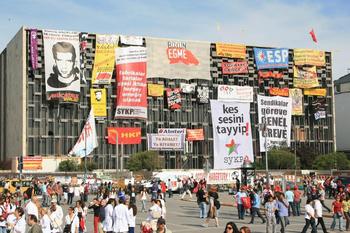
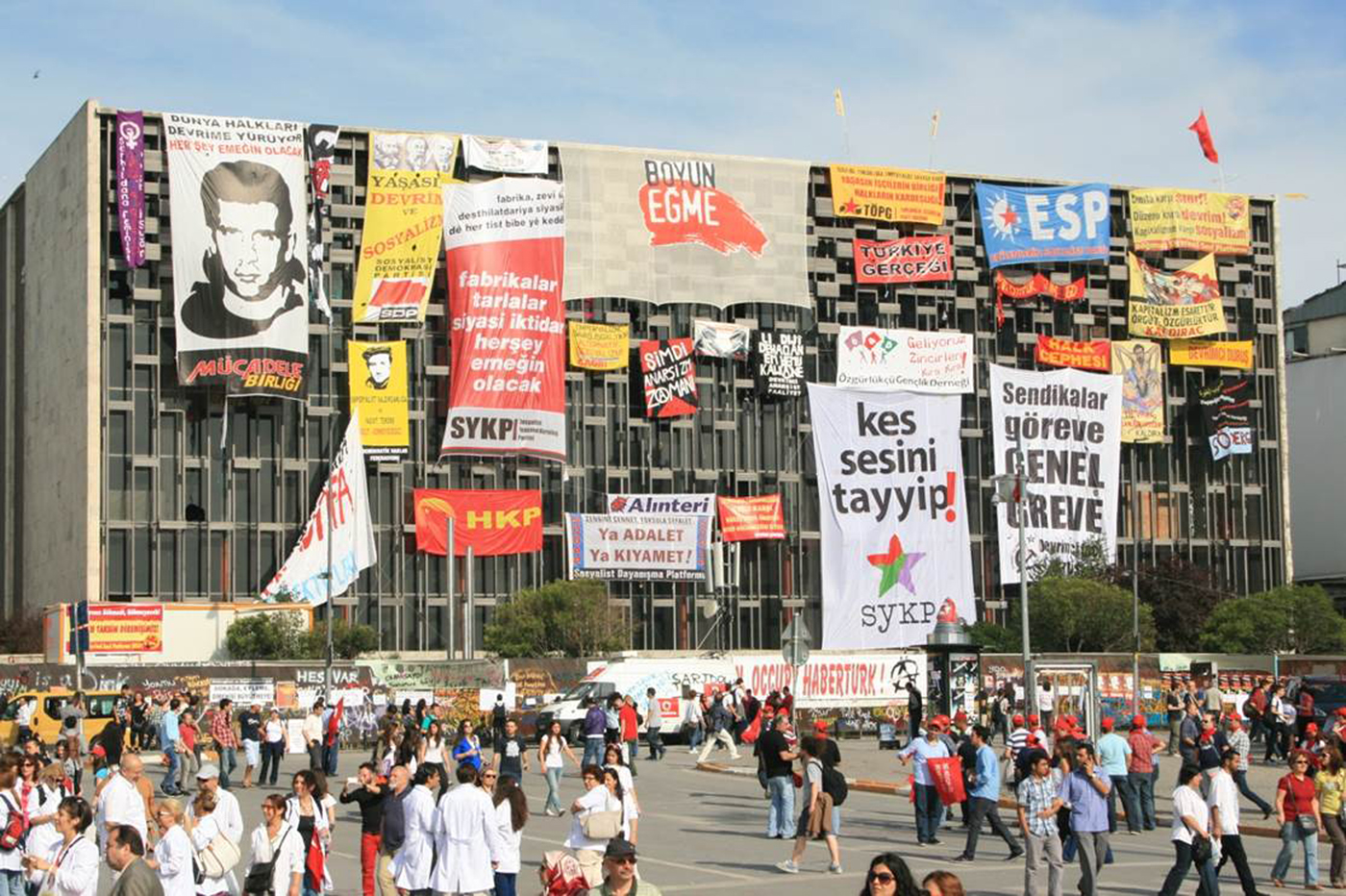
Activists of Gezi Park occupied Atatürk Cultural Centre with the aim of preserving it. However, the political message they sent was not a simplistic preservation of Kemalism. In Turkey, the modernist architecture of Taksim Square is seen as political. This is because it represents a landmark of the Kemalist construction of the Republic (Baikan and Atuka Reference Baikan and Atuka2010; Ekmekci Reference Ekmekci2013; Gül et al. Reference Gül, Dee and Cünük2014), but also because it has been venue of political demonstrations for decades, including the controversial May Day event. Taksim's political meaning is multi-layered and multi-faceted, embracing the complexity and diversity of Turkey. Good evidence of this are symbols hung on the façade of the Atatürk Cultural Centre during the first week of occupation (Figure 2): what immediately catches the eye are the very different political stances. Socialist and green logos, right-wing nationalist symbols, Çarşı (supporters of Beşiktaş football club with Anarchist tendencies), and a gigantic portrait of Deniz Gezmiş, a sort of ‘Turkish Che Guevara figure’ who founded the left-wing Turkish Liberation Army, are just some of the political images. Gezi Park highlighted the emergence of a number of new political identities: animal rights movements, environmentalism and LGBTQ+, as well as religious minorities inside Islam. In addition, Taksim Square was the venue for rallies of political parties, while activists occupying the park with tents were often engaging in their first political activity. They could hardly identify with political ideologies. This heterogeneity shows that the metaphor of the bridge between two worlds became inadequate. Possibly, with globalisation, these two worlds are no longer so clear cut.
The Atatürk Cultural Centre during the first week of occupation.
This is true also for party politics. Traditionally, the West in Turkey was seen as a force fostering modernisation and change by Kemalist and secular parties, and Western influence was seen as a corrupting principle by Islamic parties. However, this has also changed. On the one hand, Islamic parties have taken on some Western values (Daği Reference Daği2005). The rise of a new Islamic party at the end of the 1990s, namely the VP (Virtue Party) from which the current party in government originates, Erdoğan's AKP (Justice and Development Party), has completely changed the political arena (Daği Reference Daği2005, pp. 21–73). These Islamic parties embraced neo-liberal values and human rights principles traditionally associated with the West. These were means of fostering and advocating the cultural and economic rights of a new rising class voting for them. In this context, the European project was used to achieve internal party gains. For instance, the reform of the army in 2005 after a referendum was presented to the electorate as a key to unlocking the European Union's door. Indeed, this was one of the necessary democratic reforms to achieve the aquis communitaire. However, for the first time in Turkish history, the army became less of an independent institution. The army has the role of protector of constitutional principles, including secularism. Since this reform weakened the army, the latter was unable to provide checks and balances to the government's power. This important function was not taken on by any other functioning institution: the government's power increased in an unprecedented way, and since then Erdogan's party (AKP) has become less tolerant of dissent.
On the other hand, the attitude of secular elites towards the West also shifted. This has been highlighted in musical terms. For instance, the recent acceptance by intellectual elites of Arabesque (Stokes Reference Stokes1992, Reference Stokes, Akbar and Donnan1994), a popular genre once associated with migrants from rural Anatolia to the city (a hybrid between Arab music and Turkish folk music), as well as the general appreciation of folk music can be seen in the context of the refusal of European Union membership. In fact, this political decision has generated resentment in Kemalist and old secular elites, now feeling excluded from the West (Özgür Reference Özgür2006, p. 186). In addition, as Bahar Rumelili notes, analysing Turkish cultural policies vis-à-vis Europeanisation, initiatives of foreign policy in Turkey is rooted in a concept that stresses Turkey's hybrid identity as Western/European, as well as Islamic/Asian (Rumelili Reference Rumelili2011, p. 41). In 2010, this hybridity has also been highlighted on the occasion of cultural events celebrating Istanbul as European capital of culture (Potuoğlu-Cook Reference Potuoğlu-Cook2010). It seems that boundaries between East and West have blurred.
This duality has always been an over-simplification of Turkish politics which highlights one backwardness of the Turkish Republic: the oppression of minorities. According to a study carried out in Tubingen University, in Turkey there are 47 ethnic groups (Andrews Reference Andrews1989). The Kurds (Cemal Reference Cemal2003) are the best-known group. The issue of minority rights has long been one of the hindrances for Turkey's membership of the European Union; this was restated in a 2004 report (European Commission 2004). In particular, the bloody conflict with the Kurdish minority was under the spotlight (Saatci Reference Saatci2002). It has to be remembered that the civil war with the Kurds in the South East regions of Turkey has cost over 40,000 lives (Houston Reference Houston2008). Singing in the Kurdish language was considered highly political, even if the lyrics might not have a political content. As a consequence of the ban on singing, Kurdish channels broadcast abroad (Ayata Reference Ayata2011) and a strong tradition of Kurdish protest music developed: it would suffice to mention the ‘voice of Kurdistan’ Şivan Perver. Born in the province of Şanliurfa, he escaped from Turkey in the 1970s to avoid prosecution for having performed traditional music with Kurdish lyrics. His music focuses on the cultural and communitarian resistance to the Turkish state in the predominantly Kurdish areas. It has been banned in Turkey, while being widely listened to in the Middle East.Footnote 3
Arguably, the most important Kurdish protest singer, Ahmet Kaya wrote socialist songs in Turkish and became a famous protest singer in the 1980s, a time when many socialists went to jail during the dictatorship. ‘Şafak Türküsü’ (‘Song of Dawn’), his first famous song, gives voice to a prisoner who addresses his mother. The lyrics are taken from a poem written in prison by Nevzat Çelik (Gündoğar Reference Gündoğar2004, p. 212). Kaya was forced to leave the country when he was at the apex of his popularity after his album Şarkılarım Dağlara sold a record 2.8 million copies and when he was awarded the Magazin Gazetecileri Derneği prize because he acted against the ban on singing in Kurdish languages. As a result, TRT (Turkish Radio Television Broadcasting Company) banned his songs, which have now been on their blacklist for more than 20 years (Aksoy Reference Aksoy2010). At the time of the Gezi Park occupation, a ceasefire and a peace process were in place. This was the result of European Union pressure on the Turkish government (Akbulut Reference Akbulut2005), and of networking efforts in Kurdish areas of Turkey carried out by a strand of the AKP which was mainly affiliated with the Gülen movement (Bianchi Reference Bianchi2015). From the musical point of view, the 2013 pacification process resulted in the recognition of the musical career of one of the most important Kurdish protest singers, Ahmet Kaya, who was given the highest cultural award (CumhurBaşkanlığı Kültür ve Sanat Büyük Ödülü), after he died in Paris in exile. The rehabilitation of the figure of Ahmet Kaya was very important as a symbolic step forward in the direction of the pacification of the country and the recognition of Kurdish rights. In the award speech, Kaya's music and style of singing are mentioned, and also his ‘söylemiyle’, namely his discourse, as forces that can gather together people from different backgrounds.Footnote 4 At Gezi Park, there was also a component of right-wing secularism opposing the peace process: the ultra-Kemalist TGB (Union of Turkish Youth) whose protest chant was: ‘we are Atatürk soldiers’. This did not stop some Kurdish from joining the protest. Even a group of Kurdish mothers demonstrated on behalf of their sons who were imprisoned after being accused of being involved in terrorist actions (Tocco Reference Tocco, Kamp, Kaya, Keyman and Onursal Besgul2014). Are Kurds to be considered from the perspective of East or that of the West? This is still a big problem of contemporary politics that, posed during the Gezi occupation, shows how reality is much more complex than the idea of separating politics and music into only two civilisations.
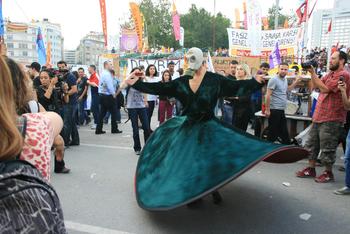
Turkey is also not a bridge between the West and the Islamic world as the latter is not homogenous. This is evident if one considers that Erdoğan's AKP is not representative of all of the Islamic groups in Turkey. Some Muslims criticised him because cutting down trees is not seen as a pious act in the Qu'ran; conversely, protecting trees is important in the tradition. Erdoğan supports a Sunni market-oriented Islam which antagonises Shia groups like Alevis (Çakir Reference Çakir1998; Küçük Reference Küçük2002; Kütahyali Reference Kütahyali2014), as well as more left-wing tendencies within the Islamic community in Turkey. Opposition of different Islamic currents was clearly shown in one of the most attractive street performances that took place several times during Gezi Park occupation showing a whirling dervish with a gas mask (Figure 3).
A whirling dervish with a gas mask © Meriç, Zeynel
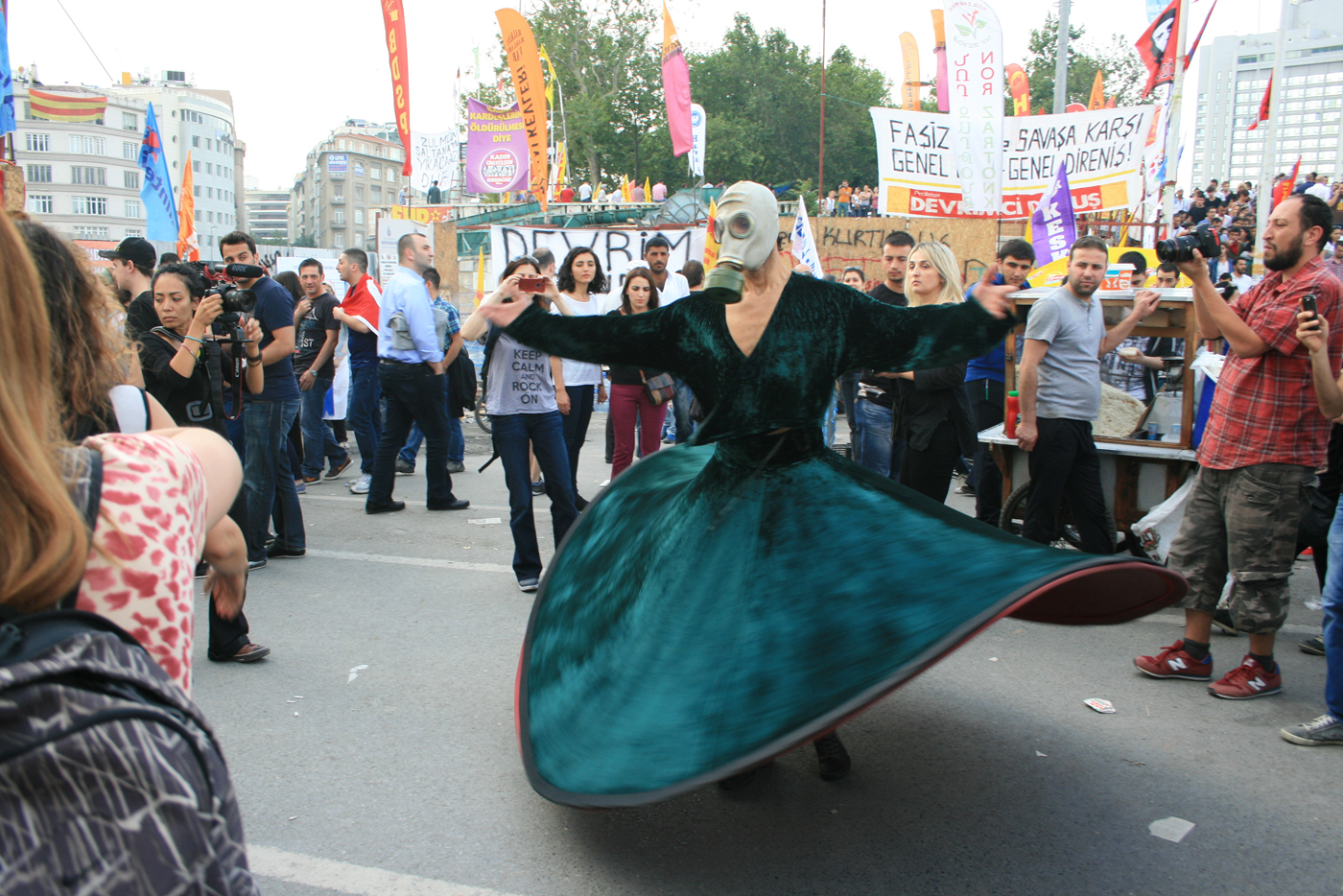
With Atatürk's reforms, traditional music schools, often affiliated with religious institutions and Sufi groups, were closed and outlawed. Although Sufi ‘dancers’ tour the world staging the traditional form of whirling dervishes, known as sema, Sufi lodges are still not officially permitted in the country. The performer was a dancer rather than a monk/dervish, but Sufi values were evident in his Facebook page entitled ‘Sende gel’ (‘come, come whoever you are …’) taken from the beginning of the most popular poem attributed to Sufi mystic Rumi. In addition, among activists a political Islamic group called: ‘Anticapitalist Muslims’ became popular. Furthermore, the Alevis (Çobanoğlu Reference Çobanoğlu2000; Dressler Reference Dressler2013; Olsson et al. Reference Olsson, Özdalga and Raudvere1998; Öktem Reference Öktem1994; Mélikoff Reference Mélikoff1975, Reference Mélikoff1998), the biggest religious/ethnic minority group of the country, are strongly antagonised by Erdoğan's AKP. In order to better understand this, it has to be said that Alevis have played a political role for centuries. During Ottoman times, they led an antagonistic struggle from the Anatolian periphery of the empire against the power of its centre. Alevis are persecuted by the AKP government. They were politically allied with Atatürk, who considered them the ‘real’ Turkish version of Islam, and they became very active as leftish and socialist intellectuals and communities in the 1970s (Shankland Reference Shankland2003). Over centuries, they have constructed and transmitted their identity through musical culture. Pir Sultan Abdal (ca.1480–1550) dominates the Turkish Alevi oral lyric tradition in his influence through text and persona, and is counted as one of the seven great bards of the Alevi–Bektaşi ritual tradition (Koerbin Reference Koerbin2011). During street gatherings it is not uncommon to hear his songs sang and played. Alevis were very much present in street rallies and movement activities; evidence suggests that all of the people who died in street protests were Alevis.
Sultan Selim, to whom the third bridge over the Bosphorus was dedicated, persecuted Alevi groups. It should be noted that in 2013 the bridge was not just a metaphor. One of the ‘environmental injustices’ denounced by the Gezi movement was the construction of the third bridge over the Bosphorus with a new highway. At the time, it was estimated that this would probably cause a new urban settlement in the last green area between the Mediterranean and the Black Sea, where the bridge and the highway were located. The Black Sea region was already involved in environmental protests against waste dumps, nuclear and coal power plants, hydroelectric dams, and new mines and factories. A musical video entitled Diren Karadeniz (Black Sea Resist/ance) made by 24 musicians and activists (Lermi et al. Reference Lermi, Çorak and Yıldız2012) shows traditional works of this green region and musicians singing lyrics condemning the exploitation of the environment. This music project was inspirational: the organisation and activities of the new leaderless social movement were called Diren Gezi (Gezi Resist/ance). ‘I don't feel like crossing this bridge’, sings the chorus of ‘Songs of Pots and Pans’. Gezi has reformulated the metaphor of the bridge itself. The bridge was no longer seen as a connector, but as a means of trespassing. ‘Everywhere is Taksim; everywhere is resistance’; this became the slogan of rallies echoing all over Turkey. Barricades of Taksim Square replaced the bridge as a political signifier: new borders were drawn.
Gas and new protest songs on social media
Repression is a catalyst for the expression of dissent channelled through artistic production. (Johnston Reference Johnston and Johnston2009, p. 18)
The first official day of occupation was 28 May; only around 50 people gathered in front of bulldozers to stop tree cutting. Their peaceful protest met with a violent response from the police. This over-reaction urged more people to take to the street in support of these peaceful protesters: an unprecedented crowd occupied Gezi Park. On 15 July, the Turkish Medical Association reported that in just 10 days of street rallies between 30 May and 10 July more than 8,000 people were injured (Amnesty International 2013; Turkish Medical Association 2013); later, 11 were killed. It was estimated that 3,000 activists were arrested. When the police ended the occupation on the 15 June, tents were set on fire and protestors were beaten up; in the first 20 weeks of occupation, 130,000 gas canisters were used. Sung in hard rock style, ‘Eyvallah’ (Duman 2013) is a manifesto of resistance against gas, a chemical weapon that was previously used in battlefields and is now being used in streets against citizens (Feigenbaum Reference Feigenbaum2014). This song epitomises the season of street rallies of Occupy movements, as it is an antagonistic statement confronting the use of tear gas. Duman is a popular band and its hard rock style sets an appropriate soundtrack to street riots. Their song depicts protesters as models of resistant heroes. Starting with the words ‘Biberine gazina’ (‘To your pepper gas’), lyrics are sung by a soloist male voice addressing the police or, possibly, the Prime Minister:
To your pepper, your gas,
Your batons, your sticks,
To your harsh kicks,
I say bring it on, bring it on (eyvallah)
Attack me shamelessly, tirelessly
My eyes are burning but I don't bow, nor do I lessen
I am still free I said
I am still right I said
to you
I am still human I said
Do you think I would give up, tell me.
This marks a political shift in movement strategies. Here music ceases to be the symbol of pacifism represented by the iconic image of the guitarist mentioned above. There were discussions among the movement about the right response to state violence: passive resistance (Diren) was the means chosen.
In this context, this song's title is a very fitting word to describe passive resistance. This is because ‘eyvallah’ is a word with religious roots, as it includes the name of God. It basically means ‘I accept’ and it is used in slang instead of ‘thank you’. Interestingly, it is not a refined word: for some, the use of this expression is also a sort of display of rude masculinity.
The movement endorsed this song: a video was uploaded on Youtube by Diren Gezi portraying different images of protesters surrounded by gas (Diren Gezi 2013). This shows violent attacks on activists that were usually censored by mainstream media in Turkey. The symbol of this censorship became penguins. During the first days of the protest, while CNN International showed worldwide real-time scenes from the streets of Istanbul, CNN Turk, the local version of the same TV channel, went on broadcasting a documentary on the life of penguins. The movement appropriated this image making it symbolic of Gezi protesters. Penguins also appear on the video of the ‘Sound of Pots and Pans’ analysed above, along with in a number of iconic images and ‘merchandising’ of Gezi Park, artefacts and art products, as well as on several pages of a popular monthly comic which made lots of fun of this idea of penguins representing protestors because the title of the magazine was (and still is) Penguin. Song videos posted in social media showed images that were often censored.
The internet was used for broadcasting live pieces of news during street fights and rallies, as well as for spreading images and music. Newly invented songs, along with other international and Turkish classics of protest music (Kahyaoğlu Reference Kahyaoğlu2003; Tore Reference Tore2013), made a playlist of 148 songs in an online directory (Çapulcular 2013) associated with the Gezi movement. These songs were mainly spread through social networks. Social networks have been seen as important means for fostering practices of active citizenship (Alemdar Reference Alemdar2013). However, it has been suggested in the case of one protest song in the English language, ‘Spring of War’ by The Ringo Jets, that social media only functioned to spread populist ideas. This conclusion was drawn after the analysis of a debate on Youtube (Way Reference Way2015). However, Youtube does not seem to be the best arena for political debates among the different social media, as there are methodological limitations (Thelwall Reference Thelwall, Cantijoch, Gibson and Ward2014). It is doubtful whether this song was popular at the time among most protesters; at least my interviewees did not mention it. Precise references to the video are not available in Way's article mentioned above. At the time of writing, in YouTube only videos posted in February 2014 are available, referring to publication on iTunes in 2014. This seems to suggest that the video was posted at a later stage. In addition, only the total views statistics are considered by Way and these are not seen in relation to chronological statistics, making it difficult to measure its popularity. As it has been pointed out by Way (Reference Way2015) himself, the analysis of one single song needs to be triangulated with more experiences; in other words further specific studies on social media need to be carried out to assess their specific roles in relations to music and politics.
As for the two most popular songs considered in this article, evidence suggests that they were used to foster political actions. ‘Eyvallah’ was broadcast during public gatherings, setting the ambience for political speeches or rallies with its hard rock guitars. The ‘Sound of Pots and Pans’ went viral on Facebook and Twitter in the first weeks of the Gezi Park occupation and was then widely performed during street gatherings. Citizens demonstrated at 9 o'clock every evening in different cities, banging pots and pans in solidarity with the Gezi occupation and against government repression. In this context, the song was often performed or sung by activists. In July, Erdoğan decided to criminalise the banging of pots and pans, and at least one criminal case has opened (Milliyet 2013). Initially expressing political messages via social media, this song fostered acts of citizenship (Isin and Nielsen Reference Isin and Nielsen2008) with political and legal implications. Tapping and hitting rhythms also took on another form in street rallies. From the very first few days, drums were used during protest by a self-organised collective, a group called Sambistanbul. The most obvious reference is to a genre of music (samba) which is played in Brazil, a place where another Occupy movement was taking the streets in the same period. This is also reminiscent of the drums of the Janissary troops of the Ottoman army. The function of drums and percussion in the Gezi movement was to foster courage among citizens facing the brutality of tear gas and water cannons (Özgür and Severgnini Reference Özgür and Severgnini2014). One can begin to see how from just ‘a frame’ (Johnston Reference Johnston and Johnston2009) music performed at Gezi rallies became ‘a source of political […] action’ (Street Reference Street2005, pp. 10–11).
Dancing the Gezi Spirit: a diverse collective identity
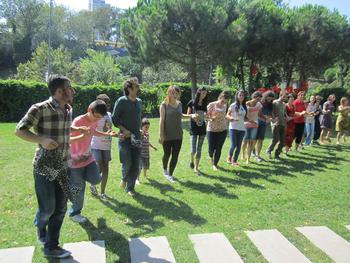
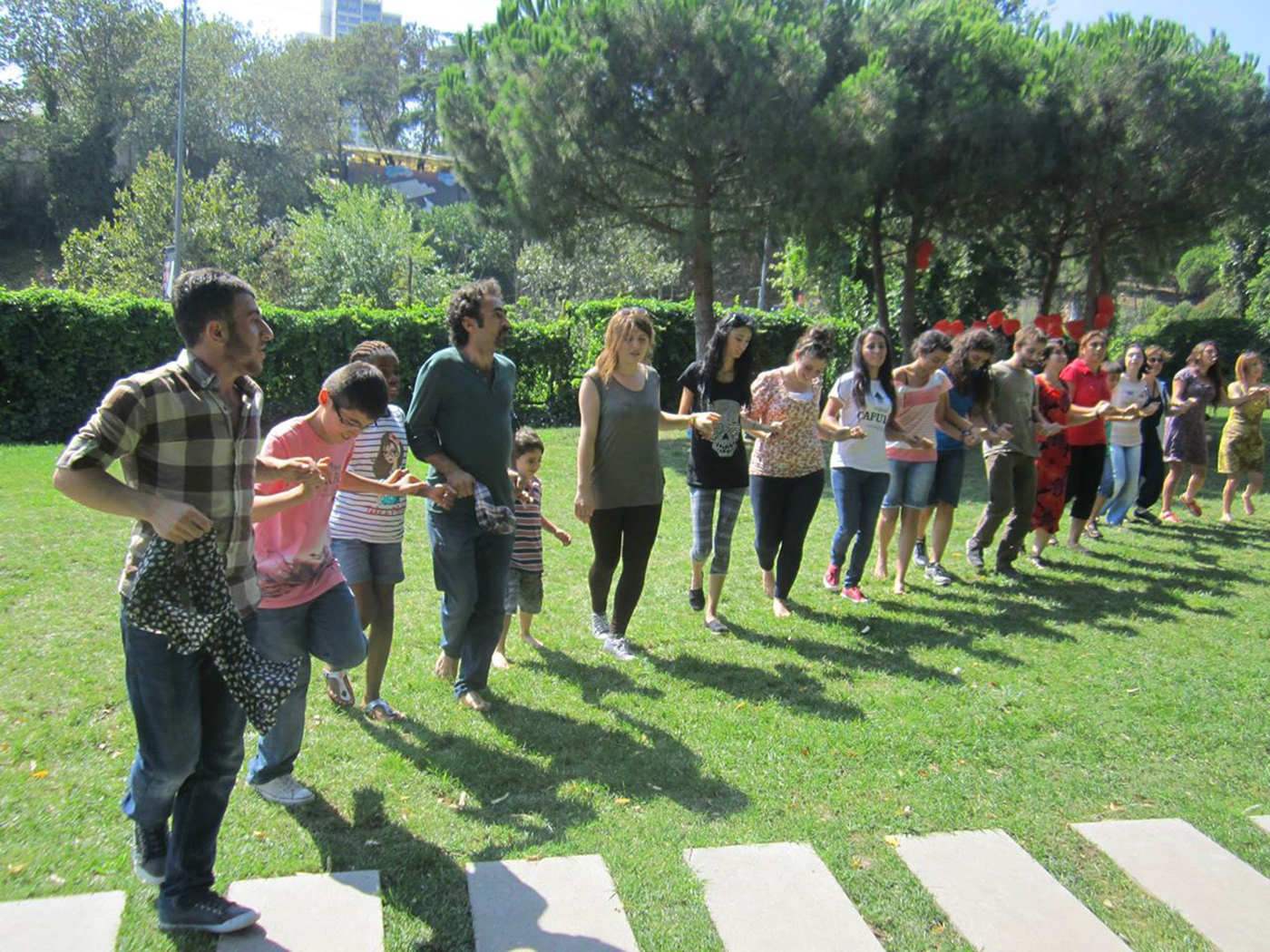
After Gezi Park was taken back by the police, the movement kept growing and activists started gathering in local parks in different neighbourhoods in Istanbul, at least three evenings per week, in the so-called Forums. Significantly, activists referred to Erdoğan using his first name, Tayip, without any of the numerous honorific titles used in Turkish language. Istifa (resignation) was the word that resounded everywhere. The movement cemented around this opposition. In a number of gatherings, traditional folk group dance (halay) was performed often spontaneously by activists. Halay dance is characterised by a high level of repetition of synchronic movements (Figure 4).
Halay dance at Maçka Demokrasi Park © Bektaş, Tolga
According to Turino, because of the importance of rhythm and synchrony, in participatory performances, people are
acutely aware of the groove of their relation to it and through it their relation to other participants. In participatory performances, feelings of social synchrony are higher level of social awareness. (Turino Reference Turino2008, p. 43)
The possibility of experiencing social synchrony is particularly important. In addition, if we conceptualise social movements as ‘experience movements’ (McDonald 2006, p. 214) where the ‘prime agent is rhythm’ (Street Reference Street2012, p. 173), we can appreciate how the rhythm of halay dance, which was not simply listened to passively, but experienced with (and as) a collective of bodies moving in sync, contributed to fostering a sense of unity and belonging.
This second phase of protest was paramount for the consolidation of collective identity. Activists used frequently a new term: ‘Gezi Spirit’ (Gezi Ruhu). Gezi Spirit was a term widely used in social media to define a new sensibility. For instance, in Gezi rallies, supporters of different football teams demonstrated together. This was seen as a huge achievement considering their violent and animated contrasts. Gezi Spirit was the respectful locus where diversity could meet:
Despite government propaganda to the contrary, devout protesters’ religious observances were respected by the non-devout throughout the demonstrations, and fellow protesters were constantly warned against using discriminatory rhetoric against veiled women. In the same spirit, Turkish secularists and Kurds resisted police brutality together; feminists urged caution about the use of sexist curse words to vent anger against government officials; the stereotypes of the ‘pretentious intellectual’ and the ‘lumpen’ have been breaking down, thanks to acting together on the streets. (Bakıner, Reference Bakıner2013)
This accent on diversity is not in tension with the construction of a collective identity. Fominaya highlights how some movements ‘including the global justice movement, understand and even explicitly define their collective identity in terms of diversity, heterogeneity and inclusivity’ (Flesher Fominaya Reference Flesher Fominaya2010, p. 399). In Istanbul, this collective identity was felt and termed as ‘Gezi Spirit’.
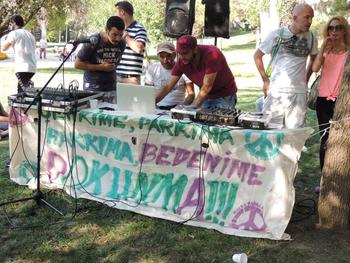
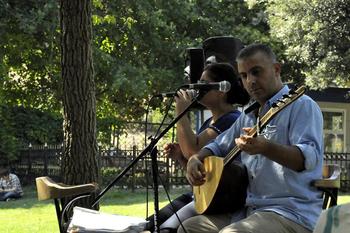
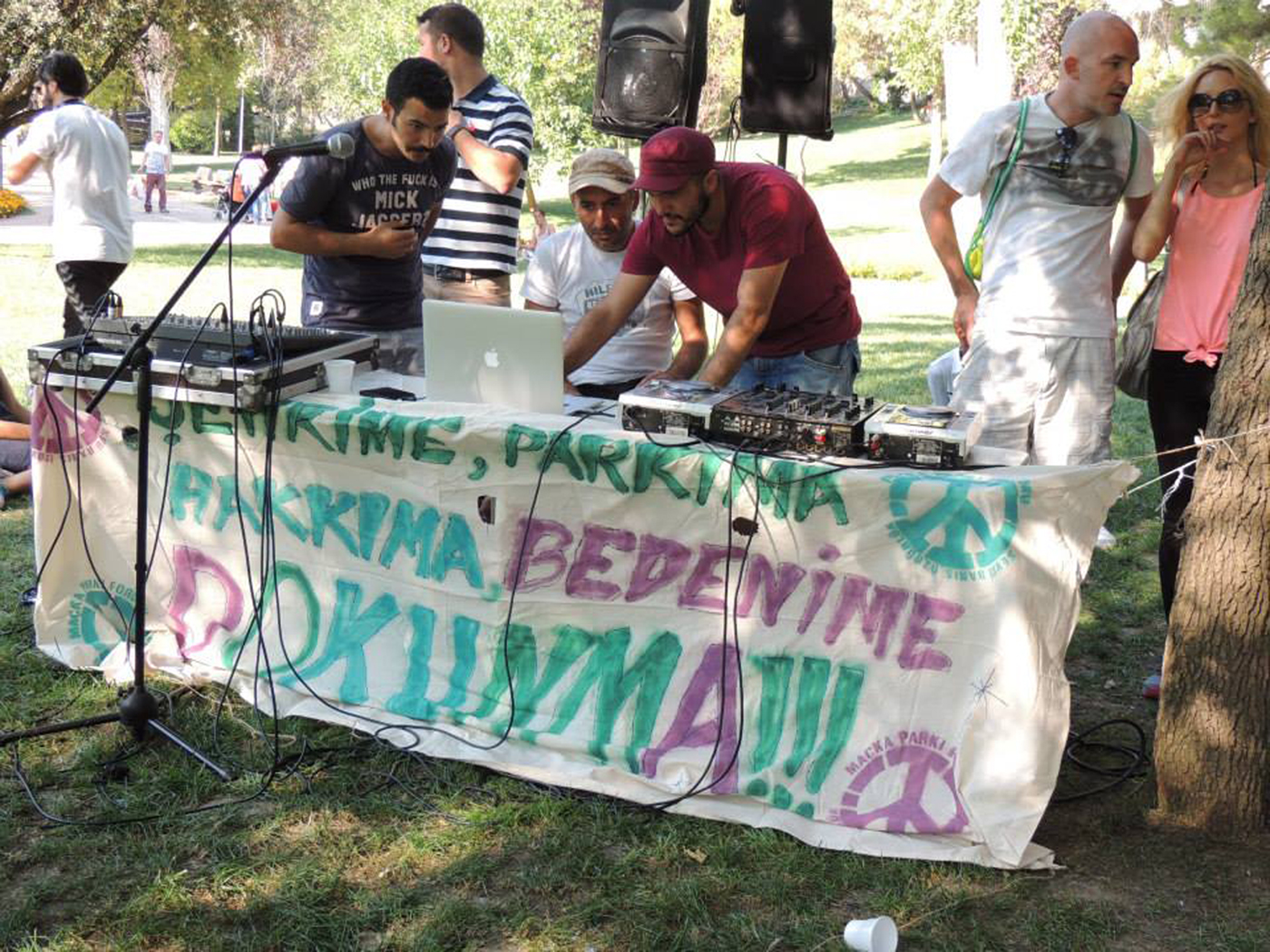
The Gezi movement allowed for an unprecedented dialogue. For instance, LGBT groups have never before discussed sexist language with football supporters. Kurds were dancing hand in hand with nationalists. Secular people came to share Iftar dinners (the meal after a day of fasting during Ramadan) with ‘Anticapitalist Muslims’ (Antikapitalist Müslümanlar), a tradition that has lasted for many years (Hurriyet Daily News 2015). This diversity was also evident in the musical culture performed at Forums. Photos I took at the same Forum gathering show how both the dee-jay culture of the West and Anatolian music were present (Figures 5 and 6).
Dee-jay in a gathering at Maçka Demokrasi Park.
Bağlama player at the same gathering of the previous photograph.
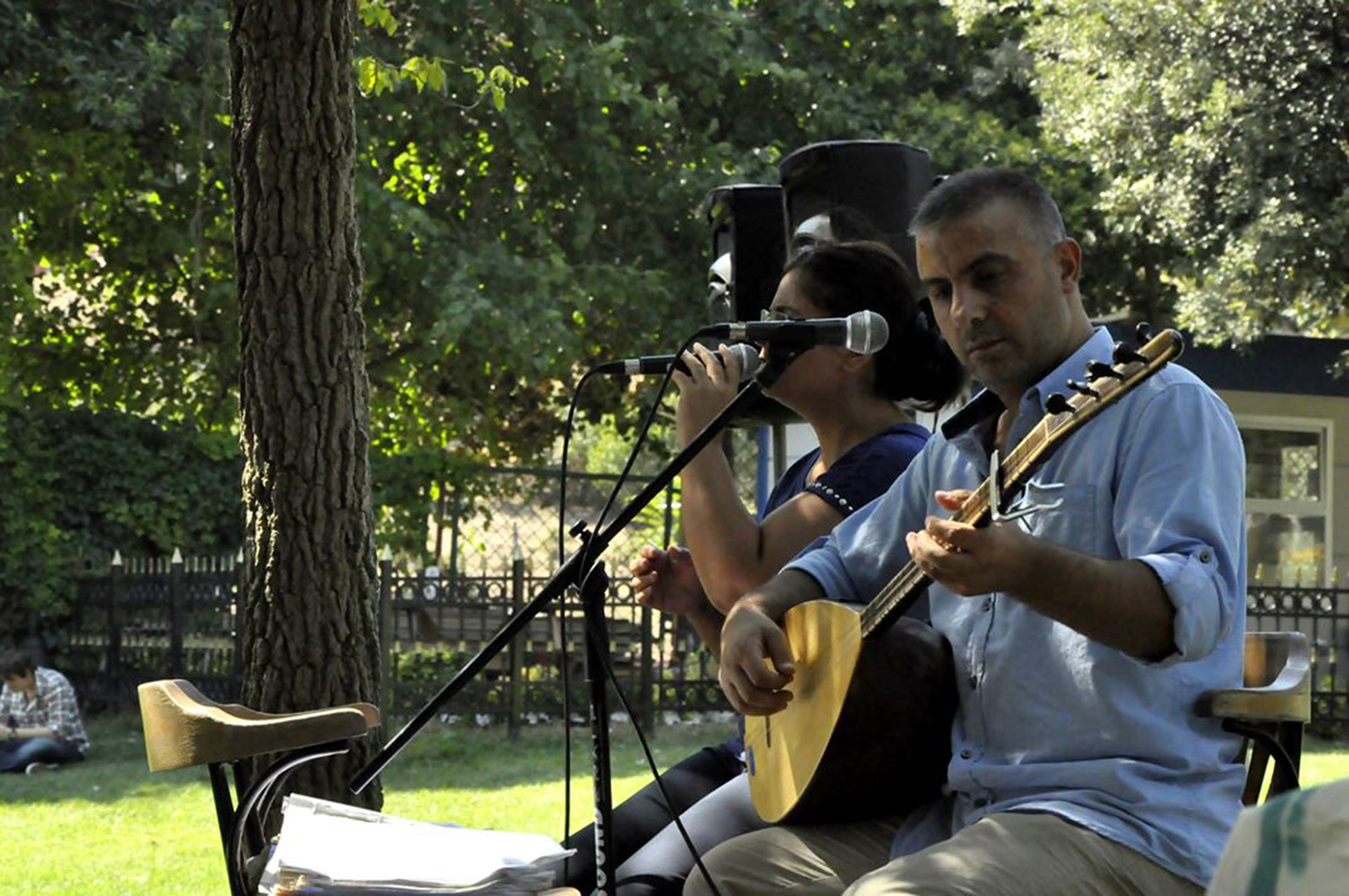
The bağlama is a traditional instrument of Turkish folk music, often simply referred to as an ‘instrument’ (saz); it is considered to be ‘a Qu'ran with strings’ by Alevi believers. Anatolian protest songs were often sung. These echoed an ancient antagonism dating back to revolts of the periphery of Anatolia against the Ottoman Empire. For instance, Pir Sultan Abdal's immense repertoire has a clearly antagonistic meaning in the tradition of the protest music of Turkey; however, it can also point to the specific struggle for Alevi rights. As we have seen, Anatolian folk music can also be identified with the process of Turkification and suppression of diversity implicit in the construction of Turkish identity when all of these songs were translated into Turkish. I investigated the meaning that activists associated with this corpus of traditional protest music which was played at the Forums. I conducted semi-structured interviews with Kurds and Alevi musicians and activists, students of music and eminent members of Forums in traditionally secular parts of Istanbul, asking which identitarian meaning they attributed to this repertoire. All interviewees were aware of the contrasting ethnic, religious and cultural associations of the Anatolian repertoire and nodded or added some details when I listed the different identities and connotations of Anatolian protest music. However, none of them pointed to just one of these cultural identities. Also, musicians who sing in one of the Kurdish languages, are affiliated to Sufi lodges or have Alevi roots did not mention their identities. FA, one of the leaders of the Adalar Forum who is sensitive to the Alevi cause, was surprised by my question and told me:
When I sing a song by Pir Sultan in the forum I only think about its antagonistic significance. I do not want to refer to a cultural or ethnic tradition. (Interview with FA, October 2013)
This answer is very significant, and also captured the surprised replies of musicians who did not want to mention their own ethnic or religious background; rather they often pointed to the photographs of different flags and symbols together running away from the police. Anatolian music was not associated by Gezi activists with a specific ethnic or religious tradition. Singing this repertoire for Gezi Park activists meant givinge voice to an antagonism against their common enemy. This repertoire was performed not to set boundaries within the movement, but between the movement and government, rather it was used as a connector for its clearly antagonistic meaning.
I believe that the re-use of Anatolian music has also to be seen in this process of development of the utopia of an identity inclusive of diversity. Anatolian music was always utopian, and its meaning changed over time. For Atatürk, the utopia was to build an independent Turkish nation. At that time, the need to build a Turkish identity was felt strongly. Lately, the meaning of Anatolia, in a musical sense, has shifted. This shift can be understood by following what was defined as Anatolian rock and pop. Taner Öngür, the electric bass of Moğollar, talked with me about the shifting political vision of Anatolian rock:
I hope that one day Anatolian pop will end. One day people in Turkey will be Anatolian pop. They will be at the same time Muslims, full of love, open to Alevis and able to enjoy the rich differences that this country has. During my life I saw five or six coups d’état. Kemalism became corrupted into a form of fascism. It was fascism Turkish style. They called themselves secular and Sunni felt oppressed. As a result Sunnis created their own political view and became advocates of human rights. However, the job is not complete. The job will be finished when Sunnis will be modern and will respect rights of Armenian and Alevis, and all these will make up Anatolian identity. (Interview with Taner Öngür, April 2014)
In this utopian perspective Anatolian music is the voice of antagonism, the breath of minorities, a utopia which was part of the Gezi project for some (and indeed not all) activists. Taner Öngür is one of the prominent activists of Gezici Müzisyenler.
Democratising musical performances: Gezici Müzisyenler
As we have seen above, participatory performances became relevant in Gezi Forums. As for presentational performances, the presence of well-known stars supporting the movement became less significant after the first month, with the exception of foreign rock stars sending messages of solidarity to the Gezi movement. Tolga Bektaş, one of the leaders of an active Forum, organising activists in an elite area of Istanbul, explained this phenomenon in relation to repression:
Now, after the repressive measures taken by the police against lawyers and doctorsFootnote 5 who assisted activists participating in street protests, supporting the Gezi movement and being associated with it is becoming more dangerous, and people are more careful in taking sides openly. (Interview with Tolga Bektaş, 10 August 2013)
In this phase, music became a form of protest itself, characterised by presentational performances of musicians identifying themselves with the movement: the Gezici Müzisyenler.
This was a horizontal organisation, not based on a particular area of the city. Therefore, this and the parallel organisation of artists Sanat Kolektif managed to gather people who lived in different areas of Istanbul, mixing ethnic, social and cultural backgrounds. Activists and people who sided with the movement talked in positive terms about the Gezi Spirit, while AKP members and opponents of the protest called protesters in disparaging terms çapulcu (looters) and gezici. Grass-roots musicians appropriated the latter derogative term Gezici, subverting its meaning. Gezici recalls the name of the park where the protest started and means also ‘roaming’ or ‘nomadic’. These attributes are important in the Kemalist idea of Turkishness as they refer to the pre-Ottoman past of Turkiç tribes, as well as to the spiritual tradition of Alevi and Sufi musicians as archetypical searchers for the Truth. In a wider context, nomadism is also one of the characteristic of post-anarchism (Kinna Reference Kinna2012, pp. 150–347; Newman Reference Newman2010, pp. 71, 105–7). From being the name of a park, Gezi started to denote a social movement with a collective identity and spirit composed also of a grass-root platform of musicians. Indeed, Gezici Müzisyenler was not simply a musical band: it was the proper structure of the Gezi movement grouping different bands and musicians. As we have seen in the case of Taner Öngür, the first electric bass of the Republic of Turkey, member of the historical band Moğollar, these musicians developed some political views and ideas contributing to the Gezi movement as organic intellectuals.
Özgur Karagüneş, as he is known to the public, the leader of the group Karagüneş (Black Sun; http://www.karagunes.net/en/index.html) was one of the most prominent musicians along with Taner. In an interview I conducted, Özgur highlighted their antagonism to the music industry:
We are against the system perpetuated by the music industry and the commercial use of music showcased by state television. Groups composing the platform do not maintain stable relationships with that system that we refuse. We are considering the possibility of having our own cultural centre where we could perform free from the market's logics. (Interview with Özgür Karagüneş, 30 October 2013, Istanbul)
These musicians were interested in political change, as well as a change in modalities of performing music. Their aim was also to build a culture of solidarity among musicians, which was expressed by their active engagement in support of the protest. In 2014, the platform was composed of about 30 musicians and bands. They played weekly in order to collect funding for injured protesters requiring medical assistance or to provide financial support to meet family needs. This is another important healing function that music took in the Gezi Park movement; healing was a power traditionally attributed to music in Ottoman times (Öztürk Reference Öztürk2012).
On 31 August 2013, I attended one of these gigs which took place in Kadiköy, a popular area for nightlife on the Anatolian side of Istanbul. The concert had an admission ticket of 15 Turkish liras; the profit of 8,000 liras was donated to the families of two injured protesters. The gig took place in a club called KadiköySahne, starting in the afternoon and finishing late at night. Bands alternated on-stage sonorities from diverse genres: from traditional Anatolian instruments, Western string instruments and electric guitars, to rock and melodic voices seeking expression in between the notes imposed by the temperate scale. Lyrics were not at the forefront of the performance, rather the diversity of languages provided a political meaning – Turkish, English and Kurmancî. The latter is the most widespread Kurdish language spoken in Turkey; the other popular language is Zaza, spoken in the city of Tünceli, which has many musical associations and where many Kurdish musicians come from, including the popular female singer Aynur Doğan (Kugay Reference Kugay2007). These languages are still received as political, as the ban was only lifted in 2005. The audience was mainly made up of young adults. Women's heads were not covered by headscarves or veils; this aspect is relevant as it provides data on the political and ethnic composition of the public with a fundamental majority of secular individuals and people pertaining to religious minorities, such as Alevis and Orthodox Christians.
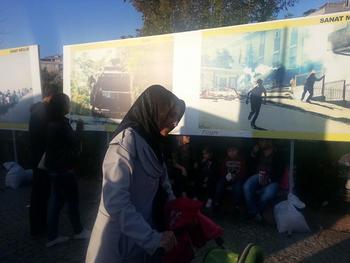
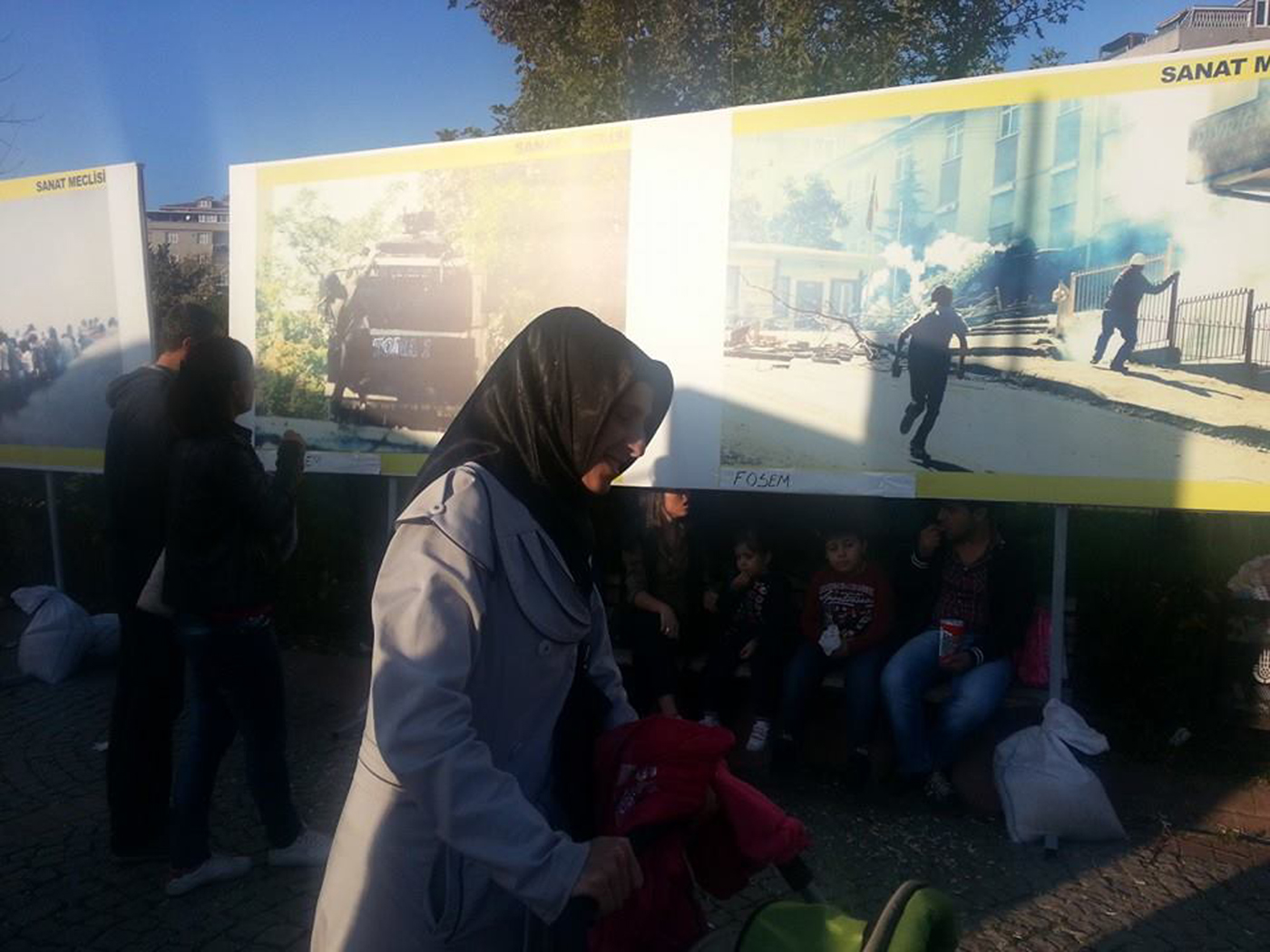
A more traditional public was present at another event organised by a cultural collective involving Gezici Müzisyenler, in the popular neighbourhood of Gazi. Despite the assonance of the name ‘Gazi’ with the park, this neighbourhood is far away from the city centre, but one of the centres of street protest. This is because Gazi is characterised by a majority of Alevis. The musical event took place on the last weekend of October and was organised by a platform called Sanat Meclisi (Musical Parliament), encompassing different art performances, poetry readings, dancing, photography and music. The audience was clearly made up of residents of the area, including more traditionally dressed people of all ages (see Figure 7).
Also a traditional public participated to the musical event held at Gazi neighbourhood in a Kurdish dominated area.
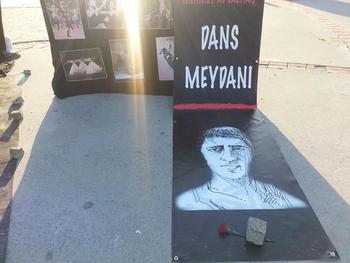
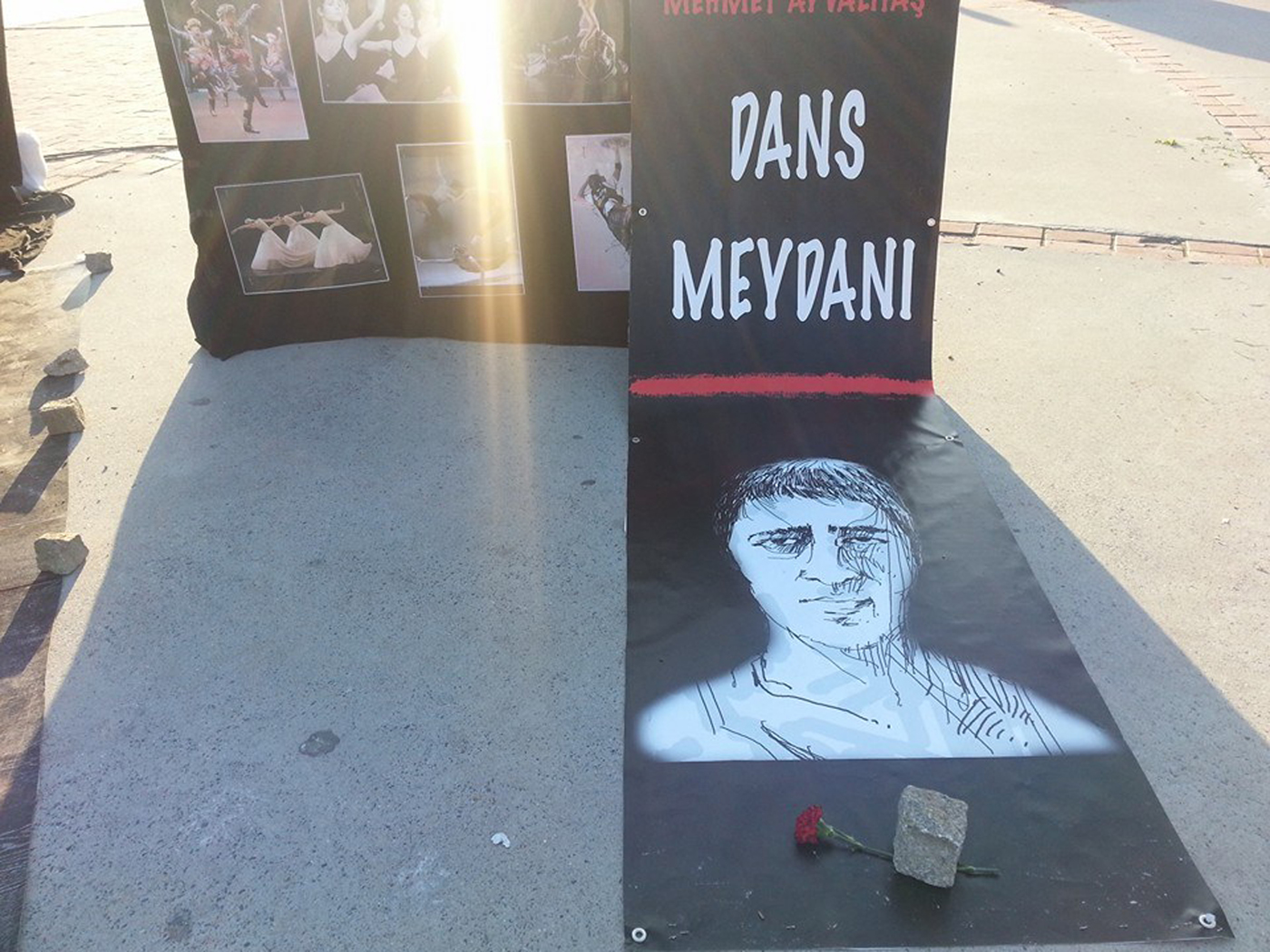
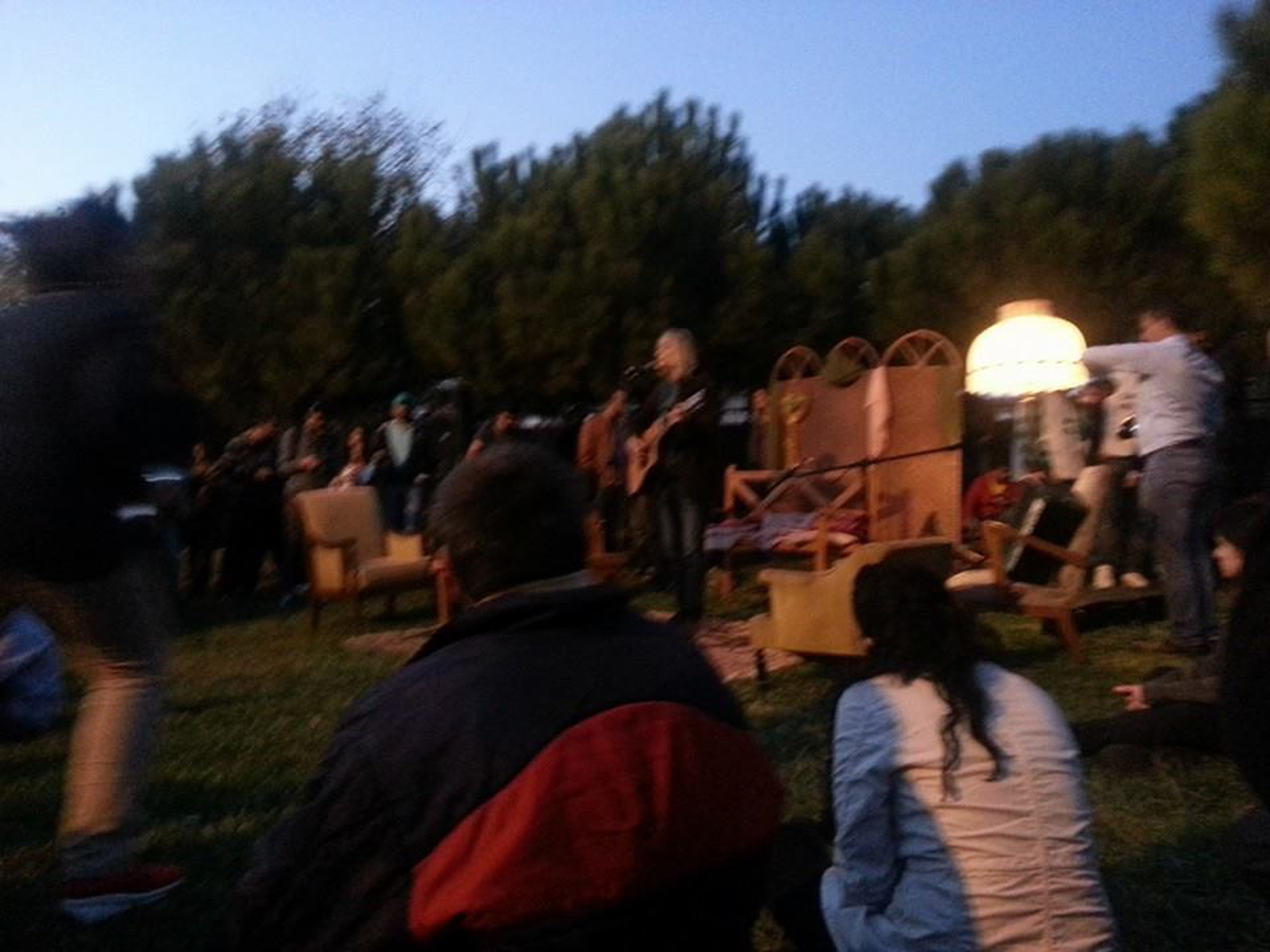
There was no entrance fee, as the idea was ‘to bring cultural and artistic activities to disadvantaged peripheries where protest played an active role’ (interview with XX, a committee member of Sanat Meclisi, 27 October 2013). A big stage was used only at night for a few musical groups, while most of the protest musicians performed in one of the corners of the park, which was sign-posted with the name of one of the protesters who had been killed (Figure 8). A star of protest music, Nesat Yavaşoğullar (Figure 9), voice and composer of the group Bulutsuzluk Önemly, author of the celebrated protest song ‘Acil Demokrasi’ (‘Emergency/Urgent Democracy’) sang solo without a stage and surrounded by curious people. This spatial organisation is politically significant as a way to democratise the space of musical performances through the physical proximity of musicians with an unprivileged audience.
Performance venues at Gazi musical event performed were sign-posted with the name of one of the murdered protesters
A star of protest music: Nesat Yavaşoğullar, voice and composer of the group Bulutsuzluk Önemly
‘Başka bir dunya mümkün (Another world is possible)’ – this was the motto written on the Facebook page of Gezici Müzisyenler. This willingness to change is also one of the common characteristics that Michael Hardt (Reference Hardt2014) has seen in the Occupy movements, from Egypt to New York, passing through Taksim Square. Hardt perceived this change as a challenge to the Western conceptualisation of democracy, a desire to question it, an attempt at re-imaging it in new forms. He also wished that the Occupy movements could find a way to organise it into more stable platforms that did not replicate the traditional forms of party or labour union organisations. He called this process a way to ‘institutionalise joy’ (Hardt Reference Hardt2014). The structure of Gezici Müzisyenler appears to be an attempt to move in this direction by creating a başka (different) way to institutionalise musical actions from below. Music, here, becomes a ‘form of social solidarity’ (Eyerman and Jamison Reference Eyerman and Jamison1998, p. 77), and musicians structured a proper political organisation (Street Reference Street2012, pp. 170–71).
Coda
A sense of failure was strongly felt among activists because of the impossibility of achieving the political goal of changing the government; this characterised Gezi Park political action of the latest period during the repression that is still taking place in Turkey. However, as Melucci (Reference Melucci, Johnston and Klanderman1995) has highlighted, the goal of a social movement is not to change policies, but to bring on cultural changes. By democratising spaces and providing microphones to enable people to express their ideas in a country where freedom of speech has never been granted, Gezi gave a voice to people and minorities that had remained unheard. The level of sharing among diverse people belonging to social, ethnical, cultural and political different affiliations blurred traditional boundaries and attempted to reconstruct new forms of dialogue. Gezi was unable to resolve these differences; however, it disclosed the relevance of a multifaceted political milieu that is suppressed in the mainstream representation of Turkey as a bridge between two outdated versions of East and West. Activists experienced forms of sharing as well as an identity based on diversity and cemented on antagonism to the former Prime Minister. In addition, new associations and political groups were formed as a consequence of Gezi movement activism.
Interestingly, protest music was central for the Gezi movement, and it fulfilled three ‘key elements necessary for participation in any social movement’ (Githens-Mazer Reference Githens-Mazer2008, p. 45): injustice and moral indignation, collective identity and agency. As we have seen above, moral indignation permeated the lyrics of songs specifically composed for the movement. Collective identity was conceptualised by protesters themselves as ‘Gezi Spirit’ and experienced with the whole body in participatory performances which re-used the tradition of Anatolian protest music and dances. As we have seen, this identity was a collective of diversity cemented on its antagonism to ‘Tayip’. Finally, the awareness of bringing on a new cultural sensibility was clearly felt by activists, and the agency of Gezici Müzisyenler stresses the self-assertion of musicians in this process of bringing change. In conclusion, the function of music shifted from framing the protest to encouraging political action and fostering a sense of belonging to the collective identity of the movement. With Gezici Müzisyenler music became political activism.
Acknowledgement
I am indebted to the musicians who have guided me to the experience and knowledge of Turkish music, in particular to bağlama player Zeynel Meriç. I also would like to express my thanks to community activists who have helped me with fieldwork, namely Tolga Bektaş and Michelangelo Severgnini. I thank the photographer Kemal Aslan for copyright permission to publish his picture, and the bands Kardeş Türküler and Duman for allowing me to publish some lines of their lyrics. I thank Professor Ruth Kinna for supporting me from distance during the process of writing this paper and for her helpful comments. I am grateful to my former colleague, Logan Sparks, for English proofreading and his insights into Turkish culture and spelling. I also thank Kıvanç Atak for his suggestions. Special thanks go to the Political Science Department of Suleyman Sah University where I was working when I conducted fieldwork. It was closed down with bulldozers in the summer of 2016. I had to leave Turkey prior to this for lack of freedom of speech. I am grateful to my family for providing me with a roof in troubled times, and to Marco d'Itri for his loving attention which gave me the peace of mind I needed to complete this article.