One of the most astonishing things about the central nervous system is its ability to adjust to the demands of an ever-changing environment. This plasticity allows for behavioral adaptations critical to survival, and the mechanisms behind it are of great interest to many in the fields of neuroscience, psychology, and psychiatry. These adaptations require environmentally driven changes in gene expression from gestation through senescence, a feat we now know is made possible by dynamic modifications of DNA and its associated proteins, or chromatin. The idea that DNA codes for RNA, which codes for proteins, is a central dogma of molecular biology. Because proteins are essential to cell function, tight regulation of their synthesis is critical to homeostasis and adaptation. Epigenetics (literally “on top of” genetics), a term first coined by Conrad Waddington (Reference Waddington1957), allows this regulation via changes that bidirectionally control transcription and translation without changing the underlying DNA sequence. These mechanisms are highly responsive to our experiences and thus are considered one major route by which environmental factors can catalyze changes in the nervous system, thereby altering behavior.
In this review, after a brief introduction to several epigenetic modifications, we examine evidence obtained from animal models on the nature of these modifications in response to environmental adversity, though a few other experiences (both within and outside of early development) are discussed as well. In addition, each section will briefly review evidence supporting the existence of these epigenetic modifications in humans. Finally, we will discuss pharmacological and behavioral treatments and interventions known to affect the epigenome and behavior.
Epigenetics: The Fundamentals
DNA methylation (5mC)
Methylation of DNA involves the addition of methyl groups to cytosines, typically at cytosine–guanine dinucleotides, and this modification generally results in a suppression of transcription due to impedance of transcription factors and the recruitment of repressor proteins (Moore, Le, & Fan, Reference Moore, Le and Fan2013). Methylation has also been found to occur in non-CG contexts (Lister et al., Reference Lister, Pelizzola, Dowen, Hawkins, Hon and Tonti-Filippini2009; Ramsahoye et al., Reference Ramsahoye, Biniszkiewicz, Lyko, Clark, Bird and Jaenisch2000). While the biological significance of non-CG methylation is not yet entirely clear, it has been associated with transcriptional suppression in vitro (Guo et al., Reference Guo, Su, Shin, Shin, Li and Xie2014). DNA methyltransferases (DNMTs), the enzymes that catalyze DNA methylation, are responsible for transferring methyl groups from S-adenosylmethionine to the 5-carbon position of the pyrimidine ring of cytosines (Moore et al., Reference Moore, Le and Fan2013). Activity of demethylases such as GADD45β (Ma et al., Reference Ma, Jang, Guo, Kitabatake, Chang and Pow-Anpongkul2009) and MBD2 (Detich, Theberge, & Szyf, Reference Detich, Theberge and Szyf2002) appear responsible for removing methyl groups in an active fashion. DNMT1 mainly functions to maintain methylation patterns by targeting hemimethylated DNA during replication, whereas DNMT3a and DNMT3b are de novo methyltransferases responsible for establishing new patterns of methylation (Bestor, Reference Bestor2000).
DNA hydroxymethylation (5hmC)
Hydroxymethylation of DNA involves the oxidation of methylated cytosines by the ten–eleven translocation (TET) family of proteins. The relationship between this modification and gene expression is not as clear as that of DNA methylation; the direction of transcriptional regulation associated with 5hmC appears to be much more dynamic (Robertson, Robertson, & Klungland, Reference Robertson, Robertson and Klungland2011; Szulwach et al., Reference Szulwach, Li, Li, Song, Wu and Dai2011; Valinluck et al., Reference Valinluck, Tsai, Rogstad, Burdzy, Bird and Sowers2004). While it was originally thought to only be an intermediary step in active DNA demethylation, evidence now suggests it could play a more stable role in gene expression. Evidence for the stability and behavioral relevance of this modification include its responsiveness to neuronal activity (Guo, Su, Zhong, Ming, & Song, Reference Guo, Su, Zhong, Ming and Song2011), its increase in neuronal cells with age (Szulwach et al., Reference Szulwach, Li, Li, Song, Wu and Dai2011), and its overall enrichment in the brain (Kato & Iwamoto, Reference Kato and Iwamoto2014).
Methyl-CpG binding protein 2 (MeCP2)
MeCP2 is a protein that binds to DNA in a methyl-dependent manner, recruiting either corepressors such as HDACs and mSin3 (Nan et al., Reference Nan, Ng, Johnson, Laherty, Turner and Eisenman1998) or coactivators such as CREB1 (Chahrour et al., Reference Chahrour, Jung, Shaw, Zhou, Wong and Qin2008), thereby contributing to the silencing or enhancement of gene expression in a context-dependent manner.
Histone acetylation
Histone acetylation involves the addition of acetyl groups at lysine residues on the N-terminal tail of histone proteins, decreasing the affinity between the histone and DNA and thereby allowing a more permissive transcriptional state (Grunstein, Reference Grunstein1997). This process is accomplished by histone acetyltransferases, which transfer the acetyl group from acetyl coenzyme A, and is reversed (i.e., the acetyl group removed) by histone deacetylases (HDACs; De Ruijter, Van Gennip, Caron, Kemp, & van Kuilenburg, Reference De Ruijter, Van Gennip, Caron, Kemp and van Kuilenburg2003).
Histone methylation
Histone methylation involves the addition of methyl groups at arginine and lysine residues on the N-terminal tail of histone proteins. Mono-, di-, or trimethylation can occur at lysine residues while only mono- or dimethylation can occur at arginine residues (Zhang & Reinberg, Reference Zhang and Reinberg2001). This process is accomplished by histone methyltransferases and is reversed (i.e., the methyl group removed) by histone demethylases. The direction of transcriptional regulation depends on the location and number of methyl groups. For example, monomethylation of histone 3 at lysine 36 (H3K36me) and trimethylation of H3K4 (H3K4me3) are activational marks. Examples of repressive histone methylation marks are H3K9me3, H4K20me3, and H3K27me3.
Epigenetic Changes Driven by Stress During the Postnatal Period
One of the most widely studied environmental effectors of epigenetic change in rodents has been early-life stress (ELS) occurring during the postnatal period. Stress is studied in the rodent postnatal period commonly through examination of natural variations in (or manipulation of) the caregiving environment. Considering the programming effects of maternal behavior on hypothalamus–pituitary–adrenal (HPA) axis function and stress responsivity in offspring (Levine, Reference Levine1994; Liu et al., Reference Liu, Diorio, Tannenbaum, Caldji, Francis and Freedman1997; Maccari et al., Reference Maccari, Darnaudery, Morley-Fletcher, Zuena, Cinque and Van Reeth2003), it is no surprise that this system has been a focal point in the search for mechanisms by which the early environment is able to shape biological and behavioral outcomes.
The HPA axis is a set of three structures (the hypothalamus, the anterior pituitary gland, and the adrenal glands) that plays a central role in stress responsivity (as reviewed in Frodl & O'Keane, Reference Frodl and O'Keane2013; Herman & Cullinan, Reference Herman and Cullinan1997; Leonard, Reference Leonard2005). Briefly, corticotropin-releasing hormone (also referred to as corticotropin-releasing factor) and arginine vasopressin are released from the paraventricular nucleus (PVN) of the hypothalamus in response to stress. These hormones then trigger the production and release of adrenocorticotrophic hormone from the anterior pituitary, which then goes on to trigger the production and release of corticosterone (cortisol in humans) from the adrenal glands (De Kloet, Vreugdenhil, Oitzl, & Joels, Reference De Kloet, Vreugdenhil, Oitzl and Joels1998).
Consistent with this focal point is one of the most well-known studies of environmentally driven epigenetic changes, conducted in 2004 by Weaver et al. Briefly, this study investigated natural variations in maternal care and found that adult male offspring of female rats that exhibited high levels of licking and grooming showed different epigenetic patterns at the glucocorticoid receptor (GR) gene than the male offspring of low licking and grooming females (Weaver et al., Reference Weaver, Cervoni, Champagne, D'Alessio, Sharma and Seckl2004). Offspring of mothers that exhibited lower levels of care were found to have high levels of DNA methylation and less histone acetylation of hippocampal GR DNA, leading to less GR expression. This epigenetic, maternal care-induced reduction in GRs resulted in a lack of negative feedback in the HPA system and therefore to an exaggerated stress response in the offspring (when assessed in adulthood). Further demonstrated by this study was the reversibility of these outcomes either by moving pups to a positive caregiving environment (cross-fostering of pups to high-care mothers) or by altering epigenetic patterns via drug administration. These results demonstrated the capability of the early environment to shape the nervous system in such a way that behavior was altered throughout the life of the organism and, more importantly, pinpointed epigenetics as a mechanism by which this incredible interaction was likely to occur.
A Reference Murgatroyd, Patchev, Wu, Micale, Bockmuhl and Fischer2009 study by Murgatroyd et al. also focused on the HPA axis and found sustained epigenetic changes of the mouse Avp gene in response to maternal separation, another common inducer of ELS in rodents. Specifically, the authors discovered hypomethylated Avp DNA accompanied by less MeCP2 in the enhancer region and greater Avp mRNA in the PVN of offspring that had experienced maternal separation. These changes led to increased activity of the HPA axis as well as deficits in memory (as assessed by an inhibitory avoidance task) and stress coping (as assessed by a forced swim task). Further, administration of an arginine vasopressin receptor antagonist proved able to partially or fully attenuate, respectively, these deficits. In addition, higher mRNA levels of the precursor hormone for adrenocorticotropic hormone (proopiomelanocortin [Pomc]) were seen in maternally separated animals, a change attributed to less methylation of the Pomc promoter region (Wu, Patchev, Daniel, Almeida, & Spengler, Reference Wu, Patchev, Daniel, Almeida and Spengler2014).
A more recent study along these lines demonstrated that while ELS resulted in hypermethylation of a region located a short distance from the GR promoter region in the PVN, an increase in GR mRNA was also seen (Bockmühl et al., Reference Bockmühl, Patchev, Madejska, Hoffmann, Sousa and Sousa2015). It is interesting that ELS animals exposed to chronic stress in adulthood did not exhibit an increase in Crh when compared to controls, likely because of this GR upregulation. Considering here that higher methylation was not correlated with a decrease in gene expression, these data highlight that DNA methylation is not always synonymous with less gene expression and suggest that other factors (e.g., other epigenetic marks such as 5hmC) may be involved, interacting with 5mC to produce different outcomes. However, data from these studies demonstrate long-term shaping of the HPA axis by the early environment that affects behavioral outcomes (whether adaptive or not) and pinpoint epigenetic changes as a mechanism of action.
Other studies have ventured outside of this stress response system to investigate whether there are ELS-induced epigenetic changes within other brain regions and genes of interest. Following maternal separation for 3 hr on each of the first 13 days of life, the neurotensin receptor 1 gene (Nt-r1; a receptor for the neuropeptide neurotensin thought to play an important role in fear and anxiety) was found to be hypermethylated in the adult rodent amygdala (Toda et al., Reference Toda, Boku, Nakagawa, Inoue, Kato and Takamura2014). These rodents also displayed enhanced freezing behavior in a fear conditioning task. Given these results and the potential anxiolytic role of neurotensin (Saiz, Carrasco, & Hernanz, Reference Saiz, Carrasco and Hernanz1991; Shilling & Feifel, Reference Shilling and Feifel2008), epigenetic changes at this gene may be a source of some of the behavioral outcomes associated with ELS.
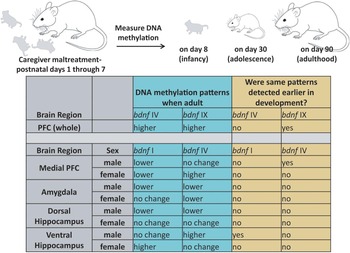
Plasticity-related genes have also been a focus in behavioral epigenetics and have proven to be quite sensitive to early postnatal events. Using a rodent model wherein rat pups are briefly exposed (30 min) daily during the first week of life to an aversive form of caregiving (i.e., stepping on, dragging, roughly handling, and actively avoiding), our lab has found changes in DNA methylation of plasticity-related genes in several different brain regions (Blaze, Scheuing, & Roth, Reference Blaze, Scheuing and Roth2013; Roth, Matt, Chen, & Blaze, Reference Roth, Matt, Chen and Blaze2014). Several of these studies have focused on DNA associated with various exons of brain-derived neurotrophic factor (Bdnf), a gene critical to the processes of neural development and synaptic plasticity (Greenberg, Xu, Lu, & Hempstead, Reference Greenberg, Xu, Lu and Hempstead2009). These studies underscore the complex nature of DNA methylation, finding ELS-induced changes in methylation that vary by exon examined, as well as by age, sex, and brain region (Figure 1). Following this type of ELS, rats of both sexes in adulthood, adolescence, and infancy exhibit specific changes in Bdnf DNA methylation in the whole prefrontal cortex (PFC; Roth et al., Reference Roth, Lubin, Funk and Sweatt2009) and medial PFC (mPFC; Blaze et al., Reference Blaze, Scheuing and Roth2013) and in the hippocampus (dorsal vs. ventral) and amygdala (Doherty, Forster, & Roth, Reference Doherty, Forster and Roth2015; Roth et al., Reference Roth, Matt, Chen and Blaze2014). Further, altered patterns of histone acetylation at Bdnf exon IV were found in the mPFC of maltreated females (Blaze, Asok, & Roth, Reference Blaze, Asok and Roth2015). These latter results are especially interesting in light of recent findings describing downregulation of histone modifiers in the mPFC of maternally separated rats (Pusalkar et al., Reference Pusalkar, Suri, Kelkar, Bhattacharya, Galande and Vaidya2016).
(Color online) Schematic of brain-derived neurotrophic factor (Bdnf) DNA methylation changes we have observed in the brain of infant (8 days old), adolescent (30 days old), and adult (90 days old) male and female rats exposed to our maltreatment regimen. Higher, lower, or no change refers to methylation levels in maltreated rats in comparison to normal (nurturing) care controls. Changes in methylation are for DNA associated with important regulatory or coding regions of the Bdnf gene (Bdnf I, IV, IX). Note we did not examine DNA associated with exon I for the prefrontal cortex (PFC) as a whole, nor did we examine DNA associated with exon IX in the medial PFC, amygdala, or hippocampus. For the whole PFC study, male and female data were combined and sexes were not examined individually (cf. data in Blaze et al., Reference Blaze, Scheuing and Roth2013; Doherty et al., Reference Doherty, Forster and Roth2015; and Roth et al., Reference Roth, Lubin, Funk and Sweatt2009, Reference Roth, Matt, Chen and Blaze2014).

In addition, using our ELS paradigm, we have also examined methylation of Reelin, another gene critical to brain development and synaptic plasticity (Curran & D'Arcangelo, Reference Curran and D'Arcangelo1998; Weeber et al., Reference Weeber, Beffert, Jones, Christian, Förster and Sweatt2002), finding transiently low levels of mPFC methylation in maltreated females (i.e., this difference did not persist into adulthood) and a trend toward high methylation in maltreated males when adult (Blaze et al., Reference Blaze, Scheuing and Roth2013). Finally, we have measured the expression of various epigenetic regulators occurring in response to this ELS model and found significant differences varying by sex and age in the mPFC of maltreated animals, with the strongest differences present in adulthood (Blaze & Roth, Reference Blaze and Roth2013). Altogether, our data indicate that amazingly brief environmental manipulations during the first postnatal week are sufficient to epigenetically modify genes, an effect that at some Bdnf loci (i.e., exon IX in the PFC) can be remarkably maintained throughout development and into adulthood. These data also help illustrate the importance of incorporating a longitudinal approach in epigenetic studies because our results for other Bdnf loci (e.g., exon IV in the female PFC and male ventral hippocampus) indicate that maltreatment does not always translate into immediate epigenetic changes but results in changes that can evolve after an appreciable delay.
All of the data reviewed thus far tell us that ELS can alter the epigenome, suggesting that epigenetic changes may be partly responsible for the adverse outcomes associated with ELS such as changes in mood, cognition, and stress responsivity (Cicchetti & Toth, Reference Cicchetti and Toth2005; Ivy et al., Reference Ivy, Rex, Chen, Dubé, Maras and Grigoriadis2010; Lee & Hoaken, Reference Lee and Hoaken2007), increased drug-seeking behavior (Dembo et al., Reference Dembo, Williams, La Voie, Berry, Getreu and Wish1989; Deminière et al., Reference Deminière, Piazza, Guegan, Abrous, Maccari and Le Moal1992; Huang et al., Reference Huang, Trapido, Fleming, Arheart, Crandall and French2011), and psychiatric disorders (Cicchetti & Toth, Reference Cicchetti and Toth2005; Heim & Nemeroff, Reference Heim and Nemeroff2001; Kaffman & Meaney, Reference Kaffman and Meaney2007). Epigenetic changes may also be responsible for altered patterns of parenting, another realm of behavior significantly affected by ELS. It has been well established in humans that patterns of abuse are often perpetuated from one generation to the next (Haapasalo & Aaltonen, Reference Haapasalo and Aaltonen1999; Ney, Reference Ney1988; Zaidi, Knutson, & Mehm, Reference Zaidi, Knutson and Mehm1989), and animal models have allowed for investigation of the molecular substrates of this perpetuation.
Female rodents receiving low levels of maternal care in infancy will in turn exhibit low levels of care toward their own pups (Francis, Diorio, Liu, & Meaney, Reference Francis, Diorio, Liu and Meaney1999). From the early to mid-2000s, Michael Meaney's laboratory made a series of discoveries that have greatly contributed to our understanding of this phenomenon. Initially, this group reported low levels of oxytocin receptor binding in rodent mothers displaying low levels of care toward pups (Francis, Champagne, & Meaney, Reference Francis, Champagne and Meaney2000), and then that sensitivity to estrogen, which increased binding at these receptors in brain regions relevant to maternal behavior, was lower in the offspring of low-care mothers (Champagne, Diorio, Sharma, & Meaney, Reference Champagne, Diorio, Sharma and Meaney2001). Further, they found lower levels of estrogen receptor-α mRNA in the medial preoptic area of low- versus high-care females (Champagne, Weaver, Diorio, Sharma, & Meaney, Reference Champagne, Weaver, Diorio, Sharma and Meaney2003). In addition, they reported differential methylation of the estrogen receptor-α promoter region in the medial preoptic area of low- and high-care females (Champagne et al., Reference Champagne, Weaver, Diorio, Dymov, Szyf and Meaney2006). Cross-fostering the offspring in these studies led to biological and behavioral outcomes resembling those of the caretaker, not the biological mother, suggesting that transmission of these patterns is nongenomic. Taken as a whole, these studies suggest that estrogen-related oxytocin binding is a critical component of rodent maternal behavior and that DNA methylation may be the mechanism by which differences in this biological state, and therefore differences in maternal behavior, are passed from one generation to the next.
A recurring theme in many of the studies discussed above is sex differences in the epigenetic state and their associated behavioral outcomes. Perhaps maternal behavior may play a significant role in these differences. Rodent mothers exhibit a different pattern of behavior toward infant male offspring than they do toward infant female offspring, with male pups receiving higher levels of maternal attention through behaviors such as licking and grooming (Moore & Morelli, Reference Moore and Morelli1979; Richmond & Sachs, Reference Richmond and Sachs1984). When compared to mothers of all-female or mixed-sex litters, higher nurturing behavior (e.g., licking, active nursing, and nest building) has been observed in mothers of all-male litters (Alleva, Caprioli, & Laviola, Reference Alleva, Caprioli and Laviola1989; Cirulli, Adriani, & Laviola, Reference Cirulli, Adriani and Laviola1997). These differences affect offspring outcomes, likely via epigenetic pathways. For example, in male- or female-only (single-sex) litters the mu-opioid receptor-encoding gene (Oprm1) exhibits site-specific hypermethylation in the hippocampus (males and females) and nucleus accumbens (males only; Hao, Huang, Nielsen, & Kosten, Reference Hao, Huang, Nielsen and Kosten2011). This receptor is thought to be involved in both attachment and reward (Kieffer & Gavériaux-Ruff, Reference Kieffer and Gavériaux-Ruff2002; Matthes et al., Reference Matthes, Maldonado, Simonin, Valverde, Slowe and Kitchen1996; Moles, Kieffer, & D'Amato, Reference Moles, Kieffer and D'Amato2004; Nelson & Panksepp, Reference Nelson and Panksepp1998), making it an interesting target considering that reward-based behaviors such as drug use may be intimately related to disruptions in caregiver attachment (Kosten, Miserendino, & Kehoe, Reference Kosten, Miserendino and Kehoe2000). Endogenous opioids are released by the infant during caregiver interactions (Nelson & Panksepp, Reference Nelson and Panksepp1998; Roth & Sullivan, Reference Roth and Sullivan2006; Weller & Feldman, Reference Weller and Feldman2003). Thus, it appears that the caregiving environment plays a programming role in the development of this system.
Using the same litter composition model (mixed-sex vs. single-sex), methylation levels of GR, early growth response protein 1 (Egr1, a transcription factor that may be involved in neuronal plasticity; Knapska & Kaczmarek, Reference Knapska and Kaczmarek2004); and Bdnf were measured in the nucleus accumbens and hippocampus of offspring (Kosten, Huang, & Nielsen, Reference Kosten, Huang and Nielsen2014). In the nucleus accumbens, a number of cytosine sites in the GR promoter region exhibited higher methylation in female pups reared in single-sex litters. In male pups reared in single-sex litters, Egr1 methylation was lower in this same brain region. Bdnf methylation was not significantly different between groups in either brain region. Given that we know GR gene methylation is higher when maternal (nurturing) interactions are lacking, and that female pups receive less of this nurturing behavior when compared to male pups, these GR data appear consistent with one another. This study also assessed fear and anxiety behaviors on postnatal day 35 but found no significant effect of litter composition, making the results difficult to interpret at a phenotypic level. Given that many studies find changes in adult behavior following disruption of the early environment, it is reasonable to suggest that litter composition could affect these behaviors at a later time point. Overall, differences in the sex composition of a litter affect maternal behavior, behavior that is already differentially exhibited toward male and female pups. Through animal models, we have come to understand that these factors alone (i.e., litter composition and male-directed maternal behavior) are environmental drivers of epigenetic change. Understanding their combined effect will help further elucidate the relationship between the early environment and epigenetically mediated behavioral outcomes, specifically those of a sex-specific nature.
Although the majority of studies we have discussed thus far have focused on specific genes, several have also zoomed out to investigate global activity of the epigenome. While there are some challenges in this approach (including costs and burdensome data sets), increasing evidence suggests that changes in genome-wide levels of methylation are associated with maladaptive behavioral outcomes (Anier et al., Reference Anier, Malinovskaja, Pruus, Aonurm-Helm, Zharkovsky and Kalda2014; Kinnally et al., Reference Kinnally, Feinberg, Kim, Ferguson, Leibel and Coplan2011). Understanding epigenetic activity on a broad scale is of course instrumental in understanding larger behavioral domains (i.e., a psychiatric disorder) and particularly for treatment considering that current drug and behavior therapies will act on a global level.
Differential promoter methylation on a broad scale has been seen in the brain (PFC) and in T cells (a component of the immune system) of maternal- versus peer-reared rhesus macaques (Provençal et al., Reference Provençal, Suderman, Guillemin, Massart, Ruggiero and Wang2012). In addition, these groups showed differential levels of hydroxymethylation in the promoter region of numerous neurologically and psychologically relevant genes (Massart et al., Reference Massart, Suderman, Provencal, Yi, Bennett and Suomi2014). While there is little research thus far on epigenetic regulation of the immune system following ELS, it is a promising regulatory candidate for the ELS-induced immune changes seen in both animals and humans (Miller et al., Reference Miller, Chen, Fok, Walker, Lim and Nicholls2009; O'Mahony et al., Reference O'Mahony, Marchesi, Scully, Codling, Ceolho and Quigley2009). Though no global effects were seen in the hippocampus in an earlier study by Brown, Weaver, Meaney, and Szyf (Reference Brown, Weaver, Meaney and Szyf2008) focusing on natural variations in maternal care, our lab recently found changes in global levels of methylation and hydroxymethylation in adolescent rats exposed to caregiver maltreatment. Specifically, maltreated males exhibited high 5-mC levels in the dorsal hippocampus and low 5-hmC levels in the amygdala (Doherty et al., Reference Doherty, Forster and Roth2015). This change in global 5-hmC may be of interest in particular because evidence suggests that this cytosine modification plays a pivotal role in behavioral adaptation (Li et al., Reference Li, Wei, Zhao, Widagdo, Baker-Andresen and Flavell2014).
Many of the animal findings of epigenetic consequences associated with ELS have been translated to humans. Some of the most compelling results in this regard are those of a Reference McGowan, Sasaki, D'Alessio, Dymov, Labonte and Szyf2009 study from Patrick McGowan and colleagues. An investigation of postmortem hippocampal tissue revealed that in suicide victims with a history of child abuse, NR3C1 (GR) promoter methylation and gene expression were significantly increased and decreased, respectively. These results mirror those found in the low-care rodent offspring discussed previously. Infants of mothers with postpartum depression have been found to exhibit significant methylation of the NR3C1 gene as well, an effect that is attenuated with tactile stimulation (i.e., stroking) of the infant by its mother (Murgatroyd, Quinn, Sharp, Pickles, & Hill, Reference Murgatroyd, Quinn, Sharp, Pickles and Hill2015). Higher NR3C1 methylation is also seen in adolescents following acute social stress, a change accompanied by aberrant cortisol recovery (Van Der Knaap, Oldehinkel, Verhulst, Van Oort, & Riese, Reference Van Der Knaap, Oldehinkel, Verhulst, Van Oort and Riese2015). One line of work is even showing far-reaching NR3C1 methylation changes (and stress responsivity) in Holocaust survivor offspring (Yehuda et al., Reference Yehuda, Daskalakis, Lehrner, Desarnaud, Bader and Makotkine2014).
In addition, methylation of Bdnf (Perroud et al., Reference Perroud, Salzmann, Prada, Nicastro, Hoeppli and Furrer2013; Unternaehrer et al., Reference Unternaehrer, Meyer, Burkhardt, Dempster, Staehli and Theill2015; Weder et al., Reference Weder, Zhang, Jensen, Yang, Simen and Jackowski2016), the oxytocin receptor gene (OXTR; Unternaehrer et al., Reference Unternaehrer, Meyer, Burkhardt, Dempster, Staehli and Theill2015), the serotonin transporter gene (solute carrier family C6, member 4 [SLC6A4]; Beach, Brody, Todorov, Gunter, & Philibert, Reference Beach, Brody, Todorov, Gunter and Philibert2011; Vijayendran, Beach, Plume, Brody, & Philibert, Reference Vijayendran, Beach, Plume, Brody and Philibert2012), and FKBP5 (Mehta et al., Reference Mehta, Gonik, Klengel, Rex-Haffner, Menke and Rubel2011; Weder et al., Reference Weder, Zhang, Jensen, Yang, Simen and Jackowski2016) are associated with the type of parental care experienced in childhood. Of note, high levels of methylation in individuals who report experiencing child abuse and neglect mirror many of the brain observations we have found in our maltreated rats. In summary, data are consistent between animal models and humans, arguing that epigenetic changes are one route through which early postnatal environments could be yielding their behavioral effects.
Epigenetic Changes Driven by Stress During Gestation
Though epigenetic changes are a consequence of environmental adversity experienced during the early postnatal period, it is clearly not the earliest time point at which the nervous system can be altered by the environment. Several groups have found that the epigenome is also highly responsive to prenatal experiences and that this interaction, again, frequently occurs within the HPA axis. For example, prenatally stressed male rats exhibit altered methylation with corresponding changes in gene expression of Crf (low methylation and high gene expression) and GR (high methylation and low gene expression). These changes were accompanied by aberrant stress responses in adulthood (Mueller & Bale, Reference Mueller and Bale2008). Beyond reinforcing our understanding of the programming effect of the prenatal environment, this study also underscored sex differences inherent in epigenetic factors even at basal levels, with higher Dnmt1 levels in control male placentas.
Related to the function of glucocorticoids during gestation is 11ß-hydroxysteroid dehydrogenase type 2 (Hsd11B2). This enzyme, which aids in protecting the fetus from maternal glucocorticoids (via oxidation of corticosterone to an inactive metabolite), may decrease in response to maternal stress (Mairesse et al., Reference Mairesse, Lesage, Breton, Bréant, Hahn and Darnaudéry2007). This decrease was investigated in rodents using restraint stress during pregnancy, and results revealed epigenetic responses to be a likely cause of the stress-induced downregulation of this gene. Specifically, low placental levels of Hsd11B2 mRNA were accompanied by high methylation at the promoter region as well as an increase in Dnmt mRNA, patterns that differed from those found in the fetal cortex and hypothalamus (Peña, Monk, & Champagne, Reference Peña, Monk and Champagne2012). These results are consistent with the hypothesis that developmental epigenetic changes serve to adapt an organism to the environment it will encounter throughout its lifetime. In this case, while a mechanism exists to protect the fetus from stress, perhaps there is a threshold (of maternal glucocorticoid exposure) above which the nervous system will react to prepare the organism for an environment that is signaling higher than “normal” adversity levels. The pattern differences between tissue types examined in this study also demonstrate the regional specificity of epigenetic mechanisms, lending support to the idea that these changes occur in a meaningful fashion.
Like postnatal stressors, prenatal stress has also been found to impact the epigenome outside of the HPA axis. For example, Boersma et al. (Reference Boersma, Lee, Cordner, Ewald, Purcell and Moghadam2014) discovered higher Bdnf methylation (accompanied by lower gene expression) and increased expression of Dnmt1 and 3a in the amygdala and hippocampus of adult rats that had been exposed to variable stress during gestation in comparison to controls. Chronic, unpredictable stress during gestation led to impaired spatial memory in male and female adult offspring, with females exhibiting high levels of Dnmt1 and low levels of acetylation of histone 3 (Benoit, Rakic, & Frick, Reference Benoit, Rakic and Frick2015). In addition, St.-Cyr and McGowan (Reference St.-Cyr and McGowan2015) found that adult female offspring of mothers exposed to predator odor during pregnancy exhibited less Bdnf IV methylation in the hippocampus along with an increase in antipredator behavior in both female and male offspring. The results from these two studies strongly support the sex-specific nature of epigenetic modifications.
Using restraint stress, studies by Matrisciano et al. (Reference Matrisciano, Tueting, Dalal, Kadriu, Grayson and Davis2013) and Matrisciano, Tueting, Maccari, Nicoletti, and Guidotti (Reference Matrisciano, Tueting, Maccari, Nicoletti and Guidotti2012) found differences in Bdnf and Dnmt1 expression similar to those of Boersma et al. (Reference Boersma, Lee, Cordner, Ewald, Purcell and Moghadam2014) as well as numerous other epigenetic changes in mice coupled with behavioral abnormalities representing a schizophrenia-like phenotype. More specifically, mice exposed to gestational stress exhibited low levels of the schizophrenia-related genes Bdnf (consistent with previously discussed postnatal stress reports, suggesting epigenetic involvement) and glutamic acid decarboxylase 67 (Gad67). They also exhibited more Dnmt1 expression, including greater DNMT1 binding in the promoter region of the genes coding for metabotropic glutamate 2 and 3 (mGlu2 and mGlu3) receptors, and greater MeCP2 binding at the mGlu2 promoter region (Matrisciano et al., Reference Matrisciano, Tueting, Maccari, Nicoletti and Guidotti2012). Given that mGlu2/3 receptor activity is implicated in an antipsychotic state (Patil et al., Reference Patil, Zhang, Martenyi, Lowe, Jackson and Andreev2007), stress-induced methylation of these promoters is particularly relevant when examining epigenetics in the context of early adversity and later mental health outcomes. In another study, prenatally stressed mice exhibited higher Dnmt levels throughout the lifespan associated with less expression of genes with known roles in schizophrenia (i.e., reelin and Gad67). These mice also exhibited more methylated and hydroxymethylated cytosines in the promoter region of these genes as well as an increase in MeCP2 binding (Matrisciano et al., Reference Matrisciano, Tueting, Dalal, Kadriu, Grayson and Davis2013). In addition, mice in both studies exhibited behaviors typical in schizophrenia-like phenotypes such as abnormal social behavior, deficits in prepulse inhibition and fear conditioning, and hyperactivity. These behavioral effects were reversible by mGlu2/3 receptor agonists or drugs with epigenetic targets (i.e., histone deacetylase inhibition and DNA-demethylation), respectively (Matrisciano et al., Reference Matrisciano, Tueting, Maccari, Nicoletti and Guidotti2012, Reference Matrisciano, Tueting, Dalal, Kadriu, Grayson and Davis2013). These studies provide further information on the link between prenatal adversity and later psychiatric disorders and provide evidence for the mechanistic role of epigenetics in these outcomes. Evidence suggests that Bdnf and Dnmt1 in particular play critical roles in this relationship and may therefore be fruitful targets in strategies of intervention.
Prenatal susceptibility of the epigenome translates to humans as well. Human offspring of mothers who reported anxiety during gestation exhibited higher methylation of 11BHSD2 while offspring of mothers who reported depression during gestation exhibited higher NR3C1 methylation (Conradt, Lester, Appleton, Armstrong, & Marsit, Reference Conradt, Lester, Appleton, Armstrong and Marsit2013). In addition, maternal depression during gestation in conjunction with a specific variant of the MTHFR gene (responsible for encoding methylenetetrahydrofolate reductase, a critical enzyme in the production of methionine) leads to less methylation of SLC6A4 in both mother and offspring (Devlin, Brain, Austin, & Oberlander, Reference Devlin, Brain, Austin and Oberlander2010). Considering that serotonin dysfunction has been implicated in depression risk (Jans, Riedel, Markus, & Blokland, Reference Jans, Riedel, Markus and Blokland2007), methylation of this gene so early in development will undoubtedly have great implications for later mental health.
In addition to psychosocial factors, several physical factors are at play in determining the epigenetic state, including maternal diet and exposure to toxins. The epigenome is inextricably related to diet due to the dependence of the methyl donor S-adenosylmethionine on diet-derived folates (Cooney, Reference Cooney1992). This relationship encompasses the interplay between maternal diet and offspring outcomes, an effect illustrated in the offspring of low- and high-care mothers following methionine infusion (Weaver et al., Reference Weaver, Champagne, Brown, Dymov, Sharma and Meaney2005). Offspring of high-care mothers, which generally exhibit less GR methylation and lower anxiety responses in adulthood (as previously discussed), exhibit the opposite pattern of methylation and behavior following methionine infusion. In addition, methionine infusion was found to have an effect on only a subset of genes (Weaver, Meaney, & Szyf, Reference Weaver, Meaney and Szyf2006), suggesting specificity in a nonspecific type of treatment. Male offspring of female mice consuming a high-fat diet during pregnancy exhibited significant decreases in both global methylation and dopamine- and opioid-related genes accompanied by higher gene expression and behavioral preferences for sucrose and fat (Vucetic, Kimmel, Totoki, Hollenbeck, & Reyes, Reference Vucetic, Kimmel, Totoki, Hollenbeck and Reyes2010). Given that these genes are associated with reward and that their expression varied in both reward circuitry and the hypothalamus (known to regulate feeding behavior), these data suggest an epigenetic basis for the transmission of obesity from parent to offspring. A second related study looking at both male and female offspring found that maternal methyl supplementation reversed some but not all of the diet-induced epigenetic changes in both males and females. This intervention was also able to attenuate the fat preference found in males (Carlin, George, & Reyes, Reference Carlin, George and Reyes2013).
The agouti mouse provides another example of the epigenetic interaction between diet and phenotype. Agouti gene expression in the mouse varies based on early epigenetic marks, leading to very distinct phenotypes in offspring: hypermethylation of a retrotransposon upstream of the Agouti gene results in brown, normal weight mice whereas hypomethylation is associated with yellow, obese mice (Dolinoy, Reference Dolinoy2008). The latter phenotype can be prevented via epigenetic changes following methyl supplementation of the maternal diet during pregnancy (Waterland & Jirtle, Reference Waterland and Jirtle2003; Wolff, Kodell, Moore, & Cooney, Reference Wolff, Kodell, Moore and Cooney1998). Other dietary components are also known to regulate the epigenome (e.g., turmeric; for a review of epigenetics and natural compounds, see Reuter, Gupta, Park, Goel, & Aggarwal, Reference Reuter, Gupta, Park, Goel and Aggarwal2011). Thus, dietary interventions may prove to be a useful tool in epigenome management. It appears that nutrition, stress, and maternal behavior interact to contribute to the development of the adult brain (Hoeijmakers, Lucassen, & Korosi, Reference Hoeijmakers, Lucassen and Korosi2015; Lucassen et al., Reference Lucassen, Naninck, van Goudoever, Fitzsimons, Joels and Korosi2013). While not discussed here, epigenetic responses to dietary factors also occur outside of developmental periods (Milagro et al., Reference Milagro, Campion, Garcia-Diaz, Goyenechea, Paternain and Martinez2009).
Developmental exposure to endocrine disruptors found in plastic (bisphenol A [BPA], the most dominant substance in this category), certain pesticides, and even in some pharmaceuticals can have drastic consequences for an organism, and emerging evidence suggests that changes in epigenetic pathways are responsible for these outcomes (Kundakovic & Champagne, Reference Kundakovic and Champagne2011). For example, in a mouse model of prenatal BPA exposure, Bdnf methylation is altered after exposure in both brain (hippocampus) and blood (Kundakovic et al., Reference Kundakovic, Gudsnuk, Herbstman, Tang, Perera and Champagne2015). It is interesting that prenatal BPA exposure also results in epigenetic changes affecting the Agouti gene in mice such that offspring coat color is shifted toward yellow, a nonadvantageous mark that can be nullified by coadministration of methyl supplements to the pregnant dam (Dolinoy, Huang, & Jirtle, Reference Dolinoy, Huang and Jirtle2007).
The effects of toxin exposure and dietary factors have been demonstrated in human studies, lending support to the translational implications of these rodent data. For example, altered BDNF methylation is seen in human cord blood following high maternal BPA levels during pregnancy (Kundakovic et al., Reference Kundakovic, Gudsnuk, Herbstman, Tang, Perera and Champagne2015), a result that is consistent with the previously discussed Bdnf methylation findings in mice prenatally exposed to BPA. In a study of individuals whose early gestational period occurred during a time of famine (i.e., during the Dutch Hunger Winter, 1944–1945) it was discovered that the maternally imprinted IGF2 (insulin-like growth factor 2) gene is less methylated in comparison to sibling controls (Heijmans et al., Reference Heijmans, Tobi, Stein, Putter, Blauw and Susser2008). Altogether, these data demonstrate the extreme responsiveness of the fetal epigenome and serve as a reminder of the many considerations to be made when attempting to study the role of epigenetics in the development of behavior.
Epigenetic Changes Driven by Adult Environments and Experiences
While the early environment has been a major focus in behavioral epigenetics, it is not the only time point during which changes in the epigenetic state can be catalyzed by external stimuli; animal studies have also shed light on the incredible plasticity of the adult epigenome. For example, an acute stressful experience in adulthood has been shown to alter epigenetic patterns in rodents. Specifically, adult rats exhibit a short-term decrease in histone H3 acetylation at Bdnf I, IV, and VI promoters following a single bout of immobilization stress (Fuchikami, Morinobu, Kurata, Yamamoto, & Yamawaki, Reference Fuchikami, Morinobu, Kurata, Yamamoto and Yamawaki2009). Though no long-term (i.e., 24 hr post-single bout of immobilization stress) changes in acetylation or gene expression were found, lower gene expression and protein levels accompanied the initial decrease in histone acetylation. While the implications of these transient changes are difficult to surmise, they may be an inherent component of the organism's ability to respond to sudden but short-term stressors.
As further evidence for epigenetic plasticity in adulthood, a growing body of research suggests that altered epigenetic patterns at various genes have a functional role in posttraumatic stress disorder (PTSD). For example, researchers found that the disks large-associated protein 2 (Dlgap2), a gene involved in neuronal synaptic organization and transmission (Ranta et al., Reference Ranta, Zhang, Ross, Takkunen, Hirvasniemi and de la Chapelle2000), exhibited higher methylation levels in the hippocampus of rats with a PTSD-like phenotype (induced by predator scent exposure) when compared to controls (Chertkow-Deutsher, Cohen, Klein, & Ben-Shachar, Reference Chertkow-Deutsher, Cohen, Klein and Ben-Shachar2010). This increase was accompanied by less gene expression and enhanced stress reactivity in behavioral tests. In a rodent model of PTSD pairing acute cat exposure and social instability, Roth, Zoladz, Sweatt, and Diamond (Reference Roth, Zoladz, Sweatt and Diamond2011) found higher methylation of Bdnf DNA at exon IV in the dorsal dentate gyrus and dorsal CA1, whereas less methylation of this exon was found in the ventral CA3. Results such as these may hold therapeutic promise because they provide potential mechanisms for dysregulation, especially considering that downregulation of Bdnf in the hippocampus has been implicated in PTSD (Andero & Ressler, Reference Andero and Ressler2012; Deppermann, Storchak, Fallgatter, & Ehlis, Reference Deppermann, Storchak, Fallgatter and Ehlis2014; Kozlovsky et al., Reference Kozlovsky, Matar, Kaplan, Kotler, Zohar and Cohen2007). Gene expression analysis by Roth et al. (Reference Roth, Zoladz, Sweatt and Diamond2011) in CA1 revealed less Bdnf mRNA in both dorsal and ventral regions. That they did not find corresponding methylation changes in ventral CA1 (i.e., higher gene expression was not accompanied by a change in methylation in this area) is not particularly worrisome because many different types of epigenetic modifications exist that are equally responsive to the environment and equally capable of/likely to be regulating gene expression in these cases (many of which are cited throughout this review). Further research is required to assess this possibility. In addition, epigenetic mechanisms appear to be highly regulated in animal models of fear conditioning (Li et al., Reference Li, Wei, Zhao, Widagdo, Baker-Andresen and Flavell2014; Lubin, Roth, & Sweatt, Reference Lubin, Roth and Sweatt2008; Mahan et al., Reference Mahan, Mou, Shah, Hu, Worley and Ressler2012; Monsey, Ota, Akingbade, Hong, & Schafe, Reference Monsey, Ota, Akingbade, Hong and Schafe2011). This paradigm is useful when exploring PTSD symptomology in rodents because it allows investigation of the neural circuitry of fear as well as memory formation and reformation, both critical components of this disorder (Amstadter, Nugent, & Koenen, Reference Amstadter, Nugent and Koenen2009; Mahan & Ressler, Reference Mahan and Ressler2012).
Adult animal models have also provided insight into the epigenetics of depression. Social defeat stress is a common paradigm used to study depressive-like behavior in rodent models. In one such study, Tsankova et al. (Reference Tsankova, Berton, Renthal, Kumar, Neve and Nestler2006) found exon-specific decreases in Bdnf expression following social defeat. Lower gene expression was associated with repressive histone methylation at promoter regions and was reversible with chronic administration of imipramine (a tricyclic antidepressant), which increased histone acetylation and lowered expression of histone deacetylase 5 (Hdac5). These results are particularly intriguing from a treatment perspective as a later study demonstrated that mice who prove to be resilient to the effects of social defeat possess epigenetic patterns in the nucleus accumbens very similar to those that are induced by imipramine in nonresilient animals (Wilkinson et al., Reference Wilkinson, Xiao, Kumar, LaPlant, Renthal and Sikder2009). It is important to note that histone methylation in the former study was not reversed with imipramine administration. Rather, a more open chromatin state was achieved through the increase in acetylation. Chromatin remodeling is a complex process; this study is an excellent example of how animal models aid our understanding of the many layers involved in chromatin configuration, thereby leading to greater understanding of disorder and the pathways through which it can be treated.
This complexity, as well as the intensity-responsive nature of epigenetic activity, was underscored by a Reference Hunter, McCarthy, Milne, Pfaff and McEwen2009 study by Hunter, McCarthy, Milne, Pfaff, and McEwen, which investigated hippocampal H3 methylation following stress of various intensities. Following acute restraint stress (30 min, one time), the dentate gyrus and CA1 exhibited higher H3K9 trimethylation as well as less H3K9 monomethylation and H3K27 trimethylation (refer to the Epigenetics: The Fundamentals section for a review on the transcriptional consequences of these marks). Following subchronic restraint stress (30 min/day for 7 days), these areas again exhibited lower levels of H3K27 trimethylation as well as reduced levels of H3K4 trimethylation in the CA1. Finally, following chronic stress (6 hr/day for 21 days), the dentate gyrus exhibited higher H3K4 trimethylation and less H3K9 trimethylation. Treatment with the antidepressant fluoxetine was able to attenuate the decrease in H3K9 methylation when administered with chronic stress, though it did not attenuate the increase in H3K4 methylation, again demonstrating that a relationship exists between antidepressants and stress-induced histone modifications that is highly variable and not yet fully understood. The behavioral response to antidepressants in adolescent mice with ELS-induced histone modifications differs from that of nonstressed mice (Levine, Worrell, Zimnisky, & Schmauss, Reference Levine, Worrell, Zimnisky and Schmauss2012). It is interesting that the antidepressant's behavioral rescue was associated with potentiation of the histone modifications found in the ELS group, whereas reversing ELS-induced histone marks worsened behavioral outcomes. Thus, epigenetic modifications following stress do not always lead to dysfunctional behavior, suggesting that it would be wise in some cases to work with, rather than against, these modifications. Other studies using animal models to investigate epigenetic mechanisms in this disorder have found less Crf methylation in mice exhibiting social avoidance after chronic social stress (Elliott, Ezra-Nevo, Regev, Neufeld-Cohen, & Chen, Reference Elliott, Ezra-Nevo, Regev, Neufeld-Cohen and Chen2010), higher levels of Dnmt3a in the nucleus accumbens following chronic social defeat (as well as induction of a prodepressive state via overexpression of Dnmt3a; LaPlant et al., Reference LaPlant, Vialou, Covington, Dumitriu, Feng and Warren2010), and changes in nucleosome positioning associated with the increase of a specific chromatin-remodeling complex (Sun et al., Reference Sun, Damez-Werno, Scobie, Shao, Dias and Rabkin2015).
Consistent with the animal literature, the human epigenome is responsive to stress outside of critical developmental periods, and aberrant methylation continues to be linked to several psychiatric disorders. For example, methylation of the OXTR gene changes in response to the Trier Social Stress Test (Unternaehrer et al., Reference Unternaehrer, Luers, Mill, Dempster, Meyer and Staehli2012), and low methylation of the SLC6A4 gene is correlated with an increased risk for PTSD following a high number of exposures to traumatic stress (Koenen et al., Reference Koenen, Uddin, Chang, Aiello, Wildman and Goldmann2011). Also seen in relation to PTSD are rises in global methylation as well as altered methylation patterns of immune-related genes (Smith et al., Reference Smith, Conneely, Kilaru, Mercer, Weiss and Bradley2011) and of FKBP5, an important component of the stress response (Klengel et al., Reference Klengel, Mehta, Anacker, Rex-Haffner, Pruessner and Pariante2013). It is interesting that epigenetic effects have been seen in this gene in the offspring of Holocaust survivors, with survivors exhibiting higher FKBP5 methylation and their adult offspring exhibiting lower levels (Yehuda et al., Reference Yehuda, Daskalakis, Bierer, Bader, Klengel and Holsboer2015). In addition, methylation patterns of repetitive elements (highly repeated, functionally important stretches of DNA) in the genome may aid in the prediction of PTSD resiliency or vulnerability (Rusiecki et al., Reference Rusiecki, Chen, Srikantan, Zhang, Yan and Polin2012).
In regard to other psychiatric disorders, analysis of postmortem cortical tissue in schizophrenia patients has revealed higher methylation within critical regulatory positions of the REELIN promoter region (Grayson et al., Reference Grayson, Jia, Chen, Sharma, Mitchell and Guidotti2005). An upregulation of TET1 (one of the enzymes involved in hydroxymethylation) is seen in the parietal cortex of psychotic patients (Dong Gavin, Chen, & Davis, Reference Dong, Gavin, Chen and Davis2012). Studies in humans have shown changes in BDNF methylation levels differing with depression status and job strain (Song et al., Reference Song, Miyaki, Suzuki, Sasaki, Tsutsumi and Kawakami2014). In human subjects diagnosed with major depressive disorder, antidepressants appear to regulate BDNF expression through epigenetic mechanisms (Lopez et al., Reference Lopez, Mamdani, Labonte, Beaulieu, Yang and Berlim2013). In addition, in subjects diagnosed with borderline personality disorder, BDNF was found to be hypermethylated compared to controls, an increase that correlated with child maltreatment (Perroud et al., Reference Perroud, Salzmann, Prada, Nicastro, Hoeppli and Furrer2013). It is important to note that these methylation patterns were altered in response to behavioral therapy, suggesting that the epigenome's responsiveness can be taken advantage of in a clinically relevant manner.
Epigenetic Changes Subserving Behavioral Change Outside of Adversity
The discussion thus far might lead one to conclude that the epigenome's plasticity serves only as a mechanism for adaptation to adverse circumstances. This, however, is not a full characterization of the role of epigenetics in behavior. Epigenetic mechanisms may underlie learning and memory processes as well as the positive effects that follow experiences such as social interaction or other forms of environmental enrichment throughout the life span.
DNA methylation in particular has been implicated in learning and memory processes. In a recent paper, Roth et al. (Reference Roth, Roth, Money, SenGupta, Eason and Sweatt2015) demonstrated that Bdnf methylation patterns in the hippocampus were altered following a task requiring remapping of place cells (neurons that provide a “map” by firing when the animal occupies a specific location), a change that did not endure in rats given the DNMT inhibitor zebularine. Data also demonstrate an important role for methylation in other learning tasks including context fear conditioning (Lubin et al., Reference Lubin, Roth and Sweatt2008) and associative reward learning (Day et al., Reference Day, Childs, Guzman-Karlsson, Kibe, Moulden and Song2013) as well as a demonstrable role in long-term potentiation (Levenson et al., Reference Levenson, Roth, Lubin, Miller, Huang and Desai2006).
Developmental studies in this field have found lower global methylation levels in the hippocampus and frontal cortex of 21-day-old offspring whose mothers had experienced an enriched environment during pregnancy, an effect also seen in offspring of environmentally enriched fathers (Mychasiuk et al., Reference Mychasiuk, Zahir, Schmold, Ilnytskyy, Kovalchuk and Gibb2012). This latter effect may have important implications for the currently controversial topic of intergenerational/transgenerational epigenetics (for a recent review, see Blaze & Roth, Reference Blaze and Roth2015). In adolescence, genome-wide levels of histone 3 acetylation were higher in the male hippocampus and cerebellum following 1 week of voluntary wheel running (Abel & Rissman, Reference Abel and Rissman2013). Both DNMTS and HDACS were downregulated in these regions as well, accompanied by changes in gene transcription associated with synaptic plasticity and signaling pathways. This suggests a widespread, functionally relevant epigenetic response to exercise.
Environmental enrichment in adulthood has also led to restructured epigenetic patterns followed by positive behavioral outcomes. Kuzumaki et al. (Reference Kuzumaki, Ikegami, Tamura, Hareyama, Imai and Narita2011) found that environmental enrichment in mice led to an increase in hippocampal histone methylation patterns associated with open chromatin and a decrease in those associated with closed chromatin, both at specific promoters of Bdnf. These changes were accompanied by an increase in Bdnf mRNA, a step known to be required for environmentally driven neurogenesis in the rodent hippocampus (Rossi et al., Reference Rossi, Angelucci, Costantin, Braschi, Mazzantini and Babbini2006), suggesting that epigenetic regulation is critical to such an outcome. In addition, adult rats exposed to a voluntary exercise paradigm displayed an increase in adaptive behavior (i.e., improved coping response to stress) accompanied by chromatin reconfiguration in dentate granule neurons (Collins et al., Reference Collins, Hill, Chandramohan, Whitcomb, Droste and Reul2009). Exercise also induces lowered methylation of Bdnf exon IV accompanied by increased MeCP2 levels in the hippocampus (Gomez-Pinilla, Zhuang, Feng, Ying, & Fan, Reference Gomez-Pinilla, Zhuang, Feng, Ying and Fan2011). Thus, it appears that epigenetic mechanisms underlie exercise-induced plasticity in the adult hippocampus. In humans, muscle methylation profiles and the related transcripts change in response to exercise (Lindholm et al., Reference Lindholm, Marabita, Gomez-Cabrero, Rundqvist, Ekström and Tegnér2014).
The epigenetics of environmental enrichment are also highly relevant in the aging process. Impairment of processes such as learning and memory are inherent in aging, and evidence suggests that the interaction between enrichment and epigenetics may be a fruitful path in the journey to attenuate such age-related impairments. For example, in a mouse model of neurodegeneration resulting in impaired learning, mice were found to exhibit improvements in learning and memory following environmental enrichment, changes that were correlated with more histone acetylation (Fischer, Sananbenesi, Wang, Dobbin, & Tsai, Reference Fischer, Sananbenesi, Wang, Dobbin and Tsai2007). Furthermore, pharmacologically increasing histone acetylation increased dendritic sprouts and synapse number in these mice while also rescuing learning and memory deficits.
Other epigenetic modifications are responsive to enrichment as well. Lower hydroxymethylcytosine levels in aged rats, coupled with improved learning and memory propensities, were found to resemble those of young rats following exposure to an environmental enrichment paradigm (Irier et al., Reference Irier, Street, Dave, Lin, Cai and Davis2014). Considering that hydroxymethylation has often been implicated in demethylation (Guo et al., Reference Guo, Su, Zhong, Ming and Song2011; He et al., Reference He, Li, Li, Liu, Wang and Tang2011; Kohli & Zhang, Reference Kohli and Zhang2013; Maiti & Drohat, Reference Maiti and Drohat2011; Shen, Song, He, & Zhang, Reference Shen, Song, He and Zhang2014), the discovery of an association between lower levels of 5-hmC and improvements in learning and memory may seem counterintuitive. However, ample evidence is now available to suggest that the role of 5-hmC is quite diverse, including evidence associating this modification with bidirectional changes in gene expression that may depend on several factors such as promoter CG content, 5-mC levels, and the specific gene promoters at which it is found (Massart et al., Reference Massart, Suderman, Provencal, Yi, Bennett and Suomi2014).
Given that early adversity has proven to be impactful at the level of the epigenome, and that this impact correlates with deleterious behavioral outcomes, it is especially encouraging that the epigenome also responds to positive, therapeutic-like experience. Environmental restructuring throughout the life span may lead to restructuring of the nervous system, thereby leading to behaviors that are more constructive in the current, ongoing context. Environmental enrichment has reversed biological and behavioral outcomes associated with early stress exposure (Bredy, Zhang, Grant, Diorio, & Meaney, Reference Bredy, Zhang, Grant, Diorio and Meaney2004; Francis, Diorio, Plotsky, & Meaney, Reference Francis, Diorio, Plotsky and Meaney2002; Morley-Fletcher, Rea, Maccari, & Laviola, Reference Morley-Fletcher, Rea, Maccari and Laviola2003), though whether this reversal is solely an epigenetic phenomenon is not yet known.
Prevention and Intervention Research Regarding the Epigenome
Much interest has been generated recently around epigenetic therapy. Drugs such as 5-aza-2′-deoxycytidine and zebularine (DNA methyltransferase inhibitors [DNMTi]) primarily inhibit DNA methylation while others, such as sodium butyrate or valproic acid (histone deacetylase inhibitors; HDACi), primarily inhibit histone deacetylation. It is important to note that these drugs and their primary epigenetic modifications are not mutually exclusive. Rather, there is much cross talk between them. For example, DNA methylation alters histone marks through the recruitment of HDACs via MeCP2 (Rountree, Bachman, Herman, & Baylin, Reference Rountree, Bachman, Herman and Baylin2001), and histone deacetylase inhibitors reduce methylation, likely via downregulation of DNMT1 (Sarkar et al., Reference Sarkar, Abujamra, Loew, Forman, Perrine and Faller2011) and upregulation of DNA demethylase (Detich, Bovenzis, & Szyf, Reference Detich, Bovenzi and Szyf2003).
Epigenetic drugs in various animal models have proven to be effective in ameliorating behavioral deficits by reversing or preventing deleterious epigenetic marks. For example, in the well-known and previously discussed study conducted by Weaver et al. (Reference Weaver, Cervoni, Champagne, D'Alessio, Sharma and Seckl2004), central administration of a HDACi ameliorated both the epigenetic changes and behavioral deficits found in low-care offspring. Similarly, Roth, Lubin, Funk, and Sweatt (Reference Roth, Lubin, Funk and Sweatt2009) found that administration of a DNMTi successfully reversed Bdnf methylation and gene expression changes found in adult rats that had experienced maltreatment in infancy. In Reference Kao, Cheng, Chen, Tzeng, Cherng and Su2012, Kao et al. reported that administration of a HDACi prior to maternal separation prevented separation-induced histone methylation. These histone marks were associated with a decrease in fear-potentiated startle in female offspring in adulthood, a behavioral alteration that was prevented with HDACi administration.
Given that chromatin modifications are often seen in psychiatric disorders (Klengel et al., Reference Klengel, Mehta, Anacker, Rex-Haffner, Pruessner and Pariante2013; Matrisciano et al., Reference Matrisciano, Tueting, Dalal, Kadriu, Grayson and Davis2013) and specific HDACs have been implicated in disorders such as depression (Tsankova et al., Reference Tsankova, Berton, Renthal, Kumar, Neve and Nestler2006) and schizophrenia (Sharma, Grayson, & Gavin, Reference Sharma, Grayson and Gavin2008), drugs that can target these modifications hold promise for psychiatric intervention. Coadministration of the HDACi sodium butyrate with the antidepressant fluoxetine (which also affects histone modifications; Cassel et al., Reference Cassel, Carouge, Gensburger, Anglard, Burgun and Dietrich2006; Hunter et al., Reference Hunter, McCarthy, Milne, Pfaff and McEwen2009) reduced depressive-like behavior in mice (Schroeder, Lin, Crusio, & Akbarian, Reference Schroeder, Lin, Crusio and Akbarian2007). Administration of DNMT inhibitors shows similar effects in rats (Sales et al., Reference Sales, Biojone, Terceti, Guimarães, Gomes and Joca2011). The HDACi valproic acid is able to attenuate schizophrenic-like behaviors induced by methionine in mice (Tremolizzo et al., Reference Tremolizzo, Doueiri, Dong, Grayson, Davis and Pinna2005). Data such as these are particularly relevant to the focus of this review as ELS is often a precipitating factor for many psychiatric disorders (Cicchetti & Toth, Reference Cicchetti and Toth2005; Jovanovic et al., Reference Jovanovic, Blanding, Norrholm, Duncan, Bradley and Ressler2009).
Finally, while many of the epigenetic drugs used in animal models are not yet approved for humans (outside of cancer treatment), many psychotropic drugs prescribed to humans affect epigenetic activity (some of which are also used in animal models, discussed in previous sections). For example, the antipsychotic drug haloperidol affects DNA methylation (Shimabukuro, Jinno, Fuke, & Okazaki, Reference Shimabukuro, Jinno, Fuke and Okazaki2006) and some histone modifications (Bertran-Gonzalez et al., Reference Bertran-Gonzalez, Bosch, Maroteaux, Matamales, Hervé and Valjent2008), whereas monoamine oxidase inhibitors affect both mono- and dimethylation of histones (Lee, Wynder, Schmidt, McCafferty, & Shiekhattar, Reference Lee, Wynder, Schmidt, McCafferty and Shiekhattar2006). Behavioral therapies are also proving to be very effective at reshaping the epigenome. Children diagnosed with anxiety disorders who respond well to cognitive behavioral therapy exhibit higher methylation of the stress- and depression-related SLC6A4 gene (Roberts et al., Reference Roberts, Lester, Hudson, Rapee, Creswell and Cooper2014). In addition, as previously discussed, the epigenome of subjects diagnosed with borderline personality disorder who exhibited a positive response to behavioral therapy exhibited changes to previously hypermethylated regions of DNA as well (Perroud et al., Reference Perroud, Salzmann, Prada, Nicastro, Hoeppli and Furrer2013).
Other environmental alterations that have been found to interact with the human epigenome include exercise (mentioned previously) and practices such as tai chi. Regarding the former, genome-wide methylation patterns in adipose tissue of low-activity individuals exhibited significant changes in response to a 6-month exercise intervention (Rönn et al., Reference Rönn, Volkov, Davegårdh, Dayeh, Hall and Olsson2013). In regard to the latter, females who had practiced tai chi for at least 3 years exhibited differential methylation patterns when compared to age-matched controls, with methylation patterns opposing those generally associated with increased age (Ren et al., Reference Ren, Collins, Clarke, Han, Lam and Clay2012). Altogether, data reviewed in these two sections demonstrate the malleability of the epigenome to not only adversity but also positive experiences and therapeutic interventions.
Conclusions and Perspectives
The ability of the central nervous system to mold itself in such a way that an organism's behavior will match the environment in which it will likely be required to survive is an incredible and highly adaptive characteristic. Evidence from animal models suggests that epigenetic mechanisms possess the responsiveness and plasticity necessary to make this adaptation possible. The tissue specificity and sexual dimorphism of environmentally induced epigenetic modifications suggest that they are functionally significant, and behavioral data continue to support this notion. Equally incredible is that this mechanism appears to be active throughout the lifetime, aiding in behavioral adaptation long after developmental windows have closed. In addition, data thus far demonstrate that the epigenome is responsive to behavioral therapies, pharmacological manipulations, and lifestyle factors such as diet and enrichment, making it a promising target for intervention. Most promising, perhaps, is that we are beginning to see these data replicated in humans.
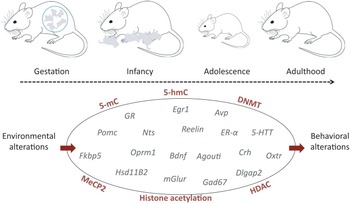
Epigenetic modifications mark experiences such that transcriptional regimes are altered in a cascade that begins in the nucleus and expands to shape behavioral outcomes (Figure 2). Some of these marks and their associated outcomes are favorable to the organism while others are not. One very important task for our field is to parse apart these differences in enough detail that we can use epigenetic information to inform diagnoses as well as targeted treatments to produce the most favorable outcomes. Inherent in this process will be the need for carefully designed longitudinal studies, which will allow the elucidation of the developmental trajectories of epigenetic changes and behavior. Further, to better inform diagnoses, studies will need to incorporate the use of multiple biospecimens, an approach easily achieved in rodent models but to date has been rarely employed. Finally, in terms of treatment, one of the major challenges for epigenetic therapy is target specificity of drugs (an issue that is true of most drugs used in psychiatry). Animal model and in vitro work is already pioneering the way for this, using targeted epigenetic editing such as transcription activator-like effectors fused with chromatin modifying enzymes (Bernstein, Le Lay, Ruano, & Kaestner, Reference Bernstein, Le Lay, Ruano and Kaestner2015; Heller et al., Reference Heller, Cates, Pena, Sun, Shao and Feng2014; Konermann et al., Reference Konermann, Brigham, Trevino, Hsu, Heidenreich and Le2013; Maeder et al., Reference Maeder, Angstman, Richardson, Linder, Cascio and Tsai2013; Sanjana et al., Reference Sanjana, Cong, Zhou, Cunniff, Feng and Zhang2012) to alter cytosine methylation and chromatin configuration at specific gene loci. Strategies to target specific epigenetic changes in humans may be coming over the horizon.
(Color online) Schematic of environmentally driven epigenetic modifications to DNA across the life span with many of the genes (gray) discussed in this review. 5-mC, methylated cytosine; 5-hmC, hydroxymethylated cytosine; DNMT, DNA methyltransferase; MeCP2, methyl-CpG binding protein 2; HDAC, histone deacetylase. See text for gene definitions.