





1. Introduction
Lexical prosody typology typically includes languages with stress-based systems (e.g., Dutch, Spanish), tonal systems (e.g., Yoruba, Cantonese), lexical pitch accent systems (e.g., Swedish, Serbian), and those with no lexical prosodic contrasts (e.g., French, Korean). Each of these prosodic systems relies on different combinations of acoustic cues. How these cues are perceived varies between native and non-native listeners. Research on lexical prosody perception has yielded mixed results. For instance, studies have shown that French listeners tend to struggle with perceiving stress contrasts in unfamiliar languages (Dupoux et al. Reference Dupoux, Peperkamp and Sebastián-Gallés2001, Dupoux et al. Reference Dupoux, Sebastián-Gallés, Navarrete and Peperkamp2008), whereas tone discrimination ability among speakers of different languages is more variable (Qin and Mok Reference Qin and Mok2012). Two main factors have been proposed to account for this variation: (1) the lexical function of certain acoustic cues in the listener’s first language, and (2) the interaction between the acoustic cues used in the target prosodic system and those already present in the native prosodic system.
1.1 Native Language Acoustic Cue Approach
Research addressing the first factor suggests that if specific acoustic cues for a lexical prosodic category are contrastive in a listener’s native language, that listener is more likely to successfully discriminate non-native prosodic contrasts that utilize the same cues. This idea underlies several theoretical models, including the Feature Hypothesis (McAllister et al. Reference McAllister, Flege and Piske2002) and the Functional Pitch Hypothesis (Schaefer and Darcy Reference Schaefer and Darcy2014). Despite different emphases, these models share a central claim: Native and non-native listeners differ in how they weigh acoustic cues, with non-native listeners relying on cue relevance as defined by their native prosodic system (Tremblay Reference Tremblay2008). We call this approach the Native Language Acoustic Cue Approach. Importantly, this approach does not assume a binary distinction in the perception of contrastive features; instead, it describes a continuum in contrastive prosodic features. For example, Schaefer and Darcy (Reference Schaefer and Darcy2014) examined how native speakers of languages with varying tonal statuses perceived Thai tone contrasts. Participants included Mandarin speakers (high tonal status), Japanese speakers (high-intermediate), English speakers (low-intermediate), and Korean speakers (low tonal status). Results revealed that performance improved with increasing tonal experience. Mandarin speakers showed the highest accuracy and speed, followed by Japanese speakers, while English and Korean speakers performed the least well. These findings led to the development of the Functional Pitch Hypothesis (FPH), which posits that the lexical role of pitch in a listener’s native language determines the listener’s success in perceiving lexical tone contrasts in a non-native language. This in turn largely aligns with the results and predictions on the perception of non-native stress contrasts. For example, some studies have found that French speakers struggle to perceive stress contrasts (Dupoux et al. Reference Dupoux, Sebastián-Gallés, Navarrete and Peperkamp2008, Rahmani et al. Reference Rahmani, Rietveld and Gussenhoven2015). This finding is attributed to the fact that French does not have stress at a lexical level, even though it uses phrasal stress (Peperkamp et al. Reference Peperkamp, Vendelin and Dupoux2010). Moreover, the FPH suggests that transferring pitch sensitivity from broader, non-lexical contexts (such as phrasal intonation in French or Korean) to fine-grained lexical distinctions in a non-native language may present significant difficulty. In other words, speakers may struggle to repurpose pitch sensitivity used at the phrasal level in their native language for word-level meaning distinctions in a non-native language.
1.2 Target Language Acoustic Cue Approach
While the FPH is supported by numerous studies, other research has shown mixed findings on the perception not only of lexical tone (Wayland and Guion Reference Wayland and Guion2004, Qin and Jongman Reference Qin and Jongman2016, Zhu et al. Reference Zhu, Chen and Yang2021), but also of stress and lexical pitch accent (Michelas et al. Reference Michelas, Frauenfelder, Schön and Dufour2016, Michelas et al. Reference Michelas, Esteve-Gibert and Dufour2018, Nikolić and Winters Reference Nikolić and Winters2022). For example, Michelas et al. (Reference Michelas, Frauenfelder, Schön and Dufour2016) and Michelas et al. (Reference Michelas, Esteve-Gibert and Dufour2018) show that French speakers are not insensitive to non-native stress contrasts, as they are capable of creating an abstract representation of stress based on the integration of the acoustic properties of stress into their perceptual space. Nikolić and Winters (Reference Nikolić and Winters2022) reveal that English speakers are able to correctly identify and recall Serbian lexical pitch accents. Even though English does not have contrastive pitch accents at the lexical level, they exist in the language at higher levels of intonational structure. Their perceptual accuracy is thus not contingent on native language influence, but rather on the acoustic cues of the target language category. The results thus suggest that the lexical prosodic category contrasts in one’s native language do not always guarantee more accurate perception of non-native lexical prosodic contrasts.
Instead, recent findings point to the nature of the target language’s acoustic cues as playing a more crucial role in non-native prosody perception than their function in the native language. We call this approach the Target Language Acoustic Cue Approach. According to this view, the listener’s ability to perceive non-native prosodic categories hinges on how the non-native acoustic cues align – or clash – with cues already present in their native system (Chen et al. Reference Chen, Antoniou and Best2023, Laméris et al. Reference Laméris, Llompart and Post2024). For instance, in a revised version of the Perceptual Assimilation Model (PAM), Best (Reference Best2019) suggests that some tones are inherently more difficult to distinguish due to their acoustic characteristics, and that these difficulties may persist even when the listener’s native language is tonal. In such cases, speakers from tonal backgrounds may still misidentify certain tones if they closely resemble native categories. Yet PAM’s predictions often fall short when the listeners speak a language with no lexical prosodic contrasts, as the mapping from one system to the other cannot be precisely determined.
Mennen’s (Reference Mennen, Delais-Roussarie, Avanzi and Herment2015) L2 Intonation Learning Theory (LiLT) could offer a more comprehensive framework for explaining why listeners often have difficulty with the perception of non-native prosody. LiLT identifies four distinct dimensions where cross-language differences can emerge. The first dimension is the inventory and distribution of intonational categories (e.g., types of pitch accents and boundary tones). The second dimension is the phonetic realization of these categories, such as pitch alignment, range, and scaling. This dimension corresponds to what Laméris et al. (Reference Laméris, Llompart and Post2024) posit as the “tone type” factor in their study. The third is the semantic dimension, which explains how intonational patterns are used functionally to convey meaning. Lastly, the frequency dimension describes how often these patterns occur in discourse. According to LiLT, listeners frequently struggle with realizing the learned non-native forms phonetically – for example, producing appropriate pitch peaks, timing, pitch range, etc. Challenges in mapping functions or matching usage frequency often follow. As such, even though not specifically drawing from the perception data, LiLT could offer a framework that would explain the results aligning with the Target Language Acoustic Cue Approach.
In the present study, we examine the perception of lexical pitch accent contrasts by native and non-native listeners. More precisely, we examine the perceptual similarity space of lexical pitch accents by Serbian (native) and French (non-native) listeners. French listeners are selected because French does not have any lexical prosodic contrasts. We provide a brief description of Serbian and French prosodic systems next.
1.3 Serbian lexical prosody
There are many different kinds of lexical pitch accent system; we are testing the Serbian variant. There are primarily two acoustic cues for Serbian lexical pitch accents: F0 movement and duration.Footnote 1 Based on the contrasts in F0 movement and the duration relation between the accented and post-accented vowels, there are four Serbian lexical pitch accent categories: 1) long-falling, 2) short-falling, 3) long-rising, and 4) short-rising. Serbian is described as having contrastive lexical pitch accents, but minimal pairs are quite scarce, and the functional load of a lexical pitch accent in Serbian appears to be minimal, as the meaning of a word in an utterance can generally be deduced from context. The lexical pitch accents could have a demarcative function (Sredojević Reference Sredojević2017), which could be useful for acquisition, in that infants acquiring the language use lexical pitch accents to understand how many content words an utterance includes. With respect to duration, there is a clear difference in short and long syllables, and the F0 contour is more discernible on the long lexical pitch accents than on the short lexical pitch accents (Lehiste and Ivić Reference Lehiste and Ivić1986; Godjevac Reference Godjevac, Muller, Huang and Roberts2000, Reference Godjevac and Jun2005; Petrovic and Guduric Reference Petrovic and Guduric2010, Sredojević Reference Sredojević2017). The distinction between the falling and rising accents is that the pitch of the post-accented syllable is lower or at the same level as the pitch of the accented syllable in rising accents, while this is not the case with words which bear falling accents. This type of analysis produces a lexical pitch accent system with two bitonal accent types: L*+H and H*+L. The starred tone is aligned with the stressed syllable, while the following tone determines the type of pitch accent – rising or falling. L*+H is a rising accent, and H*+L is a falling accent (Table 1). The star is associated with the second mora of a long-accented vowel or the only mora of a short-accented vowel.
Serbian lexical pitch accents. First syllable is accented in all the examples

Table 1 Long description
Columns list lexical pitch accent type, tone annotation, and examples. Short falling has tone annotation H star plus L with a short vowel, example para meaning steam. Short rising has tone annotation L star plus H with a short vowel, example para meaning coin. Long falling has tone annotation H star plus L with a long vowel, example radio meaning radio. Long rising has tone annotation L star plus H with a long vowel, example radio meaning he or she worked.
1.4 French prosody
The non-native listeners in our study are native speakers of Hexagonal French. The French language does not have lexical prosodic contrasts. French prosodic structure differs from other Romance languages in that stress is assigned at the phrasal rather than at the lexical level, always occurring phrase-finally. Jun and Fougeron’s (Reference Jun, Fougeron and Botinis2000) model identifies two primary prosodic levels: the Intonation Phrase (IP) and the lower-level Accentual Phrase (AP), the latter being the basic unit of French intonation. The AP contains a final rising pitch accent (LH*) on the last full syllable and may also feature an optional initial rise (LHi), yielding a default tonal pattern of /LhiLH*/. Variants of this pattern arise due to undershoot, especially under fast speech or shorter phrase conditions. The AP-final rise aligns with metrically strong syllables, while the initial rise marks the AP boundary and aids segmentation. IPs, meanwhile, are marked by major tonal movements (H% or L%) and the greatest preboundary lengthening, though final lengthening patterns are variable and do not always clearly reflect prosodic hierarchy. With respect to duration, French mainly uses it to lengthen vowels allophonically and to indicate pre-boundary lengthening. A greater degree of “intra-speaker durational variability is found within the AP level when closely inspecting preboundary lengthening data” (Michelas and D’Imperio Reference Michelas and d’Imperio2012: 817, drawing on Michelas Reference Michelas2011 and Michelas and D’Imperio Reference Michelas and d’Imperio2010).
2. Methodology
In the present study, our main goal is to explore the perception of the acoustic cues of lexical pitch accents by Serbian (native) and French (non-native) listeners. Following the Native Language Acoustic Cue Approach, we expect French listeners to have difficulties in contrasting both F0 and duration cues for lexical pitch accents, as these have extremely low functionality at the lexical level in their native language. In contrast, according to the Target Language Acoustic Cue Approach, French listeners should not have a lot of issues distinguishing Serbian lexical pitch accents, as they should be able to repurpose the F0 movement and duration used at phrasal levels in their language to accurately discriminate between the lexical pitch accent types. For example, the predicted surface realizations of a French AP all contain the rising and falling patterns which are, to a different degree, typical of Serbian lexical pitch accents. According to this theory, the French listeners should thus be able to integrate the target acoustic cues into their perceptual space.
2.1 Free classification method
The free classification task has been extensively used to investigate the perceptual similarity space of regional dialects (Clopper and Pisoni Reference Clopper and Pisoni2007; Bradlow et al. Reference Bradlow, Clopper, Smiljanic and Walter2010; Atagi and Bent Reference Atagi and Bent2013, Reference Atagi and Bent2016; Daidone et al. Reference Daidone, Lidster and Kruger2023). Its variations have also been used to examine the perception of voice quality (Kreiman et al. Reference Kreiman, Gerratt and Berke1994), phonation types (Esposito Reference Esposito2010), and even musical themes (McAdams et al. Reference McAdams, Vieillard, Houix and Reynolds2004). The main advantage of this task is that it allows listeners to classify stimuli without specifying category labels or dimensions of contrasts in advance. In addition, Clopper (Reference Clopper2008, p. 575) states that “free classification allows the experimenter to explore the complex interaction of perceptual cues to linguistic and indexical categories without requiring any a priori judgments about what the relevant acoustic-phonetic cues or their weightings might be”.
In this study, we use a modified, online version of the free classification task because it helps us visualize the perceptual similarity space of lexical pitch accent types based on acoustic dimensions (primarily, F0 and duration), allowing us to determine which categories both native and non-native listeners developed based on these dimensions. In addition, the task does not impose any extra cognitive demands such as the working memory load used in tasks such as SRT. In our version of the task, listeners could click on the digital icons arranged around a circle, which played sound tokens of Serbian words with different lexical pitch accents (the detailed procedure is described in the next subsection). After listening to each sound token, they moved the icons so that the distance between them reflected how similar they perceived those sounds to be, positioning icons more closely to each other if they thought those sounds were more similar, and further away from each other if they thought those sounds were more dissimilar.
2.2 Procedure
The entire experiment was carried out online through Cognition.run. The basic components of the code used are the jsPsych plugins that could be implemented within the Cognition.run platform, and the D3 library used for the visualization of the data in an online environment. The free classification task we used in the study was adapted from a task in the rating toolbox built by Donhauser and Klein (Reference Donhauser and Klein2022). Since the toolbox is used via a plugin for the programming language jsPsych, we adapted the code to fit the purpose of this study.Footnote 2
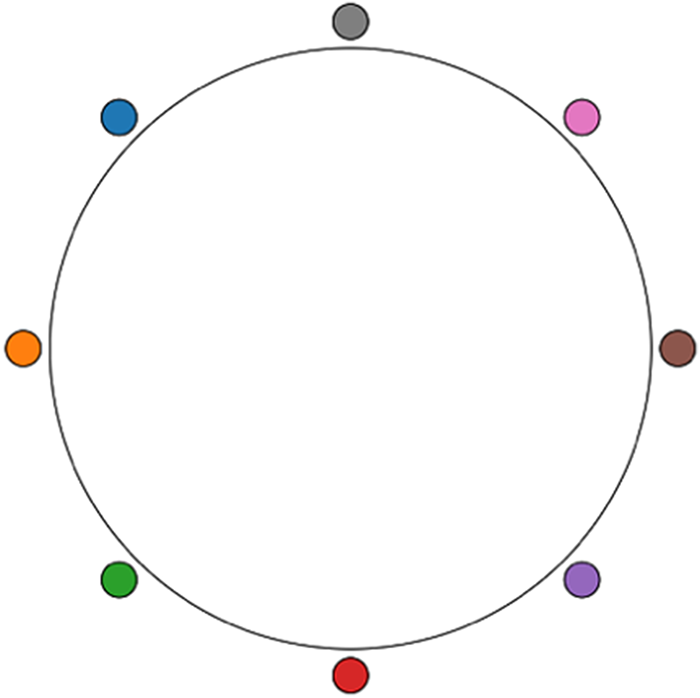
In the task, the listeners were told that they would see an empty circle with small, differently coloured circles placed around it (Figure 1). Each small circle was linked to a recording. The listeners could listen to the recording for each circle as many times as they wanted by hovering over the circle with the cursor.
Initial experimental set-up of the task.

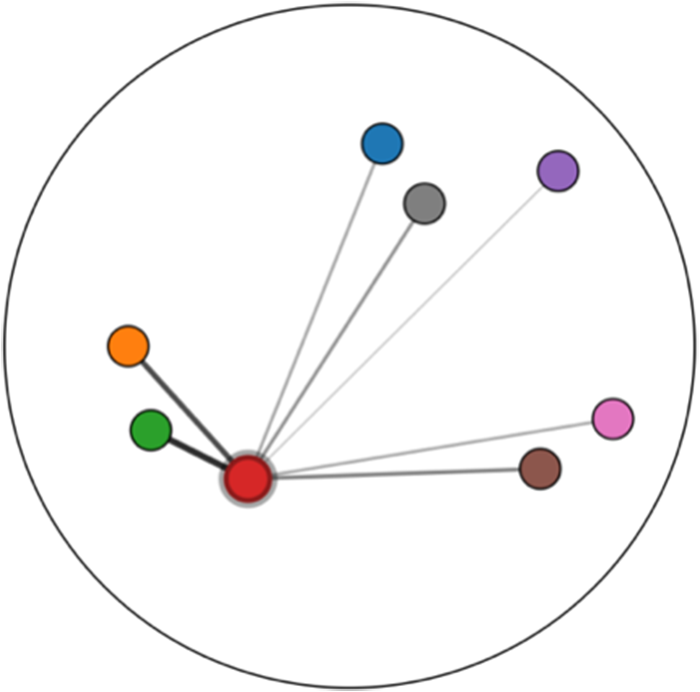
Their task was to place the circles into the bigger circle based on the similarity of the recordings. The interface had association lines between the circles (Figure 2) so that the listener could more easily determine the distance between them. The thicker the line, the closer they were placed.
The listener positioning the red circle inside the big circle.

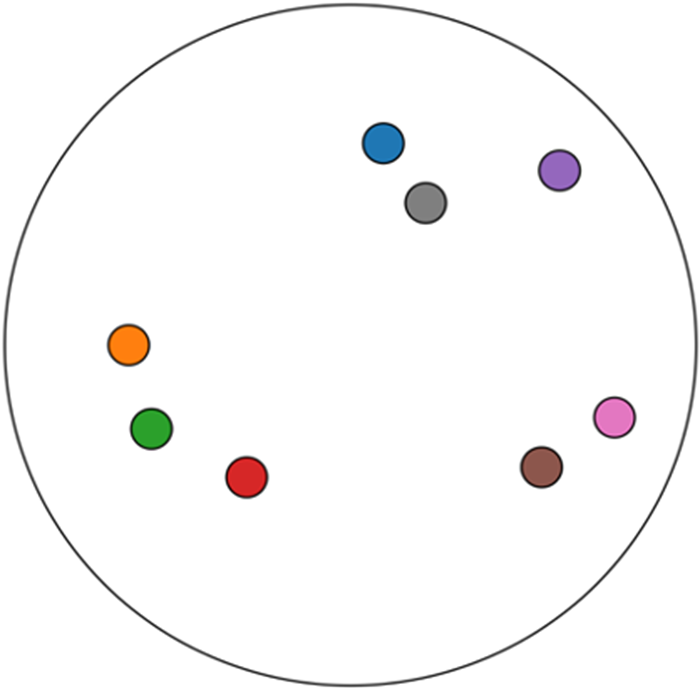
Once they were satisfied with their classification, the listeners would submit their ‘work’ (Figure 3).
Example of a submitted classification of items.

2.2.1 Phases
The task was comprised of two parts, a training phase and a testing phase. In the training phase, the listeners were instructed how to complete the task and provided with two short video tutorials (∼10s long) showing a hypothetical participant completing the task. They were presented with a big empty circle with four small circles around it. Each circle represented a nonword, blava, which they heard produced in four different ways by a male speaker. The training phase served to teach the listeners how to complete the task, and was not used to filter the listeners based on their performance.
In the testing phase, the listeners listened to two nonwords, kavan and rejav, each produced with two different pitch accents by a female and a male talker, for a total of four pitch accents. In the two free classification tasks, the listeners heard the items listed in Table 2. The combinations of gender and lexical pitch accents therefore differed between the two parts.
The lexical pitch accent items used in the first and second free classification tasks

Table 2 Long description
Columns list Item and Talker, plus for each of two free classification tasks an LPA entry and an Abbreviated code. For kavan, male: first task short-rising MKavan_SR and long-falling MKavan_LF; second task short-falling MKavan_SF and long-rising MKavan_LR. For kavan, female: first task short-falling FKavan_SF and long-rising FKavan_LR; second task long-falling FKavan_LF and short-rising FKavan_SR. For rejav, male: first task short-falling MRejav_SF and long-rising MRejav_LR; second task short-falling MRejav_SF and long-falling MRejav_LF. For rejav, female: first task short-rising FRejav_SR and long-falling FRejav_LF; second task short-falling FRejav_SF and long-rising FRejav_LR.
Although previous research by Clopper and Pisoni (Reference Clopper and Pisoni2007) gave participants an extremely high number of tokens to classify (e.g., 66 tokens), we decided to reduce the number of tokens to 16 in two classification tasks in total. When piloting the task, our participants found it extremely difficult to compare all the tokens with each other when there were more than 10 tokens. That is, they could not memorize which tokens were cross-compared without any labels. In addition, given that the tokens are compared along two acoustic dimensions – F0 and duration – a large number of tokens would increase the memory load on the listeners, which would, in turn, obscure the perception process.
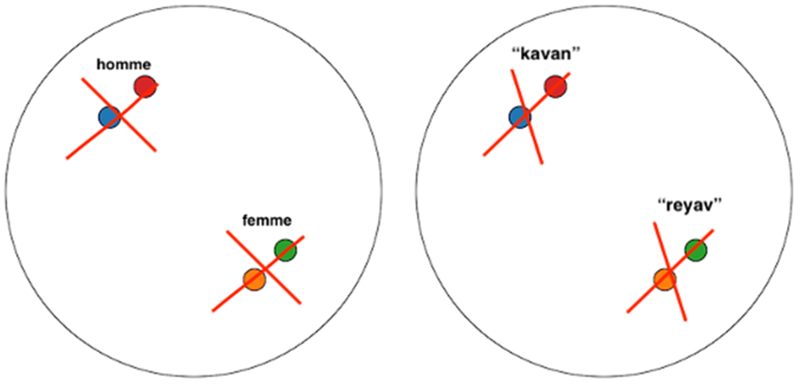
Since there were 40 Serbian listeners, half of them heard one set of items from Table 2 first and then the other set of eight items. For the other listeners, the order was switched. The same ordering strategy was used with the 60 French listeners. While the training phase used one nonword produced by a single talker, the testing phase had two different nonwords which were produced by both the male and female talker. For this reason, the listeners could have grouped the recordings together solely based on the item itself (kavan and rejav) or the talker gender (female and male). However, the participants received clear instructions not to do this, but to instead listen carefully and place the similar recordings next to one another (Figure 4) independently of the word or speaker presented in each token. These written instructions were also present during the task.
Visual instructions reminding listeners not to group recordings by talker gender (left, French version) or by word (right).

2.2.2 Stimuli
We asked two native speakers of Serbian (one male and one female) to produce three nonwords, rejav [rejav], kavan [kavan], and blava [blava], with four Serbian lexical pitch accents.
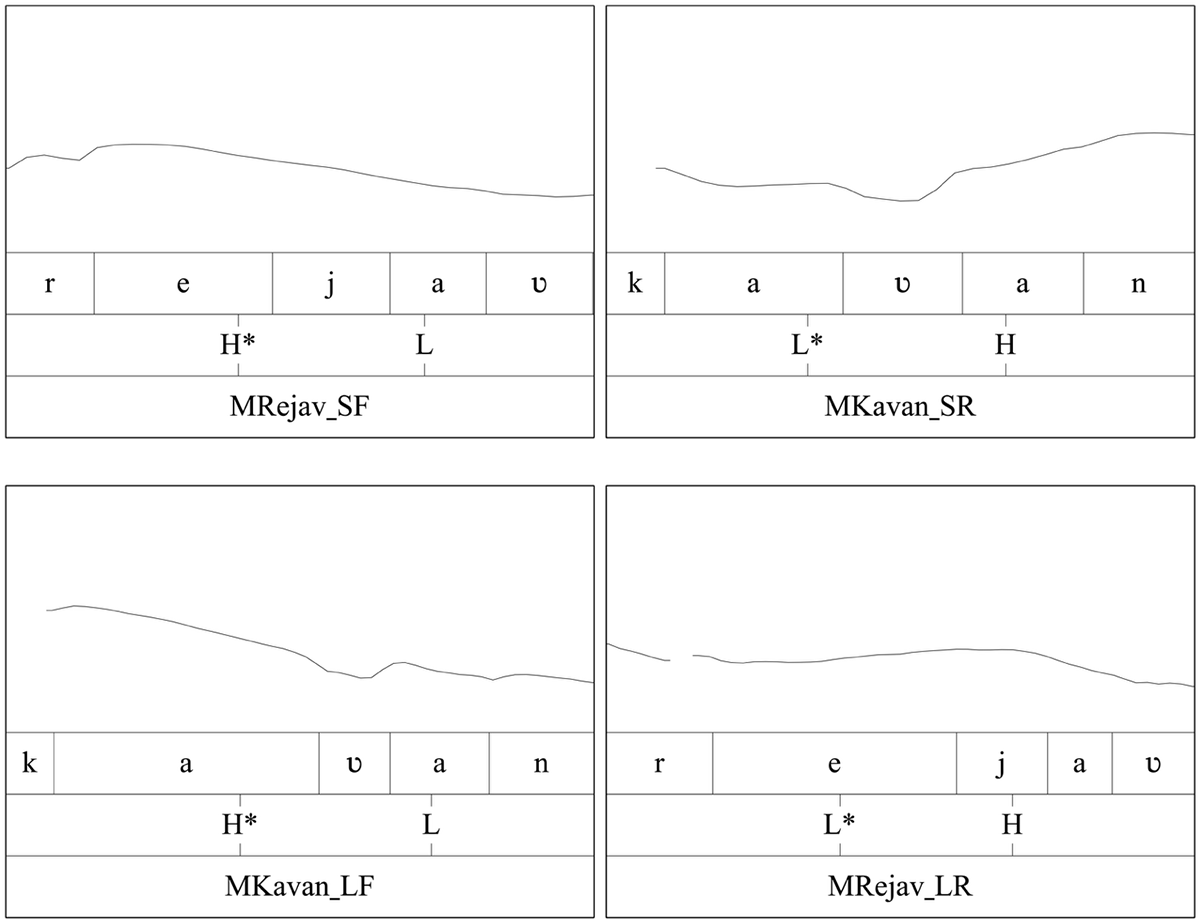
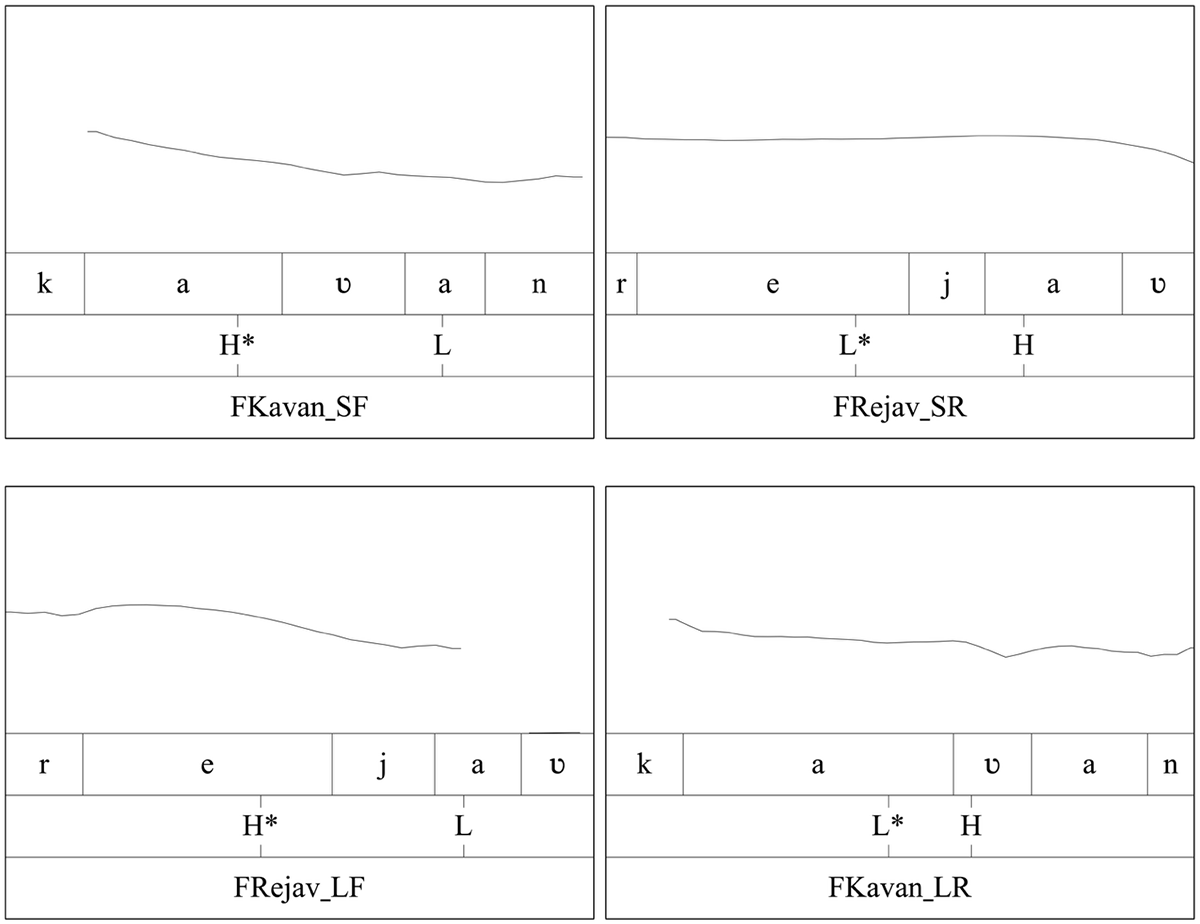
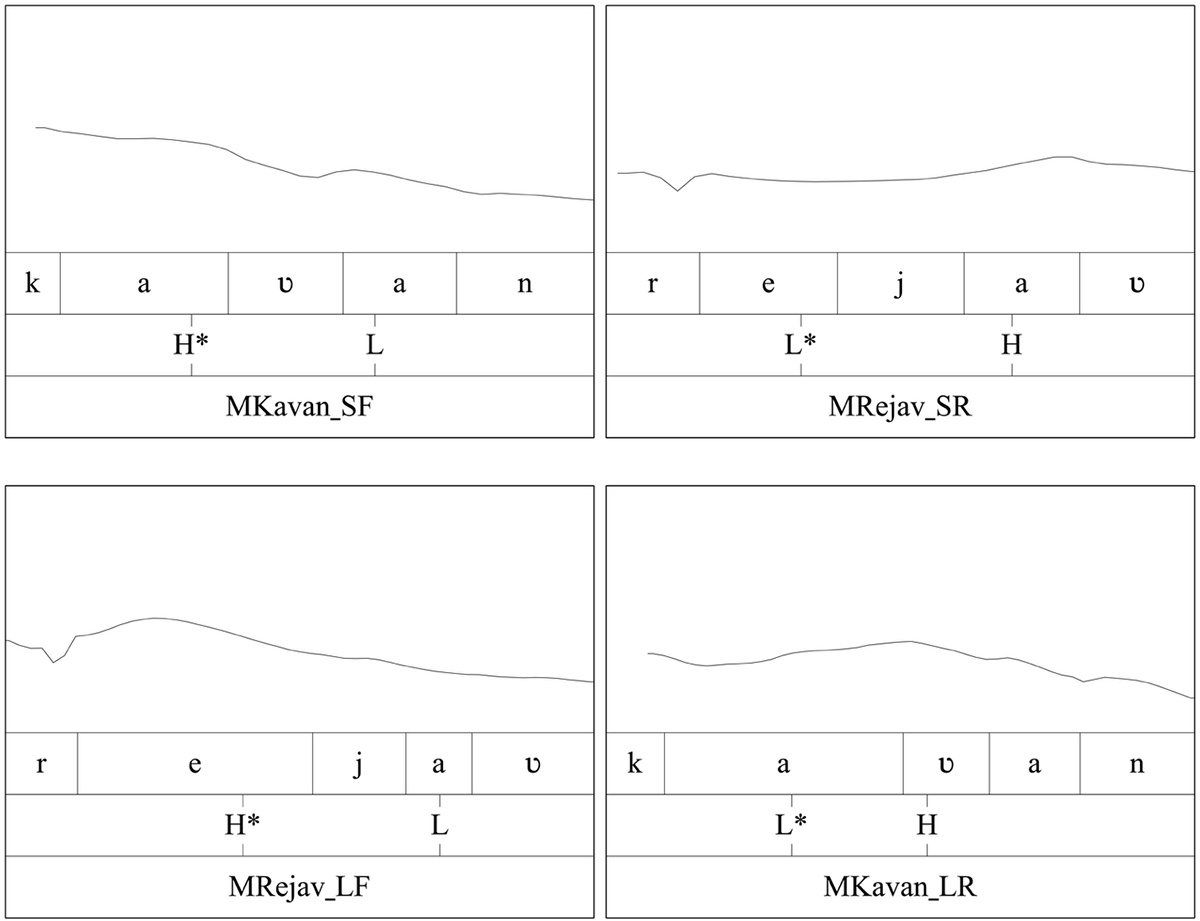
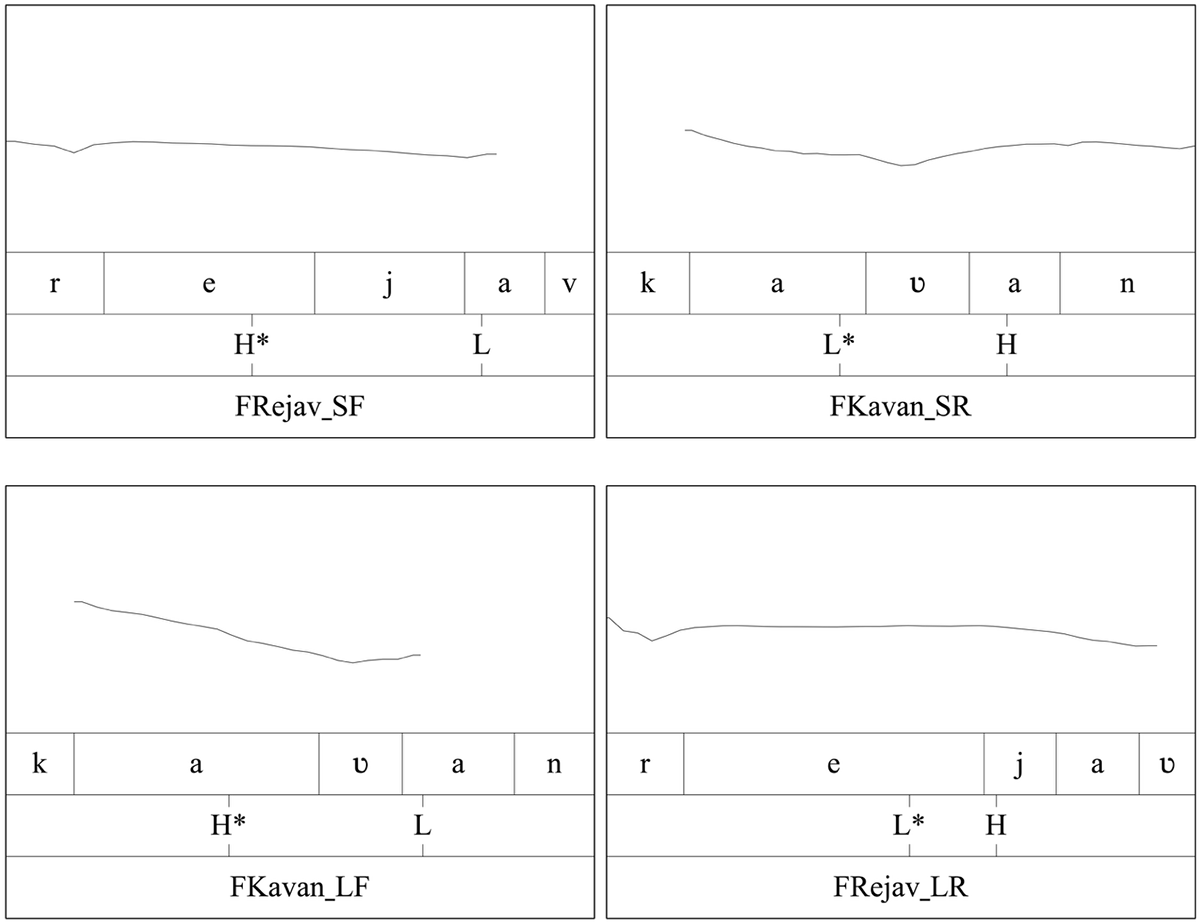
As explained in section 2.2 above, there were two free classification tasks with two different sets of stimuli. The items were produced by one male and one female talker, who were native speakers of Serbian. They were instructed how to produce the stimuli by the researcher, who is both a native speaker of Serbian and a trained linguist. Figures 5–8 display the F0 contours of all the nonwords and lexical pitch accents in both tasks produced by the male and the female talker. The nonword blava was used in the training phase, while the other two nonwords were used in the testing phase. We present only the analysis of the words used in the testing phase, because the differences in the parameters (pitch and length) were intentionally made more drastic for the nonword blava in the training phase, helping the listeners to get a grasp of the task rather than testing their discrimination of lexical pitch accents at that stage.
F0 contours of all the lexical pitch accents used in the first free classification task produced by the male (M) talker (LF = long-falling, SF = short-falling, LR = long-rising, SR = a short-rising lexical pitch accent type).

F0 contours of all the lexical pitch accents used in the first free classification task produced by the female (F) talker.

F0 contours of all the lexical pitch accents used in the second free classification task produced by the male (M) talker.

F0 contours of all the lexical pitch accents used in the second free classification task produced by the female (F) talker.

2.2.3 Participants
There were two groups of participants in this experiment: Serbian and French listeners. They were recruited through various universities in Serbia and France. There were 40 Serbian participants (with a mean age of 23.2) and 60 French participants (with a mean age of 27). The French participants had never learned Serbian nor had they ever been exposed to Serbian. None of the participants reported any hearing issues.
3. Results
In the following sections, we present the results of the acoustic analysis of the stimuli and the free classification task.
3.1 Experimental stimuli analysis
We extracted the F0 values (in Hz) from each of these stimuli by using the ProsodyPro Praat script (Xu Reference Xu, Bigi and Hirst2013). We conducted Wilcoxon rank sum test comparisons of the median F0 values, for both the male and female talker, on both the falling and rising lexical pitch accents. Because there were only two tokens (words), we could not run any statistical analyses to compare the durations of the accented and post-accented vowels. The duration values are still presented in images through box-plot figures (Figures 11 and 12), where the distinctions are easily observed.
The F0 values and the differences of the accented and post-accented vowels per each lexical pitch accent on all nonwords are displayed in Table 3. The F0 movement is calculated following the procedure in Sredojević (Reference Sredojević2017), who found that the F0 movement (rising/falling) depends on the relationship of the F0 value of the final third of the accented vowel and the first third of the post-accented vowel. In most cases, our examples show this relationship, except in long-rising accents, where the maximum F0 occurs on the sonorant following the accented vowel. Therefore, for long-rising accents (but only those), we consider the sonorant to be the post-accented ‘vowel’. For falling accents, we subtract the F0 of the post-accented vowel from the F0 of the accented vowel, while for the rising accents, we subtract the F0 of the accented vowel from the F0 of the post-accented vowel. In this way, we calculated a value for the range or F0 movement which should indicate whether the accent is falling or rising. Understanding that a more precise perceptual measurement should be expressed in semitones, we also converted the relationship into semitones. Even though Rietveld and Gussenhovent (Reference Rietveld and Gussenhovent1985) determined that differences of less than 3.0 ST are unlikely to play a communicative role in speech, our stimuli are used in isolation, and we believe that even lower values could be perceived. Based on the values and the figure displaying the F0 movement below (Figure 9), the falling interval is much more pronounced in the falling accents, while the rising interval is either rising or remains at a plateau.
F0 values of each item

Table 3 Long description
Rows list accent type, nonword, talker, F0 of accented in Hz, F0 of post accented in Hz, F0 movement in Hz, and F0 movement in ST. For kavan, LF female is 168 Hz accented and 67 Hz post accented with 128.6 Hz movement and 18.3 ST, while LF male is 169 and 121 with 83.5 Hz and 9.5 ST. For kavan, SF female is 164 and 133 with 87.1 Hz and 8.9 ST, and SF male is 179 and 133 with 60.9 Hz and 7 ST. For kavan, LR female is 155 and 143 with 2 Hz and 0.2 ST, and LR male is 137 and 124 with 13.27 Hz and 1.6 ST; SR female is 165 and 170 with 17.4 Hz and 1.8 ST, and SR male is 127 and 153 with 51 Hz and 6.2 ST. For rejav, LF female is 190 and 74 with 126.5 Hz and 17 ST, and LF male is 163 and 120 with 63.6 Hz and 7.6 ST. For rejav, SF female is 172 and 96 with 20.8 Hz and 2.2 ST, and SF male is 166 and 125 with 55.2 Hz and 6.6 ST. For rejav, LR female is 169 and 122 with 0 Hz and 0 ST, and LR male is 133 and 124 with 10.1 Hz and 1.3 ST; SR female is 179 and 181 with 6.8 Hz and 0.7 ST, and SR male is 132 and 148 with 23 Hz and 2.7 ST.
F0 movement expressing the relationship between the end of the accented and the beginning of the post-accented vowels.

Figure 9 Long description
F0 Movement in Hz. Eight small line graphs arranged in 4 columns and 4 rows. Horizontal axis label: Accented, Post-accented. Vertical axis label: F0 (Hz). Vertical axis range: 0 to 200. Top row titles, left to right: FkavanLF, FkavanLR, FkavanSF, FkavanSR. Second row titles, left to right: FrejavLF, FrejavLR, FrejavSF, FrejavSR. Third row titles, left to right: MkavanLF, MkavanLR, MkavanSF, MkavanSR. Bottom row titles, left to right: MrejavLF, MrejavLR, MrejavSF, MrejavSR. Fkavan_LF line points: (Accented, 200), (Post-accented, 70). Fkavan_LR line points: (Accented, 150), (Post-accented, 140). Fkavan_SF line points: (Accented, 165), (Post-accented, 135). Fkavan_SR line points: (Accented, 165), (Post-accented, 170). Frejav_LF line points: (Accented, 190), (Post-accented, 75). Frejav_LR line points: (Accented, 170), (Post-accented, 120). Frejav_SF line points: (Accented, 172), (Post-accented, 96). Frejav_SR line points: (Accented, 179), (Post-accented, 181). Mkavan_LF line points: (Accented, 169), (Post-accented, 121). Mkavan_LR line points: (Accented, 137), (Post-accented, 124). Mkavan_SF line points: (Accented, 179), (Post-accented, 133). Mkavan_SR line points: (Accented, 127), (Post-accented, 153). Mrejav_LF line points: (Accented, 163), (Post-accented, 120). Mrejav_LR line points: (Accented, 133), (Post-accented, 124). Mrejav_SF line points: (Accented, 166), (Post-accented, 125). Mrejav_SR line points: (Accented, 132), (Post-accented, 148).
For both the male and female talkers, on falling lexical pitch accents, a Wilcoxon rank sum test analysis showed a significant difference in F0 between the accented and post-accented vowels [female – Z = 6.45, p < 0.001; male – Z = 8.8, p < 0.001]. Falling lexical pitch accents therefore had a consistently higher F0 on the accented than on the post-accented vowel, which in turn signals the fall in the movement from the peak that is aligned with the accented vowel.
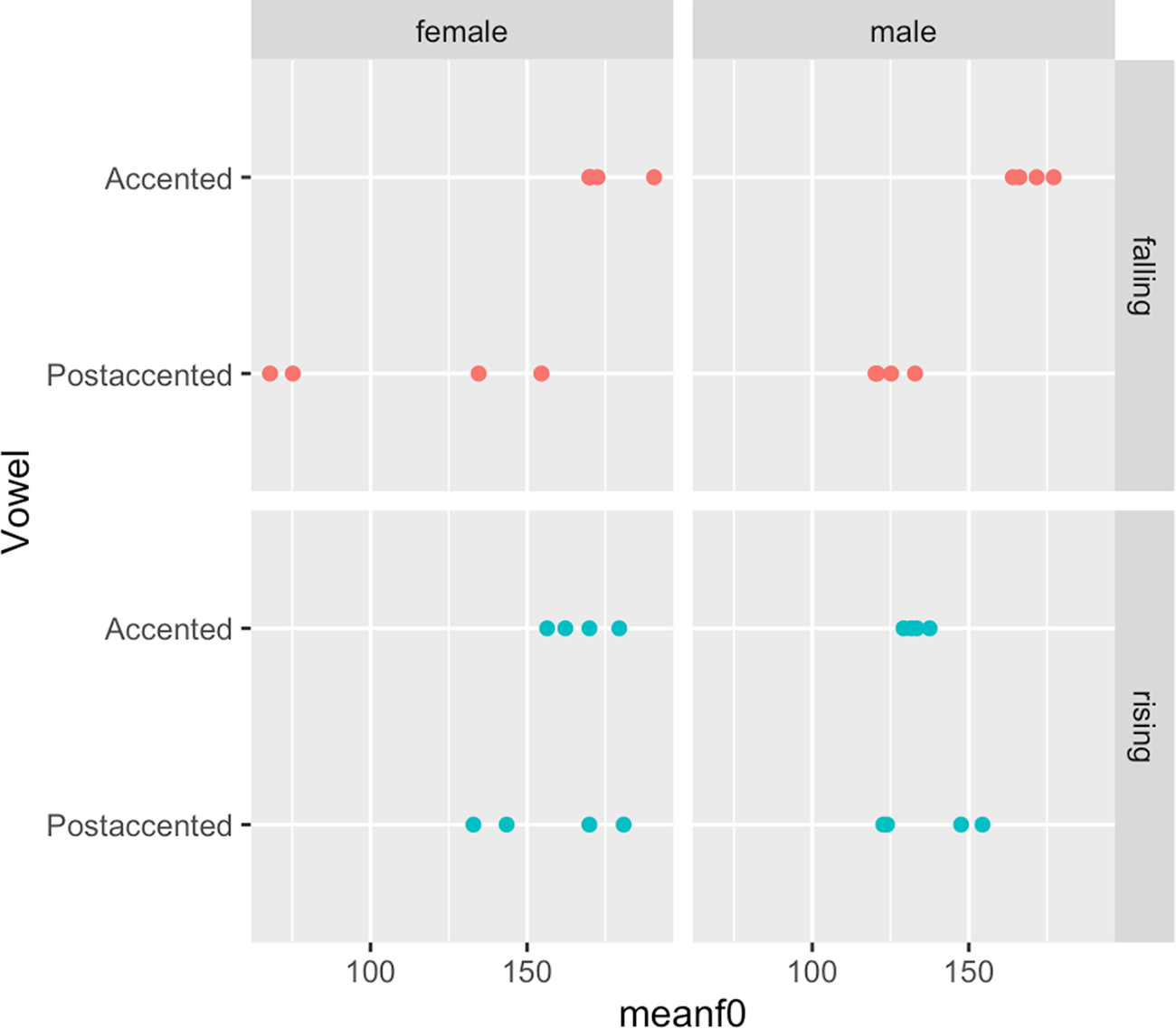
With respect to F0 on rising lexical pitch accents (Figure 10), the average F0 of the accented and the post-accented vowels were not significantly different from each other [male – Z = -1.74, p = 0.082; female – Z = 1.73, p = 0.084]. This indicates that there was no true rise in the rising lexical pitch accents.
Point plot of the F0 (Hertz) on the falling and rising lexical pitch accents per vowel for the female talker and the male talker.

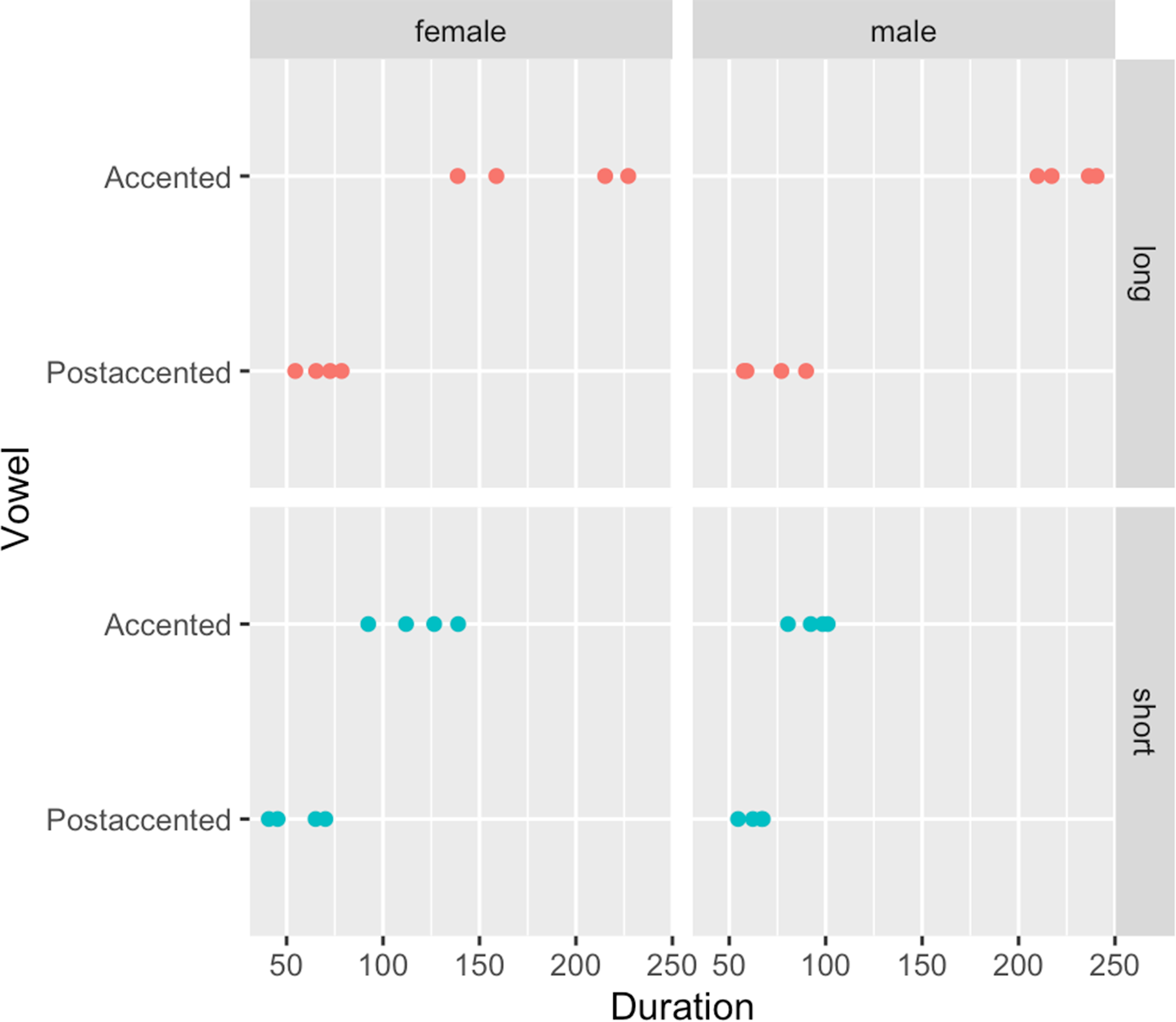
The durations of the vowels in both short and long lexical pitch accents per each talker are displayed visually in Figure 11. The accented vowels are clearly longer than the post-accented vowels.
Box plots of the duration per accented and post-accented vowel on short pitch accents for the female talker (left) and the male talker (right).

The stimuli analyses therefore show a significant difference in F0 between the accented and post-accented vowels. The accented vowels are also consistently longer than post-accented ones, and the long vowels are consistently longer than short vowels.
3.2 The free classification task
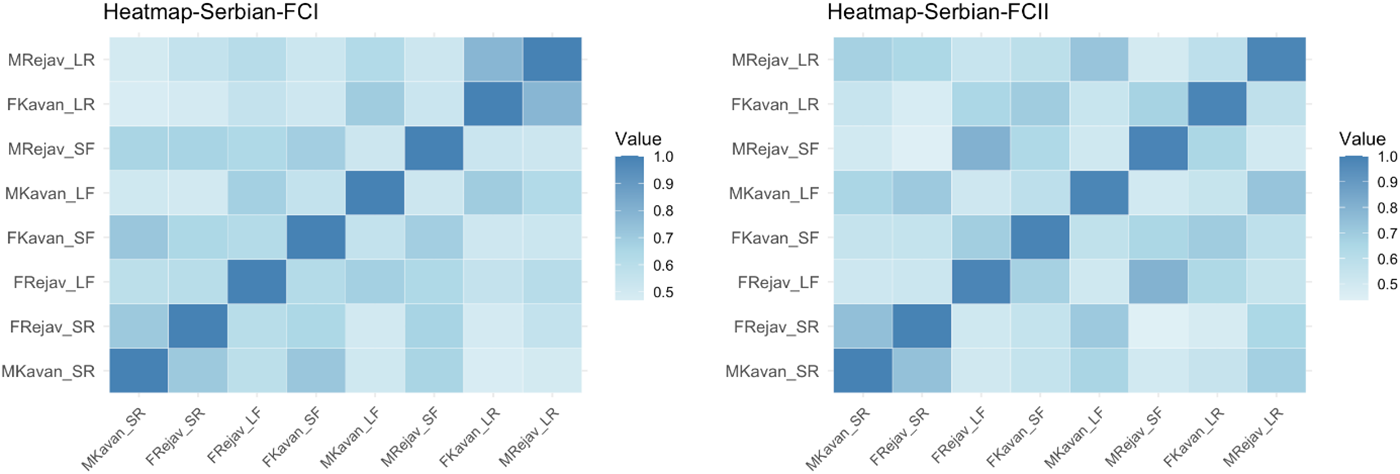
The coordinates received for each token per participant were transformed into proximity matrices by following the procedure illustrated by Donhauser and Klein (Reference Donhauser and Klein2022). The Python script from the toolbox was used to convert the coordinates to similarity matrices by calculating Euclidean distances between each lexical pitch accent per each listener. The normalization process thus yielded the value 1 for the most similar tokens, while the most dissimilar tokens were 0. The matrices for each participant and the matrix of the averages across both participant groups (Serbian and French) were calculated. Tables 4 and 5 show the average matrix values received from the two classification tasks from Serbian participants. Figure 12 shows the heatmaps produced from these matrices.
Heatmaps of the Serbian free classification task matrices.

Figure 12 Long description
Two heatmaps labeled Serbian FC1 and Serbian FC2. Each heatmap displays a matrix with row and column labels representing categories such as MPlayerLR, MPlayerLF, MPlayerRF, MPlayerSR, FPlayerLR, FPlayerLF, FPlayerRF and FPlayerSR. The cells contain numerical values ranging from 0.0 to 1.0, indicating interaction strength between categories. The diagonal cells show consistently higher values, suggesting stronger interactions within the same category. The legend indicates that higher values represent stronger interactions. In FC1, MPlayer categories show slightly higher interaction values compared to FPlayer categories, while FC2 displays more balanced interactions across both groups. The heatmaps provide insights into interaction patterns between different player categories, highlighting differences in clustering between FC1 and FC2.
Matrix of the distances of the classification made by the Serbian listeners in the first free classification task (MKSR = male kavan short rising token)

Table 4 Long description
Lower triangular distance matrix for eight labels, with columns MKSR, FRSR, FRLF, FKSF, MKLF, MRSF, FKLR, and MRLR, and matching row labels. Diagonal cells show self distances of 1 for MKavan_SR, FRejav_SR, FRejav_LF, FKavan_SF, MKavan_LF, MRejav_SF, FKavan_LR, and MRejav_LR. Row FRejav_SR lists 0.70 to MKavan_SR. Row FRejav_LF lists 0.58 to MKavan_SR and 0.60 to FRejav_SR. Row FKavan_SF lists 0.71 to MKavan_SR, 0.65 to FRejav_SR, and 0.62 to FRejav_LF. Row MKavan_LF lists 0.50 to MKavan_SR, 0.50 to FRejav_SR, 0.68 to FRejav_LF, and 0.56 to FKavan_SF. Row MRejav_SF lists 0.6 to MKavan_SR, 0.67 to FRejav_SR, 0.64 to FRejav_LF, 0.69 to FKavan_SF, and 0.52 to MKavan_LF. Row FKavan_LR lists 0.47 to MKavan_SR, 0.48 to FRejav_SR, 0.56 to FRejav_LF, 0.51 to FKavan_SF, 0.7 to MKavan_LF, and 0.53 to MRejav_SF. Row MRejav_LR lists 0.49 to MKavan_SR, 0.56 to FRejav_SR, 0.61 to FRejav_LF, 0.52 to FKavan_SF, 0.63 to MKavan_LF, 0.52 to MRejav_SF, and 0.78 to FKavan_LR.
Matrix of the distances of the classification made by the Serbian listeners in the second free classification task

Table 5 Long description
Distances are listed for Serbian listeners second free classification task, with columns labeled LPA, MKSR, FRSR, FRLF, FKSF, MKLF, MRSF, FKLR, and MRLR, and rows labeled MKavan_SR, FRejav_SR, FRejav_LF, FKavan_SF, MKavan_LF, MRejav_SF, FKavan_LR, and MRejav_LR. Values are provided in a lower triangle, and each row has a diagonal value of 1 under its matching column. Row FRejav_SR has 0.75 under LPA. Row FRejav_LF has 0.51 under LPA and 0.52 under MKSR. Row FKavan_SF has 0.55 under LPA, 0.55 under MKSR, and 0.69 under FRSR. Row MKavan_LF has 0.66 under LPA, 0.71 under MKSR, 0.51 under FRSR, and 0.58 under FRLF. Row MRejav_SF has 0.50 under LPA, 0.44 under MKSR, 0.80 under FRSR, 0.64 under FRLF, and 0.51 under FKSF. Row FKavan_LR has 0.54 under LPA, 0.47 under MKSR, 0.65 under FRSR, 0.70 under FRLF, 0.54 under FKSF, and 0.67 under MKLF. Row MRejav_LR has 0.68 under LPA, 0.65 under MKSR, 0.54 under FRSR, 0.59 under FRLF, 0.73 under FKSF, 0.49 under MKLF, and 0.59 under MRSF.
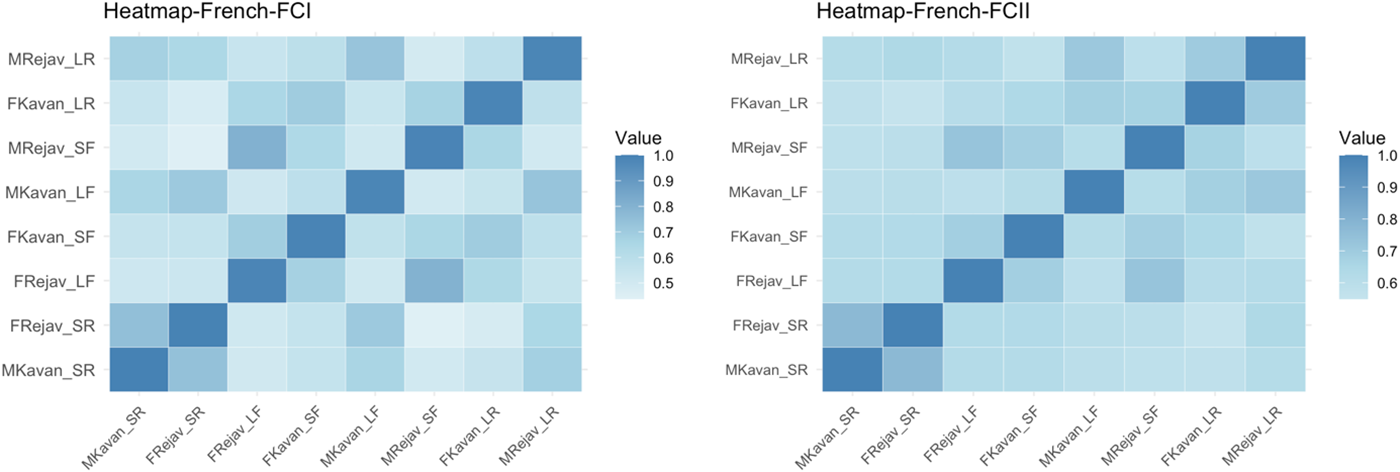
Tables 6 and 7 show the same from French participants. Figure 13 shows the heatmaps produced from these matrices.
Heatmaps of the French free classification task matrices.

Matrix of the distances of the classification made by the French listeners in the first free classification task

Table 6 Long description
Distance matrix for French listeners classifications, with columns labeled LPA, MKSR, FRSR, FRLF, FKSF, MKLF, MRSF, FKLR, and MRLR, and rows labeled MKavan_SR, FRejav_SR, FRejav_LF, FKavan_SF, MKavan_LF, MRejav_SF, FKavan_LR, and MRejav_LR. Values are shown on the diagonal as 1 for each row label where it intersects its matching column label. For MKavan_SR, distances are 0.75 with FRejav_SR, 0.57 with FRejav_LF, 0.62 with FKavan_SF, 0.64 with MKavan_LF, 0.57 with MRejav_SF, 0.54 with FKavan_LR, and 0.61 with MRejav_LR. For FRejav_SR, distances are 0.62 with FRejav_LF, 0.63 with FKavan_SF, 0.58 with MKavan_LF, 0.54 with MRejav_SF, 0.52 with FKavan_LR, and 0.64 with MRejav_LR. For FRejav_LF, distances are 0.72 with FKavan_SF, 0.58 with MKavan_LF, 0.69 with MRejav_SF, 0.61 with FKavan_LR, and 0.60 with MRejav_LR. For FKavan_SF, distances are 0.61 with MKavan_LF, 0.66 with MRejav_SF, 0.63 with FKavan_LR, and 0.55 with MRejav_LR. For MKavan_LF, distances are 0.61 with MRejav_SF, 0.67 with FKavan_LR, and 0.69 with MRejav_LR. For MRejav_SF, distances are 0.68 with FKavan_LR and 0.56 with MRejav_LR. FKavan_LR has a distance of 0.68 with MRejav_LR.
Matrix of the distances of the classification made by the French listeners in the second free classification task

Table 7 Long description
Pairwise distances are listed for French listeners second free classification task, with columns labeled LPA, MKSR, FRSR, FRLF, FKSF, MKLF, MRSF, FKLR, and MRLR and rows labeled MKavan_SR, FRejav_SR, FRejav_LF, FKavan_SF, MKavan_LF, MRejav_SF, FKavan_LR, and MRejav_LR. Diagonal entries are 1 for MKavan_SR, FRejav_SR, and MRejav_LR. Distances from MKavan_SR to later rows are 0.77 with FRejav_SR, 0.62 with FRejav_LF, 0.62 with FKavan_SF, 0.59 with MKavan_LF, 0.58 with MRejav_SF, 0.57 with FKavan_LR, and 0.62 with MRejav_LR. Distances from FRejav_SR are 0.63 with FRejav_LF, 0.63 with FKavan_SF, 0.60 with MKavan_LF, 0.59 with MRejav_SF, 0.55 with FKavan_LR, and 0.64 with MRejav_LR. Distances from FRejav_LF are 0.69 with FKavan_SF, 0.58 with MKavan_LF, 0.73 with MRejav_SF, 0.61 with FKavan_LR, and 0.62 with MRejav_LR. Distances from FKavan_SF are 0.61 with MKavan_LF, 0.68 with MRejav_SF, 0.64 with FKavan_LR, and 0.57 with MRejav_LR. Distances from MKavan_LF are 0.61 with MRejav_SF, 0.68 with FKavan_LR, and 0.71 with MRejav_LR, and distances from MRejav_SF are 0.67 with FKavan_LR and 0.59 with MRejav_LR, with FKavan_LR to MRejav_LR at 0.70.
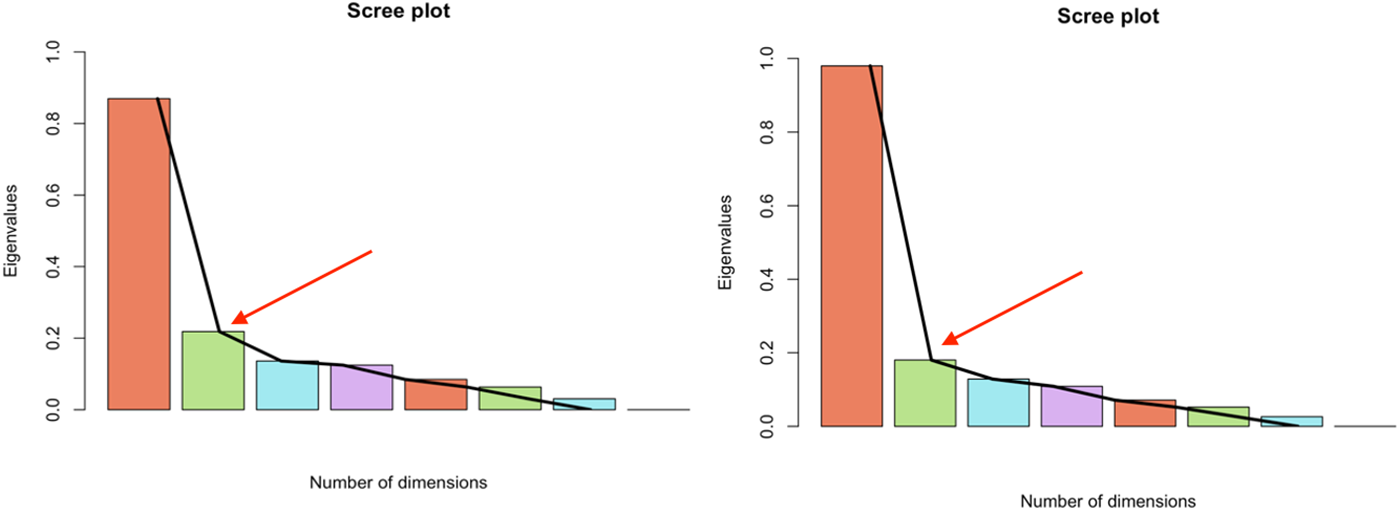
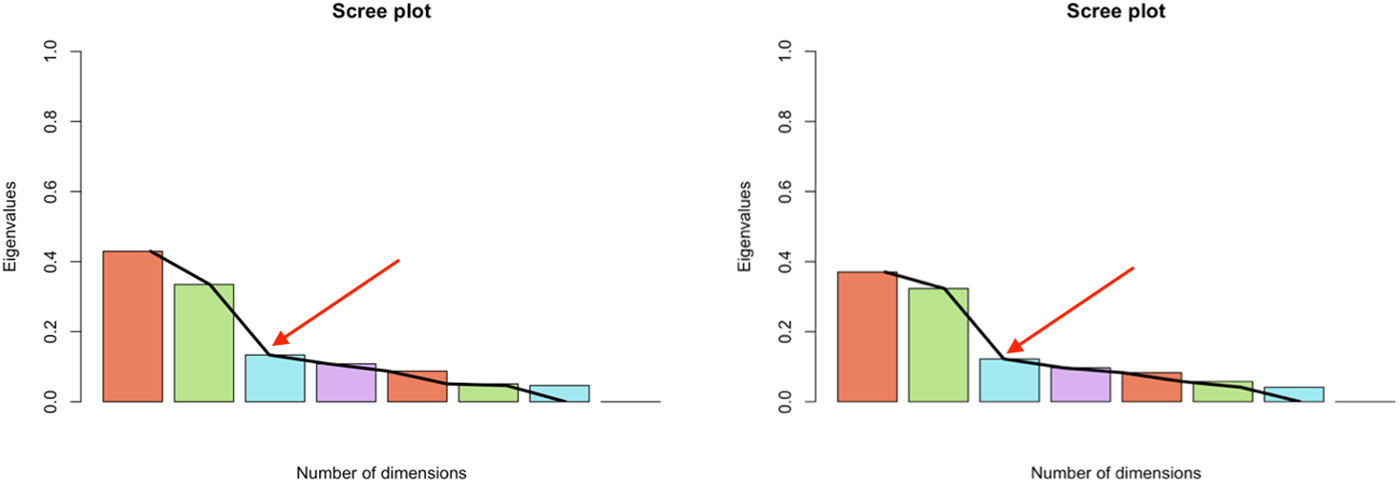
Before developing a multidimensional scaling model, we calculated the number of dimensions that would be the best fit for each set of data using the ‘elbow’ method (as per Levshina Reference Levshina2015). In the elbow method, we first calculated the ‘stress’, which is the measure of how well an MDS solution with a specific number of dimensions captures the original distances in the free classification response data, for models with different numbers of dimensions. We then plotted the stress values against the number of dimensions. We looked for the point where the plot started to flatten out, indicating that adding more dimensions did not significantly reduce the stress. This point was the ‘elbow’ point, indicating the optimal number of dimensions to fit the data. The scree plots (Figures 14 and 15) show the number of dimensions for each model for the Serbian and French listeners respectively. This analysis shows that there should be a minimum of two dimensions for the multidimensional scaling to be efficient. For Serbian, the ‘elbow’ (arrow) was on the second dimension in both cases, so we selected two dimensions as the best option for the multidimensional scaling (Figure 14).
Scree plot for the Serbian listeners on the first free classification task (left) and the second free classification task (right); the arrow points to the dimension from which there is no significant change in the variation explained.

Scree plot for the French listeners on the first free classification task (left) and the second free classification task (right).

For French, the optimal number of dimensions was three, so we developed MDS models with three dimensions (Figure 15).
These matrices were submitted to a multidimensional scaling analysis, closely following the procedure outlined in Levshina (Reference Levshina2015). Figures 16 and 17 represent the output of the multidimensional scaling analysis for the Serbian and French listeners from the first free classification task.
MDS plot on the first free classification task for the Serbian listeners.

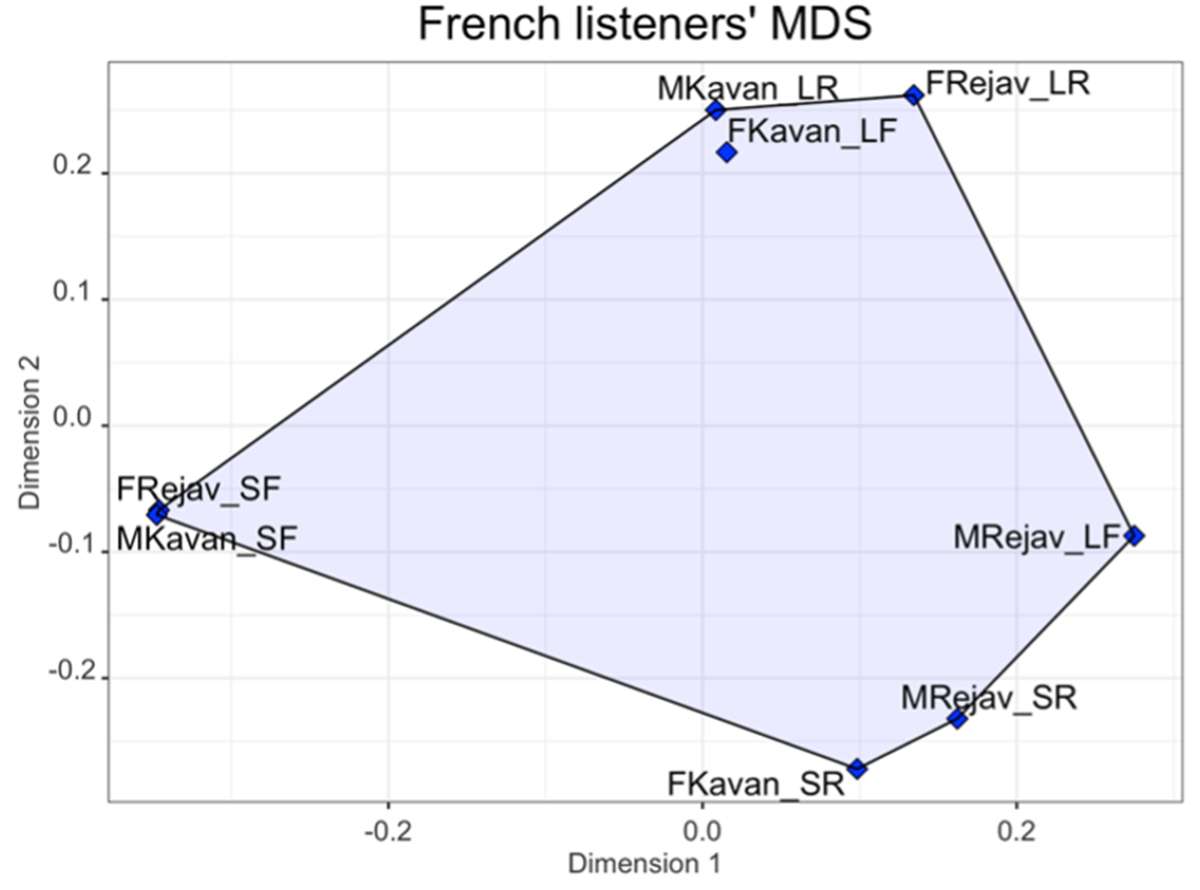
MDS plot on the first free classification task for the French listeners.

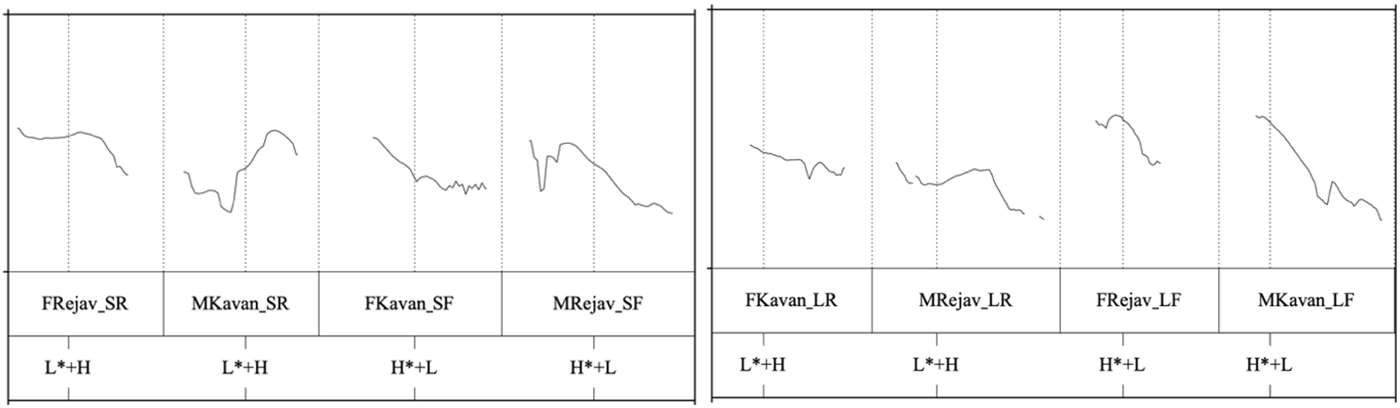
Both the Serbian and French listeners position the two tokens of the short-rising accent close to each other. With respect to their phonetic parameters, the male-produced short-rising accent (MKavan_SR) is indeed short and rising, while the female-produced item (FRejav_SR) is short but not really rising, as the mean F0 reaches a plateau (Figure 18).
F0 contours of all short and long lexical pitch accents.

Figure 18 Long description
Eight line graphs arranged in two groups of four. The labels visible across the graphs are FRejavSR, MKavanSR, MKavanSP, FRejavLR on the left group and FRejavLR, MKajanLR, FRejavLF and MKavanLF on the right group. Each graph plots F0 contour lines along the vertical axis, representing pitch in Hertz and time along the horizontal axis. The vertical axis spans an approximate range visible across all panels. Each panel contains multiple lines distinguished by solid and dashed line styles, where solid lines and dashed lines correspond to different listener or condition series as shown within each plot. Below each graph, labels appear indicating conditions: L superscript negative H and IP superscript negative L are visible beneath several panels. In the FRejavSR panel, the lines show a relatively flat or plateau-shaped contour with a slight rise toward the end. In the MKavanSR panel, lines show a rising contour pattern moving upward across the time axis. In the MKavanSP panel, lines show a steeper declining pattern. In the FRejavLR panel, contours show a gradual falling shape. In the MKavanLR panel, lines show a falling then leveling pattern. In the FRejavLF panel, lines show a sharper falling contour. In the MKavan_LF panel, lines descend steeply before leveling near the end. Across all panels, the contours vary in height and slope, with rising patterns most visible in the SR-labeled panels and falling patterns most visible in the LF-labeled panels.
Length is clearly perceived in the same manner by both groups; that is, both groups perceive short-rising accents as short. The Serbian listeners position the female-produced kavan with the short-falling accent next to the short-falling accent on the male-produced rejav. The French listeners include the female-produced long-falling accent in the group of short-falling accents. The female-produced short-falling and the female-produced long-falling accents are especially close to each other. The French listeners also place the male-produced long-falling pitch accent closer to the two long-rising pitch accents, especially closer to the male-produced long-rising accent.
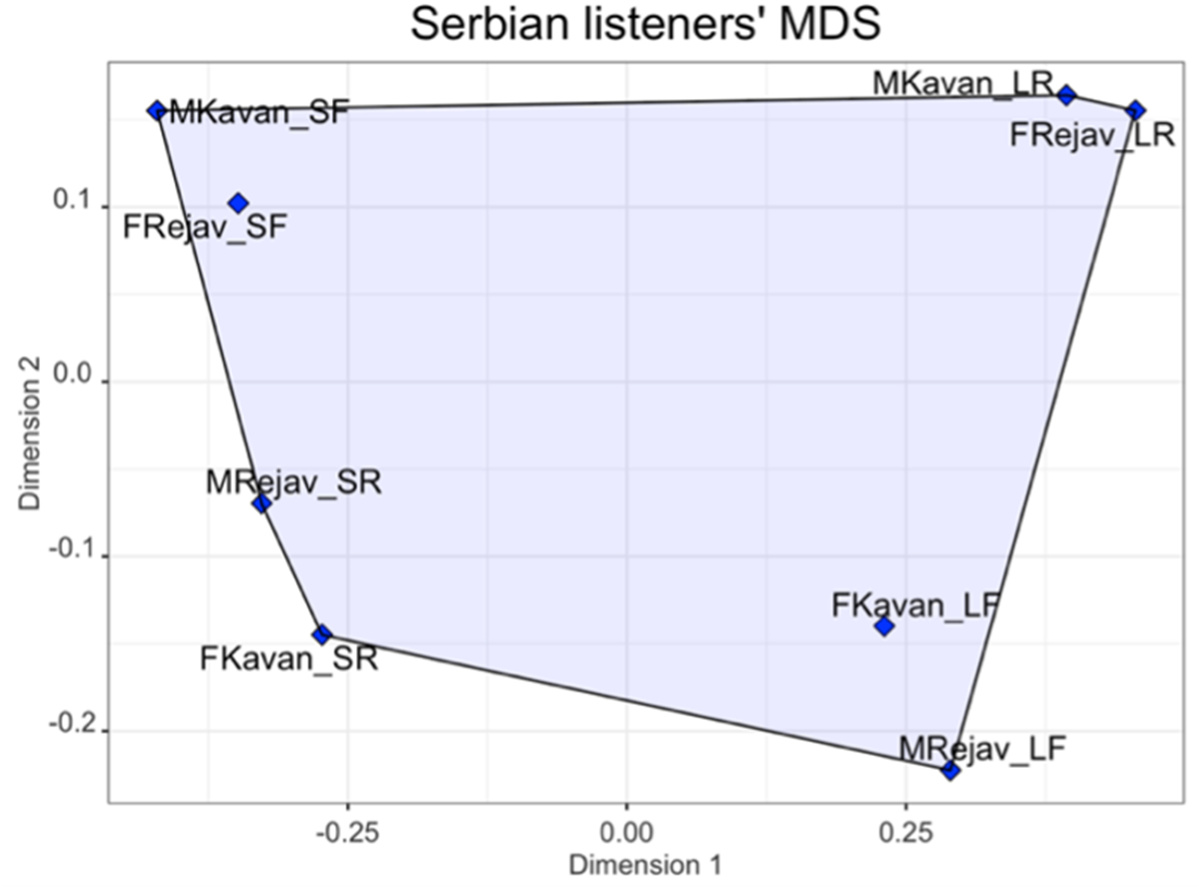
The data from the second free classification task shows that the Serbian listeners retain the distance between the two short accents, which indicates that they could be hearing all four categories of lexical pitch accents (Figures 19 and 20). With respect to the French listeners’ classifications, they manage to differentiate the short-falling lexical pitch accents from the rest of the lexical pitch accents. They split the LF tokens up into two different parts of the perceptual space. The listeners place long-falling accents among long-rising and short-falling, respectively. The male long-falling lexical pitch accent was placed closer to the two short-rising lexical pitch accents, while the female long-falling lexical pitch accent was considered more similar to long-rising lexical pitch accents.
MDS plot on the second free classification task for the Serbian listeners.

MDS plot on the second free classification task for the French listeners.

The MDS analyses do not reveal which perceptual dimensions might have the greatest effect on the perception of Serbian lexical pitch accents. Therefore, we compared the relationships between the listeners’ ratings, F0, and duration by using the Spearman correlation test (De Winter et al. Reference De Winter, Gosling and Potter2016) in R, specifically using the rcorr() function of the Hmisc package in R (Harrel Reference Harrell2015). The Spearman correlation test is a non-parametric correlation test that does not assume linear relationships between the variables and a normal distribution of data. We calculated the correlations between the Serbian and French listeners’ MDS dimension values with the acoustic properties of the Serbian lexical pitch accents. We included mean F0 and mean duration as the two most important acoustic parameters of the accents. We also included the F0 min and max of each accent in order to test whether the peak or the valley of the accent could be correlated with one of the MDS dimensions. All the F0 and duration values were listed from the measurements we obtained with the ProsodyPro script. The measurements were taken for both the accented and post-accented syllables. The MDS dimension values were obtained from the MDS analyses and were listed next to the F0 and duration values. The correlations for the Serbian listeners for both classification tasks show that duration is correlated with dimension 1, while there was no significant correlation between the rest of the parameters and dimension 2. No significant correlation was found between any of the dimensions and parameters for the French listeners’ classification (Table 8).
Correlation of F0 and duration values and distances

Table 8 Long description
Correlation results are listed for Serbian listeners and French listeners, with columns for Parameter, Dimension, R, and p. For Serbian listeners, maxF0 has R minus 0.17 with p 0.342 in Dim1 and R 0.004 with p 0.981 in Dim2. Serbian minF0 has R minus 0.40 with p 0.022 in Dim1 and R minus 0.14 with p 0.437 in Dim2, and Serbian meanF0 has R minus 0.26 with p 0.147 in Dim1 and R minus 0.024 with p 0.896 in Dim2. Serbian duration has R 0.49 with p 0.004 marked with an asterisk in Dim1 and R 0.021 with p 0.907 in Dim2. For French listeners, maxF0 has R minus 0.14 with p 0.419 in Dim1, R minus 0.03 with p 0.871 in Dim2, and R 0.12 with p 0.51 in Dim3. French minF0 has R minus 0.3 with p 0.098 in Dim1, R minus 0.2 with p 0.274 in Dim2, and R minus 0.01 with p 0.966 in Dim3. French meanF0 has R minus 0.22 with p 0.234 in Dim1, R minus 0.10 with p 0.582 in Dim2, and R 0.043 with p 0.813 in Dim3. French duration has R 0.2 with p 0.281 in Dim1, R minus 0.03 with p 0.869 in Dim2, and R minus 0.16 with p 0.376 in Dim3.
Note: The three dimensions for the French listeners indicate the 3-dimensional space.
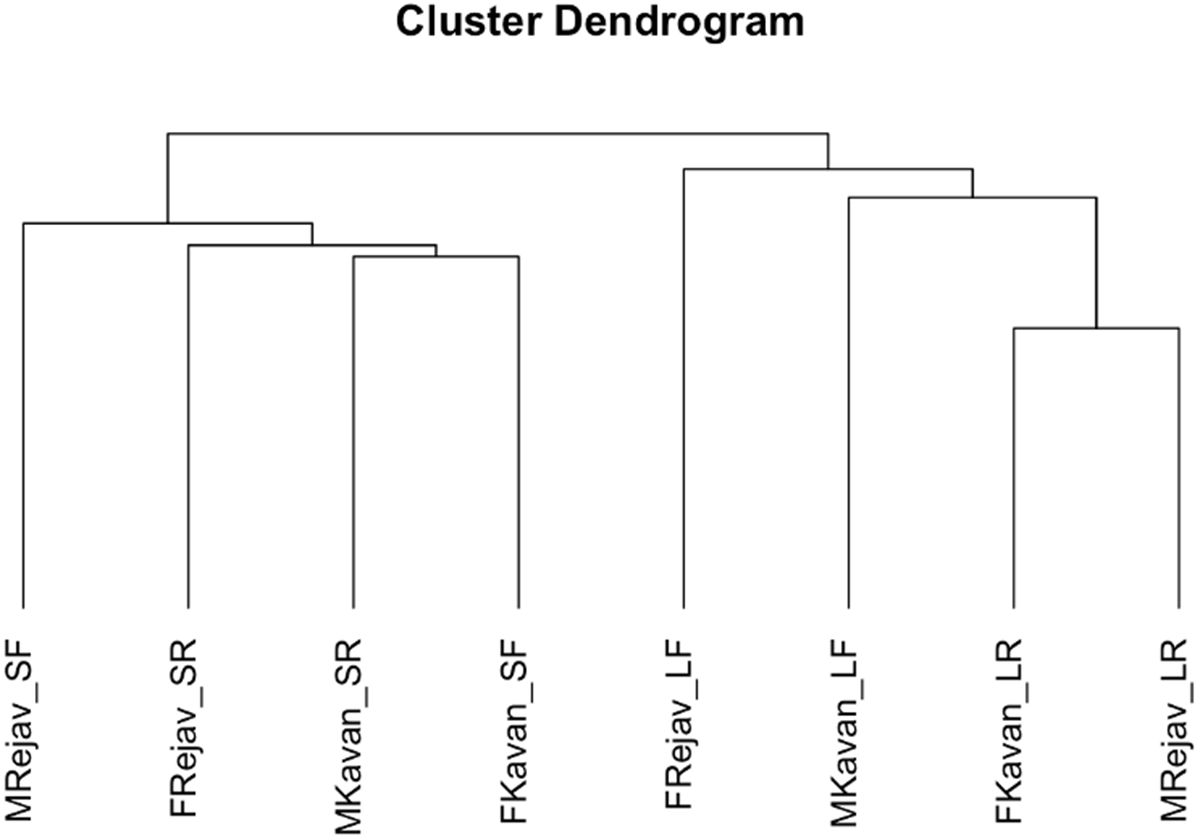
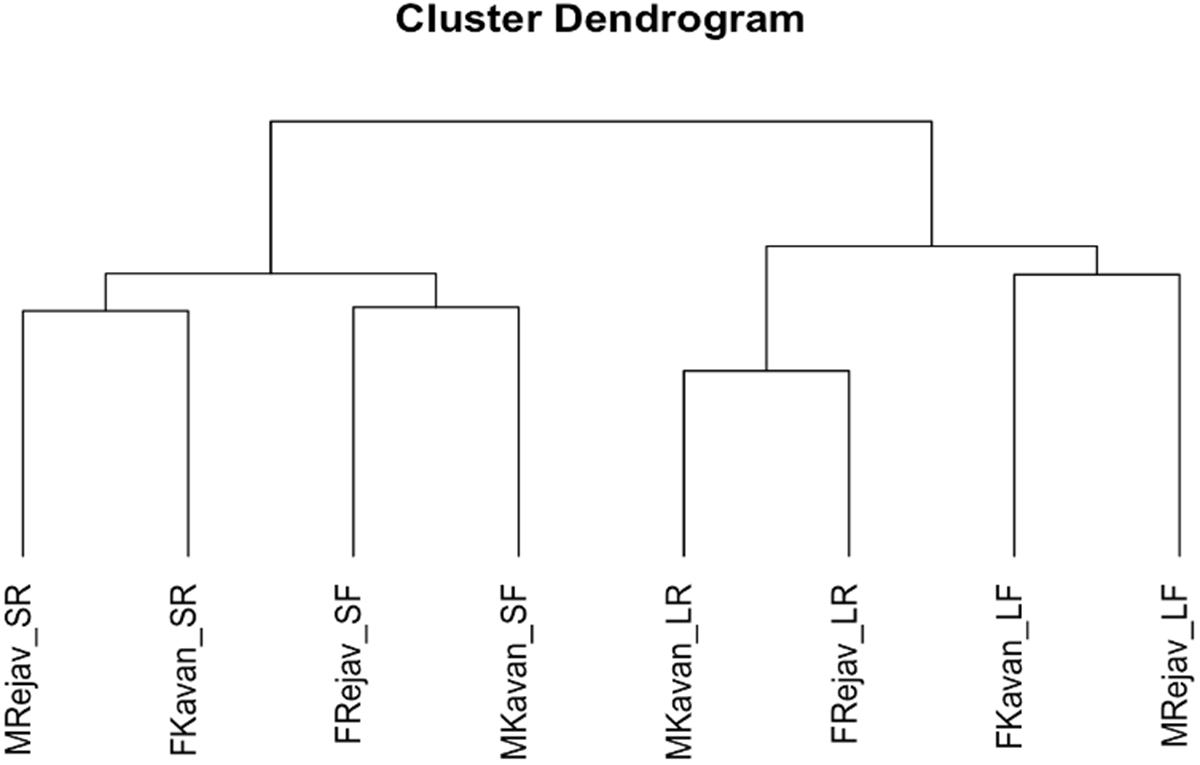
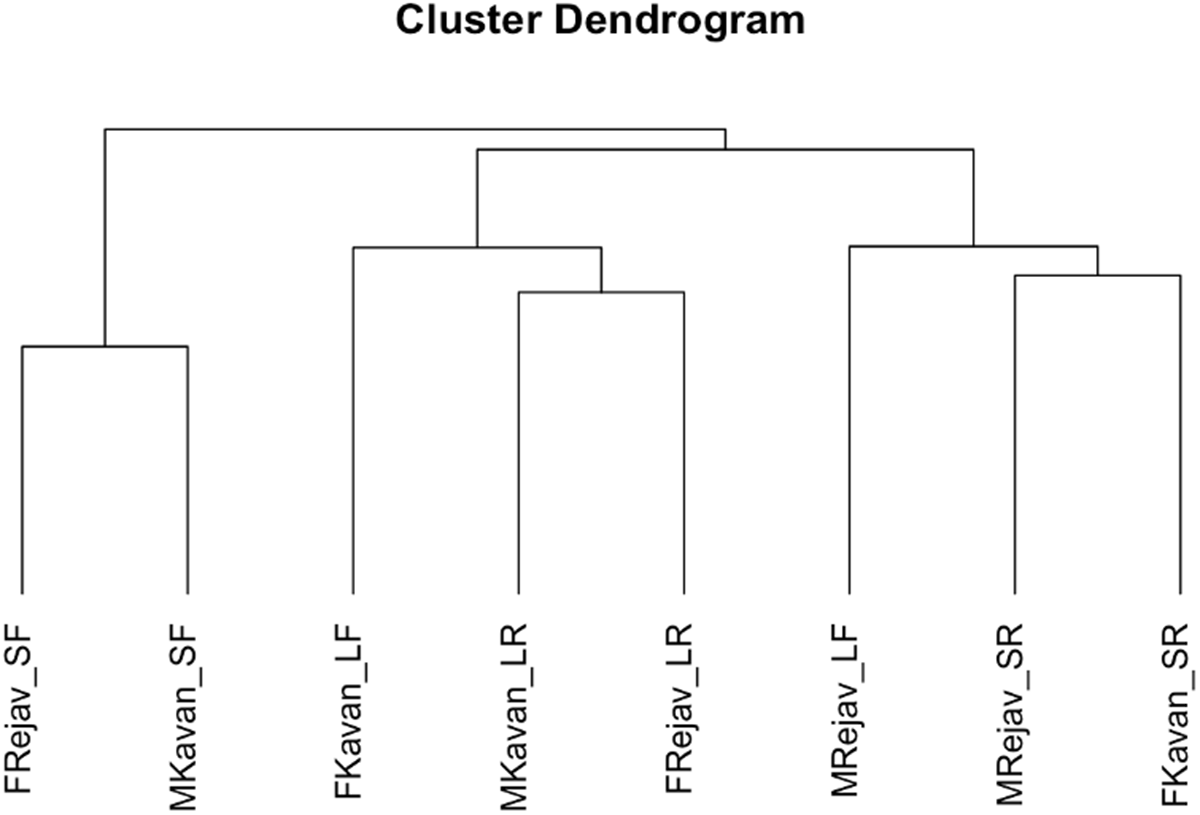
Although we did not ask the listeners to create groups of items, the nature of the task implicitly required them to do so. Because the visual representation is often not quite clear as to which items were placed in which groups, we carried out a clustering analysis of the data in R, using the hclust() function available in the embedded stats package. We implemented the hierarchical clustering on the (Euclidean-based) distances using the single-linkage criterion (Levshina Reference Levshina2015). The clustering analysis for the responses for both free classification tasks provided by the Serbian listeners is displayed in Figures 21 and 22.
Clustering of Serbian listeners’ classification of items in the first free classification task.

Clustering of Serbian listeners’ classification of items in the second free classification task.

These clustering analyses show that the Serbian listeners created two major groups of lexical pitch accents which differed clearly in length (long and short). With respect to pitch movement, they only confused the short-rising and short-falling accents in the first free classification task. In the second free classification task, the Serbian listeners clearly distinguished between the four lexical pitch accent types.
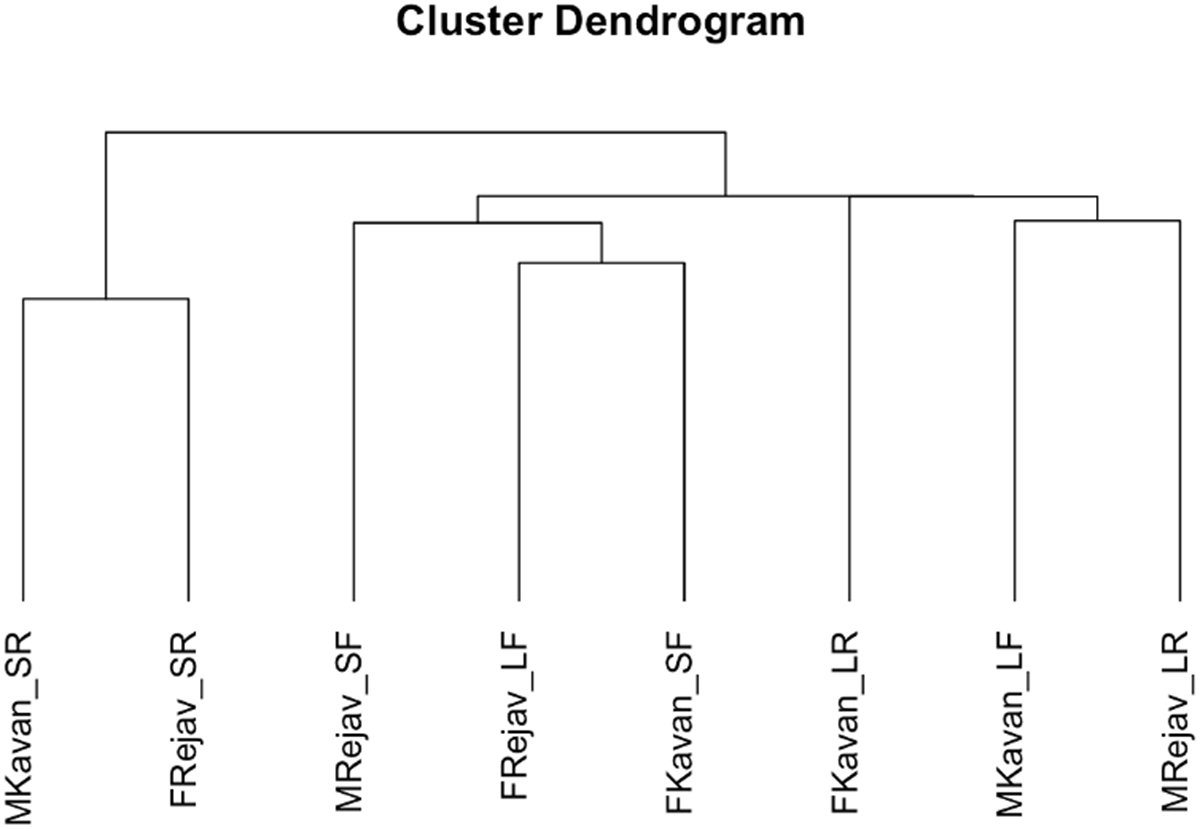
The clustering analysis of the French listeners’ responses from the free classification tasks (Figures 23 and 24) shows that the listeners effectively created three groups. The clustering analysis shows identical findings to those from the multidimensional scaling analysis. The listeners distinguished between the short-rising lexical pitch accents and the rest of the lexical pitch accents in the first free classification task, whereas the short-falling lexical pitch accent was distinguished from the rest in the second free classification task. The long-falling lexical pitch accent was classified with a combination of other lexical pitch accent categories in both tasks.
Clustering of French listeners’ classification of items in the first free classification task.

Clustering of French listeners’ classification of items in the second free classification task.

4. Discussion
In this study, we investigated how Serbian (native) and French (non-native) listeners would organize Serbian lexical pitch accents in perceptual similarity space. The multidimensional scaling and clustering analysis of the two free classification tasks showed that the Serbian listeners have a tendency to create three or four lexical pitch accent groups, while the French listeners develop three lexical pitch accent types. With respect to specific classifications, the French listeners tend to confuse falling and rising pitch movements across both long and short lexical pitch accent types, while the Serbian listeners do so only with short lexical pitch accents.
The results suggest that the majority of Serbian listeners can distinguish between the four types of pitch accents. However, there is the tendency to ‘conflate’ short pitch accents, which indicates that in perception Serbian listeners do not consistently hear the difference between short-rising and short-falling pitch accents, which has been observed in their production as well (Subotić et al. Reference Subotić, Sredojević and Bjelaković2012). The main reason for this is because the F0 on the short-rising accent often remains level instead of going up, and because the accented vowel is short, which precludes the F0 movement from being drastically more different on the rising accent in comparison to the falling accent (Lehiste and Ivić Reference Lehiste and Ivić1986, Subotić et al. Reference Subotić, Sredojević and Bjelaković2012, Sredojević Reference Sredojević2017). It needs to be emphasized that in many speech varieties across Serbia, including that of Belgrade – the capital of Serbia, where at least one third of the country’s population resides – there is no distinction between short rising and short falling accents in two-syllable words (most often those ending in with an open syllable, but also in those that end with a closed syllable, and even, with some speakers, in three-syllable words) (Sredojević Reference Sredojević2022). In all these situations, both accent types are pronounced as the short-falling accent. Thus, the distinction becomes obscured, which we confirmed in the first free classification task. In addition, the Serbian listeners’ pitch-accent perceptual space reveals that the Serbian listeners can most certainly perceive the vowel length difference between the accents. This and the fact that vowel length – but not pitch – significantly correlated with one of the multidimensional scaling solutions for the Serbian free classification data strengthens the previous finding that length carries greater weight than pitch in the perception of (isolated) Serbian lexical pitch accents by Serbian listeners.
A reviewer pointed out that these results could reflect the fact that we used nonwords to explore the perception of Serbian lexical pitch accents. While in some other contexts – for example, when coupling lexical prosodic contrast and meaning – real words could tell us more than nonwords, we believe that, in this specific study, real words and thereby the meaning of the words would not add to the exploration of the perception of the acoustic properties of lexical pitch accents and to the categorization. In Serbian, Serbian listeners simply do not pay attention to the accent type, as there are few minimal pairs and the meaning of words can be clearly derived from context.
The results obtained from the French listeners reveal that these non-native listeners confuse long-falling lexical pitch accents with long-rising and short-falling/rising accents. The French listeners’ prosodic system does not have pitch targets that map lexical pitch accent properties (rising and falling F0 and short and long vowels) to a native lexical pitch accent category or to lexical items. French prosody specifies pitch targets at the phrasal level (e.g., Accentual Phrase), where the variation designates meaning (e.g., new information, different focus types, delimitation), but these pitch targets do not make up a category. This means that they are not basing their responses strictly on these measurable acoustic parameters. This finding could also be due to the acoustic properties of the long-falling lexical pitch accent, as both the F0 peak and the fall occur within the accented vowel. This means that the peak could be either early – which would conflate the long-falling accent with the short-rising accent, as the fall could be obscured – or somewhat late, which would obscure the distinction between the falling and the rising lexical pitch accents.
The French listeners could be perceiving the similarity between the pitch accent categories based on the categories that already exist in their language – AP and IP. Assuming that the IP has a different (above-the-phrase) function, they are most likely resorting to the AP, whose full specification is LHiLH*, with H* as the only obligatory element, usually preceded by L. Just as in the free classification task used in this study, a single word can be the entire AP in French (as well as the entire IP). Given that Serbian has an L*H pitch accent, which indicates a rising contour, it could be the case that the French listeners are simply not successful at grouping together the H*L (falling) contours. They could also be attending to the F0 peak as a simple H* and L separately, which would again describe their ‘successful’ (or normative) grouping of the rest of the pitch accents (two rising and one falling). The long-falling accent would therefore become difficult for them because of the dip-rise-fall pattern that occurs on words with the long-falling accent.
Moreover, although it is unlikely that these listeners confused length (as the native listeners demonstrated), their confusion between the long-falling and short-falling accents could be because the duration of the accented vowel for the male talker is longer than the duration for the female talker. The fact that the French listeners noticed this difference could imply an increased level of perceptual sensitivity towards length distinctions in lexical pitch accents. In addition, there is greater variation in the fine phonetic detail of the pitch targets as compared to length, whose phonetic implementation is less variable (e.g., Post et al. Reference Post, d’Imperio, Gussenhoven, Trouvain and Barry2007).
Contrary to the predictions based on the Native Language Acoustic Cue Approach, French listeners did not struggle to create lexical pitch accent categories or to make distinctions between the majority of lexical pitch accents. The fact that the acoustic cues for these lexical pitch accents do not directly participate in any lexical prosodic contrasts in their native language did not preclude the French listeners from relying on the two major acoustic cues – pitch and length – to reliably classify non-native lexical pitch accents. Apart from the long-falling lexical pitch accent, which the French listeners could not accurately group, they managed to distinguish between the rest of the lexical pitch accents. Instead, the results were in alignment with the predictions of the Target Language Acoustic Cue Approach, which held that they could rely on the F0 movement and duration cues from their native language prosodic categories to perceptually process non-native lexical prosodic categories. In addition, the results reveal that the phonetic realizations of the categories are more important and impactful on the perception of non-native lexical pitch accents than the functionality of those in one’s native language, which is explained by Mennen’s (Reference Mennen, Delais-Roussarie, Avanzi and Herment2015) LiLT. Although LiLT is mainly based on the production challenges of non-native speakers, perception results such as these could also be incorporated into the model.
Crucially, our study shows that cross-domain similarity mappings – from the phrasal level to the lexical level – can occur in the perception of the acoustic cues of a non-native lexical prosodic category. The perception of non-native lexical prosodic categories is largely influenced by the target acoustic cues rather than by the functionality of those acoustic cues in one’s native language, as predicted by the Target Language Acoustic Cue Approach. Listeners may engage more general auditory (psychoacoustic) strategies when processing non-native lexical prosodic contrasts (Laméris et al. Reference Laméris, Llompart and Post2024). That is, their processing may be based more on the integration of the target acoustic cues with their native acoustic cues than on how those acoustic cues function in their native language. This highlights the importance of considering not just the influence of the listeners’ native language, but also the integration of the properties of the native and target language when evaluating lexical prosody perception.
Lastly, at the methodological level, the free classification task as employed in this study is a novel technique that can help reveal that listeners can perceive distinctions in non-native stimuli without strictly replicating the original non-native categories of those stimuli.
Statement of ethics
The study was approved by the Conjoint Faculties Research Ethics Board
(CFREB) of the University of Calgary and received the ethics ID: REB20-0210. All participants read and signed an informed consent form before starting the study.
Disclosure statement
The authors have no conflict of interest to declare.
Funding sources
The authors did not have any funding for this research.
Data Availability Statement
The materials and analyses for all tasks for both experiments are available at https://osf.io/yg2tn/?view_only=44863fd259c546d1bfbf5591413595e7.












 Open access

