How does international law affect state behavior? A vast and still growing body of work has been looking to domestic politics for an answer. These scholars have looked past traditional international-level factors such as state power, country reputation, and reciprocity, focusing instead on the role of constituents and interest groups to explain why countries join international treaties in the first place, and how they behave within treaties subsequently. Such theories rest on a common set of highly specific assumptions about individual behavior. Yet strikingly, these often elaborate premises have been left largely unexamined.
The puzzle of why countries would commit to international binding rules in trade, investment, or human rights agreements has led to increasingly rich theorizing. Mansfield, Milner, and Rosendorff believe that countries join trade agreements in order to credibly convey to voters that economic downturns, when they occur, are not due to leaders' offering distortionary protection to industries.Footnote 1 Kono argues that democratic leaders are more likely to offer protection through convoluted policy instruments, because these are less likely to be seized upon by the opposition.Footnote 2 Looking at the human rights regime, Simmons and Danner claim that countries ratify the International Criminal Court (ICC) statute as a means of raising expectations among the general populace about the government's will to find peaceful solutions to potential domestic conflicts: “the frustration of these expectations by the commission of atrocities is likely to cost the government popular support.”Footnote 3
In all these instances, theoretical claims rest on a common premise: when international legal institutions inform constituents of their governments' violations, these constituents will react by withdrawing political support, whether at the polls or through popular forms of dissent. It is precisely because of the threat of such ex post costs imposed by constituents that leaders make those international commitments. As with all audience cost models,Footnote 4 the credibility of hand tying is built on the expectation of constituents' forceful reaction in the event of broken commitments.
But do constituents really care about their governments flouting international agreements? These models' validity rests on this being the case, yet scholars have little way of knowing one way or the other. The premise that constituents would know and care enough to punish their government over the highly technical rulings of international institutions such as the World Trade Organization (WTO) can easily appear far-fetched. Thus far, the only means of assessing the soundness of these individual-level assumptions has been through surveys.
However surveys do poorly on questions that put high demands on timing, such as the study of repeated events or emerging trends. More importantly, they come up against a consistent problem, which is intimately related to skepticism over the very assumptions in question: typical respondents often know little about the issues they are asked about. High rates of respondent ignorance can bias survey results.Footnote 5 Further evidence shows that in the absence of prior knowledge, respondents become highly vulnerable to framing effects.Footnote 6 Such effects grow even more likely given that these surveys often find it necessary to preface questions with information about the issue at hand. For these reasons, and because the problem of respondent ignorance is so closely linked to the very assumptions being tested, surveys fall short of a satisfactory means to assess an electorate's likely behavior in reaction to its government's (non)compliance with international rules.
To remedy this shortcoming, I turn to a novel approach, relying on search-engine data. Web-search data have recently been fruitfully exploited in public health research to predict outbreaks of diseases ranging from influenza and listeria to chickenpox and kidney stone incidence; and in economic applications, to chart activity such as foreign travel, unemployment claims, and stock price movements.Footnote 7 In this article, I claim that web-search data may be of equal value to political economists, because such data are particularly well adapted to assessing many of the otherwise untestable behavioral assumptions underlying the majority of scholarly models.
I focus on the behavior of individuals with regards to purported violations within trade agreements. By their technical nature, trade agreements constitute a hard test of expectations about constituents' response to noncompliance with international rules. It is more plausible that citizens react forcefully to information about their government's violation of laws against torture than to purported abuse of antidumping provisions. Indeed, the saliency of trade agreements among voters has been thrown in doubt in the past.Footnote 8 The other reason for examining trade agreements is that one can identify the material interests at stake more easily than in other issue areas, and thus distinguish the reactions of constituents concerned about noncompliance itself, either for normative or for reputational reasons, from the reaction of groups or individuals who stand to gain or lose materially from such noncompliance.
The key aspect of web-query data is that it measures not preferences, but behavior. Seeking information is a crucial political activity, yet it has been widely overlooked because until recently scholars had little means of observing it. If constituents possess insufficient information to make decisions, rational-actor models predict that they will expend resources trying to gather that information.Footnote 9
Yet information seeking is costly: constituents cannot gather and process infinite amounts; they must decide what issue to spend scarce resources seeking information about. It is such scarcity of resources, and the necessary choice it entails, that renders web-search volumes informative from the standpoint of political economy. Web searches related to political events are a form of mobilization on the basis of preferences over those events.
I expect that if constituents care about their government being found in breach of international law, as models of treaty making assume, they will expend efforts to seek related information. Using data about Google searches across time and space, I test the effect of the United States being taken to WTO dispute settlement by other WTO members, or its taking another country to dispute settlement, on the volume of WTO-related search terms. The findings provide measured support for assumptions of treaty-making models. I find considerable evidence demonstrating that US constituents react strongly to their country being filed against by seeking WTO-related information. I also examine how material interests figure into the equation, weighing geographical regions by the commercial stake they hold in a given dispute, as proxied by employment. I find little evidence that material interests magnify the reaction to US filings against trade partners. Yet a material stake does significantly magnify reactions to signals about US violations. This should be cause for concern, since it implies that filing against the United States may “awaken” precisely those groups most likely to oppose swift US compliance.
I further consider constituents' reaction to a category of disputes that concern not specific traded goods, but domestic regulation. These “nonmerchandise disputes” can have a significant impact on the trade regime, yet they usually pertain to no identifiable trade volume, and generally deal with more abstract legal issues than do merchandise disputes. In another finding that should trouble institutionalist scholars, I demonstrate that constituents fail to react to their government's purported violations over such abstract issues by seeking related information, which bolsters the view that increasing complexity can play an obfuscating function.Footnote 10
To test these beliefs, I begin by taking a simple regression approach, trying to predict the volume of search by looking at the occurrence of disputes. I then reexamine my main hypothesis using a method borrowed from financial econometrics. My intuition is that the relation between political events and search volumes for related terms should be analogous to that between stock prices of firms and events that may affect those firms' valuation. This method allows me to effectively ask whether a given event leads to a higher search volume in US states than one would expect had that event not occurred.
As a first step in testing the individual-level assumptions underlying political economy models of treaty making using search-engine data, the approach holds important implications for future research. Political scientists know much about the supply side of information—one can measure money spent on television ads, or the number of billboards put up by an electoral campaign—but comparatively less about the demand side of political information, which is likely to be a more telling indicator of behavior. Web-search data may allow us an unprecedented look into an overlooked political activity: information seeking.
The Assumptions Underlying Treaty-Making Models
The institutional literature's recent focus on the domestic level serves as a solution to an enforcement problem. If institutions such as the WTO have “no bail bondsmen, no blue helmets, no truncheons or tear gas,”Footnote 11 how do they hold countries to their commitments? It is generally agreed upon that a key function of the institution in this regard is to provide reliable information about whether or not country behavior is in contravention of its commitments. Who is the intended audience for this information? Traditionally, under the cast of theories that portrayed states as unitary actors, scholars envisioned the audience as other country members. But another belief has proven dominant in the past two decades, which sees domestic constituents as the intended audience.Footnote 12
In this telling, the enforcement of governments' commitments flows not as much from the threat of other states' sanctions as it does from a government's own constituents. As one observer puts it, these agreements are predicated on “the availability of [domestic] victims of noncompliance as low-cost monitors.”Footnote 13 In the case of trade, protection is distortionary and hampers economic growth. While import-competing industries gain, the median voter loses. Countries signing international trade agreements capitalize on this loss: it is precisely because of the threat of discontented constituents removing a government from office that international trade commitments are credible, and thus beneficial to signatories who are held to Pareto-improving policy changes. As with audience-cost models of any sort, what lends credibility to the commitment is an ex post cost.Footnote 14
In the case of trade, the expectation is that constituents will react to information about their government offering distortionary protection to interest groups.
Since the existence of an ex post cost relies on constituents reacting forcefully to information about breached commitments, these theories hinge on constituents not only noticing, but also caring enough about information concerning breaches by their government to act on their discontent, be it through voting at the polls, withdrawing campaign support, or popular forms of dissent.Footnote 15 It is easy to be skeptical of this premise. In the face of widespread reports of voter apathy, political ignorance, and information saturation, should scholars really be constructing models that hinge on constituents acting against leaders on the basis of purported violations of, say, the WTO Agreement on the Application of Sanitary and Phytosanitary Measures?
Yet this assumption is the lynchpin not only of treaty-making models that ask who joins,Footnote 16 but also of a number of related questions. In this way, Kono finds that more democratic regimes are likely to fall back on more opaque forms of protection, because these are less likely to lead to reactions among constituents, and thus are less likely of being seized upon by the opposition, which looks for messages that can be delivered in a sound bite.Footnote 17 Examining the point of view of enforcers, Davis demonstrates that countries initiate WTO disputes to credibly convey to domestic industries that they are serving their interests.Footnote 18 Filing thus amounts to pandering to an export-oriented audience. Examples of work resting on similar individual-level assumptions are not limited to trade. A wave of domestic-level theorizing has also taken over the study of human rights treaties, where scholars argue that countries join human rights treaties not so much as a gesture to other states, but rather as a credible signal to their domestic audience.Footnote 19 There too, the premise is that human rights agreements accrue significance as citizens become more likely to react to reports of violations. The same reasoning has been applied to environmental treaties. European countries' compliance with the 1985 Sulfur Protocol is said to have been due to the electoral leverage of domestic constituencies likely to act on information about compliance with the protocol.Footnote 20 In the face of domestic political apathy, all these models fall apart.
Thus far, the only means of knowing whether the underlying individual-level behavioral assumptions are sound has been through surveys. Yet surveys come up against some of the very problems that are grounds for skepticism toward treaty-making models in the first place. The average respondent tends to know little about specifics of the political questions they are asked about—in this case, international rules.Footnote 21 Low response rates are thus endemic. And as Milner and Tingley point out in work that seeks to improve on the design of these surveys, “forcing a response to a question introduces noise into the analysis.”Footnote 22
Wide variation in polling results for the same issue during the same period speaks to the potential significance of framing in questions' formulation.Footnote 23 While one would hope that any potential framing would have a consistent effect across all respondents, there is considerable evidence to suggest that less-knowledgeable respondents tend to be more vulnerable to framing,Footnote 24 entailing not only considerable noise in the data, but also biased findings. So in making up for respondents' lack of information, surveys become more vulnerable to another, equally serious problem.
By comparison, the method employed in this study is premised precisely on the notion that individuals are not initially likely to have all the necessary information to process signals from an international institution about their government's (non)compliance, but that if they care sufficiently, they will seek that information out.
Individuals Seeking Information
As an alternative means of testing individual-level behavioral assumptions in domestic models of political economy, the novel approach here uses search-engine data. Although such data did not exist until very recently,Footnote 25 they have already proven invaluable in, among other applications, tracking and predicting outbreaks in public health. Mohebbi and colleagues show how Google search data can be an earlier and equally accurate predictor of flu outbreaks in the United States compared to the data collected by the Center for Disease Control from hospitals around the country on a weekly basis.Footnote 26 Similar applications have shown web queries to be equally valuable in predicting listeria, chickenpox, and a host of other diseases and medical conditions.Footnote 27 These epidemiological applications rely on one simple idea. Because more than 90 million Americans search the web for information about medical conditions every year,Footnote 28 and because data are available on where and when these searches occur, a sudden uptick in the volume of searches relating to a specific condition in a given area may be a first clue of an increase in that condition's occurrence in the area. Similarly, economists have used web queries to predict trends in the volume of unemployment claims because individuals likely to file them are also more likely to seek information on such claims before they file. The main application of web data thus far has consisted of “predicting the present,”Footnote 29 that is, producing early forecasts of measures that we learn about subsequently through traditional means. And while these applications hold great promise for public policy, where obtaining highly detailed, continuous data days or weeks in advance can improve decision making considerably, such gains in time hold less value for analysis. Rather, their true potential from the standpoint of social science research lies in providing measures that are difficult to obtain through other means: in this case, charting the reaction of constituents to information about their country's violation of international law. Search-engine data may thus become as useful to political economy applications as they have already proven themselves to be for epidemiology and economics.
The social science concept that comes closest to what web-search data capture is public attention, or attentiveness, defined as the scarce resources that individuals dedicate toward a political issue.Footnote 30 Scholars of public attentiveness are adamant about differentiating it from public opinion, which bears repeating in the context of web searches: the data capture not opinion or preferences, but behavior.
The heroic homo economicus assumption of perfectly informed individuals is largely obsolete. There has long been a recognition among economists themselves that rationality is bounded by limited information, and limited capacity to process it: in short, a “bottleneck of attention.”Footnote 31 Crucially, however, recent evidence suggests that the means by which individuals make up for the information they lack can usefully be modeled as resting on a premise of rationality.
Information-seeking involves a decision: What piece of information must be pursued at the cost of what other bit of information to make a decision? As Simon, the scholar at the origin of attention economics, put it succinctly, “a wealth of information creates a poverty of attention and a need to allocate that attention efficiently among the overabundance of information sources that might consume it.”Footnote 32 In this regard, lab experiments have shown that subjects access more information to make a decision concerning two centrist candidates than two candidates of extreme positions, the implication being that the information-seeking behavior itself has rational underpinnings, in this case because it takes additional information to distinguish choices that are very similar.Footnote 33 Seeking information involves a trade-off. For instance, national news outlets come at the expense of local news sources, with corresponding implications for political behavior: a recent finding shows how the penetration of the New York Times in local markets was correlated with decreased political participation in local elections.Footnote 34
Web searches allow one to observe something political scientists have lacked access to until recently: individuals seeking information. Given what one knows about the cost of, and the strategic behavior individuals display in seeking information, the existence of data on web searches allows one to ask the very question needed to test the assumptions of treaty-making models in the international political economy: do individuals care sufficiently about signals concerning their governments' violations that they react by seeking related information?
Expectations: The Case of Trade Violations
Treaty-making models in a range of issue areas, from international trade and human rights to the environment, rest on a common set of assumptions about individual behavior. I test these assumptions in the issue area of trade for three reasons. First, trade constitutes a harder test of the models' assumptions: it appears more plausible that constituents will react forcefully to news of a government's violation of human rights agreements, or of an environmental treaty, than a trade agreement. This is because trade agreements tend to be more technical in nature, and because violations of trade agreements have a less immediate impact on the daily life of constituents than water pollution or a regime torturing members of the opposition. Second, trade is contained within a highly coherent regime, with a single multilateral organization, the WTO. As a result, the great majority of violation claims will come through a single institution, and there is less need to account for the relative importance of alternative forums.Footnote 35 By comparison, there are dozens of multilateral human rights agreements, varying in their degree of success, membership, and exact issues covered; the environmental regime looks much the same. Finally, trade allows one to separate normative and material objections to noncompliance in a way that would be impractical in other issue areas.
The WTO is a decentralized enforcement institution—it does not pursue violations itself, but merely provides information about possible noncompliance, through devices such as Trade Policy Reviews (TPRs), and precise tariff schedules outlining every member's commitments.Footnote 36 It is up to other members to pursue purported violations of the rules by filing for consultations with the member at issue, the necessary first step to any WTO dispute. Every such filing is immediately made public, to both the WTO membership and domestic audiences. Most cases are settled before reaching a verdict, usually with concessions by the defendant.Footnote 37 Cases that do make it to a verdict exhibit a pro-complainant bias, owing to the selection effect both in the filing of cases and in the escalation to litigation. In other words, because of the costs involved in filing, and the resulting process of selection, a majority of cases filed ostensibly represent some form of actual rule violation.
Taken together, this reasoning leads to the following expectations. My first hypothesis is also the simplest. If constituents truly react to signals from the WTO about possible violations by their government, as presumed by treaty-making models such as in Mansfield, Milner and Rosendorff,Footnote 38 one should be able to observe an increase in the number of WTO-related web searches following such announcements:
H1: Time periods during which the United States is accused by another country of flouting WTO commitments should be associated with a increase in WTO-related searches over the same period.
Second, if dispute filing functions as a credible signal to export-oriented groups, as per Davis,Footnote 39 then the presence of a material stake, denoted by employment associated with the products at issue in a dispute, should have an observable effect on web searches associated with filings. This leads to my second hypothesis:
H2: The US filing against a trade partner should be associated with a relatively greater increase in web searches in those geographical areas where there exists a material interest in the dispute in question.
Third, if governments have an incentive to choose obfuscatory forms of protection as a way to avoid adverse reactions by constituents, as per Kono's claims,Footnote 40 then one should be able to observe lesser reactions to highly technical disputes about domestic legislation. Similarly, scholars know from research on public agenda setting that more complexity drives down salience, and that abstract issues are less likely to raise public attentiveness than more concrete ones.Footnote 41 The disputes most representative of such complex and abstract issues are nonmerchandise disputes, which concern issues of domestic legislation and legal principle, rather than specific barriers on a given product. The effects of such nonmerchandise disputes are both more diffuse, and harder to measure. Accordingly, my third expectation is the following:
H3: Initiation of disputes over nonmerchandise issues should lead to a lesser increase in WTO-related searches than the initiation of disputes concerning identifiable products.
Together, these three hypotheses represent some of the assumptions underlying institutional models in political economy that ask a range of questions about who joins, and when; who complies; what form noncompliance takes in the alternative; and who enforces in those events.
Research Design
I test the hypotheses using data about web queries in time and space. Specifically, the unit of analysis is the amount of queries for a given term in Google's search engine, in a given US state, in a given week, over the period from January 2004 to May 2011. More than 85 percent of searches online take place through Google, and it is the only search engine to readily offer access to data on search volumes.Footnote 42 Google provides users with what amounts to a search index. The data are normalized and scaled. All scores range from 0 to 100, with 100 being the highest volume of search for the entire period, for the state at issue. The data are also normalized by the overall volume of search for all terms in the state under observation. In other words, the data effectively convey how likely it is that a search in a given state, during a given week, corresponds to the term of interest. Throughout the analysis, I am interested in searches relating to the term WTO. As such, the dependent variable across all analyses is a relative measure of interest in all phrases containing the term WTO. These can be as simple as “what is the WTO,” or as complex as “WTO dispute on antidumping measures on corrosion-resistant carbon steel flat products from Korea.” The obvious advantage of picking acronyms such as “WTO” as a search term is that they do not have alternate meanings in other languages, and they are highly specific, in that their meaning is not context sensitive.
The independent variables of interest all correspond to the initiation of WTO disputes. I consider every WTO dispute initiated over the relevant period, from 2004 to 2011, that involves the United States as either complainant or defendant. There are thirty such disputes. The relevant date of initiation is the request for consultations, which is the first publicly available sign of a dispute, and which is immediately publicized by the institution. Other events could plausibly be used. For instance, one could focus on the announcement of a ruling. Yet rulings occur in a minority of cases, and given that there is a significant pro-complainant bias, they result in relatively little new information about a country's (non)compliance.
I separate the thirty disputes according to the role that the United States plays in each one, either as complainant or defendant. Then, I further distinguish nonmerchandise disputes, which concern no specific product and instead focus on an aspect of domestic legislation, from the rest.Footnote 43
I then code the material stake of every US state in every dispute, which I use to weigh disputes differently for every state. To do so, I build an original data set of all products at issue in every dispute, coded in the Harmonized System (HS), using WTO documents to complete and extend the Horn and Mavroidis database of WTO disputes, hosted by the World Bank.Footnote 44 I then match these to the North American Industry Classification System (NAICS), which is the standard used by federal statistical agencies in classifying business establishments. Using NAICS codes, I obtain employment data by state corresponding to the products at issue in every dispute from 2008 US census data. The employment data are highly precise, and vary a great deal across the sample, from 2 to 167,213 employees in industries at issue in a dispute in a given state. Together, these data allow me to weigh a dispute's occurrence by the employment at stake in every state. I employ weights rather than interaction terms, since I have no use for dispute-related employment data in periods where there were no disputes.
Weighing disputes by related employment can help ascertain whether information seeking is driven largely by material concerns, or a preoccupation with, for instance, a country's international reputation or its role as enforcer of global rules. Trade policy preferences are likely to play an important role here. In those disputes where the United States is a complainant, a significant effect for material stake would suggest that as per Davis and as per H2, those constituents employed in export-oriented industries are responding to the filing of disputes that uphold their interests. In those disputes where the United States is a defendant, however, a significant effect for material stake would represent information seeking by import-competing groups—those groups that benefit from the continuation of the measures being challenged.
While the data from Google Insights represent the best available data on web searches, a few idiosyncratic aspects of these data bear mentioning. First, to make processing manageable, the data do not correspond to the totality of Google searches over the entire period under study, but rather to a representative sample of all searches. This sample is recalculated by Google at each time period. All scores are normalized to take into account the total volume of search in a given area. Similarly, the data are scaled, which means that results can vary over time. If data are collected at time t, and then at time t + 1, the search volume for that term reaches a new maximum, then the score for t + 1 will be 100, and all prior scores will be recalculated in reference to this new value. For these reasons, it is important to run the estimations on data collected at different points in time, to make sure findings stand up to these changes.
The second consequence of sampling is that searches in every state-week must attain a minimum threshold before appearing in the data at all. A score of 0 thus does not necessarily entail an absence of searches for the term of interest but simply signifies that the minimum threshold has not been attained. The more precise a search term, or the smaller the unit of time, the larger the selected geographical area must be for there to be available data. In other words, there is a significant trade-off between time frequency and available US states. For WTO-related searches on a weekly basis, I obtain data from only the thirteen most populous states in the United States, for a sample size of 5,031 observations.Footnote 45 As a result, I rerun the analysis using monthly data for all fifty states, for the same period of study. The sample size there is 4,481 observations.
I use two distinct methods to get at my hypotheses. The first is a standard panel regression analysis estimating the volume of search in a state-week. My main explanatory variables are event indicators, either weighed by employment or not. I also include a control variable for the level of Internet access across states on the right-hand side. And I either include state-level fixed effects or control for state-level variables, and in all cases, cluster robust standard errors on the state. Finally, I either add a lagged dependent variable or use an AR(1) correction to get at autocorrelation,Footnote 46 which is likely to be a concern. The second approach I use is borrowed from financial econometrics, adapting methods used to look for “abnormal returns” in stock prices to the questions being asked in this study.
Analysis and Findings
I begin by examining whether the initiation of disputes has an observable effect on the volume of related web searches. I distinguish four categories of disputes: the United States can play one of two roles, either defendant or complainant, and in each case, the dispute can relate to identifiable goods, or be a nonmerchandise dispute concerned with domestic legislation.
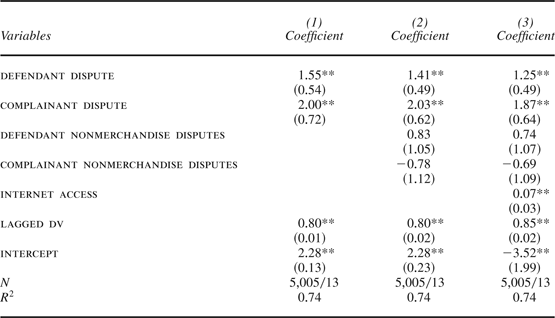
Table 1 shows the announcement of disputes' effect on the volume of WTO-related searches, using a time-series panel regression. Column (1) shows an ordinary least squares (OLS) estimation with state-fixed effects looking at how the initiation of a dispute both against and by the United States affects WTO-related searches. Robust standard errors are clustered by US state. The estimation includes a lagged dependent variable term, the most straightforward means of getting at autocorrelation, which is likely to be a concern throughout the analysis. In column (2), I run a similar estimation, this time adding the initiation of nonmerchandise disputes as separate variables. In column (3), I run a generalized least squares (GLS) panel estimation, and instead of running fixed effects at the US state level, I add a variable for the proportion of households with Internet access in the state under examination.
The effect of WTO disputes on WTO-related web searches

Notes: Columns (1) and (2) show ordinary least squares (OLS) panel regression with US state-level fixed effects and robust standard errors clustered on state. Column (3) shows generalized least squares (GLS) panel regression with robust standard errors clustered on state. Robust standard errors in parentheses. Significance levels:
† p < .10;
* p < .05;
** p < .01.
The results from Table 1 are highly consistent. Web searches rise significantly when the United States is accused by a trade partner of flouting the agreement; the United States accusing trade partners of violations also leads to a significant increase in WTO-related web searches. Indeed, this enforcement function seems to have a comparatively greater effect on web searches. Using an AR(1) correction for autocorrelation, as per Baltagi and Wu, instead of the lagged dependent variable offers similar results.Footnote 47 To put it in substantive terms, using the estimation from column (2) that includes both merchandise and nonmerchandise disputes, and state-level fixed effects, the occurrence of a filing against a foreign trading partner increases the amount of search by 18 percent on average. Because the data are scaled from 0 to 100, it is difficult to know how much of an increase this truly represents. For the purpose of illustration, the average search volume in the absence of a dispute is lower than that for the term European Union for the states in the sample; a country filing against the United States brings WTO-related searches above the volume of “European Union” searches.Footnote 48 The greater relative effect of complainant disputes is perhaps not so surprising, considering that the government actively publicizes its enforcement efforts, in a way that it does not when it is being taken to court.
As for nonmerchandise disputes, neither the cases where the United States is a complainant nor those where it is a defendant show any effect on related web searches. Yet H3 is explicitly about a comparison between merchandise and nonmerchandise cases. To test this expectation more directly, I perform a Wald test, to check whether the linear combination of the merchandise dispute coefficients is statistically different from the linear combination of the nonmerchandise cases. I can reject the null: not only are nonmerchandise cases not jointly significant, they also exert a significantly lower effect than merchandise cases.
Taken together, this initial evidence provides measured support for my hypotheses: constituents do react to their government being accused of violations by trade partners, as per Mansfield, Milner, and Rosendorff and Tomz, who argue that signing international agreements is beneficial because constituents care about their government breaking those agreements.Footnote 49 Yet constituents react even more forcefully to information about their government pursuing other countries' violations, perhaps because such information is made more readily available, providing measured support Davis's belief that states initiate disputes as a credible signal to domestic groups that they are fighting on their behalf.Footnote 50 As for nonmerchandise disputes, neither cases where the United States is a complainant nor those where it is a defendant appear to have any significant effect on WTO-related web searches, bolstering claims put forth by Kono that technical complexity diminishes public reaction to both violations of international rules and efforts to challenge them legally.Footnote 51
This is especially striking given the fact that nonmerchandise disputes would seem to be the very cases that would require the most information gathering, given the complexity of the underlying issues. Although consistent with prior findings, the outright insignificance of nonmerchandise disputes is cause for concern, implying that there is a limit in the extent to which an international institution can provide information that constituents are likely to act upon. If a dispute cannot be identified with a specific product, victim, or beneficiary, as in the case of disputes challenging domestic legislation, individuals are unlikely to react by seeking related information.
The Effect of Material Interests
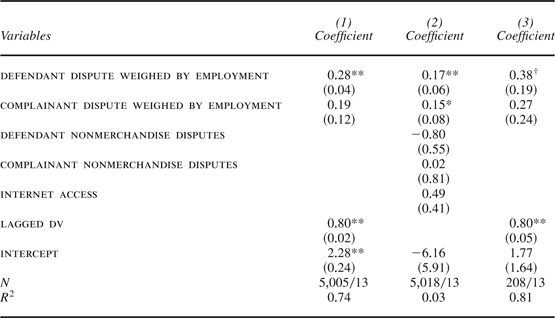
Next, I account for each US state's material stake in the dispute by weighing the event dummies used in the previous estimations by the log of the total number of employees in the industries at issue in a given dispute, in the state under observation.Footnote 52 These are not interaction effects: the constitutive term corresponding to employment at stake has no meaning outside of the period of a given dispute, since the industries at issue vary from one dispute to the next. As a result, the weighting of dummies amounts to including the log of employees concerned by the event under consideration on the right-hand side. The results are presented in Table 2. Column (1) runs a fixed-effects panel estimation, with only the United States as defendant and United States as complainant merchandise cases and a lagged dependent variable on the right-hand side. Column (2) shows a panel estimation with a first-order autoregressive disturbance term instead of the lagged dependent variable; it adds variables for nonmerchandise disputes and replaces fixed effects with a variable for the proportion of households in the state that have access to the web.
The effect of WTO disputes weighed by employment on WTO-related web searches
Notes: Column (1) shows panel regression with ordinary least squares (OLS) state-level fixed effects and robust standard errors clustered on state. Column (2) shows panel regression with a first-order autoregressive disturbance term. Column (3) shows panel regression with OLS state-level fixed effects and robust standard errors clustered on state, and sample limited to periods during which a dispute was initiated. Robust standard errors in parentheses. Significance levels:
† p < .10;
* p < .05;
** p < .01.
In both these estimations, the initiation of disputes against the United States, weighted by the employment associated with the underlying products at issue in every dispute is statistically and substantively significant. Meanwhile, the occurrence of similarly weighted disputes initiated by the United States appears to have no significant effect in column (1) and becomes significant at the 5 percent level only once the other variables are introduced in column (2). As before, nonmerchandise disputes remain insignificant throughout.
While these findings indicate that material stakes do play some role, because stakes are coded as weighted dummies rather than by using interaction terms, it remains difficult to measure just how much of a net additional effect the material stake has, above and beyond the sheer occurrence of the dispute. To do this, in column (3) of Table 2, I isolate the role of material stake by rerunning the first fixed-effects panel estimation for only those periods where a dispute was initiated. Naturally, the resulting sample is greatly reduced. The result is striking. In the case of disputes against the United States, conditional on there being such a dispute, the size of the material stake, as proxied for by related employment, retains a positive, though less significant, effect on search volume. But the same is not at all true of disputes filed by the United States, where the effect of material stake now falls short of significance. The findings remain the same when I run both types of disputes separately, on corresponding samples.
The contrast between weighted event dummies for United States-as-complainant and United States-as-defendant disputes could be due to the fact that individuals with a material stake in a dispute are more concerned with losses (from trade protection that may be successfully challenged) than with gains (from the market access obtained through concessions by the defendant).Footnote 53 Alternatively, it could be that a government's publicizing its enforcement efforts has less of an effect on an audience that is more likely to already be informed, given the stake they hold in the dispute, and the odds that they have actively petitioned for its initiation. In either case, it appears that taking material interest into account, what drives up the seeking of WTO-related information most significantly is the prospect of losing existing trade protection. Importantly, one need not assume that the individuals searching for information are necessarily employed in the industries at stake, or that they are, for example, unskilled workers whom one expects to oppose liberalization in capital-rich countries. The unit of analysis is a geographical area. And one knows that the distributional effects of trade liberalization often operate at a regional level. For instance, an individual living in an area that is vulnerable to trade will be more likely to oppose liberalization by virtue of owning a house in that area, controlling for that individual's factor and sector of employment.Footnote 54 In other words, the presence of an industry targeted in a trade dispute will have material implications for more than just the individuals employed in that industry.
To be sure, it may be that these findings correspond to information seeking by export-oriented industries with a stake in the dispute, who are wary of US violations making barriers abroad more likely. Yet the very existence of a purported trade violation makes this unlikely: the existence of a trade barrier suggests that import-competing groups were successful in surmounting a collective-action problem to secure protection in the first place. Indeed, politically and geographically concentrated industries do better in mobilizing on their trade preferences.Footnote 55
In sum, the asymmetric effect of material stake holds potentially worrying implications for the odds of compliance with dispute settlement. What these findings suggest is that the act of filing against the United States may have its biggest “awakening” impact on precisely those groups that are likely to be opposed to swift compliance, either because they stand to lose directly, or because they hold a stake in a geographic region that is vulnerable to liberalization.
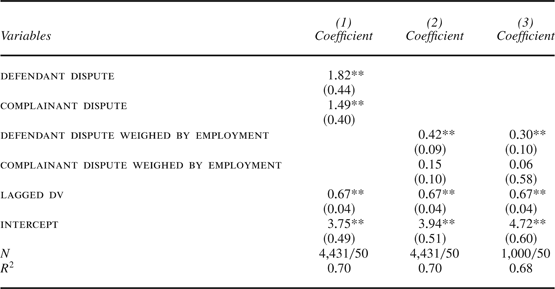
As noted at the outset, the weekly data include only the thirteen US states with sufficiently high weekly volume of search to meet the required threshold. In order to ensure the results hold for the remainder of US states, I rerun the analysis on monthly data that includes all fifty US states. The maximum number of observations decreases somewhat, from 5,031 to 4,481, because the greater number of panels does not quite make up for the decreased frequency.
The results are presented in Table 3. Column (1) shows the effect of unweighted disputes and column (2) shows the effect of disputes weighted by state employment. Despite the considerable difference in the makeup of the sample, and the addition of thirty-seven states that were not in the previous estimations, the findings remain consistent. This time, however, the United States being taken to court has a greater relative impact on searches across both weighted and unweighted estimations. When looking at material stake, the same relationship emerges, with the weighted defendant disputes having a highly significant effect, and weighted complainant disputes having no significant effect. In column (3) of Table 3, I isolate the impact of material stake in the same way as in Table 2, and once again, employment for complainant disputes has no effect, while it has a highly significant positive effect for disputes against the United States.
The effect of WTO dispute initiation on web searches using monthly data
Notes: All estimations are panel regressions with ordinary least squares (OLS) state-level fixed effects and robust standard errors clustered on state. Column (3) limits the sample to periods during which a dispute was initiated. Robust standard errors in parentheses. Significance levels: †p < .10;
* p < .05;
** p < .01.
Three broad conclusions emerge from the findings thus far: (1) the general population reacts forcefully both to instances where the United States accuses others of violations, and when it is accused itself, by seeking related information; (2) material stakes have a highly asymmetric effect, significantly increasing the impact of disputes against the United States, while having no such effect for disputes filed by the United States on behalf of American industries; and (3) across the board, nonmerchandise disputes in no way lead constituents to seek WTO-related information.
Event Studies
Finally, I turn to an alternative means of assessing the effect of dispute initiation on web-search volume. I borrow this method from financial econometrics, where scholars examine whether an unexpected event has led to an “abnormal return” in an asset price.Footnote 56 Its great advantage, in this case, is that it allows one to consider each individual dispute's impact on search volume.
The two assumptions behind all financial event studies are (1) that markets are sufficiently efficient to process the way in which new information is likely to affect future earnings of a firm, and (2) that all things equal, there is a linear relation between the return of any given security and the return of the market index that includes that security.Footnote 57 The method's underlying intuition is straightforward. After identifying a series of events of interest, and the specific firms that may be affected by these events, one defines an event window, which corresponds to a short period after the event, the length of which depends on the observer's belief about how long markets are likely to take to react to the event. Then one defines an estimation window, which precedes and does not overlap with the event window, and which is typically much longer than the event window. Using the relationship identified between a market index and returns of firms during the estimation window, one predicts what a normal return for the firms under observation would be in the event window, without the event. The abnormal return can then be calculated as the difference between predicted and actual returns. The last step is to verify whether these abnormal returns are statistically significant. Applied to the task of calculating events' effect on web searches, returns correspond to the volume of search; the market index becomes the scaled aggregated WTO-related searches across the world; and firms under observation become US states. Given these modifications, the event-study methodology can be readily used to test my main hypothesis: Does WTO dispute initiation result in significantly greater information seeking among constituents?
Since long time series are essential for event studies, I rely entirely on the weekly data, looking at the thirteen states in the estimations in Table 1. For every dispute, I define estimation windows spanning weeks (t − 30) to (t − 10). I define event windows that stretch four weeks past every dispute initiation. Within the sample used in the estimations above, one defendant event and two complainant events occur too early in the data to have a sufficiently long estimation window. I am thus left with ten disputes where the United States is a defendant, and four disputes where the United States is a complainant.
For each event, I calculate a “normal” expected search volume using WTO-related searches around the world. I then calculate the abnormal search volume, and aggregate it over the five-day event window. To calculate whether this abnormal search volume is statistically different from the expected search volume, I calculate the following test statistic for cumulated abnormal search volume CAS, event window period (T1 − T 2), for state i:
 $$
Z = {{{1 \over n}\sum\limits_{i = 1}^n {CAS(T_1 ,T_2 )} } \over {\sqrt {{1 \over {n^2 }}\sum\limits_{i = 1}^n {\sigma _i^2 (T_1 ,T_2 )} } }} \sim N(0,1)
$$
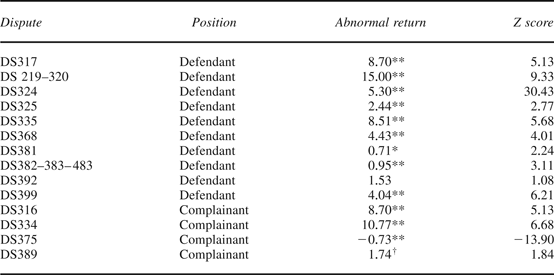
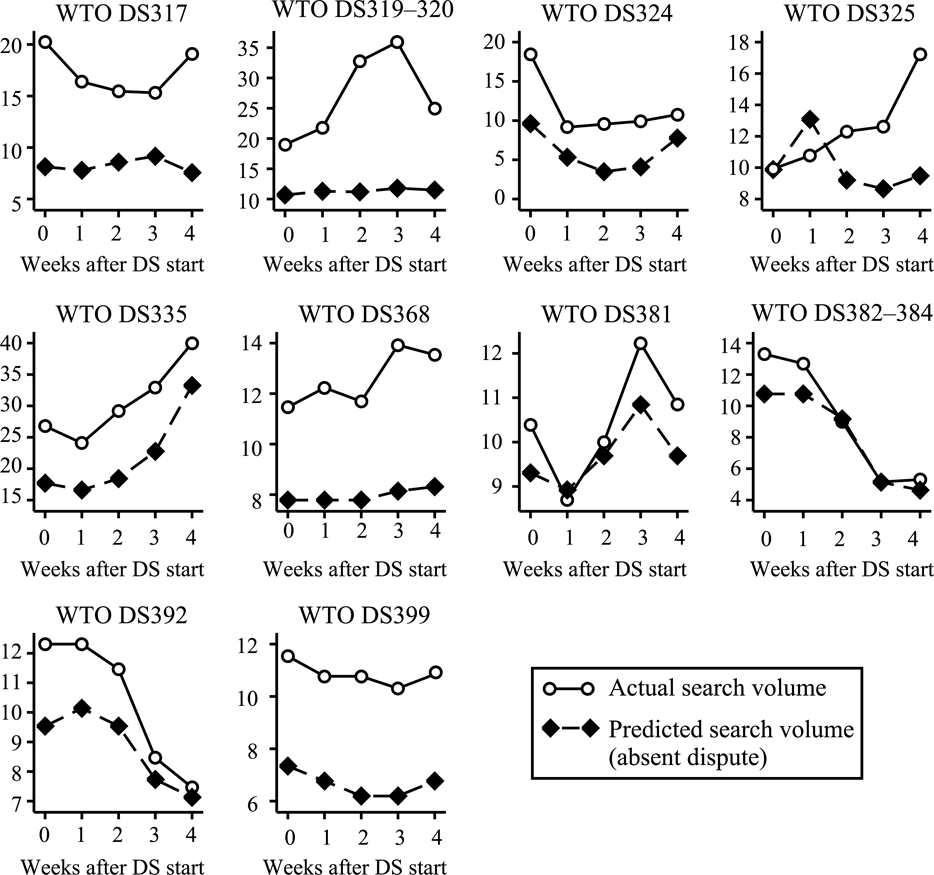
Table 4 shows separate test statistics for every US merchandise dispute. All disputes against the United States, save for one, result in a statistically positive abnormal search volume following their announcement. The standout is DS392, launched by China over poultry, which nonetheless results in a positive increase in searches, but falls short of statistical significance. Taken together, all the defendant events have very high joint significance. These results are presented graphically in Figure 1, with each graph representing a specific dispute. The dashed line corresponds to the predicted volume of search had the event not occurred, and the full line represents the actual volume of search. In every instance, results are shown starting at the week of the announcement, and for the four following weeks.
Abnormal search volume following WTO disputes
Notes: N = 5,229. Significance levels:
† p < .10;
* p < .05;
** p < .01.
Abnormal WTO-related search volume following dispute initiation against United States
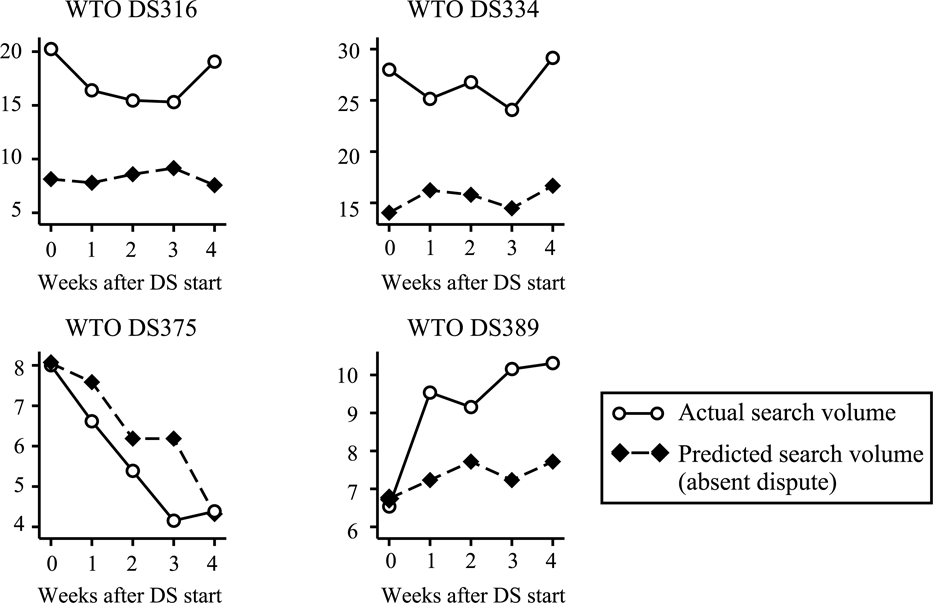
Looking at disputes filed by the United States, the results look very different. Only two out of four disputes show a positive and statistically significant abnormal volume of search. Moreover, while defendant disputes taken as a whole result in a very significant abnormal search volume at 0.01, the same is not true of complainant disputes. The same graphical representation is shown in Figure 2, where one can see how the actual search volume is not always greater than the predicted search volume, meaning that there is not statistically significant abnormal increase in search. Finally, I run the equivalent event-study analysis on nonmerchandise disputes (not shown). There, as before, the occurrence of these disputes, either on the complainant or the defendant side, shows no associated abnormal volume of search.
Abnormal WTO-related search volume following WTO dispute initiation by United States
The difference between the findings in the event studies and the previous regression results is in great measure due to the fact that the regressions consider only the week of the announcement by the WTO, while the event studies also look at the month that follows. When compared to the results using weekly data, both the findings from the monthly data, and those from event studies, which look at a longer period following the event, suggest that the effect of complainant disputes is slightly higher at first than cases where the United States is being taken to court, but then declines precipitously. Another way of getting at this is to expand the window of weekly searches: when I do so, a tipping point appears (not shown). Past the second week, complainant disputes decline in magnitude and statistical significance, while defendant disputes remain highly statistically and substantively significant. Another difference between the regression approach and event studies is that the regressions effectively control for the occurrence of other events, while the event studies do not, though this is the reason the event studies consider very small event windows.
Overall, these results offer strong support for the first hypothesis. When a trade partner accuses the United States of violating trade rules at the WTO, American constituents react by seeking WTO-related information. As for H2, the analysis offers mixed findings. It seems that constituents do react to information about their state pursuing violations abroad in the short term, but this effect declines rapidly over time. A material interest in United States-as-complainant disputes seems to hold no additional effect, while US states with employment at stake in disputes filed against the United States seem to react much more forcefully. Finally, across all estimations, the opacity of nonmerchandise disputes appears sufficiently forbidding to keep constituents from seeking any additional information at all.
Conclusion
There has been a recent surge of research looking at domestic politics to account for why countries join international institutions and how they subsequently behave within them. This body of work has resulted in rich theorizing. It also rests on a common set of assumptions about individual behavior. Unless constituents truly react to signals from international institutions about their governments breaking their commitments, these models fall apart. Given the technical nature of the issues at hand, and consistent accounts of voter apathy and political ignorance, it is easy to be skeptical of such a premise. It is all the more surprising, then, that these assumptions have rarely been tested.
Part of the reason for this is the unavailability of adequate means to do so. Surveys have traditionally been the way of gauging constituents' reactions to news about their government's actions. Yet as I discuss, in the case of the treaty-making models, surveys often provide conflicting results, suggesting they may be vulnerable to the very problems facing the theories under examination. To make up for this shortcoming, I turn to search-engine data, which have grown popular in a range of disciplines, most prominently in epidemiology. These data are especially well adapted to tracking rapidly changing trends. The belief behind their utility to political economy is that individuals are unlikely to have all the necessary information to react to signals from an international institution about their government's (non)compliance, but if they care sufficiently, they will seek that information out. I analyze the data through a combination of traditional regression analysis and event-study methods borrowed from financial econometrics.
American constituents do appear to react strongly to announcements about their government being accused of trade violations by another WTO member. By comparison, the evidence about reactions to announcements of the United States accusing its trade partners of violations is more mixed. While regression analysis shows a strong positive increase in WTO-related web searches, the approach using event studies suggests that the effect of these WTO complaints does not last past the time period of the dispute's initiation.
Moreover, material interest has an asymmetric impact: it has no additional effect on the reaction to disputes filed by the United States on behalf of American exporters, while magnifying the reaction to disputes filed against the United States. Since the latter effect is likely to represent reactions by the very groups who successfully lobbied for protection in the first place, this should be cause for concern for institutionalist scholars. This finding calls to mind Goldstein and Martin's “cautionary note” of more than a decade ago: one of the key functions of institutions is to disseminate information, yet an overlooked possibility is that such information has an asymmetric effect, mobilizing the losers of liberalization more than the winners.Footnote 58 In short, the distributional effects of information have the potential of working against an institution's primary objectives.
Even for United States-as-defendant cases, there is a limit to constituents' willingness to seek out related information. In the case of nonmerchandise issues, which concern not identifiable products but domestic legislation, the economic cost of which is harder both to calculate and convey, and for which there is no readily identifiable victim or beneficiary, American constituents do not appear to react by seeking related information at all, regardless of whether their government is accusing a trade partner of noncompliance or being accused. It follows that the treaty-making models scholars rely on are likely to hold least well for technical agreements dealing with abstract issues, such as international regulatory bodies, since constituents cannot be counted on to react to their publicizing noncompliance by member-states. The broader point is that the view of international institutions ringing a “fire alarm” when they identify a violation may be overly simplistic: alarms vary in their effectiveness.Footnote 59 What ultimately matters is not the signal from the institution, but constituents' reaction to it, which varies in accordance with the complexity and abstraction level of the purported violation.
Data charting web searches in time and space provide an unprecedented look at individual-level behavior. While they are already commonly used in public health applications, these data are also ideally suited for testing the domestic politics models that have come to dominate international political economy in recent years. Because the risk associated with promising new data and methods is that scholars ask too much of it, it is worth mentioning some of the data's limitations. Most importantly, these data cannot tell us with confidence about individuals' attitudes—information-seeking is directionless. An increase in web searches about a given issue could be a sign of either growing support or criticism. As a result, web-search data are best suited to situations where there is little ambivalence about underlying attitudes—where the analyst is concerned not with preferences, but with the magnitude of a reaction. Beyond treaty-making theories, other models hinging on audience costs may be good candidates for tests that rely on the approach taken here. Similarly, the effectiveness of international campaigns that hinge on naming and shaming, or that aim at raising awareness of a specific issue, would also be well suited for analysis using search-engine data.
Second, although this is likely to change in the near future, currently available data cannot tell us much about highly specific issues, since related searches are unlikely to meet the required threshold volume. The trade-off in terms of data availability between the number of states and the frequency of observations described in the analysis is a consequence of the same limitation. Finally, problems of selection are likely to grow more pronounced as the segment of the population with ready access to the Internet in a given area grows narrower. As a result, highly developed countries, for now, constitute the best test cases for analyses using web-query data. One thing is certain. Internet data, whether from search engines or social networks, is fertile new ground on which to test long-standing ideas about individual behavior. The challenge for social scientists is to be discriminating in applying these new tools to questions well suited for them.