


In the collective memory of political scientists, the 1950s and 1960s are the era of an abrupt advance from lore to science. Yet an examination of the American Political Science Review during the decade-long editorial tenure of Harvey C. Mansfield, Sr., of Ohio State University (1956–1965) reveals a surprisingly strong presence of traditional political theory, at first weighted toward contributions by Leo Strauss and a number of young scholars closely associated with him.
The marked upturn of interest in traditional political theory in several forums, as manifested in the discipline's flagship journal, may seem anomalous in light of the simultaneous thrust toward professionalization and efforts to reform political science on the model of economics, sociology, and psychology, under the motto of the “behavioral revolution” (Eulau 1969). Compounding that seeming anomaly is that the trend in traditional political theory that was most successful during the first half of the period under review was uniquely hostile to precisely the paradigm that was ascending in political science as a whole. I will argue that three factors combine to explain the unexpectedly strong showing of traditional political theory in the most important forum of political science during this period. First, its proponents made effective use of an unexpected reallocation of material and symbolic resources by the Rockefeller Foundation. Second, a sophisticated insider cohort socialized to the wartime Washington bargaining culture came to occupy key positions of power within the Review. Third, the incorporation of two waves of émigré scholars oriented to traditions of theoretical reflection had dynamic consequences. The effect was an adjustment in the professional bargaining structure that yielded measurable gains to theorists despite the advantages of the more cohesive and better funded behavioral movement. The deals made visible (and measurable) at the level of the Review were not limited in their effects on the table of contents. At issue was the institutional saliency of the “political theory question” to the discipline of political science. Because a gatekeeper like the Review allocates legitimacy within the institutional structure of an organized field of knowledge, the continued and even expanded presence of traditional political theory would have had consequences in decisions about appointments, promotions, grants, fellowships, curricula, and programs, although the evidence for this commonplace point is as yet anecdotal. The striking success of the Straussian school appears to be a case in point.
The distinctive advantage gained by the group around Strauss in the Review was a function, first, of a decision by the editor, following the familiar American negotiations model, to designate a bargaining agent for political theory. Second, the subgroup displayed remarkable productivity, organization, and leadership. Third, it succesfully deployed, in putting itself forward as mentor to the profession, an ideological composite that melded the iconic names of the classical political theory canon with American exceptionalism. That the initial disproportionate advantage of this voice in the Review was not sustained stemmed from its failure to solidify its position as bargaining agent. During his second 5-year term as editor (1961–1966), Mansfield accepted the political theory bargaining partner as comprising, rather, a pluralistic federation, united only against the hegemonic claims of the behavioral revolution.
The end of Mansfield's editorship marked the decline and fall of the bargaining regime epitomized by the publication policy of the Review during the 1950s. This does not mean that traditional political theory activities abruptly ceased. Rather, their standing and development were made a function of institutional settings and processes other than the professionalized discipline and its prime institutions. There ensued a fractionalizing of the political theory interest, in the course of political struggles about the legitimating agencies of the profession, epitomized by the Caucus for a New Political Science, as well as emigrations to new institutional settings, developments whose effects were nevertheless mitigated within the profession by a measure of traditionalist tolerance within many political science departments.
POLITICAL THEORY IN THE AMERICAN POLITICAL SCIENCE REVIEW, 1951–1971
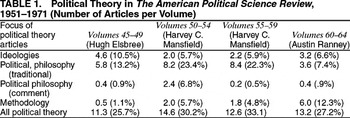
The changing presence and profile of political theory in the Review come through clearly in Table 1, which begins with the editorship of Hugh Elsbree and runs through Mansfield's two terms to the end of Austin Ranney's first term. The mean number and proportion of political theory articles per year reflect editorial decisions to allocate scarce recognition and space to political theorists. In addition to breaking down these articles according to the familiar trifurcation of approaches toward political theory discussed below, I list published comments solicited from political theorists; the latter is a small but exceptionally important category.

The study of ideologies played a more important part under Elsbree than Mansfield or, relatively speaking, Ranney. (The rate shown is actually an underestimate, for several items classed as political philosophy could be reassigned to this category.) American political ideas were often the focus and many of the canonical references and philosophical discussions characteristic of the articles classified as political philosophy in later volumes were absent. More importantly, the frequency of political philosophy items took a sharp upward turn when Mansfield became editor and held at that elevated level until the end of Mansfield's tenure, after which it plunged precipitously. At the same time, articles devoted to methodology tripled in frequency between Mansfield's decade and Ranney's first 5 years. (This is again an underestimate, for several articles that were too narrowly focused on specific empirical research to be treated as representing political theory contained extensive methodological discussions in these later volumes.)
Of special interest is the category of political philosophy comments. In every instance during Mansfield's tenure, these were products of express solicitations. More than half were written by young scholars close to Leo Strauss, whom Mansfield had brought to the Editorial Board, where he remained until ill health led to his replacement about halfway through Mansfield's tenure.
Overall, the main difference across editorial regimes was not in the total proportion of articles assignable to political theory, but in the distribution of articles among the various approaches to political theory.
POLITICAL THEORY AS CONTESTED CONCEPT
The minutes of the 1957 Board Meeting of the Rockefeller Foundation proudly noted that “the American Political Science Review has for the first time appointed a political philosopher as a member of its editorial board” and that five articles by political philosophers were included in the Review for March of that year (RF 1957). This was taken as vindication of the Foundation's response to the initiative of its Board, beginning with an Arden House Conference on Legal and Political Philosophy in 1952 and extending through subsidies to selected programs in political theory, notably at Harvard and Berkeley, as well as modest but unique pre- and post-doctoral fellowship programs in Legal and Political Philosophy (LAPP), both of which were delegated to the Social Science Research Council after a 1-year in-house trial period. In the transcript of the 1952 conference and in the correspondence and discussions that followed it, three competing sets of concerns can be distinguished, all under the heading of political theory (RF 1952).
First was an eagerness to strengthen the liberal democratic practical belief system and to explore structural and sociological differences with competing belief systems, themes originating with the Foundation's Board and prominent in the rationales consistently offered by the Director of the Social Studies Division, J. H. Willits. These concerns led to research projections that can be clustered around the concept of political ideology, although that term was not consistently used.
Second and uppermost was a conception derived from the work valued by senior academics conventionally labeled as political theorists, privileging the canon of political philosophers but surprisingly agreed, at the same time, on depreciating purely historiographical scholarship. Almost without exception, political theory collected under this heading reflected a common unwillingness to limit theoretical designs to scientific models of explanation, as well as a shared insistence that the meaning and value of political phenomena were open to disciplined inquiry.
The third general conception of the political theory that the Social Science Division (and especially its staff) was inclined to consider was grounded in the congeries of self-consciously scientific approaches whose legitimacy claims proponents of the second conception rejected. A useful aid to designating the third group in a historically faithful way is a distinction that intermittently appeared in the Book Notes section of the Review: the separation of items dealing with “Methodology and Research” from items dealing with “Political Theory” as such.
The Rockefeller Foundation's initiative gained special resonance in the profession because of the coincidence of two generational developments: the approaching retirement of the cohort of academics, predominantly teachers of the history of political thought, who had been incorporated into political science departments during the formative years just before and after the First World War; and the surge of enrollments in political theory classes and graduate programs, notably in institutions like Columbia, which had excellent lines of communication to the foundations and other centers of the profession. An additional factor, whose weight became clearer as the bargaining about theory got underway, was the recognition gained by a number of European scholars, notably 1930s exiles from the Nazi era, as well as their first generation of students, whose backgrounds led them to bring theory to the fore. Suddenly academic political science could no longer simply tolerate its traditional theory component as a bit of cultural decoration.
The agreement that something had to be done about renegotiating the deal between political theory and political science, as well as the concomitant disagreements epitomized in the terms ideology, political theory, and methodology, was by no means limited to the Rockefeller Foundation and its immediate network during the 1950s. In February of 1955, for example, Northwestern University's Political Science Department held a 3-day conference on “political theory and the study of politics,” with funding from the Carnegie Corporation and with the LAPP associate director present as an invited guest. Although all but one of the commissioned papers were presented by political philosophers—Norman Jacobson, Mulford Q. Sibley, Frederick M. Watkins, and Carl J. Friedrich, with Lindsay Rogers serving as skeptical and idiosyncratic observer—the discussions, as later reported by Harry Eckstein (1956), consisted of a clash between the political philosophy and methodology contingents, as well as its mediation by a majority of moderates. The one side stated wisdom as the aim of political studies; and the other, scientific precision. A major theme of the mediating majority was the importance of political theories as themselves an objective political fact, in the form of ideology. Eckstein, indeed, concluded that the “real problem” that the discussion revealed was “how and why had the political ‘philosophers’ and the political ‘scientists’ managed to drift so far apart in their work when most of them were so eager to concede that they had much to learn from one another?” He proposed, revealingly, that “the most promising step at present would be to attempt some sort of collaborative analysis of the area in which political science and philosophy touch most closely on one another, that is, the field of politically significant ‘ideologies’” (1955, 487; Young 1958).

Harvey C. Mansfield, Sr., 1958.
THE IMPORTANCE OF THE ÉMIGRÉ SCHOLARS
Eckstein's conceptualization, derived from European social theory, illustrates the mediating role played by scholars familiar with this discourse. In the aftermath of the 1952 LAPP conference, the English legal theorist H. L. A. Hart told the foundation officer in charge of the initiative that the émigré scholars Walter Friedmann and Franz L. Neumann “were quite different from their American colleagues. Their statements tended to be more general and positive and sometimes were dogmatic and in need of further discussion and modification. But both had the virtue of clarity and of deep concern for ideas and their importance. From many of the Americans, on the other hand, one got the impression that ideas and reflections upon them are not really serious or respectable pursuits” (RF 1952).
It is important to underline the extent to which the exiles' approaches were adapted in the course of the negotiations that gained them entrance to American discussions, but it is no less important to be aware, as shown by Ira Katznelson (2003), that the direct influence of the exile thinkers was by no means limited to those identified as traditional political theorists. Katznelson revises received opinion about Robert Dahl, Charles Lindblom, Harold Lasswell, and, above all, David Truman, arguing that their realism was very much a sympathetic incorporation of political knowledge derived from the theoretical writings of Hannah Arendt and other authentic reporters from the front of totalitarianism and holocaust. Such awareness significantly conditioned the eagerness of these leading political scientists to render the discipline more rigorous and scientific. Unlike many proponents of the model of normal science associated with the behavioral revolution, for whom the disciplinary agenda was to be largely determined by the refinement of methods, they were closer to the reading of Max Weber mediated by émigré scholars (Kettler and Wheatland 2004). The questions to be investigated by the discipline were defined by the scholars' moral and political interests, whereas the answers were to be controlled by the most objective, rigorous methods available. The difference matters very much for present purposes because only the latter attitude sees value in exchanges with philosophical explorations of moral and political issues.
THE MANSFIELD NETWORK
If not the moral urgency that Katznelson finds in the scholars he studies, then perhaps an urbane cosmopolitanism associated with joint wartime service in Washington, where intellectual salons often featured émigré scholars, distinguished the well-established political scientists who found themselves charged with the management of the American Political Science Association—and especially the American Political Science Review—during the decade bounded by the beginning of the second Eisenhower Administration and the multiple polarizations that set in after Lyndon Johnson's election in 1964. The cohort that became the dominant network in the profession for at least a decade included Alexander Heard, Dwight Waldo, Edgar Furniss, Wallace Sayre, Harold Stein, Norton Long, and V. O. Key, but the pivotal position was occupied by their close friend, Harvey C. Mansfield.
Characterizing his own policy research, which he conducted by historical methods and on the premise that social scientists will never “so far reduce human behavior to laws as to eliminate from practical calculations the effects of chance and purposes,” Mansfield expressed the hope of adding “to the accumulated stock of later wisdom,” ingenuously invoking the term that the political theorists had made their motto in the Northwestern meetings (Millis 1958, 13). Most, if not all, of the group agreed, although they were also open to many of the methods associated with the behavioral revolution. Key, who is honored as a pioneer in quantitative studies of political parties and who wrote page-long critical comments as the Review's principal gatekeeper in this field, also played a leading role in defending the program of fellowships in legal and political philosophy at the key 1954 meeting of the Social Science Research Council, of which he was a director. Typically, in the words of John B. Stewart, who attended on behalf of the Rockefeller Foundation, Key “started the discussion with a long, whimsical comment on legal and political philosophy.” “The general burden of his comments,” Stewart continued,” was that some of these fellows in philosophy had somehow managed to get a hold of sort of important questions that in one way or another had been rather neglected” (RF 1954). If the Mansfield group had a common aim, then, it was to enhance the worldliness of the discipline, which was as much an intellectual's or connoisseur's criterion as a strictly academic one. Under Mansfield's very personal editorship and with the use of his network for an unprecedented program of peer review in a mentoring mode, accordingly, the Review served as a prime site for both implicit and explicit bargaining between philosophical political theory and political science.
LEO STRAUSS AND THE STRAUSSIANS IN THE REVIEW
A striking feature of Mansfield's opening to traditional political theory was the prominent place given to Leo Strauss and his school. Strauss was brought to the Board of Editors, and his students were by far the most visible theorists during the first 5 years of Mansfield's editorship. Two pieces of evidence provide telling evidence that that this development was not an outgrowth of Mansfield's supposed political or theoretical preferences.
First, Mansfield's strategy for strengthening the political theory component of the department at Ohio State when he became chairman was markedly pluralistic. In addition to Harry V. Jaffa, who was a star of the Strauss group, the group was headed by David Spitz, a prize student of Robert M. MacIver, and David Kettler, whose teacher had been Franz L. Neumann, and who was brought in as a junior over the objections of several senior members of the department (and soon appointed by Mansfield to be his assistant on the Review). Colleagues at Columbia, MacIver and Neumann themselves represented mutually opposed schools of thought, both as remote as possible from the Straussian view, and they had played key roles in the Rockefeller initiative in political theory. The makeup of the political theory group also shows that Mansfield was not imbued with the genteel anti-Semitism of the older generation, a factor in both his resistance to objections to the appointment of three Jewish academics in this subfield and his responsiveness to many of the émigrés. In David Hollinger's provocative phrase, he accepted the “de-Christianization of public culture” that opened the social sciences to the discourses of the less formal urban intellectual settings where Jewish writers had become prominent during the decades after the First World War (Hollinger 1996).
Second, Mansfield was quite clear about the pragmatic character of his responsiveness to Strauss. In March 1957, coincident with an issue of the Review in which Strauss and Straussians were especially prominent, Mansfield attended a selective Rockefeller Foundation conference convened to monitor and assess the LAPP program. Ruminating on the difficulties raised by the multiplicity of schools of thought among political theorists—lately including not only Marxist currents and a new kind of conservatism, but also newly reflective proponents of behavioral science—he suggested that “It may be reasonable to give a boost to one of these trends if it seems reasonably enduring. It might be wise to back an individual like Strauss who has influenced the whole field. “Yet he tellingly relativized his proposal by adding, “The problem here is that the individual may have shot his bolt or may treat support as patronage. His worshippers may not get any further with the old man” (RF 1957a). The suggestion evoked no interest around the table.
Mansfield's experiment with giving a “boost” to the Straussian “trend” in the Review did not mean that he simply rejected other kinds of political theory articles or that he gave Straussians a privileged role among peer reviewers (who were in any case selected by his assistant, whose loyalties lay elsewhere). In the absence of an exclusionary policy or unprofessional procedures, the opening to political theory and the boost to Strauss were mostly matters of sending signals. The appointment of Strauss to the Editorial Board was one such signal. Another was the welcome given to articles submitted by political theorists, with Strauss' followers most immediately responsive to the signs and, in turn, duly rewarded for their sophisticated and well-written pieces. Exceptionally important, however, was a pointed exercise of editorial initiative in soliciting and publishing Straussian commentaries on articles whose authors had made no reference to Strauss or his students. In the first two volumes of the Review edited by Mansfield, there were four such comments (as well as one in a different mode written by a student of David Spitz of Ohio State). The concentration of voices overwhelmingly in one key, and the sudden flurry of pieces published without peer review, certainly suggested a measure of editorial endorsement of the Straussian approach beyond the ordinary professional judgments of quality. A telling redirection of the same editorial discretion three years later marked the end of the boost.
Two comments were by Howard B. White, Strauss' close collaborator and successor at the New School (1956, 1957) along with one by Harry V. Jaffa (1957), and another by Martin Diamond (1957), both close followers of Strauss. All four picked up the urgent preoccupation with American ideas elsewhere in the Review (and a major force as well behind the Rockefeller initiative) and presented themselves as prime contestants in the competition to provide a suitably elevated reception of American political thought, asserting that only the classical philosophy recovered by Strauss could comprehend both its faults and its greatness. These comments show especially well that the aim of these theorists was not to vindicate an autonomous traditional subdiscipline but to redefine the ethos of political science and to assign to it a special mission of political education (Kettler 2002).
A common feature was the attempt to render the concept of political philosophy uncontroversial, to render political thought continuous with “The element of reason in man…, which all men, when they think clearly and consistently, recognize as the basis of their cognition of humanity” (Jaffa 1957, 63–64). This argument was invoked, on the one hand, against Felix Oppenheim's neo-Kantian distinction between scientific knowledge and moral reflection (1957), and, on the other, against elements in essays by James Prothro (1956) and Robert G. McCloskey (1957), which examined political ideas as expressing ideologies that could be judged as more or less adequate to their time and place. When Hans Morgenthau (1957) concluded that the concept of political freedom entailed contradiction between the autonomy of the individual and the collective power of the people and that this antinomy could be dealt with only by a modest recognition of plural truths and sound political management of the tension, he was charged with failing to appreciate the substantive wisdom of the political judgment attainable by a natural aristocracy in power, an instance of which “it was the god-given grace of this country [to come] close to [having happen] at the time of the Founding Fathers” (White 1957, 728). White concluded magisterially that “the heritage of freedom is the heritage of political science, for it has never confined itself to formal considerations, but it has numbered among its teachers some of the freest spirit and some of the wisest of men” (733).
White's (1957) polemical use of the distinction between substantive reason and the mere “formalism” he found in Morgenthau is redolent of the contest among exiles over the legacy of Max Weber, which was especially vigorous at the New School, where White had joined Strauss some years before. It serves as a reminder of the extent to which the contests over political theory also constituted an arena for continued competition among the German exiles and their intellectual progeny. Two of these four commentaries by Straussians were aimed at the work of émigré scholars, and all of them sought the high—and ideologically appealing—ground of defending reason in American political thought, to which they subsumed political science.
THE CHANGE IN CONTEXT
In the 2 following years, the number of submissions and acceptances by Straussians at least equaled those of other scholars whose work may be classed as traditional political theory. Comments faded from this field, however, until the surprising solicitation of a vigorous critique of an article by Alan Bloom (1960), who had followed Jaffa in proposing Straussian readings of Shakespeare (Burckhardt 1960). The appearance of this blunt challenge by a literary critic, who criticized especially the presumption of political theorists in denying the autonomy of poetry, was a clear sign that the Straussian advantage had been withdrawn. When Strauss resigned from the Editorial Board because of illness, political theory came to be represented by John Lewis, a traditional historian of political thought, and Otto Kirchheimer, an émigré scholar at home in the social theory mode that had been the original target of Strauss' project.
A further indication that the striking attempt of the Strauss School to establish itself as the ethical teacher and loyal opposition of American political science had lost its protected status came in the Book Review section of the Review's March 1962 issue. Twenty-five extra pages, far more than the longest articles in most issues, were allocated, necessarily with the concurrence of Mansfield, who controlled the space, for an extensive book review by John H. Schaar and Sheldon S. Wolin of Essays on the Scientific Study of Politics: A Critique, a collective publication by Strauss and his group; another eleven pages were dedicated to rebuttals by each of the criticized authors in turn.
Wolin, who had published several political theory articles in the Review, joined with Schaar, a fellow Berkeley political theorist, to defend representative figures and works of the “new political science” against the Straussian charge that they were abandoning the political education of the “center” in the world of “common sense” no less than in political science. Herbert Simon, Arthur Bentley, Harold Lasswell, and the authors of several well-known voting studies, the Straussians contended, were pursuing an inhuman mode of knowing, indifferent to the very possibility of religious truth as well as to the defense of liberal democracy, that was no less vicious in being sought than it would have been if it had been attainable. Wolin and Schaar left aside the programmatic statements on method in the work under attack by the Straussian group, choosing instead to defend the actual practice of the political science under attack. They offered a tolerant, surface reading of the political science texts in question in opposition to the Straussian reading in depth that they viewed as philosophically unfounded and politically suspect, putting forward a proposal to political science that countered not only the Straussian version of “philosophy” but also the political science preoccupation with “methodology.”
This entry in the struggle for the center, directly competitive with the Straussians in its claims on the ethos and mission of the discipline, came shortly before the attention of the political science center moved away from the “question of political theory.” Mansfield's Review continued to publish political philosophy articles at a comparatively high rate for the rest of his term, and there are even some signs that the Wolin-Schaar intervention had allowed Mansfield to shift his ground from the experiment of backing “an individual like Strauss” to favoring the cause of Strauss' opponents from Berkeley (Hauptmann 2004). Yet the professional agenda was changing.
The shift can be shown, perhaps too neatly, by comparing the APSA presidential addresses of 1965 and 1966, the years of the changing of the guard on the Review. In 1965, David Truman credited the cognitive as well as normative and literary contributions of political theory in the traditional mode, although he left open the possibility that with the eventual emergence of a fully scientific paradigm such speculative systems would no longer be of value. A year later, Gabriel Almond confidently assigned a merely auxiliary, instrumental task to scholars trained in the older literatures, asking them to help make the transition from a political science oriented to the American separation of powers model to the new functionalist models emerging in reaction to the anomalies of the old.
For Mansfield and his cohort of insiders who sponsored the open bargaining over the “question of political theory” as long as it lasted, the issue was never a choice between a purely philosophical or a purely scientific political science. Nor were they interested in offers to provide an ethos for political science, an activity whose justifications they never doubted. They were interested, rather, in the constitution of a plural discipline structured to produce and reproduce complementarities among the forces in play, such that the specialists in one or the other mode would also be connoisseurs of the sort of work they chose not to pursue. Operationally defined, the aim was a political science profession whose members could and would read everything in the Review, as it was edited between 1956 and 1965.
That did not happen, as the political theory question became confounded with the struggle for and against dissidents in the profession; the Review became overwhelmingly specialist; and many political theorists joined forces with historians and philosophers to speak through the Conference for the Study of Political Thought (1968) and to publish in Political Theory, largely abandoning the effort to learn from and speak to the empirical study of politics. The Strauss group, secure in the professional gains achieved through its phase of maximum legitimacy, strengthened its own organization and publication. For the leading agencies of political science, the question of political theory was tabled, at least for some decades, and the tables were folded away.




Comments
No Comments have been published for this article.