Introduction
Severe persistent mental illnesses (SPMIs) are those that are prolonged and recurrent, impair activities of daily living, and require long-term treatment (Woods et al., Reference Woods, Willison and Kington2008). Common diagnoses include schizophrenia, bipolar disorder, and major depression (Woods et al., Reference Woods, Willison and Kington2008). The prevalence of SPMI is estimated to be 4.2% in the United States (National Institute of Mental Health, 2017). Although a recent count of people with SPMI in Canada has not been conducted, rates were between 4.6% and 5.5% when last broken down by diagnosis in a national survey (Public Health Agency of Canada, 2012). People with SPMI suffer from more chronic diseases, greater severity of chronic disease, and late diagnosis (Correll et al., Reference Correll, Solmi and Veronese2017; Walker et al., Reference Walker, McGee and Druss2015). They receive fewer medical treatments, experience poor-quality care, die prematurely from medical illness, and may be less likely to receive palliative care (Chochinov et al., Reference Chochinov, Marten and Prior2012; Lavin et al., Reference Lavin, Davydow and Downey2017). Palliative care is defined by the World Health Organization (2017) as “…an approach that improves the quality of life of patients and their families facing the problem associated with life-threatening illness, through the prevention and relief of suffering by means of early identification and impeccable assessment and treatment of pain and other problems, physical, psychosocial and spiritual.” Palliative care can be provided by specialist palliative care services, by nonspecialist healthcare providers, or by any combination thereof according to need and setting (Sawatzky et al., Reference Sawatzky, Porterfield and Lee2016).
Unequal access to care and disparities in health outcomes are key indicators of inequity of healthcare for people with SPMI. Although there is evidence that these inequities persist for those approaching end-of-life (Chochinov et al., Reference Chochinov, Marten and Prior2012), very little is known about palliative care for those with SPMI (Woods et al., Reference Woods, Willison and Kington2008). Scoping reviews allow the researcher to “…‘map’ relevant literature in the field of interest” (Arksey & O'Malley, Reference Arksey and O'Malley2005). In Reference Woods, Willison and Kington2008, Woods et al. conducted a scoping review identifying four themes related to palliative care for people with SPMI: decision-making capacity and advance care planning, access to care, provision of care (both illness- and healthcare provider-related issues), and vulnerability. To update this review and capture new knowledge, a systematic scoping review was undertaken to determine the extent, range, and nature of research activity about those with SPMI requiring palliative care and to identify gaps and opportunities for future research.
Methods
The purpose of this scoping review was to map literature on this topic, to determine the extent and range of what has been published, and to report the findings (Arksey & O'Malley, Reference Arksey and O'Malley2005). This approach is particularly appropriate when addressing a broad topic encompassing a variety of study designs, and is used to summarize and interpret existing findings rather than conduct a quality appraisal (Arksey & O'Malley, Reference Arksey and O'Malley2005). The framework provided by Arksey and O'Malley (Reference Arksey and O'Malley2005) was used. This five-stage framework includes: (1) identifying the research question/aim, (2) identifying relevant studies, (3) determining study selection, (4) charting the data, and (5) collating, summarizing, and reporting the results.
Studies were included if the primary topic was palliative care for people with SPMI, included adults >18 years, were published in English, and were published in a peer-reviewed journal. The conceptual definition of SPMI was based on that used by Woods et al. (Reference Woods, Willison and Kington2008) provided previously. Publications were included if the term “severe mental illness” or “SPMI” was used; or included schizophrenia, bipolar disorder, or major depression. Studies were excluded if they did not meet inclusion criteria, or if the SPMI had not been present before terminal medical diagnosis. Where studies included information about both SPMI and dementia, only information related to SPMI was extracted. No time restrictions were applied to the searches.
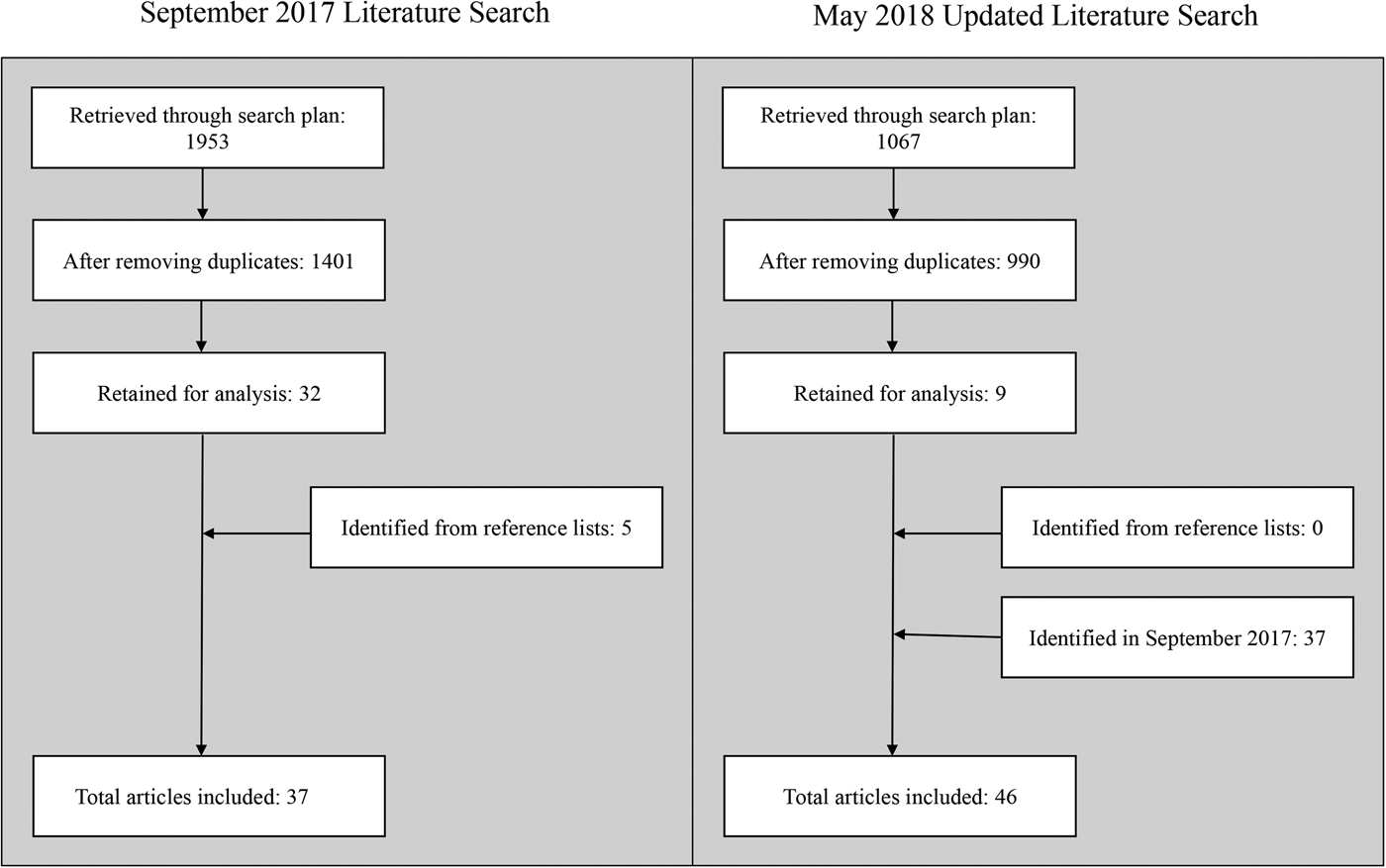
To identify relevant studies, the following databases were searched during September 2017 and again in May 2018: Web of Science, PubMed, Medline (EBSCO), CINAHL, Healthsource, Academic Search Complete, PsycInfo, PsycArticles, Cochrane Database of Systematic Reviews, and Cochrane Central Register of Controlled Trials. Search terms were drawn from two concept groups: mental illness and end-of-life. Specific terms included were: “mental health,” “mental illness,” “schizophrenia,” “major depression,” “bipolar disorder”; and “palliative,” “end of life,” “end-of-life,” “hospice,” “end stage,” and “end-stage.” The reference lists of included articles were also searched. Original searches produced 1,401 articles after duplicates were removed. Title and abstract reviews followed by full-text reading produced 32 articles. The reference lists of these articles were searched for relevant articles, resulting in the inclusion of a further five articles for a total of 37 articles. An updated search in May 2018 identified an additional nine articles for a total of 46 (Figure 1).
Article selection process.

Articles were coded using NVivo 10 to chart the data and identify key issues and themes (Arksey & O'Malley, Reference Arksey and O'Malley2005). An iterative codebook was developed to act as an analytical framework and inform a narrative review of the data (Arksey & O'Malley, Reference Arksey and O'Malley2005). Codes were then grouped to identify and articulate themes and to reveal gaps. Greenhalgh et al. (Reference Greenhalgh, Thorne and Malterud2018) describe narrative review as “a scholarly summary along with interpretation and critique” (p. 2). Using a scoping review methodology, a narrative approach to analysis draws on published literature not only to provide a synopsis, but also to examine critically how information has been presented, built up, and how it may be useful to advancing health systems and clinical practice (Greenhalgh et al., Reference Greenhalgh, Thorne and Malterud2018). Suggestions for practice resulting from narrative review are evidence-informed rather than evidence-based; this approach to analysis is especially relevant for bodies of research containing very few, if any, clinical trials (Arksey & O'Malley, Reference Arksey and O'Malley2005; Greenhalgh et al., Reference Greenhalgh, Thorne and Malterud2018).
Results
Description of identified studies
Forty-six eligible articles were identified after excluding duplicates and determining the relevance of the articles (Figure 1). Descriptive studies made up the majority of included articles (18 total: nine quantitative, eight qualitative, and one mixed-methods) followed by qualitative case studies (nine), literature reviews (eight), intervention studies (five articles representing three studies; two of which used mixed-methods evaluation and one of which used quantitative methods alone), and other (six, including discussion and theoretical analysis). Articles originated in the United States (20), Australia (seven), Europe (five), Canada (six), the United Kingdom (five), New Zealand (one), Taiwan (one), and South Africa (one). The majority of articles featured all SPMIs (31), with 14 focused on schizophrenia. With the exception of one article on posttraumatic stress disorder, no other specific SPMIs were addressed. Profession of the first author included physician (MD; 21), nursing (11), social work (five), and other or unknown (nine). The majority of articles were published in mental health journals (26), with 14 appearing in palliative care journals. General or other journal types composed the remaining six articles. Forty-four articles have been published since 2000 and more than half of all included articles (27) published since 2010.
Findings from our review resulted in four themes being drawn from the collected articles: complexity of care; limited access to care; competence and autonomy; and relationships between mental health and palliative care.
Complexity of care
People with SPMI at the end of the life are part of a highly complex population. Studies showing early mortality reveal that those with SPMI are approaching end-of-life early, and late presentation often results in high needs and a short timeline for care (Baker, Reference Baker2005; Moini & Levenson, Reference Moini and Levenson2009). Reviews and case studies found that late presentation can be due to both disease and system issues, resulting in overlapping and interacting health effects with high symptom burden and treatment interactions (Baker, Reference Baker2005; Davie, Reference Davie2006; Terpstra et al., Reference Terpstra, Williamson and Terpstra2014; Woods et al., Reference Woods, Willison and Kington2008). The coexistence of physical and psychological illnesses can create confusion about symptoms and etiology, for example when unusual behaviors convey or obscure the presence of symptoms, including pain (Baker, Reference Baker2005; Griffith, Reference Griffith2007b; Kelly & Shanley, Reference Kelly and Shanley2000; Morgan, Reference Morgan2016). Nurses in qualitative studies report that cooccurring disorders such as substance abuse can make pain management challenging because of both physiological factors and provider stigma (Evenblij et al., Reference Evenblij, Widdershoven and Onwuteaka-Philipsen2016; Morgan, Reference Morgan2016). People with schizophrenia are thought to have a decreased response to pain, which can mask illness (Evenblij et al., Reference Evenblij, Widdershoven and Onwuteaka-Philipsen2016; Terpstra et al., Reference Terpstra, Williamson and Terpstra2014; Webber, Reference Webber2012). Treatment for one illness may influence the other, including medication interactions, as identified in an intervention study by Picot et al. (Reference Picot, Glaetzer and Myhill2015) and a case study analysis by Terpstra et al. (Reference Terpstra, Williamson and Terpstra2014). Changes during decline in health may influence the physical as well as the psychological state and cause complications, including changes in drug metabolism (Craun et al., Reference Craun, Watkins and Hefty1997; Picot et al., Reference Picot, Glaetzer and Myhill2015; Terpstra et al., Reference Terpstra, Williamson and Terpstra2014). In the discussion of end-of-life care for people with posttraumatic stress disorder, Feldman (Reference Feldman2017) reminds readers that “[t]he treatment of psychosocial issues at the end-of-life is not a straightforward extension of evidence-based approaches for physically healthy individuals” (p. 117), and emphasizes attention to the complex nature of the illness experience for people with SPMI and the importance of making decisions for care with an understanding of this context.
Psychiatric symptoms lend their own complexity to palliative care, such as delusions, psychosis, denial of illness (both psychiatric and physical), and social withdrawal or apathy, all of which can hinder or obstruct participation in care (Craun et al., Reference Craun, Watkins and Hefty1997; Griffith, Reference Griffith2007a, Reference Griffith2007b; Kelly & Shanley, Reference Kelly and Shanley2000; Moini & Levenson, Reference Moini and Levenson2009; Rice et al., Reference Rice, Dobry and Novakovic2012). Although severity of psychiatric symptoms varies widely, active psychiatric illness can prevent people with SPMI from identifying changes in physical health, seeking out diagnosis, and participating in treatment (Moini & Levenson, Reference Moini and Levenson2009; Rice et al., Reference Rice, Dobry and Novakovic2012; Terpstra et al., Reference Terpstra, Williamson and Terpstra2014; Webber, Reference Webber2012). Psychiatric symptoms often result in special care needs such as requiring quiet space or increased time for explanations and assessments, which may not be possible in some facilities (Baker, Reference Baker2005; Craun et al., Reference Craun, Watkins and Hefty1997; Geppert et al., Reference Geppert, Rabjohn and Vlaskovits2011; McNamara et al., Reference McNamara, Same and Rosenwax2018; Woods et al., Reference Woods, Willison and Kington2008). Psychiatric symptoms may influence healthcare behaviors and help-seeking patterns for people with SPMI, making it difficult to assess, collaborate on, and provide care (Jerwood et al., Reference Jerwood, Phimister and Ward2018; Moini & Levenson, Reference Moini and Levenson2009; Terpstra et al., Reference Terpstra, Williamson and Terpstra2014; Woods et al., Reference Woods, Willison and Kington2008). A recent qualitative study by Jerwood et al. (Reference Jerwood, Phimister and Ward2018) found that challenges experienced by staff may differ by specialty or setting: whereas mental health clinicians report increased difficulty with content of challenging conversations including despair and suicidality, palliative care clinicians were more likely to report discomfort with care-seeking, care-rejecting, or aggressive behaviors. Lifestyle factors such as smoking may provide challenges for staff and facilities that are increasingly adopting smoke-free policies or require staff accompaniment for people leaving the unit (Griffith, Reference Griffith2007b; Terpstra et al., Reference Terpstra, Williamson and Terpstra2014).
Complexity in care needs affects not only the person with an SPMI, but also those around him or her. People with SPMI may have close existing relationships with mental health staff in other settings, and the needs of end-of-life may result in separation from those staff members and relationships, limiting potential for collaboration and continuity of care (Bloomer & O'Brien, Reference Bloomer and O'Brien2013; Geppert et al., Reference Geppert, Rabjohn and Vlaskovits2011). Family caregivers of people with SPMI may also have special needs that can differ from those of other palliative patients, because many may have been lifelong caregivers for people with SPMI, or may be suffering from damaged relationships (Bloomer & O'Brien, Reference Bloomer and O'Brien2013; Davie, Reference Davie2006; Evenblij et al., Reference Evenblij, Widdershoven and Onwuteaka-Philipsen2016; Geppert et al., Reference Geppert, Rabjohn and Vlaskovits2011; Morgan, Reference Morgan2016). A case study analysis by Geppert et al. (Reference Geppert, Rabjohn and Vlaskovits2011) provides the example of family members who have been advocates for access to care over many years, and may perceive a lack of aggressive care associated with a palliative approach as “…a failure to appreciate their loved one[’]s value and humanity” (p. 183). The importance of an advocate is echoed by multidisciplinary healthcare provider participants interviewed by McNamara et al. (Reference McNamara, Same and Rosenwax2018), who shared that without an assertive advocate (professional or lay) people with schizophrenia are unlikely to receive high-quality end-of-life care.
Additional complexities reported in the literature seem to result from social disadvantages experienced by people with SPMI, including stigma, discrimination, isolation, and poverty (Baker, Reference Baker2005; Bloomer & O'Brien, Reference Bloomer and O'Brien2013; Candilis et al., Reference Candilis, Foti and Holzer2004; Craun et al., Reference Craun, Watkins and Hefty1997; Morgan, Reference Morgan2016). Alienation from friends and family members places people with SPMI at a disadvantage in palliative care settings that rely on lay caregivers, such as community-based hospice care (Baker, Reference Baker2005; Craun et al., Reference Craun, Watkins and Hefty1997). Special populations, such as those who are homeless or incarcerated, are reported to experience additional complexities from systems that are not prepared to care for them (Baker, Reference Baker2005; Wright et al., Reference Wright, Vanderspank-Wright and Holmes2017). According to Baker's (Reference Baker2005) literature review, follow-up and continuity of care are particularly challenging for people with SPMI who are homeless, and those suffering from SPMI and terminal illness who are incarcerated are increasingly vulnerable to the harsh environment founds in prisons, where adequate pain and symptom management is often not provided.
Davie (Reference Davie2006) identifies people who are dying and those with SPMI as individuals facing many challenges unique to these conditions. Both a terminal diagnosis and a diagnosis of SPMI can evoke grief, hopelessness, and fear as well as being subject to the effect of stigma and social disadvantages that may come with each condition. When these diagnoses coexist, a person experiences the effects and complexities of both. In an ethical analysis by Levin and Feldman (Reference Levin and Feldman1983), the authors contend that the complexity innate in caring for patients with SPMIs and terminal illness should alter the way disease is considered, recognizing how these overlapping complexities cannot be considered separately when treating patients and designing treatment and support programs.
Limited access to care
The articles reviewed suggest limited access to care is a serious issue for people with SPMI at end-of-life. Two primary access issues emerged in the studies reviewed: system challenges and challenges with healthcare providers.
System challenges
Late diagnosis contributes to complexity in care and is a systemwide issue that spans providers and settings, and is influenced by access to the healthcare system itself. Late diagnosis is emblematic of difficulties accessing and being properly assessed by the healthcare system, both in general and specialist care settings (Baker, Reference Baker2005; Davie, Reference Davie2006; Webber, Reference Webber2012). People with SPMI may not seek medical attention in a timely manner or may not report early symptoms, and disconnection between systems of care (such as limited communication between psychiatrists and primary care providers) may result in fewer or less frequent physical examinations (Baker, Reference Baker2005). Contributing to late diagnosis is system siloing, or the barriers that exist between healthcare specialties (Baker, Reference Baker2005; Davie, Reference Davie2006). Studies by Jerwood et al. (Reference Jerwood, Phimister and Ward2018), Lloyd-Williams et al. (Reference Lloyd-Williams, Abba and Crowther2014), and Bloomer and O'Brien (Reference Bloomer and O'Brien2013) showed that siloing concentrates resources and expertise in narrowly defined populations, such as the availability for specialist care for mental health on a mental health unit in a way that is not available on a palliative care unit. This concentration of resources results in limited access to settings with capacity to care for complexity, such as for a person with SPMI who is experiencing active psychiatric symptoms and cannot be cared for on a general medical unit despite the potentially high need for medical care (Terpstra et al., Reference Terpstra, Williamson and Terpstra2014). Such variations in setting capacity can strongly influence the care received by a person with SPMI and can limit the system resources available to him or her (Baker, Reference Baker2005; Terpstra & Terpstra, Reference Terpstra and Terpstra2012). Institutional and legal guidelines in psychiatric facilities may not be in line with what would normally be considered in palliative care and may not meet the needs of people with SPMIs who are at end-of-life (Jerwood et al., Reference Jerwood, Phimister and Ward2018; McGrath & Forrester, Reference McGrath and Forrester2006). Guidelines such as those investigated by McGrath and Forrester (Reference McGrath and Forrester2006), requiring a coroner's inquest into all deaths in an inpatient mental health facility, are system factors that can facilitate or hinder care. In this case, staff were hindered in their discussions of death and reported feeling concern that routine actions such as giving morphine might be perceived under inquiry as hastening death, resulting in criminal charges (McGrath & Forrester, Reference McGrath and Forrester2006). These types of guidelines are examples of system contributions that limit access to appropriate care for people with SPMI at end-of-life.
People with SPMI at end-of-life are often transferred between settings and may be underserved (such as having psychiatric medications discontinued) when they are admitted to acute care (Jerwood et al., Reference Jerwood, Phimister and Ward2018; Morgan, Reference Morgan2016; Terpstra et al., Reference Terpstra, Williamson and Terpstra2014). Settings unable to meet the needs of those with SPMI may result in transfer or discharge to equally inappropriate settings, such as nursing homes ill-equipped to provide palliative care for patients with schizophrenia and other SPMIs (Cai et al., Reference Cai, Cram and Li2011; Chochinov et al., Reference Chochinov, Marten and Prior2012; Lavin et al., Reference Lavin, Davydow and Downey2017; Jerwood et al., Reference Jerwood, Phimister and Ward2018; Martens et al., Reference Martens, Chochinov and Prior2013). Relatedly, people with SPMI may not have access to the care they need because of the potential loss of information between service providers and settings (Davie, Reference Davie2006; Terpstra et al., Reference Terpstra, Williamson and Terpstra2014).
Analyses of palliative care use and related indicators show that those with SPMIs are not receiving the same palliative care services as their counterparts without an SPMI. A quantitative descriptive study by Chochinov et al. (Reference Chochinov, Marten and Prior2012) compared a Canadian provincial cohort of people with schizophrenia against those without and found that people with schizophrenia had lower rates of seeing nonpsychiatric specialists, were less likely to receive opioid analgesia, and were less likely to receive palliative care. Similar results were reflected in New Zealand, where Butler and O'Brien (Reference Butler and O'Brien2018) found that people with schizophrenia in a region well-populated with healthcare resources were 3.5 times less likely to access specialist palliative care. A study in Taiwan identified that people with schizophrenia and cancer were less likely than people without schizophrenia in a matched cohort to receive chemotherapy, but more likely to receive invasive treatments and be admitted to the intensive care unit in the final month of life (Huang et al., Reference Huang, Wang and Hsieh2017). Patients in an institutionalized setting may not be entitled to the same services as someone dying at home, such as specialist palliative nursing care management provided by hospice organizations in the United States (McGrath & Jarrett, Reference McGrath and Jarrett2007). It is not yet known why these disparities in treatment exist, but some articles addressing general system issues in access to care provide further information. A person with an SPMI who has experienced barriers to healthcare access in the past, such as discrimination, may be hesitant to attempt to seek care again (Bloomer & O'Brien, Reference Bloomer and O'Brien2013; Jerwood et al., Reference Jerwood, Phimister and Ward2018; McNamara et al., Reference McNamara, Same and Rosenwax2018). In addition, ethical issues arise when a patient with an SPMI who lacks competence and does not have a substitute decision-maker refuses treatment, and providers must decide whether to impose guardianship and force treatment (Harman, Reference Harman2017; Levin & Feldman, Reference Levin and Feldman1983).
The exception to articles identifying limited access to care was that of Ganzini et al.’s (Reference Ganzini, Socherman and Duckart2010) cross-sectional study of people with schizophrenia and cancer in the Veterans Administration (VA) system in the United States. Ganzini et al. (Reference Ganzini, Socherman and Duckart2010) found that patients experienced the same or better palliative care than counterparts without schizophrenia, and the authors assert that common symptoms of SPMI, including denial of illness and impaired decision-making capacity, do not undermine care in the presence of institutional support. Ganzini et al. (Reference Ganzini, Socherman and Duckart2010) proposes several system possibilities for these findings, including fewer financial and insurance barriers within the single-payer VA system, and liberal regulations for surrogate decision-makers within the VA.
Challenges with healthcare providers
Access to care is dependent on healthcare providers, and some access to care issues for people with SPMIs are specific to the people they encounter within the healthcare system. Lack of training in palliative care or mental health care, particularly for those outside of mental health or palliative specialties, is a recurrent issue in the literature that inhibits access to palliative care for those with SPMIs (Cai et al., Reference Cai, Cram and Li2011; Evenblij et al., Reference Evenblij, Widdershoven and Onwuteaka-Philipsen2016; Morgan, Reference Morgan2016; Webber, Reference Webber2012). Lack of awareness of mental or physical health issues, particularly because one condition may obscure or compound the other, also limits access to palliative care (Webber, Reference Webber2012). In some cases, the symptoms of psychiatric illness such as active hallucinations, disordered self-care, or negative symptoms such as not being forthcoming with information or exhibiting a flat affect may result in healthcare provider avoidance of caring for patients with SPMIs (Craun et al., Reference Craun, Watkins and Hefty1997; Davie, Reference Davie2006; Moini & Levenson, Reference Moini and Levenson2009; Terpstra et al., Reference Terpstra, Williamson and Terpstra2014; Woods et al., Reference Woods, Willison and Kington2008). Healthcare providers may be subject to internalized stigma that can result in access to care issues for patients with SPMIs (Cai et al., Reference Cai, Cram and Li2011; Chochinov et al., Reference Chochinov, Marten and Prior2012; McGrath & Jarrett, Reference McGrath and Jarrett2007).
Competence and autonomy
Competence and autonomy were common themes across articles. One literature review (Candilis et al., Reference Candilis, Foti and Holzer2004) and one qualitative study of staff members in a psychiatric hospital (McGrath & Forrester, Reference McGrath and Forrester2006) found that people with SPMI suffer from presumed incompetence and may be assumed to be incapable of informed decision-making solely based on psychiatric diagnosis. As a result, those with SPMIs are often excluded from medical decision-making and forming advance directives (Candilis et al., Reference Candilis, Foti and Holzer2004; Terpstra & Terpstra, Reference Terpstra and Terpstra2012). Advance directive completion is very low for people with SPMI (Baker, Reference Baker2005; Cai et al., Reference Cai, Cram and Li2011; Terpstra & Terpstra, Reference Terpstra and Terpstra2012). Often the chronic episodic nature of SPMI results in fluctuating capacity, in which a person may be capable of autonomous decision-making at some times but not others depending on disease status or the complexity of the decision (Candilis et al., Reference Candilis, Foti and Holzer2004; Irwin et al., Reference Irwin, Henderson and Knight2014; Terpstra et al., Reference Terpstra, Williamson and Terpstra2014; Webber, Reference Webber2012). Decision-making conversations happening on the timeline of healthcare providers may miss out on opportunities to involve a person with an SPMI during times of capacity (Foti et al., Reference Foti, Bartels and Merriman2005a). Standardized tools may not be designed for those with SPMIs and may be inadequate for eliciting or documenting preferences, whereas interviews or customized tools with tailored education may be better suited (Elie et al., Reference Elie, Marino and Torres-Platas2018; Foti et al., Reference Foti, Bartels and Merriman2005a; Woods et al., Reference Woods, Willison and Kington2008). Foti et al. (Reference Foti, Bartels and Merriman2005a) used a semistructured interview format that was successful in allowing people with SPMIs to talk about their wishes for care, and in 2003, Foti developed a workbook called “Do It Your Way” to assist people with SPMIs select a healthcare proxy and make decisions to guide future care. This approach was revisited and expanded upon by Elie et al. (Reference Elie, Marino and Torres-Platas2018), whose results suggest that people with SPMIs are comfortable discussing end-of-life issues (including medical assistance in dying) regardless of previous suicidality, and were able to make treatment choices even in cases of mild cognitive impairment.
In cases in which people with SPMI are unable to make their own healthcare decisions (either temporarily or long term), a proxy decision-maker is often sought. People with SPMIs may be estranged from friends or family, or may have their strongest relationships with healthcare providers, who are restricted from acting as proxy decision-makers, making it difficult to find someone to fill this role (Candilis et al., Reference Candilis, Foti and Holzer2004; Foti, Reference Foti2003). People with SPMIs who do not have a close friend or family member lack not only a substitute decision-maker, but an advocate for end-of-life care wishes (Jerwood et al., Reference Jerwood, Phimister and Ward2018; McNamara et al., Reference McNamara, Same and Rosenwax2018). Third-party decision-makers such as public trustees or guardians may have strict limits to their decision-making capacities, such as the need to seek (and await) a court order for the withdrawal of life-sustaining treatments or permission to forgo resuscitation (Harman, Reference Harman2017).
Having end-of-life conversations with people with SPMIs can be daunting for healthcare providers, who may lack education or training or who may assume the person with a SPMI will cope poorly with discussions of illness and death (Baker, Reference Baker2005; Bloomer & O'Brien, Reference Bloomer and O'Brien2013; Foti, Reference Foti2003; Irwin et al., Reference Irwin, Henderson and Knight2014; Terpstra & Terpstra, Reference Terpstra and Terpstra2012). Despite this, Foti et al. (Reference Foti, Bartels and Merriman2005a, Reference Foti, Bartels and Van Citters2005b) and Elie et al. (Reference Elie, Marino and Torres-Platas2018) found that such conversations were not unduly distressing, and that people with SPMIs share many of the same concerns as those without SPMIs regarding palliative care, namely: burdens on family, suffering and symptom management, interpersonal issues, spiritual issues, and funeral arrangements. Sweers et al. (Reference Sweers, de Casterlé and Detraux2013) similarly found in discussions of end-of-life preferences for people with schizophrenia that death was considered to be a natural process, was not frightening, and that concerns were greatest for loss of quality of life and loss of skilled companionship. Participants reported feeling positive and reassured after discussing death (Sweers et al., Reference Sweers, de Casterlé and Detraux2013).
Relationships between mental health and palliative care
Mental health and palliative care are divided by siloing, yet share many similarities in treatment philosophy and approaches to caring (McGrath & Holewa, Reference McGrath and Holewa2004; Terpstra & Terpstra, Reference Terpstra and Terpstra2012; Wright et al., Reference Wright, Vanderspank-Wright and Holmes2017). Both mental health and palliative care are person-centered (McGrath & Holewa, Reference McGrath and Holewa2004; Wright et al., Reference Wright, Vanderspank-Wright and Holmes2017), focused on the therapeutic relationship (Baker, Reference Baker2005; McGrath & Holewa, Reference McGrath and Holewa2004; Picot et al., Reference Picot, Glaetzer and Myhill2015; Sweers et al., Reference Sweers, de Casterlé and Detraux2013), share hope for a good outcome regardless of prognosis (Wright et al., Reference Wright, Vanderspank-Wright and Holmes2017), and are centered on compassionate and holistic care (McGrath & Holewa, Reference McGrath and Holewa2004; Picot et al., Reference Picot, Glaetzer and Myhill2015). Respect for autonomy is important in both mental health and a palliative care (McGrath & Holewa, Reference McGrath and Holewa2004; Webber, Reference Webber2012) as is concern for quality of life as defined by the person receiving care (Griffith, Reference Griffith2007a; McGrath & Holewa, Reference McGrath and Holewa2004). Both specialties aim to provide continuity of care (Baker, Reference Baker2005) and to anticipate future needs to prevent crises (Bloomer & O'Brien, Reference Bloomer and O'Brien2013). Lack of familiarity with mental health or palliative care breeds stigma, fear, and emotional distress in providers (Jerwood et al., Reference Jerwood, Phimister and Ward2018; McGrath & Jarrett, Reference McGrath and Jarrett2007).
Many authors recommended joint endeavors between palliative care and mental health, whether that was collaborating in treatment teams or providing cross-training and sharing resources (Bloomer & O'Brien, Reference Bloomer and O'Brien2013; Davie, Reference Davie2006; Kelly & Shanley, Reference Kelly and Shanley2000; Lloyd-Williams et al., Reference Lloyd-Williams, Abba and Crowther2014; McCormack & Sharp, Reference McCormack and Sharp2006; McGrath & Jarrett, Reference McGrath and Jarrett2007; Picot et al., Reference Picot, Glaetzer and Myhill2015; Terpstra & Terpstra, Reference Terpstra and Terpstra2012; Terpstra et al., Reference Terpstra, Williamson and Terpstra2014; Woods et al., Reference Woods, Willison and Kington2008). Galappathie and Khan (Reference Galappathie and Khan2016) emphasize the importance of psychiatrists staying up to date on palliative care practices.
Two intervention studies identified by the review are examples of such collaborations (Byock et al., Reference Byock, Twohig and Merriman2006; Foti, Reference Foti2003; Picot et al., Reference Picot, Glaetzer and Myhill2015; Taylor et al., Reference Taylor, Swetenham and Myhill2012). The Integrated Mental Health and Palliative Care Task study combined a cross-training initiative alongside a joint collaboration between palliative care and mental health nurse practitioners (NPs) (Picot et al., Reference Picot, Glaetzer and Myhill2015; Taylor et al., Reference Taylor, Swetenham and Myhill2012). The cross-training initiative involved two workshops: one on palliative care provided to mental health practitioners and vice versa provided by a team including a mental healthcare recipient (Taylor et al., Reference Taylor, Swetenham and Myhill2012). The workshops were supplemented with skills modeling and self-directed leaning modules, including staff members who were identified as liaisons between mental health and palliative care (Taylor et al., Reference Taylor, Swetenham and Myhill2012). In the NP collaboration component, patients were seen by both a palliative care NP and a mental health NP in case conference (Byock et al., Reference Byock, Twohig and Merriman2006; Foti, Reference Foti2003) and in independent and joint follow-up (Picot et al., Reference Picot, Glaetzer and Myhill2015). Although a systematic assessment of patient outcomes was not reported for the Integrated Mental Health and Palliative Care Task project, qualitative feedback from staff on the cross-training was positive (Picot et al., Reference Picot, Glaetzer and Myhill2015; Taylor et al., Reference Taylor, Swetenham and Myhill2012). “Do It Your Way” was a demonstration project whose primary objective was to develop advance care planning tools for people with SPMI, and included stakeholder collaboration and cross-training components (Byock et al., Reference Byock, Twohig and Merriman2006; Foti, Reference Foti2003). Stakeholders, including those from palliative care and mental health, came together and “…helped to design, support, and participate in the project's initiatives” (Foti, Reference Foti2003, p. 664). Cross-training initiatives involved workshops about palliative care for mental health providers and vice versa, along with meetings that brought palliative care and mental health practitioners together (Foti, Reference Foti2003). Both Taylor et al.’s (Reference Taylor, Swetenham and Myhill2012) and Foti's (Reference Foti2003) cross-training initiatives contained similar material covering common topics including the characteristics and trajectories of both life-limiting and psychiatric diseases, symptom control and medications, presentation of case studies, and system context including legal guidelines and referral information. These types of collaborations have promise for increasing access to care for those with SPMIs: mental health and palliative care staff in Jerwood et al.’s (Reference Jerwood, Phimister and Ward2018) qualitative study reported that, when palliative care was successfully provided to people with SPMI, it was usually driven by an individual staff person who understood both contexts of care.
Discussion
In spite of the publication of twenty-nine new articles since Woods et al. (Reference Woods, Willison and Kington2008)’s scoping review, this comprehensive review of the literature identified similar themes. Although this speaks to the validity of the findings of this review, it also reveals that the scope and lay of the literature as well as the clinical settings being investigated, have not made significant progress since the original review was done. This body of evidence does not develop in sophistication until very recently, because studies cite each other but rarely build on previous findings. Particularly lacking were more rigorous and advanced investigative study designs as well as a lack of intervention studies informed by previous findings. Although some progress has been made in the past year toward more rigorous investigation of the current state of palliative care for people with SPMI, studies continue to draw on large administrative data and healthcare provider perspectives, excluding people with SPMIs and their caregivers as expert data sources in their own experience. It is likely that a combination of stigma against mental illness in funding bodies, challenges in accessing this population because of disparities in location and access to care, gatekeeping on the part of organizations, and conservative requirements for capacity to consent from ethics review boards have all contributed to the limited progress in this field (Bloomer & O'Brien, Reference Bloomer and O'Brien2013; Carlsson et al., Reference Carlsson, Blomqvist and Jormfeldt2017; Keogh & Daly, Reference Keogh and Daly2009; McNamara et al., Reference McNamara, Same and Rosenwax2018). Although research with people with SPMIs and with those in the palliative phase can be challenging because of diminished capacity for communication and other barriers, existing bodies of research in both mental illness and palliative care attest to the possibility of including such people in research and their perspectives are invaluable for informing care (Carlsson et al., Reference Carlsson, Blomqvist and Jormfeldt2017).
What the authors drew from this review was the picture of a highly vulnerable population. Moore and Miller (Reference Moore and Miller1999) identify vulnerability as diagnosis with an illness and subsequent lack of ability to maintain autonomy, independence, and self-determination as a result of that illness; however, this definition fails to capture the many social factors, such as limited access to care (including timely diagnosis), that people with SPMIs may experience. Reimer-Kirkham et al. (Reference Reimer-Kirkham, Stajduhar and Pauly2016) identify structural and social inequities as a key component of vulnerability for people in need of palliative care, paying special attention to the frequent presence of mental illness in those who suffer from structural vulnerability such as extreme poverty and poor housing. For those with SPMIs medical and psychiatric complexity, late presentation, presumed incompetence, barriers to system access, and stigma and discrimination result in high susceptibility to harm.
It is vital that research continue to inform treatment, educate providers, and empower individuals with SPMIs. When conducting research with vulnerable populations, it is always important to ask: Whose voice is being represented? As Moore and Miller (Reference Moore and Miller1999) attest, some research questions will always require input from a vulnerable group to uncover answers, and this is the case for people with SPMI who hold unique perspectives on their own experiences and goals of care. Although two studies in this review included people with SPMI directly (Elie et al., Reference Elie, Marino and Torres-Platas2018; Foti, Reference Foti2003), it is overwhelmingly the voices of researchers and healthcare providers who are represented here. Keogh and Daly (Reference Keogh and Daly2009), in their article on the ethics of conducting research with people with mental illness, recommend that special attention to the capacity to consent, using a process approach to informed consent, and seeking ongoing participant understanding of the research and the participant's voluntary role. Approaches such as these can provide an avenue for researchers to seek input from people with SPMI while protecting research participants, promoting better care, and avoiding harm.
Gaps in the literature are numerous and include the previously mentioned scarcity of people with SPMI represented in research; underrepresentation of caregivers, family, and friends; the effects and effectiveness of psychiatric treatment during the palliative phase and vice versa; research on the physical and psychosocial experience of dying for people with SPMIs (including needs, reactions, values, and experiences of those with SPMIs); and evidence-based strategies for healthcare providers working with people with SPMI at end-of-life.
Perhaps the most glaring gap in the literature is that it has failed to address organization- and system-level factors in providing palliative care for people with SPMIs. In this capacity, we advise researchers not to neglect a public health perspective on palliative care, which integrates social justice and health equity, and pays attention to the sociopolitical, economic, cultural, and historical factors that influence populations, such as those with SPMI in need of palliative care (Reimer-Kirkham et al., Reference Reimer-Kirkham, Stajduhar and Pauly2016).
Recommendations
Two sets of recommendations are presented here: recommendations from the included articles and recommendations from the researchers conducting this review. As mentioned previously, a partnership approach between mental health and palliative care is promoted by the authors of many included articles (Bloomer & O'Brien, Reference Bloomer and O'Brien2013; Butler & O'Brien, Reference Butler and O'Brien2018; Candilis et al., Reference Candilis, Foti and Holzer2004; Davie, Reference Davie2006; Elie et al., Reference Elie, Marino and Torres-Platas2018; Griffith, Reference Griffith2007b; Harman, Reference Harman2017; Jerwood et al., Reference Jerwood, Phimister and Ward2018; McGrath & Jarrett, Reference McGrath and Jarrett2007; McNamara et al., Reference McNamara, Same and Rosenwax2018; Terpstra & Terpstra, Reference Terpstra and Terpstra2012; Woods et al., Reference Woods, Willison and Kington2008). Providers are urged to be aware of the medical and psychiatric complexity, to know symptoms of both psychiatric and chronic life-limiting illnesses and to know how to react to those symptoms, and to be alert to changes (Baker, Reference Baker2005; Candilis et al., Reference Candilis, Foti and Holzer2004; Feldman, Reference Feldman2017; Griffith, Reference Griffith2007a; Moini & Levenson, Reference Moini and Levenson2009; Woods et al., Reference Woods, Willison and Kington2008). Providers are also encouraged to respect the patient, build therapeutic relationships, and make full use of the multidisciplinary healthcare team as well as any existing relationships with healthcare providers the person with SPMI may have (Baker, Reference Baker2005; Bloomer & O'Brien, Reference Bloomer and O'Brien2013; Butler & O'Brien, Reference Butler and O'Brien2018; Craun et al., Reference Craun, Watkins and Hefty1997; Griffith, Reference Griffith2007a, Reference Griffith2007b; McNamara et al., Reference McNamara, Same and Rosenwax2018; Terpstra & Terpstra, Reference Terpstra and Terpstra2012; Woods et al., Reference Woods, Willison and Kington2008). Existing relationships with healthcare providers are opportunities for collaboration to maintain continuity of care, minimize adverse events, and capitalize on connections to established support systems (Bloomer & O'Brien, Reference Bloomer and O'Brien2013; Craun et al., Reference Craun, Watkins and Hefty1997). Also recommended in the included articles was a reduction in siloing in all specialties and primary care to ensure access to care wherever it is needed, and to collaborate with existing services (such as street nurses or community outreach workers who may already be in contact with people with SPMIs) (Baker, Reference Baker2005; Bloomer & O'Brien, Reference Bloomer and O'Brien2013; Candilis et al., Reference Candilis, Foti and Holzer2004; Jerwood et al., Reference Jerwood, Phimister and Ward2018; Moini & Levenson, Reference Moini and Levenson2009). Some authors recommended NPs as an ideal role to provide coordination and care for people with SPMIs at end-of-life (Baker, Reference Baker2005; McGrath & Jarrett, Reference McGrath and Jarrett2007). Providers are encouraged to engage in end-of-life care conversations with those with SPMIs (Baker, Reference Baker2005; Butler & O'Brien, Reference Butler and O'Brien2018; Elie et al., Reference Elie, Marino and Torres-Platas2018; Foti, Reference Foti2003; Foti et al., Reference Foti, Bartels and Van Citters2005b; Terpstra & Terpstra, Reference Terpstra and Terpstra2012). More research is encouraged to develop the field, overcome barriers, identify strategies, and learn more about the current state of care for people with SPMIs (Baker, Reference Baker2005; Bloomer & O'Brien, Reference Bloomer and O'Brien2013; Elie et al., Reference Elie, Marino and Torres-Platas2018; Foti et al., Reference Foti, Bartels and Van Citters2005b; Griffith, Reference Griffith2007b; Jerwood et al., Reference Jerwood, Phimister and Ward2018; Lavin et al., Reference Lavin, Davydow and Downey2017; Lloyd-Williams et al., Reference Lloyd-Williams, Abba and Crowther2014; Terpstra & Terpstra, Reference Terpstra and Terpstra2012; Woods et al., Reference Woods, Willison and Kington2008). It is important to recognize the heterogeneity in this population and to seek diversity when investigating the experiences of people with SPMIs (Woods et al., Reference Woods, Willison and Kington2008). More research into advance care planning was also called for (Bloomer & O'Brien, Reference Bloomer and O'Brien2013; Candilis et al., Reference Candilis, Foti and Holzer2004; Elie et al., Reference Elie, Marino and Torres-Platas2018; Foti et al., Reference Foti, Bartels and Merriman2005a; Lavin et al., Reference Lavin, Davydow and Downey2017). Studies by Nahm (Reference Nahm2009) and Nahm et al. (Reference Nahm, Greyson and Kelly2012) examined potential shifts in psychiatric symptoms at end-of-life and suggested studying the experiences of people with SPMI at end-of-life as a way to better understand SPMI and develop new options for treatment. Some authors called for a greater commitment to providing care and redressing injustice for people with SPMIs at end-of-life (Baker, Reference Baker2005; Davie, Reference Davie2006; Webber, Reference Webber2012).
Recommendations from the researchers conducting this review include a call for more research targeting system issues and leadership. Although this review did not assess for quality, it is clear that more rigorous quantitative and qualitative study designs are needed to move this field forward. Follow-up is needed for successful intervention studies with rigorous patient, family, provider, and system outcome measurements. New interventions including treatment plans, collaborative team approaches, and system shifts should be developed and tested based on what is already known. Further research needs to involve people with SPMIs and their caregivers to capture their perspective and input in the study design, implementation, and analysis process.
Knowing that people with SPMIs in need of palliative care do not always have access to palliative care specialists, this field of study would benefit from engaging (in research and practice) with a palliative approach. A palliative approach makes use of the skills and principles of palliative care embedded in nonspecialist care settings and adapted for people with life-limiting conditions upstream in the disease trajectory (Sawatzky et al., Reference Sawatzky, Porterfield and Roberts2017). A palliative approach has the potential to bring high-quality palliative care to people with SPMIs wherever they are cared for and supports collaboration and cross-training between palliative care, mental health, and primary care specialties.
Conclusion
The aim of this scoping review was to determine the extent, range, and nature of research activity about people with SPMIs approaching end-of-life, and to identify gaps and opportunities for future research. Research in this population is limited and includes few intervention studies. Narrative themes in the research include complexity of care, limited access to care (both through systems and healthcare providers), competence and autonomy, and the relationship between mental health and palliative care. Emerging from this research is the picture of a highly vulnerable population. The voices of people with SPMIs and their caregivers are largely missing from this research. Key recommendations from the literature include collaboration between mental health and palliative care, as well as specific recommendations for clinicians working with this population. Key recommendations from the researchers of this scoping review include conducting more rigorous quantitative and qualitative studies, and the adoption of a palliative approach in the care of people with SPMIs to ensure high-quality palliative care across settings. People with SPMIs suffer from a high burden of chronic disease and high medical acuity, yet they are receiving very little attention from researchers when it comes to determining needs and providing care in the palliative phase. Although initial research suggests people with SPMIs are receiving substandard care compared with the general population, leaders and providers in healthcare cannot hope to improve care without high-quality investigation and input from people with SPMI themselves.
Conflicts of interest
The authors have no conflicts of interest to declare.