The etiology of eating disorders (EDs) involves a complex interplay of biopsychosocial risk factors, including personality (Keel and Forney, Reference Keel and Forney2013; Culbert et al., Reference Culbert, Racine and Klump2015). Research on personality traits that confer vulnerability to development of EDs has focused on adolescents and adults, and has been largely cross-sectional in design. Few prospective, large-scale longitudinal epidemiological studies have been conducted and even fewer have employed a prospective investigation spanning early life onto adolescence to identify risk factors for EDs (Johnson et al., Reference Johnson, Cohen, Gould, Kasen, Brown and Brook2002; Keel and Forney, Reference Keel and Forney2013). Longitudinal studies that identify individuals who are most at risk provide an opportunity to devise prevention and intervention targeting high-risk groups.
Despite a lack of prospective studies, there is evidence that specific personality and temperament traits, such as negative emotionality/neuroticism and perfectionism, represent significant risk factors for the development of EDs across diagnostic categories (Bastiani et al., Reference Bastiani, Rao, Weltzin and Kaye1995; Keel and Forney, Reference Keel and Forney2013; Culbert et al., Reference Culbert, Racine and Klump2015; Kaye et al., Reference Kaye, Wierenga, Knatz, Liang, Boutelle, Hill and Eisler2015; Farstad et al., Reference Farstad, McGeown and von Ranson2016). Personality is defined as the ‘psychological qualities that contribute to an individual's enduring and distinctive patterns of feeling, thinking and behaving’ (Cervone and Pervin, Reference Cervone and Pervin2015, p. 7). Temperament is a related construct referring to biologically based, heritable, developmentally stable, emotion-based patterns of behavior (Cloninger, Reference Cloninger1994; Thomas and Chess, Reference Thomas and Chess1977). Early temperament styles in infancy and childhood are thought to interact with sociocultural influences to form adult personality (Cloninger, Reference Cloninger1994; Rothbart et al., Reference Rothbart, Ahadi and Evans2000).
Little is known regarding the developmental pathways of EDs from childhood to adolescence and adulthood. Temperament in early childhood influences personality development; personality factors in turn may then increase vulnerability to EDs via sociocultural factors of internalization of thin body ideal and peer group selection (Keel and Forney, Reference Keel and Forney2013). For example, the temperament characteristic of negative emotionality in childhood may render an individual at risk to develop maladaptive coping mechanisms of binge eating and purging in adolescence when exposed to media and peer influences. Temperament and personality factors are not orthogonal to biologically based theories of EDs however; rather, these are thought to be highly heritable and central to neurobiological models (Kaye et al., Reference Kaye, Wierenga, Knatz, Liang, Boutelle, Hill and Eisler2015). Further, personality traits may interact with biological, i.e. starvation, and environmental factors, i.e. sociocultural influences, heightening vulnerability. Elucidating the developmental pathways for EDs via temperament and personality is critical for understanding their etiology, onset and maintenance.
First and foremost, being an adolescent or young adult female is a well-established primary risk factor for EDs based on epidemiological studies (Keel and Forney, Reference Keel and Forney2013). Beyond this, a comprehensive review of the literature reveals that all EDs are associated with personality factors of heightened negative emotionality/neuroticism, perfectionism, avoidance motivation, sensitivity to social rewards and lower extraversion and self-directedness compared to controls (Farstad et al., Reference Farstad, McGeown and von Ranson2016). Higher levels of neuroticism and lower levels of extraversion are consistently found in anorexia nervosa (AN) and bulimia nervosa (BN) when applying the NEO PI-R five-factor model of personality (Costa and MacCrae, Reference Costa and MacCrae1992a; Farstad et al., Reference Farstad, McGeown and von Ranson2016). Neuroticism refers to ‘the individual's tendency to experience psychological distress’ (Costa and McCrae, Reference Costa and MacCrae1992b, p. 5) and includes facets of anxiety, depression, hostility, self-consciousness, impulsiveness and vulnerability. Neuroticism is a dimensional trait, like all NEO PI-R factors, with the opposite pole of this factor characterized as Emotional Stability, i.e. Neuroticism v. Emotional Stability (McCrae and Costa, Reference McCrae and Costa1987). Extraversion indicates sociability, activity and ability to experience positive emotions. High neuroticism and low extraversion in ED groups broadly suggest that trait-based emotional instability and interpersonal problems may contribute to the development of EDs in young females. There is robust support for emotion regulation difficulties being core to the developmental pathway of binge eating and bulimic symptoms (Stice et al., Reference Stice, Shaw and Nemeroff1998; Stice, Reference Stice2001; Allen et al., Reference Allen, Byrne and McLean2012). Among eating disorder (ED) groups, emotional instability is most pronounced in BN and AN binge eating-purging type (AN-BP) (Farstad et al., Reference Farstad, McGeown and von Ranson2016); these ED subtypes are characterized by binge eating and purging behaviors. Impulsivity, characterized by negative urgency and sensation seeking, is also elevated in EDs and BN in particular, compared to both controls and AN (Cassin and von Ranson, Reference Cassin and von Ranson2005; Culbert et al., Reference Culbert, Racine and Klump2015; Farstad et al., Reference Farstad, McGeown and von Ranson2016). Patterns of emotional instability evidenced in ED patients are often longstanding across domains of functioning, suggesting that trait-based temperament and personality factors are major contributors to development and maintenance of these disorders. Distinct temperament features have been linked to development of specific clusters of ED symptoms and behaviors (Bulik et al., Reference Bulik, Sullivan, Weltzin and Kaye1995; Keel et al., Reference Keel, Fichter, Quadflieg, Bulik, Baxter, Thornton, Halmi, Kaplan, Strober and Woodside2004). Emotionally unstable personalities may be at greatest risk for engaging in binge eating and purging behaviors. The highest prevalence of personality disorders was found in BN and AN-BP ED subtypes, with borderline personality disorder (BPD) most commonly diagnosed (Cassin and von Ranson, Reference Cassin and von Ranson2005; Sansone et al., Reference Sansone, Levitt, Sansone, Sansone and Levitt2006; Sansone and Sansone, Reference Sansone and Sansone2011). Hence, personality and temperament traits characterized by emotional instability and interpersonal difficulties may increase risk for EDs.
We aimed to investigate longitudinal temperament/personality pathways of risk factors for ED behaviors, purging and binge eating, stratified by sex in youth from early childhood to adolescence using data from a large-scale prospective study of women and children. Based on previous research, we hypothesized that emotional instability (neuroticism), lower extraversion, BPD features, sensation seeking and depressive symptoms would predict binge eating and purging. We also hypothesized a longitudinal pathway whereby early childhood temperament characterized by heightened emotionality would predict the personality trait of emotional instability and depressive symptoms in adolescence, which in turn would predict binge eating and purging in mid-adolescence.
Method
Participants
The Avon Longitudinal Study of Parents and Children (ALSPAC) is a longitudinal, population-based, prospective study of women and their children (Boyd et al., Reference Boyd, Golding, Macleod, Lawlor, Fraser, Henderson, Molloy, Ness, Ring and Davey Smith2013; Fraser et al., Reference Fraser, Macdonald-Wallis, Tilling, Boyd, Golding, Davey Smith, Henderson, Macleod, Molloy, Ness, Ring, Nelson and Lawlor2013). All pregnant women living in the geographical area of Avon, UK, expected to deliver between 1 April 1991 and 31 December 1992 were invited to participate in the study. Children from 14 541 pregnancies were enrolled; 13 988 children were alive at 1 year. An additional 713 children were enrolled at age 7 (Phase 2 and 3) (Boyd et al., Reference Boyd, Golding, Macleod, Lawlor, Fraser, Henderson, Molloy, Ness, Ring and Davey Smith2013; Fraser et al., Reference Fraser, Macdonald-Wallis, Tilling, Boyd, Golding, Davey Smith, Henderson, Macleod, Molloy, Ness, Ring, Nelson and Lawlor2013); these children were excluded by design from the current investigation. All women gave informed and written consent. Amongst twin-pairs, one twin per pair was randomly excluded due to non-independence. Please note that the study website contains details of all data that is available through a fully searchable data dictionary and variable search tool (http://www.bris.ac.uk/alspac/researchers/our-data/).
Our study is based on five waves of youth follow-up. Data were collected at child aged 3, 11, 13, 14 and 16 years, from face-to-face assessments and questionnaires.
Youth were included if they had participated in the two data collection waves, at child age 14 and 16 years, that assessed ED behaviors of interest, i.e. binge eating and purging. At Wave14+ 10 581 and at Wave16+ 9702 adolescents were eligible for follow-up (i.e. had not withdrawn consent and were contactable for data collection when questionnaires were sent out) (Boyd et al., Reference Boyd, Golding, Macleod, Lawlor, Fraser, Henderson, Molloy, Ness, Ring and Davey Smith2013; Fraser et al., Reference Fraser, Macdonald-Wallis, Tilling, Boyd, Golding, Davey Smith, Henderson, Macleod, Molloy, Ness, Ring, Nelson and Lawlor2013) and were sent questionnaires; of these, 6140 (58%) and 5069 (52%) respectively completed questionnaires.
For consistency with the DSM-5 definition of binge eating, those participants who reported overeating without loss of control were removed from the analyses.
Measures
Sociodemographic data
Data on maternal educational level and age were obtained at recruitment; child sex and ethnicity obtained at birth.
Eating disorder behaviors
At ages 14 and 16 years, ALSPAC participants self-reported whether they had engaged in binge eating and purging behaviors in the previous year using questions adapted from the Youth Risk Behavior Surveillance System questionnaire (Kann et al., Reference Kann, Warren, Harris, Collins, Williams, Ross and Kolbe1996; Micali et al., Reference Micali, Solmi, Horton, Crosby, Eddy, Calzo, Sonneville, Swanson and Field2015), validated in an adolescent population-based sample (Field et al., Reference Field, Taylor, Celio and Colditz2004). Binge eating was assessed as present amongst adolescents who reported in the past year eating a very large amount of food and felt out of control during these episodes. Purging was assessed by asking whether in the past year the adolescent had made herself or himself sick or used laxatives to lose weight or avoid gaining weight.
Early childhood temperament
The Emotionality, Activity and Sociability (EAS) Temperament Scale (Buss and Plomin, Reference Buss and Plomin1984) was administered at 38 months. The EAS consists of four subscales (emotionality, shyness, sociability and activity). Due to correlation between the original EAS scales, we utilized three EAS factors (emotionality, activity and sociability) derived in a previous study of the EAS data from ALSPAC as our predictors (Stringaris et al., Reference Stringaris, Maughan and Goodman2010). The emotionality factor indicates that a child cries and gets upset easily, tends to be emotional and reacts intensely when upset. The activity factor means that a child is very energetic, is active soon after waking and prefers active to quiet games. The sociability factor suggests that a child makes friends easily, is very sociable and warms quickly to strangers.
Borderline personality disorder
BPD features were assessed at 11 years in a face-to-face semi-structured clinical interview using the UK Childhood Interview for DSM-IV Borderline Personality Disorder (UK-CI-BPD) (Zanarini et al., Reference Zanarini, Horwood, Waylen and Wolke2004). Children were rated either as either ‘high risk’ for BPD or ‘low risk’ for BPD (Mistry et al., Reference Mistry, Zammit, Price, Jones and Smith2017). Good reliability and convergent reliability have been demonstrated for this measure of BPD features in youth (Winsper et al., Reference Winsper, Zanarini and Wolke2012).
Sensation seeking
Sensation seeking at 11.5 years was measured with a modified version of Arnett's Inventory of Sensation Seeking (Arnett, Reference Arnett1994). Sensation seeking is a personality trait characterized by the need for ‘varied, novel and complex sensations and experience and the willingness to take physical and social risks for the sake of such experience’ (Zuckerman, Reference Zuckerman1979).
Personality factors
Big five personality factors of extraversion, agreeableness, conscientiousness, emotional stability (i.e. reverse of neuroticism) and intellect/imagination (i.e. openness) were assessed at age 13 in face-to-face assessments through self-report with a computerized version of the International Personality Item Pool (IPIP) (Goldberg, Reference Goldberg1999; Ehrhart et al., Reference Ehrhart, Roesch, Ehrhart and Kilian2008). Excellent reliability and convergence with the NEO-PI-R five-factor model have been found for the IPIP (Maples et al., Reference Maples, Guan, Carter and Miller2014).
Depression
This was assessed at age 13.5 years using a short version of the Moods and Feelings Questionnaire (Angold et al., Reference Angold, Costello, Messer, Pickles, Winder and Silver1995; Messer, Reference Messer1995; Sharp et al., Reference Sharp, Goodyer and Croudace2006), a well-known validated 13-item tool for youth. It measures self-reported depressive symptoms experienced in the past 2 weeks.
Data analysis
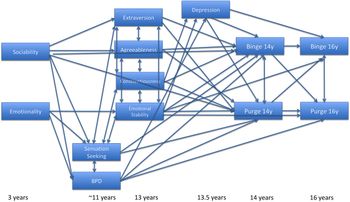
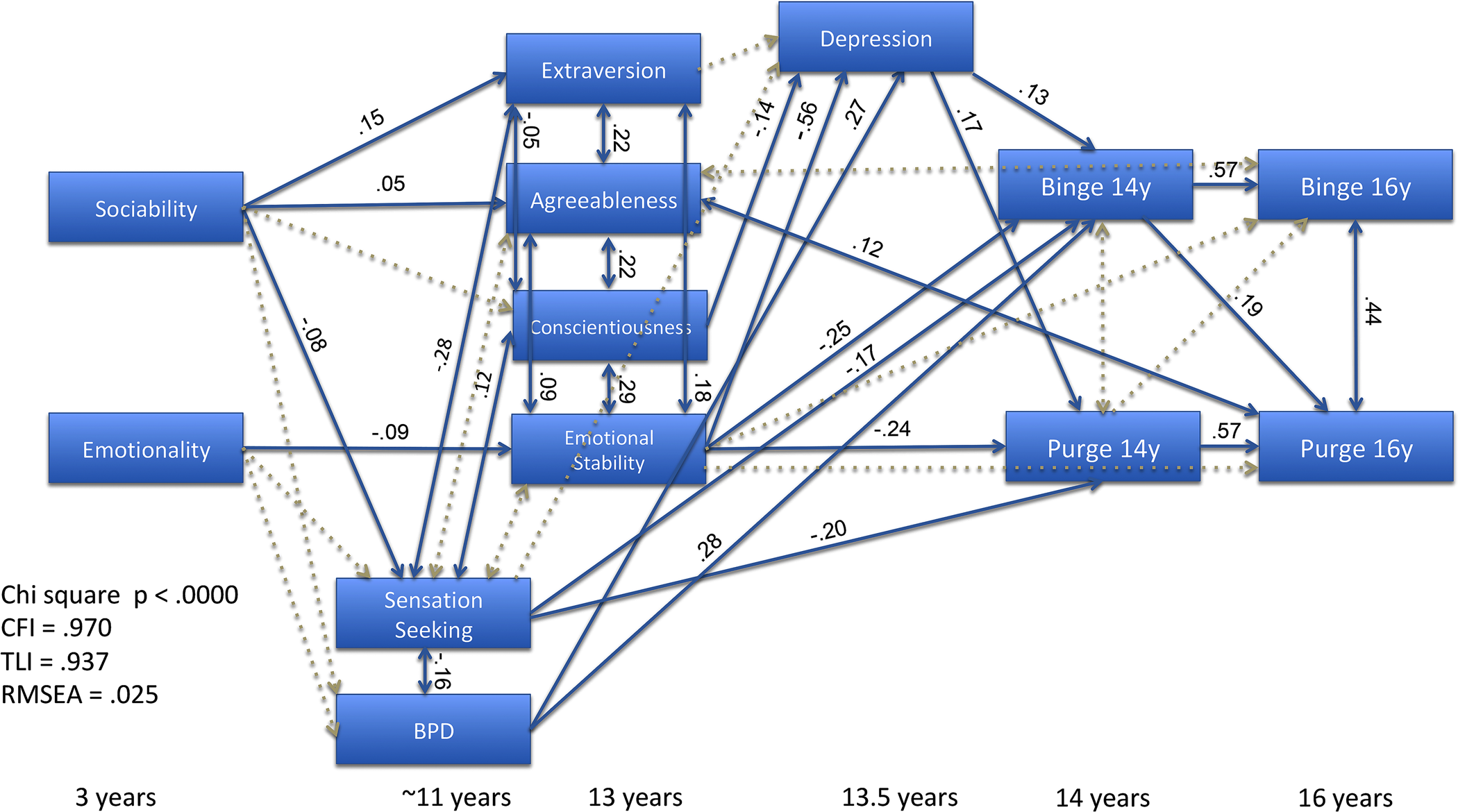
Data analysis was carried out in multiple steps. First, univariate logistic regression analyses were conducted using sex, temperament and personality factors (EAS and IPIP), BPD, sensation seeking and depression as predictors of ED behaviors at 14 and 16 years for the total sample. Second, analyses were stratified by sex. Third, a path analysis model was drawn, based on hypothesized associations (see Fig. 1) in a structural equation model (SEM). Models were stratified by sex, and were built by successive iterations to test how the model fits the available data. Models were assessed for good fit to the data; the model that best fit the data was then chosen as the final model.
Hypothesized associations between temperament and personality predictors and eating disorder behaviors.

Structural equation modeling and model testing
Hypothesized models were tested using SEM. SEM is a method to describe, assess and test hypothesized relationships between observed variables and latent, unobserved variables. SEM is commonly graphically represented with observed variables enclosed by rectangles and latent variables by circles. An assumed causal path between two variables is shown by a directed edge (single-headed arrow). Path coefficients on the edges are partial standardized regression coefficients, which measure the effect of one variable on another. Controlling for all other variables prior in the model, coefficients show a positive association, except for those with a minus sign, which indicate a negative association. Parameters were estimated using Full Maximum Likelihood methods. This makes use of all available data and provides unbiased and efficient parameter estimates if data are missing at random (Allison, Reference Allison2001). This method is an improvement over traditional methods that use listwise deletion; these require more strict assumptions about missingness (missing completely at random) and have less power (Allison, Reference Allison2001). The Root Mean Square of Approximation (RMSEA), a parsimony-adjusted index and the Comparative Fit Index (CFI) were used for model comparison and final model selection. The model with the lowest RMSEA was chosen as best fitting the data.
Due to the small number of boys reporting relevant outcomes, SEM in boys did not converge. All SEM analyses reported were therefore carried out amongst girls only.
Attrition
Those girls who contributed to SEM analyses were more likely to be born from older mothers (p < 0.0001), to have parents with higher socio-economic status (non-manual social class) (p = 0.01), but had similar number of siblings and had a similar BMI adjusted for sex and age at 14 and 16 years to those who did not.
Ethical approval
Ethical approval for the study was obtained from the ALSPAC Ethics and Law Committee and the Local Research Ethics Committees.
Results
Sample characteristics
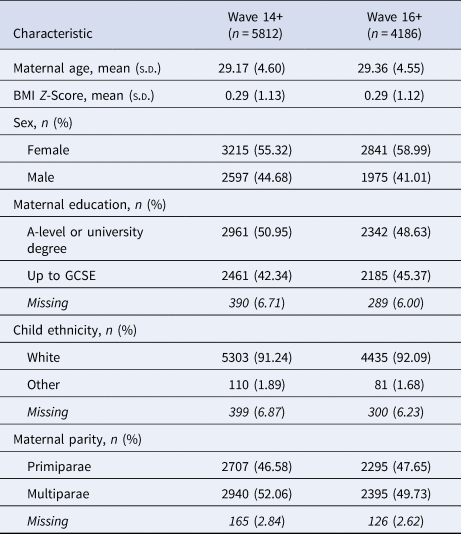
Sociodemographic data for youth included in our analysis are shown in Table 1.
Socio-demographic characteristics of adolescents

GCSE, general certificate of secondary education; BMI, kg/m2 calculated based on weight (kg) and height (m) measured objectively
Prevalence of eating disorder behaviors
Table 2 sets out the prevalence of binge eating and purging for the total sample and stratified by sex.
Prevalence of eating disordered behaviors among the ALSPAC adolescents at each wave

ALSPAC, Avon Longitudinal Study of Parents and Children.
Predictors of eating disorder behaviors
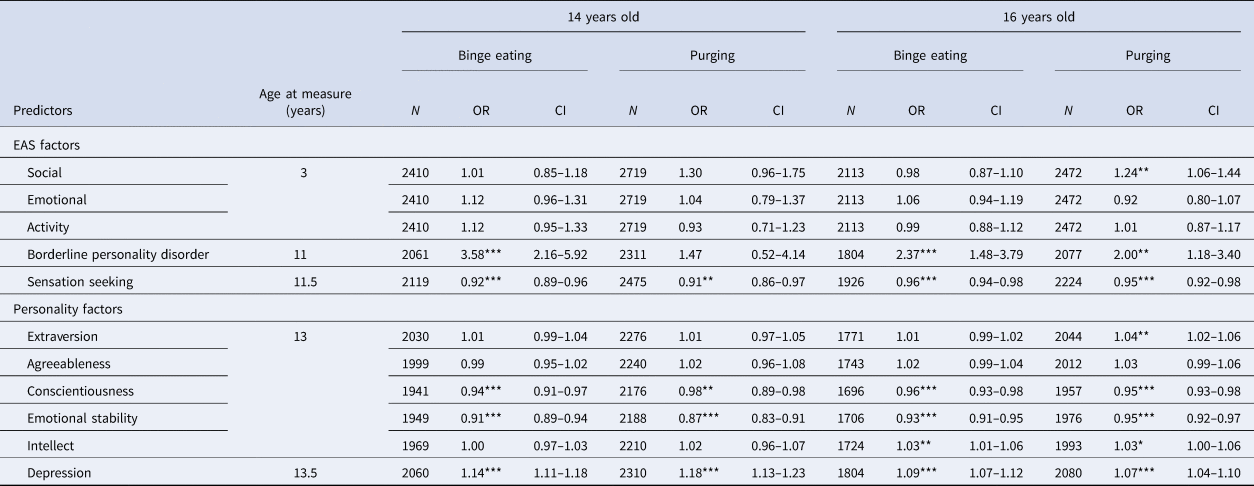
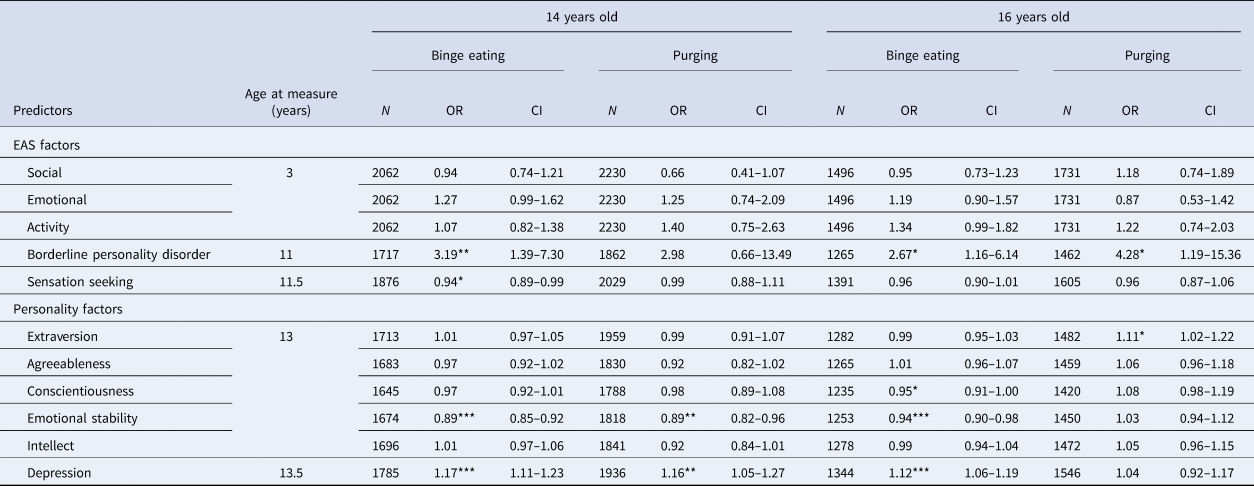
Results for the univariate logistic regression analyses for temperament and personality factors, BPD, sensation seeking and depression as predictors of binge eating and purging are shown for females and males in Tables 3 and 4, respectively. Odds ratios (OR), confidence intervals (CI) and p values for predictors discussed below for the sex-stratified samples are found in these tables.
Univariate analyses of temperament and personality factors as predictors of binge eating and purging in females at 14 and 16 years

OR, odds ratio; CI, confidence interval.
*p < 0.05, **p < 0.01, ***p < 0.001.
Univariate analyses of temperament and personality factors as predictors of binge eating and purging in males at 14 and 16 years

OR, odds ratio; CI, confidence interval.
*p < 0.05, **p < 0.01, ***p < 0.001.
Sex
Female sex positively predicted binge eating at 14 years (OR 2.34, 95% CI 1.83–3.01, p < 0.001) and 16 years (OR 4.85, 95% CI 3.77–6.23, p < 0.001); and purging at 14 years (OR 2.99, 95% CI 1.84–4.85, p < 0.001) and at 16 years (OR 8.18, 95% CI 5.41–12.37, p < 0.001).
Early childhood temperament
Early childhood temperament factors (age 38 months) predicted adolescent ED behaviors. For the total sample, sociability in early childhood positively predicted purging at 16 years (OR 1.23, 95% CI 1.07–1.42, p < 0.01); early sociability also positively predicted purging at 16 for females only, with no significant association found for males.
Heightened emotionality in early childhood positively predicted binge eating at both 14 years (OR 1.21, 95% CI 1.06–1.37, p < 0.01) and 16 years (OR 1.15, 95% CI 1.04–1.28, p < 0.01) for the total sample. The relationship between early emotionality and binge eating was not significant in the sex-stratified samples. No relationship was found between emotionality in early childhood and purging in adolescence.
Borderline personality disorder
BPD features in childhood (age 11 years) strongly predicted binge eating and purging for the total, female and male groups across time. This positive association was found between BPD and binge eating at 14 years (OR 3.32, 95% CI 2.18–5.06, p < 0.001) and at 16 years (OR 2.23, 95% CI 1.50–3.30, p < 0.001) for the total group; BPD also strongly predicted purging at 16 years (OR 2.11, 95% CI 1.31–3.40, p < 0.001). The strong relationship between BPD and ED behaviors was also reflected in the female and male sex-stratified groups at both time points (see tables).
Sensation seeking
Sensation seeking (age 11.5 years) negatively predicted binge eating and purging at both 14 and 16 years for the female group. For total and male samples, sensation seeking negatively predicted binge eating at 14 years only (total sample OR 0.96, 95% CI 0.93–0.98, p < 0.01).
Personality factors
Big five personality factors (age 13 years) predicted adolescent ED behaviors. Extraversion predicted purging at 16 years for the total sample (OR 1.05, 95% CI 1.03–1.08, p < 0.001) as well as for females and males when analyzed separately.
Agreeableness predicted binge eating (OR 1.05, 95% CI 1.03–1.08, p < 0.001) and purging (OR 1.08, 95% CI 1.04–1.11, p < 0.001) at 16 years for the total sample, but was not a significant predictor in sex-stratified samples.
Conscientiousness negatively predicted binge eating at 14 years (OR 0.94, 95% CI 0.92–0.97, p < 0.001) and at 16 years (OR 0.95, 95% CI 0.93–0.97, p < 0.001) for total sample; it also negatively predicted purging at 14 (OR 0.9, 95% CI 0.89–0.98, p < 0.01) and 16 years (OR 0.95, 95% CI 0.93–0.97, p < 0.001) for this group. In females, conscientiousness followed a similar pattern of negatively predicting both ED behaviors across time points. For males, conscientiousness was negatively associated with purging at 16 years only.
Emotional stability was a negative predictor of both ED behaviors for total, female and male samples. For the total group, emotional stability negatively predicted binge eating at 14 (OR 0.90, 95% CI 0.88–0.92, p < 0.001) and 16 years (OR 0.91, 95% CI 0.90–0.93, p < 0.001). Likewise, it predicted binge eating and purging at both time points for females. For males, emotional stability negatively predicted binge eating at 14 and 16 years and purging at 14 years.
Intellect was unrelated to ED behaviors in the total and male groups; however, this factor positively predicted binge eating and purging at 16 years for females.
Depression
Depressive symptoms in early adolescence (age 13.5 years) was found to be a relatively stable positive predictor of ED behaviors in total, female and male samples. For the total group, depression was associated with binge eating at 14 and 16 years (OR 1.16, 95% CI 1.13–1.19, p < 0.001; OR 1.12, 95% CI 1.09–1.14, p < 0.001) and purging at 14 and 16 years (OR 1.19, 95% CI 1.15–1.24, p < 0.001; OR 1.10, 95% CI 1.07–1.13, p < 0.001). For females, depressive symptoms also positively predicted both ED behaviors across time points. This pattern was also found for males, with the exception of purging at 16 years.
Full path analysis model
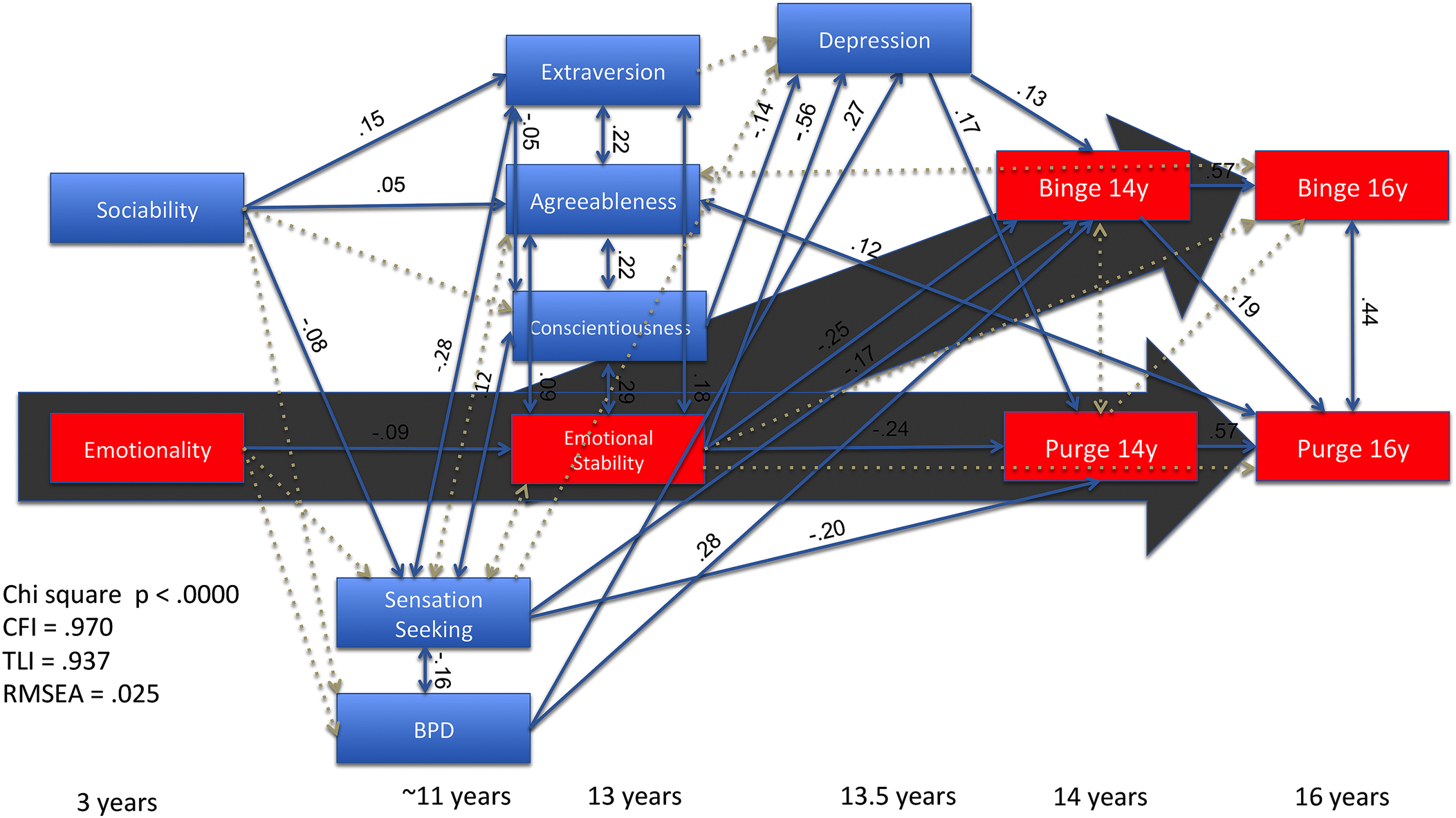
SEM were sequentially built by including all hypothesized associations between temperament and personality predictors and ED behaviors. Our starting model is shown in Fig. 1. This model included associations between all childhood variables and subsequent behaviors. Successive models were built on the initial one by dropping non-significant associations. The model shown in Fig. 2 best fit the data, with an RMSEA = 0.025, TLI = 0.937 and CFI = 0.970. This model showed continuity of early temperament into personality for females. In particular early emotionality was associated with emotional instability, and high sociability with extraversion and agreeableness. As hypothesized emotional stability predicted lower levels of binge eating (β = −0.25, s.e. = 0.01, p < 0.001) and purging (β = −0.24, s.e. = 0.01, p = 0.001) at 14. Depressive symptoms also predicted binge eating (β = 0.13, s.e. = 0.01, p = 0.023) and purging (β = 0.17, s.e. = 0.01, p = 0.002) at 14. High sensation seeking was protective for binge eating at 14 (β = −0.17, s.e. = 0.01, p < 0.001). There was stability of ED behaviors, in that binge eating at 14 was predictive of binge eating at 16 (β = 0.57, s.e. = 0.09, p < 0.001), and purging at 14 was predictive of purging at 16 (β = 0.57, s.e. = 0.12, p < 0.001). There were no lagged effects of early predictors on binge eating and purging at 16. As would be expected binge eating at 14 predicted purging at 16 (β = 0.19, s.e. = 0.09, p = 0.016), but the opposite was not true. Binge eating and purging were correlated at 16 (β = 0.44, s.e. = 0.09, p < 0.001) but not at 14.
Best fit SEM model of temperament and personality factors predicting eating disorder behaviors in females.

Discussion
In this large-scale prospective study of 5812 adolescents, ED behaviors were relatively common, with 12.54% of adolescents engaging in binge eating and 7.05% engaging purging by 16 years. At this age, adolescent females were over four times more likely to binge eat and eight times more likely to purge compared to males. The prevalence of ED behaviors also increased dramatically for females from 14 to 16 years with more than twice as many engaging in binge eating and nearly four times as many engaging in purging at 16 compared to 14 years.
Consistent with our hypothesis, we found robust support for low trait emotional stability, BPD features and depressive symptoms in late childhood and adolescence as stable predictors of ED behaviors of binge eating and purging in adolescence across both sexes. The strength of the findings for some risk pathways to the ED behaviors was striking. Most notable were the large effect sizes for BPD features in late childhood predicting binge eating and purging in adolescence for both females and males (females binge eating OR 3.58, 2.37; purge OR 1.47, 2.00; males binge eating OR 3.19, 2.67; purge OR 2.98, 4.28). These effect sizes indicate that adolescents identified as ‘high risk’ for BPD as children were two to four times more likely to engage in binge eating and purging by 16 years compared to those who were considered ‘low risk’ for BPD. Moreover, binge eating and purging at 14 years were the most powerful predictors of these same behaviors at 16 years for females, as revealed in path analysis. The strength and consistency of these effects across time have important implications for the timing and aggressiveness of interventions. Conversely, the effect sizes for depressive symptoms (females binge eating OR 1.14, 1.09; purge OR 1.18, 1.07; males binge eating OR 1.17, 1.12; purge OR 1.16, 1.04) were more moderate. These effect sizes for depressive symptoms also decreased over time for both sexes. Results of this study suggest that being identified as ‘at risk’ for BPD, i.e. instability in emotional, interpersonal and self-image domains, may be a more powerful longitudinal predictor of ED behaviors (binge eating and purging) than depressive symptoms alone.
Contrary to our hypothesis, low extraversion did not predict ED behaviors as anticipated. Higher extraversion was associated with greater purging reported at 16 years for the total and sex-stratified samples in our univariate analyses, but this association was not relevant in path analysis. Likewise, higher levels of sensation seeking did not predict greater levels of ED behaviors as expected, and in fact lower sensation seeking was a significant predictor of binge eating and purging for the female sample only.
Our results suggest a number of sex-specific differences in risk factors for ED behaviors. For females only, our path analysis revealed a trait-based ‘emotional instability’ longitudinal pathway from early childhood to adolescence that confers risk for the development of ED behaviors. Early childhood temperament characterized by emotionality, i.e. the child becomes upset easily, predicted lower emotional stability in adolescence, which in turn predicted adolescent binge eating and purging. This emotional instability pathway for females is illustrated in Fig. 3. Further, depressive symptoms mediated an indirect pathway from adolescent emotional stability to binge eating and purging. Namely, lower emotional stability and being ‘at risk’ for BPD predicted depressive symptoms, which predicted binge eating and purging. While low base rate of ED behaviors in the male sex-stratified sample may have hindered our ability to detect such an emotional instability pathway in males, the proportion of males classified with BPD features in childhood (6.0%) was similar to that of females (5.5%). This suggests that sex-specific factors may have influenced the developmental trajectory to these ED behaviors for emotionally unstable youth. Young females with trait emotional instability appear to be most at risk for developing binge eating and purging, as well as full threshold EDs characterized by these behaviors, namely BN and AN-BP. This finding may explain, at least in part, consistently higher prevalence rates of these disorders among females (Hudson et al., Reference Hudson, Hiripi, Pope and Kessler2007; Cossrow et al., Reference Cossrow, Pawaskar, Witt, Ming, Victor, Herman, Wadden and Erder2016; Nagl et al., Reference Nagl, Jacobi, Paul, Beesdo-Baum, Höfler, Lieb and Wittchen2016).
Best fit SEM model: emotional instability pathway in females.

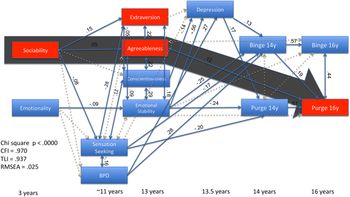
Several other sex differences in the development of ED behaviors from childhood to adolescence were notable. In addition to the emotional instability pathway, path analysis revealed a ‘sociability pathway’ for females whereby a sociable early childhood temperament predicted adolescent extraversion and agreeableness, which predicted adolescent purging (Fig. 4). This was an unexpected finding. While somewhat speculative, one plausible explanation for this result is that sociable temperament and personality in females may confer greater vulnerability to sociocultural influences that promote a thin ideal body image and increase risk for ED behaviors. Another unexpected result was that lower sensation seeking was a stable predictor of ED behaviors in females in both univariate and path analyses. High sensation seeking individuals may engage in other behaviors such as drinking or drug use rather than ED behaviors, although this interpretation is also speculative. Lower conscientiousness was consistently associated with ED behaviors in females but not males, and an indirect pathway via depressive symptoms was also observed from conscientiousness to ED behaviors in females. Overall, our results support the more general hypothesis that temperament and personality factors play a pivotal role as risk factors for ED behaviors; these risk factors were found to be both overlapping and distinctive for females v. males.
Best fit SEM model: sociability pathway in females.

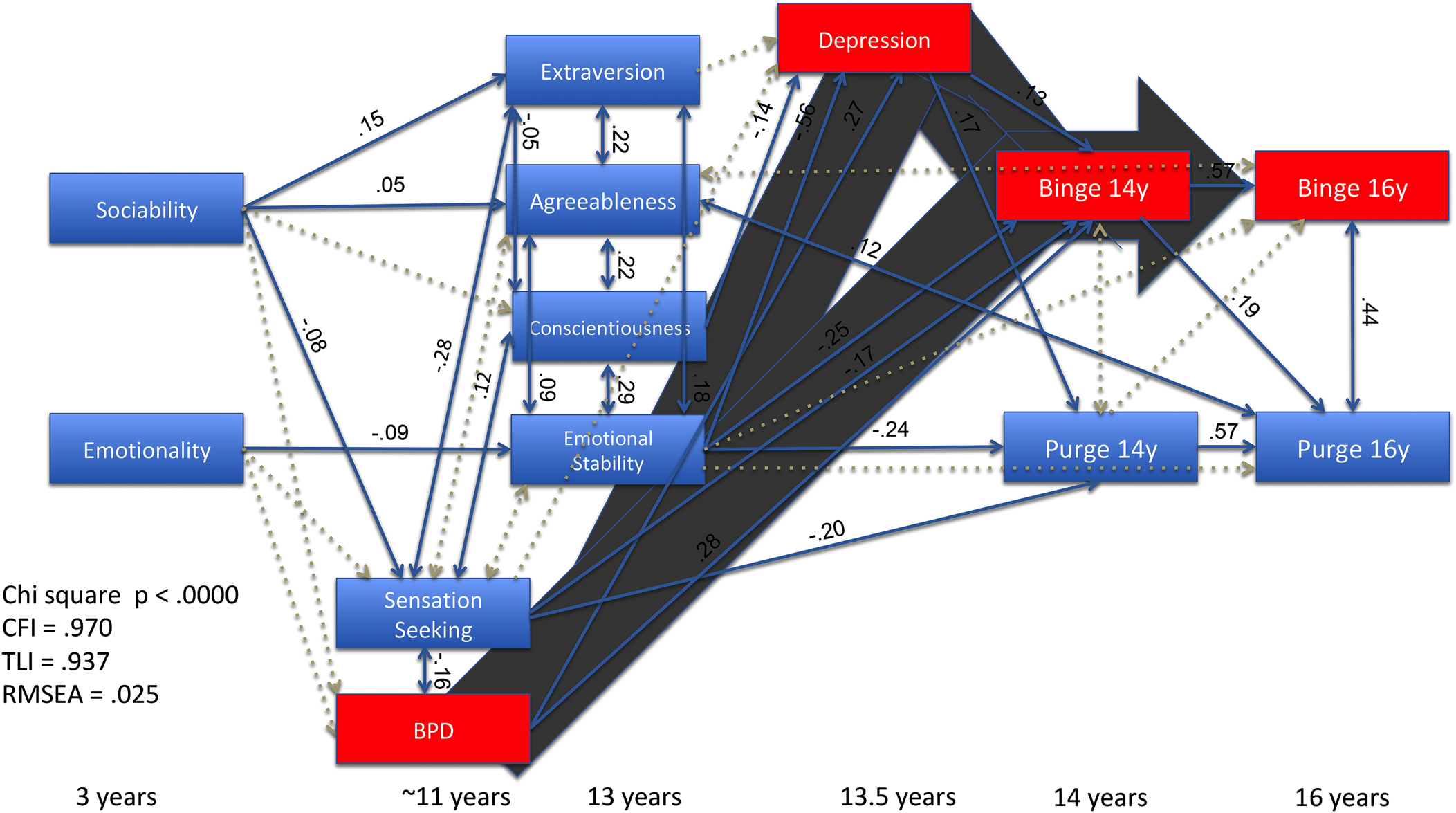
Lastly, the path analysis revealed evidence of a differential pathway in the development of binge eating v. purging for females. Binge eating in early adolescence (14 years) predicted purging in later adolescence (16 years), but not vice versa, i.e. early purging did not predict later binge eating. Also, binge eating and purging at 14 years were not associated with the path model. This might be due to the low prevalence of purging at 14; however, it also suggests that binge eating precedes onset and development of purging in later adolescence. This finding also has implications for prevention and intervention programs and their timing. Further, the pathway to binge eating includes BPD features, depressive symptoms and emotional instability, whereas the direct pathway to purging includes agreeableness, as well as depressive symptoms and emotional instability. Unique to binge eating alone, we identified a pathway shown in Fig. 5 from BPD to binge eating, both directly and indirectly via depressive symptoms for young females. This pathway could be described as a ‘borderline risk’, pathway. Such a pathway from BPD to purging was not evident using SEM, though BPD was predictive of purging in univariate analyses. Again, while speculative, purging may have a more socially oriented function, rather than a purely emotion regulation based one found in binge eating. Purging emerges during a developmental period when youth are keenly focused on peers and themselves; female adolescents who are more agreeable, i.e. interpersonally trusting, sympathetic and cooperative (Costa and McCrae, Reference Costa and MacCrae1992b), appear to be at greater risk for extreme weight control behaviors like purging.
Best fit SEM model: borderline risk pathway in females.

To our knowledge, this study is one of the first to assess the prospective association between temperament/personality factors and ED behaviors from early childhood to mid-adolescence. The proportion of youth shown to be at risk for development of ED behaviors and the rapid escalation of these behaviors in adolescence, particularly for females, is profound and alarming. Moreover, the results are consistent with the literature highlighting the significance of temperament and personality in the complex etiology of EDs (Keel and Forney, Reference Keel and Forney2013; Culbert et al., Reference Culbert, Racine and Klump2015; Kaye et al., Reference Kaye, Wierenga, Knatz, Liang, Boutelle, Hill and Eisler2015). ED behaviors investigated in this study, i.e. binge eating and purging (vomiting, laxative and other medicine use for weight control), are diagnostic criteria for BN and AN-BP, EDs associated with emotionally unstable personality (Cassin and von Ranson, Reference Cassin and von Ranson2005; Sansone et al., Reference Sansone, Levitt, Sansone, Sansone and Levitt2006; Sansone and Sansone, Reference Sansone and Sansone2011; Farstad et al., Reference Farstad, McGeown and von Ranson2016). The current study offers evidence of a developmental trajectory from trait-based emotional instability, starting in early childhood, to these ED behaviors in adolescence. These results cannot speak to a developmental pathway for restricting type AN however, which presents with a differential personality profile characterized by avoidant and obsessive-compulsive traits (Farstad et al., Reference Farstad, McGeown and von Ranson2016). The study also confirms sex differences in the prevalence of ED behaviors, with females being at much greater risk for developing such behaviors as well as a significant a minority of males being affected (Striegel-Moore et al., Reference Striegel-Moore, Rosselli, Perrin, DeBar, Wilson, May and Kraemer2009). The emotional instability pathway found for females originating in early childhood temperament suggests a trait biological basis for adolescent binge eating and purging and related full threshold EDs, i.e. BN and AN-BP. While these ED behaviors are less common in males, emotionally unstable youth of both sexes appear to be at greatly increased risk for the development of ED in adolescence.
This study has numerous strengths, the most notable being large sample size, population basis and prospective design that allows for causal inferences regarding risk factors for the outcome variables. Length of longitudinal follow-up over a 13-year period (3 to 16 years) further strengthens the robustness of results. The large sample included similar numbers of males and females, which is unusual in ED research, which often relies on largely or exclusively female samples. Several limitations affect generalizability of results however. The sample was mostly White and based in southwest England, with some selective loss of more disadvantaged families (Boyd et al., Reference Boyd, Golding, Macleod, Lawlor, Fraser, Henderson, Molloy, Ness, Ring and Davey Smith2013; Fraser et al., Reference Fraser, Macdonald-Wallis, Tilling, Boyd, Golding, Davey Smith, Henderson, Macleod, Molloy, Ness, Ring, Nelson and Lawlor2013). As such, these results may not apply to more diverse populations. With regard to sex, the male base rates of ED behaviors were low, which may have compromised our ability to detect associations that may exist in males, such as an emotional instability pathway. In addition, the ED behaviors assessed in the study relied upon self-report and did not include other ED behaviors and cognitions, such as restrictive eating, compulsive exercise or body image disturbance. The outcome ED behaviors, binge eating and purging, are applicable to only certain DSM-5 ED diagnoses, namely BN, AN-BP and binge eating disorder, but not others, such as anorexia nervosa restricting type or avoidant/restrictive food intake disorder. It is also unclear if the ED behaviors measured reached clinical or diagnostic significance.
Our findings have significant implications for prevention, identification and treatment of eating and other psychiatric disorders, pathological behaviors and health outcomes in young females and males. Large numbers of females, as well as males, are at-risk for developing ED behaviors of binge eating and purging in adolescence, which may advance to clinical levels of EDs. For this reason, both sexes should be targeted in community or school-based prevention programs. ED behaviors themselves are harmful, and they are also predictive of other adverse outcomes for youth, including anxiety, depression, substance use, self-harm and unhealthy weight outcomes (obesity and underweight) (Micali et al., Reference Micali, Solmi, Horton, Crosby, Eddy, Calzo, Sonneville, Swanson and Field2015). For youth that struggle with binge eating, helping children develop healthier eating patterns may be preventative for development of other ED behaviors, such as purging, based on our results. While the preponderance of risk is associated with females, at-risk males tend to go undiagnosed and untreated (Strother et al., Reference Strother, Lemberg, Stanford and Turberville2012; Sweeting et al., Reference Sweeting, Walker, MacLean, Patterson, Räisänen and Hunt2015), and improved prevention, identification and treatment is needed for males. BPD features, emotional instability and depressive symptoms were predictive of ED behaviors in both females and males, suggesting that early intervention in late childhood or early adolescence to improve emotion regulation skills, e.g. Dialectical Behavior Therapy (DBT) for BPD, may be effective in decreasing risk for later ED behaviors and other negative outcomes. For young children with temperamentally based heightened emotionality starting in early life, e.g. child cries and gets upset easily, tends to be emotional and reacts intensely when upset (EAS emotionality factor; Buss and Plomin, Reference Buss and Plomin1984), interventions that help caregivers effectively manage child emotions and behaviors and teach children to self-soothe are recommended. For some cases, psychiatric medication may be indicated, in conjunction with behavioral and skills-based interventions. Learning to adaptively cope with negative emotions at an early age may have a significant impact on later psychiatric, behavioral and health outcomes.
More longitudinal research is needed to clarify developmental trajectories to EDs and other psychiatric illnesses across childhood and into adulthood. Sex differences in development of pathological behaviors, such as binge eating and purging, are also poorly understood and require further investigation. Given that EDs involve a complex interplay of biopsychosocial factors, untangling the roles of these factors in development provides an opportunity to develop novel cognitive, behavioral and biological interventions at multiple time points across the lifespan.
In sum, ED behaviors of binge eating and purging are common in both female and male adolescents, although prevalence rates are much higher in females and increase dramatically from early- to mid-adolescence. Early childhood and adolescent temperament and personality factors were predictive of later adolescent ED behaviors; being ‘at risk’ for BPD in particular was a powerful univariate predictor of binge eating, on its own and via depressive symptoms. Our results have significant clinical implications, including ED prevention programs, increased identification, and temperament based and emotion regulation interventions for all at-risk youth.
Acknowledgements
The UK Medical Research Council and the Wellcome Trust (Grant ref: 102215/2/13/2) and the University of Bristol provide core support for ALSPAC. This publication is the work of the authors, who will serve as guarantors for the contents of this paper. We are extremely grateful to all the families who took part in this study, the midwives for their help in recruiting them, and the whole ALSPAC team, which includes interviewers, computer and laboratory technicians, clerical workers, research scientists, volunteers, managers, receptionists and nurses.
Conflict of interest
None.
Ethical standards
The authors assert that all procedures contributing to this work comply with the ethical standards of the relevant national and institutional committees on human experimentation and with the Helsinki Declaration of 1975, as revised in 2008.