Introduction
Red ear syndrome is a rare disorder originally described by Lance in 1994,Reference Lance1 and it was further characterised in 1996.Reference Lance2 With this condition, the colour of the ear(s) suddenly becomes red, either bilaterally or unilaterally, with discomfort, pain and a burning sensation. The frequency and duration of red ear syndrome vary, ranging from 4 times a day to once a month, lasting from 10 minutes to 3 hours. The syndrome can be triggered by temperature changes such as showers and cold exposure. Recently, it has been reported that red ear syndrome can accompany migraine.Reference Kumar and Swanson3 Studies have proposed that primary and secondary forms of red ear syndrome should be distinguished; primary red ear syndrome is considered migraine related, whereas the secondary form is considered a neuralgiform radiculopathy involving the C3 nerve root.
Therapeutic modalities for red ear syndrome are wide-ranging, with medications including gabapentin, non-steroidal anti-inflammatory drugs, calcium channel blockers, tricyclic antidepressants and triptans. Other treatments include nerve blockage, cooling and dental plates.Reference Ryan, Wakerley and Davies4
Here we report a case of red ear syndrome with vestibular migraine, and describe neurotological examination findings. We found no previous reports of red ear syndrome with vestibular migraine. The diagnosis of red ear syndrome with vestibular migraine should be considered in cases of dizziness and headache with recurrent redness of the ear.
Case report
This case concerns a 39-year-old woman who was born in Bangladesh and came to Japan 10 years previously. Both she and her mother had a history of headaches. In addition, she reported that both of her ears sometimes became red, along with a hot feeling. She had experienced repeated dizziness and headaches since she was 18 years old. She was admitted three times to other hospitals because of intensive dizziness and headache attacks.
She initially presented to Tokai University Hospital in Kanagawa, Japan, at the age of 34 years, with intractable dizziness. Neurotological examinations, which included pure tone audiometry, revealed no abnormal findings. The following year, she suffered from longstanding dizziness without other auditory symptoms such as tinnitus, transient hearing loss or auditory hallucinations, and she returned to our hospital for further evaluation.
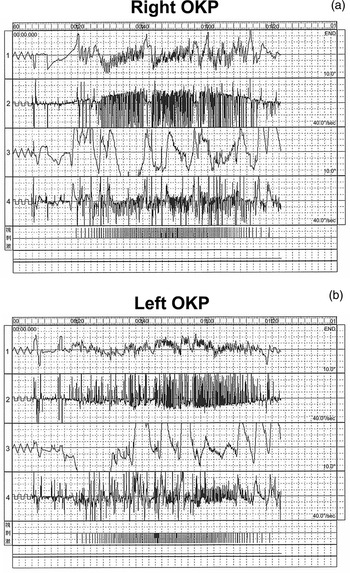
Magnetic resonance imaging of the brain revealed no abnormal findings. Several questionnaires were utilised to help diagnose this patient. The patient's dizziness handicap inventory score was 26. Her Hospital Anxiety and Depression Scale scores were 6 for anxiety and 4 for depression. The pure tone audiogram was normal. Additionally, stabilometry revealed normal findings. Subsequently, electronystagmography (ENG) was performed. A caloric test revealed 23 per cent left canal paralysis. The right optokinetic pattern was markedly reduced, whereas the left optokinetic pattern was normal (Figure 1). Cervical vestibular-evoked myogenic potential testing with a 500 Hz tone burst yielded no response. Ocular vestibular-evoked myogenic potential testing with a bone-conducted vibration also yielded no response. The potentiation of middle latency responses (whereby averaged responses are divided into four sets: s1–s4)Reference Ryan, Wakerley and Davies4 was positive (s4/s1 ratio was greater than 1.11) (Figure 2).
Optokinetic pattern testing results for the (a) right and (b) left sides. The right optokinetic pattern was reduced, whereas the left optokinetic pattern was normal. Sec = seconds

(a) Cervical vestibular-evoked myogenic potential testing with a 500 Hz tone burst yielded no response. (b) Ocular vestibular-evoked myogenic potential testing with a bone-conducted vibration also yielded no response. (c) Middle latency response (MLR) findings were positive (s4/s1 ratio was greater than 1.11).

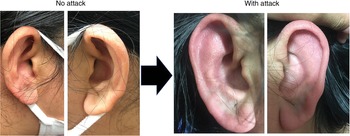
The patient sometimes felt burning sensations and reddening of both auricles (Figure 3). These episodes occurred two to three times a week, and continued for several minutes before subsiding. These attacks happened spontaneously without any trigger, and the patient did not experience any trauma or temporomandibular joint dysfunction. These symptoms fulfilled the red ear syndrome diagnostic criteria.Reference Lambru, Miller and Matharu5
Red ear appearance. Prior to treatment, the patient's bilateral auricle became red (‘with attack’) and was associated with discomfort two to three times a week, and each episode lasted for several minutes before subsiding (‘no attack’).

The co-morbidity of red ear syndrome with vestibular migraine was strongly suspected. After describing her symptoms in a headache diary, finally, at the age of 39 years, she was diagnosed with red ear syndrome and vestibular migraine.
We prescribed migraine prophylaxis, including 5 mg of amitriptyline and 100 mg of valproic acid for 10 weeks. After this treatment, the frequency of red ear syndrome attacks gradually reduced from two or three times per week to twice per month. The frequency of continuous dizziness for 5–20 minutes at a time also reduced from 2 or 3 times a week to 2 or 3 times a month.
Discussion
This paper reports a case of red ear syndrome with vestibular migraine successfully treated by migraine prophylaxis. A close relationship between migraine and red ear syndrome has been described previously.Reference Kumar and Swanson3 In one report, 6 patients with headache, including 3 patients with migraine, were found among 12 patients with red ear syndrome.Reference Lance2 Another study reported eight cases of red ear syndrome with migraine.Reference Raieli, Monastero, Santangelo, Eliseo, Eliseo and Camarda6 However, in those studies, none of the patients with red ear syndrome had vestibular migraine, making our case unique.
There are no objective examinations to define migraine. Recently, the application of several neurotological examinations, including tests of middle latency responses, vestibular-evoked myogenic potentials and optokinetic patterns, have been used to detect vestibular migraine in patients with migraine. For the current case, several neurotological examinations, including ENG, middle latency response and ocular vestibular-evoked myogenic potential testing, were useful for arriving at the correct diagnosis.
Middle latency response testing was reported as useful for diagnosing vestibular migraine in 13 definite Ménière's disease patients, 13 vestibular migraine patients and 8 control subjects.Reference Murofushi, Goto and Tsubota7 The potentiation of middle latency responses was positive in our case. Therefore, such testing may also be useful for the diagnosis of this type of red ear syndrome with vestibular migraine.
Recently, there have been contradictory reports on the usefulness of cervical and ocular vestibular-evoked myogenic potential testing for the diagnosis of vestibular migraine.Reference Baier, Stieber and Dieterich8–Reference Zuniga, Janky, Schubert and Carey11 However, the application of such testing in a case of red ear syndrome with vestibular migraine has not been previously reported. In our patient, both cervical and ocular vestibular-evoked myogenic potential test findings were negative. Therefore, red ear syndrome with vestibular migraine may be associated with dysfunction of the sacculo and utriculo pathways.
There are only a few reports of ENG conducted for patients with vestibular migraine. Electronystagmography was performed to investigate abnormal eye movement including an eye tracking test.Reference Dieterich and Brandt12 In another report, 91 patients with migraine-associated dizziness were reviewed based on their clinical background histories, health examination findings and quantitative vestibular testing results.Reference Cutrer and Baloh13 However, these reports lacked optokinetic pattern testing. In one report from Japan, three in seven patients with vestibular migraine had a reduction in slow phase speed and fusion/adaptation disorder according to their optokinetic pattern results.Reference Yokota, Motegi, Inoshita and Yamaguchi14 However, there have been no reports of vestibular examinations in patients with red ear syndrome and vestibular migraine.
This is the first report to clearly describe the results of neurotological examination in a patient with red ear syndrome. Our findings suggest there may be possible characteristic results, including: a positive potentiation of middle latency responses; negative findings in both cervical vestibular-evoked myogenic potential and bone ocular vestibular-evoked myogenic potential testing, which are seen in other patients with vestibular migraine; and a unilateral abnormality in the optokinetic pattern examination. Our results suggest a close association between red ear syndrome and vestibular migraine. Middle latency response, cervical and ocular vestibular-evoked myogenic potential, and optokinetic pattern optokinetic testing are useful for generating differential diagnoses. Additionally, our observations show that some patients with red ear syndrome may have not only headaches but also dizziness.
• Red ear syndrome is characterised by pain and redness of one or both external ears, with a burning sensation, and is associated with migraine
• This report presents a unique case of red ear syndrome with vestibular migraine
• There are a few reports on red ear syndrome with migraine, but no accounts to date of red ear syndrome with vestibular migraine
• In the present case, the right optokinetic pattern was markedly reduced
• Cervical and ocular vestibular-evoked myogenic potential testing yielded no response; potentiation of middle latency responses was positive
• In this case, red ear syndrome was successfully treated with migraine medication
In conclusion, we observed a case of red ear syndrome with vestibular migraine. The co-morbidity of red ear syndrome and vestibular migraine should be considered in patients with dizziness and headache with recurrent redness of the ear. However, this report presents only one case, and therefore the findings cannot be generalised; further studies on a larger number of cases are needed to confirm the results of this report.
Acknowledgement
The authors wish to thank Enago for English-language proofreading.
Competing interests
None declared