Introductıon
The antibacterial properties of heavy metal cations and some cationic and anionic surfactants can be combined with the properties of clay minerals to produce a new antibacterial material compatible with organic tissue and suitable for biomedical applications. Montmorillonite (Mnt) is modified easily by adsorption of heavy-metal cations and quaternary ammonuim-type cationic surfactants (QACs) to form highly stable composite materials. Clay minerals loaded with metal ions are superior to traditional metal-ion applications in terms of safety and long-term antibacterial effectiveness (Malachová et al., Reference Malachová, Praus, Rybková and Kozák2011; Zhao et al., Reference Zhao, Zhou and Liu2006). Heavy metal (e.g., Ag+, Cu2+, and Zn2+) exchanged clay minerals have worked as antimicrobial agents in in vitro studies (Jiao et al., Reference Jiao, Ke, Xiao, Song, Lu and Hu2015; Jiao et al., Reference Jiao, Lin, Cao, Wang, Wu, Shu and Hu2017; Malachová et al., Reference Malachová, Praus, Rybková and Kozák2011). The QACs have been deployed actively since the 1930s with no notable reduction in their antibacterial effectiveness (Gilbert & Moore, Reference Gilbert and Moore2005). Although numerous studies have reported apparent bacterial resistance to QACs, this refers to changes in the minimum inhibitory concentration (MIC) and does not affect the activity at levels of use (Gilbert & McBain, Reference Gilbert and McBain2003; Gilbert & Moore, Reference Gilbert and Moore2005). The antibacterial agents used to inhibit the growth of cariogenic microorganisms present frequent side effects such as irritation, taste-perception alteration, and increase in tooth discoloration (Escribano et al., Reference Escribano, Herrera, Morante, Teughels, Quirynen and Sanz2010). The side effects of the QAC-based antibacterial agents are expected to diminish by immobilization, hindering the interaction of the cationic head groups of the surfactants with the tissues. In addition to suppressing unpleasant side effects, the immobilization of surfactants onto Mnt enables a long-term applicability and also prevents the spreading of surfactants into the environment. For this reason, research on the use of minerals as carriers for antibacterial agents and antibacterial nanoparticles has been conducted for decades (Chen et al., Reference Chen, Ye, Cai, Huang, Zhong, Chen and Wang2016; Hsu et al., Reference Hsu, Wang and Lin2012; Ma et al., Reference Ma, Yang and Xie2010; Makvandi et al., Reference Makvandi, Ghaemy, Ghadiri and Mohseni2015; Pupe et al., Reference Pupe, Villardi, Rodrigues, Rocha, Maia, de Sousa and Cabral2011; Song & Ge, Reference Song and Ge2019).
Streptococcus mutans (S.mutans) is accepted as the primary aetiological agent causing tooth decay in humans and is of medical significance because of its virulence in biofilm initiation and formation, leading to increased tolerance to antibiotics (Cross et al., Reference Cross, Kreth, Zhu, Qi, Pelling, Shi and Gimzewski2006). Besides, S. mutans is implicated in sub-acute bacterial endocarditis, a life-threatening inflammation of heart valves, while a subset of strains has been linked to other extraoral pathologies such as cerebral microbleeds, IgA nephopathy (Berger's disease), and atherosclerosis (Lemos et al., Reference Lemos, Palmer, Zeng, Wen, Kajfasz, Freires, Abranches and Brady2019). Therefore, the development of versatile agents to prevent and/or to treat infectious diseases is an important public health challenge.
Inorgano(I)- and organo(O)-montmorillonite (I/O-Mnt) prepared using Zn2+, Cu2+, cetylpyridinium chloride (CPC), and N-lauroyl sarcosinate (SR) were previously shown to be effective antibacterial agents against Staphylococcus aureus and Escherichia coli (Özdemir et al., Reference Özdemir, Hoşgör-Limoncu and Yapar2010; Özdemir et al., Reference Özdemir, Yapar and Hoşgör-Limoncu2013; Özdemir & Yapar, Reference Özdemir and Yapar2020; Yapar et al., Reference Yapar, Ateş and Özdemir2017). The aim of the present study was to conduct systematic and comparative experiments to evaluate the antibacterial activities of I/O-Mnt against S. mutans. For this purpose, Mnt was modified by integrating cetyltrimethyl ammonium bromide (CTAB) and benzethonium chloride (BZT) as the new cationic surfactants and as testing agents used previously. Original studies of desorption tests, scanning electron microscopy (SEM), and time-kill tests were conducted to gain a broader insight into the antibacterial interactions. Among other methods, time-kill assay was used to distinguish the time-dependent killing-rate properties related to the structural characteristics and potential applications requiring short contact times. A further objective was to prepare materials acting as scavengers for the pathogenic microorganisms in oral microbiota that can have a profound effect on the development of antimicrobial materials and help to prevent opportunistic bacterial infections, such as in recent pandemic scenarios.
Experimental
Materials
Mnt-Na obtained from Middle Anatolian clay minerals was purified by differential sedimentation to separate the coarse impurities. Afterwards, 5 wt.% of Mnt-water dispersions were prepared and shaken in a water bath at 20°C for 24 h. The layer on the precipitated part was separated and dried at 95°C. The drying was followed by pulverization to pass through a 600 μm sieve.
The heavy metal ions were of analytical grade. The copper(II) nitrate trihydrate (Cu(NO3)2·3H2O, MW=241.60 g mol–1) (Merck, Darmstadt, Germany) and the zinc nitrate hexahydrate (Zn(NO3)2·6H2O, MW=297.47 g mol–1) (J.T. Baker, Radner, Pennsylvania) were used as received without further purification. High-purity grade surfactants were obtained from various commercial sources, which consisted of cetylpyridinium chloride monohydrate (C21H38ClN·H2O, MW=358.01 g mol–1) (Merck, Darmstadt, Germany), N-lauroylsarcosine sodium salt (C15H28NNaO3, MW=293.38 g mol–1) (Sigma Aldrich, St. Louis, Missouri, USA), cetyltrimethyl ammonium bromide (CH3(CH2)15N(Br)(CH3)3, MW=364.45 g mol–1) (ACROS Organics, Geel, Antwerp, Belgium), and benzethonium chloride (C27H42ClNO2, MW=448.08 g mol–1) (Sigma Aldrich, St. Louis, Missouri, USA).
Lyophilized S. mutans culture ATCC 25175 was obtained from Kwik-Stik (Microbiologics Inc., St Cloud, Minnesota, USA).
Methods
Preparation of Inorgano- and Organomontmorillonites
The benzethonium montmorillonite (Mnt-BZT) was prepared using a Mnt-Na with a cation exchange capacity (CEC) of 87 mmol/100 g clay and 1.2 nm basal spacing by the microwave irradition method (Türker et al., Reference Türker, Yarza, Sánchez and Yapar2017). 10 g of Mnt-Na was added to the solutions containing BZT, equivalent to 100% of the CEC value of the Mnt. The dispersions were stirred for 5 min at 700 rpm and then subjected to 360 W of microwave irradiation for 5 min. The Mnt-CP, Mnt-CP-SR, Mnt-CTA, Mnt-Cu, and Mnt-Zn were prepared using Mnt-Na with a CEC of 68 mmol/100 g clay and 1.29 nm basal spacing using the wet method (Özdemir et al., Reference Özdemir, Yapar and Hoşgör-Limoncu2013). The cetylpyridinium montmorillonite (Mnt-CP), copper montmorillonite (Mnt-Cu), and zinc montmorillonite (Mnt-Zn) were synthesized by adding 10 g of Mnt-Na to the solution containing the ions in an amount equivalent to 70% of the CEC of Mnt-Na and the dispersions were shaken for 24 h at 25°C. The cetyltrimethyl ammonium montmorillonite (Mnt-CTA) was prepared following the same procedure but the dispersions were stirred at 70°C for 1 h in 100% CEC of Mnt of the CTA solution. The cetylpyridinium-N-lauroyl sarcosinate montmorillonite (Mnt-CP-SR) was prepared in two steps, adding SR in the amount of 100% of the CEC of Mnt-Na to the Mnt-CP prepared (Yapar et al., Reference Yapar, Ateş and Özdemir2017).
Thermogravimetric Analyses
The TG analyses were conducted using a TA Instruments model SDT Q600 V20.9 Build 20 (New Castle, Delaware, USA) with alumina as a reference. The samples, weighing 50 mg, were placed in Pt crucibles and heated from 30 to 1000°C at a rate of 10°C min–1 under an 80 mL min–1 nitrogen flow.
Antibacterial Susceptibility Tests
The antibacterial susceptibility tests of the samples were accomplished using Mnt-Na as a negative control because it exhibited no inhibition activity and a 0.2% solution of chlorhexidine (CHX) digluconate as a positive control. S. mutans was cultured using Brain Heart Infusion (BHI) broth (Merck Millipore, Darmstadt, Germany) and was incubated microaerophilically at 37°C for 24 h. Prior to the antibacterial tests, the turbidity of the microbial suspension was adjusted to 0.5 McFarland units using a densitometer (Grant Inst., Cambridge, UK) and the suspension was diluted to the desired concentration according to the procedure of each test method.
Agar-well Diffusion Method
The agar-well diffusion method was used to assess the antibacterial effect of the samples against S. mutans. The initial concentration of the microorganism was adjusted to 108 CFU mL–1 (CFU: colony forming units) for this assay. The BHI Agar was inoculated by spreading 100 μL of the S. mutans suspension over the entire agar surface. Wells with a diameter of 8 mm were punched in the agar (Güven et al., Reference Güven, Ustun, Tuna and Aktoren2019) and 10 mg samples were introduced into the wells. After incubation (48 h and 37°C), the inhibition zone diameters were recorded in millimeters. The tests were accomplished in triplicate.
Determination of MIC and MBC
The minimum inhibitory concentration (MIC) and minimum bactericidal concentration (MBC) values of the I/O-Mnt samples were determined by modifying the Clinical and Laboratory Standards Institute (CLSI, 2015) guidelines according to the growth-rate conditions of S. mutans. A total of 80 μL of the aqueous suspension of the samples at a concentration of 100 mg mL–1 was poured into the first well of a 96-well plate, each containing 80 μL of BHI broth. The two-fold serial dilutions were made from the 2nd to 8th wells. The 9th and 10th wells were used as negative and positive controls, respectively, and kept untreated. Distilled water and a 0.2% CHX digluconate were used as negative and positive controls, respectively. 20 μL of S. mutans suspension was added to the wells to obtain a final bacterial inocula of 106 CFU mL–1. Experiments were performed in duplicate for each sample and control. The MIC value was determined after incubation (24 h and 48 h, 37°C) for the concentration at which there was no turbidity. The turbidity was taken as the measure of bacterial growth. MBC was determined at 24 h and 48 h of incubation using the plate drop method. 10 μL samples taken from the wells were inoculated onto the plates containing BHI Agar and the minimum concentration at which no bacterial growth was observed was taken as the MBC value.
Time-Kill Assay
A time-kill assay was performed using ASTM E2149 (Standard Test Method for Determining the Antimicrobial Activity of Immobilized Antimicrobial Agents under Dynamic Contact Conditions) (ASTM E2149-13a Standard Test Method for Determining the Antimicrobial Activity of Antimicrobial Agents Under Dynamic Contact Conditions, 2013). Samples prepared at 10 times their MIC concentrations were transferred to 10 mL of phosphate buffer solution (PBS pH = 7.4). They were then inoculated with a suspension of S. mutans to a final concentration of 105 CFU mL–1. The inoculation was followed by the incubation period at 37°C and 100 rpm in an orbital shaker. After 0, 2, 3, 5, and 15 min, and 1, 3, 6, 12, and 24 h of incubation, tenfold serial dilutions were carried out and 0.1 L aliquots were inoculated onto BHI Agar plates by the spread plate count technique. After an incubation period for 48 h at 37°C, the numbers of colonies on the agar plates were counted and the log10 reductions were calculated. The tests were performed in triplicate.
Desorption Study
Desorption studies were conducted by the method reported in the literature (Herrera et al., Reference Herrera, Burghardt and Phillips2000). 1 mg of the samples in 1 mL of sterile PBS was washed by shaking at 600 rpm for 24 h and subsequently centrifuged at 1000×g for 15 min. The supernatants were transferred to new tubes. The solids were rehydrated with 1 mL of PBS. S. mutans suspension (105 CFU mL–1) was added to the rehydrated solids and supernatants and the mixtures formed were then shaken for 24 h at 100 rpm. Mixtures of 100 μL of the solid and liquid were spread on the BHI Agar and incubated for 48 h. The viable colonies were counted and the results evaluated.
Determination of the State of Bacteria Adsorbed on the Sample Surfaces
1 mL of S. mutans suspension (~105 CFU mL–1) was brought into contact with 5 mg of the samples at 37°C and 100 rpm in a shaking incubator for 24 h. The incubation period was followed by separation of solid and liquid phases by centrifugation (1000×g for 15 min). 1 mL of the BHI-added solid samples was inoculated to the BHI Agar plate using the spread plate technique, while 0.1 mL of the supernatants was transferred directly to the BHI Agar plate. After the incubation period, the number of colonies of S. mutans grown on each plate was counted and the log10 reductions were calculated. Two parallel sets were used to accomplish the study.
SEM of the Samples Subjected to Antibacterial Tests
Scanning electron microscopy (SEM) analyses were conducted to study the bacteria adsorbed onto the samples after the antibacterial tests. To examine S. mutans on isolated Mnt-Na and OMnt particles, bacterial suspensions with concentrations greater than those used in antibacterial tests were utilized. 10 mg of the samples and 1 mL of S. mutans suspension (1.5×10⁷ CFU mL–1) were mixed in an incubator with agitation (100 rpm, 37°C for 18 h). The bacteria on the samples in a 0.2 mol mL–1 Na-phosphate buffer (pH 7.2) were fixed by the addition of glutaraldehyde to a final concentration of 2.5%. The dispersions were shaken rigorously overnight at 4°C. They were centrifuged at 450×g for 10 min and washed three times with deionized water. The samples were subsequently dehydrated twice with 50, 75, 95, and 100% ethanol solutions and centrifuged at 450×g for 10 min after adjusting the final volumes of fixed samples to a volume of 15 mL with absolute ethanol. The supernatants were then discarded. One mL of hexamethyldisilazane was added to the solid samples as fixative, and samples were air-dried in a dryer cabinet. The SEM images were captured using the Thermo Scientific Apreo S scanning electron microscope (Waltham, Massachusetts, USA) at 15 keV (Herrera et al., Reference Herrera, Burghardt and Phillips2000).
Results and Discussion
Characterization of the Organomontmorillonite Samples
Montmorillonites have stacked platelets with negatively charged surfaces and positively charged edges. Consequently, quaternary ammonium cations CP, CTA, and BZT interact with the Mnt surfaces by electrostatic binding. The anionic surfactant SR exhibits a different adsorption behavior, however. The main part of the anionic SR adsorbs onto the previously intercalated CP layers of Mnt through van der Waals forces and a small part of the SR onto the positively charged edge sites by electrostatic attraction (Yapar et al., Reference Yapar, Özdemir, Solarte and Sánchez2015).
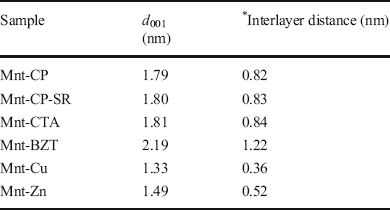
The characteristic structural properties of the samples were reported extensively in previous studies (Özdemir et al., Reference Özdemir, Hoşgör-Limoncu and Yapar2010; Özdemir et al., Reference Özdemir, Yapar and Hoşgör-Limoncu2013; Özdemir & Yapar, Reference Özdemir and Yapar2020; Türker et al., Reference Türker, Yarza, Sánchez and Yapar2017; Yapar et al., Reference Yapar, Ateş and Özdemir2017). Among these properties, the d 001 values and interlayer distances of the samples were used in the current work. The increase in d 001 values and interlayer space of the samples in comparison to those of Mnt (Table 1) indicated the intercalation of the Cu2+, Zn2+, CP+, CTA+, and BZT+. The small change in the d 001 values from 1.79 nm (Mnt-CP) to 1.80 nm (Mnt-CP-SR) with SR intercalation showed that SR molecules filled up the cavities among CP chains of the Mnt-CP mainly as a result of hydrophobic interactions. The calculated interlayer spacings of the Mnt-CP, Mnt-CP-SR, Mnt-CTA, and Mnt-BZT (Table 1) were 0.82, 0.83, 0.84, and 1.22 nm, respectively. The first three values correspond to a bilayer arrangement and the 1.22 nm indicates a pseudotrilayer or paraffin-like monomolecular arrangement in the interlayer spaces and that the surfactants were distributed between the internal and external surfaces (Brindley & Moll Jr., Reference Brindley and Moll1965; Özdemir & Yapar, Reference Özdemir and Yapar2020; Yapar et al., Reference Yapar, Özdemir, Solarte and Sánchez2015; Zhu et al., Reference Zhu, He, Guo, Yang and Xie2003).
Interlayer spacing of I/O-Mnt samples

*Interlayer distance is the difference between the d 001 value and that of dehydrated Mnt (0.97 nm)
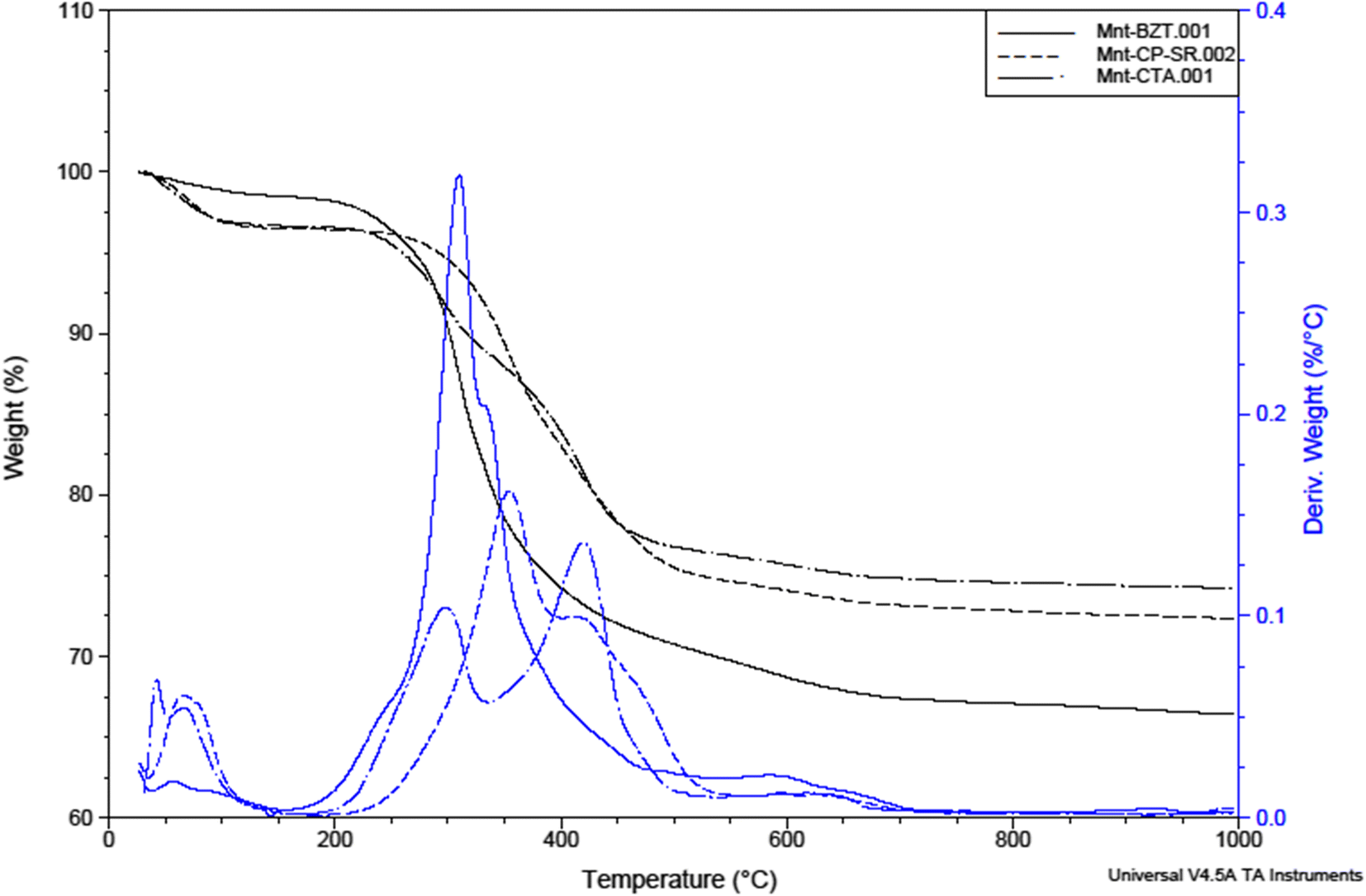
Thermal analyses (TG) were conducted with the most effective samples, Mnt-CTA, Mnt-BZT, and Mnt-CP-SR, and also with Mnt-Na as a reference. The analyses showed that Mnt-Na had two peaks at maximum mass-loss rate temperatures of 50.43 and 713.15°C. The corresponding weight losses were ascribed to removal of physically adsorbed water (dehydration) and that of crystal water (dehydroxylation) (Atia, Reference Atia2008).
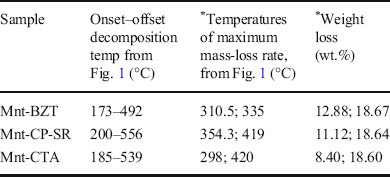
The thermal behavior of the OMnt specifies the interactions between the Mnt surface and quaternary alkylammonium cations. Both dehydration and dehydroxylation maxima shifted to lower temperatures and the mass loss during dehydration was less than that observed in Mnt-Na. The shift to the lower peak temperatures indicated the hydrophobization of the surface. The results showed that the Mnt-BZT, Mnt-CP-SR, and Mnt-CTA displayed different thermal behaviors (Fig. 1). While the Mnt-BZT and Mnt-CP-SR had two overlapping peaks with narrow and broader shapes, respectively, the Mnt-CTA exhibited two distinct peaks. The two mass-loss steps (Table 2) were indicative of two types of bonding of surfactant molecules in the OMnt, namely one type of bonding was to the silica surface and the second to other surfactant molecules (Xi et al., Reference Xi, Martens, He and Frost2005).
The TGA-DSC curves of Mnt-BZT, Mnt-CP-SR, and Mnt-CTA with good antibacterial performance

The temperature range of the surfactant decomposition, temperature of maximum mass-loss rate, and weight loss of the organo-Mnt samples

*Temperatures of maximum mass-loss rate and weight loss that are related to the bonding to the silica surface and other surfactant molecules, respectively.
Antibacterial Susceptibility Tests
As a categorical test, the well-diffusion test results were interpreted according to the size of the inhibitory zone. Because the agar well-diffusion test provides only qualitative information, the samples were also subjected to quantitative tests, MIC and MBC values were determined. The MIC and MBC values were, however, insufficient to describe time-dependent interactions (Rubin, Reference Rubin, Giguére, Prescott and Dowling2013) which are especially significant in short-term applications. Consequently, the time-kill assays defining the effect of antimicrobials on an organism over time were specifically applied to the samples.
Agar Well-Diffusion Tests
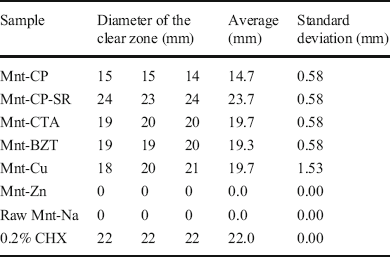
The CHX used as a positive control exhibited a 22 mm diameter clear zone (Table 3), whereas Mnt-Na used as a negative control exhibited no such zone. The results of the agar well-diffusion tests showed that S. mutans was susceptible to the samples in the order Mnt-CP-SR > Mnt-CTA, Mnt-Cu, and Mnt-BZT > Mnt-CP, showing clear zones with diameters in the range 24–14 mm, while no susceptibility to Mnt-Zn was observed. The results for the Mnt-CP-SR (23.7 mm), Mnt-CTA (19.7 mm), Mnt-Cu (19.7 mm), and Mnt-BZT (19.3 mm) were comparable to those of CHX.
Diameters of the clear zones of the agar well-diffusion tests for the samples

MIC and MBC Tests
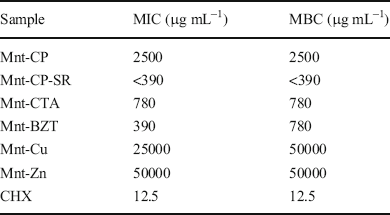
The MIC and MBC values (Table 4) were calculated based on the amount of I/O-Mnt in the tests not based on the amount of surfactants/metal cations adsorbed. After 24 and 48 h of incubation, the ratio of MBC to MIC was <4, indicating that all the samples were bactericidal.
The MIC and MBC values of the I/O-Mnt samples

A close examination of the table revealed that Mnt-Cu and Mnt-Zn have greater MIC and MBC values than the OMnt samples. Accordingly, the efficacy of the Mnt samples was rather poor, and larger amounts were required for a considerable antibacterial effect. On the other hand, CHX exhibited minimum MIC and MBC values of 12.5 μg mL–1 with the culture bacteria used at the first passage. Although CHX is used widely in mouth washes, research on the undesired effects of CHX in dentistry shows a reduction in saliva pH associated with tooth enamel demineralization and risk of dental caries, tooth loss, and other problems (Bernardi & Teixeira, Reference Bernardi and Teixeira2015; Bescos et al., Reference Bescos, Ashworth, Cutler, Brookes, Belfeld, Rodiles, Agustench, Farnham, Liddle, Burleigh, White, Easton and Hickson2020).
The considerable difference between the MIC and MBC values for Mnt-CP and Mnt-BZT was attributed to the existence of the second aromatic ring in BZT and to the greater surface concentration of BZT. Although CTA has no aromatic ring and has a linear alkyl chain with C16, the MIC and MBC values of the Mnt-CTA were lower than those for the Mnt-CP having CP with the same chain length. The larger head group of CP binding to the Mnt surface decreased the number of CP cations adsorbed onto the outer surface of the Mnt compared to CTA cations. A densely adsorbed layer of the CTA onto Mnt increased the interaction ability of hydrocarbon tails with S. mutans. The interactions between the hydrocarbon chain of the surfactants and cell walls are important because the antibacterial activity of the adsorbed surfactants is attributed to their ability to alter the permeability of the cell walls, allowing intercellular ions and low molar mass metabolites to diffuse out.
Time-Kill Assay
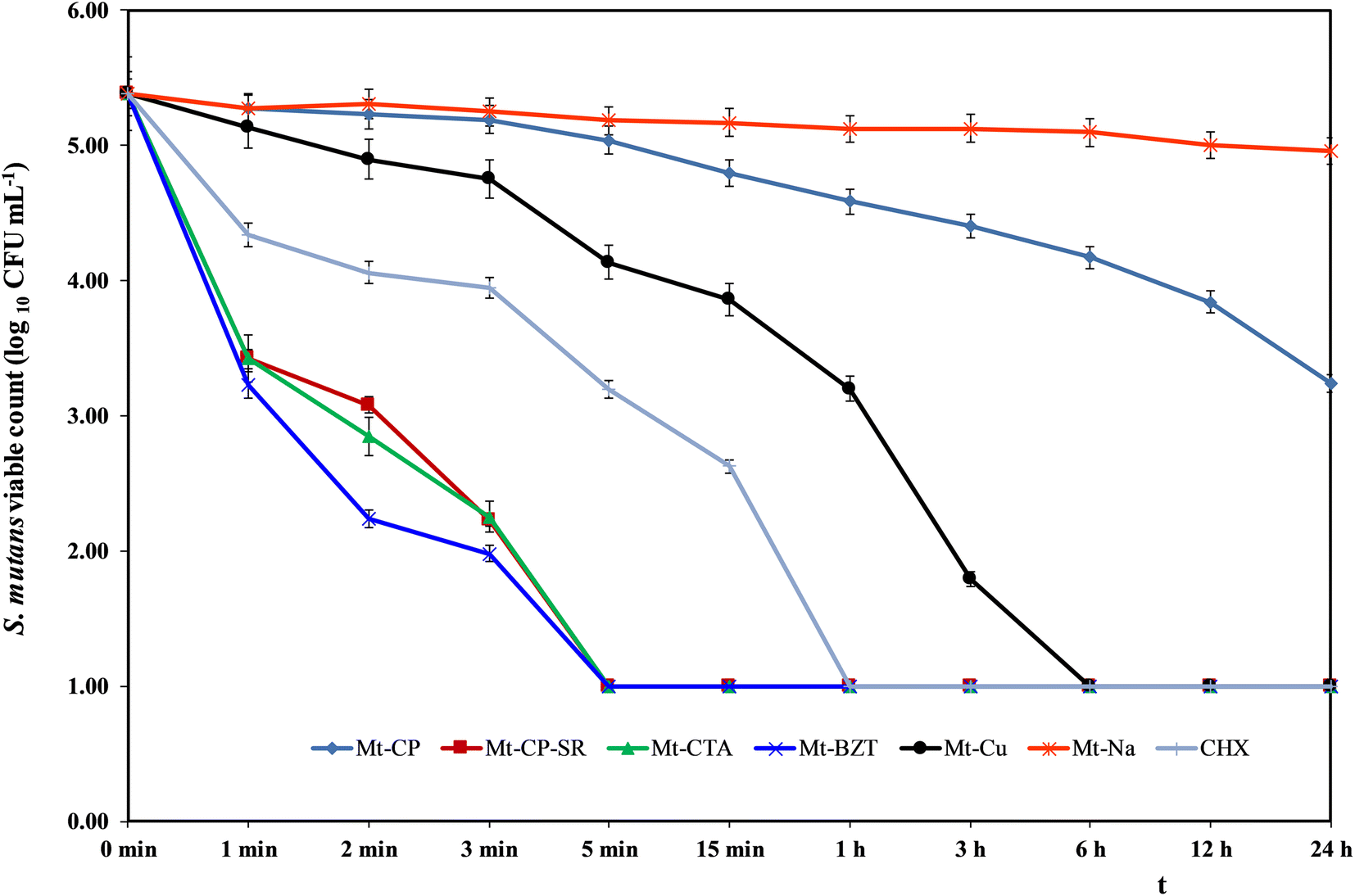
The Mnt-Zn was not subjected to this test because of the insufficient results of the well-diffusion test and MIC/MBC values. The time-dependent death rate of S. mutans was calculated by comparing the number of viable bacteria at predetermined times with the viable count at 0 h. The test specimen showing a decrease of 99.9% (≥3 log10 ) of the total number of CFU mL−1 in the original inoculum was considered bactericidal.
The results of the time-kill tests (Fig. 2) indicated that the samples Mnt-CP-SR, Mnt-CTA, and Mnt-BZT exhibited a considerable, rapid bactericidal efficacy against S. mutans, within 5 min, while a longer time was required for Mnt-Cu and Mnt-CP. Considering the time-dependent death rate (Fig. 2), two different behaviors were observed. The samples Mnt-CTA, Mnt-CP-SR, and Mnt-BZT worked very rapidly and almost all microorganisms were killed within 5 min. The Mnt-CP exhibited a longer and almost constant initial death rate period and a gradual increase in the death rate was observed after 3 h. From these findings, the samples were ranked in accordance with their bactericidal activity as Mnt-CTA ≈ Mnt-CP-SR ≈ Mnt-BZT > Mnt-Cu > Mnt-CP. The time-kill test results enabled distinctions to be made of the rapid bactericidal effect among the samples, which is important for short-term biomedical applications.
Time-dependent death rate of S. mutans as a function of the materials used

Desorption Study
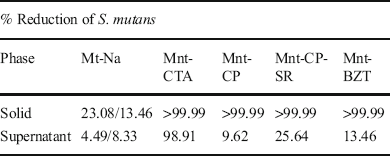
The antibacterial effect of OMnt could be a result of the immobilization of the bacteria on the surface by adsorption and/or by dissociation of the cationic surfactants from the Mnt surface. To determine which one of these situations induced the antibacterial activity, desorption studies were conducted. The OMnt samples were washed with PBS buffer solution (pH = 7.4) and the liquid and solid parts were separated. The washed solids and their supernatants were subjected to antibacterial tests. The results of the tests (Table 5) revealed that the bacterial reduction on the solid samples was almost of the same order and greater than 99.9% while the supernatants and Mnt-Na had very low reduction values. These results confirmed that it was the OMnt particles which imparted the antibacterial activity and not the supernatants; the supernatants probably contained no effective concentration of surfactants released from the OMnt. The unpleasant side effects of the cationic surfactants occuring in liquid preparations, and causing skin and oral mucosa irritations, may be suppressed by the immobilization.
Reduction in number of bacterial cells after 24 h from the desorption study

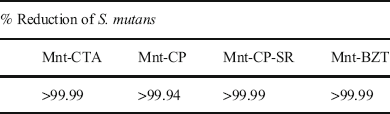
Comparison of the results of the desorption study with those of the time-kill assay (Table 6) revealed further that the washed samples (from the desorption study) were as effective as unwashed samples (from time-kill assay). This observation confirmed the conclusion that the antibacterial activity was due to immobilization of S. mutans by adhesion onto the modified Mnt surface, which is in accordance with other studies (Herrera et al., Reference Herrera, Burghardt and Phillips2000; Özdemir et al., Reference Özdemir, Yapar and Hoşgör-Limoncu2013).
Reduction in number of bacterial cells after 24 h from time-kill test

State of the Bacteria Adsorbed on the Sample Surfaces
The state of the bacteria on the solid surface was determined by following a different route from that used normally for antibacterial tests. In this route, the solid phase and supernatant were separated after contact with the bacteria for 24 h. They were then inoculated separately onto BHI agar plates to ascertain whether the bacteria adsorbed on the solid and remaining in the supernatant were still viable or not. After a 24-h incubation period, an intensive growth was observed in supernatants while no growth was detected in solid phases, indicating that the bacteria on the OMnt were dead, i.e they were bactericidal.
SEM Analysis
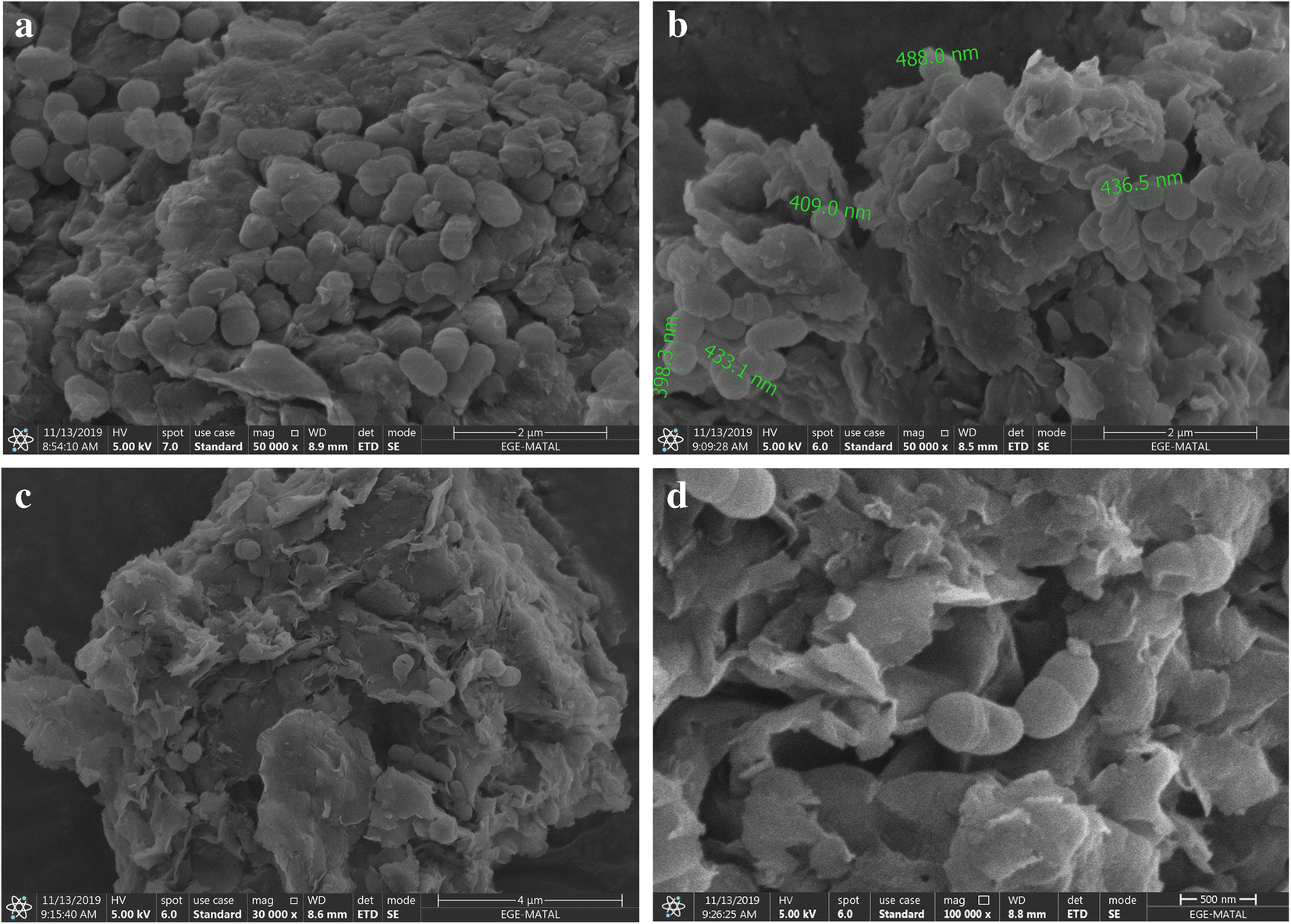
The samples contacted with S. mutans were examined using SEM to observe the interaction between the bacteria and the surfaces of OMnt particles (Fig. 3). The bacteria adhered to the sample surfaces appeared distorted and damaged. On the other hand, they were rarely found on the surfaces of the Mnt-Na. S. mutans adhered to the Mnt-CTA, and Mnt-CP surfaces were in the form of clusters while those on the Mnt-CP-SR and Mnt-BZT surfaces were disjoined. However, cave-in and pores were observed on almost all S. mutans surfaces, confirming the mechanism based on the alteration of the cell wall permeability and allowing intercellular ions and low-molar-mass metabolites to diffuse out. The change in the bacterial structure depending on the type of the surfactant used was attributed mainly to hydrophobic interactions and various electrostatic attractions resulting from the concentration and orientation of the surfactants on OMnt surfaces with the cell walls of bacteria.
SEM images of organomontmorillonites: a Mnt-CTA, b Mnt-CP c Mnt-CP-SR, and d Mnt-BZT

Conclusıons
The antibacterial study proved that the configuration and chemical structure of the surfactant on the Mnt surface determined the antibacterial activity of the immobilized surfactants. The existence of a linear alkyl chain and a double aromatic ring are the structural factors causing a greater antibacterial effect. The anionic surfactant also demonstrated the same effect of the linear alkyl chain and its amino acid head group. These conclusions confirmed observations of the state of the bacteria adsorbed on the sample surfaces as revealed by the SEM images as well as the results of desorption studies. These studies further indicated that the S. mutans cells were not viable after their interaction with the OMnt samples. The fast-acting mechanism of the Mnt-CTA, Mnt-CP-SR, and Mnt-BZT samples killed most of the S. mutans bacteria within 5 min and so are promising bactericidal agents suitable for biomedical applications.
Acknowledgments
The authors gratefully acknowledge the support of Scientific Research Projects of Ege University (BAP) through the project number FGA-2019-20715 and proofreading assistance to Enago, Crimson Interactive Inc, New York.
Funding
Funding sources are as stated in the acknowledgments.
Declarations
Ethics Approval and Consent to Participate
Not applicable
Concent for Publication
Not applicable
Competing interests
Not applicable
Conflict of interest
The authors declare that they have no conflict of interest.