In his comic poem Baucis and Philemon (1709), Jonathan Swift tells how two hermit saints visit a ‘good old honest yeoman’ and his wife, and reward the couple for their hospitality by transforming their humble cottage into a splendid church. The chimney stack stretches to become steeple and spire, the upside-down kettle rises to become a bell, and so on, until all the expected components of a church – pulpit, font, pews etc. – are created from domestic objects. The popular prints which decorated the cottage walls are metamorphosed into large wall paintings of ‘the heraldry of ev'ry tribe’. It can therefore be presumed that such heraldry was as familiar a sight in the early eighteenth century as a print of Robin Hood or Fair Rosamond, effectively a cliché of what might be expected as decoration in a rural church.
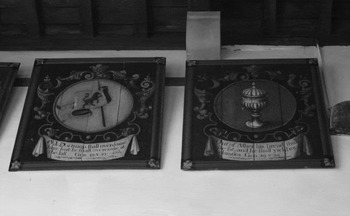
Just such a series of the heraldric devices of the patriarchs of the tribes of Israel exists in the parish church of Hartington, Derbyshire (see fig. 1). Twelve framed paintings on boards are now in the south transept, but hung originally on both sides of the nave at clerestory level.Footnote 2 These paintings are dated around 1700 so can be taken as just the sort of display that Swift was referring to. Yet fifty years later, in an edition of Swift's works, the editor thought it necessary to add a note of explanation, commenting, ‘in country churches the twelve tribes of Israel are sometimes distinguished by the ensigns appropriated to them by Jacob on his deathbed’.Footnote 3 This comment suggests that the fashion for the subject had passed its zenith by the mid-eighteenth century. Today in only a few English churches do wall-paintings with the heraldry of the tribes of Israel survive and they are all, perhaps not coincidentally, in country churches. Surveys of English wall-paintings mention the theme as a post-Reformation one, but it has rarely been subject to comment.Footnote 4 Yet the heraldry of the tribes of Israel has good cause to be considered as a distinctive iconographic invention of the Reformed English Church, and it will be argued that the theme emerged in the first quarter of the seventeenth century.Footnote 5
St Giles, Hartington, Derbyshire: south transept, panels. © author.

Through recent research it is now clear that churches were being repaired, refurbished and beautified during James's reign, well before the ‘Laudian’ era of the 1630s, and not only in London.Footnote 6 This period has often been characterised as iconophobic and apart from eye-catching and eye-holding frames around scriptural texts on church walls (or very occasionally images of Moses and Aaron accompanying the Decalogue), parish churches are still regarded as being devoid of ‘the allurements of glorious pictures’.Footnote 7 The view that only texts were imaged in churches needs to be reconsidered. The visual language of heraldry, like words, avoided strictures on figurative imagery and many of the churches referred to in the research contained examples of personal, civic or livery company heraldry. Swift's poem gives a clue that ‘the heraldry of every tribe’ was a popular theme with which to embellish bare whitewashed walls.
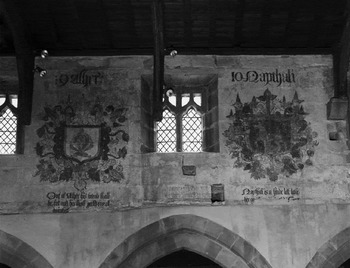
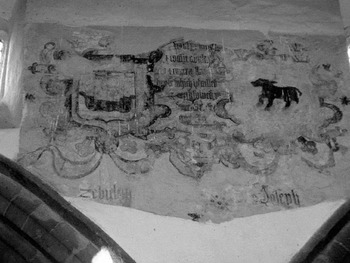
In addition to the panels at Hartington, wall-paintings of the Israelite heraldry survive at Eyam in Derbyshire (see figs 2, 9A), West Walton in Norfolk (see 9C), Stoke Dry in Rutland (see figs 3, 9B), Burton Latimer in Northampshire (see figs 10, 11) and Prestbury in Cheshire (see figs 9D, 13). There are other documented examples, no longer surviving.Footnote 8 All but one of these cycles, that of Burton Latimer, are difficult to date precisely, since documentary evidence is lacking. However, the visual sources for the theme were available in two illustrated books, The genealogies of the Scriptures according to every familie and tribe, and The testamentes of the twelve patriarches. Footnote 9 Both books, despite their phenomenal publication successes, have, like the wall-paintings, been ignored in scholarship on church history in the period. The genealogies was repeatedly reissued from 1610 onwards and contains images of the heraldry which are an obvious model for the church decorations. The testamentes was first published in English nearly forty years earlier, in 1574, usually with woodcut images of the twelve patriarchs themselves, though these seem not to have been used as models until the ‘Laudian’ era of the 1630s.
St Lawrence, Eyam, Derbyshire: north nave arcade, heraldry of Asher and Napthali. © Heritage House Group Ltd.

St Andrew, Stoke Dry, Rutland: north nave arcade, heraldry of Zebulon and Joseph. © author.

Israelite heraldry also forms part of the elaborate painted ceiling decoration of a family pew within the Skelmorlie Aisle, Ayrshire.Footnote 10 But this Scottish survival may be an exception, for the theme is habitually found in the nave, the parishioners' part of the church, which leads one to ask whether it might have had particular meaning in this space. In attempting to answer this question, textual and visual evidence needs to be examined to consider why and where this subject emerged and what resonances it might have had in Reformation England.
I
From the time of the earliest reformers the figurative use of Israel became common, and was applied in a variety of ways; indeed, Patrick Collinson has demonstrated that the trope of Israel, the chosen nation, had a long history.Footnote 11 Printed annotations in the Geneva Bible, first published in 1560, repeatedly use the analogy between the history of God's chosen people in the Old Testament, and contemporary situations.Footnote 12 The frontispiece of the first edition shows the Israelites caught between the Egyptians and the Red Sea, the image surrounded by texts concerning God's testing and protection of his people. This woodcut is unique in that, of the other twenty-five images, it alone does not derive from the French Estienne Bibles of 1540 and 1560. The usual depiction of this scene is of the triumph of the Israelites as the waters part and they make their escape. Instead their predicament was presumably chosen purposefully because it mirrored the experiences of the Marian exiles and the faithful sufferers back in England, now freed from persecution and bondage by the succession of a Protestant queen.Footnote 13 Where it occurs again, in the proper narrative place (Exodus xiv), the marginal note makes this allusion clear:
In this figure foure chiefe points are to be considered. First, the Church of God is ever subject in this world to the Crosse and to be afflicted after one sort or other. The second, that the ministers of God following their vocation, shall be euill spoken of, and murmured against, even of them that pretend the same cause and religion that they doe. The third, that God delivereth not his Church incontinent out of dangers, but to exercise their faith and patience continueth their troubles, yea and often-times augments them: as the Israelites were now in less hope of their lives, then when they were in Egypt. The fourth point is, that when the dangers are most great, then Gods help is most ready to succour: for the Israelites had on either side of them, huge rockes and mountaines, before them the sea, behind them most evill enemies, so that there was no way left to escape to mans judgement.Footnote 14
The image is treated in a unique way, for all the other illustrations – Noah's ark, the tabernacle, the temple furniture, even Ezekiel's vision – are there strictly to illustrate textual information, with annotations solely concerning measurements or areas. Only the Red Sea image gets interpretative comment – a mini-exegesis. The Red Sea woodcut continued to be used as frontispiece throughout the Geneva Bible's long publishing history. It can be considered as a seminal image linking reformed believers with the Israelites, who became synonymous with the Reformed Church or with a nation which had adopted Reformed religion. Where, as in England, the Reformed Church could be equated with the nation, the Israelite parallel had particular strength.
While Israel was the true (Reformed) Church, the Israelites themselves, under Jeroboam, could also be equated with Roman Catholics, both worshippers of idols, and in general the falling away of the Israelites and their casting off by God was used by countless preachers to castigate the sins of the nation.Footnote 15 In the doctrine of predestination St Paul's words (Romans ix.6): ‘for all they are not Israel, which are of Israel’ gave a restricted meaning to the term. For while Israel was centrally understood as the Reformed Church or a Reformed nation, for some Israel could mean only the truly godly within the Church or nation, even just those who believed in their own election.Footnote 16 The Israel trope was a rich one, and with different emphases was widely used by writers and preachers. But such evidence provides only a context for the Israelites imaged, for which other topics need exploring, and in particular, heraldry.
II
What were understood by the end of the sixteenth century as the heraldic devices of the twelve patriarchs of Israel and their descendants have two sources in the Old Testament. Genesis xlix gives Jacob's enigmatic deathbed utterances to his twelve sons when, in blessing them, he characterises them and foretells their futures. The metaphorical imagery in his words ‘tells’ their characters in a way exactly analogous to the purposes of heraldry – ‘armes are tokens or resemblances, signifying some act or quality of the bearer’.Footnote 17 For example, Ruben is ‘unstable as water’, Zebulon ‘shall be for an haven of ships’ (see fig. 3), Naphtali is ‘a hind let loose’ (see fig. 2, 13), Issachar is ‘a strong ass couching down between two burdens’. Thus three watery waves, a ship, a hind and a burdened ass become their respective ensigns, and express their ways of life or roles in Israel's history. Not every device could be deduced from Jacob's words so clearly as these; Asher, for example, has a goblet perhaps denoting that ‘his bread shall be fat and he shall yield royal dainties’ (see figs 1, 2). The other source of devices is the deathbed utterances of Moses to the descendant tribes of Israel in Deuteronomy xxxiii. Here, Joseph's ensign is a bullock (see fig. 3) ‘for his glory is like the firstling of a bullock’ (Deut. xxxiii.17), rather than his father Jacob's description of him as a ‘fruitful bough’ (Gen. xlix.22).Footnote 18 The dying Jacob coupled Levi with his brother Simeon, cursing their anger and cruelty (Gen. xlix.5–7). Simeon consequently acquires a sword as his device. Levi, however, has a book (see fig. 11), derived from the decree of Moses, himself a Levite, that the tribe of Levi was the priestly tribe, alone permitted to enact sacrifices to God, and be the teachers of God's law (Deut. xxxiii.8–11). Despite these derivations from Deuteronomy (and with the one exception of Burton Latimer), where biblical references or quotations are given with the heraldry in the examples studied, it is the Genesis passages that are cited.
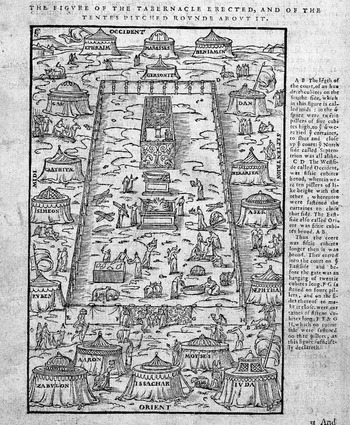
In the early Reformation period the tribes of Israel are represented visually simply by tents, which look like contemporary campaign tents, usually with each patriarch's name written on or by them. The tribes appear thus in maps of the holy land, and in the Geneva Bible woodcut of the tabernacle in the desert the tents are ranged around on four sides, as the Israelites obeyed God's instructions that ‘every man of the children of Israel shall camp by his standard’ (Numbers i.2) (see fig. 4). The tents of the four chief tribes have the standards flying from them. For an Elizabethan viewer, familiar with the heraldic system of identification, these standards cry out for emblems – heraldic devices – but their billowing folds are blank. Yet early writers on heraldry, who assumed that God was the originator of heraldic language, all cite as evidence this very episode in Israel's history, and they describe the emblems or devices of the twelve patriarchs.Footnote 19 The sacred origins and nature of this visual language formed the starting point for all early English writers on heraldry, a topic of deep interest to a literate, socially conscious elite, and to upwardly mobile gentry or yeomen. But a far wider, even illiterate, audience would have seen and recognised the heraldic shields of grandees and patrons, on tombs or family pews and on the very structures of their churches. Very often these shields were held by pairs of angels, acting as heraldic supporters. This link between the sacred and the language of heraldry was commonly understood and widely demonstrated visually.
‘The Figure of the Tabernacle erected, and of the tentes pitched rounde about it’: The Bible and Holy Scriptures, Geneva 1560, Bodl. Lib., Bib. Eng, 1560 d.1, fo. 60v. Reproduced by permission of the Bodleian Library, Oxford.

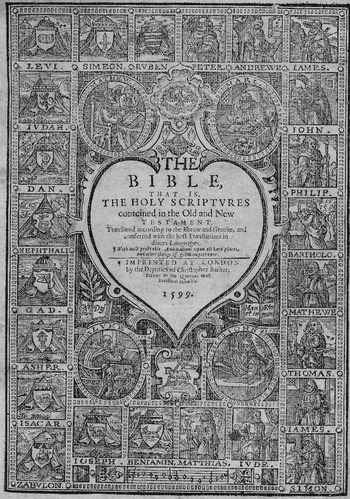
The tents of the Israelites, their collective representation, eventually came to display not only the names but also the ensigns, or tokens, of the individual patriarchs. It is unclear who first drew out these ensigns, and whether on the continent or in England, but the heraldry of the twelve tribes, together with their tents, appears for the first time in England in the frontispiece to the Geneva Bible published in London and Amsterdam in 1599 (see fig. 5).Footnote 20 The tents are again named, but now they enclose the heraldic shields.
Frontispiece to a Geneva version of The Bible, London 1599, Bodl. Lib., Bib. Engl. 1599 e.3(1), first title page. Reproduced by permission of the Bodleian Library, Oxford.

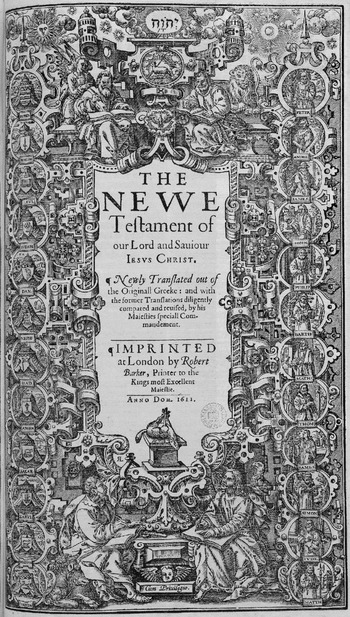
The tents frame the title on the left hand side of the design, balancing half-length images of the twelve Apostles on the right hand side. The correspondence is not fortuitous: Christ chose his twelve Apostles deliberately, and told them that they would sit on twelve thrones, judging the tribes of Israel.Footnote 21 This typological pairing of Apostles and tribes is confirmed in St John's vision of the heavenly Jerusalem: the names of the twelve tribes are written on the twelve gates of the city, analogous to their organisation round the tabernacle in the wilderness, while the twelve Apostles form the foundations of the walls.Footnote 22 This 1599 Geneva frontispiece appears in many variants from that date on, in different sized volumes, and in editions of the Bishops Bible as well.Footnote 23 While the shape of the compartments might vary, the basic juxtaposition of tribes and Apostles remains. One variant (see fig. 6) was employed in the King James Bible as the frontispiece to the New Testament, making a thematic link from the Old Testament.Footnote 24
Frontispiece to the New Testament, The Holy Bible, London 1611, Bodl. Lib., Bib. Eng. 1611 b.1. Reproduced by permission of the Bodleian Library, Oxford.

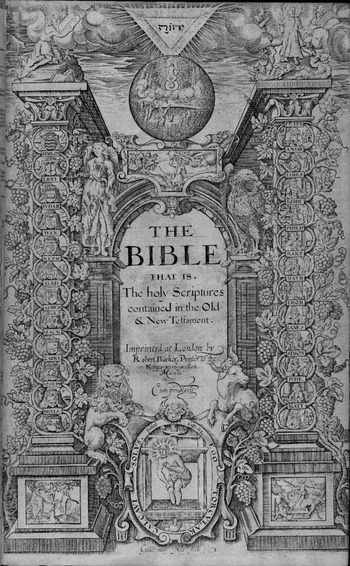
While the availability and the visual interest of the design may be reasons for its popularity with printers, the pairing of the patriarchs of the chosen people of God under the old covenant of the law, with the chosen Apostles of Christ under the new covenant of grace was clearly of significance. This is made clear in a 1607 variant frontispiece (which is also in a 1612 edition) (see fig. 7) which juxtaposes law and grace through the scenes depicted at base and above the paired columns, on which the patriarchs and Apostles hang.Footnote 25 This represents a different theological pairing from the more familiar conjunction of prophets with Apostles (or evangelists) found in pre-Reformation iconography, and used by the Roman Church in establishing papal authority. The typological pairing of patriarchs and Apostles expressed the view that the new Israel, the Reformed Church, must live under the law as well as living under grace, and in this it was particularly suited to the expression of a national Church. In another Geneva variant of the design the compartments are formed by interweaving vine branches, all stemming from a central trunk, in the manner of a Jesse tree, the medieval visualisation of the ancestry of Christ.Footnote 26 The Apostles may supersede the twelve tribes, but their ancestries originate in the twelve patriarchs, and the apostolic Church that they fostered replaced in God's favour the Israelite nation, now rejected and dispersed throughout the world.
Frontispiece to a Geneva version of The Bible, 2nd edn, London 1607. Reproduced by permission of the Warden and Fellows of All Souls College, Oxford.

III
What has been discussed so far suggests a widespread interest in the patriarchs as the lineal ancestors of the Apostles and in the Israelites as the spiritual ancestors of the true Church. That they alone of biblical figures were understood to possess God-given heraldic emblems must have widened this interest, and strengthened their potential for visualisation. Heraldry is the visual language of genealogy and the establishment of the genealogy of Christ, with an accuracy to satisfy the scholarly standards of the Renaissance, was a contemporary concern. In so doing, the prophecies of the Old Testament were confirmed and, coincidentally, the patriarchs of the Israelites were brought into prominence and a context provided for investigation of their heraldry. Genealogical lists are very common in the Old Testament and two versions of Christ's genealogy occur in the New Testament. Matthew begins his Gospel by tracing Christ from Abraham, through Judah and King David, justifying his title as ‘king of the Jews’; Luke inserts his genealogy at the moment when God announces Jesus as his son, at his baptism, tracing his ancestry back to Adam and God, and thus emphasising his divine nature.Footnote 27 Both versions trace this royal ancestry through Joseph, not Mary, but these Gospel genealogies have contradictions and lacunae, as do those in the Old Testament. Reformation scholars attempted to reconcile such inconsistencies, for an irrefutable genealogy of Christ could be used to confound rabbinical denials of his messianic nature, or the claims of false Christs.Footnote 28 In the words of Hugh Broughton, the most learned, prolific and incomprehensible writer on this subject, it was considered for Christians ‘needefull to be knowen for to strengthen our fayth’.Footnote 29 Genealogy conferred legitimacy in both sacred and secular contexts.
The popular medieval visualisation of the genealogy of Christ was through the Tree of Jesse, father of King David.Footnote 30 It varied in how many of the kingly ancestors of Christ were depicted in the branches growing up from the recumbent figure of Jesse. This depended on the space available – in windows, sculpted doorways or manuscripts, and it was usual to include some prophets among the kings. Thus lineage and prophecy together enforced Christ's humanity and his royal descent. The medieval cult of the Virgin meant that far more common than Christ alone at the apex, was a depiction of the Virgin and child. This elevation of Mary is sanctioned through prophecies, and not through the genealogies of the Old Testament or Gospels. But it was historical rather than prophetic material that Reformation scholars worked on.
The first published genealogy of Christ to appear in Reformation England formed part of the prefatory material to the first Bishops Bible, the folio of 1568. The eleven-page genealogy introduced by scholar-bishop Matthew Parker is laid out as a chart in the manner of medieval ones.Footnote 31 But every available space around is filled with notes on people, places and nations, as a running commentary on the history of the world. These densely packed pages must have baffled rather than strengthened faith, for the quarto edition published the following year (for domestic reading, rather than as a church Bible) included instead a one-page ‘A Table to make plaine the difficultie that is found in St Matthew and St Luke, touching the generation of Jesus Christ’. Nevertheless, the eleven-page version began to be inserted in the Geneva Bible too, for the first time in 1583.
Clearly the true and full genealogy of Christ was an important matter in late sixteenth-century England. When Hugh Broughton left England in 1589 he deposited his unfinished writings with John Speed, the historian and mapmaker, and it was Speed himself who produced the most popular and long lasting version.Footnote 32 In 1610 he published The genealogies of the Scriptures, according to every familie and tribe, and in the same year was granted the right to insert it in every copy of the about-to-be-published King James Bible.Footnote 33 Speed also continued to produce The genealogies as a separate book; its publishing success can be judged by the fact that, with variations in title, it went through over sixty printings by 1642.
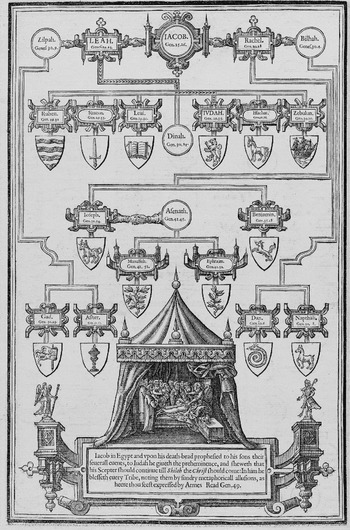
Speed's charts differ in a number of ways from those in the Bishops Bible, but what is most important paper is that the heraldic shields of the patriarchs appear (see fig. 8). Since from 1611 onwards the King James Bible became the official church Bible, fine woodcuts of the heraldry thus began to be available in parish churches throughout the country, to study and even copy, and editions of Speed's Genealogies must have existed in a great many homes, reinforcing the visibility and authority of the heraldry on bible frontispieces.
‘The genealogies of holy scriptures’: The Holy Bible, London 1611, 10, Bodl. Lib., Bib. Eng. 1611, b.1. Reproduced by permission of the Bodleian Library, Oxford.

Speed's genealogy is expanded from the Bishops Bible's eleven pages to a remarkable thirty-four, but the contextual historical material has almost disappeared. This allowed Speed to set out the hundreds of ancestors in a spacious way, each page having a clarity and visual interest quite unlike the crowded, maze-like pages of those in the Bishops Bible. With the inclusion of strap-work framing for some small illustrations and biblical citations, with the traced line of Christ decoratively elaborated, and with crowns over the names of kings or clasped hands linking married couples, these pages must have had a powerful appeal, to the eye and to the mind of those intent on understanding: ‘by the pointing of the finger they may sensibly perceive the chief points of religion and the order of them’.Footnote 34
Speed's whole organisation is also new. Rather than the chronological continuum of the Bishops Bible, Christ's ancestors are divided into family groups or tribes. For example Adam and Eve's grandsons Shem, Ham and Japheth are each given a page with their own family descendants. Page 10 is devoted to the family of Jacob (see fig. 8), each patriarch set with his heraldic shield, while beneath is a scene of Jacob's deathbed blessing. Below, in a tablet, Speed explains that Jacob ‘prophesied to his sons their seuerall euents … blessed euery tribe, noting them by sundry metaphoricall allusions, as here thou seest expressed by Armes’. The patriarchs of Israel take on a key importance denied them in the Bishops Bible, not simply because their unique heraldry marks them out, but because their descendant branches are allotted separate pages, sometimes several pages, each bearing the appropriate heraldic shield. This organisation gives a sense of the history of the Israelites (and indeed of the world from the beginning), as of families and, from the time of the patriarchs onwards, families possessed of heraldry. The final page culminates in the family of Christ, the shields of Judah tied illusionistically to two branches of the family line. Christ is shown as ‘that only absolute gentleman … perfite God and perfite man … [who] bare coate-armour by ancestry’.Footnote 35 All this must have held a particular appeal in an age obsessed by family and ancestry, and made the patriarchs seem more accessible and of major importance in the sequence of the history of God's chosen people.Footnote 36
One final and perhaps surprising element in Speed's designs is that the Virgin Mary is given prominence, both visually and in descent. Both Matthew's and Luke's genealogies of Christ are traced through David to Joseph, not Mary, and in the Bishops Bible version it is Joseph who is attached to the elaborated line of Christ, while Mary joins this line of descent from David by virtue of her marriage to Joseph, her minor line appearing quite separately, on the opposite page. In the final page of Speed's genealogy, however, Mary too is shown as descended from the Judah/David line (from a different branch), and shields of Judah are suspended from both branches. Moreover, she rather than Joseph is placed on the major line from Judah/David to Christ, and her name is in capitals, a typographical distinction reserved for major figures. Below their interlocked hands Mary is labelled ‘By nature’, Joseph ‘By Lawe’. The significance of this new Marian emphasis is beyond the scope of this paper, except in that the armigerous family of Christ becomes a visually emphatic conclusion, reinforcing the whole organisation of Speed's Genealogies. In this expression of the certainty of Christ's lineage through family and tribe the Israelite heraldry plays a prominent role, and since the layout of Speed's pages is very like visitation pedigrees recorded by Heralds, it confirms the link between sacred and secular genealogies.
IV
Sufficient evidence has so far been considered to establish the wide use of the Israel trope, and the visibility and significance of the heraldry of the twelve tribes of Israel, by the early seventeenth century. While this gives a firmly reformed context for the heraldry as church decoration, it does not explain why it was chosen by parishioners – indeed even the very decision to decorate their church walls other than with elaborately framed biblical texts. The only other visual enrichment such churches almost certainly possessed was heraldry of local grandees and, of course, the royal arms. The possession of heraldry was of limited value unless displayed – on newly erected family pews, gifted pulpits or screens. In London city churches non-armigerous parishioners, even donors, might shelter under the heraldry of their livery companies.Footnote 37 Outside London ordinary parishioners did not possess such distinguishing group identifications, but since they were repeatedly told or read that they were the children of Israel, they could and probably did feel themselves entitled to shelter under the arms of the twelve tribes. Where better to display this heraldry than in that part of the church peculiarly their own – the nave?
In the repairing of decaying churches, practical necessity was not the only consideration; social and religious forces were also in play.Footnote 38 Heraldry belonged to both social and religious spheres. In the social world, the desirability of possessing a coat of arms induced some people to go to great lengths and expense in order to acquire one from the Heralds (whether legitimately claimed or not), and visitations by Heralds to check on the status of arms displayed locally, including within the church, were regular occurrences.Footnote 39 The heraldry of the Israelites had biblical authority; and since Israel was equated with the Reformed Church, this meant that the placing of Israelite heraldry above the new Israelite members of that Church had a legitimacy far stronger than many questionable ones sought out, or even issued, by Heralds, and one with national resonances, not simply familial ones. Heraldry established social status; Israelite heraldry gave non-armigerous parishioners an equivalent, or even in some minds a superior status, because it spoke of more ancient ancestors, established with biblical authority.
In 1612, shortly after Speed's Genealogies and the King James Bible were published, a series of sermons on the twelve patriarchs of Israel by the Calvinist Francis Rollenson appeared in print. In the fifth sermon, on Zebulon, he considered the contrast of God seeing into the heart of man with man's preoccupation with worldly show:
Birth, wealth and gorgeousnesse are the objects of humane eyes; him we respect and reverence, that is an elder brother, that can shewe us his painted armes, the ensigns of his rotten antiquitie, and honourable and worshipfull alliance; to him we bow downe as the Israelites did to the golden calf.Footnote 40
The ensigns of the twelve tribes had no such ‘rotten antiquitie’. Parishioners, by laying claim to Israelite heraldry, established for themselves, as a group, a God-ordained status, in contrast to those obdurate recusants and non-conformists who stayed away from church and who were enquired about in bishops' visitation articles.Footnote 41 In this respect the heraldry expressed loyalty to Church and to nation as Church.
In his introduction to A display of heraldrie (1610), Guillim considers the ‘uses and ends’ of armorial ensigns, which he claims ‘have received approbation in the highest degree, even from the mouth of God himselfe’, and he cites the episode of the Israelites gathered round the tabernacle:
How great the dignitie and estimation of Armes ever hath beene, and yet is, we may easily conceive by this, that as they doe delight the beholders, and greatly grace and beautifie the places wherein they are erected; so also they doe occasion their spectators to make serious inquisition whose they are, who is the owner of the house wherein they are set up, of what Familie their bearer is descended, and who were his next, and who his remote Parents or Ancestors.Footnote 42
Of the surviving church paintings on the Israel theme, in most cases it is expressed exclusively through heraldry. The framed heraldic shields which decorate the nave walls of Eyam (see fig. 2), Stoke Dry (see fig. 3) and West Walton (see fig. 9C) churches would certainly, in their pristine state have ‘greatly graced and beautified the places’, and even in their present much-mutilated or over-painted condition they still ‘delight the beholders’. The set of twelve paintings on board at Harrington, Derbyshire (see fig. 1) are well conserved and form an impressive display. Unlike many churches where texts decorate the walls in a haphazard organisation, the heraldry in all these churches was clearly conceived as an ordered scheme (see figs 9A–D). At Stoke Dry the shields in the clerestory area of north and south arcades are linked by garlands; at Eyam they once circled the nave at clerestory level and on either side of the chancel and tower arches, while below are the words Jacob spoke on his deathbed, with their Genesis references. At West Walton the devices fit neatly in the spandrels of nave arches, with two on the chancel arch.Footnote 43 Such campaigns of decoration were most likely parish enterprises rather than funded by individuals.Footnote 44 So the ‘spectators to make serious inquisition’ were the very people who had paid for the work, and even if instigated by the incumbent or the churchwardens, they would have in substantial measure acquiesced in the choice of subject. The knowledge gained through their regular repetition of the Psalms and bible readings throughout the year meant that the heraldry could prompt their ‘inquisitions’, leading them through the whole history of God's dealings with his chosen race; the ubiquity of the use of the Israel parallel placed themselves as the inheritors of that special relationship.Footnote 45 On the walls was the Old Testament era of the law, and seated beneath were the recipients of New Testament grace. The heraldry is that of their spiritual ancestors, their family heraldry, and as such it had both spiritual and social value. It enriched and aggrandised that part of the church in which they sat; it gave them social status and religious identity.
Parish churches of Eyam (A), Stoke Dry (B), West Walton (C) and Prestbury (D): diagrammatic view of nave arcades. © author.

The naves of these churches, in being surrounded by the twelve tribes, take on a form reminiscent of the tabernacle in the wilderness surrounded by the tents of the twelve tribes (see fig. 4), an incident illustrated in so many Bibles and referred to in books on heraldry. There the tabernacle housed the ark of the covenant of the law; here the parishioners could, by analogy, think of themselves as tabernacles, temporary dwellings – the dwellings of their souls, similarly surrounded by the twelve tribes. They housed, as tabernacles, the covenant of grace, and lived in the hope of an eternal dwelling in heaven.Footnote 46
Of course a parish of several hundred parishioners will not all think alike, or equally deeply. Nor was this heraldry the only kind to be seen, though its visual importance would only have been challenged by a royal coat of arms. For some who recalled printed texts or sermons in which Israel was equated with the nation and also ‘mother church’, the heraldry could be seen in an overarching context, proclaiming and cementing loyalty to Church and crown just as the royal arms were intended to do. For others the heraldry could speak of pride in their church as the true Church in contrast to the Roman, or to Puritan conventicles. Godly parishioners might see an allusion limited to themselves – the saints, set aside from the undeserving who also attended services and sat beneath the heraldry, but who attended merely out of habit or coercion, unconcerned or uncomprehending of election and rejection. The heraldry also neatly sidestepped any vestiges of iconoclast distaste for figurative imagery, such as was far more likely to be employed in private or family chapels.Footnote 47 For all parishioners the decorations surely gave a dignity to their particular space, in the same manner as the space marked off and embellished by heraldry, and occupied by the lord of the manor.
None of these schemes can be securely dated, since churchwardens' accounts do not survive from the period.Footnote 48 Nor is it straightforward to date by the styles of framing, lettering or spellings used in the surrounds, not least because of over-painting. In the case of Eyam and West Walton over-painting even involved changing the positions of the tribes. However, at Stoke Dry the heraldry overlays fragments of texts, and this suggests that they replace sixteenth-century post-Reformation painting (see fig. 3). This is also true at Hartington, where the panel painting would have hung on the nave walls over earlier, and still visible, texts painted on the walls. The Hartington paintings are given a date around 1700, and the delicate decorative surrounds are obviously far later in style than the hefty strapwork and leafy framing at Eyam and Stoke Dry, which look early to mid-seventeenth century in style. The 1599 Geneva Bible frontispiece gives the earliest date when the heraldry appeared in English books and it became widespread after the publication of Speed's Genealogies and the King James Bible, in 1610 and 1611. Given this, and the uncontroversial, non-figurative nature of heraldry – an iconography for iconophobes – it is reasonable to suppose that the theme for decoration emerged in the early years of James's reign, and the example of Hartington suggests that it had a long life.
But if the heraldry of the twelve tribes of Israel could express parish adherence to a national Church, was this peculiarly appropriate and meaningful in England? The Israel metaphor was employed in other countries, in writings and sermons, and several series of engravings were produced in the Netherlands of the twelve patriarchs themselves.Footnote 49 However, no European examples of the Israelite heraldry have been located, despite the ubiquitous interest in and use of personal, civic and company heraldry. England was also unique in having a monarch as head of a Reformed Church to which the entire nation was required to conform. The monarch's position in the Church of Scotland was very different and, to say the least, contested. In Ireland, the requirement of conformity was always a lost cause. Scandinavian countries with monarchs had embraced Lutheranism, with its very different attitude to imagery in churches, while in some princely states conformity to one confession might be imposed, but the prince would be a deputy for a greater power, not the direct head of a national Church. The northern Netherlands, where the trope of Israel was commonly used, was a republic, the Reformed Church subservient to civic authority, and other confessions let to practice their faith unofficially. In parts of Hungary the Israel trope was also widely used, but there freedom of worship existed. The binding national unity of Church and State in England was unique and allows the suggestion that the heraldry represented, among other things, indivisible loyalty to Church and Crown.Footnote 50
V
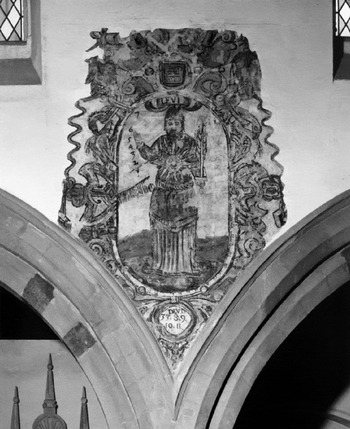
The two final examples to be considered add other dimensions to such an understanding. In both cases the heraldry is present, but now plays a minor role. That the wall-paintings at Burton Latimer and Prestbury originated in the 1630s is proved by surviving documents for the former and strong evidence for the latter.Footnote 51 The walls of Burton Latimer's nave retain the original 1633 paintings (see fig. 10). Here full-length images of the patriarchs themselves are framed in elaborate strap-work, which merely incorporates on a smaller scale the heraldry and biblical references (see fig. 11). The visual source for these figures is the series of woodcuts by Joos Lambrecht in The testamentes of the twelve patriarches (see fig. 12), which was widely available in illustrated English editions from 1574 yet seems to have been ignored as potential for church decoration in favour of the heraldry until the 1630s.Footnote 52 The introduction of the patriarchs manifests an easing by the 1630s of attitudes to figurative imagery, but it also causes a shift of emphasis within the theme. The devices of the heraldry originated in the patriarchs as individuals, but the heraldry itself (that is, the devices enclosed in a shield), identified groups, the descendant tribes and, collectively, God's chosen people. The new godly who appropriated this heraldry to themselves did so not as individuals but as a community, a self-identifying group, whether thought of as a parish, a Church or a nation. By contrast, the patriarchs at Burton Latimer are imaged as exemplary individuals of authority, in the tradition of painted prophets, Apostles or saints depicted in just such places on church walls. Of course the associations already discussed could still be deduced from the Burton Latimer paintings, but here parishioners did not sit beneath ‘their’ heraldry, for it had been returned, visually, to the individual patriarchs of the twelve tribes; Burton Latimer parishioners merely sat in their subservient, non-armigerous, places.
St Mary the Virgin, Burton Latimer: nave looking east. © Crown copyright, NMR.

St Mary the Virgin, Burton Latimer: north nave arcade, the patriarch Levi. © Crown copyright, NMR.

Frontispiece to the testament of Levi: The testamentes of the twelve patriarches, trans. A. G., London 1574, Bod. Lib., Douce L518 (2), fo. 16v. Reproduced by permission of the Bodleian Library, Oxford.

The testamentes of the twelve patriarches is a para-biblical text which had long been known in manuscript copies, probably all stemming from the thirteenth- century Latin translation from the Greek by Bishop Grosseteste of Lincoln. Because some of the testaments include prophecies of the coming of a messiah, they were seen to constitute the earliest extended prophecies by Old Testament figures. Joos Lambrecht's illustrated 1552 edition was followed by editions in various languages issuing from all the major reforming cities of Europe, usually with copies of the woodcuts.Footnote 53 The first English edition, of 1574, was published by London's foremost Protestant publisher, John Day. The translation is by Anthony Gilby, who must have known the earlier published continental books during his Marian exile in Geneva.Footnote 54 These testaments seem to have held particular interest for early Reformed scholars, but their authenticity must later have been doubted since published sermons which focus on the Israel metaphor, including those by Francis Rollenson, do not make use of The testamentes.Footnote 55 However their publication history in England, stretching through the seventeenth century, suggests that they had a wide popular appeal.Footnote 56
In The testamentes each patriarch represents a type (such as soldier, lawgiver or servant), and is also made to personify a particular vice or virtue following the characteristics described by his father Jacob. The frontispiece to each testament consists of a woodcut portrait with text above and below (see fig. 12). The text above sets out the chief quality of the patriarch with which the testament is concerned; for example Joseph's testament is ‘concerning charity and patience’, Dan's ‘concerning anger and lying’, Nepthalim's ‘concerning goodness’, Simeon's ‘concerning envy’. Verses beneath the image also characterise each patriarch, and are addressed to the reader, giving him lessons to be learned. These pages look very like emblems, designed for puzzlement and instruction. The testaments themselves are addressed to the children of each patriarch. They have a common structured pattern and describe key events of the patriarch's life – good and bad, punishments, repentances and rewards, from which he gives advice to his children on how they should live. The testaments read as exemplary deathbed confessions. The foreword to the English editions of ‘this grave and godly booke’ presents the testaments as homilies, lessons for living for all sorts and conditions of men:
art thou a Prince, a Magistrate, a Ruler, let Iuda rule thee: … Art thou a Byshop, a Minister, a preacher of Christ … behold Leuy as a Lanterne … Looke vpon Iacob, O you Paretēs, … reade them … diligently, neither read onely, but co[n]tend to follow. … So may we accompt of Jacobs blessing: so may we thoroughly chalēdge to be his Childrē, I meane, not by fleshe, but spirite.Footnote 57
For those who read these testaments, or heard them read – and their publishing history suggests it was many – they would have indeed seemed exciting as well as edifying stuff, containing as they do stories of murder, trickery, cruelty and sexual misconduct, as well as charity, forbearance and fervent faith. Imagery on church walls had always reminded viewers of matter familiar to them, rather than instructing them in the unfamiliar. It can therefore be assumed that, to a very wide audience, the figures decorating the nave could not only conjure up sensational, vivid stories but could also focus meditative minds on the lessons to be learnt from them, in much the same way as last judgement scenes must have done in pre-Reformation times.
The wall paintings at Burton Latimer were produced as part of the repair, re-furnishing and beautification of the church initiated by the newly appointed rector, Robert Sibthorpe, ‘a hard-line conformist disciplinarian who by the 1630s was the kind of cleric who gave Laudianism a bad name’.Footnote 58 He has received scholarly attention for his support of the forced loan and ship money, his anti-Puritan paranoia, and his role in imposing ceremonial conformity in the diocese of Peterborough.Footnote 59 The thoroughly Laudian character of this parish during the 1630s was due to him, and the efficiency of his churchwardens, especially George Plowright.Footnote 60
Sibthorpe must have been dismayed on arrival in April 1629 to find a church in physical decay and to be presented with churchwardens' accounts which were mere scraps of paper. But matters improved rapidly. There were hefty levies on the parishioners over the next four years, first for structural work, then new pulpit, reader's desk, elaborate font cover which rose on a pulley, new pews, chancel screen refurbished with royal arms, ten commandments and creed, chest, poor box and paving. Accounts were meticulously kept. ‘Mr Salter’, the painter, was paid for ‘oyling and gilding divers workes in the church’, and for ‘painting the church’. He received not only the large sum of £11, but an extra £2 in addition ‘Given to Mr Salter the painter for the townes beneuolence and contribution for his extraordinary performance of the painting and gilding of the church thereto assented by the p'ishons.’ Indeed, he sustained serious injury from a fall off the ladder while executing the paintings, damaging the new font cover in the process.Footnote 61
That the parisioners ‘assented’ to the extra gratuity for Mr Salter the painter, suggests their willing agreement to and satisfaction in the choice of subject for the paintings they paid for. Though the theme could have been suggested by the rector, it was just as possibly the choice of the churchwardens, though there is no way of finding out. Certainly the Israel topos was known to and used by Sibthorpe. He used the Israel metaphor in a Paul's Cross sermon, published 1618, paralleling the sins of Israel and contemporary ones (‘I could wish there were no such iniquity in Jacob nor such perverseness in our Israel’) and in his notorious Assize sermon of 1627, he refers to himself as ‘of the Tribe of Levi’.Footnote 62
The patriarch figures follow the Lambrecht woodblock illustrations fairly faithfully (see figs 11, 12), but the surrounding strapwork framing does not derive from Lambrecht and employs devices which elaborate on individual patriarchs. Zebulon, who is a harbour for ships, has sea creatures suspended from the strap-work; Gad the warrior has shields and weaponry. Levi the priest has two pelicans pecking blood from their breasts, traditional symbols of the sacrament (see fig. 11). But most significantly, because uniquely at Burton Latimer, the biblical reference beneath Levi is taken from Deuteronomy, not Genesis, thus replacing Jacob's description of Levi as ‘instrument of cruelty’, with Moses's words bestowing on the tribe of Levi their priestly role. If Sibthorpe did not choose the theme, he surely instructed Mr Salter the painter in order that Levi should appropriately represent the priesthood – ‘us of the tribe of Levi’.
Modern scholars see the passages within the testaments that contain prophecies of the coming of Christ as late insertions in a pre-Christian text, but this was not so in the Reformation. Then, the testaments provided not only exemplary lives, but were understood to contain the earliest prophesies by figures of the Old Testament.Footnote 63 So these figures of the patriarchs at Burton Latimer were not only visual equivalents of pre-Reformation figures painted on church walls, but they served similar purposes, as prophetic as well as exemplary characters.
Perhaps surprisingly, it is also possible to see relationships between these painted figures and what had been more usually found in naves in the post-Reformation period – scriptural texts accompanying the Ten Commandments and Lord's prayer. If the imaged patriarchs could act as ‘scholmaister and preacher to princes and magistrates, women and children, servants and every particular state’, so too could texts.Footnote 64 A particularly apt comparison can be made with the scheme of texts at Holdenby Church, Northampshire, where the walls of the nave and aisles are covered with biblical texts, many similarly addressed to ‘every particular state’: masters and servants, husbands and children, landowners and merchants, old men and youths.Footnote 65 Whether through figurative or verbal imagery, the walls provided food for thought about the daily conduct of a godly life.
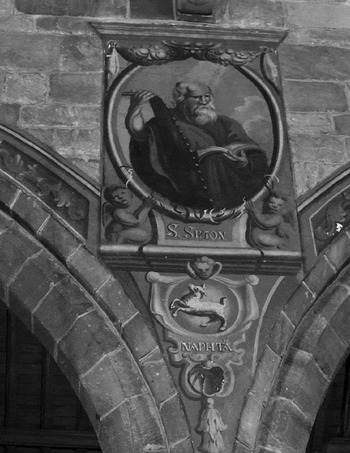
At Prestbury, Cheshire (see figs 9D, 13) the spandrels of the nave arcades are decorated with half-length figures of the Apostles, with the heraldry of the tribes of Israel beneath. These paintings are dated to 1719, which is visually plausible, but churchwardens' accounts also show that in 1636 the very large sum of £16 11s. was ‘paid to the paynters for their bewtifyinge the church’.Footnote 66 Such a large sum must have been for elaborate wall paintings, part of a general refurbishment. The rectangular shape of the eighteenth-century Apostle paintings cuts into the spandrel arches in a remarkably clumsy way (see fig. 13); it looks like awkward over-painting of something which fitted better. Though it is impossible to know what exactly was depicted in 1636, it could have been the Israelite heraldry, over-painted with the Apostles in a later era, when figurative imagery was more acceptable, the heraldry being reproduced below, on a much reduced scale. Equally possible, figures of the patriarchs, who feature at Burton Latimer, would have fitted well in the ovals now occupied by Apostles. Strap-work framing would have included their heraldry below, in the place it still occupies. The 1719 pairing of Apostles and tribes is, in any case, in the tradition, so this typological theme of so many earlier Bible frontispieces was still alive into the eighteenth century.
St Peter's Prestbury, Cheshire: north nave arcade, the Apostle St Simon, and heraldry of Naphtali. © author.

The heraldry of the twelve tribes acted as the badge of a community, identifying and proclaiming the parish as part of a chosen people, the new Israel, the Reformed Church of England, an allegiance indivisible from allegiance to the monarch. That heraldry was the means of expressing these sentiments adds a social dimension to Speed's ‘metaphoricall allusions expressed by armes’. The heraldry of the monarch, the armigerous, and – through that of the tribes – non-armigerous parishioners, and its placing in the different spaces of the church could express the ordered hierarchy of a community (and nation) just as the distribution of pew spaces did. But at Burton Latimer this heraldry and its ‘metaphoricall allusions’ have been visually relegated to a minor role in the depiction of the almost life-size exemplary and authority figures from whom the heraldry derived. The paintings remind the viewers that by avoiding the sins and following the wisdom of the patriarchs ‘we thououghly chalēdge to be his [Jacob's] Childrē, … not by fleshe, but spirite’. The claim of England as Israel which the heraldry can be seen to represent, is here made conditional, less to do with a triumphant Reformed nation than with the necessity of a nation to reform.