Many scholars have noted the rise of individualism in the United States (Bellah et al. Reference Bellah, Madsen, Sullivan, Swidler and Tipton1985). This individualist hypothesis describes a shift in how people navigate moral decision-making; in short, Americans are thought to have seized moral authority from the state, the church, and even the community. Instead of looking to institutional or collective sources of moral authority to solve ethical problems, more and more Americans look inward because the self is believed to be the truest moral arbiter.
Although an individual-guided moral system might lead to unpredictable attitudes due to the idiosyncrasies of personal experiences, most theorists tend to expect an overall “liberalizing” effect of individualism on moral attitudes (Evans Reference Evans1997; Brooks Reference Brooks2002; Baker Reference Baker2005; Starks and Robinson Reference Starks and Robinson2009). Progressivism, according to Hunter (Reference Hunter1991, 126–127), is “a form a moral authority that is uniquely shaped by and oriented toward legitimating the prevailing zeitgeist or spirit of the age,” which is decidedly individualistic. Progressivism and individualism are thus inextricably linked; as Hunter describes it, the moral logic of progressivism is expressive individualism rooted in personal experience and/or reason.
Moral individualists, then, are expected to be more open to changes in moral imperatives which reflect rigid, absolutist principles, and are characteristically leery of adhering to moral rules simply out of tradition. Instead, they privilege choice and the sovereignty of the individual. Consequently, Hunter (Reference Hunter1991) and others have argued that moral individualists will be more influenced by cultural trends which champion individual choice and question the legitimacy of traditional norms and prohibitions. In contrast, conservatives, or Hunter's “orthodox,” draw not on moral individualism, but rather from religious teachings, texts, and traditions to combat progressive trends, as seen in the cases of interracial and same-sex marriage (Rosenfeld Reference Rosenfeld2007). Indeed, conservative or orthodox religious institutions have been at the forefront in pushing back against the progressive (and individualistic) narratives associated with the sexual revolution, legal abortion, and no-fault divorce (Wilcox Reference Wilcox2004).
The individualist turn in the United States is commonly thought to be an aspect of a religious-secular divide or “God gap” in American culture and politics (see Conover and Feldman Reference Conover and Feldman1981; Jelen Reference Jelen1991; Wald Reference Wald1992; Davis and Robinson Reference Davis and Robinson1996a; Reference Davis and Robinson1996b; DiMaggio, Evans and Bryson Reference DiMaggio, Evans and Bryson1996; Olson Reference Olson and Williams1997). Yet moral individualism is so ubiquitous that it affects the moral cultures of both predominantly secular and religious communities, as well as secular and religious individuals. Indeed, Bellah et al. (Reference Bellah, Madsen, Sullivan, Swidler and Tipton1985), as well as others (e.g., Wuthnow Reference Wuthnow1988; Roof Reference Roof1993; Cherlin Reference Cherlin2009; Madsen Reference Madsen2009; Luhrmann Reference Luhrmann2012), have noted the prevalence of religious individualism in the United States, a belief that religious authority is rooted in the individual—or perhaps more precisely, one's personal relationship with God. As such, religious institutions and sacred texts which deny or contradict the cultural preferences of individualist adherents risk losing their moral legitimacy, even among those who remain active in religious communities.
Despite acknowledging the existence and prevalence of religious individualism, scholars have done little in the way of measuring it or testing its effects on moral attitudes. Some have speculated about the relationship, however (Inglehart and Baker Reference Inglehart and Baker2000; Cherlin Reference Cherlin2009). For example, Cherlin (Reference Cherlin2009) argues that religious individualism explains higher levels of divorce in the United States relative to other developed nations, despite levels of religiosity that are often associated with lower rates of divorce (Call and Heaton Reference Call and Heaton1997; Vaaler, Ellison, and Powers Reference Vaaler, Ellison and Powers2009). That is, although many Americans attend religious services at relatively high rates and claim that religion plays an important role in their daily lives, their religiosity often does not presume a moral traditionalism but rather describes a personal quest to find and know God (Madsen Reference Madsen2009). As a result, contemporary religious believers have more flexibility to craft their individual moral beliefs. Cherlin (Reference Cherlin2009), citing Wuthnow (Reference Wuthnow1998), points out that part of this individualistic turn in religion is a move toward a spiritual seeking wherein individuals mix and match religious beliefs and identities to their chosen lifestyle.
Cherlin's argument is in line with theory and evidence that emphasizes the decline of institutional religious authority in the lives of Americans (Chaves Reference Chaves1994; Reference Chaves2011; Petersen and Donnenwerth Reference Petersen and Donnenwerth1997; Kohut et al. Reference Kohut, John, Scott and Toth2000). This scholarship indicates that religious Americans are becoming less observant of the teachings of their chosen religious tradition (Chaves Reference Chaves1994). Thus, contemporary religiosity is less strongly associated with condemnation of things like premarital sex than in previous decades (Petersen and Donnenwerth Reference Petersen and Donnenwerth1997). By extension, many expect religious individualists to be more likely to hold progressive attitudes on a number of moral attitudes.
Our paper tests this claim. We analyze the extent to which the differences in individuals’ source of moral authority matter for moral attitudes, with a particular focus on those who draw on individualistic religious authority versus those who draw on institutional religious authority. We focus particularly on moral attitudes related to family life, which Hunter (Reference Hunter1991, 176) identified as “the most conspicuous field of conflict in the culture war.” Cherlin (Reference Cherlin2009) notes that, with respect to the family, the rise of individualism results in four cultural emphases: one's primary obligation is to oneself as opposed to one's partner or children, one's intimate relationships are the product of individual choices, a variety of living arrangements are acceptable, and people who are unhappy with their intimate partnerships should (or at least should be able to) end them. Each of these privileges the individual and the individual's emotional satisfaction over duty to others or conformity to external expectations or tradition and should therefore lead to more progressive attitudes toward abortion, same-sex marriage, divorce, and premarital sex. We find that having an individualistic religious authority, vis-à-vis an institutional religious one, predicts progressive attitudes on same-sex marriage, divorce, and premarital sex, but not abortion. Abortion attitudes, interestingly enough, have not become more progressive over time (Putnam and Campbell Reference Putnam and Campbell2010), suggesting this issue may be distinct from the others. Our findings suggest that religious individualism is correlated with attitudinal shifts in moral principles, making contemporary religious involvement more compatible with moral progressivism, or “the prevailing zeitgeist” of American morality.
INDIVIDUALISM, RELIGIOUS INDIVIDUALISM, AND MORAL AUTHORITY
In Habits of the Heart and elsewhere, Robert Bellah made the argument that American moral culture was becoming dominated by “two complementary aspects, utilitarian and expressive individualism” (Bellah Reference Bellah, Bellah and Tipton2006, 333). Bellah's assessment follows a long line of cultural critique dating back at least to Tocqueville's mid-19th century observation that Americans tended to be excessively individualistic and self-interested. Sorokin (Reference Sorokin1957) and Rieff (Reference Rieff2006) note similar shifts in Western morality, with an overall trajectory toward increasingly personalized sacred values. Hunter (Reference Hunter1991) argued that moral variation in the United States is most clearly understood in terms of different perceptions of moral authority (see also Woodrum Reference Woodrum1988; Jelen Reference Jelen and Williams1997; Lakoff Reference Lakoff2002; Evans Reference Evans2003). For Hunter (Reference Hunter1991), “progressives” understand morality as self-determined while “the orthodox” perceive morality as having a transcendent and immutable authority. Davis and Robinson's (Reference Davis and Robinson2006, 167) moral cosmology theory states this more precisely by positing that “because religious Orthodox are theologically communitarian in viewing individuals as subsumed by a larger community of believers subject to timeless laws and God's greater plan,” they are predisposed to traditional communitarian values. And according to many thinkers, old and new, a shift toward moral individualism has become a dominant “cultural dynamic” for the entire West (Sorokin Reference Sorokin1957; Roof Reference Roof1993; Wuthnow Reference Wuthnow1998; Putnam Reference Putnam2000; Rieff Reference Rieff2006).
In an attempt to better quantify an individual's sense of moral authority, various researchers have translated moral schemas into survey responses (e.g., Hunter Reference Hunter2000; Vaisey Reference Vaisey2009; Froese and Bader Reference Froese and Bader2010). Vaisey (Reference Vaisey2009), for example, analyzed an item from the National Study of Youth and Religion which mirrors Bellah et al.’s (Reference Bellah, Madsen, Sullivan, Swidler and Tipton1985) four-fold typology: (1) expressive individualist, (2) utilitarian individualist, (3) community-centered relationalist, and (4) theistic. The first two suggest an individualistic morality, or one based on personal concerns in the moment (progressivism). The second two indicate the reliance on more traditional forms of moral authority—respected community members or God. Vaisey (Reference Vaisey2009, 1702) found that teens with more individualist sources of morality tend “toward more ‘deviant’ and less pro-social behavior.” It is apt that Vaisey focused on adolescents because Roof (Reference Roof1993) argued that the rise of moral individualism was especially prevalent among youth, in particular those who grew up in the 1960s and 1970s. Putnam (Reference Putnam2000) also identified this era as marking a decline in traditional associations and the rise of individualized activities such as he notably put it, “bowling alone.”
This categorization of moral schemas marks a “theistic” schema as distinct from individualistic ones. This distinction, while analytically useful, is not so cut and dried. Although there are certainly differences between those who do what makes them happy (i.e., expressive individualists), those who do what helps them get ahead (i.e., utilitarian individualists), and those who do what God or scripture says is right (i.e., theists), there is also considerable variation among theists in how individualistic their moral decision-making is (Roof and Roof Reference Roof and Roof1984; Greeley Reference Greeley1988; Kellstedt et al. Reference Kellstedt, Green, Smidt, Guth, Green, Guth, Smidt and Kellstedt1996; Kniss Reference Kniss and Williams1997; Froese and Bader Reference Froese and Bader2008; Froese and Bader Reference Froese and Bader2010). Although the rise of moral individualism is often seen as compatible with or even brought on by a modern secular worldview, many scholars indicate its effect on religious systems of thought. For Bellah (Reference Bellah, Bellah and Tipton2006, 344), moral individualism is found within Western Christianity and is marked by a “near exclusive focus on the relation between Jesus and the individual, where accepting Jesus Christ as one's personal Lord and Savior becomes almost the whole of piety.” Luhrmann's (Reference Luhrmann2012) study of conservative American Christianity highlights the decidedly personalized nature of the contemporary religious experience, in which believers talk directly to God and often reference the source of religious knowledge as being in one's “heart.” She explains that “to say that something happens ‘in your heart’ means that the experience is private, personal, deeply felt, and spontaneous. At the same time, it is a claim that you feel this way because God wants you to feel this way, and that these feelings are really God's” (Luhrmann Reference Luhrmann2012, 107). In this way, moral authority is “felt” in the religious individual rather than dictated by a religious leader or sacred text.
Others have highlighted this individualistic impulse in religious Americans as well. Wellman (Reference Wellman2008) utilizes Hunter's (Reference Hunter2000) moral schemas to explain differences in the perspectives, theologies, and political agendas of liberal and evangelical Protestants. He finds that while many conservative evangelicals still respect the authority of the church, they tend to advocate a highly individualized moral project—personal salvation (see also Wuthnow Reference Wuthnow1988; Smith Reference Smith1998). Froese and Bader (Reference Froese and Bader2010) operationalize Hunter's (Reference Hunter2000) moral categories using questions about God (one of the most universal and overt symbols of moral authority). They found that individuals who believe God is a cosmic force as opposed to a more traditional character tend to feel that morality is relative to individual circumstance (Froese and Bader Reference Froese and Bader2010). For these believers, the idea of God is wholly compatible with a progressive moral outlook on issues ranging from same-sex marriage to legalized abortion.
It is likely that this type of religious individualism has been increasing over time. Bengtson, Norella, and Harris (Reference Bengston, Norella and Harris2013) note a generational shift in religious moral individualism, in particular an increased focus on being “spiritual” but not necessarily “religious.” In fact, they find that Americans born in the 1930s and 1940s make no distinction between spirituality and organized religion, while believers born in the 1980s tend to have “limited concepts of religious traditions” and tend to think that “God is whatever you want it to be” (Bengtson, Norella, and Harris Reference Bengston, Norella and Harris2013, 52). Putnam and Campbell (Reference Putnam and Campbell2010, 81) also argue that “for many Americans raised in the 1980s and 1990s, religion as they saw it around them seemed to be mostly about conservative politics and especially about traditional positions on issues of sexual morality, like homosexuality.”
In sum, scholars have noted the rise of moral individualism for decades if not centuries and more recent research has more clearly identified this cultural shift within religious spheres. Namely, a change in how Americans understand “God” and “religion” indicates that the rise of moral individualism is not dependent upon secularization. Rather, many religious believers hold progressive moral attitudes because their understanding of morality comes directly from their personal understanding of God rather than an institutionally prescribed understanding. In turn, we postulate that because religious individualism allows believers to foster personal moral preferences there will be a general tendency to embrace more progressive moral attitudes.
The Current Study
This study combines survey responses from two moral authority items to distinguish between those with institutional and individualistic religious authorities. In addition to the now common question, “If you were unsure of what was right or wrong in a particular situation, how would you decide what to do?” (see Vaisey Reference Vaisey2009), we further ask, following Christian Smith's Religious Identity and Influence Survey (1996), “What is the primary way you know how God wants you to live?” Two of our response categories—“from religious teachings” and “from the Bible”—indicate an institutional source of authority. Respondents indicate that they rely on accepted Truths provided by sacred texts or religious communities rather than a more personalized knowledge of God. More individualized ways of knowing how God wants someone to live are indicated in the responses “through human reason” and “I know in my heart or through my experience with God.” In the end, we have five distinct sources of moral authority: (1) expressive individualism, (2) utilitarian individualism, (3) community-centered relationalism, (4) religious individualism, and (5) religious institutionalism. Formally stated, we test the hypothesis:
H1:
Religious individualism, compared to religious institutionalism, will be associated with more progressive moral attitudes, net of sociodemographic characteristics and other measures of religious identity and involvement.
DATA, MEASURES, AND METHODS
Sample
The data for this study come from the fourth wave of the Baylor Religion Survey (BRS IV). The survey was an address-based sample of households in the 48 contiguous states, conducted in January 2014 by the Gallup Organization. The final sample was 1,572 respondents. The BRS and General Social Survey (GSS) 2014 respondent demographics are very similar. The mean ages in the GSS 2014 and BRS IV are 46 and 45, respectively; females comprise 53% of the BRS IV and 54% of the GSS 2014; 18% of the GSS 2014 hold a BA degree, as do 18% of the BRS IV; 46% of the respondents in the GSS 2014 are currently married, 27% are single never married, compared to 47% currently married and 25% single never married in the BRS IV. The BRS and GSS are also similar in their religious composition, though the BRS has a slightly higher percentage of respondents who attend church about weekly or weekly. Additional information about the BRS can be found at http://www.baylor.edu/baylorreligionsurvey.
To account for missing values, we rely on multiple imputation techniques to create 25 data sets. The dependent variables were used to impute values for independent values, but we did not impute values for the dependent variables themselves. There was at least one missing value on 22% of the observations, though only 8% had more than one missing value. The variable with the most missing values is the race-ethnicity variable, with 6% (91) missing values.
Measures
Dependent Variables
The dependent variables for this study are four measures of attitudes about social issues: abortion, same-sex marriage, divorce, and premarital sex. With respect to abortion, respondents were asked, “How do you feel about the morality of the following? Abortion, if the family cannot afford the child.” Respondents could choose “always wrong,” “almost always wrong,” “only wrong sometimes,” and “not wrong at all.” We dichotomize this outcome such that 1 = only wrong sometimes/not wrong at all and 0 = always wrong/almost always wrong. We opt to include analysis of this abortion attitudes variable, and not a similar variable about the morality of abortion if the pregnancy is the result of rape, because abortion in the context of rape is often considered an extreme position. Nevertheless, ancillary analysis of this additional abortion variable produced results substantively identical to those presented here.
The same-sex marriage measure indicates level of agreement with the statement, “Gays and lesbians should be allowed to legally marry.” Those who strongly agree or agree are coded 1; those who strongly disagree or disagree are coded 0. The divorce item is a similar measure of agreement, this time with the statement, “Divorce is usually the best solution when a couple can't seem to work out their marital problems.” Respondents are coded such that those who strongly agree or agree with this statement are coded 1, and those who disagree or strongly disagree are coded 0.
The last dependent variable, premarital sex attitudes, is similar to the abortion item described above, where respondents were asked how they felt about the morality of “premarital sex.” Those who said it was only wrong sometimes or not wrong at all are coded 1; those who said it is always wrong or almost always wrong are coded 0. Thus, all four dependent variables are coded such that a response of 1 represents a more permissive, liberal, or progressive position on the issue in question. Models treating these variables as four-category ordinal variables (i.e., ordered logistic regression models) produced substantively similar results to those presented here.
Key Independent Variable
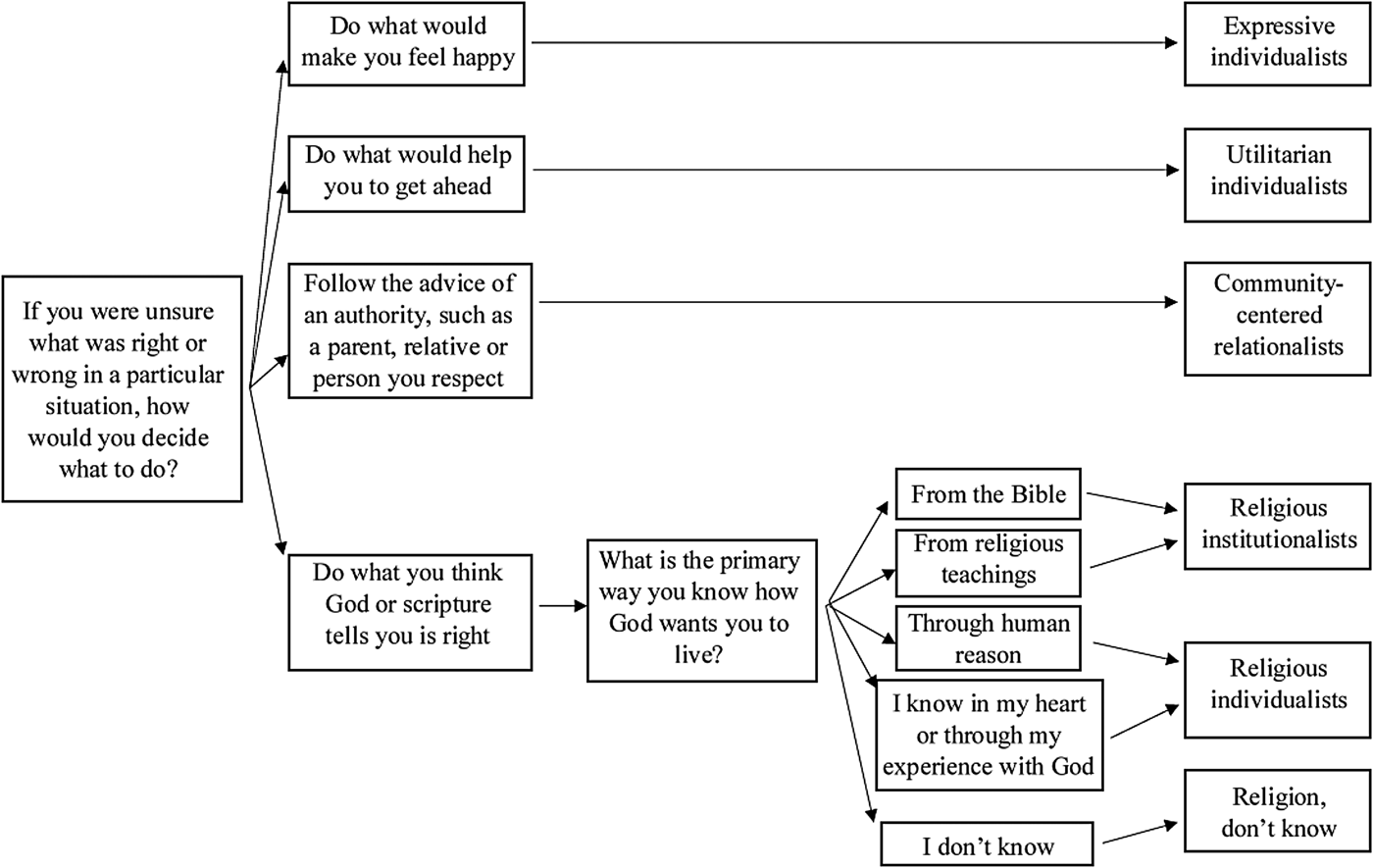
The key independent variable combines two measures of moral authority. BRS IV respondents were asked, “If you were unsure of what was right or wrong in a particular situation, how would you decide what to do?” Respondents could choose “Do what would make you feel happy” (i.e., expressive individualists), “Do what would help you to get ahead” (i.e., utilitarian individualists), “Follow the advice of an authority, such as a parent, relative, or person you respect” (i.e., community-centered relationalists), or “Do what you think God or scripture tells you is right” (i.e., theists). We found that respondents choosing this last option (49% of our sample) are religiously very diverse. To better gauge differences within this group, we additionally asked, “What is the primary way you know how God wants you to live? Choose the best answer that applies to you?” Respondents could select “From religious teachings,” “From the Bible,” “Through human reason,” “I know in my heart or through my experience with God,” and “I don't know.” We consider the first two responses—from religious teachings and from the Bible—to reflect an appeal to institutional religious authority. We consider the next two responses—through human reason and I know in my heart or through my experience with God—to be individualistic approaches to religious authority. Notably, the vast majority of this individualistic group falls into the latter “know in my heart” category; only about 9% of the respondents in this group chose the human reason option. We create another category for those who said they make decisions based on what God or scripture says but “don't know” how they know how God wants them to live. Thus, we split the “theist” category into three: (1) religious institutionalists, (2) religious individualists, and (3) religion, don't know.
The individualistic-institutional divide among theists is not necessarily a clear one. While many theists who responded that they know God “in my heart” are religious conservatives by other measures, and may actually be in keeping with their religion's teachings by drawing on their relationship with God, we consider this response as individualistic due to the conceptual sense that knowledge of God's will is individually gained or at least is gained outside the context of institutional religion. This option is chosen above the option of following the teachings of one's religion, so when forced to choose between an institutional and personal explanation, the respondent has opted for the personal one. Additionally, respondents reporting they navigate moral conjunctures based on “the Bible” as their source of moral authority may also have their attitudes shaped by individualism as most of American Protestantism encourages adherents to interpret the Bible for themselves. Thus, we recognize there is some conceptual ambiguity to the institutional and individualistic approaches in these items. This ambiguity aside, we consider people who acknowledge an external source of authority like the Bible or religious teachings to be distinct from those who discern what God would have them do entirely within themselves or in a personal relationship with the divine.
Thus, we use a six-category variable with responses for each source of moral authority: (1) expressive individualists (15% of the sample), (2) utilitarian individualists (4% of the sample), (3) community-centered relationalists (32% of the sample), (4) religious institutionalists (31% of the sample), (5) religious individualists (18% of the sample), and (6) religion, don't know (<1% of the sample). Appendix Figure A1 provides a visual representation of how this variable was constructed. Religious individualists (18%) serve as the reference category in our regression models, allowing us to compare them to those who draw on other religious and non-religious sources of authority. Because it is such a small group and is impossible to interpret, we do not interpret or discuss the findings for the “religion, don't know” category.
Control Variables
We include a number of sociodemographic and religious variables in order to isolate the independent effect of religious individualism on attitudes toward social issues. We control for gender, age, political liberalism (coded 1–7 with higher responses indicating higher political liberalism), race-ethnicity (White, Black, Hispanic, and other), educational attainment, region of residence, and marital status.
We also include several religious control variables. First, we include dummies for religious tradition following the Steensland et al. (Reference Steensland2000) coding scheme. We have categories for evangelical Protestants, mainline Protestants, black Protestants, Catholics, “other religious tradition,” and no religious tradition. Jewish respondents are included in the “other religious tradition” category due to small cell sizes.
We also include a dummy system measuring beliefs about the Bible—whether it should be taken literally, is true but shouldn't be taken literally, contains some human error, is a book of history or legend, or don't know. We control for frequency of religious service attendance (coded 0–8) and religious salience (coded 1–4) as well.
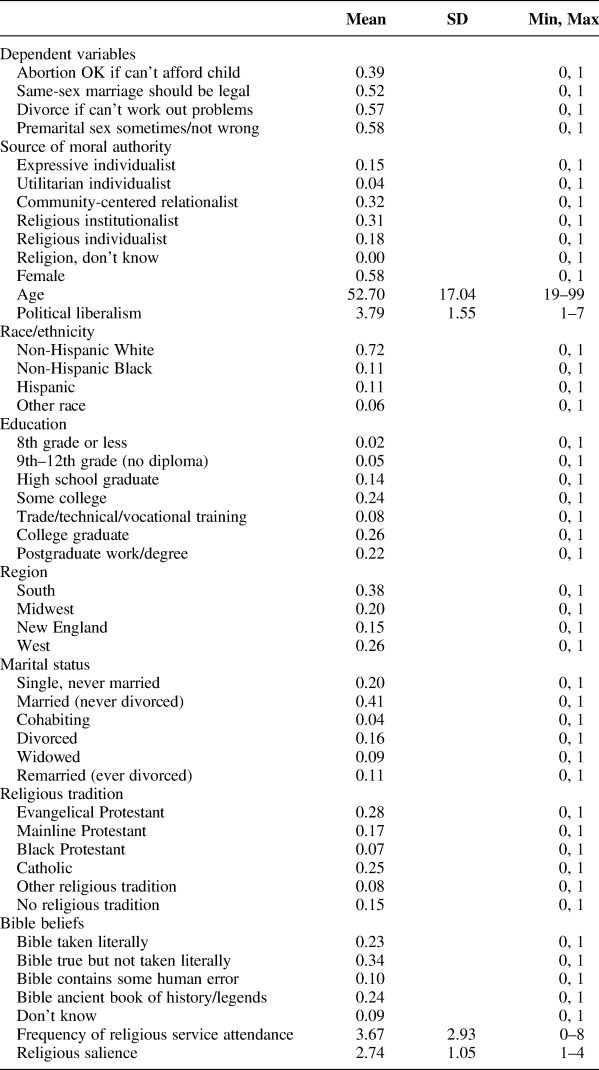
Descriptive statistics for all study variables are presented in Table 1.
Descriptive statistics for all study variables

N = 1,572.
Note: N’s for dependent variables are 1,500 (abortion and same-sex marriage), 1,522 (divorce), and 1,514 (premarital sex).
Analytic Approach
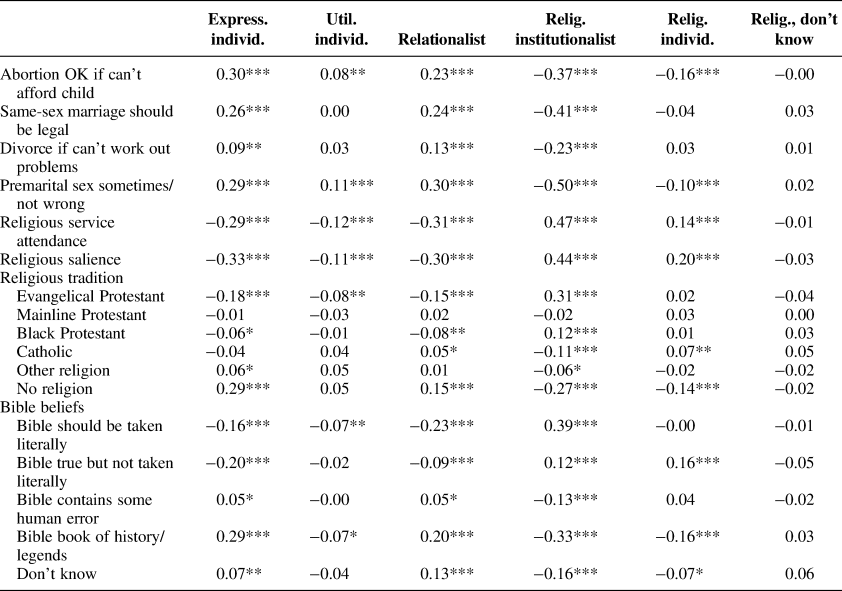
We begin by reporting correlations among sources of moral authority, the dependent variables, and the religious control variables. We pay particular attention to the individualistic religion column in comparison to the institutional religion column in order to assess how these may be differentially associated with both the dependent variables and the religion variables, and how closely linked the individualistic religion response is to other religious characteristics.
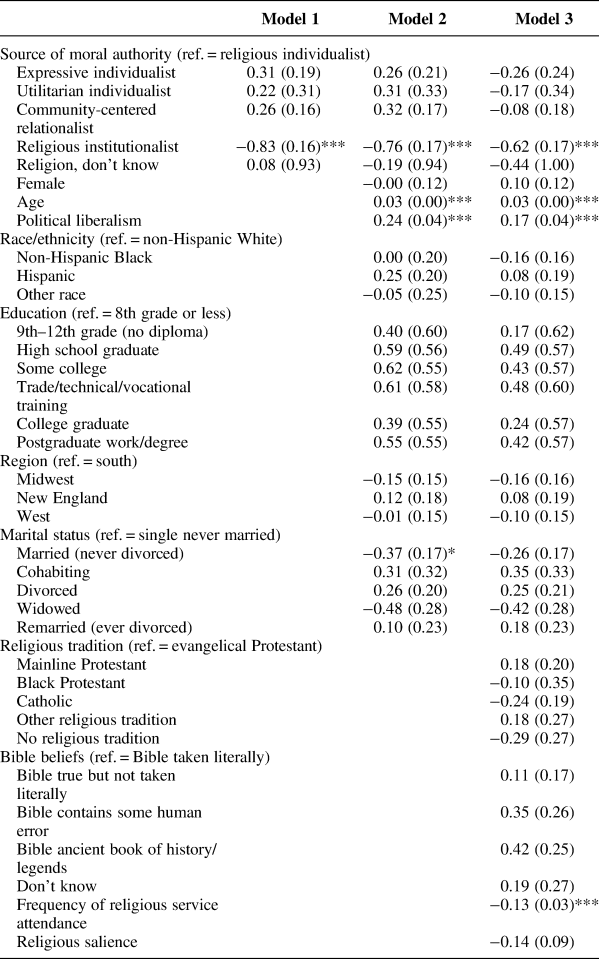
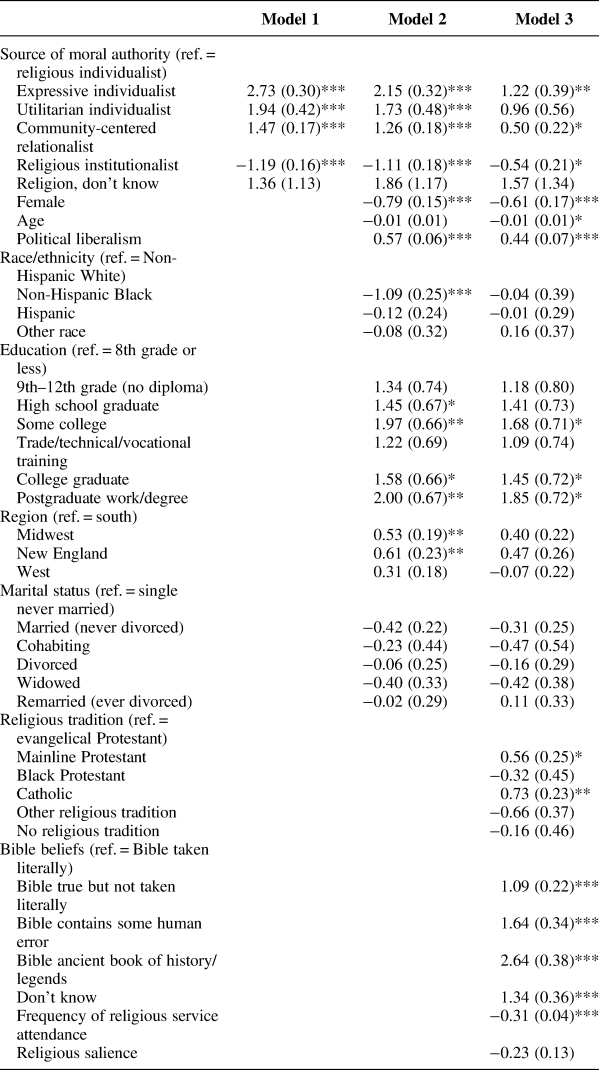
After providing these descriptive statistics, we present tables of coefficients from logistic regression models predicting a progressive stance on each of the four dichotomous outcomes: abortion (Table 3), same-sex marriage (Table 4), divorce (Table 5), and premarital sex (Table 6). Each of these tables includes three models per outcome. The first model for each outcome includes only the moral authority dummy system. The second model adds the sociodemographic controls. The third model adds our religion variables: religious service attendance, religious salience, Bible beliefs, and religious tradition.
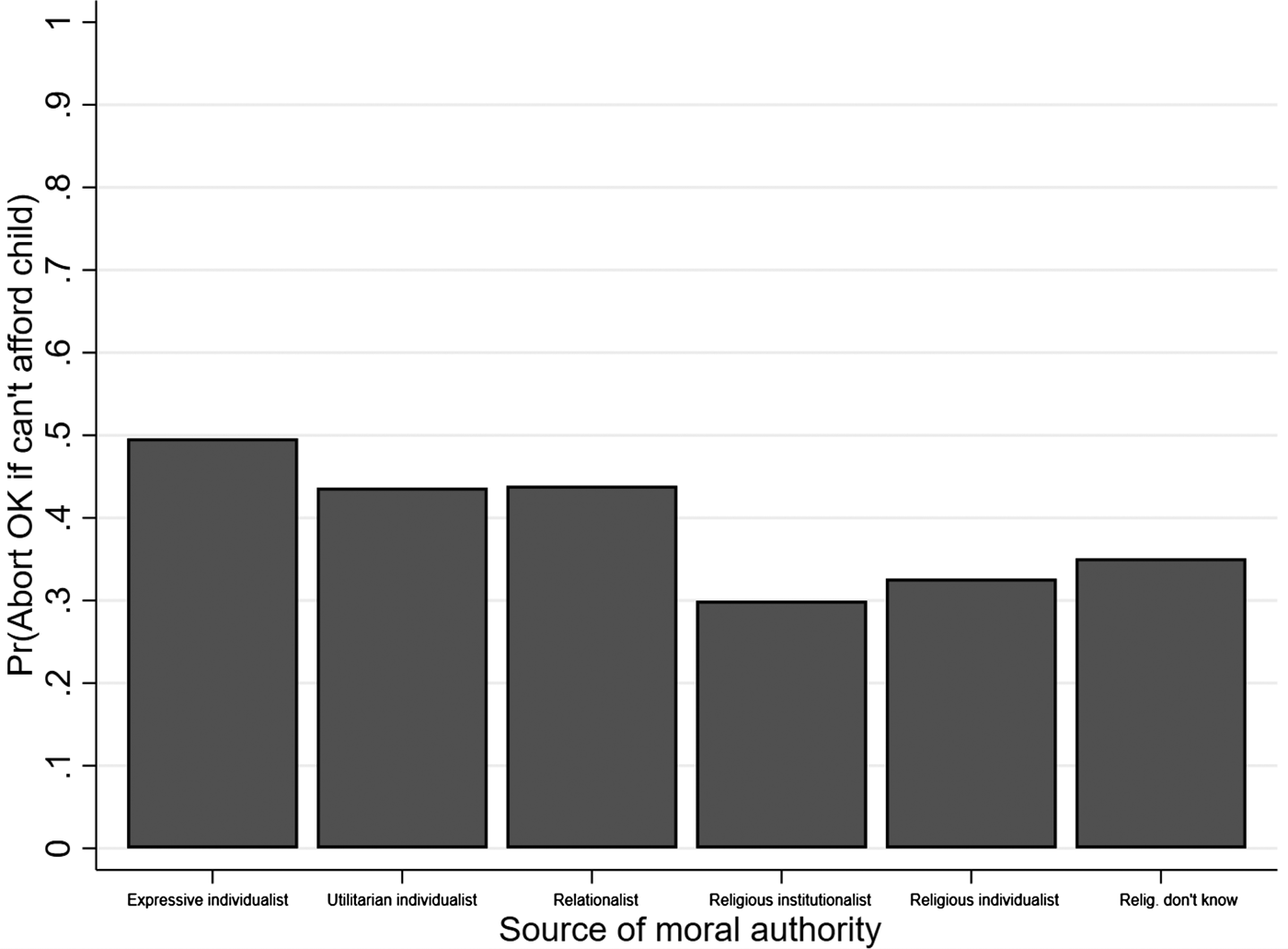
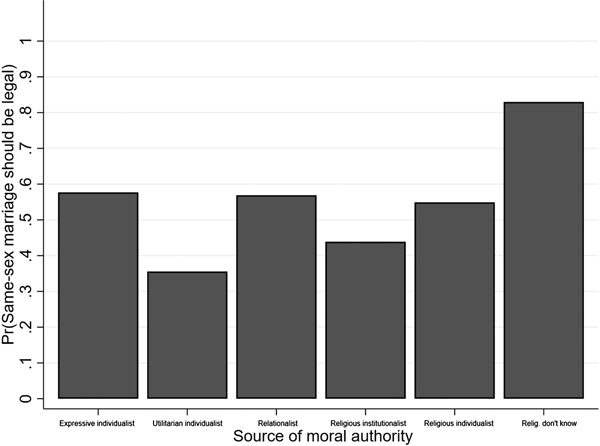
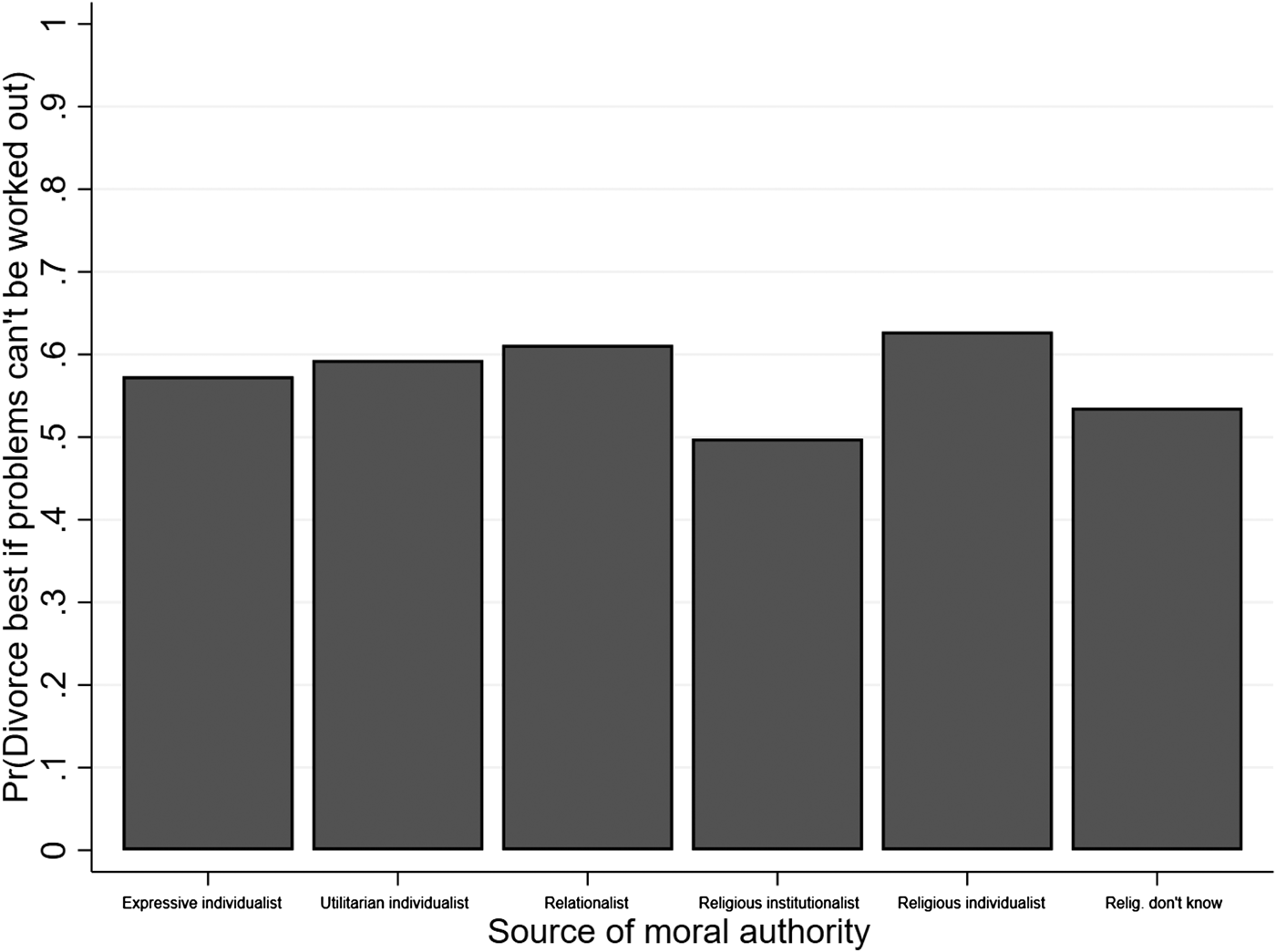
In order to help with interpretation of the substantive significance of the effects, we also present predicted probabilities of each outcome by the sources of moral authority in Figures 1–4. We present average adjusted predicted probabilities. Average adjusted predicted probabilities use the observed values of all independent variables and vary the source of moral authority to calculate a predicted probability for each respondent for each category of source of moral authority; the predicted probabilities for each category are then averaged across all respondents.
Average predicted probability of agreeing abortion is OK if family cannot afford child by source of moral authority (N = 1,500). Probabilities predicted based on estimates from Model 3 of Table 3, using values of covariates as observed

Average predicted probability of agreeing same-sex marriage should be legal by source of moral authority (N = 1,500). Probabilities predicted based on estimates from Model 3 of Table 4, using values of covariates as observed

Average predicted probability of agreeing divorce is best solution when can't work out differences by source of moral authority (N = 1,522). Probabilities predicted based on estimates from Model 3 of Table 5, using values of covariates as observed

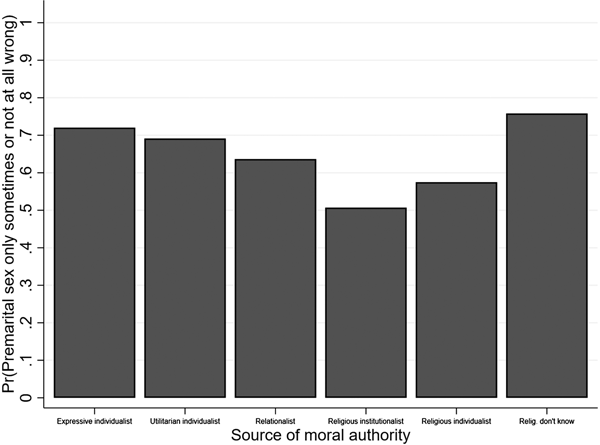
Average predicted probability of believing premarital sex is only sometimes or not at all wrong by source of moral authority (N = 1,514). Probabilities predicted based on estimates from Model 3 of Table 6, using values of covariates as observed

We present unweighted results because the variables used to construct the weight are included as controls in the multivariate analysis (Winship and Radbill Reference Winship and Radbill1994).
RESULTS
Table 2 reports correlations among our key variables. We focus here on the institutional and individualistic religious authority categories. Institutional religious authority is associated in expected ways with the dependent variables: all four correlations are negative and statistically significant. Additionally, it is strongly and positively correlated with religious service attendance and religious salience, being evangelical Protestant, and believing the Bible should be taken literally. Individualistic religious authority, however, is only weakly and negatively associated with abortion attitudes and premarital sex attitudes, and not significantly associated with same-sex marriage and divorce attitudes. It is also only weakly correlated with religious service attendance and religious salience. It is not significantly correlated with either evangelical Protestant affiliation or biblical literalism. These bivariate associations suggest both that individualistic religious authority is differently associated with social attitudes vis-à-vis institutional religious authority, and that it is not highly correlated with more traditional measures of religion. The strongest correlation between individualistic religious authority and any of the religion variables is only 0.20 (religious salience).
Correlations among sources of moral authority, dependent variables, and religion variables

***p < 0.001; **p < 0.01; *p < 0.05.
Note: N’s for correlations with dependent variables (for which missing values were not imputed) are 1,500 (abortion and same-sex marriage), 1,522 (divorce), and 1,514 (premarital sex).
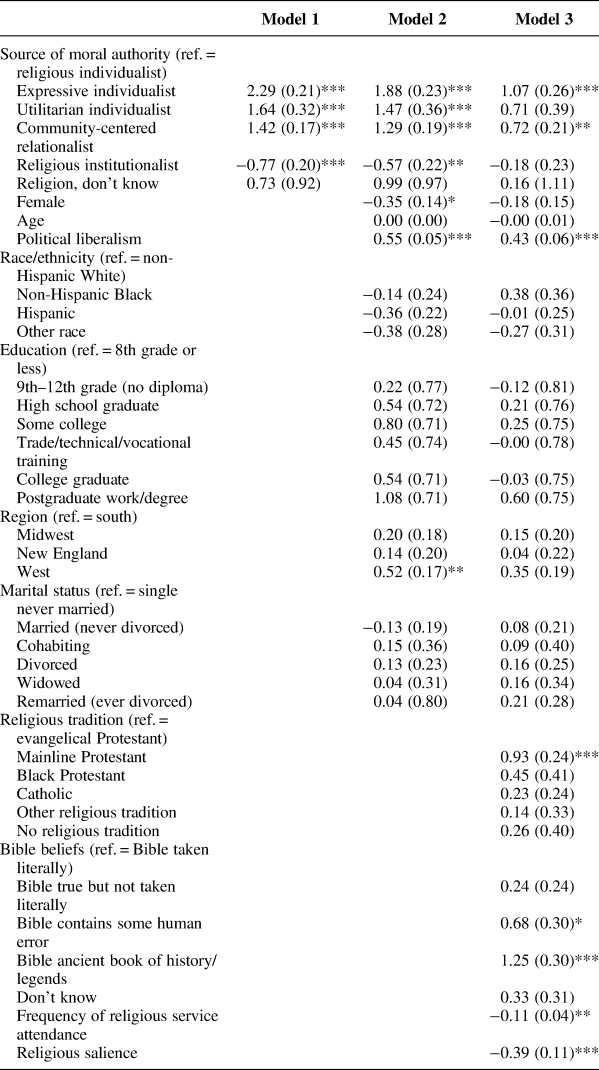
Table 3 reports coefficients from logit regression models predicting liberal attitudes toward abortion in the case of financial difficulties. The individualistic religious authority category is the suppressed reference category. Model 1 shows significant differences between individualistic religious authority (e.g., religious individualists) and each of the other sources of moral authority (except for the “Religion, don't know” category, which is less than 1% of the sample). Most significantly, those who navigate moral conjunctures based on institutional religious authority (e.g., religious institutionalists) are significantly less likely to agree that abortion is acceptable when a family cannot afford a child. In terms of odds ratios (e−0.77 = 0.46), they have 54% lower odds of agreeing with this statement than do those who appeal to an individualistic religious authority. Those who navigate moral decision making by doing what makes them happy (e.g., expressive individualists), what helps them get ahead (e.g., utilitarian individualists), or by appealing to an authority figure or respected person (e.g., community centered relationalists) are all more likely than religious individualists to report that abortion under these circumstances is acceptable. In Model 2, once sociodemographic controls are added, the differences by source of moral authority are reduced, but still statistically significant and in the same direction. Once religious control variables are introduced in Model 3, however, the difference between religious institutionalists and religious individualists disappears. The differences across all sources of moral authority are illustrated as predicted probabilities in Figure 1.
Coefficients (standard errors) from logit regression models regressing abortion OK if family cannot afford child on sources of moral authority and other controls (N = 1,500)

***p < 0.001; **p < 0.01*p < 0.05.
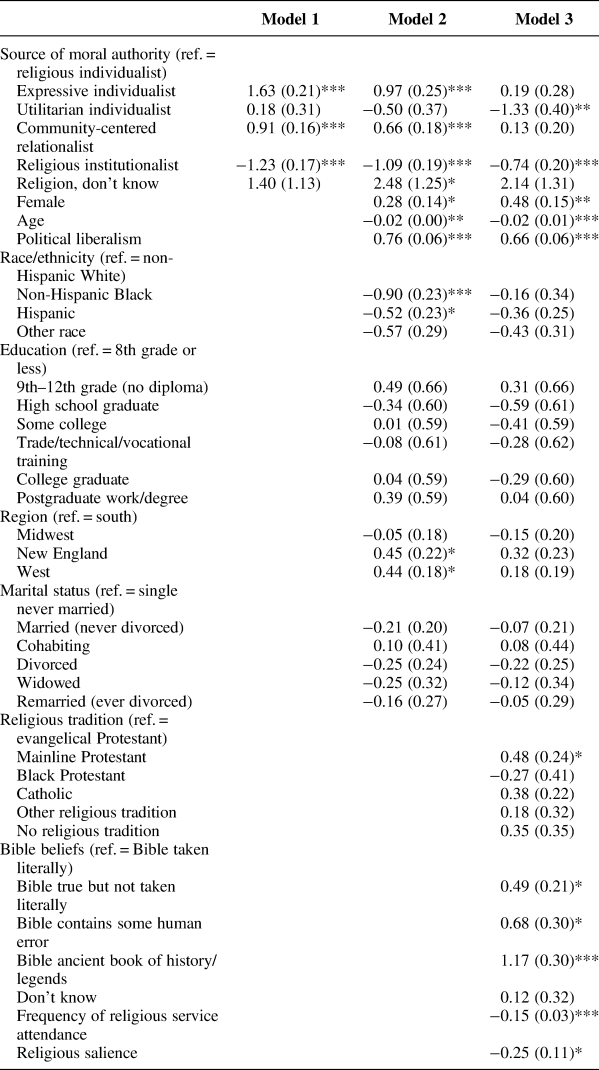
Table 4 presents coefficients predicting agreement that same-sex marriage should be legal. Model 1 reveals that religious institutionalists are less likely than religious individualists to agree that same-sex marriage should be legal. The difference is considerable. In terms of an odds ratio (e−1.23 = 0.29), those guided by institutional religion have 71% lower odds of agreeing same-sex marriage should be legal than do those guided by individualistic religion. Expressive individualists and community centered relationalists are more likely than religious individualists to say same-sex marriage should be legal. Model 2 adds sociodemographic controls, and as with the previous table analyzing abortion attitudes, the controls reduce but do not eliminate the moral authority effects seen in Model 1. Model 3 includes the religion control variables, and though these traditional religion variables are clearly associated with attitudes about same-sex marriage, the difference between those guided by institutional religion and those guided by individualistic religion remain. As seen in Figure 2, adjusting for all the control variables in Model 3, religious individualists have a 0.55 probability of agreeing same-sex marriage should be legal, compared to just a 0.44 probability for those who appeal to institutional religion. Religious individualists are virtually indistinguishable from expressive individualists or community centered relationalists. Interestingly, utilitarian individualists are the least likely to support same-sex marriage, with an adjusted average probability of just 0.36.
Coefficients (standard errors) from logit regression models regressing same-sex marriage should be legal on sources of moral authority and other controls (N = 1,500)

***p < 0.001; **p < 0.01; *p < 0.05.
Table 5 presents results predicting agreement that divorce is the best solution for a couple when they are unable to work out their differences. In Model 1, the only significant difference observed is between those guided by institutional religion and those who are guided by individualistic religion, with the former being less likely to agree divorce is the best solution. This relationship holds across all three models. As Figure 3 shows, the difference between these two groups is sizable after accounting for control variables: religious individualists have a 0.63 probability of agreeing that divorce is the best solution to irreconcilable differences, but those who are guided by the Bible or religious teachings have only a 0.50 probability of agreeing with this sentiment.
Coefficients (standard errors) from logit regression models regressing divorce is best solution when can't work out differences on sources of moral authority and other controls (N = 1,522)

***p < 0.001; **p < 0.01; *p < 0.05.
Table 6 presents results predicting permissive attitudes about premarital sex. In Model 1, we see that religious individualists are distinct from those who draw on any of the other four major sources of moral authority. Religious individualists are less permissive about premarital sex than those who do what makes them happy, what helps them get ahead, or what an authority figure or respected person says. They are more permissive, however, than those who draw on the Bible or religious teachings. These effects are reduced as sociodemographic controls are added in Model 2, and reduced further in Model 3 when religion variables are added, but religious individualists remain statistically different from expressive individualists, community centered relationalists, and religious institutionalists. Figure 4 illustrates these effects. Expressive individualists have a 0.72 probability of having permissive attitudes about premarital sex, compared to 0.69 for utilitarian individualists, and 0.64 for community-centered relationalists. The probability for religious individualists is lower at 0.57, but lower still at 0.51 for those who draw on institutional religion.
Coefficients (standard errors) from logit regression models regressing premarital sex is wrong only sometimes or not at all on sources of moral authority and other controls (N = 1,514)

***p < 0.001; **p < 0.01; *p < 0.05.
Ancillary Analyses
Some religious traditions, especially within evangelical Protestantism, encourage their adherents to focus on their relationship with God. Because of this, we might expect that religious individualism functions differently in institutional religions that are themselves more individualistic. To test for this, we ran all our full models including multiplicative interaction terms between a dummy variable for evangelical Protestants and the moral authority variables. We opted for a single dummy variable rather than the full RELTRAD dummy system to compare evangelical Protestants versus all others for theoretical reasons (i.e., they are more likely to emphasize one's personal relationship with God than other traditions), and in order to retain large enough cell sizes to detect statistically significant differences across groups. Even so, none of the interaction terms for religious institutionalist X evangelical Protestant (or interactions between evangelical Protestant and any of the other moral authority categories) were statistically significant, suggesting religious individualism functions similarly for evangelical Protestants and for others.
In addition to the interaction coefficients, we also considered whether the effects—particularly for religious institutionalists versus religious individualists—held for both non-evangelicals and evangelical Protestants. Among non-evangelicals, we found statistically significant and negative effects of religious institutionalism (vis-à-vis religious individualism) on same-sex marriage, divorce, and premarital sex but not abortion—just as we did among the full sample. The effects of religious institutionalism for evangelicals—which again are not significantly different from the effects for non-evangelicals per the nonsignificant interaction terms—are negative but only marginally significant for same-sex marriage (p = 0.054), are negative and statistically significant for divorce (p = 0.004), and are negative but not statistically significant for premarital sex (p = 0.241) and abortion (p = 0.348). Although the results among evangelicals for same-sex marriage and premarital sex are not statistically significant at an alpha level of 0.05, we do not believe this means that religious individualism does not matter for these attitudes among evangelical Protestants. Rather, we strongly suspect that this is merely the effect of a reduced cell size as evangelicals comprise only 28% of the sample. We suspect this for two reasons. First, the effects of religious institutionalism remain sizable among evangelicals (coefficients of −0.68 for same-sex marriage and −0.45 for premarital sex, compared to coefficients of −0.83 and −0.61 for non-evangelicals). Second, the interaction terms in these models have very large p-values (0.73 in the same-sex marriage model and 0.72 in the premarital sex model), giving us very little indication that religious individualism is functioning differently among evangelicals for these outcomes. A table of these interaction models is available upon request from the first author.
We also ran models interacting religious service attendance and the moral authority variables. The attendance-moral authority interactions were not significant for abortion, same-sex marriage, or premarital sex attitudes. The results for our divorce outcome suggest that religious individualism is not a significant predictor for those who never attend church, but religious individualists increasingly distinguish themselves as more progressive on divorce than religious institutionalists as their religious service attendance increases. In other words, for divorce attitudes, religious individualism matters most, vis-à-vis religious institutionalism, among those who are actively involved in religious communities.
In addition to testing for differences across groups, we tested whether breaking out religious individualists from religious institutionalists improved our model fit. That is, we sought to identify whether this additional piece of information helped explain the overall variation in social attitudes. We did this in two ways that are appropriate for comparing non-nested models: by comparing the Bayesian information criterion (BIC) between the two models (Raftery Reference Raftery1995), and by comparing the area under the receiver operating characteristic curve (AUC) for each model (Cleves Reference Cleves2002). Using both methods, the model with religious individualists broken out is preferred for the same-sex models. The BIC is 4.250 lower for the model with religious individualists, which constitutes positive support per Raftery's (Reference Raftery1995) guidelines. The AUC improves from 0.8795 to 0.8833 when the theist category is subdivided, which is a statistically significant improvement at p < 0.05. The simpler models with theists grouped together are preferred (or are not significantly worse) for the other three outcomes using both methods. When we drop the “religion, don't know” respondents from the model (because they are a small, ambiguous group that is using up a degree of freedom without benefit), comparing the BIC across models results in strong support for the split of theists for the divorce outcome and support for the theist split improves to strong support, from positive support, for the same-sex marriage outcome. Thus, we have modest support that for two of these issues—same-sex marriage and divorce—our measure of religious individualism contributes significantly to our overall understanding of these attitudes.
DISCUSSION
We hypothesized that religious individualism would be associated with more progressive moral attitudes even among those who base their moral decision-making on theistic considerations (H1). We found support for our hypothesis with respect to attitudes toward same-sex marriage, divorce, and premarital sex, but not abortion.
Our analyses support Hunter's (Reference Hunter1991) “culture wars” thesis that moral differences within the American population are often rooted in different understandings of moral authority (see also Williams Reference Williams1997). This conceptual divide exists between those who believe in a moral order prescribed by an absolute authority (orthodox) and those who believe that moral truth is found through subjective intuition (progressivists or individualists). Hunter argued that the orthodox would champion the decrees of sacred texts and established leaders while individualists would eschew inherited values in favor of the current moral zeitgeist. The underlying logic of the argument, as expressed by numerous thinkers, is that moral individualism legitimates the breaking of traditional rules when they come into conflict with contemporary standards or knowledge. In particular, the moral logic of expressive individualism prioritizes individual happiness with respect to intimate relationships (Cherlin Reference Cherlin2009). In the United States today, progressive attitudes on issues of same-sex marriage, divorce, and premarital sex (but not abortion) have all grown in popularity as individualist logic has become more pervasive (Mouw and Sobel Reference Mouw and Sobel2001; Jelen and Wilcox Reference Jelen and Wilcox2003; Putnam and Campbell Reference Putnam and Campbell2010). Shifting beliefs about homosexuality are the most dramatic example of how a cultural zeitgeist can change, one which now openly discusses the re-assessment of traditional attitudes toward sexuality (Loftus Reference Loftus2001).
But orthodox and progressive camps do not fall neatly along a religious and secular divide. Moral individualism characterizes individuals within even orthodox religious communities. Indeed, our central claim is that moral individualism is a cultural trend that crosses the secular-religious divide. While moral traditionalists tend to be highly religious, there is a substantial percent of the American public who are both highly religious and morally individualistic. These religious individualists (18% of our sample) are also more morally progressive, “discovering” in their hearts that God is not as opposed to same-sex marriage, divorce, and premarital sex as their forebears once thought.
The hidden irony to moral individualism is that personal moral preferences remain largely a product of collective social forces. The difference is that popular moral attitudes are not codified in sacred texts or believed to be the sole domain of institutional authorities, but rather emanate from a cultural ether which communicates values through social networks and media in non-hierarchical ways. Consequently, increasingly progressive attitudes toward divorce, pre-marital sex, and same-sex marriage are still based in external authority structures, but simply ones that are not identified as absolute, inflexible, or rooted in the past.
Our findings are consistent with the idea that religious individualism explains the apparent contradiction between high religiosity and high divorce rates in the United States (Cherlin Reference Cherlin2009), and also with the idea that institutional religious authority has declined over time, resulting in things like more liberal attitudes toward sex (Chaves Reference Chaves1994; Petersen and Donnenwerth Reference Petersen and Donnenwerth1997). Religious individualism, then, is one way individuals are able to maintain a salient religious identity even as their attitudes and behaviors begin to oppose traditional understandings of religious texts and teachings. Our findings link religious individualism and progressive attitudes, but future research may seek to link religious individualism to non-traditional behaviors, as Cherlin (Reference Cherlin2009) speculated but did not test directly.
We should caution that our measure of religious individualism explains only a modest amount of variation in progressive attitudes. We suspect that a more refined measure of religious individualism would uncover a much higher proportion of the population turning ultimately to individualistic reasoning, whether it be through an individualized interpretation of Scripture, a selective appropriation of the teachings of one's religion, or some other means. That is, we suspect our measure here—while a solid step toward identifying religious individualists in a nationally representative sample of adults—underestimates the number of religious individualists. Thus, we stop short of a full-throated endorsement of Cherlin's (Reference Cherlin2009) explanation for high divorce rates among religious Americans, even as our findings are consistent with such an explanation.
Progressive attitudes toward abortion, unlike those toward same-sex marriage, divorce, and premarital sex, are not more popular among religious individualists than religious traditionalists (net of other characteristics). This is the case when we look at the morality of abortion for financial reasons (as we have shown above) or when we look at the morality of abortion in the context of rape (results not shown). Unlike attitudes toward same-sex marriage, divorce, and premarital sex, Americans’ support of abortion has actually declined over time (Putnam and Campbell Reference Putnam and Campbell2010). Thus, a shifting cultural zeitgeist toward liberal abortion attitudes is not discernable.
Indeed, Putnam and Campbell suggest that abortion is a more nuanced issue than these other issues, with abortion finding more or less support depending on the circumstance in question. They further suggest that abortion can be viewed as a failure of individual responsibility (to contracept) and abortion cast as a way to avoid the consequences of one's actions in ways that other issues cannot. Moreover, technological advancements like ultrasound photos may give credence to the pro-life narrative of the fetus as an unborn child. Understanding abortion as a violation of the rights of the unborn may also tap into individualistic understandings in powerful ways; even though adults’ emotional well-being may be improved by having an abortion it is not sufficient justification in the minds of many to terminate the right to life of an unborn child. Although similar arguments about child well-being have been made to oppose divorce and same-sex marriage, the modest negative effect of divorce on child well-being (Amato Reference Amato2005) and the dearth of findings showing differences between children raised by opposite-sex and same-sex parents (APA 2010) may not strike Americans as compelling enough to trump the emotional well-being of the adults involved.
It could also be that the lack of liberalization in abortion attitudes means religious individualists do not perceive any need to update or re-evaluate a traditional religious perspective. In other words, the theorized connection between religious individualism and moral progressivism might be wholly dependent on larger cultural shifts; this seems to be the case with regard to divorce, premarital sex, and same-sex marriage. Religious individualists might be more open to changing mores, but they do not automatically question or reject traditional attitudes without new cause. Whatever the reason(s), religious individualism is not associated with progressive abortion attitudes like it is with other progressive attitudes.
We should note a couple of limitations to our research. First, as already mentioned, labeling people as “religious individualists” or “religious institutionalists” based on their answer to a survey question does not mean that personal experiences or critical thinking do not serve as sources of religious authority for religious institutionalists. As described above, those we have categorized as religious institutionalists may still have individualistic impulses. For instance, traditional believers employ their own interpretive frame to understanding what the Bible says—a process common in traditions such as Pentecostalism. Believers also pick and choose their preferred religious teachings from their tradition based on personal inclinations. Thus, religious institutionalists can certainly be individualistic in many ways. But we believe that an appeal to external religious authorities (such as the Bible or religious teachings) signals a deference to tradition that is distinct from the authority of one's personal feelings or ideas about God. This research suggests developing and implementing more precise measures of religious individualism would be a fruitful endeavor. Examples of such efforts exist (e.g., Jeeves Reference Jeeves1959; Cohen and Hill Reference Cohen and Hill2007), but they are not widely used in nationally representative samples.
It is also important to note that we do not specifically assess attitudes about the morality of divorce and same-sex marriage. The divorce item asks the respondent if divorce is the “best” solution to marital troubles and the same-sex marriage item addresses only the legality of the issue. Indeed, about 24% of evangelicals think homosexual activity is immoral but that same-sex civil unions should be legal (Bean and Martinez Reference Bean and Martinez2014). Although that percentage is likely smaller for those who believe same-sex marriage should be legal, we must be clear that legality and morality are not the same thing. We do believe, however, that these two attitudes are highly correlated, and thus for the sake of parsimony have treated the legality of same-sex marriage as a reflection of moral attitudes.
Finally, it is possible that our measure of religious authority may also be capturing ambivalence or equivocation on the part of respondents who identify as theistic moral decision-makers but are ultimately less dogmatic about or committed to this idea. Although we control for factors like religious service attendance and religious salience to help alleviate concerns that our measure is capturing religious commitment and not religious individualism, we do not have a measure about the strength or intensity of one's commitment to religiously based moral decision-making per se, and our measure could thus be labeling expressive individualists or utilitarian individualists as religious individualists. As mentioned above, future research should continue to refine and test measures of religious individualism that account for possibilities like these.
Despite these limitations, we have shown that individualistic sources of religious authority have a robust association with progressive attitudes on salient moral issues. Religious beliefs and practices have always shifted with historic and cultural circumstances, but in addition to secularists, it is religious individualists who are most inclined to relegate fading religious conventions to the past.