Introduction
Apricot (Prunus armeniaca L.), belonging to family Rosaceae, is an important temperate fruit crop of the northern and western Himalayan region of India. It is believed to have originated in the mountains of northern and north-eastern China, with the Dzhungar and Zachlag mountains of central Asia as a secondary centre of origin (Zeven and De wet, Reference Zeven and De wet1982). Wild and cultivated apricots are grown either in orchards or as isolated trees in the high-altitude areas of northern India, Afghanistan and Pakistan. Wild apricots can be found in the Indian states of Himachal Pradesh (HP) and Jammu and Kashmir (J & K) at altitudes of up to 3500 masl. Several local types (or folk cultivars) were identified as seedling selections and are being cultivated and maintained since several years. In Ladakh (J & K), in particular, dried apricot is a valuable commodity, and the value of its production from the Kargil district alone amounts to 20 M Indian rupees per annum (Mir, Reference Mir, Sharma and Mir2000; Dar and Wani, Reference Dar and Wani2007). At least 50% of the trees are of seedling origin and tend to produce low-quality fruits and bitter-tasting kernels, but vegetative propagation techniques have developed sufficiently to allow for the grafting of good-quality fruits and sweet-kernelled variety scions on to bitter-type rootstocks (Dar and Wani, Reference Dar and Wani2007). The genetic variability of the wild apricot germplasm present in northern India reflects a long period of plant introduction from neighbouring countries (Zaffar et al., Reference Zaffar, Mir and Sofi2004). At the same time, it is of potential benefit for the improvement of cultivated apricots. Without proper documentation and management, there is a risk that these genetic resources will soon be lost (Dwivedi and Dwivedi, Reference Dwivedi, Dwivedi, Saroj, Vashishtha and Dhandar2004).
The traditional knowledge concerning the local uses of folk cultivars has not been comprehensively documented, especially from the more remote and inaccessible areas of the Himalayan region. The increasing accessibility of commercial fresh and processed fruits, combined with the changing life style and taste of the population in these areas, is leading to the loss of knowledge regarding the traditional varieties and their processing. The concerns of ethnobotanists over such a loss of knowledge have been widely emphasized (Shanley and Rosa, Reference Shanley and Rosa2004; Brosi et al., Reference Brosi, Balick, Wolkow, Lee, Kostka, Raynor, Gallen, Raynor, Raynor and Ling2007). The systematic collection and characterization of Indian wild apricot germplasm has not been attempted, and, as yet, a few studies have been made to emphasize the genetic variability present in the Kargil district population (Sofi et al., Reference Sofi, Zaffar and Mir2001; Zaffar et al., Reference Zaffar, Mir and Sofi2004). Recently, Mandal et al. (Reference Mandal, Suneja, Malik and Mishra2007) have described some of the major nutritional features of wild apricot, and in particular their protein, oil and fatty acid profile. Here, we present a survey and collection of apricot germplasm present in the high-altitude areas of J & K and HP and a documentation of traditional uses associated with folk cultivars grown there.
Materials and methods
Exploration and collection
Three exploration and collection missions were undertaken in the north-western Himalayas comprising the states of HP and J & K, including Ladakh, for the collection of apricot germplasm during 2005–2007 (Fig. 1). First, two trips were taken in the parts of Leh and Kargil districts in J & K and Lahaul-Spiti and Kinnaur districts in HP, while the third was in the districts of Kullu, Mandi and Chamba of HP (Fig. 1). During these explorations, collections of wild and cultivated apricots were made based on selective sampling strategy, where samples collected from single plant were given an indigenous collection (IC) number and treated as individual accession. General field observations, status of natural populations and indigenous traditional importance and use of various folk cultivars of wild apricot were recorded and herbarium specimens were prepared and photograph of fruits with leaves were taken, wherever necessary. The information on fruit and oil processing and cultural and historical importance of cultivars were gathered from women, heads of the families and communities with the help of local guides.
Collection sites of wild apricot cultivars from Himachal Pradesh and Jammu and Kashmir states of India.

Characterization
Morphological characterization of fruits was carried out on the same day of collection, while data for stone and kernel characters were recorded after bringing the material to the laboratory at National Bureau of Plant Genetic Resources (NBPGR), New Delhi. Descriptors developed for fruit crops (Mahajan et al., Reference Mahajan, Gangopadhyay, Kumar, Dobhal, Srivastava, Gupta and Pareek2002) at NBPGR, New Delhi, were uniformly used for recording characterization data of fruit, stone and kernel. Eight fruit characters (colour, shape, taste, length, diameter, weight, total soluble sugars (TSS) and fruit:stone ratio), four stone characters (colour, length, diameter and weight) and six kernel characters (length, width, weight, taste, oil content and stone:kernel ratio) were recorded for 147 accessions belonging to 28 cultivars. The oil content in kernels was estimated by non-destructive method using a Newport nuclear magnetic resonance analyzer (model-4000; Oxford Analytical Instruments Ltd., Buckinghamshire, UK) after calibrating with the pure apricot kernel oil.
Data analysis
Statistical values for quantitative data were calculated on the basis of five fruits, stone and kernel in each accession. In the case of more than one accession in a cultivar, the values were calculated from data of all the accessions in that cultivar. Neighbour-joining (NJ) tree was generated from morphological characters based on Euclidean distance using the software NTSYS version 2.10e (Rohlf, Reference Rohlf2000).
Results
Exploration and collection
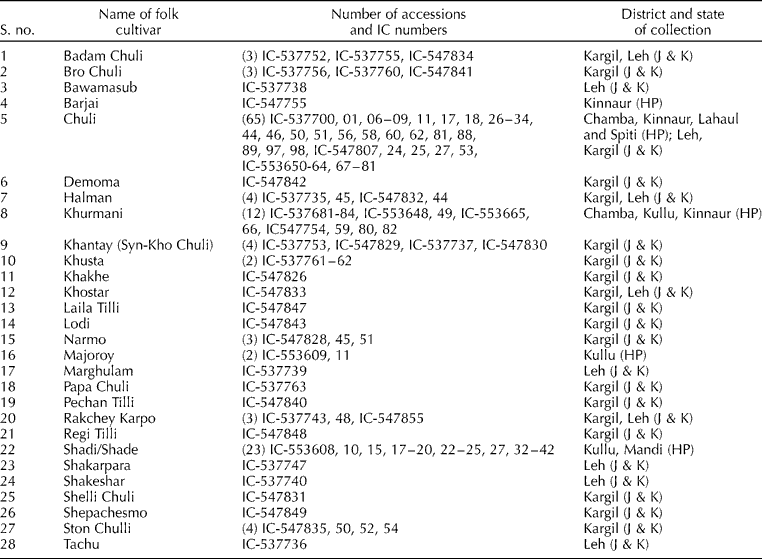
During the exploration missions, seven districts, viz. Chamba, Kinnaur, Kullu and Lahaul-Spiti of HP and two districts of Ladakh namely Leh and Kargil of J & K were surveyed (Fig. 1). Various promising cultivars were collected from villages Skuru, Deskit, Bogdang and Turtuk of Nubra valley in Leh. These diverse folk cultivars were being maintained in these villages since centuries. Similarly, in Drass and Batalik blocks of Kargil, villages historically famous for apricot cultivation are Chulichan, Kharbo, Darchik, Hundermann, Hardass, Daskit, Mulbek and Shilkchay. The cultivars collected from these areas are listed in the Table 1. In HP, diversity was collected from Pooh, Murang, Nichar, Kalpa and Sangla of Kinnaur, Keylong and Udaipur in Lahaul and Spiti; Jari, Banjar and Balichowki in Kullu and Salooni and Bharmaur in Chamba (Table 1). The collected germplasm (147 accessions) belonging to 28 local cultivars were from areas between 1200 and 3500 m altitude and between 31.31 and 34.47 latitude and between 76.01 and 78.34 longitude (Table 1).
Folk cultivars of wild apricot collected from north-western Himalayas, India

IC, indigenous collection; J & K, Jammu and Kashmir; HP, Himachal Pradesh.
The maximum numbers of accessions were collected for cultivar Chuli (65) and Shadi (23), as they exhibited maximum variability in tree phenology and fruit characters due to their highly heterozygous, natural wild-seedling populations. Most of the other cultivars had local importance and were specific to Ladakh in J & K and to Kinnaur in HP. Most of the diverse and promising cultivars were reported from Kargil and Leh (Table 1). Some of the popular cultivars Khurmani, Halman, Marghulam, Shakarpara, Narmo, Bawa Masub, Rakchey Karpo and Majoroy with specific characters were restricted to the area of collection only. Apricot cultivation has been practiced in these areas since last 100–200 years as seedling trees. During the recent years, known cultivars (selections) were also planted in the backyards of homes and in the farmer fields. Commercial orchards of apricots were rarely encountered in the areas explored.
Fruit and kernel characters
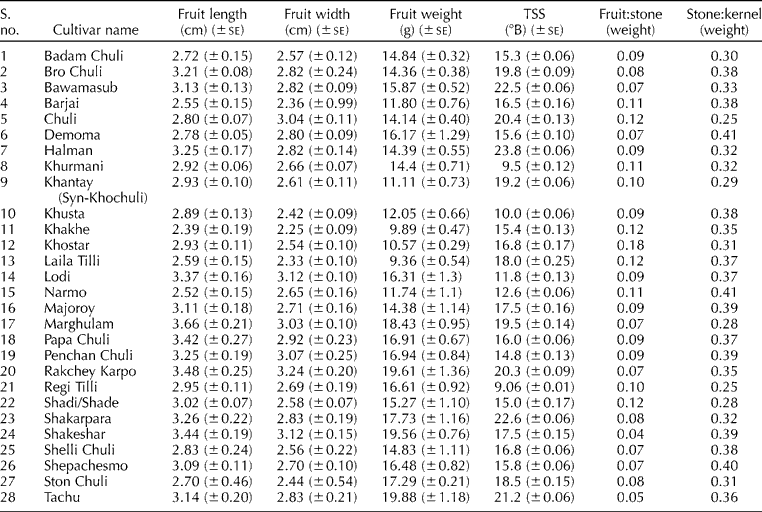
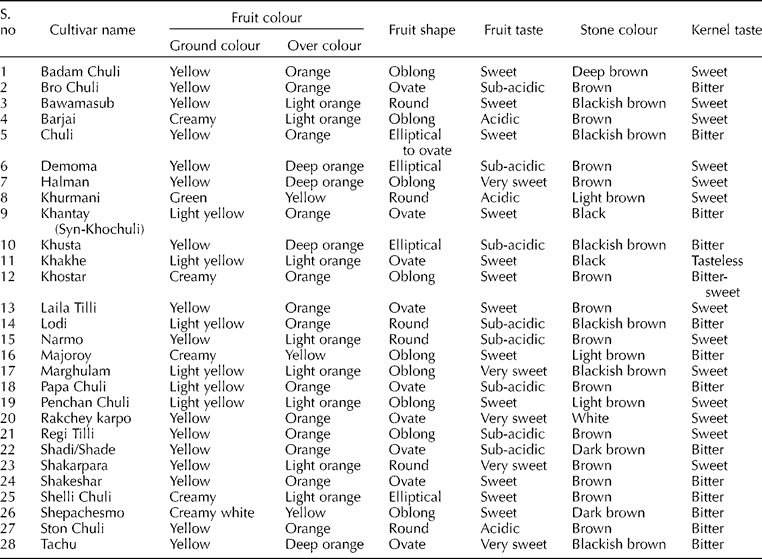
Fruits are glabrous and compressed drupes with sweet or bitter kernel. Fruit ripens during July to October depending upon the cultivar, altitude and temperature of the area. Sizeable variability in fruit, stone and kernel characters was present within and among the cultivars collected from diverse locations (Tables 2–4). Fruit ground colour in most of the cultivars was creamy-light yellow to yellow and fruit over-colour was light orange to deep orange. Fruit length was highest in Margulam (3.66 cm) followed by Rakchey Karpo (3.48 cm), while minimum was recorded in Khakhe (2.39 cm) followed by Narmo (2.52 cm). Fruit width was highest in Rakchey Karpo (3.24 cm) followed by Lodi, while minimum was recorded in Khakhe (2.25 cm) followed by Laila Tilli (2.33 cm). The maximum average fruit weight was recorded in Tachu (19.80 g) followed by Rakchey Karpo (19.61 g), while minimum average fruit weight was recorded in Laila Tilli (9.36 g) followed by Khakhe (9.89 g). Highest TSS (23.8°B) was recorded in Halman cultivar followed by Shakarpara (22.6°B) and Bawa Masub (22.5°B). All these collections belong to Nubra valley of Ladakh, J & K. The sizeable variability in stone and kernel morphology, colour, shape and size was recorded. Stone colour varied from light brown to brown and going up to blackish brown except in the cultivar Rakchey Karpo where the stone colour is white, which is indicative by its name Rakchey (outer cover) and Karpo (white), which is not a usual feature in apricots.
Quantitative fruit characters of folk cultivars of wild apricot

TSS, total soluble sugar.
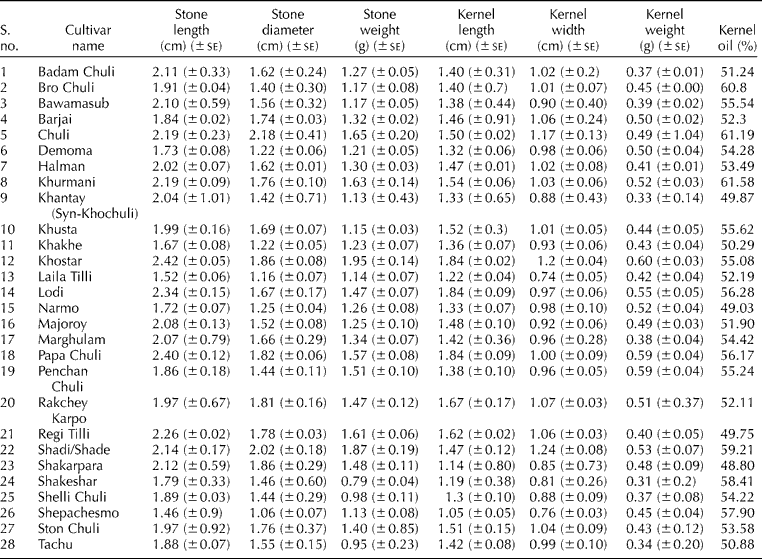
Quantitative stone and kernel characters of folk cultivars of wild apricot

Qualitative fruit characters of folk cultivars of wild apricot

The average stone weight was the highest in Khostar (1.95 g) followed by Shadi (1.87 g), while the minimum stone weight was recorded in Shakeshar (0.79 g). Fruit:stone ratio was the lowest in Shakeshar (0.04) followed by Tachu (0.05) and Bawa Masub (0.07), while the highest was recorded in Khostar (0.18) followed by Chuli, Khakhe, Laila Tilli and Shadi (0.12). The highest average kernel weight was recorded in Khostar (0.60 g) followed by Papa Chuli and Penchan Chuli (0.59 g); however, the highest kernel weight (0.85 g) was recorded in Khurmani (IC-537744) collected from Saspol district Leh, J & K. Kernel:stone ratio was lowest in Regi Tilli (0.24) followed by Chuli (0.25) and Marghulam (0.28), while the highest was recorded in Demoma and Narmo (0.41) followed by Shepachesmo (0.40). The highest oil content (61.58%) was recorded in Khurmani (IC-537681) followed by 61.19% in Chuli (IC-537727) and 60.8% in Brow Chuli (IC-537756). Cultivar Chuli (IC-537701) contained the lowest oil content (44.08%). Kernel taste in cultivars with high oil content was generally bitter except in the Khurmani where the kernel was sweet.
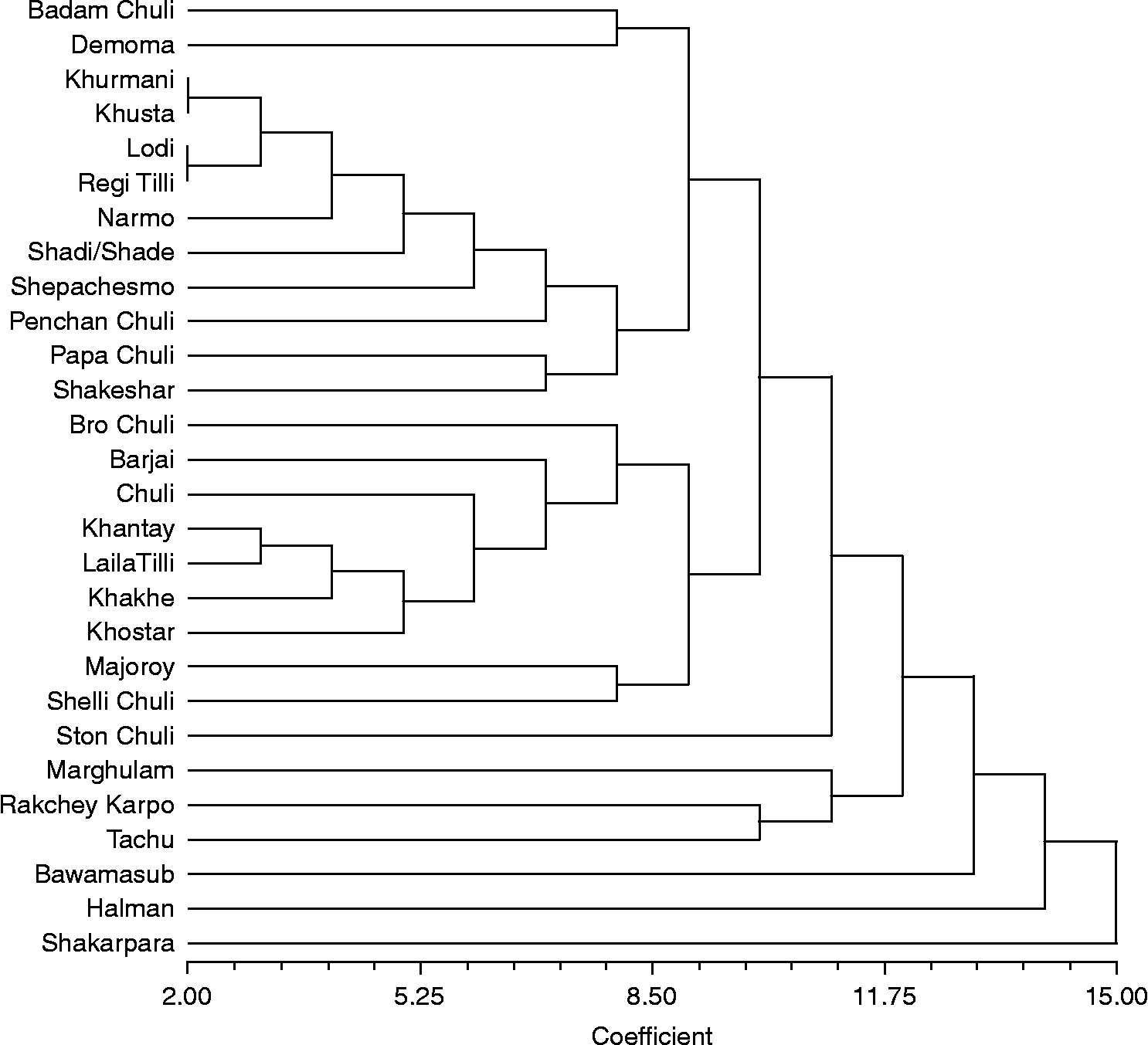
NJ tree of 28 cultivars of apricot was generated based on 19 morphological characters (13 quantitative and 6 qualitative characters) using Euclidean distance, in which all the cultivars were grouped into nine clusters (Fig. 2). Clusters I, II, III and V comprised single cultivar, i.e. Shakarpara, Halman, Bawa Masub and Ston Chuli, respectively. Cluster IV had three cultivars, i.e. Marghulam, Rakchey Karpo and Tachu. Majoroy (Kullu) and Shellichuli (Kargil) cultivars were grouped to form a separate cluster VI, both of which were more similar based on morphology, although they were collected from different states. Cluster VII comprised of seven cultivars, viz. Brochuli, Barjai, Chuli, Khantay, Laila Tilli, Khakhe and Khostar. Cluster VIII was the largest cluster, which contained ten cultivars, viz. Khurmani, Khusta, Lodi, Regi Tilli, Narmo, Shadi, Shepachesmo, Penchan Chuli, Papa Chuli and Shakeshar. Badam Chuli and Demoma grouped to form a distinct cluster IX were collected from the same region of Kargil, J & K.
Neighbour-joining tree of 28 cultivars of apricot, generated based on Euclidean distance.

Traditional uses
Traditional uses and drying of apricot fruits have been found to be of great significance in the socio-economy of local people of these areas. Apricots have been grown in Ladakh area of J & K since time immemorial as Moorecroft and Trebek (Reference Moorecroft and Trebek1825) reported the export of dried apricots from Ladakh to Tibet and Tartary. Apricot fruits and kernels have found diverse uses in the high-altitude areas of HP and J & K and have long history of cultural significance. Fresh fruits were directly consumed by the local people or dried for use in the later part of the year. Kernels were used for oil extraction and for direct consumption. Fresh fruits were rarely taken to the market; however, nuts and extracted oil have good market value and excess produce was sold to the local shopkeepers in the villages.
Fruits
Fresh fruits of almost all the cultivars of apricots were used for human consumption. In some of the remote villages, fruits of non-drying and bitter kernel folk cultivars, namely Chuli, Shadi and Ston chuli, were also used as cattle feed. Fresh and dried fruits of apricot form a complete food and are easily digestible; in addition, these provide protection to many diseases due to the presence of high fibre content. Apricot fruits are rich source of vitamin A, B and C and minerals like calcium, phosphorus and iron. Apricot cultivars having high TSS (above 20°B) were found to be used for drying in the Ladakh area of J & K. Drying of apricots is the oldest technique of apricot preservation known to Ladakhis and is attempted for whole as well as ‘slip pits’ fruits depending on the cultivar. Whole dried fruits are known as ‘fating’ while ‘slip pits’ are known as ‘Shali-chulli’. Whole fruits of apricots are spread on the wheat straw on the rooftops for drying and after several turnings kept for consumption during the coming months. ‘Fating’ and ‘Shali-chulli’ are consumed as such or reconstituted by giving a boil in water to which a little of sugar or jagri is added and kept overnight to serve with bread in routine as well as in marriage functions throughout the Ladakh region. Powdered ‘Shali-chulli’ is mixed with roasted barley flour known as ‘Chulphey’ and used during travelling or trekking. Dried powdered apricots are commercially available in this area now and make a refreshing and aromatic drink. In some areas, sulphur fumigation and drying trays are now used for drying; this method allows better quality and colour of dried apricots. Some of the promising drying-type cultivars grown in villages of Leh and Kargil are Halman, Rakchey Karpo, Marghulam, Khantay, Kho Chulli and Shakarpara. Osmotic drying and canning of fruits are also attempted successfully for preservation and such apricots are much in demand outside the Ladakh.
Kernel
Apricot kernels are used for various purposes by local people depending on the taste of the kernel which is sweet, bitter and bitter-sweet in respective cultivars (Table 4). Sweet kernels are used as almond and have high commercial value. All types of kernel are used for extraction of oil, which is similar to the almond oil, and are also used as an adulterant or a substitute for it. In the dry temperate parts of north-western Himalayas, no conventional oilseed crop is being grown and hence the apricot oil is extensively used for culinary purposes. Recently, apricot oil has gained high value in the cosmetic industry. The extracted oil is almost colourless with agreeable flavour. Ladakh being a land of Gompas (Buddhist place of worship), the apricot oil is used for lightening the prayer lamps in Gompas and it is believed that this offering and religious sentiments of local people have aided in maintaining the existing local cultivars and genetic diversity in this region.
Discussion
Apricot grown in high-altitude parts of India comprises the cold arid areas of Ladakh in J & K and Chamba, Kullu, Kinaur and Lahaul-Spiti districts of HP. These areas are traditionally famous for temperate fruits, particularly for wild apricots, which have cultural and historical significance for local communities. However, limited attempts have been made to manage the existing invaluable genetic diversity and to document the traditional knowledge about the folk cultivars. Wild apricots have economic value for fruits which are used as table type, drying type and are processed for pulp, jam, jelly, squash, nectar and fruit bar. Kernels are consumed as almond and also form the potential source of the good-quality edible oil. As far as the Ladakh area of J & K is concerned, the main horticulture produce in this region is wild apricot and apple, but without an organized cultivation in the orchards, only the traditional scattered distribution of apricot is present. Apricot cultivation is practiced in the milder climatic areas of lower parts of Nubra, Leh, Kargil, Batalik, Sanjak, etc. The cultivation of rare non-drying apricot varieties, ‘Khantey’ and ‘Normu’ is followed at these sites (Sharma and Mir, Reference Sharma and Mir2000). Most of the apricots growing in the Ladakh area are of seedling origin (Corssa-Reynaud and Audergon, Reference Corssa-Reynaud, Audergon, Rom and Carlson1987); however, some of the cultivars like Halman and Shakarpara are now being vegetatively propagated.
The characterization of apricot folk cultivars of high-altitude areas of India has not been taken up extensively, leading to very little use of the vast genetic diversity available in this region. Several promising collections have been identified during the present study based on fruit quality, sugar content, amount of pulp and oil content. Good table-type fruit cultivars Marghulam, Lodi, Shakarpara, Narmo and Khurmani contained bold fruit size, higher weight, high juice content and high TSS. Drying-type cultivars Halman, Shakeshar, Rakchey Karpo and Tachu had better drying qualities with high TSS, higher pulp content and cling stone character. Highest TSS (23.8°B) was recorded in Halman (IC-537735) followed by 22.6°B in Shakarpara (IC-537747) and 22.5°B in Bawa Masub (IC-537738). All these collections belong to the Ladakh region of J & K. The cultivars with bitter kernels were used for oil extraction; good cultivars where above 50% oil content was recorded were Chuli, Bro Chuli, Khante, Khusta, Khostar, Lodi, Mejoroy, Papa Chuli, Shadi, Shakeshar, Shelli Chulli, Shepachesmo, Ston Chuli and Tachu. The sweat kernel cultivar, Khurmani (IC-537681), collected from Kullu valley of HP recorded above 60% oil content. In four accessions IC-537727, IC-537756, IC-537681 and IC-537752, the oil content was above 60%. The total oil content ranged from 44.08 to 61.58% in the accessions analyzed in the present study. Kapoor et al. (Reference Kapoor, Bedi and Bhatia1987) reported the wide variability of kernel oil in apricot ranging from 27 to 67%. Characterization of various accessions indicated that the cultivars from Ladakh, J & K, were the best in fruit quality and were also superior for oil purpose in comparison to the cultivars from other areas of J & K and HP. This may be due to the suitable climatic and environmental conditions available for apricot cultivation in this cold arid region of India.
In the NJ tree, Shakarpara, Halman and Bawa Masub cultivars were separated into three distinct clusters – I, II and III, respectively. These three cultivars collected from Ladakh region showed highly divergence nature based on morphology from rest of the cultivars. TSS values of these cultivars were also recorded higher than the other cultivars. Marghulam, Rakchey Karpo and Tachu cultivars, which were collected from Leh region of J & K, showed close association among each other as grouped under cluster IV. Ston chuli cultivar formed a separate cluster V, which showed morphological distinctiveness from the other cultivars. Maximum similarity was found between Lodi and Regi Tilli, collected from Kargil and formed a distinct subgroup within the cluster VIII. Both cultivars showed similarity in fruit colour, stone colour and kernel taste. The cultivars Khurmani and Khusta also showed maximum similarity and formed a separate subgroup under cluster VIII, although these were collected from different states. Badam Chuli and Demona cultivars grouped in cluster IX, which belong to the same region of Kargil, showed similarity in fruit colour, kernel taste and TSS. Analysis using NJ tree exhibited sizeable genetic and phonological diversity within 28 cultivars, which needs to be further confirmed using molecular markers analysis for utilization in area-specific selections and improvement programmes.
Collected genetic diversity of apricot has been successfully cryopreserved using seeds and embryonic axes in the cryogenebank at NBPGR (Malik and Chaudhury, Reference Malik and Chaudhury2010); however, it still needs to further evaluate, conserve and utilize the available variability for improvement in the quality of fruits with better shelf-life and high yield. Cultural significance, qualities and traits of specific folk cultivars of apricot are also to be preserved for future use and also for enhancing socio-economic conditions of local communities and tribal populations of this area.
Acknowledgements
The authors thank the Director, NBPGR, New Delhi, for encouragement and providing the facilities. Our thanks are due to Head, Division of Collection and Exploration, NBPGR, New Delhi, for the guidance for undertaking three exploration trips. We thank Mr. Susheel Kumar, Research Associate, Cryolab, NBPGR, New Delhi, for statistically analyzing the data. We sincerely acknowledge the help extended to us by various government and non-governmental organizations, farmers and defence personnels during our exploration trips.