1 Introduction
Dominant party systems were once considered to be highly durable. In an influential survey of democratic regimes with such ‘uncommon’ party systems, Pempel (Reference Pempel1990) predicted that the ruling parties in Italy, Japan, and Sweden would likely remain in power for the foreseeable future. Looking at authoritarian regimes in transition, Haggard and Kaufman (Reference Haggard and Kaufman1995) examined the cases of Mexico and Taiwan in the early 1990s, concluding that dominant parties have distinct capacities to adjust their policies without diminishing their political power. However, the past two decades have seen remarkable changes in the political landscape, with many ruling parties either losing their grip or completely disappearing from the electoral map.
These events were important in their own right, since they drastically changed the structure of the party system and brought substantial political competition. However, they also pose a theoretical challenge for political scientists. What were the causes of the demise of dominant parties that have kept such a firm grip on their countries? So far, few researchers have explored this question beyond examining particular cases.
In order to tackle this question of party system change, we begin with an overview of dominant party systems in the postwar world. Examining the choices of voters and ruling elites, we find that most dominant parties have experienced major splits before they fell from power. In many of these cases, the defection of important party factions or powerful politicians either directly caused electoral turnover, or became a catalyst for further changes towards a more competitive party system. If these splits had not occurred, the dominant parties are likely to have survived much longer.
These findings suggest that we should pay more attention to intraparty politics in order to explain the collapse of dominant party systems. Previous works have provided a number of reasons why ruling parties lose their dominant position as a result of interparty competition, but have had relatively little to say about the conflicts that occur within those parties. Especially, the literature leaves two important theoretical puzzles unresolved: why party members ever decide to defect from electorally ‘dominant’ parties, and why leaders fail to buy off those dissidents in order to stay in power. We address these problems by analyzing simple game-theoretic models of intraparty bargaining. Whereas the literature on party switching generally assumes that politicians make decisions without considering how other ruling elites would respond to their choices, we consider models in which strategic interactions take place between party factions over the distribution of government resources.
The analysis shows two results. First, ruling parties are more likely to break up when they lose popularity among the voters. Rational politicians stay in their party as long as the party assures their reelection with a high likelihood, but they would have stronger incentives to leave when the party becomes a sinking ship. When their willingness to defect becomes too strong, the cost for party leaders to appease them becomes so high that intraparty bargaining breaks down altogether. We argue that even when the ruling party still provides its members with better chances of reelection than the opposition, there are conditions under which factional defection occurs through this mechanism.
Second, ruling parties break up because of commitment problems among factions. Our model predicts that major splits of dominant parties occur when exogenous shocks, such as the death of leaders or an economic crisis, lead to a rapid shift in the balance of power between party factions. When the non-mainstream faction is marginalized as a result of these shocks, the mainstream faction can no longer commit to the future allocation of government resources, which in turn increases the incentive of the non-mainstream faction to defect immediately. We show that this mechanism undermines the ruling party regardless of its electoral strength.
Our argument not only contributes to the understanding of a specific type of party system, but also has broader implications for the literature on party systems in general. If we seek to explain party system changes, we not only need to study how parties compete against each other, but also account for the conflicts that takes place within them. We briefly discuss this point in the concluding section.
2 An overview of dominant party systems
Although many recent studies have examined particular cases of dominant party systems that have collapsed, few have described their demise in the context of a larger universe of cases.Footnote 1 Therefore, we first attempt a comprehensive overview of dominant party systems in the postwar world. Because we are interested in the transitions of party systems rather than political regimes, the universe of cases includes both full democracies as well as authoritarian regimes with electoral competition. For this purpose, we follow Greene's (Reference Greene2007: 12–17, 258) classification of party systems and examine the 16 countries he lists as either ‘Dominant Party Democratic Regimes’ or ‘Dominant Party Authoritarian Regimes’. Greene defines dominant party systems in terms of ‘meaningful electoral competition with continuous executive and legislative rule by a single party for at least 20 years or at least four consecutive elections’. Compared to other attempts at counting dominant party systems (Beck et al., Reference Beck, Clarke, Groff, Keefer and Walsh2001; Cox, Reference Cox1997; Pempel, Reference Pempel1990; Sartori, Reference Sartori1976; Ware, Reference Ware1996), this list has the virtue of including authoritarian regimes with electoral competition but excluding regimes that ban opposition parties, as well as excluding multiparty democracies where one party receives more votes than others but does not always occupy the government.
Dominant parties fall from power, either by the loss of support from voters or by the defection of their members. Therefore, for each dominant party system, we examine whether the ruling party lost its power as a result of electoral defeat, and whether it suffered from major splits before the end of its tenure. We define major party splits as an establishment of an opposition movement by members of the dominant party that fulfills either of the following two conditions. First, defections that lead to the immediate loss of the legislative majority for the ruling party or the coalition count as major splits. Second, party splits that involve the departure of notable political figures, such as cabinet members or party leaders who have considerable personal supporters among the electorate, are also defined as major party splits. Even if the departure of those politicians does not lead to an immediate loss of the legislative majority for the ruling party, their ability to attract a large segment of voters constitutes a serious threat in future elections.
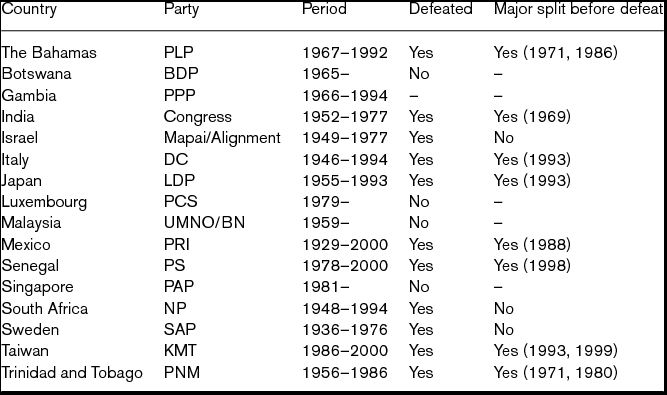
The immediate observation that arises from the list of dominant party systems is that most of them have collapsed (Table 1). There are only four parties that managed to contain internal dissent and thwart the challenge of opposition parties altogether. The People's Action Party in Singapore and the Botswana Democratic Party have maintained their predominance over much weaker opponents until today. The Christian Social Party in Luxembourg and the United Malays National Organization, which has led the ruling coalition Barisan National in Malaysia, also belong to this group. Aside from these four cases, Gambia's People's Progress Party continued to be undefeated in elections, but was overthrown by a military coup in 1994.
Dominant parties and party splits

Note: The period of dominant party rule differs slightly from Greene (Reference Greene2007) because we take the period from the year of the election in which the party entered office, or the year in which the first multiparty election was held, to the year of the election in which the party went out of office.
In the other 11 countries, the ruling parties have been voted out of office, but the cases differ in whether they experienced serious factional splits before their electoral defeat. Three dominant parties were defeated without suffering from major defections. The Social Democrats in Sweden took a serious hit from the recession that followed the first oil crisis, losing the 1976 election to the center-right coalition. The Alignment in Israel, formed in 1969 as an alliance of leftist forces including the long dominant Mapai, suffered a similar consequence as it failed to adjust to economic problems, and was defeated by Likud in the 1977 election.Footnote 2 The National Party in South Africa went out of power in 1994 when the African National Congress contested in the first multiracial election after the end of apartheid.
Among the eight cases in which dominant parties experienced major splits before their electoral defeat, in four cases the splits led to immediate electoral turnover. In Italy, the Christian Democrats (DC) held 206 out of 630 seats in the 1992 Chamber of Deputies election and was by far the largest party, but broke up into four different groups in 1993. The DC changed its name to the Italian People's Party right before the 1994 election, but only managed to win 33 seats, and was ousted from government by the center-right coalition led by Silvio Berlusconi's Forza Italia (Morlino, Reference Morlino1996). In Japan, the Liberal Democratic Party (LDP) held well over the majority of the 512 seats in the lower house in 1993 when Ichiro Ozawa, a powerful faction boss, defected on a no-confidence vote with 34 legislators and brought down the government.Footnote 3 The LDP was reduced to 223 seats in the election that immediately followed, and was replaced by a seven-party coalition government formed by the opposition parties including Ozawa's new party. Although the LDP was back in power by 1996, the party was much weaker than before, and it always formed a coalition with smaller parties in the subsequent years (Christensen, Reference Christensen2000). In Taiwan, the Kuomintang (KMT) barely held the legislative majority after the defection of the New Party (NP) in 1993, and suffered a decisive split in 1999 when James Soong, a powerful provincial governor, defected from the KMT and announced his candidacy for the 2000 Presidential election against the party's official candidate Lien Chan. This split directly benefited the main opposition, the Democratic Progress Party (DPP). Its candidate Chen Shui-bian won the Presidency with a vote share of 39.3%, whereas Soong and Chan split the KMT vote between themselves (Niou and Paolino, Reference Niou and Paolino2003). In Senegal, the Socialist Party (PS) had dominated the political scene under President Abdou Diouf until Moustapha Niasse and Djibo Ka, both former cabinet ministers, broke away from the PS to run against Diouf in the 2000 election. Although Diouf led the first round with 41.3% of the vote, the two rebel candidates threw their support behind Abdoulaye Wade of the Senegalese Democratic Party in the runoff, allowing Wade to defeat Diouf with a vote share of 58.5% (Galvan, Reference Galvan2001).
In the four remaining cases, the dominant parties survived for some time after they were badly split. Except for the case of India, however, these splits were critical in that they made the party system significantly more competitive in the subsequent elections, accelerating the decline of the ruling party. In Mexico, the Party of Institutional Revolution (PRI) had been dominating the electoral arena with a vote share that typically exceeded 70% in the Presidential elections, but the defection of Cuauhtémoc Cárdenas led to an exceptionally fierce electoral contest in 1988. The PRI only secured 50.7% of the votes with the use of massive electoral fraud, and Cárdenas subsequently launched the Party of Democratic Revolution (PRD). The entry of PRD eroded the PRI's strength in its electoral strongholds, allowing the National Action Party to eventually prevail in the 2000 Presidential election, with Vicente Fox winning 42.5% of the votes against the PRI's Francisco Labastida who polled 36.1% (Klesner, Reference Klesner2005). In the Bahamas, the Progressive Liberal Party (PLP) suffered from its first major split in 1971 when eight legislators in the 38-member parliament, including four former cabinet ministers, defected to the opposition and formed the Free National Movement (FNM). Although the rule of the PLP was not immediately threatened, the FNM invited Hubert Ingraham, a former cabinet minister, as the new party leader in 1986, and scored a decisive victory in the 1992 election by winning 33 out of the 49 seats (Nohlen, Reference Nohlen2005: 73–83). In Trinidad and Tobago, the People's National Movement dominated under the leadership of Prime Minister Eric Williams by winning around two thirds of the 36 seats in the parliament, but its strength was gradually reduced through defections. In 1971, the Deputy Prime Minister A. N. R. Robinson resigned from the party to establish the Democratic Action Congress that won both seats in the island of Tobago. In the 1981 election, Karl Hudson-Phillips, a former cabinet minister, launched the Organization for National Reconstruction, and despite winning no seats, secured 22% of the vote. In the 1986 election, these groups built a united front with other opposition parties under the banner of the National Alliance for Reconstruction, electing Robinson as the party leader and achieving a decisive victory of 33 seats (Meditz and Hanratty, Reference Meditz and Hanratty1987).
India's Congress party is somewhat an exception, because the party faced a massive split but lost its power for different reasons. In 1969, the Congress's leaders decided to expel Prime Minister Indira Gandhi, and the party was split into the Gandhi's supporters and opponents, forcing her to rule with a legislative minority. However, Gandhi's Congress won the 1971 election with a landslide by capturing 352 out of 518 seats, almost completely eliminating the defectors. Gandhi's reign came to an end as a result of her own subsequent actions. The emergency rule that Gandhi imposed in 1975 proved very unpopular, and the Congress was defeated by the opposition in the 1977 election (Brass, Reference Brass1990: 42, 68).
To summarize, we find that most dominant parties in our sample have experienced major splits before they lost their power. These splits either caused an immediate electoral defeat of the ruling party and changed the structure of the party system overnight, or accelerated the decline of the ruling party by significantly reducing its strength. Either way, these findings suggest that an explanation for the breakdown of dominant party system needs to include an account of why politicians defect from ruling parties that have hitherto been electorally dominant.
3 Explaining defections from dominant parties
3.1 The literature
The vast literature on the determinants of party systems has traditionally focused on the effects of two variables: social cleavages and electoral institutions (Boix, Reference Boix, Boix and Stokes2007). First, parties are organized around major social cleavages, such as class, religion, and ethnicity. The key implication of this literature is that party systems are likely to change when new social groups enter the electoral arena as a result of demographic shifts and value changes that accompany industrialization and post-industrialization (Inglehart, Reference Inglehart1971; Kitschelt, Reference Kitschelt1994; Lipset and Rokkan, Reference Lipset, Rokkan, Lipset and Rokkan1967). Second, the number of parties that can effectively compete in each party system depends on electoral institutions, especially the rules that govern the relationship between seats and votes. First-Past-The-Post (FPTP) systems are likely to create two-party systems, whereas Proportional Representation (PR) systems tend towards multiparty systems. According to this literature, major shifts in the structure of party systems are most likely when electoral reforms drastically change the rules of electoral competition (Cox, Reference Cox1997; Duverger, Reference Duverger1954).
However, neither of these variables provides an adequate account for the demise of dominant party systems. Dominant parties have emerged across a wide range of countries regardless of whether they are rich or poor, religious or secular, ethnically homogenous or heterogeneous, and these parties have usually withstood the challenge of incorporating various social groups under their wings (Arian and Barnes, Reference Arian and Barnes1974). In our sample, South Africa is the only case in which the entry of a party based on a new social group decisively led to the defeat of the ruling party, but this was also the only case that lacked universal suffrage. Electoral reform has also rarely coincided with party system change. Whereas Italy changed its electoral system from an open-list PR to a Mixed-Member Majoritarian system in 1993, it is not clear how this reform should have disadvantaged the DC, considering the fact that it had already broken up into smaller parties before the 1994 election took place.
Recognizing the limits of this literature, recent studies of dominant party systems have focused on how ruling parties use its monopolistic access to patronage resources in order to consolidate its popular support and marginalize the opposition parties. Because dominant parties are able to selectively distribute money and jobs to its supporters, voters tend to throw their support behind the ruling party either out of gratitude for receiving benefits or from fear of punishment. The implication of this argument is that dominant parties are likely to fall from power when their control over patronage resources is eroded, and the voters begin to switch their support to the opposition parties (Greene, Reference Greene2007; Magaloni, Reference Magaloni2006; Scheiner, Reference Scheiner2006). However, although these studies have made important contributions, they have much in common with the older literature, focusing on explaining why voters stop supporting the ruling party, and not directly addressing the question of why its members defect to the opposition.
The literature on party switching offers a potential explanation based on individual incentives. These studies usually begin with the general assumption that legislators choose parties that maximize their benefits minus the cost associated with switching, whether the benefits are electoral, ideological, or distributive. Empirically, they take a cross-sectional sample of politicians that belong to a party, and examine the statistical association between individual-level variables such as seniority or electoral strength, and the decision to change their party affiliation (Heller and Mershon, Reference Heller and Mershon2009; Milazzo and Scheiner, Reference Milazzo and Scheiner2011).
However, two theoretical issues remain unresolved. First, it is not so straightforward to explain why politicians would ever leave the current ruling party that enjoys an advantage in terms of reelection prospects, access to policy-making, and the distribution of pork-barrel resources. If rational office seekers ‘choose to run in whichever party offers the higher (highest) probability of victory’ or ‘the candidate desires as great a certainty of holding office as possible and acts so as to minimize the risk of defeat’ (Aldrich, Reference Aldrich2011: 53), it is difficult to explain why ‘dominant’ parties ever break up.
Second, and more fundamentally, it is not clear why party leaders fail to prevent defection. Existing studies have assumed that politicians independently decide whether to stay or leave in a given political setting, and have failed to account for the outcomes of intraparty bargaining between party leaders and other members. When a group of politicians are threatening to defect, party leaders would not simply let them leave, but would consider buying them off. If the ruling party is losing popularity and some members are becoming disaffected, leaders could nevertheless placate them through various means such as providing campaign funds, handing over government posts, and altering the party's policies. Japan's LDP and Italy's DC have both been famous for being riddled with factional conflict, and yet maintained their organizational cohesion by rotating cabinet posts among the major factions in their heyday (Krauss and Pekkanen, Reference Krauss and Pekkanen2011; Mershon, Reference Mershon1996). From this perspective, party splits should be regarded as bargaining failure among party factions, not just as a result of individual politicians’ isolated decisions. The core question is as follows: How and when do party leaders fail to buy off potential defectors?
It is especially important to take intraparty bargaining seriously when explaining major splits of dominant parties. Since these splits involve the defection of large factions or influential figures, party leaders should fear the loss of legislative dominance and attempt at all costs to forestall such events. The puzzle is that party splits still occur in those cases in which party leaders should have strong incentives to pay the necessary costs to keep their party united. Previous theories that do not consider bargaining among factions have not provided an answer to this puzzle and, therefore, have provided only a partial understanding of the mechanisms of party splits.
3.2 Decline of public support
We present two mechanisms through which ruling parties split as a result of bargaining failure. First, as the conventional wisdom suggests, we argue that the electoral strength of the ruling party matters. Even when we consider the incentives for party leaders to strike a bargain with members who are attempting to defect, party splits would occur when public support for the ruling party drops below a certain threshold. Importantly, the ruling party can split even if it still has an electoral advantage over the opposition, as long as its degree of dominance is in decline.
A simple game with factional bargaining makes this point clearer. We construct a model of a political regime with a ruling party and an opposition party that compete in a general election.Footnote 4 The ruling party consists of a mainstream faction (M) and a non-mainstream faction (N). M currently controls the party and the government, and has the institutional power to allocate government resources such as ministerial posts and patronage to party members. We assume the total amount of government resources to be positive (π > 0).
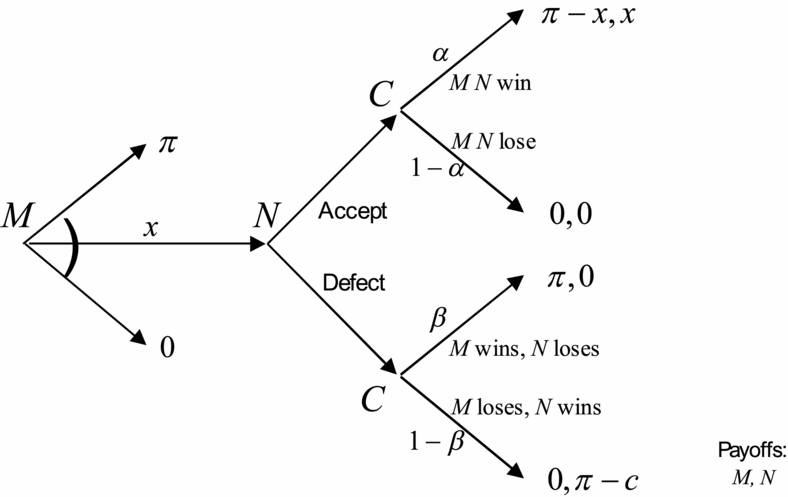
The game between the two factions proceeds as follows (Figure 1). First, M makes a take-it-or-leave-it offer x ∈ [0, π] to N on the division of government resources between the two factions. Given this offer, N decides whether to accept it or to defect from the party and join the opposition. Once N makes its decision, an election takes place and Chance (C) decides the outcome. The election ends in a clear-cut victory or defeat for the ruling party.
Intraparty bargaining game
If N accepts x, the ruling party maintains its organizational unity and N contests the election together with M against the opposition. The government wins the election with probability α and loses with probability 1 − α. In the context of this model, α can be considered as the degree of dominance by the ruling party. If the government wins, M and N will respectively receive π − x and x according to the pre-election agreement. If the opposition party wins, M and N will lose everything to the opposition and their payoffs are zero.
On the other hand, if N decides to defect, the party breaks up, and N contests the election together with the opposition. In this election, the ruling party now consists only of M, and it wins with probability β and loses with probability 1 − β. Since β represents the probability that M can still stay in power when N sides with the opposition, this parameter concerns the degree of threat that M faces as a result of N's defection. Since factional defection is more threatening when β is smaller, we can consider β to be inversely related to the importance of N within the party. For example, if the number of politicians belonging to N is quite large, or if the leader of N is very popular among voters, the loss of this faction makes M's victory in the coming election more difficult.
If M survives the challenge of N and the opposition party, it can monopolize the government resources and receive π. If M loses the election, then N and the opposition will take power and form a new government. Because N must make compromises with the opposition party in forming electoral agreements before the election, and share the benefits from office after the election, c ∈ [0, π) is subtracted from N's payoff. c will be large, for example, when the size of the opposition is relatively large or its policy position is relatively far from N's position. As a result, M and N receive payoffs of zero and π − c if this outcome is realized.
The game can easily be solved by backwards induction. If N accepts the offer x, M and N will each receive α(π − x) and αx as expected payoffs. On the other hand, if N rejects x and chooses to defect, M and N's expected payoffs are βπ and (1 − β)(π − c). Therefore, in equilibrium,Footnote 5N accepts x if and only if αx ⩾ (1 − β)(π − c) or x ⩾ (1 − β)(π − c)/α ≡ x*.Footnote 6 Anticipating N's response, M offers x = x* if and only if α(π − x*) ⩾ βπ or α ⩾ 1 − (1 − β)c/π ≡ α*, where α* is a positive constant that is less than or equal to 1.Footnote 7
This result suggests why the electoral dominance of the ruling party is so crucial for the organizational stability of the party. If α ⩾ α*, then the game has a unique equilibrium in which M provides x = x* and N accepts the offer.Footnote 8 In other words, the model predicts that the ruling party would stay together as long as it enjoys a healthy electoral lead over the opposition. A dominant party system (in the ideal type) can be considered as a special case where α is very close to one. Under the extreme case of α = 1, M can always strike a bargain with internal dissidents regardless of the values of the other parameters in this model.
In contrast, if α < α*, the game has no ‘peaceful’ equilibrium: M will not make an offer that can satisfy N, and therefore cannot prevent the party from splitting. In other words, when α is sufficiently small and there is a fair chance that the ruling party can lose the upcoming election, the non-mainstream faction would choose to defect because it makes them better off. Intuitively, when the ruling party is expected to fall from power regardless of its cohesion, it looks more attractive for N to get off the sinking ship earlier. This in turn makes it too expensive for M to buy off N.
As an interesting and somewhat counterintuitive theoretical implication, this analysis suggests that the ruling party can split even when staying in the party is the better option for members seeking reelection. In the model, N expects to win the election with probability α if it stays in the ruling party and probability 1 − β if it sides with the opposition. When α > 1 − β, we may expect that the members of N would have a higher probability of reelection if they choose to stay. Note that even in this case, factional bargaining within the ruling party can still break down as long as c is sufficiently small (i.e., α < α* holds).Footnote 9 When the cost of defection is low, N can receive a higher expected payoff by defecting because the stakes are higher, even though it may be harder for N to survive the election.
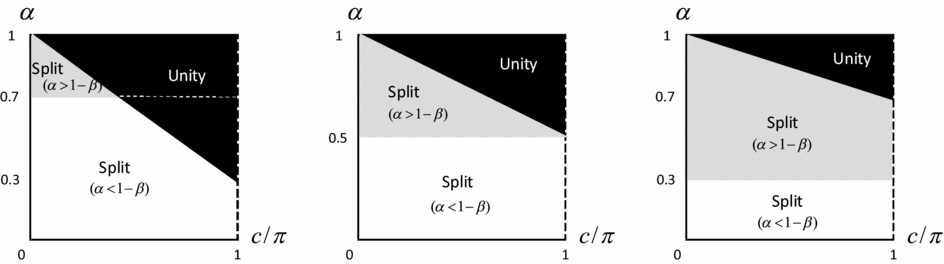
Figure 2 summarizes these results. The black area in each graph represents parameter sets where the ruling party can stay united after bargaining, and the party splits in the gray and white areas. This illustrates that, given β and c, the decline of electoral support (smaller α) leads to a party split in general. This also shows the gray area exists in general, implying the breakup of the ruling party can occur even when α > 1 − β as long as c is sufficiently small.
Fate of the ruling party Note: β is set to 0.3 (left), 0.5 (middle), and 0.7 (right).
In several cases, the dominant parties were significantly weakened before they were split. For example, Italy's DC had suffered from a major setback in the 1992 election when it faced the challenge of the regional party Northern League, and it was the first time that its vote share dipped below 30%. Its fortunes were reduced even further after many of its senior members were implicated in the ‘clean hands’ investigations. Finally, a string of defeats in the 1993 local elections showed that the DC was much weaker at the polls than it once used to be (Furlong, Reference Furlong, Gundle and Parker1996: 62–9). In Japan, the introduction of the Value-Added Tax in 1989 significantly reduced public support for the LDP, and a series of major scandals in the early 1990s damaged the party's reputation even further. Although the LDP still held an overwhelming share of seats in the national diet and was still the best option for politicians seeking reelection, its popularity was at an all-time low when it faced Ozawa's rebellion in 1993 (Curtis, Reference Curtis1999: 73–8, 126–7).
3.3 Power shifts within the dominant party
The second mechanism that causes the split of dominant parties involves commitment problems among factions.Footnote 10 Defections from dominant parties occur when the mainstream faction fails to credibly commit itself to following through an agreement with the non-mainstream faction on the allocation of government resources in future periods.
Following the seminal paper by Powell (Reference Powell2004), we argue that commitment problems arise when the relative bargaining power of the non-mainstream faction is rapidly declining against the mainstream faction over time. A faction that is powerful today does not necessarily remain as influential tomorrow. When a faction is losing its power for certain reasons (for example, by losing its members), the allocation of resources that it expects to receive in the future becomes smaller, which will then increase its incentive to take a risk of defecting now rather than later. When a faction becomes very pessimistic about its future, because the decline in its bargaining power is so rapid and large, its willingness to leave would become so strong that the price of compromise would become too high for the party leaders to pay. In this situation, it is very difficult for party leaders to avoid a party split by making an agreement on future allocation of resources beforehand, because nothing guarantees that the leaders will keep the promise once the balance of power between the factions has shifted. In other words, the party leaders face a commitment problem.
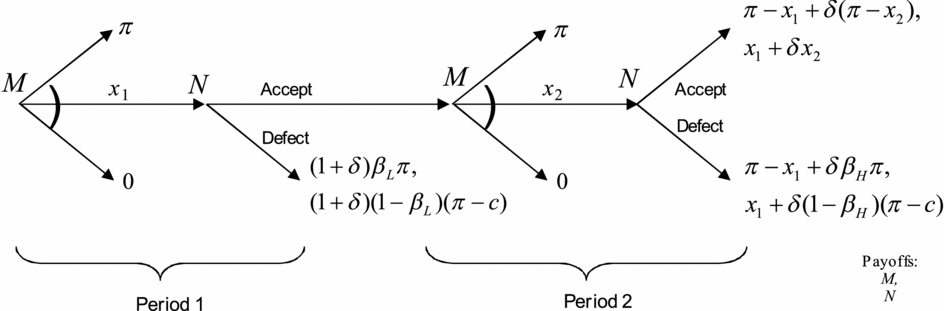
To lay out this argument more formally, we modify our bargaining model in two ways (Figure 3). First, we set α = 1 and assume that the ruling party is perfectly dominant or has no chance of losing power unless N leaves the party. This implies that the condition of α ⩾ α* always holds or N never defects on the equilibrium path in the original model. Therefore, the dominant party in this model only splits, if it ever does, for reasons other than the value of α. In other words, the decline of public support for the ruling party plays no role in this model.
Intraparty bargaining game with a power shift
Second, the new model repeats the intraparty bargaining process twice to capture a situation where N's relative bargaining power is declining. We model the temporal shift by assuming that the parameter β increases in Period 2. Specifically, while the value of β in Period 1 is βL, it will increase to βH = βL + Δβ (Δβ ⩾ 0) in Period 2. This is a situation where N's option of defecting is becoming less threatening for M, and, thereby, N is losing bargaining power over M.Footnote 11
In this model, M makes an offer x 1 ∈ [0, π] for Period 1 and x 2 ∈ [0, π] for Period 2. In each period, N decides whether or not to accept the offer, and an election takes place following the decision. Each player's final payoffs are defined as the sum of the resources they receive through the first and the second bargaining processes. The present value of the resource allocation at the second period is discounted at δ ∈ [0, 1]. If the bargaining breaks into a party split in Period 1, the allocation of resources between M and N over the two periods depends on the balance of their current bargaining power.Footnote 12 Thus, M and N's expected payoffs in this case are (1 + δ)βLπ and (1 + δ)(1 − βL)(π − c).
The question is whether the non-mainstream faction chooses to defect in either of the periods. Solving by backwards induction again, we find that M offers x 2 = (1 − βH)(π − c) ≡ x*2 at Period 2 in equilibrium, which gives N the payoff that is equivalent to defection. Therefore, to avoid N's defection at Period 1, M has to make an offer x 1 such that
 \begin{equation*}
(1 + \delta )(1 - \beta _L )(\pi - c) \le x_1 + \delta {\kern 1pt} x_2^*
\end{equation*}
 \begin{equation*}
\Leftrightarrow x_1 \ge (\pi - c)(1 - \beta _L + \delta {\kern 1pt} \Delta \beta ) \equiv x_1^* ,
\end{equation*}
where the left-hand side of the first inequality represents N's expected payoff from defection, and the right-hand side represents N's payoff from staying in the party.
At first sight, it may seem that M can avoid a party split like it did in the previous model by offering x*1.Footnote 13 However, M cannot always make such a deal, since the amount of resources that M can distribute at a period is not infinite. Specifically, if the constant x*1 is strictly greater than π, it is impossible for M to buy N off. Formally, if
 \begin{equation*}
x_1^* > \pi \Leftrightarrow \delta {\kern 1pt} \Delta \beta - \beta _L > \frac{c}{{\pi - c}},
\end{equation*}
then the game has no ‘peaceful’ equilibrium. If this condition is met, it is impossible for M to make an offer that can satisfy N at Period 1 and N will immediately leave the party before Period 2.
This analysis shows that a major party split due to factional conflict is logically possible to occur even when the party is perfectly dominant. Here we find that the factions are facing a commitment problem. For example, if M can make N believe that it will offer (1 − βL)(π − c) not only in Period 1 but also in Period 2, then a party breakup would be avoided (even when x*1 > π) and both factions would be better off.Footnote 14 However, M cannot commit itself to keeping such a plan in Period 2, since there is no reason for M not to renege on it once the power balance between the factions has shifted.
The last condition is likely to be met if Δβ is relatively large. This implies that peaceful bargaining between the factions is more likely to break down when they experience a large and rapid change in the balance of power between them. In contrast, if Δβ is small enough or, in the extreme case, Δβ = 0, no defection will occur at any period in equilibrium. This suggests that it is not the repetition of the bargaining process itself that causes party splits. What really matters is the expectations of a substantial and sudden power shift between factions, which makes M's commitment on future resource allocations less credible.
The above condition also reveals that such a power shift is especially damaging to the party when the value of c is small. Therefore, the prediction from our model is that it is difficult for M to appease N, for example, when the opposition is weak, or when the policy position of the opposition is relatively close to N.
Expectations of drastic shifts in factional bargaining power have frequently been observed in periods that preceded major party splits.
In Japan, the catalyst that led to Ichiro Ozawa's defection from the LDP in 1993 was a major corruption scandal. In the summer of 1992, the press revealed that Shin Kanemaru, LDP's most powerful faction boss, had received a huge amount of illicit funds from a trucking company. Ozawa was Kanemaru's closest protégé. After failing to take control of Kanemaru's faction, Ozawa launched his own faction with dozens of politicians following him. However, Ozawa was now cornered into a vulnerable position. His new faction mostly consisted of junior legislators who typically had low reelection rates (Kohno, Reference Kohno1997: 145–7), and Ozawa's rivals expected that his faction would be wiped out after a few election cycles. Facing unfavorable prospects, Ozawa began a battle against the party leadership by framing his demands in terms of electoral reform. His demand was to abolish Japan's multimember district system in the lower house that had been widely considered as the root cause of political corruption. Electoral reform had already been on the government agenda for some time, but in the wake of the Kanemaru scandal, Ozawa turned it into a critical issue that would split the LDP. He also demanded the reshuffle of party posts in order to reduce the power of his rivals. Despite Ozawa's threats to defect unless his demands were fulfilled, the party leaders could not formulate a reform package that would survive the legislative process.Footnote 15 In June 1993, Ozawa joined the opposition on a no-confidence vote after Miyazawa failed to deliver the reforms in time (Christensen, Reference Christensen2000: 9–35; Curtis, Reference Curtis1999: 84–95). One factor that facilitated Ozawa's move was the moderation of the main opposition, the Japan Socialist Party (JSP). In the past, the JSP had followed a Marxist doctrine, making it too costly for dissident factions in the conservative LDP to join the opposition. Since the JSP had abandoned this doctrine in 1986, it was relatively less costly for Ozawa to cooperate with the opposition in 1993. The outcome of the election following the LDP's split was a seven-party coalition that included all opposition parties except the communists.
In Taiwan, James Soong's decision to run as an independent Presidential candidate was a reaction to the decision of President Lee Teng-hui in 1997 to downsize the Taiwan Province, where Soong had been governor since 1994. Despite being a Mainlander, Soong was enormously popular among the Taiwanese electorate. Lee had intended the reform as a response to the demands from the DPP, the main opposition since 1986, for an independent Taiwan. However, it was also a direct threat to Soong's power base. Lee's reform reflected the long-term transformation of the KMT from a party dominated by Mainlanders to a party of Taiwanese elites, a trend that had become clear after President Chiang Ching-kuo died in 1988 without nominating his successor. Because Lee was Chiang's Vice President, he succeeded the Presidency according to the constitution, despite misgivings from conservative Mainlanders within the party. This event had the effect of changing the head of state from a Mainlander to a Taiwanese overnight. As Lee subsequently consolidated his power, a group of dissatisfied Taiwanese politicians defected from the KMT to launch the NP in 1993, but Soong was one of the Mainlanders who remained loyal to Lee at the time. When Soong threatened to resign from the party, Lee attempted to reach a compromise by nominating him as the Vice Presidential candidate, but even this prize was not enough. In the end, Lien Chan was nominated as the KMT's official candidate, and the 2000 election became a three-cornered fight between the KMT, the DPP, and Soong (Roy, Reference Roy2003: 186–89, 195–202).
In Mexico, Cuauhtémoc Cárdenas defected from the PRI in response to the rise of technocrats in government. The sudden decline of oil prices in the early 1980s had led to a massive debt crisis, and President Miguel de la Madrid had embarked on an aggressive austerity program. In order to implement radical reforms, he appointed a large number of technocrats to major ministerial and party positions. The party's left wing that had traditionally committed to egalitarian policies, the Cárdenistas, were completely marginalized, and became severely dissatisfied. Fearing that de la Madrid's reforms would continue in the future under the technocrats, they formed a dissident group around Cárdenas and launched the Democratic Current (CD). The CD made strong demands on the party leaders to democratize the nomination process of the Presidential candidate. Because of Cárdenas's popularity among the electorate, de la Madrid attempted to make a compromise, but the bargaining between the CD and the party leadership soon broke down, and Cárdenas announced his intention to run as an independent candidate in the 1988 Presidential election (Bruhn, Reference Bruhn1997: 75–103).
Although the contexts of these cases differ from each other in various aspects, there is a common thread that runs through each narrative. In each case, there was an exogenous shock that marginalized a non-mainstream faction in the dominant party: a huge corruption scandal in Japan, a death of a dictator in Taiwan, and an economic crisis in Mexico. Despite the variation in the nature of the shocks, the non-mainstream factions responded to the shifting balance of power by demanding greater power within the party, and the party leaders ultimately failed to strike a bargain that could satisfy them. Our formal model allows us to shed light on this mechanism by specifying exactly why non-mainstream factions defected despite the electoral advantage of the dominant party.
4 Conclusion
Since democracy is ‘a system in which parties lose elections’ (Przeworski, Reference Przeworski1991: 10), dominant party systems are something less than optimal in terms of providing citizens with meaningful alternatives, even in countries that offer free and fair elections. Political scientists have repeatedly examined the foundations of those extremely stable and noncompetitive political systems, wondering whether electoral turnover would ever occur. However, now that many dominant parties have fallen from power in the last few decades, the question is how and why such stable party systems collapse.
This paper is intended as a first step toward the goal of understanding the breakdown of dominant party systems in general. We first provided a brief but thorough overview of dominant party systems in the postwar period. An important finding was that the seemingly stable dominant parties had in fact quite often suffered from large-scale defections by unsatisfied factions before they were defeated in an election, and that those splits had frequently been a critical cause of subsequent electoral turnover.
This implies that we should pay more attention to the dynamics of intraparty politics. The current literature has mainly focused on interparty competition, explaining how voters’ shift their allegiances from the ruling party to the opposition. In contrast, we know relatively little about why dominant parties break up. This is a topic that is not only theoretically important but also challenging. To date, there are still no standard theories that explain why politicians seeking reelection would be willing to leave parties that are electorally dominant.
We presented two mechanisms through which politicians leave advantageous parties: the decline of public support and commitment problems among factions. We argued that dominant parties are likely to split (1) when their level of popularity among the electorate declines significantly, or (2) when the balance of bargaining power between factions competing for party leadership shifts drastically. What is theoretically important is that we drew these implications from models of intraparty bargaining that involve strategic interaction between factions. This aspect of intraparty politics has been absent in existing studies on party switching that had focused on predicting the behavior of individual politicians in an isolated political setting. By taking this step, we explained why ruling parties may break apart even when its electoral prospects are better than the opposition, or even if it has no chance of losing power without a collective defection.
We also briefly discussed how the two mechanisms map onto actual cases. However, our theory only touches on certain aspects of each of the cases, and there are clearly other forces at work. In this sense, our research intends to complement rather than replace the previous studies of dominant party systems. For future research, we need to examine a greater number of cases in more detail in order to make an assessment of how applicable our theory is across space and time, and search for other mechanisms.
As a more general implication, this paper suggests that in order to arrive at a better understanding of interparty competition in dominant party systems, we need to also examine the dynamics of intraparty politics instead of treating it as a separate subject. Since intraparty conflict has been a major catalyst of structural change in dominant party systems, there is no reason to think that the ruling parties in more competitive party systems, which are less blessed with resources and popularity, are immune to these pressures from within. This reminds us that the intellectual founders of the field such as Duverger (Reference Duverger1954) and Sartori (Reference Sartori1976) made detailed observations on the nature of party systems, only after examining the structure and organization of the parties that populated them. Although our analytical and empirical tools have improved considerably over the years, we still have a lot to learn from their classical approach.
About the authors
Shiro Sakaiya is Associate Professor of Social Science at the University of Tokyo. His research focuses on political parties and elections.
Kentaro Maeda is Associate Professor of Law and Politics at the University of Tokyo. His research interests include comparative political economy, institutional change, and the politics of public sector reform.