




No CrossRef data available.
Article contents
HOW IMPORTANT IS THE SIZE OF A REPRINT ORDER?
Published online by Cambridge University Press: 21 April 2004
Abstract
Objectives: This study aims to assess the impact of articles with very high reprint orders (“high-reprint articles”) by measuring their citation in the subsequent literature as compared with a control group of articles.
Methods: The twenty-one articles (published in the Lancet in 1998) with reprint orders of over 10,000 were matched with a control set of twenty-one articles with smaller reprint orders. The Science Citation Index was used to obtain the number of citations for each of the forty-two articles.
Results: The twenty-one high-reprint articles were cited 2,548 times; the mean number of citations was 121 (range, 3 to 499 citations per article). Five of the twenty-one high-reprint articles had more than 200 citations, but seven (33%) were cited twenty-five times or fewer. The twenty-one control articles were cited 986 times; the mean number of citations was forty-seven (range, 1 to 165). Fifteen (71%) of the twenty-one control articles were cited twenty-five times or fewer. Thirteen of the high-reprint articles were reports of randomized trials with a mean of 163 citations. In the control articles, six were reports of randomized trials with a mean of eighty-eight citations.
Conclusions: Articles with a high-reprint order were cited more frequently than other articles. However, some high-reprint articles were cited infrequently. If the size of a reprint order is related to the importance of an article, those articles with very high reprint orders may, therefore, be perceived as more important. Further research is needed to explore other aspects of the relative importance and impact of high-reprint articles.
Information
- Type
- RESEARCH NOTES
- Information
- International Journal of Technology Assessment in Health Care , Volume 19 , Issue 4 , December 2003 , pp. 711 - 714
- Copyright
- © 2004 Cambridge University Press
The requesting of articles published in the medical literature is an established tradition and can be a valuable means of obtaining information (6). Reprints are sought by a variety of people and organizations, including the original authors, others in the scientific community, sponsors, and the pharmaceutical industry.
The earliest recognition we have found that large numbers of reprints are bought and circulated within the scientific community was in 1962. In a letter to the editor of Anesthesia, Moore and Dundee wrote, “It has been brought to our attention that a large number of unsolicited reprints have been circulated to virtually every anesthetist in the United States.” They go on to say “it did not occur to the authors when they gave their permission that the order would be for 10,000 reprints, which must be a record in this field” (3).
The pharmaceutical industry is probably the purchaser of the largest number of reprints. These become the most common promotional material (excluding gifts and drug samples) distributed to physicians by pharmaceutical companies (5).
One, albeit crude, measure of the importance of journal articles is the number of times they are cited in the subsequent literature. The more an article is cited by other articles, the more “important” it might be, and the higher the value attributed to the journal in which it was originally published (2). Many articles are cited infrequently. However, it has been suggested that articles cited 100 times or more can be regarded as “citation classics” (4). The aim of this study was to assess the impact of articles with very high-reprint orders by measuring their citation in the subsequent literature compared with a control group of articles.
METHODS
We were given (by the journal's editor, Richard Horton) a list of the twenty-one articles, published in The Lancet in 1998, with the highest individual reprint orders as of April 1999. Each of the twenty-one articles had reprint orders of over 10,000 copies, at that time, and represent a total of just under two million reprints. For ease of reference, these are called “high-reprint articles” in this manuscript.
We matched each of these twenty-one articles with a control article, each of which by definition must have had a smaller reprint order than the high-reprint articles. The control articles were selected from the same section and issue of The Lancet as the high-reprint article by choosing the article published just before the high-print article or, if this was not possible, published just after it. Where neither was possible, the high-reprint article was matched with an article in the same section in the previous issue of the journal. This was to ensure that there had been a similar amount of time during which the high-reprint article and its control could have been cited. The Science Citation Index was searched in October 2000 to obtain the number of citations for each of the forty-two articles.
RESULTS
Number of Reprints
All twenty-one high-reprint articles had individual orders of over 10,000 reprints, and five of these had reprint orders of over 100,000 (as of April 1999). All the control articles had, by definition, orders of fewer than 10,000 reprints (if any). (At the time of preparing this manuscript, it had not been possible to obtain the actual reprint data for each control article).
Number of Citations
The twenty-one high-reprint articles had been cited 2,548 times (range, 3 to 499 citations per article). Five articles had more than 200 citations, and seven were cited twenty-five times or fewer. The twenty-one control articles had been cited 986 times (range, 1 to 165 citations per article). None of the twenty-one control articles had been cited more than 200 times, and fifteen had been cited less than twenty-five times. The mean number of citations was 121 for the high-reprint articles and 47 for the control articles (Table 1).

Study Design
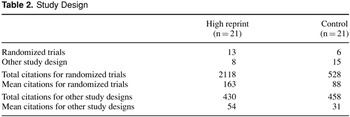
Of the twenty-one high-reprint articles, thirteen were reports of randomized trials and had been cited 2,118 times (mean, 163). In the twenty-one control articles, six were reports of randomized trials and had been cited 528 times (mean, 88) (Table 2). All thirteen trials in the high-reprint article group had statistically significant results favoring the experimental arm of the trial. In the control article group, only one trial had a statistically significant result favoring the experimental arm, four had a null result favoring neither arm of the trial, and one had a statistically significant result favoring the control arm of the trial.

Source of Funding
Twelve of the twenty-one high-reprint articles had received funding from the pharmaceutical industry (eleven of which were reports of randomized trials). In the control article group, five had received funding from the pharmaceutical industry (two were reports of randomized trials). The industry-sponsored research with high-reprint orders was cited more frequently than the industry-sponsored control articles. Studies that received funding from the pharmaceutical industry were cited more frequently than those that received funding from other sources (Table 3).

DISCUSSION
One of the potential limitations of this study could be a misrepresentation in the number of citations for corporate authored reports. A recent study found that reports of trials with corporate authorship (where authors are listed by research group only) are difficult to identify and result in lower citation rates (1). In the study reported here, five of the high-reprint articles had corporate authorship compared with only one in the control group, and we made strenuous efforts to identify all citing papers in the Science Citation Index. However, if we failed to identify some such citations, it would, in fact, mean that the difference in the number of citations found for the high-reprint articles compared with the control articles is an underestimate of the truth.
Our study showed that articles with high-reprint orders were cited more frequently than other articles. However, some high-reprint articles were cited infrequently and reasons for this are unclear. A further possible limitation is that the number of randomized trials and the number of pharmaceutical industry-sponsored research in the high-reprint and the control article groups were not equal. This finding is because articles were not matched on the basis of the subject of the report, or other factors, but simply on the time of their publication and their place within the journal. However, for both the high-reprint and the control articles, reports of randomized trials were cited more frequently than other types of study design and this finding was particularly the case for the high-reprint articles. Also, as might be expected (given that the purchases of the large reprint orders are likely to be dominated by the industrial sponsor), those studies that received funding from the pharmaceutical industry were cited more frequently than those that received funding from other sources.
In our study, no attempts were made to assess the impact of study quality, or factors other than the number of reprints, on subsequent citation rates. Further research is needed to explore other aspects of the relative importance and impact of high-reprint articles and to assess whether the size of reprint orders has an impact independently of other factors that might influence citation, such as study quality.
We are grateful to Richard Horton, editor of the Lancet, for supplying reprint data for the high-reprint articles. We are also grateful to those people who commented on the study in relation to its presentation at the Peer Review Congress in September 2001. S. Hopewell and M. Clarke were both involved in the design, analysis, and interpretation of the study and subsequent writing of this manuscript. This study has been carried out as part of the program of methodological research being undertaken at the UK Cochrane Centre, which is funded by the National Health Service Research and Development Programme. The views expressed in this study represent those of the authors and are not necessarily the views or the official policy of The Cochrane Collaboration.
References
Dickersin K,
Scherer R,
Gil-Montero M,
Suci E.
Corporate authorship: Problems with current systems for indexing and citation.
Fourth International Congress on Peer Review in Biomedical Publications, September 14-16, 2001, in Barcelona, Spain.
Hoeffel JC,
Hoeffel C,
Henrot P,
Lostette Y.
1996
How to assess the value of scientific publications.
Arch Mal Coeur Vaiss.
89:
1661-
1665.Google Scholar
Stern RS,
Arndt KA.
1999
Classic and near-classic articles in the dermatologic literature.
Arch Dermatol.
135:
948-
950.Google Scholar
Stryer D,
Bero LA.
1996
Characteristics of materials distributed by drug companies. An evaluation of appropriateness.
J Gen Intern Med.
11:
575-
583.Google Scholar
Vinson DC.
1990
Reprint requests for family medicine literature: How do we respond?
Fam Med.
22:
404-
405.Google Scholar

Number of Citations
Study Design

Source of Funding
 You have
Access
- 6
- Cited by