

Introduction
The 1896 contest between Democrat, William Jennings Bryan and Republican, William McKinley is considered one of the most important presidential elections in American history, marking significant changes in the nation’s trajectory. Some argue that it remains relevant for us today given strong parallels in the electoral environment then and now. Elections are once again as competitive and issues of “race, morality, immigration, and themes related to populism” are also now prominent (Azari and Hetherington Reference Azari and Hetherington2016). Back then, the US economy was transforming from an agrarian to an industrialized one, and the country was starting to play a more central role in the international arena. The election followed the recent panic of 1893 and associated recession that took place under Democratic leadership. Experiencing high unemployment, many now looked for changes in the nation’s economic policies. Democrats, backed by farmers in the rising Populist Party, sought to improve economic woes through changes in tariff policies and the use of free silver, whereas Republicans supported the gold standard (Bensel Reference Bensel2000; Sanders Reference Sanders1999). Bryan built an agrarian coalition, while an unlikely cohort of corporations and urban factory workers backed McKinley (Bensel Reference Bensel2000).
The Republican victory that year set forth the beginning of a new era in American electoral politics, a shift from a system of competitive elections to one of persistent Republican dominance and a solid Democratic South for decades to come. The post-1896 US was quite different from the one before (Burnham Reference Burnham1970). This election was crucial in “establishing the Republicans as the party of big business” that we know today, “and putting the Democrats on the losing end of the struggle over economic modernization” (Gelman Reference Gelman2014). This is what some describe as a critical realignment (Burnham Reference Burnham1965, Reference Burnham1970; Key Reference Key1955; Schattschneider Reference Schattschneider1960). In general, a realigning election is one in which the behavior of mass electorates transforms; one of the key characteristics is large groups of voters switching their party affiliation. A critical realignment (Burnham Reference Burnham1970; Key Reference Key1955),Footnote 1 in contrast to a secular realignment (Key Reference Key1959), is an abrupt, sudden change in electoral behavior usually revealed after the election (Key Reference Key1955). Proponents of this view further argue that a major consequence of the 1896 realignment was a rapid and persistent drop in voter turnout in states that became electorally uncompetitive (Burnham Reference Burnham1970; Key Reference Key1955; Schattschneider Reference Schattschneider1960).
The 1896 realignment and its effects are the subject of a vast literature in the social sciences (Brewer and Stonecash Reference Brewer and Stonecash2009; Burnham Reference Burnham1965, Reference Burnham1970; Converse Reference Converse1972, Reference Converse1974; Darmofal and Nardulli Reference Darmofal and Nardulli2010; Geer Reference Geer1991; Key Reference Key1955; Mayhew Reference Mayhew2000, Reference Mayhew2002; Nardulli Reference Nardulli1995; Rusk Reference Rusk1970, Reference Rusk1974, Reference Rusk2001; Schattschneider Reference Schattschneider1960; Stonecash and Silina Reference Stonecash and Silina2005; Sundquist Reference Sundquist1983). Some debate the causes and characteristics (critical or secular) of the realignment, whereas critics question if it happened at all.Footnote 2 Even if disregarding the idea of realignments, there is no denying the shifts in partisan power and turnout drop. The literature identifies three potential causes, conversion (voters switch parties), mobilization (new people join the electorate), and dealignment (active voters stop participating) (Darmofal and Nardulli Reference Darmofal and Nardulli2010). There is also dispute on the causal impact of the resulting decline in competition on turnout, with critics arguing that changes in electoral administration better explain the post-1896 dip in participation (Converse Reference Converse1972, Reference Converse1974; Rusk Reference Rusk1970, Reference Rusk1974, Reference Rusk2001).
The underlying theme in the literature is understanding voting behavior or political change more generally (Stonecash and Silina Reference Stonecash and Silina2005). The central disagreement is about the behavior of mass electorates, more specifically, about aggregate partisanship. The traditional realignment view (Key Reference Key1955; Burnham Reference Burnham1970) sees aggregate partisanship as stable for approximately 36 years, only rarely disrupted through crises (punctuated equilibria), and returning to a long period of stability. Others see aggregate partisanship as constantly moving and prone to sudden changes in response to politics and the economy; no return to stability is expected (MacKuen, Erikson, and Stimson Reference MacKuen, Erikson and Stimson1989; Reference MacKuen, Erikson and Stimson1998; Erikson, MacKuen, and Stimson Reference Erikson, MacKuen and Stimson2002). A third view posits that realignments are exceptionally rare and happen through the incorporation of new voters (Green, Palmquist, and Shickler Reference Green, Palmquist and Shickler1998, Reference Green, Palmquist and Shickler2004). The first two are in line with the conversion and dealignment theories, whereas the latter supports the mobilization thesis.
Studies focusing on historical periods rely on election returns data to identify shifting patterns in mass partisanship (Key Reference Key1955; Burnham Reference Burnham1970), while those on more contemporary electorates use poll data at the aggregate level (Erikson, MacKuen, and Stimson Reference Erikson, MacKuen and Stimson2002). The use of election returns data is a limitation in historically oriented research because it is not clear if the changes in partisan coalitions result from voters switching parties, dealignment or mobilization—this is inferred from election results, whereas research based on poll data can find out directly from the public if voters switched parties, did not vote, or recently joined the electorate. Though there was some polling done during the 1896 election (Thies Reference Thies2018), it was before the advent of scientific polling. And so, absent from this extensive electoral history are the voices of the people. In fact, Geer (Reference Geer1991) argued that it was precisely the lack of survey data in 1896 that contributed to a critical, not a secular, realignment.Footnote 3 The present study addresses this gap in the literature. It uses prediction market data to measure the public’s expectations on the election outcome and examines the consequences of the realignment on voting behavior. In doing so, this research adds a missing dimension to the story of the of the 1896 realignment—how the American public perceived the changing electoral environment. Did people anticipate the realignment? Did the shifts in partisan power initiate a decline in voter turnout that persists to the present day? Answers to these questions can clarify some of the conclusions about voting behavior in the existing debates on realignments and their effects.
Using an original dataset of election betting market data at the state level for the 1896 presidential election, this article explores how the American public perceived the realignment and its consequences on voting behavior. Betting odds data capture voters’ expectations on the election outcome at the aggregate level. When used as a measure of perceptions on electoral closeness between the two major parties, market odds serve as a rough measure of mass public opinion. The data make it possible to identify shifts in aggregate partisanship. I argue that evidence from the market odds supports the conversion and dealignment theories. I test two hypotheses. The first examines whether or not people anticipated the realignment and the second focuses on its effects on turnout.
-
(1) Betting markets were good predictors of election outcomes.
-
(2) Perceptions of declining electoral competition suppressed voter turnout.
Findings show that election betting markets accurately forecasted the outcome a month before the election. This means that the public was able to anticipate the realignment. Partisanship was changing in the states, and election forecasters, the media, and much of the public were aware of this. Expectations on the election outcome also influenced turnout. In states where people expected competition to drop, participation dipped accordingly. The article makes several contributions: (1) it adds a missing component to the literature of the 1896 election that shows how Americans viewed the realignment in the states, (2) it uses new data at the state level as a measure of ex ante electoral competition for the historical period, and (3) it shows the important role that election betting markets played in forecasting elections in the states during the pre-poll era.
The Role of Betting Markets in Nineteenth Century Election Forecasting
Regular media coverage of the “horse-race” between presidential candidates vying for the nation’s top office is commonplace nowadays. Months before the election, people know how the polling is going, which are the “battleground” states, the chances candidates have of carrying these, as well as the forecasts of renowned pollsters. With rare exceptions, the outcome is known in advance. It might seem surprising that things were not all that different over a century ago. During the era before the advent of scientific polling, newspapers tracked the state of political races using forecasts from the nation’s election betting markets (Rhode and Strumpf Reference Rhode and Strumpf2004), a type of prediction market.Footnote 4 These markets consist of groups of people wagering on various types of election outcomes, for example, national results, chances of a candidate carrying a state, and likelihood of a plurality. Betting commissioners (i.e., bookmakers) set the odds and collected commissions on all bets placed, making a profit regardless of who won (Rhode and Strumpf Reference Rhode and Strumpf2004). Like today the media report on the forecasts of well-known pollsters, such as, Nate Silver, in the past, newspapers obtained election forecasts from bookmakers such as, Chicago’s Jim O’Leary, D.C.’s Lynn and Wall, or New York’s Ullman brothers.
Rhode and Strumpf (Reference Rhode and Strumpf2004, Reference Rhode, Strumpf, Vaughan-Williams and Donald2013) were the first to document a detailed history of election betting markets in the nineteenth and early twentieth century US, therefore, I only summarize the information here and supplement it based on data collected for the present study. New York City housed one of the “thickest” markets, given that “over one-half” of the nation’s betting took place there (Rhode and Strumpf Reference Rhode and Strumpf2004). The amount of money wagered was in the millions of dollars, ranging from $13.7 million (in 2000 dollars) in 1884 to a whopping $165 million in 1916, averaging $37 million at the turn of the twentieth century (see Table 1 in Rhode and Strumpf Reference Rhode and Strumpf2004). The New York City market was a national market in the sense that people bet from across the nation (sometimes from outside the US), at times placing wagers by telegraph or telephone not unlike how transactions are conducted today through the Internet. Rhode and Strumpf (Reference Rhode and Strumpf2004, Reference Rhode, Strumpf, Vaughan-Williams and Donald2013) focus on the New York market and outcomes at the national level and the state of New York. But they note that markets “emerged in most major cities.”
Betting was so lively in other urban areas that national and local newspapers (Town Talk 1904) regularly reported how the wagering was going in places like Philadelphia, Chicago, Cleveland, Boston, San Francisco, Baltimore, and Washington, DC. Hotels and bars were the most common sites of betting in the Northeast and Midwest (Election Bets 1884), whereas in the West bookmakers seemed to typically operate in cigar shops (Californians Give Odds 1888). The Chicago betting market probably rivaled New York City’s. Millions were similarly bet there (Chicago Wagers Near $1,000,00 1916; Offers $100,00 on Taft 1908).
Gambling on presidential elections usually started in the summer and became livelier as the outcome neared. All types of people participated in either “freak bets,” in which no money is wagered, or monetary bets (Rhode and Strumpf Reference Rhode and Strumpf2004). Newspapers reported that “so common and universal is the custom of betting on the elections that a man from Mars upon witnessing it for the first time would be astonished to be informed that it is forbidden by law in every State of the Union” (Baker Reference Baker1912). For the most part, two kinds of people participated in monetary betting, committed partisans (e.g., voters) and professional gamblers. The partisans were a “very large class […] who blindly follow the party lead and religiously believe in their party’s success […] chiefly because they are partisans and are anxious to uphold their party’s standard with their money.” The professionals, on the other hand, were motivated by profit. They placed “their money out in a very cold and systematic way that no amount of enthusiasm could influence” (Campaign Betting 1888).
How Historical Election Betting Markets Produced Accurate Forecasts
Frequently referred to in the papers as “oracles” or “prophets” of the election, bookmakers were the prominent figures in election betting markets. They kept a book of gambling odds and published changing prices regularly in their establishments. These were the odds that the media reported on to keep track of the election. These circulated in newspapers across the nation and were often found in front pages. Journalists typically consulted some of the best-known bookmakers due their record on accurately forecasting elections (Baker Reference Baker1912). Even presidential candidates expressed great confidence in market predictions. Days before winning the presidential election in 1912, Woodrow Wilson put to rest any doubts about the likely victory noting, “the Gentlemen in Wall Street do not bet 5 to 1 [84%] on their own destruction” (Wild Over Wilson 1912). Commenting on the precision of the odds, The Nation stated “it is a general impression that the odds in the closing weeks of other Presidential campaigns have never failed to indicate the result, and the impression is correct” (Election Odds 1916). Similarly, a writer for a labor magazine wrote “I cannot remember a time when the odds offered by the New York gamblers on presidential candidates were misplaced; and these bets are now regarded by the people in general and the politicians in particular as the true oracles of the event” (Graham Reference Graham1913).Footnote 5 Research shows that these forecasts were as precise as the nineteenth century papers stated. Scholars stress that this is particularly remarkable given that these prediction markets did not benefit from insight gained through poll data (Erikson and Wlezien Reference Erikson and Wlezien2008, Reference Erikson and Wlezien2012; Rhode and Strumpf Reference Rhode and Strumpf2004, Reference Rhode, Strumpf, Vaughan-Williams and Donald2013).
Erikson and Wlezien (Reference Erikson and Wlezien2012) note that the “early markets worked so well that we are led to believe that the political cognoscenti of the times could read the political tea leaves about as well as modern day observers can from reading the polls.” They explain that essentially the markets capture the “fundamentals of the election” (e.g., information on the economy, voters’ inclinations) because two conditions were met, and the betting pool was large and included a mix of partisan and professional gamblers. Profit incentivizes the latter to share private knowledge about the election through the act of betting. The markets aggregate information on the election, and errors (incorrect information) cancel out. The general principle behind the accuracy of prediction markets derives from the concept of the “wisdom of the crowds”—the idea is that groups are smarter than any single individual in them. This is also known as the Condorcet Jury Theorem. In addition to size, groups need to include some individuals that have the “correct” information. In the betting markets, these are the professional gamblers, which include the bookmakers. As Rhode and Strumpf (Reference Rhode and Strumpf2004) note, in order for the historical markets to be informative they need not only partisan bettors but also “well-informed betting commissioners who serve as market makers and use their impartial beliefs to set the prices competitively.”
Since the betting odds were published in newspapers, the data are preserved in the historical record. This inspired a literature on whether historical prediction markets outperform polls (Rhode and Strumpf Reference Rhode and Strumpf2004, Reference Rhode, Strumpf, Vaughan-Williams and Donald2013; Erikson and Wlezien Reference Erikson and Wlezien2012). This article uses market predictions from the historical era in a different way—to measure public perceptions of electoral competition in the American states. This is not the first study to use betting odds as a measure of electoral closeness. Rhode and Strumpf (Reference Rhode and Strumpf2004) highlight this characteristic of the data stating that “another indication of the predictive power of the betting markets is that they were highly successful in identifying those elections […] that would be very close.” Others have also previously used prediction market data as a measure of closeness (Strijbis, Arnesen, and Bernhard Reference Strijbis, Arnesen and Bernhard2016; Wall, Costello, and Lindsay Reference Wall, Costello and Lindsay2017) or to similarly capture people’s expectations on election outcomes (Erikson Reference Erikson2016). Wall, Costello, and Lindsay (Reference Wall, Costello and Lindsay2017) use betting odds data to identify shifts in the behavior of the electorate prior to the election. Building on the existing research, this study’s novel approach is in using historical state-level betting market data as a measure of electoral competition. The next section describes state-level expectations on the election of 1896 from the perspective of betting markets.
The 1896 Presidential Election Through the Lens of Election Betting Markets
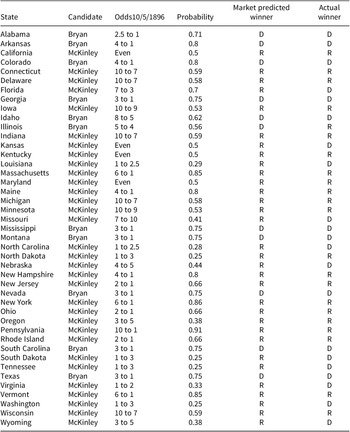
Expectations on the outcome of the 1896 presidential election plagued newspapers since the early summer of that year. The policy issues made for a close contest, marked by popular enthusiasm, memorable speeches, and innovations in campaigning. The media kept track of virtually every aspect of the campaigns, including what the betting activity suggested about the potential results. Beginning in July of 1896, reports on how the betting on the election was going surfaced. These were of minor bets, and some of the early wagers on July 3rd in Missouri gave McKinley less than a 30% chance of victory (Betting Against McKinley 1896). Things changed in the early fall. Bettors now expressed greater confidence in a McKinley victory; odds on July 2nd suggested the Republican candidate’s chances of winning were 72% (Bets on McKinley 1896). Things continued to look grim for Bryan that fall. In September 19th, the bettors in the Chicago market gave Bryan only a 40% chance of winning the general election (Odds Against Bryan 1896). By the end of that month, it seemed the markets identified McKinley as the potential victor in the general election and in several states. Table 1 displays the betting odds from October 5, 1896 as published by New York’s bookmakers, the Ullman brothers, from the firm Ullman and Rankin. These are the bookmaker’s predictions on the chances of a candidate carrying the state a month ahead of the outcome. They published nearly identical odds a week prior to this, on September 26, 1896. See the September odds in Table 1A in the Supplementary Appendix.Footnote 6 Figures 1A and 2A in the Supplementary Appendix display the original data. I discuss the October odds because, as is the case with poll data, odds data increase in accuracy as the election approaches. The figures in Table 1 show that McKinley was the expected winner both at the national and state level.Footnote 7 The markets correctly predicted 72% of the outcome in the states. Forecasts were wrong for 12 states. Some of those included places where the candidates were tied in market predictions (e.g., Kansas) and where the election was comparably close (e.g., Missouri, Nebraska). Though the bookmakers name McKinley as the expected winner in some of the uncertain states, the chances of victory for the Republican candidate in Missouri and Nebraska were lower than 20%. The uncertainty might have been driven by third parties. The predictions for some southern states, such as North Carolina and Tennessee, are correct in terms of probability—they gave McKinley only a 1 in 4 chance of carrying those states, but nonetheless the Republican candidate was listed as the expected winner.Footnote 8
Betting odds on the chances of a candidate carrying the state, October 1896

Note: Source for betting odds: “Odds against Bryan.” San Francisco Call 1896.
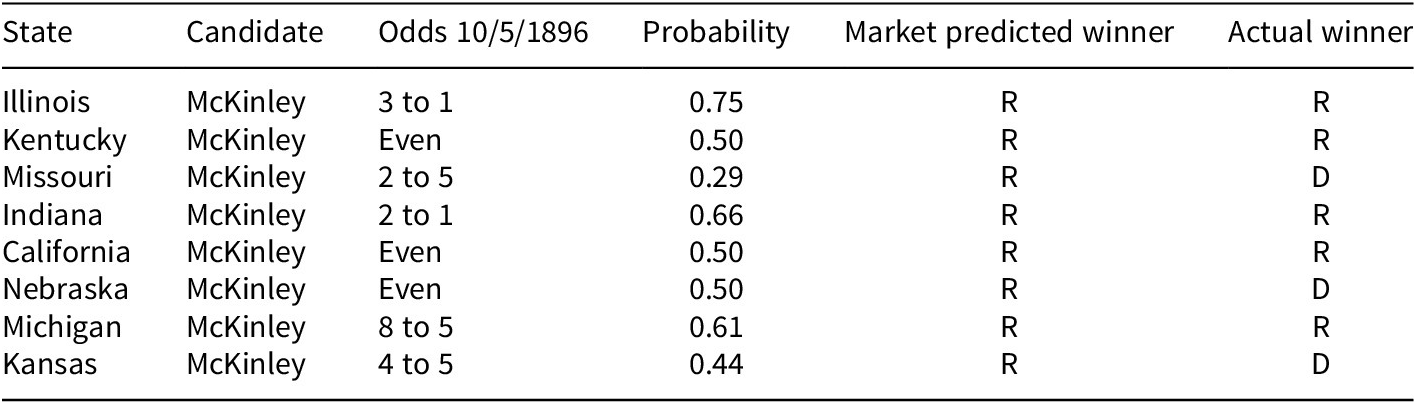
Predictions improved by election-eve. Table 2 displays election-eve odds in states for which reliable data were available. The forecast for Illinois is now closer to the actual outcome, and it has McKinley carrying the state with a 75% probability. A month prior, the markets gave Bryan a 56% chance of victory there. The election-eve forecasts for Kansas, Missouri, and Nebraska list McKinley as the expected winner, but the odds improved and are more aligned with the actual election outcome than the expectations listed in October. The markets gave McKinley a probability of victory of less than a third, an improvement from the 41% listed in October. Bryan carried the Show-Me state, as well as Kansas and Nebraska. The odds for Kansas were closer to the outcome at that time; the markets expressed less certainty of the Republican carrying that state than they did in early October.
Election-eve market predictions on the 1896 election

Notes: Source: “Odds in Election Bets.” The Chicago Tribune Nov 1 1896.
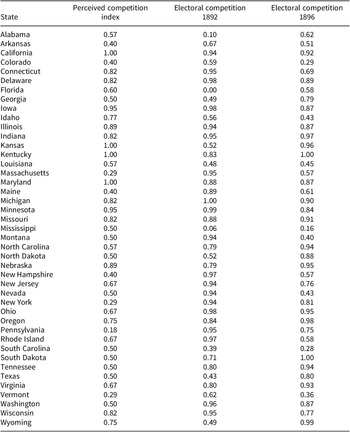
The 1896 market odds also signal the realignment a month prior to the outcome. The predictions identify some of the states that became electorally uncompetitive that year and for decades to come. Table 3 displays an index of electoral closeness based on the betting odds (perceived competition index)Footnote 9 alongside levels of electoral competition from the 1892 and 1896 contests based on election returns data. The interpretation of the closeness indexes based on the betting and election return data is that higher values indicate increasing competition and perceived competition, a value of 1 means an election is perfectly competitive. Some of the states where the betting markets signaled that competition was declining were in the Northeast, such as New Hampshire, New Jersey, New York, Pennsylvania, and Rhode Island. The gambling data also helped to identify those states that would become more competitive in 1896 (and after), such as Missouri, Nebraska, and South Dakota. Markets missed some marks, such as Wyoming, which became more competitive in 1896. These findings are important because perceptions of electoral competition can influence the behavior of parties and voters.
Changes in electoral competition in the states reflected in betting market data

Using Prediction Market Data to Measure Electoral Competition in the 1896 Election
The 1896 realignment resulted in one-party dominance across the nation. Republicans controlled most states outside of the South. This is a problem because competitive elections are an important characteristic of healthy democracies. Close contests give voters viable alternatives in governance and foster greater party mobilization and voter participation. Ideally, this leads to better policies and politician accountability (Burnham Reference Burnham1970, Reference Burnham1974; Key Reference Key1955; Parry et al. Reference Parry, Dowdle, Long and Kloss2022; Schattschneider Reference Schattschneider1960). Some scholars argue that a major consequence of this shift in partisanship was a precipitous drop in voter turnout post-1896 (Burnham Reference Burnham1965, Reference Burnham1970). Turnout dropped by an average of 12–16 points nationally, and by more at the state level (Rusk Reference Rusk2001). That turnout drop is the subject of an extensive literature. Realignment theorists attribute the bulk of the drop to declining competition (Burnham Reference Burnham1965, Reference Burnham1970, Reference Burnham1974), whereas others argue that changes in the legal institutional environment explain the low voting rates (Converse Reference Converse1972, Reference Converse1974; Rusk Reference Rusk1970, Reference Rusk1974). But one limitation in this long line of research is that most of the existing studies use measures of electoral competition that capture closeness on Election Day. Theoretically, it should be expectations of the outcome that matter most given that the degree of competitiveness drives the behavior of parties and voters. Political campaigns might invest resources in registering voters in states where races are close and in turn avoid spending in uncompetitive places.
Scholars usually employ two approaches to measuring electoral competition, ex post measures—those that capture the degree on competitiveness on the day of the election, and those that do so prior to the event—ex ante measures. By far, the most common used are indexes based on election returns data (ex post). These indexes usually combine the percentage of the vote and legislative seats won by a party along with the proportion of elections each party wins over a certain time frame (David Reference David1972; Pfeiffer Reference Pfeiffer1967; Ranney Reference Ranney, Jacobs and Vines1965; Rusk Reference Rusk2001). Though the use of ex ante measures is growing in the literature, (Foster Reference Foster1984; Erikson Reference Erikson2016; Neiheisel Reference Neiheisel2016; Ban et al. Reference Ban, Rouirnaies, Hall and Synder2019) these are harder to come by. In an analysis of hundreds of articles that used ex post and ex ante measures to study the effects of competition on turnout, Geys (Reference Geys2005) found that the success rate of studies using ex ante measures was 74% compared to 51% in studies that used ex post measures. This article builds on the research that uses ex ante measures of electoral competition. It is not possible to determine from the data if perceptions of competition in 1896 explain the decline that persisted over the following decades, but the data can reveal if voters stopped participating in those states that became uncompetitive during the realignment.
Data and Methods
This study uses an original dataset of betting odds on the 1896 presidential election at the state level for 43 states. In this manner, it differs from prior betting market data studies, which focused primarily on national elections. The data consist of betting odds on the chances of a candidate carrying a state in the 1896 election. The 43-state data are from one page of the Ullman Brother’s betting book. They were nationally recognized betting commissioners from the New York market. The data are from the New York City betting market because it was a thick market both in terms of betting volume and participation (Rhode and Strumpf Reference Rhode and Strumpf2004). Most of the data used here are for gambler’s odds posted a month ahead of the election—October 5, 1896. See the data in Table 1, and Figure 2A in the Supplementary Appendix. Reliable betting odds data on state-level predictions for all states are quite rare and difficult to find. The October data used here represent the most complete set of betting odds at the state level for the 1896 election. Data that meet the conditions of an informative market are not available for such a large sample of states or for later dates. Election-eve data would be ideal. A smaller dataset of election-eve betting odds for eight states for which data were available is also analyzed. These data are from the Chicago betting market, comparably thick to that of New York.
Collecting and identifying reliable betting odds data was a multi-step process. The data were gathered primarily from online databases of historical newspapers and also from newspapers in microfilm. To locate data in historical online databases, I conducted searches using multiple variations of such terminology as “election wagers,” “gambling,” “election,” or “betting odds.” The search of newspapers in microfilm was based on proximity to Election Day; odds were likely to be published in front pages as the outcome neared. Betting odds data are most often scattered across various news stories listing the odds published by bookmakers or offers made. Sometimes the data are neatly posted as tables, but in most instances the data are embedded in news stories. See Figure 3A in the Supplementary Appendix for an example of how most data appear in newspapers. The data used here are based on actual bets, not on offers made. All data on offers made, but not backed with money, were excluded from the analysis. The reason for this is that these data do not aggregate information on expectations of the outcome given that offers are not always taken. The next step involved determining which data came from thick or thin markets (those with little betting). To do this, I searched for supporting information in other news stories that described how “lively” the betting was going in a given market on a specific date or approximate dates as determined by the betting volume or stories that directly stated the amount of money bet. I also rely on Rhode and Strumpf’s analysis of the New York City market.
Following the literature, I transform the candidate prices (implied probabilities) into the log of the odds of a Republican victory.Footnote 10 This is done because “winner-take-all prices are related to the actual vote in a decidedly non-linear fashion” (Erikson and Wlezien Reference Erikson and Wlezien2012). The log-transformed betting odds are linearly related to the actual vote.Footnote 11 See Erikson (Reference Erikson2016) for a similar use of betting market data.Footnote 12 These data capture what people knew regarding the closeness of races in the states in early October.
I employ correlation and regression analysis to test the following hypotheses:
-
(1) Betting markets were good predictors of election outcomes. The first step is to establish if the betting markets could accurately forecast the outcome. This helps to determine if the odds are a measure of electoral closeness.
-
(2) Public perceptions of declining competition suppressed voter turnout (at the aggregate level). The expectation is that turnout declined in states that became electorally uncompetitive.Footnote 13
The dependent variable for the first hypothesis is the Republican percent of the two-party vote. The key independent variable is the log of the odds that the Republican candidate (McKinley) carries a state. The Republican percent of the two-party vote from the 1892 election is included as a control variable since expectations from the previous presidential race could influence the 1896 candidate prices. Election returns data are from the CQ Press Voting and Elections Collection database. The expectation is that the betting markets could forecast the outcome ahead of the election even when taking into account knowledge from the previous presidential contest.
For the second hypothesis, the dependent variable is voter turnout in the 1896 presidential election, defined as the total number of ballots cast divided by the total voting eligible population. It is an aggregate measure of voting rates from Gans and Mulling (Reference Gans and Mulling2011). To measure perceptions of electoral competition using the betting odds data, I constructed an index ranging from 0 to 1, where 1 indicates perfect perceived competition.Footnote 14 The expectation is that when people expected a close contest turnout increased and vice versa. One of the model specifications includes several control variables known to be associated with voter turnout. I control for electoral competition, as measured in the traditional way using election return data. This captures competition levels on Election Day. It is an index ranging from 0 to 1, where 1 indicates perfect competition.Footnote 15 To account for the potential influence of turnout patterns from the prior race, the turnout percent for the 1892 race is added. Legal institutional variables control for progressive reforms long thought to suppress turnout (Burnham Reference Burnham1974; Converse Reference Converse1972, Reference Converse1974; Rusk Reference Rusk1970, Reference Rusk1974). I include a measure of strict voter registration laws (personal registration) and another on the Australian ballot.Footnote 16 The personal registration variable is coded 1 if a state had a personal registration law in place and zero otherwise. Australian ballot is a dummy variable coded 1 if a state had implemented this law by 1896. Personal registration and the Australian ballot are expected to suppress participation. Additionally, I incorporate data from a study on candidate visits to the states during the 1896 election. Buggle and Vlachos (Reference Buggle and Vlachos2020) used data on Bryan’s visits across the nation during the 1896 campaign.Footnote 17 I created a binary measure coded 1 if Bryan visited a state. Candidate visits are associated with increased turnout (Hill and McKee Reference Hill and McKee2005). The analysis on the second hypothesis focuses on a subset of the data of 25 states for two reasons, (1) data for the control variables are not available for all states; (2) voting behavior in the former Confederate states represents a unique case in US electoral history. There was virtually no electoral competition in the South (Burnham Reference Burnham1970) and numerous electoral institutions as well as the use of violence were employed to suppress the black vote (Rusk and Stucker Reference Rusk, Stucker, Silbey, Bogue and Flanigan1978).
Results
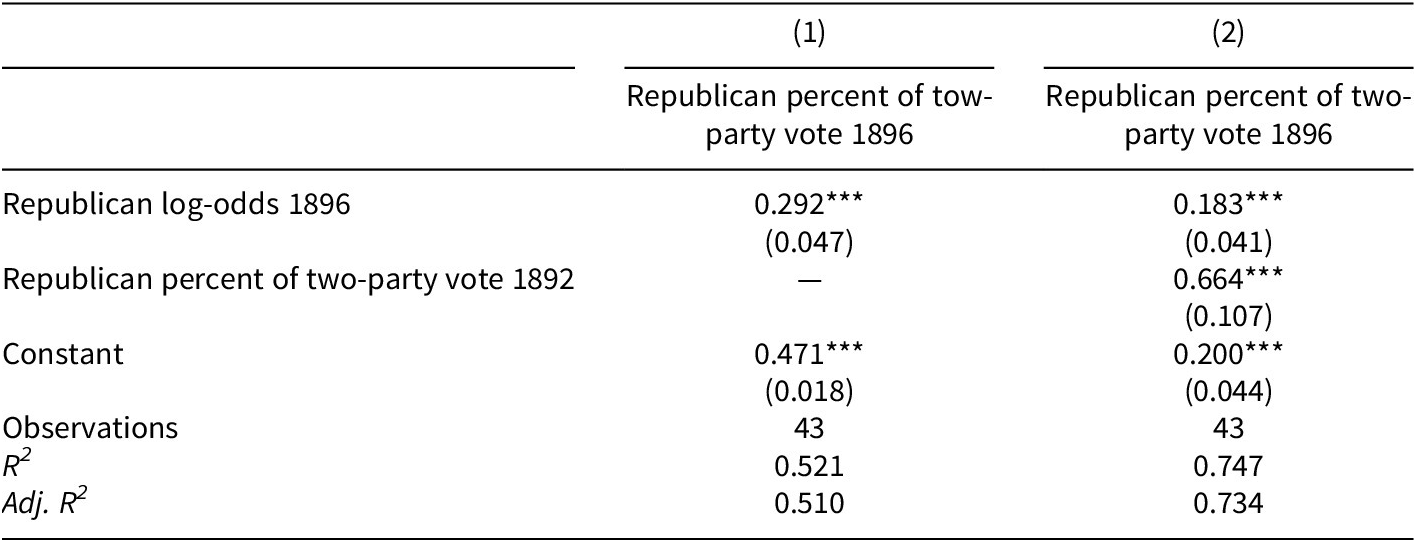
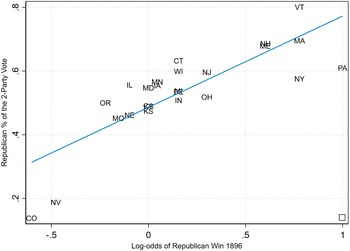
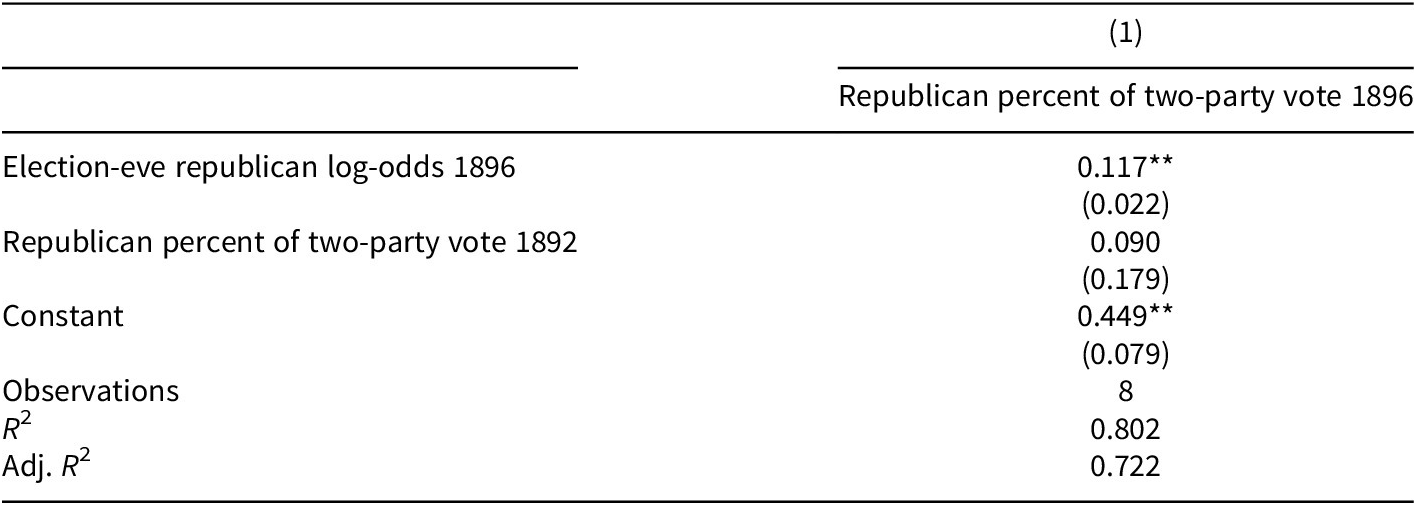
This section first presents the results of a set of regressions predicting the Republican share of the two-party vote in 1896 from the log-odds. Table 4 displays the findings from two model specifications. Column 1 is a bivariate regression of the Republican percent of the two-party vote on the Republican log-odds for 1896 a month ahead of the election. The coefficient on the log-odds is significant and appropriately signed, providing evidence that the betting markets were able to gauge how the election would turn out a month prior to the election. An increase in the Republican log-odds is associated with a greater share of the vote for the Republican candidate. The intercept shows that when expectations indicated a competitive race (log-odds were 0) the contest was close (47% Republican share, near 50–50). Column 2 controls for the Republican share of the two-party vote in the 1892 election. Both coefficients are significant at all conventional levels. This means that the markets were tapping into new information specific to the 1896 contest. The coefficient on the log-odds in column 2 decreased in magnitude relative to its size in column 1, which suggests price-setters relied on current (1896) and past information to set the odds. To illustrate this, Figure 1 displays the Republican share of the two-party vote as a function of the log-odds excluding the Southern states.Footnote 18 The correlation is tight at 81%. Even when the Southern states are included, the correlation is moderately strong at 73%. This shows a linear and positive relationship between price and the actual vote indicating that a month prior to the election the prices reflected people’s expectations of a McKinley victory.
The republican share of the two-party vote as a function of betting market predictions, 1896

Note: Robust standard errors in parentheses.
*** p < 0.001.
Republican share of the two-party vote vs. market predictions, 1896. Correlation is 0.81.

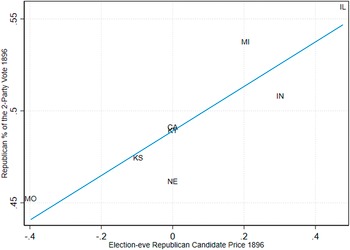
Table 5 replicates the analysis from column 2 in Table 4 using a sub-sample of eight states for which election-eve data were available. The results are consistent with expectations. The coefficient on the election-eve log-odds is positive and significant. As the log-odds rise so do the chances of a Republican victory. The coefficient on the Republican share of the two-party vote for the 1892 election is insignificant. Caution must be taken given the small sample used here. Figure 2 illustrates these results. The correlation is now tighter at 89% indicating that on election-eve price setters were nearly certain of a McKinley victory.
The republican share of the two-party vote as a function of election-eve betting market predictions, 1896.

Note: Robust standard errors in parentheses.
** p < 0.01
Republican share of the two-party vote vs. election-eve market predictions, 1896. Correlation is 0.89.

Impact of Perceived Competition on Turnout 1896
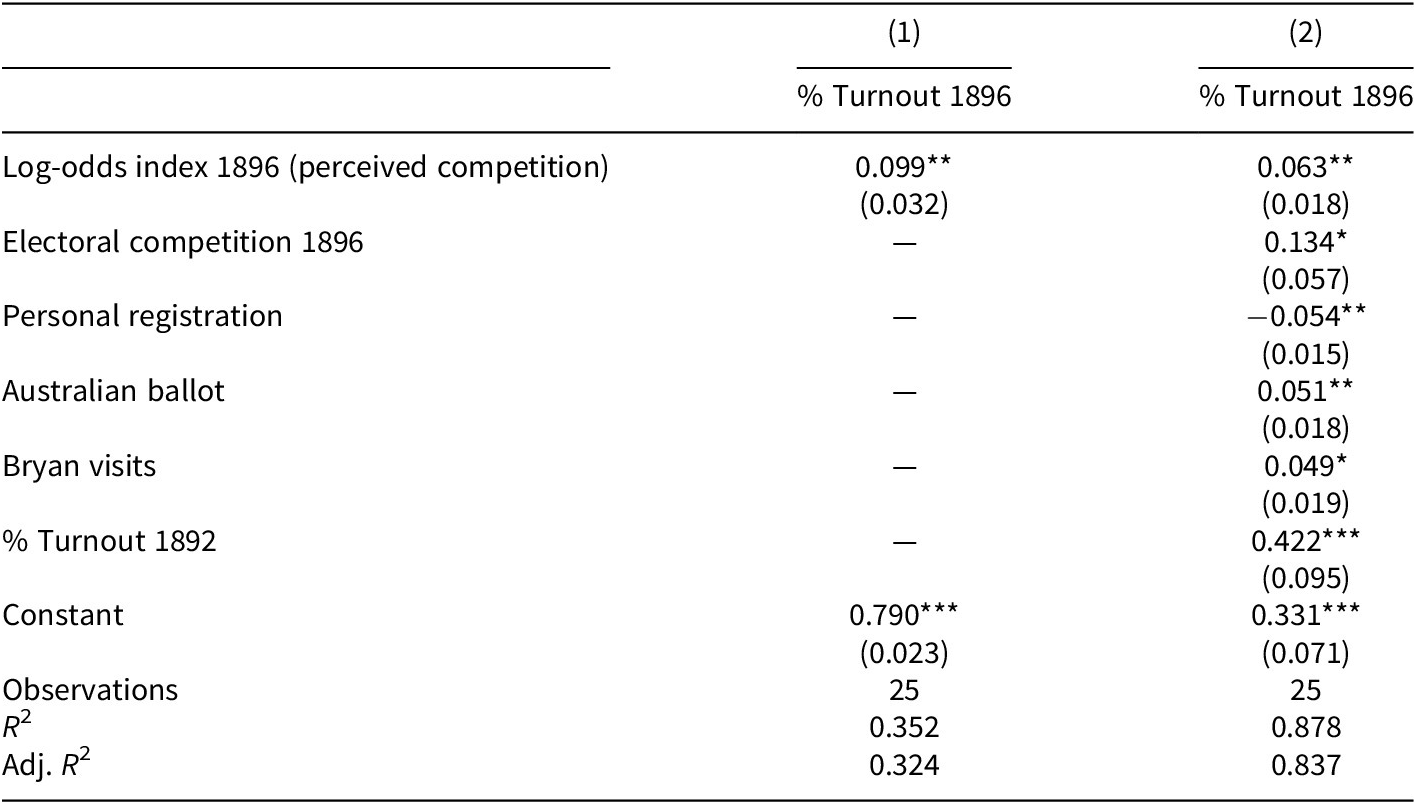
This section turns to an analysis on the impact of voters’ expectations of electoral competition on turnout in 1896. To start, column 1 in Table 6 first presents the results of a bivariate regression of turnout on perceived competition, measured as an index ranging from 0 to 1 using the log-odds of the Republican and Democratic candidates, a value of 1 indicates the election was perceived as perfectly competitive, 50–50. The dependent variable is voter turnout in the 1896 presidential election. The coefficient on the log-odds index is significant and in the expected direction, indicating that when the public perceived contests were close turnout increased accordingly.
Impact of perceived competition on turnout, 1896

Note: Robust standard errors in parentheses.
*p < 0.05, **p < 0.01, ***p < 0.001.
The multivariate model in column 2 controls for relevant factors associated with voter participation during the late nineteenth century. Findings show that people’s expectations on the outcome boosted turnout by as much as 6%, on average, holding all else constant, in those states expected to be perfectly competitive, such as California, Kansas, and Kentucky. Taking California as an example, voter turnout there rose from 46% in 1892 to 75% four years later. This means that perceptions of how the race would turn out in that state were a crucial component to voter participation. In states where the anticipation was for one-party dominance, turnout dropped. In Colorado, voter expectations of declining competition account for a 1.2% drop in participation, Massachusetts experienced a 3.4% dip, and in Pennsylvania anticipation that the race was uncompetitive accounted for a 6% drop in turnout. New Hampshire, New York, and Vermont also experienced declining turnout based on perceptions of declining competition there. Turning to the control variables, electoral competition on Election Day boosted turnout by as much as 13 points in highly competitive states holding everything else constant. Some of the states that were nearly perfectly competitive on Election Day included South Dakota, Ohio, and Kentucky—all places were turnout rose from the prior presidential election. Not surprisingly, turnout dipped by 5% in states that had personal registration laws in place. The coefficient on the secret ballot is significant but did not move in the expected negative direction. As would be expected turnout rose by as much as 4 points, on average, in places Bryan visited during the campaign, and turnout from the previous election is positively associated with participation in 1896.
Conclusion
This study set out to analyze the 1896 presidential election and the associated realignment using an original dataset of state-level gambling odds from historical election betting markets. During the pre-poll era, the media relied on information from prediction markets to forecast election outcomes. Research shows these predictions were remarkably accurate. This study confirmed that markets could also forecast the outcome in the states with comparable precision. The markets also identified those states where the race was close or tied as well as those that were about to become uncompetitive on Election Day in 1896. The results showed that the public anticipated the realignment prior to the election outcome. It was known that Republicans were backed in many states with a great deal of support and that Democrats would dominate in the South.
Like today, back then the outcome of presidential elections was uncertain during the summer. Some of the betting markets gave Bryan a chance at victory up until the fall, when the tide turned in favor of the Republican candidate. The markets were able to identify these shifts in mass partisanship. This finding lends support to the conversion thesis in the realignment literature. A great deal of the information aggregated in the markets was from voters backing their beliefs. Bookmakers used that knowledge combined with other information to set prices that indicated a shift in the partisan balance across the states. These results cast doubts on the mobilization theory. While some argue that the incorporation of new immigrants into the electorate could explain the partisan shifts in 1896 (Salisbury and MacKuen Reference Salisbury and MacKuen1981), or, more generally, that the addition of new voters better explains shifts in mass partisanship (Green, Palmquist, and Shickler Reference Green, Palmquist and Shickler2004) it is unlikely the markets would capture accurate information on the voting rates of new immigrants joining the electorate in the early days of the fall. The 1896 realignment happened during the Second Great Wave of immigration, when most states restricted voting rights to citizens. Political machines were less interested in mobilizing newcomers (Erie Reference Erie1988). There were also a host of innovations in election laws that made it incredibly difficult for immigrants (even if naturalized), African Americans, and other non-white individuals to register to vote (Perez Reference Perez2021). Even when bookmakers took into account the voter registration rates prior to setting prices (Range of Election Bets 1904), the odds might not have reflected the voting behavior of new immigrants. This is because individuals’ registration records were in most cases compared to the ballot cast on Election Day and sometimes discarded. It would be difficult to know if the vote of new immigrants or non-white registered voters would count. Future research could look into this further with case study analysis of specific state or cities with large immigrant populations and longitudinal betting data.
The results of this study also showed that public perceptions of declining electoral competition suppressed turnout. This means that the post-1896 turnout decline that persisted for decades had already started in those states that became uncompetitive in 1896. This finding is consistent with the idea that changes in electoral competition account for part of the persistent turnout drop (Burnham Reference Burnham1965, Reference Burnham1970). This suggests that campaigns were likely not mobilizing some voters in states where the outcome was certain and also that some individuals might have lost the incentive to participate when the results were known in advance. This lends support to the dealignment thesis. Some voters dropped out of the electorate in 1896.
Perceptions of declining competition might have also influenced the decision to register to vote. Another line of research is to use voter registration rates data as the dependent variable, and market predictions as the key explanatory variable. Did perceptions of competition lead to increased voter registration in states where competition was expected to increase? Did registration rates drop in those states where the public anticipated one-party dominance?
The findings in this study must be taken with caution given that the analysis focused on one election year and the sample sizes were relatively small for some tests. This project is part of an ongoing data collection effort of state-level betting odds from the historical era. Future work might employ longitudinal and cross-sectional analysis. This would help to further clarify what is known about the realignment, and more broadly, how political change happened at the turn of the twentieth century in America.
Supplementary Materials
To view supplementary material for this article, please visit http://doi.org/10.1017/spq.2022.14.
Data Availability Statement
Replication materials are available on SPPQ Dataverse at https://doi.org/10.15139/S3/X6BYHS (Perez Reference Perez2022).
Acknowledgments
The author would like to thank Bob Erikson, John Bowman, and the three anonymous reviewers for their helpful comments on previous versions of this work.
Funding Statement
The author received no financial support for the research, authorship, and/or publication of this article.
Conflict of Interest
The author declared no potential conflicts of interest with respect to the research, authorship, and/or publication of this article.
Author Biography
Vanessa M. Perez is an Assistant Professor of Political Science at Queens College, CUNY. Her research focuses on the interaction between electoral institutions and the changing American electorate over time.