1. Introduction
Svalbard's Caledonian bedrock is divisible into three main provinces: Eastern, Northwestern and Southwestern (Fig. 1), separated by major, late Palaeozoic, N-trending faults (Harland, Reference Harland1997; Gee & Tebenkov, Reference Gee, Tebenkov, Gee and Pease2004). All three incorporate substantial Precambrian complexes. This paper focuses on the Southwestern Province in Wedel Jarlsberg Land, between Bellsund and Hornsund, where recent research in southwesternmost parts (Larionov et al. Reference Larionov, Tebenkov, Gee, Czerny and Majka2010) has established the presence of a Mesoproterozoic (c. 1200 Ma) igneous complex (Eimfjellet) thrust over a Neoproterozoic schist and carbonate succession (Isbjørnhamna Group). Elsewhere in Wedel Jarlsberg Land, thick greenschist-facies metasedimentary successions dominate (Birkenmajer, Reference Birkenmajer1975; Czerny et al. Reference Czerny, Kieres, Manecki, Rajchel and Manecki1993) and are separated into two parts by a major unconformity (Birkenmajer, Reference Birkenmajer1975; Bjørnerud, Reference Bjørnerud1990). Recent studies have demonstrated that the deformation and metamorphism beneath the unconformity is of late Cryogenian age (Majka et al. Reference Majka, Mazur, Manecki, Czerny and Holm2008). New evidence is presented here of earliest Neoproterozoic igneous rocks overprinted by the above mentioned late Cryogenian Torellian Orogeny. The results have implications for interpretations of the Svalbard Caledonides and reconstructions of this orogen in the High Arctic. In a broader sense, the results presented herein call for reconsideration of existing plate tectonic models for the High Arctic region.
Geological map of Svalbard showing the Caledonian basement provinces (modified from Gee & Tebenkov, Reference Gee, Tebenkov, Gee and Pease2004).

2. Svalbard's Caledonian provinces
The Eastern Province comprises two terranes, Nordaustlandet and West Ny Friesland. The former is influenced by the Tonian (Nordaustlandet) Orogeny, with earliest Neoproterozoic (c. 950 Ma) syn- and post-tectonic granites (Gee et al. Reference Gee, Ohta, Tebenkov, Krasilščhikov, Balashov, Larionov, Gannibal and Ryungenen1995; Johansson et al. Reference Johansson, Larionov, Tebenkov, Gee, Whitehouse and Vestin2000) intruding uppermost Mesoproterozoic to lowermost Neoproterozoic turbidites. The latter are overlain unconformably (Ohta, Reference Ohta1982; Gee & Tebenkov, Reference Gee and Tebenkov1996) by calc-alkaline volcanites (c. 950 Ma; Tebenkov, Reference Tebenkov, Krasilshikov and Basovs1983; Ohta, Reference Ohta1985) and thick Neoproterozoic siliciclastic and carbonate successions, including Ediacaran tillites that pass conformably up into Cambrian and Ordovician sedimentary rocks. Caledonian migmatization influences the deeper parts of the structural section (Tebenkov et al. Reference Tebenkov, Sandelin, Gee and Johansson2002). By contrast, the West Ny Friesland terrane is dominated by late Palaeoproterozoic (c. 1735 Ma) granites (Gee, Björklund & Stølen, Reference Gee, Björklund and Stølen1994; Witt-Nilsson, Gee & Hellman, Reference Witt-Nilsson, Gee and Hellman1998), locally hosted by late Archaean granitic basement (Hellman, Gee & Witt-Nilsson, Reference Hellman, Gee and Witt-Nilsson2001), unconformably overlain by, and thrust together with, a Mesoproterozoic metasedimentary cover (Hellman et al. Reference Hellman, Gee, Johansson and Witt-Nilsson1997) during Caledonian, amphibolite-facies metamorphism. A thrust separates the Nordaustlandet from the West Ny Friesland terrane and, within the latter, there is no evidence of the influence of Tonian tectonothermal activity.
The Northwestern Province, separated from the West Ny Friesland terrane of the Eastern Province by the Andréeland–Dicksonland Old Red Sandstone graben, is also made up of two terranes. Most of this province is similar to the deeper parts of the Nordaustlandet terrane, apparently comprising only upper Mesoproterozoic siliciclastic and carbonate successions that were subject to late Tonian-age deformation and metamorphism, intrusion of c. 960 Ma granites (Ohta & Larionov, Reference Ohta and Larionov1998) and Caledonian migmatization (Gee & Hjelle, Reference Gee and Hjelle1966; Ohta et al. Reference Ohta, Larionov, Tebenkov, Lepvrier, Maluski, Lange and Hellibrant2002; Myhre, Corfu & Andresen, Reference Myhre, Corfu and Andresen2009; Pettersson et al. Reference Pettersson, Pease and Frei2009). In one area, east of Raudfjorden, a paragneiss, marble and amphibolite assemblage, the Richarddalen Complex (Group of Gee, Reference Gee1966), intruded by augen granites (mostly gneisses) and gabbros at c. 960 Ma and younger mafic dykes and agmatites at c. 660 Ma (Peucat et al. Reference Peucat, Ohta, Gee and Bernard-Griffiths1989), subsequently metamorphosed under eclogite-facies conditions, was intercalated by thrusting with lower grade metasedimentary rocks during the Caledonian Orogeny (Gromet & Gee, Reference Gromet and Gee1998).
Svalbard's Southwestern Province is more complex than the others, being located within the Cenozoic belt of transpressive deformation that dominates the western coast of Spitsbergen, south of Kongsfjorden (Harland, Reference Harland1997). From northernmost areas near Ny Ålesund (Piepjohn, Thiedig & Manby, Reference Piepjohn, Thiedig, Manby and Tessensohned2001), where the rocks deformed during the Caledonian Orogeny occur thrust over upper Palaeozoic and younger strata, to Isfjorden, Bellsund, Hornsund and Sørkapp, the pre-Carboniferous basement is uplifted and incorporated into the core of the West Spitsbergen fold-and-thrust system. The latter flanks the major synform that dominates the structure of southern Spitsbergen (Fig. 1, see also more-detailed geological maps of Svalbard). In southernmost Spitsbergen (Sørkapp Land), Cambro-Ordovician mainly carbonate successions have been described (Major & Winsnes, Reference Major and Winsnes1955), with strata of similar age and facies to those on Nordaustlandet. Smith (Reference Smith2000) emphasized correlation of the Palaeozoic strata of Nordaustlandet with Bjørnøya and northeasternmost Greenland. As with the other Caledonian provinces, Proterozoic metasedimentary successions and igneous suites play an important role in the plate tectonic reconstructions; distinguishing their deformation and metamorphism from superimposed Caledonian and younger episodes within the Cenozoic fold-and-thrust belt can be difficult.
In the northern parts of the Southwestern Province north of Isfjorden and including Prins Karls Forland, thick, apparently unfossiliferous, generally low-greenschist-facies metasedimentary formations have poorly defined stratigraphic relations (Harland, Reference Harland1997) and include thick diamictites, interpreted to be of Ediacaran age and glacial origin (Harland, Hambry & Waddams, Reference Harland, Hambry and Waddams1993). These metasediments comprise the footwall to a thrust sheet that includes greenstones, eclogites and blueschists that yield c. 470 Ma K–Ar (Horsfield, Reference Horsfield1972) and Ar–Ar (Dallmeyer, Peucat & Ohta, Reference Dallmeyer, Peucat and Ohta1990) ages of metamorphism and deformation. These rocks, called the Vestgötabreen Complex (Kanat & Morris, Reference Kanat and Morris1988), are unconformably overlain by conglomerates and limestones that pass up into turbidites from which Late Ordovician and early Silurian faunas have been reported (Scrutton, Horsfield & Harland, Reference Scrutton, Horsfield and Harland1976; Armstrong, Nakrem & Ohta, Reference Armstrong, Nakrem and Ohta1986).
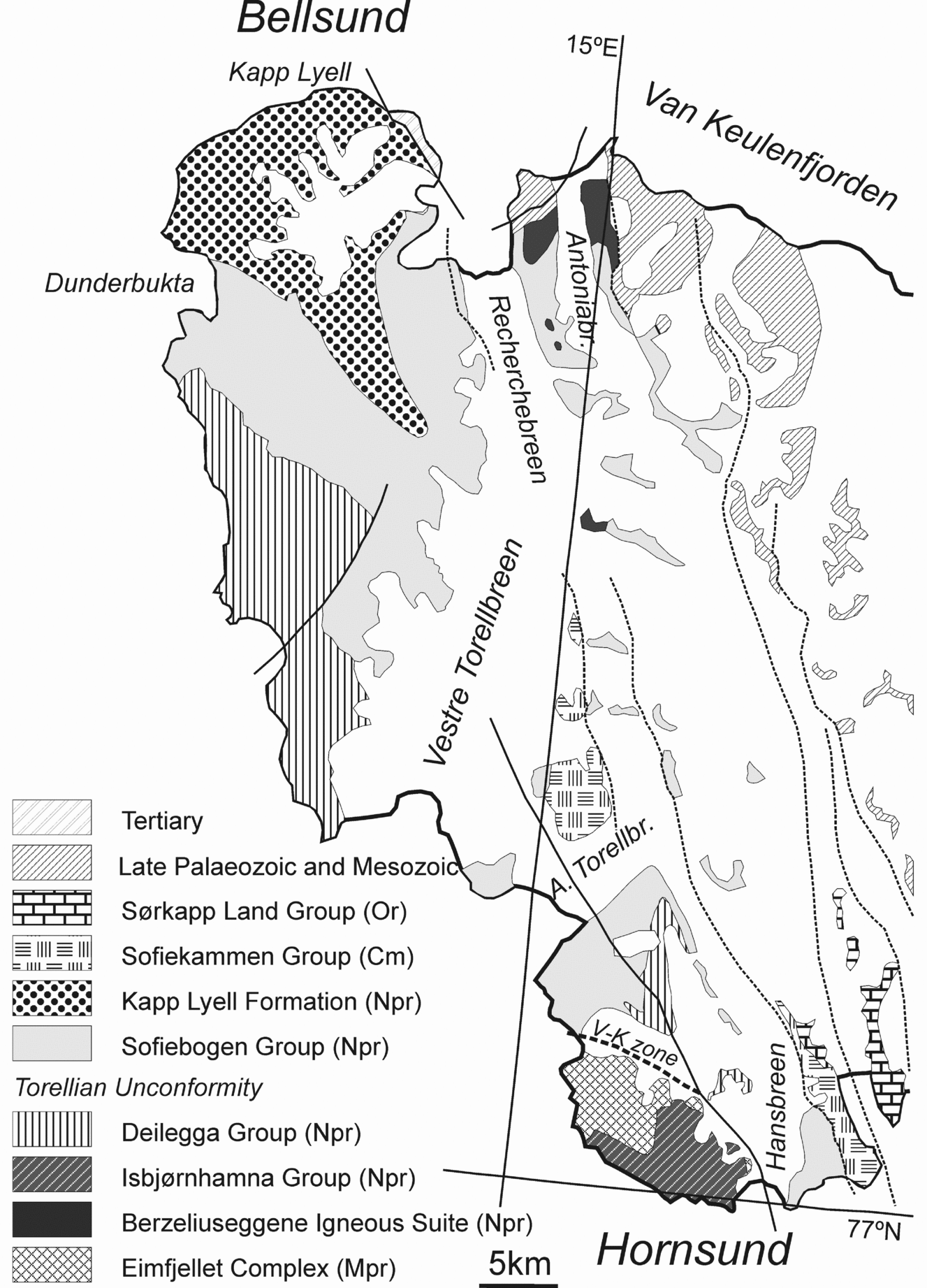
South of Isfjorden, the diamictites reappear at Kapp Linné, where a granite clast has been dated to c. 680 Ma using the U–Pb zircon method (Larionov & Tebenkov, Reference Larionov and Tebenkov2004). These diamictites are well exposed in a major syncline on the southwestern side of Bellsund (Fig. 2), in northern Wedel Jarlsberg Land (Birkenmajer, Reference Birkenmajer2010; Bjørnerud, Reference Bjørnerud2010), where they overlie a low-grade Neoproterozoic succession that dominates most of the area southwards to Hornsund. Only in the Isbjørnhamna–Eimfjellet area of southwesternmost Wedel Jarlsberg Land, and furthest to the northeast on the ridges to the east and west of Antoniabreen, are more metamorphosed and partly older units preserved.
Geological map of Wedel Jarlsberg Land showing the location of the Berzeliuseggene Igneous Suite. V-K – Vimsodden–Kosibapasset shear zone.
3. Wedel Jarlsberg Land
The Neoproterozoic successions of Wedel Jarlsberg Land (Fig. 2), underlying the tillites (Kapp Lyell Group) referred to above, are divisible into two main units that have been defined in southern parts as the Sofiebogen and underlying Deilegga groups (Birkenmajer, Reference Birkenmajer1975; Czerny et al. Reference Czerny, Kieres, Manecki, Rajchel and Manecki1993). A major discontinuity was recognized to separate these two groups and referred to as the Torellian Unconformity (Birkenmajer, Reference Birkenmajer1975). The Sofiebogen Group is dominated by siliciclastic formations, including basal conglomerates (Slyngfjellet and Konglomeratfjellet formations) with some mafic volcanites, passing up into carbonates and black pelites. The underlying Deilegga Group contains cyclothems of sediments, siliciclastic in lower parts and carbonate-dominated towards the top. In the areas south of Bellsund and beneath the Kapp Lyell tillites, two successions have been described (Bjørnerud, Reference Bjørnerud1990; Dallmann et al. Reference Dallmann, Hjelle, Ohta, Salvigsen, Maher, Bjørnerud, Hauser and Craddock1990), the lower (Deilegga correlative) being referred to as the Nordbukta sequence, and the upper (Sofiebogen correlative) to the Dunderbukta and Recherchebreen ‘sequences’. M. Bjørnerud (unpub. Ph.D. thesis, Univ. Wisconsin–Madison, 1987; 1990) and J. C. Nania (unpub. M.Sc. thesis, Univ. Wisconsin–Madison, 1987) have described tight folding and local inversion beneath the Torellian Unconformity separating these units. Detrital monazite, provenance studies (Czerny et al. Reference Czerny, Majka, Gee, Manecki and Manecki2010) have yielded ages as young as 950 Ma in the Deilegga Group and 650 Ma in the Sofiebogen Group,
In the vicinity of Hornsund, both on the north and south sides of the fjord, Cambro-Ordovician strata overlie Neoproterozoic successions and are folded and thrust eastwards within the Cenozoic fold belt. Relationships to Devonian Old Red Sandstones further east in the Hornsund area are not well defined.
3.a. Isbjørnhamna–Eimfjellet area
A relatively small part of southern Wedel Jarlsberg Land, located south of Werenskiöldbreen and west of Hansbreen, is separated from the rest of the Wedel Jarlsberg Land basement by a NW-trending, high-angle fault, the Vimsodden–Kosibapasset shear zone. Mazur et al. (Reference Mazur, Czerny, Majka, Manecki, Holm, Smyrak and Wypych2009) presented evidence for both dip- and strike-slip movement along this fault-zone and speculated that it may have as much as 600 km of sinistral displacement. To the southwest of the fault, amphibolite-facies metasedimentary and meta-igneous rocks occur in a major, NW-plunging, NE-vergent synform. The suite of meta-igneous rocks, including metagabbros, metagranites, abundant metadolerites and other amphibolites of probable volcanic origin, are underlain and overlain by quartzites with greenschists, mica schists and metarhyolites (Birkenmajer, Reference Birkenmajer1990; Czerny et al. Reference Czerny, Kieres, Manecki, Rajchel and Manecki1993) that together compose the Eimfjellet Complex (Group, in previous literature). The overlying quartzites have yielded detrital zircon populations of late Archaean and Palaeoproterozoic age (Majka, Ladenberger & Kuznetsov, Reference Majka, Ladenberger and Kuznetsov2009), and the gabbros and granites have well-constrained ages of c. 1200 Ma (Balashov et al. Reference Balashov, Tebenkov, Ohta, Larionov, Sirotkin, Gannibal and Ryungenen1995, Reference Balashov, Tebenkov, Peucat, Ohta, Larionov and Sirotkin1996; Larionov et al. Reference Larionov, Tebenkov, Gee, Czerny and Majka2010).
The Eimfjellet Complex overlies a thick metasedimentary succession of turbidites and carbonates, the Isbjørnhamna Group, which lack igneous rocks and have yielded detrital zircon populations of mainly Mesoproterozoic age, but including grains as young as c. 700 Ma (Larionov et al. Reference Larionov, Tebenkov, Gee, Czerny and Majka2010). Thrust emplacement of the Eimfjellet Complex over the Isbjørnhamna Group and ductile deformation of these metamorphic rocks in southwestern Wedel Jarlsberg Land is probably of Caledonian age, but recent chemical dating of metamorphic monazites (Majka et al. Reference Majka, Mazur, Manecki, Czerny and Holm2008) and ion microprobe dating of zircons in pegmatites (Majka et al. Reference Majka, Czerny, Larionov, Pršek and Gee2012) have shown the importance of a late Neoproterozoic (c. 640 Ma) tectonothermal episode, finding support in previous K–Ar (Gayer et al. Reference Gayer, Gee, Harland, Miller, Spall, Wallis and Winsnes1966) and Ar–Ar data (Manecki et al. Reference Manecki, Holm, Czerny and Lux1998).
3.b. Antoniabreen area
In northeastern Wedel Jarlsberg Land, east of Recherchebreen (Fig. 2), an assemblage of generally greenschist-facies metamorphosed sedimentary and igneous rocks crop out on the ridges along the eastern and western sides of Antoniabreen. They were referred to by E. C. Hauser (unpub. M.Sc. thesis, Univ. Wisconsin–Madison, 1982) as the Antoniabreen sequence and, subsequently, by Dallmann et al. (Reference Dallmann, Hjelle, Ohta, Salvigsen, Maher, Bjørnerud, Hauser and Craddock1990) as the Magnethøgda sequence. Within this assemblage of tectonically intercalated units, the higher metamorphosed igneous rocks are represented by augen gneisses (locally gneissic granites, Fig. 3), with some pegmatites, occasional amphibolites and schists, and some very fine-grained igneous rocks, probably of volcanic (rhyolitic and dacitic) origin. The igneous rocks are best developed on the ridge on the east side of Antoniabreen, called Berzeliuseggene, and are therefore referred to here as the Berzeliuseggene Igneous Suite (BIS). The associated metasedimentary units include carbonates (partly dolomitic) and various phyllites and quartzites, and the entire complex is overlain unconformably by lower Carboniferous and younger successions of the south Spitsbergen basin.
View on the Martinfjella ridge from the east. The Berzeliuseggene Igneous Suite is thrust onto the sedimentary Deilegga (post-950 Ma, Tonian–Cryogenian) and Ediacaran Sofiebogen groups (undivided on the photograph). Locations of the studied samples SVL 144 (77.5072°N, 14.8414°E) and SVL 145 (77.5075°N, 14.8415°E) are indicated by arrows. Inset diagram presents simplified tectonostratigraphy.

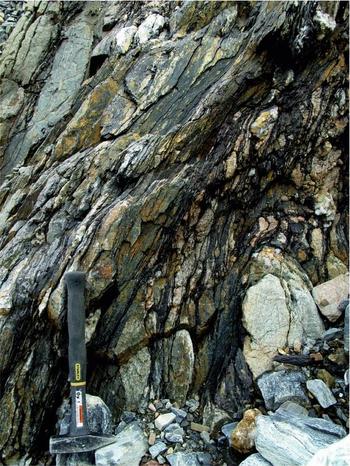
On the geological map of Van Keulenfjorden (Dallmann et al. Reference Dallmann, Hjelle, Ohta, Salvigsen, Maher, Bjørnerud, Hauser and Craddock1990), the Magnethøgda sequence is treated as a separate assemblage from the other Precambrian units in the area, perhaps related to the Nordbukta sequence (i.e. Deilegga Group), underlying the Torellian Unconformity. However, these authors drew attention (p. 17) to the possibility that the metasedimentary units in their Magnethøgda sequence might well be correlated with formations overlying the Torellian Unconformity, including those in the Sofiebogen and Sofiekammen groups. Recent identification of Slyngfjellet-like conglomerates (Fig. 4) overthrust by the BIS, favour this interpretation and suggests the existence of both the Deilegga and Sofiebogen rocks beneath the basal BIS thrust.
Photograph of the Slyngfjellet conglomerate (marking the Torellian Unconformity) occurring beneath the Berzeliuseggene Igneous Suite basal thrust, located on western slopes of Berzeliuseggene. Hammer for scale is 40 cm long.

The BIS has been described previously as augen gneisses and feldspathic quartzites (Dallman et al. Reference Dallmann, Hjelle, Ohta, Salvigsen, Maher, Bjørnerud, Hauser and Craddock1990 and previous literature) or ‘migmatized phyllites’ (sensu Birkenmajer, Reference Birkenmajer2002); many of the latter are interpreted here to be felsic meta-igneous rocks, and one augen gneiss has been dated in this study, reported below. On the ridge along the eastern side of Antoniabreen, the compositional banding and tectonic contacts with other lithologies dip at low to moderate (30°) angles northwards. The whole succession is tectonically repeated and two different thrust sheets, separated by strongly deformed metasediments of unknown origin, can be observed on Aldegondaberget and Berzeliuseggene. West of Antoniabreen, on Jarnfjellet, only one thrust sheet occurs (see also Fig. 3). Mylonitic and cataclastic varieties of the BIS are ubiquitous, occasionally with visible pseudotachylites. Parageneses in the augen gneisses are generally dominated by quartz (35–40%), plagioclase (15%), potash feldspar (8–10%) and micas (10–20%). Although extensively retrogressed, the occasional presence of garnet in the BIS indicates earlier amphibolite-facies metamorphism, prior to thrust intercalation with the younger sedimentary rocks. Protoliths of granitic rocks have been identified in the gneisses on the slope northeast of the glacier front. Pegmatites (also analysed in this study) appear to be concentrated towards the base of thrust sheet. Rare schists are also intercalated with the other BIS lithologies.
The BIS was subjected to extensive fluid alteration. Metasomatic zoning patterns are observed to be related to the sole thrust. At the bottom of the sequence, a zone up to a few metres thick of whitish K-feldspar-enriched rocks is present and is overlain by a wider zone of similar, but pinkish K-feldspar-enriched rocks. Earliest K-metasomatism was probably syn-tectonic and developed during thrusting, because the metasomatized rocks form horizons parallel to the thrust sole. However, a later metasomatic stage is the youngest feature in the studied sequence (BIS), because it mostly develops along fractures that cross-cut the main foliation and also commonly overprints the main foliation.
4. New studies of the Berzeliuseggene Igneous Suite
Of the samples from the BIS collected for analytical studies, two have been selected for isotope dating: a fine-grained augen gneiss (SVL 145, Fig. 5a) and a pegmatite (SVL 144, Fig. 5b). Zircons were separated from both samples. One of the samples (SVL 145) was initially analysed (by D.F.) by laser ablation inductively coupled plasma mass spectrometry (LA-ICP-MS) and both were subsequently analysed by ion microprobe (by Y.B.S.) at the Nordsim facility in Stockholm.
Photographs of sampled and dated (a) augen gneiss and (b) pegmatite of the Berzliuseggene Igneous Suite.

4.a. Sample description
4.a.1. Augen gneiss (SVL 145)
The sample was collected on the Jarnfjellet ridge, west of Antoniabreen (Fig. 3). The rock is greyish pink, fine grained and strongly sheared (Fig. 5a). The foliation is defined by a parallel arrangement of muscovite, biotite and quartz-dominated layers. In the latter, subordinate K-feldspar and plagioclase also occur. K-feldspar also forms augen up to 0.5 cm in diameter. Rarely, bigger quartz porphyroclasts are also found. Garnet is quite common and usually forms non-coaxially deformed porphyroclasts aligned in the foliation planes. The metamorphic origin of the garnet is indicated by snowball-like microtextures and its chemistry. Accessory mineral phases in the rock include allanite, titanite and zircon. Allanite is common and is almost always overgrown by later epidote. Rarer titanite is always deformed. Zircon is a very common phase and forms idiomorphic crystals. The intensity of deformation of this felsic rock has thoroughly overprinted its original plutonic or volcanic textures.
4.a.2. Pegmatite (SVL 144)
The sample was also collected on the ridge of Jarnfjellet close to the basal thrust contact of the BIS (Fig. 3). A lens-shaped pegmatite in the host augen gneiss is whitish (Fig. 5b) and coarse grained with quartz, plagioclase, less prominent K-feldspar and muscovite dominating. Quartz exhibits undulatory extinction. Plagioclase is strongly altered and replaced by fine-grained muscovite. By contrast, K-feldspar is rather well preserved. Muscovite usually forms relatively small (≤ 100 μm) matrix flakes; however, bigger ones also occur, occasionally in the garnet pressure shadows. Garnet is rather scarce and forms subhedral slightly deformed crystals. Among the accessory phases, rare apatite, allanite, titanite and zircon were found. Although zircon is not a very common phase, it occasionally forms even macroscopically visible (up to 1 cm long) crystals.
4.b. Zircon separation
Zircon separation was performed by standard methods using a water-table and without heavy liquids, and the grains were handpicked and mounted in a resin disc along with a zircon standard and polished to reveal the grain interiors. The mounts were gold-coated and imaged with a Hitachi S-4300 scanning electron microscope and Gatan mini-CL at the Swedish Museum of Natural History.
4.c. LA-SF-ICP-MS analyses
All U–Pb age data obtained at the Geological Survey of Denmark and Greenland in Copenhagen were acquired by laser ablation single collector magnetic sectorfield inductively coupled plasma mass spectrometry (LA-SF-ICP-MS) employing a Thermo Finnigan Element2 mass spectrometer coupled to a NewWave UP213 laser ablation system. All age data presented here were obtained by single spot analyses with a spot diameter of 30 μm and a crater depth of approximately 15–20 μm. The methods employed for analysis and data processing are described in detail by Gerdes & Zeh (Reference Gerdes and Zeh2006) and Frei & Gerdes (Reference Frei and Gerdes2009). For quality control, the Plešovice (Sláma et al. Reference Sláma, Košler, Condon, Crowley, Gerdes, Hanchar, Horstwood, Morris, Nasdala, Norberg, Schaltegger, Schoene, Tubrett and Whitehouse2008) and M127 (Nasdala et al. Reference Nasdala, Hofmeister, Norberg, Mattinson, Corfu, Dörr, Kamo, Kennedy, Kronz, Reiners, Frei, Košler, Wan, Götze, Häger, Kröner and Valley2008; Mattinson, Reference Mattinson2010) zircon reference materials were analysed, and the results were consistently in excellent agreement with the published isotope dilution thermal ionization mass spectrometry (ID-TIMS) ages. Full analytical details and the results for all quality control materials analysed are reported in Table S1 (online Supplementary Material available at http://journals.cambridge.org/geo).
4.d. SIMS analyses
The U–Th–Pb zircon analyses were performed on the Nordsim Cameca IMS-1270 ion microprobe, following methods described by Whitehouse, Kamber & Moorbath (Reference Whitehouse, Kamber and Moorbath1999) using a spot size of c.10–25 μm. Analyses used 12 scans per mass and U/Pb ratio calibration was based on analyses of the Geostandards zircon 91500 (Wiedenbeck et al. Reference Wiedenbeck, All'e, Corfu, Griffin, Meier, Oberli, von Quadt, Roddick and Spiegel1995). Data reduction employed in-house Excel macros. Age calculations were made using Isoplot version 3.02 (Ludwig, Reference Ludwig2003). Decay constants follow the recommendations of Steiger & Jäger (Reference Steiger and Jäger1977). Common lead corrections were applied using a modern-day average terrestrial common Pb composition, i.e. 207Pb/206Pb = 0.83 (Stacey & Kramers, Reference Stacey and Kramers1975), where significant 204Pb counts were recorded and which are assumed to represent surface contamination. All age errors quoted in the text are 2σ.
4.e. Zircons, isotope data and interpretations
4.e.1. Augen gneiss (SVL 145)
Zircons from SVL 145 are medium sized (100–200 μm) euhedral clear grains of yellowish colour with minor inclusions. Under cathodoluminescence (CL), the zircons exhibit oscillatory to sector zoned cores passing outwards into darker inner rims where only relict oscillatory zoning can be seen. These cores and inner rims are in turn rimmed by bright CL rims, which are best developed at the long terminations of grains where they reach a thickness of up to c. 50 μm (Fig. 6; grains 3, 7, 13). The border between the CL-bright outer rims and the darker inner parts is generally sharp, cross-cutting the internal zoning. However, in a few cases, the internal zoning can be traced out into the CL-bright rims (Fig. 6; grains 7, 13).
Cathodoluminescence (CL) images of representative zircons from pegmatite sample SVL 144 and augen gneiss sample SVL 145. Ellipses show ion microprobe U–Pb analyses numbered as in Table 1. U–Pb dates are 206Pb–238U ages except for grain 19 of sample SVL 144 where this is 207Pb–206Pb. All dates are quoted with 2σ uncertainties. Horizontal scale bars are 100 μm.

The initial analysis of this sample by LA-ICP-MS yielded a concentration of ages (c. 85%) at c. 965 Ma, with a trail of apparently younger grains down to c. 650 Ma and a few (c. 5%) older analyses at 1100–1200 Ma, 1300 Ma and 1400 Ma, and 1650–1750 Ma (Figs S1, S2 in online Supplementary Material available at http://journals.cambridge.org/geo). Closer examination of the analysed sites with CL images showed that the post-950 Ma ages were from locations within the inner and outer rims, and that the pre-950 Ma ages were all from the cores of the crystals, apparently from xenocrysts. All the analytical data are presented in Table S2 (online Supplementary Material available at http://journals.cambridge.org/geo). Since CL images of the grains indicate a complex zircon growth/recrystallization, interpretation of the LA-ICP-MS analyses is complicated by the possible mixing of domains within an analysis spot. While analyses where spot location was found to have overlapped two zircon domains were omitted from the dataset, possible mixing at the depth of a few micrometres could not be precluded. We therefore chose to apply further secondary ion mass spectrometry (SIMS) U–Pb analyses to zircons from this sample as the shallower analysis spot using this technique is associated with a higher certainty that U–Pb isotope data from two different domains was not mixed.
Thirty-one new SIMS analyses were made on SVL 145 zircons. Twenty-one analyses of oscillatory zoned cores and darker inner rim domains yielded a concordia age of 950 ± 5 Ma (MSWD = 1.3; Fig. S2 in online Supplementary Material available at http://journals.cambridge.org/geo). The darker inner rims exhibit a low range of Th/U (0.02–0.1 average 0.22) relative to the brighter outer domains (0.36–0.89 average 0.63) and thus potentially may reflect post-crystallization Pb-loss events. Nevertheless, no correlation between age and texture was observed. The concordia age is thus interpreted as the best estimate for crystallization of the magma and there is no evident Pb loss in the core–inner rim domains. An additional analysis of an oscillatory zoned core yielded a slightly discordant analysis with a 207Pb–206Pb age of 1341 ± 26 Ma (2σ), and this domain is interpreted as a xenocryst (Fig. 7). This interpretation is supported by the fact that this domain is concordantly mantled by a dark inner rim which yielded a concordant age at c. 950 Ma.
Tera-Wasserburg Concordia diagrams showing zircon ages for the pegmatite sample SVL 144 (a), and augen gneiss sample SVL 145 (b). Inset in (a) shows a discordia line intercept calculation which follows a forced horizontal shift of analyses 19cr and 25cr from their original reversely discordant location onto the concordia. Dashed lines ‘a’ and ‘b’ in (b) represent core–inner rim + CL-bright domain mixtures and Pb-loss trends, respectively.

Compared with the core–inner rim domains, the bright CL rims are characterized by lower U (35–70 ppm), Th (0–1 ppm) and Pb (4–9 ppm) contents, and by very low Th/U ratios (0.003–0.02). The nature of the contact between the bright CL rims and the inner domains, the low U and Th contents with very low Th/U ratios, as well as the faint oscillatory zoning and shape of crystal faces (both of which are concordant with inner domain oscillatory zoning), are all compatible with fluid-associated recrystallization of the zircon crystal lattice (Corfu et al. Reference Corfu, Hanchar, Hoskin, Kinny, Hanchar and Hoskin2003; Martin et al. Reference Martin, Duchêne, Deloule and Vanderhaegh2008). Of the ten analyses of CL-bright domains, three yielded a concordia age of 635 ± 10 Ma (MSWD = 0.86; Fig. 7) interpreted to reflect sub-solidus reactions along zircon margins. This fluid-associated process was characterized by a reaction front moving inwards into the zircon cores. Post-analytical inspection of several other analytical sites in the CL-bright rims provided evidence that they represented mixtures with core–inner rim domains (Fig. 7; trend line a). This is also reflected by elevated U, Th and Pb and higher Th/U ratios (Table 1). In other cases, analyses are either significantly discordant (Fig. 7; grains 9r2, 12r2) or the age is significantly older than 635 Ma (Fig. 7; 13r), but the post-analytical inspection showed that spots were correctly sited within the CL-bright domains, as is also reflected by low U, Th, Pb and Th/U. The significance of the discordant analyses is difficult to assess, and analyses 9r2 and 12r2 may possibly reflect Pb-loss events associated with zircon recrystallization processes (Fig. 7; trend line b), or problems associated with the common Pb correction for these very low Pb analyses. Analysis 13r is more problematic as it is concordant with a 206Pb–238U age of 692 ± 9 Ma (2σ; Table 1). This is interpreted to reflect incomplete recrystallization of the zircon domain with an inherent older age component; however, possible early crystallization pre-dating 635 Ma cannot be ruled out.
SIMS U–Th–Pb data

Notes:
Abbreviations: Conc. = concordance; Mag = magmatic; Rev. Dis = Reversely discordant; Xe = xenocryst
a – f206 % is the percentage of common 206Pb, estimated from the measured 204Pb. Figures in parentheses indicate when no correction has been applied.
b – Conc. % is the % age discordance between 207Pb–206Pb and 206Pb–238U ages as defined = 100 − ([(238U–206Pb date) − (207Pb–206Pb date)]/(207Pb–206Pb date) × 100).
c – 207-corrected ages calculated by projecting from an assumed common Pb composition (207Pb/206Pb = 0.83) through the analysis onto Concordia (Ludwig, Reference Ludwig2003).
4.e.2. Pegmatite (SVL 144)
Zircons from SVL 144 are dominantly medium sized (100–200 μm) euhedral turbid grains containing many small inclusions of unidentified character. Under CL, the grains are generally dark and have little discernable internal structure (Fig. 6), making the dating of these grains challenging. Twenty-two analyses were sited on domains exhibiting faint oscillatory zoning. Two have medium U contents (c. 800 ppm) and the rest are characterized by high U concentrations (2000–9000 ppm), which likely resulted in radiation damage, metamict domains, lack of CL response and high common Pb. Indeed, most analyses are associated with high common Pb and low 206Pb/204Pb ratios (Table S2 in online Supplementary Material available at http://journals.cambridge.org/geo), and are not further discussed here. Only eight grains with low common Pb are plotted on the concordia diagram (Fig. 7). Six analyses define a discordia line with intercepts at 662 +29/−28 Ma and 100 +26/−28 Ma (MSWD = 0.9), which are interpreted to reflect late Cryogenian crystallization (c. 660 Ma) and later Pb loss, probably associated with Cretaceous (c. 100 Ma) tectonothermal activity. Two other reversely discordant (7–12%) analyses were not used for this regression; however, their 207Pb–206Pb ages are within error of the upper intercept. If these two analyses are ‘forced’ horizontally onto the concordia and the age is recalculated using all eight analyses, an age with smaller error is obtained, with intercepts of 665 +11/−11 Ma and 106 +20/−21 Ma, respectively, as well as a better MSWD of 0.92 (Fig. 7, inset). While the forced shift of the two analyses onto concordia is speculative, it may be justified. Reverse discordance within high-U zircons is considered to reflect problems with the U–Pb calibration between a low-U standard and high-U sample (McLaren, Fitzgerald & Williams, Reference McLaren, Fitzgerald and Williams1994; Wiedenbeck, Reference Wiedenbeck1995). Consequently, the location to the left of the concordia may reflect an analytical problem rather than a geologically significant process. We thus consider the discordia intercepts calculated using the combined eight analyses to be a robust estimate of the time of crystallization and the later Pb-loss events.
5. Discussion
The discussion that follows below considers the new isotope age data from Wedel Jarlsberg Land in relation to other evidence from Svalbard. It then examines the relationships between Svalbard's Southwestern Province and the evidence for Neoproterozoic orogeny in northern Ellesmere Island (Pearya) and in the Timanides of northeastern Baltica.
5.a. Mesoproterozoic and late Palaeoproterozoic xenocrysts
The LA-ICP-MS ages of 1100–1200 Ma, 1300–1400 Ma and 1650–1750 Ma in combination with the ion microprobe identification of the presence of 1350 Ma xenocrysts in sample SVL 145, suggest that the BIS magmatic rocks were generated by melting of rocks with Grenvillian signatures. Similar ages have also been recorded in the metasedimentary rocks of northwestern Spitsbergen (Montblanc Formation) and associated migmatites (Ohta, Larionov & Tebenkov, Reference Ohta, Larionov and Tebenkov2003) and from the Krossfjorden Group metasediments (Pettersson, Pease & Frei, Reference Pettersson, Tebenkov, Larionov, Andresen and Pease2009). The 1350 Ma ages, in particular, have been compared with the Metamec Complex and Nain Plutonic Suite of the Eastern Grenville Province (Pettersson Pease & Frei, Reference Pettersson, Pease and Frei2009). Ages of c. 940 Ma and c. 1360 Ma were also obtained on xenocrystic zircons from Frænkelryggen tuffites interbedded with Devonian Red Bay Group sandstones occurring within the Raudfjorden graben in northwestern Spitsbergen (Hellman et al. Reference Hellman, Gee, Johansson and Witt-Nilsson1997).
5.b. Early Tonian magmatism in southern Svalbard
The dating here of the BIS augen gneiss sample (SVL 145), indicating magma crystallization at 950 ± 5 Ma, provides the first unequivocal evidence of early Tonian igneous activity in southwestern Spitsbergen. Previous isotope age investigations of magmatic rocks in Wedel Jarlsberg Land have identified c. 1200 Ma Ectasian–Stenian plutonic and volcanic rocks in the Eimfjellet Complex (Larionov et al. Reference Larionov, Tebenkov, Gee, Czerny and Majka2010), with no record of younger Tonian rocks. Magmatism of this age has been previously reported from both Svalbard's Eastern and Northwestern provinces. In Nordaustlandet, the c. 970–940 Ma ages include both granites, and andesites and rhyolites (Gee et al. Reference Gee, Ohta, Tebenkov, Krasilščhikov, Balashov, Larionov, Gannibal and Ryungenen1995; Johansson et al. Reference Johansson, Gee, Larionov, Ohta and Tebenkov2005). In the Northwestern Province, granites (usually augen gneisses) and gabbros yielded c. 960 Ma ages (Peucat et al. Reference Peucat, Ohta, Gee and Bernard-Griffiths1989; Ohta & Larionov, Reference Ohta and Larionov1998; Pettersson, Pease & Frei, Reference Pettersson, Pease and Frei2009). Recently, Gasser & Andresen (Reference Gasser and Andresen2013) have reported a c. 930 Ma augen gneiss of unknown tectonostratigraphical position (probably similar to the BIS’s) from Oscar II Land, in the northern part of Svalbard's Southwestern Province. Thus, it is now evident that all three Svalbard provinces include magmatic units of similar early Tonian age, suggesting a common history at this time.
5.c. Late Cryogenian (Torellian) metamorphism, deformation and pegmatite generation
Zircons from the BIS pegmatite (SVL 144), yielding a discordia upper intercept age of 665 ± 11 Ma, and the zircon rims from augen gneiss (SVL 145) with an age of 635 ± 10 Ma both indicate the importance of a late Cryogenian tectonometamorphic event in Svalbard's Southwestern Province. Similar ages have been obtained from pegmatites in the Isbjørnhamna Group of southwestern Wedel Jarlsberg Land (Majka et al. Reference Majka, Czerny, Larionov, Pršek and Gee2012) where small, inclusion-rich, metamict zircons from the Skoddefjellet pegmatite yielded an ion microprobe age of c. 650 Ma and monazite and uraninite from the same pegmatite yielded slightly older 680–660 Ma U–Th–total Pb ages. Based on mineralogy, the Skoddefjellet pegmatite was classified as Muscovite–Rare Element type, Rare Earth Element subtype (Majka et al. Reference Majka, Czerny, Larionov, Pršek and Gee2012), which typically forms under moderate- to high-amphibolite-facies conditions (Černy & Ercit, Reference Černy and Ercit2005). The Isbjørnhamna Group host rocks for the Skoddefjellet pegmatite were subjected to Barrovian amphibolite-facies metamorphism (up to c. 11 kbar and 670°C) at c. 645 Ma, which supports syn-metamorphic formation of the pegmatite. Similarly, the BIS pegmatite (SVL 144) could have been formed during the amphibolite-facies metamorphism of the host augen gneiss. The BIS augen gneisses contain metamorphic garnet, which suggests a metamorphism under at least moderate grade. Rare schists intercalated with the augen gneisses, and containing two generations of garnet, yielded preliminary minimum pressure–temperature (P–T) conditions, based on thermodynamic modelling of phase equilibria, of c. 550°C and 6 kbar for an older metamorphic event (garnet-I) and c. 500°C and 12 kbar for a younger one (garnet-II; Kośmińska et al. Reference Kośmińska, Majka, Klonowska, Krumbholz, Manecki and Czerny2013). If the P–T conditions obtained from these schists are representative for the whole BIS, the zircon rims from the augen gneiss (SVL 145) may date an older amphibolite-facies event, rather than a high pressure – low temperature (HP–LT) event, but an unequivocal judgement is not possible with the current state of knowledge.
Regional metamorphism of the Isbjørnhamna Group at c. 640 Ma (Majka et al. Reference Majka, Mazur, Manecki, Czerny and Holm2008) has helped constrain the age of the Torellian Unconformity (Birkenmajer, Reference Birkenmajer1975; Bjørnerud, Reference Bjørnerud1990) and the timing of deformation of the underlying Deilegga Group metasedimentary formations. Dating of detrital monazite in the Deilegga and overlying Sofiebogen groups (Czerny et al. Reference Czerny, Majka, Gee, Manecki and Manecki2010), with 650 Ma grains in the latter and none in the former, have provided further support for this interpretation of the tectonothermal history and the importance of the Torellian Orogeny in Svalbard's Southwestern Province.
A late Cryogenian c. 660 Ma U–Pb zircon age has also been reported from Svalbard's Northwestern Province, from agmatites in the Richarddalen Complex (Peucat et al. Reference Peucat, Ohta, Gee and Bernard-Griffiths1989; Gromet & Gee, Reference Gromet and Gee1998). Somewhat younger (mainly Ediacaran) ages were obtained on hornblende from amphibolitized eclogites and hornblendic gneisses in this complex by the K–Ar method (Gee in Gayer et al. l966) and subsequently by the Ar–Ar method (Dallmeyer, Peucat & Ohta, Reference Dallmeyer, Peucat and Ohta1990), suggesting the possibility of late Neoproterozoic deformation and metamorphism. However, this interpretation did not find support in subsequent U–Pb titanite investigations (Gromet & Gee, Reference Gromet and Gee1998), which provided strong evidence for mid Ordovician (c. 455 Ma) eclogite-facies metamorphism.
The evidence that late Neoproterozoic tectonothermal events are more widespread in the Southwestern Province than hitherto recognized implies that the ‘basement block’, comprising the Eimfjellet–Isbjørnhamna units, is not exotic as previously suggested (Majka et al. Reference Majka, Mazur, Manecki, Czerny and Holm2008; Mazur et al. Reference Mazur, Czerny, Majka, Manecki, Holm, Smyrak and Wypych2009) and the Vimsodden–Kosibapasset shear zone may not necessarily be a terrane boundary. Evidence from Wedel Jarlsberg Land suggests that the Torellian Orogeny is likely to have influenced much, if not most, of Svalbard's Southwestern Province. Caledonian metamorphism and deformation can be expected to have obscured the Neoproterozoic tectonothermal history, if the latter did not exceed greenschist facies.
5.d. Caledonian overprint
The lack of evidence of Caledonian influence on the zircons in both the BIS pegmatite and the augen gneiss indicates that Caledonian metamorphism probably did not exceed greenschist facies. Kośmińska et al. (Reference Kośmińska, Majka, Klonowska, Krumbholz, Manecki and Czerny2013) have reported HP–LT metamorphism following an amphibolite-facies event for schists occurring within the BIS. In this case, the HP–LT event may be of Caledonian age (c. 470 Ma), like in the Motalafjella region (Horsfield, Reference Horsfield1972; Dallmeyer, Peucat & Ohta, Reference Dallmeyer, Peucat and Ohta1990; Bernard-Griffiths, Peucat & Ohta, Reference Bernard-Griffiths, Peucat and Ohta1993), but it probably would not cause the growth of zircon. Dallman et al. (Reference Dallmann, Hjelle, Ohta, Salvigsen, Maher, Bjørnerud, Hauser and Craddock1990) reported K–Ar ages of micas clustering around 460 Ma for the lithologies belonging to the Magnethøgda sequence, hence probably to the BIS. These ages are similar to those known from the HP–LT units of the Vestgötabreen Complex in the Motalafjella region.
5.e. Cretaceous tectonothermal events
Most of the dated zircons from the BIS pegmatite (SVL 144) plot along a discordia line with a lower intercept at 106 +20/−21 Ma. Early Cretaceous (100–130 Ma) mafic volcanism is well represented on Svalbard and its surrounding areas (Barents Sea Igneous Province). We note that the lower intercept age is similar to the K–Ar age of a dolerite sill exposed only c. 500 m away from the pegmatite (103 ± 4 Ma; Birkenmajer et al. Reference Birkenmajer, Krajewski, Pécskay and Lorenc2010). It is, therefore, likely that the Pb-loss event in the pegmatite zircons was associated with widespread Cretaceous magmatic activity and that this was facilitated by these zircons susceptibility of Pb loss, as attested by their high-U content and internal textures. Alternatively, the Pb loss could have been connected to the late metamorphic extensive fluid activity.
5.f. Regional correlations and implications for the relative positions of Baltica and Laurentia in the Neoproterozoic
Zircon dating of the BIS provides evidence of previously unrecognized Tonian crystalline basement within Svalbard's Southwestern Province and a subsequent late Neoproterozoic metamorphic event. Recently, several reconstructions of Rodinia and the Grenvillian–Sveconorwegian belt have been proposed. Based on the Rodinia reconstruction by Li et al. (Reference Li, Bogdanova, Collins, Davidson, De Waele, Ernst, Fitzsimons, Fuck, Gladkochub, Jacobs, Karlstrom, Lu, Natapov, Pease, Pisarevsky, Thrane and Vernikovsky2008), who placed Baltica and Scotland near southeastern Greenland, several authors (e.g. Pettersson, Pease & Frei, Reference Pettersson, Pease and Frei2010) explained the existence of the Tonian basement on Svalbard by very long-distance strike-slip movements of terranes. Cawood et al. (Reference Cawood, Strachan, Cutts, Kinny, Hand and Pisarevsky2010) favoured an external (in relation to the Grenville–Sveconorwegian belt) early Neoproterozoic Valhalla orogeny, based on palaeomagnetic data. Lorenz et al. (Reference Lorenz, Gee, Larionov and Majka2012) suggested a northern continuation of the Grenville–Sveconorwegian orogen, beneath the continental shelves of the North Atlantic, within the hinterland of the Caledonides, into the High Arctic. This reconstruction allows an in situ late Neoproterozoic tectonothermal reworking of the Tonian crystalline basement. This late Neoproterozoic (Torellian in Svalbard) event is approximately contemporaneous with the early stages of the Timanide Orogen (e.g. Andreichev, Reference Andreichev1998; Lorenz et al. Reference Lorenz, Pystin, Olovyanishnikov, Gee, Gee and Pease2004); however, the continuation of the Timanian basement northwestwards from the Pechora basin, beneath the Barents Sea, is not well defined. In northernmost Norway, the NW-trending Timanides are truncated by the Caledonian deformation front. The correlation of southwestern Svalbard with the Timanides suggests that the Timanide Orogen continued from the northern Urals region through the Barents shelf to Svalbard's Southwestern Province prior to the Iapetus Ocean opening and then split into at least two parts during separation of Baltica and Laurentia in the Ediacaran. Signs of rifting related to the Iapetus opening may be found in the mafic magmatism occurring as dykes within the Deilegga Group and lava flows within the Sofiebogen Group (Czerny, Reference Czerny1999), which is closely associated with the (post-)Torellian unconformity. This postulated northwestern arm of the Timanide Orogen argues against the Cambrian rotational models of Baltica (e.g. Hartz & Torsvik Reference Hartz and Torsvik2002; Cawood et al. Reference Cawood, Strachan, Cutts, Kinny, Hand and Pisarevsky2010).
According to Trettin (Reference Trettin1987), Harland (Reference Harland1997), Gee & Tebenkov (Reference Gee, Tebenkov, Gee and Pease2004) and Mazur et al. (Reference Mazur, Czerny, Majka, Manecki, Holm, Smyrak and Wypych2009), at least some parts of the Southwestern Province may be correlated with the basement of the Pearya Terrane (Northern Ellesmere Island). The Proterozoic succession there, though less well known than on Svalbard, appears to be similar, comprising Grenville-age crystalline basement and thick sedimentary sequences of conglomerates, carbonates, quartzites and diamictites of probable glacial origin. According to Trettin's (Reference Trettin1987) and Estrada et al.'s (Reference Estrada, Piepjohn, Henjes-Kunst and von Gosen2003) descriptions of the Yelverton Bay area within the Pearya Terrane, the oldest rocks of that basement are deformed orthogneisses with subordinate amphibolites, quartzites, mica schists and marbles (their Succession 1). This unit is overlain by lower grade monotonous siliciclastic and carbonaceous metasediments with minor admixture of mafic metavolcanites (Succession 2, Unit W1) and further up section by siliciclastic and calcareous metasediments, diamictites and metavolcanites (Succession 2, Unit W2). Little is known about the age of the Pearyan sedimentary units. The lower boundary of Unit W1 is indicated by a c. 965 Ma U–Pb zircon age of the basement orthogneisses (S. J. Malone, unpub. Ph.D. thesis, Univ. Iowa, 2012) and the upper limit of Unit W2 is defined by the existence of Cambrian volcanic rocks and younger Palaeozoic cover. It is suggested here that the Pearyan Succession 1 may correlate with southwestern Svalbard's amphibolite-facies rocks (Isbjørnhamna Group, Eimfjellet Complex and BIS), and that units W1 and W2 of Pearyan Succession 2 are equivalents of the Deilagga and Sofiebogen groups, respectively. This interpretation is supported by similar rock types, especially the occurrence of diamictites and associated metabasalts. Notably, recent detrital zircon dating of Ordovician, Silurian and Devonian rocks from Pearya yielded 680–570 Ma ages, typical for the Southwestern Svalbard Province and the Timanides (Malone & McClelland, Reference Malone and McClelland2010; S. J. Malone, unpub. Ph.D. thesis, Univ. Iowa, 2012). However, a better understanding of both Pearya's and southwestern Svalbard's geology, and more isotopic and petrological work is needed to test this hypothesis. Nevertheless, already back in the 19th century, baron Nordenskiöld (Reference Nordenskiöld1876) stated that ‘Probably during the Glacial Period the west coast of Spitzbergen was the west coast, not merely of a large island, but of a considerable Arctic continent, which towards the south was connected with Scandinavia, and towards the east with continental Siberia’. It appears that there are several lines of evidence to, at least partly, support this brave statement.
6. Conclusions
(1) This study shows that the Berzeliuseggene Igneous Suite of Svalbard's Southwestern Province is of Tonian (c. 950 Ma) age and shares an early Neoproterozoic history with the other Caledonian basement provinces of Svalbard.
(2) Zircon rims in augen gneisses and zircon from pegmatite show that the Torellian orogenic event is more widespread than previously thought and probably extends throughout the length of the entire Southwestern Province.
(3) Possible correlation of Svalbard's Southwestern Province with the Timanides and the Pearya Terrane suggest that the late Neoproterozoic, post-Grenvillian and pre-Iapetian orogenic belt may have continued from northeastern Baltica to northern Laurentia.
Acknowledgements
We named the rocks described in this paper after Jacob Berzelius, a graduate of Uppsala University where J.M. and D.G.G. are affiliated. Marcia Bjørnerud, Maciek Dwornik and Nikolay Kuznetsov are thanked for their help during the fieldwork. Jurek Różański and his yacht Eltanin are thanked for their help during the transportation in Svalbard. Karolina Kośmińska is thanked for her help with technical preparation of the manuscript. She is also acknowledged for pointing out Nordenskiöld's publications from the 19th century. We thank Tom Moore and an anonymous reviewer for their constructive reviews. The study was supported by Ymer-80 Stiftelsen grant to J.M. and by a Polish Ministry of Science and Higher Education research grant N30704231/3336 to J.C. This paper is published with the permission of the Geological Survey of Denmark and Greenland. SIMS data was collected at the Nordsim facility, which is funded by the research councils of Denmark, Norway, Sweden, the Geological Survey of Finland and the Swedish Museum of Natural History. This is Nordsim Publication no. 351.