Learning words that refer to events is a difficult task. Events are dynamic and transient, and languages differ in the way they use predicate terms (e.g. Maratsos, Reference Maratsos1990). For example, to learn a new verb, children need to deduce which elements of a changing scene should be considered together as a part of a new verb's meaning, or solve a ‘packaging problem’ (e.g. Gleitman & Gleitman, Reference Gleitman and Gleitman1992). In addition, languages vary in the kinds of meanings that are incorporated within different word types in the predicate system (e.g. path is often incorporated in verbs in Spanish but not English; Talmy, Reference Talmy and Kimball1975), thus children need to attend to different sets of elements of events in different languages.
Structural alignment and comparison
Given the difficulty of this word learning task, it would not be surprising to find that children attend to cross-situational information in some way when learning predicate words. However, it is clear that an unconstrained approach that incorporates every situational cue in every context would quickly overwhelm children's memory capacities. Gentner and others have shown that adults and children use a comparison process to abstract regularities across multiple exemplars (e.g. Markman & Gentner, Reference Markman and Gentner1993; Gentner & Markman, Reference Gentner and Markman1994; Kotovsky & Gentner, Reference Kotovsky and Gentner1996; Gentner & Markman, Reference Gentner and Markman1997; Gentner & Namy, Reference Gentner and Namy2000; Waxman & Klibanoff, Reference Waxman and Klibanoff2000; Loewenstein & Gentner, Reference Loewenstein and Gentner2001; Namy & Gentner, Reference Namy and Gentner2002; Paik & Mix, Reference Paik and Mix2006). In this view, an observer compares two contexts to each other by analyzing objects and their relations in one instance (e.g. propositions, spatial layouts, scenes) and then by seeking out objects in the second instance that can be aligned to the first instance based on their common relational structure. Given the importance of relational structure for understanding events, a process that highlights this information (Gentner & Markman, Reference Gentner and Markman1997) seems especially well suited to the problem of learning new words that refer to events.
Most studies of early verb learning provide the child with only a single example of a new event, and thus may not provide the cross-situational information children may need. However, a few previous studies have provided children with multiple contexts (Behrend, Reference Behrend, Tomasello and Merriman1995; Childers, Reference Childers2005, in press; Forbes & Farrar, Reference Forbes and Farrar1995; Gropen, Pinker, Hollander & Goldberg, Reference Gropen, Pinker, Hollander and Goldberg1991). The focus of most of these studies has been to show variation across contexts and test whether children could infer that elements that vary are not central to a new verb's meaning. Forbes & Farrar (Reference Forbes and Farrar1995) found that three-year-olds could use cross-situational information to deduce that a change in an agent, instrument or outcome was permitted. Behrend (Reference Behrend, Tomasello and Merriman1995) found that three-year-olds could use multiple instances to deduce that the action or result could vary, and Gropen et al. (Reference Gropen, Pinker, Hollander and Goldberg1991) shows that four-year-olds are able to use contrastive information during verb learning (e.g. ‘Now let me show you something that is not keating’) to shape their later verb productions. Even with these findings, children's attention to consistency across contexts during verb learning is poorly understood.
One recent set of studies that examined attention to consistency across events shows that two-and-a-half-year-old children can attend to similarities across related events (Childers, Reference Childers2005, in press). In Study 1, children saw a complex event with a specific action (e.g. picking up) and result (e.g. removing), followed by events that preserved the action, preserved the result or repeated the initial event. In this study, children who saw consistent actions or results preserved the consistent action or result in their enactments, extending the verb appropriately using new objects. In a second study, children shown two or three additional events with a consistent result were able to generalize the result while children shown only a single additional event imitated the experimenter. In a third study, children hearing new verbs while seeing consistent results produced more result extension responses at test than did children hearing non-labeling speech. These studies are important because they demonstrate that children younger than three can compare events in terms of the similarities between the events. They also suggest that comparing events may help children overcome a conservative tendency in verb learning (e.g. Tomasello, Reference Tomasello1992) and generalize a newly learned verb to a new situational context.
At the same time, none of these previous studies examining children's attention to cross-situational information have included children learning a language other than English. A strength of the view of structural alignment and comparison (e.g. Gentner, Reference Gentner1983, Reference Gentner, Vosniadou and Ortony1989) is that it could describe a way in which children could discover patterns within the predicate system in a particular language. The present study examines whether Korean- and English-speaking-children use comparison to learn a new predicate term.
English and Korean verbs
Many of the previous studies that have examined on the acquisition of Korean have focused on comparing the rate of the acquisition of verbs to nouns in early language development. Verbs should appear in the input to Korean children more frequently than is seen in English-speaking samples because their arguments can be omitted if the context permits (e.g. Imai, Haryu & Okada, Reference Imai, Haryu and Okada2005) and because Korean-speaking caretakers do not emphasize nouns to the same degree as commonly noted in naturalistic samples of English-speaking caregivers (Choi, Reference Choi2000; Choi & Gopnik, Reference Choi and Gopnik1995). Thus, Korean-speaking children could have larger verb vocabularies than are found in an aged-matched English-speaking sample. However, studies that have examined the balance of nouns and verbs in early vocabularies have not consistently found a ‘verb bias’. Instead, at least two studies suggest that young Korean-speaking children produce more nouns than verbs (Au, Dapretto & Song, Reference Au, Dapretto and Song1994; Kim, McGregor & Thompson, Reference Kim, McGregor and Thompson2000; see also Choi & Gopnik, Reference Choi and Gopnik1995), which is the same pattern of productions as is found in English (e.g. Tardif, Shatz & Naigles, Reference Tardif, Shatz and Naigles1997).
A more specific question important to the present study concerns whether there are general patterns in the verb system in Korean, particularly in the typical kinds of meanings encoded, that would lead children learning Korean to make specific assumptions when learning a new predicate term. Evidence from Choi's examination of early verb learning patterns in Korean in naturalistic contexts (Bowerman, de León & Choi, Reference Bowerman, de León, Choi and Clark1995; Choi, Reference Choi and Slobin1997; Choi & Bowerman, Reference Choi and Bowerman1991) suggests that children acquiring Korean verbs (at least in some contexts) may be making different and finer-grained distinctions than are English-speaking children. For example, young Korean-speaking children produce verbs for different types of breaking, including kkayta/kkayttulita to represent items broken into pieces, pwulecita to represent long stick-like items broken into pieces and kocangnata to represent something mechanical that does not function properly (Choi, Reference Choi and Slobin1997). Young children learning Korean also use different verbs for caused motion or spontaneous motion (Choi, Reference Choi and Slobin1997); in her transcripts, Choi notes that they never violated this distinction between these two verb types (Choi & Bowerman, Reference Choi and Bowerman1991). In contrast, English-speaking children use a single verb for both types of motion. As early as 1 ; 5 or 1 ; 8, Korean-speaking children use different verbs for ‘support’ or ‘carry’, depending on the body part involved (e.g. one for using arms and one for using the back), and use different clothing verbs for putting clothing on the trunk or putting clothing on the feet (Choi & Bowerman, Reference Choi and Bowerman1991). Thus, Korean-speaking children use different verbs for actions related to different body parts and for different figure–ground relations that would each be referred to with a single verb in English. This suggests that the verb category in Korean is organized differently than is the verb category in English, which is not surprising. Many researchers have noted cross-linguistic differences in how verb categories are organized (e.g. Maratsos, Reference Maratsos1990). For example, a study comparing the conceptual organization of nouns and verbs in the input to children learning Mandarin Chinese or English found that the noun category in these two languages was organized in a similar way, but the conceptual relations referred to by verbs in the two languages differed (Sandhofer, Smith & Luo, Reference Sandhofer, Smith and Luo2000).
In the present study, older two-year-old children in Korea and in the US were presented with a novel predicate term and then were shown different kinds of comparison events. We hypothesized that the type of comparison event shown would influence their enactments across language. That is, both Korean-speaking and English-speaking children shown a restricted range of contexts would form a more restricted view of a new word's meaning than would children given related events that differed, and thus would be more conservative in their enactments. To test this idea, we provided half of the children with sets of events that were very similar to each other (e.g. the objects were similar and the action was the same, Close comparisons). The other half was shown sets of related events in which the objects differed and the action could differ as long as the action accomplished the same result as in the target event (Far comparisons). This type of variation should demonstrate to the child that the set of events to which a new verb can be applied includes varied events. If children are comparing events to each other, their pattern of responses at test should vary following these two different comparison conditions.
At the same time, experience with the verb system of a native language may lead children to have different initial expectations about the level of specificity a new verb is likely to have, and these initial expectations could influence the conclusions children draw during comparison. Given the differences between early verbs in Korean and English, we hypothesized that Korean children might expect adults to use new predicate terms in specific ways, and thus might be more conservative in the way they extend the new words. Thus, we hypothesized that children could respond differently to our event conditions in a way that corresponded to their previous language experiences.
METHOD
Participants
Twenty-four Korean-speaking children in Korea (mean age=2 ; 11; range: 2 ; 8–3 ; 5) participated in the study, eleven girls and thirteen boys. Twenty-four English-speaking children in the US also participated in the study (mean age=2 ; 10; range: 2 ; 6–3 ; 3), eleven girls and thirteen boys. All of the children in Korea were Asian. In the US sample, nine of the participants were Caucasian, ten were Hispanic or Latino, two were Black or African-American, one was Black and Caucasian, one was Asian and Caucasian and one was unknown. Across both languages, seven additional children were excluded because they did not complete the study, three were extremely distracted, and two experienced an experimenter error.
In Korea, participants were recruited through four public preschools. Most participants lived in middle-class or upper-middle-class families in a major city in Korea (Seoul). All children in Korea were monolingual Korean speakers. The preschool teachers in Korea were asked to report any children who were experiencing an apparent language delay; none were reported. We did not ask parents or teachers in Korea to complete a Korean version of the MacArthur-Bates CDI because it was not available.
In the US, potential participants were identified using information from a direct mail marketing company. Families received an introductory letter followed by a phone call. Most participants were scheduled to participate in an on-campus laboratory; a few participants were recruited through their preschool. Most participants lived in middle-class or upper-middle-class families in a major city in the US. All children in the US were monolingual English speakers who could produce at least a two-word sentence in English. Parents of English-speaking children who brought their children to an on-campus laboratory completed portions of the MacArthur-Bates CDI: Words and Sentences Form (Fenson, Dale, Reznick, Bates, Thal & Pethick, Reference Fenson, Dale, Reznick, Bates, Thal and Pethick1994). According to published norms (Dale & Fenson, Reference Dale and Fenson1996), 70% of English-speaking children at 2 ; 6 either comprehend or produce 84 of the 101 action words on the form. Parents in our sample reported on their children's verb productions; the average number of action words produced was 74 words, thus our children appear to be at least typical. The mean length of sentence (MLS) for these children was 5·4 words (range: 3 to 10 words; n=15).
Materials and design
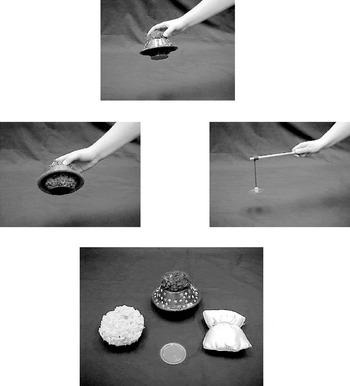
Four novel complex events were constructed as Target events (e.g. see Figure 1). A novel word was randomly assigned to each event (i.e. in English: gorp, tam, meek, pilk; in Korean: kopu, tami, mikku, pillkku). Sentences were constructed to include the novel word as a predicate term for an action. These sentences allowed the novel word in each language to be presented in about the same position in the sentence (i.e. medially) and allowed the novel word to appear with few modifiers. These decisions meant that the novel word functioned somewhat differently in the two languages, an issue we consider further in the Discussion.
Example of stimuli: Target (top), Close comparison (bottom, left), Far comparison (bottom, right), and test objects (Close, bottom left; Far, bottom right).

In each target event, the E(experimenter) used a specific movement/set of movements with one or more objects to create a noticeable change in an affected object. Additional events that were related to the target event were created using other objects. Related events were designed to be very similar to the Target in terms of the objects themselves and the actions E used with those objects (Close Comparisons Condition, see Figure 1), or were designed to differ from the Target in the types of objects used and actions demonstrated (Far Comparisons Condition, see Figure 1) with the constraint that even with these differences, these events accomplished the same result as seen in the Target event. A third set of stimuli was available at test. These included the same objects used in the Target event, an object that was similar to the Target, and an object that was not similar to the Target but could be used to produce the same result.
For example, in one event, a sponge ball embedded in a bowl was pressed down and squished, and could pick up a metal disk (see Figure 1). In the three Close Comparison events, differently colored sponge balls in bowls were used to pick up differently colored disks. In the Far Comparison events, a magnet attached to a stick with a string was used to pick up a metal disk, a yellow rod with an attached magnet was used to pick up a disk, and a multicolored loufah with an attached magnet was used to pick up a disk. At test children were given the original sponge ball embedded in the bowl which could be used to pick up the metal disk (Target response), a natural sponge with a hidden magnet which could be used to pick up the metal disk (Close response), and a pillow with a hidden magnet which could be used to pick up the metal disk (Far response) (see Appendix A for a complete list of stimuli).
Prior to the beginning of the study, ten English-speaking adults in the US (mean age=21 years old; range: 19–26 years) were shown all of the events and asked to rate them. After seeing the Target event, half of the participants rated the Close Comparison events before the Far Comparison events for a given set and the other half rated the Far events first for that set. Adults rated how similar each event was to the Target and how similar it was to the immediately preceding comparison event, with 1 labeled as ‘very similar’ and 7 labeled as ‘very dissimilar’. Results showed that adults rated the Close Comparison events as more similar to each other (M=1·33, SD=0·68) than the Far events were to each other (M=3·08, SD=0·61), t(9)=6·29, p<0·001. They also rated Close Comparison events as more similar to the Target (M=2·4, SD=0·48) than Far events (M=3·6, SD=0·70), t(9)=7·65, p<0·001. When comparing Close Comparison events to Far events, adults reported that they were not very similar to each other (M=3·15, SD=0·73). In addition, we asked adults to look at our static target object and test objects and imagine events that could be enacted using the test objects. Adults rated an imagined Close response as more similar to Target (M=2·7, SD=0·86) than was an imagined Far response (M=3·6, SD=1·15), t(9)=2·47, p<0·05.
In each language group, twelve participants were randomly assigned to either a Close Comparisons Condition or a Far Comparisons Condition. After seeing the Target event, the Close Comparison and Far Comparison groups were shown three additional events twice per event (total additional actions=6) before test. The four blocks of trials, one for each new word, were presented in a random order.
Procedure
Familiarization
Each child heard four new words associated with four different target events. E began by producing a novel word before s/he began enacting the novel event. In English, children heard ‘Look! I'm going to <novel word> it’. In Korean (see Appendix B for a description of abbreviations used in the glosses), children heard;
Seonsang-nim-i<novel word>-(r)eulha-l-ko-eyo.teacher-hon-nom<nw>-accdo-fut-contemplating action-hon‘(The) teacher is going to be doing <novel word>-ing.’
E then enacted the event while using a present tense sentence with the novel word. In English, s/he said ‘I'm <novel word>-ing it’. In Korean, children heard:
Seonsang-nim-i<novel word>-(r)eulha-goiss-eo-yo.teacher-hon-nom<nw>-accdo-progexist-lv-pol‘(The) teacher is doing <novel word> ing.’
After completing the event, in English E said ‘I <novel word>-ed it’. In Korean, E said:
Seonsang-nim-i<novel word>-(r)eulhaess-eo-yo.teacher-hon-nom<nw>-accdo_past–lv-pol‘(The) teacher did <novel word>-ing.’
The set of three sentences and the enactment of the target event was repeated a second time. Children next were given a chance to enact the event and say the new verb (e.g. ‘Can you say <novel word>?’). In Korean, E said:
<novel word>-ra-gomal-hal su iss-eo-yo?<nw>- be-compspeak-do abilityexist-lv-pol‘<novel word> can (you) say it?’
E then enacted three new events that were related to the target action. These new events were very similar to the target event (Close Comparison group) or were dissimilar in objects and movements from the target event while still accomplishing the same result as in the target event (Far Comparison group). When demonstrating each new event, E produced the same set of three sentences that s/he produced for the target action while performing the event once and then repeated these three sentences while s/he demonstrated that event a second time. After the children had seen the target event and comparison events they were asked in English ‘Can you see why they're all <novel word> ing?’ (Gentner, Reference Gentner2002). In Korean, E said:
Jigeum-kkajihan- geos-deul-iwae da <novel word> ra-gobul-li-neunjial-gess-eo-yo?now–untildo_adnom thing-plu-nomwhy all <nw>be-compcall-passive-compknow-irrealis-lv-pol‘Until now, (can you see) why all (we) are doing is called <novel word>?’
Thus, all children heard each novel word a total of twenty-five times before the test phase.
Test
E put new objects in front of the child and asked the child to enact the event. In English, E said ‘Can you <novel word> it?’ In Korean, E said:
<novel word> ha-lsuiss-gess-eo-yo?<nw> do-futabilityexist-irrealis-lv- pol‘Are (you) able to do <novel word>?’
Each test set of objects included the apparatus used in the target event, a new object that was similar to those seen in the Close Comparison events, and a new object that could be used to produce the same result as could the Target and Far comparison objects. Once the child acted, E asked the child to produce the verb. In English, E asked ‘What are you doing?’ In Korean, E asked:
‘Jigeummueoha-goiss-eo-yo?nowwhatdo-progexist-lv-pol‘Now what (are you) doing?’
Then E imitated the child's actions and asked the child to produce the verb again (English ‘Now look. What am I doing?’) Korean:
I-geo bwa-yo.Jigeum seonsaeng-nim-imueoha-goiss-eo-yothis-thing look-polnow teacher-hon-nomwhatdo-progexist-lv-pol‘Look at this. Now what is (the) teacher is doing?’
Once a child had acted on the objects in some way, and had been asked to produce the verb, the child was given one more chance to perform a new action (English: ‘Can you <novel word> again? How else can you <novel word> it?’). Korean:
Han-beon deo<novel word> ha-lsuiss-gess-eo-yo?one-time more<NW> do-FUTability exist-IRREALIS-LV-POL‘One more time <novel word> can (you) do it?’ Han-beon dareu-ge<novel word> ha-lsuiss-gess-eo-yo?one-time different-adv<NW> do-FUTabilityexist-IRREALIS-LV-POL‘One more time differently <novel word> can (you) do it?’
The teaching and test phase formed a single block of trials. The process was repeated until children had completed a block of trials for each of the four novel events.
Coding
Children's behavioral enactments were coded as follows. A Target response was operationally defined as using the target apparatus to perform the target action in the way that had been demonstrated by the experimenter. A Close extension response was defined as reproducing the result seen in the target event using an object that was similar to the target object, a Far extension response was defined as reproducing the result using an object that was not similar to the target, and an Other response included any irrelevant response made by the child. To better examine the range of different responses children produced, only the first production of a particular response was scored (e.g. see Meltzoff, Reference Meltzoff1995; Wiebe & Bauer, Reference Wiebe and Bauer2005). Following one or both test questions, English-speaking children produced a single type of response 78% of the time; Korean-speaking children produced a single type of response 88% of the time.
A live observer created a written record of children's responses during the session. A second independent observer coded each participant's responses from videotape; these responses were used in the analyses. A third independent coder coded a randomly selected sample of 25% of the participants in each language group from videotape. Inter-rater agreement between the second and third coders was 93% with Cohen's kappa=0·86, p<0·01.
RESULTS
Preliminary analyses revealed that the patterning of children's responses to one event (‘pilk’) differed from the other three events.Footnote 1 The ‘pilk’ event corresponds to a movement from within a container to outside a container. Choi has shown that spatial relations involving putting an object into or out of a container (and others) are organized differently in English and Korean (e.g. Choi, Reference Choi and Slobin1997). Given the unique patterning of responses in this event, and the past research by Choi demonstrating differences in this spatial concept in these two languages, we excluded this event from the main analyses.
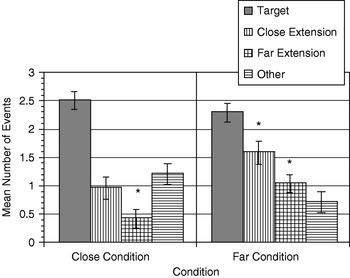
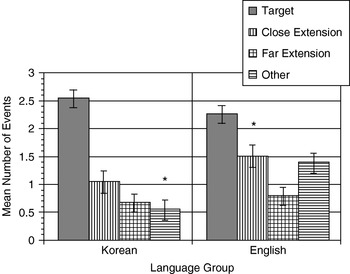
A repeated measures ANOVA was computed with condition (2: Close comparisons, Far comparisons) and language (2: English, Korean) as between-subjects factors, and response type (4: Target, Close extension, Far extension, Other)Footnote 2 as a within-subjects factors; the dependent measure was the number of events in which children made a particular response.Footnote 3 This analysis revealed a main effect of response type (F(3, 44)=32·11, p<0·001; ηp2=0·42), a significant main effect of language (F(1, 44)=7·22, p=0·01; ηp2=0·14), a significant condition by response type interaction (F(3, 44)=4·91, p=0·003; ηp2=0·10) and a significant language by response type interaction (F(3, 44)=3·38, p=0·02; ηp2=0·07) (see Figures 2 and 3).
Graph shows the mean number of events in which each response type was produced by condition.
note: *In the Close condition, there were significantly fewer Far responses than any other response type (p<0·05). Across conditions, there were more Close responses and Far responses in the Far condition than in the Close condition (ps<0·05).

Graph shows the mean number of events in which each response type was produced by language.
note: *In the English-speaking group, children produced more Close responses than Far responses (p<0·05). Across language, Korean-speaking children produced significantly fewer Other responses than did the English-speaking group (p=0·002).

Additional analyses were used to examine the two significant interactions revealed in the main analysis. First, pairwise comparisons with Sidak adjustments for multiple post hoc tests (Sidak, Reference Sidak1967) were computed to investigate the condition by response type interaction. In both conditions, there were significantly more target responses than Far extensions or Other responses (ps<0·05). In the Close condition, there were also more target than Close responses, and there were more Close extensions and Other responses than there were Far extensions (ps<0·05). In the Far condition, there were also more Close extensions than Far extensions and Other responses (ps<0·05). Across conditions, there were more Close extensions and Far extensions in the Far condition than in the Close condition (ps<0·05) (see Figure 2).
Pairwise comparisons with Sidak adjustments for multiple post hoc tests also were used to investigate the language by response type interaction. In both groups, children produced more target responses than Other responses (ps<0·05). In the English-speaking group, children produced more Close than Far extensions (p<0·05). Across language, Korean-speaking children produced significantly fewer Other responses than did the English-speaking group (p=0·002) (see Figure 3).
In addition to parametric analyses, we used non-parametric analyses to examine the patterns of children's responses. To examine these patterns, we categorized each child into one of four patterns of response: Target or Target and Other responses only (with a possible single extension), Close extensions in at least two events (with a possible single Far extension), Far extensions in at least two events or one Close and one Far extension across the three events. These four categories of responses characterized all of the children's responses in our sample.
A Pearson chi-square statistic examining the distribution of these response patterns by condition was significant (χ2 (3, N=48)=7·86, p<0·05, see Table 1). A Pearson chi-square statistic that examined the distribution of these four response patterns by language was not significant (χ2 (3, N=48)=3·59, ns, see Table 2).
Number of children producing each response pattern by condition

note: N=24 per condition. The chi-square statistic examining response pattern by condition was significant (p<0·05).
Number of children producing each response pattern by language

note: N=24 per language. The chi-square statistic examining response pattern by language was not significant.
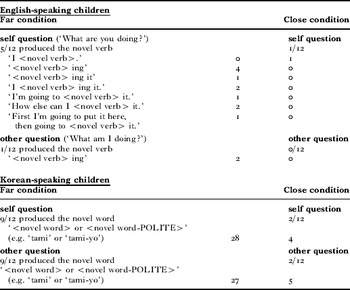
We also examined all of the children's verbal utterances at test that included the novel word. Table 3 lists all of the productive utterances children made in each language group, including information about the frequency of each utterance type and the number of children who were productive.
Children's productions of the novel verbs by language, condition and prompt at test

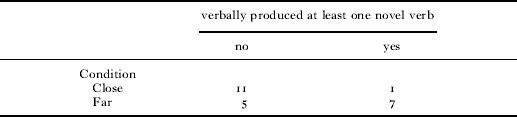
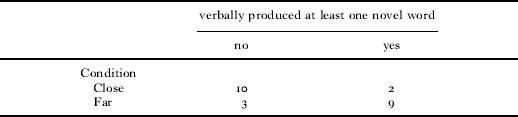
To examine children's productions using non-parametric statistics, we tallied the number of children who produced at least one novel word by condition (see Tables 4 and 5). A chi-square analysis of these data shows that, as individuals, English-speaking children produced the novel word more frequently in the Far condition than in the Close condition (χ2 (1, N=24)=6·75, p=0·009), and the same pattern was found for Korean-speaking children (χ2 (1, N=24)=8·22, p=0·004).
English-speaking children: Number of productive children by condition

note: χ2 (1, N=24)=6·75, p<0·01.
Korean-speaking children: Number of productive children by condition

note: χ2 (1, N=24)=8·22, p<0·01.
DISCUSSION
In this study, we asked whether children learning English or Korean could compare multiple events, and whether the nature of these events (very similar or more varied) would influence children's subsequent enactments when asked to enact an action that had been linked to a novel word. To our knowledge, this is the first empirical study comparing the acquisition of a new action word in these two languages. We found that, regardless of language, children who experienced varied events produced more far extensions, or enacted the event using more varied objects, than did children who experienced very similar events. Children in this condition also produced more extensions that included similar objects (Close extensions) than did children in the Close condition. In fact, as a group, children in this condition extended the word in some way on approximately 2·5 of 3 events, which is remarkable given that children at this age are often conservative in their use of verbs in different situations and syntactic contexts (e.g. Barrett, Reference Barrett, Seiler and Wannenmancher1983; Bowerman, Reference Bowerman and Nelson1985; Forbes & Poulin-Dubois, Reference Forbes and Poulin-Dubois1997; Imai, Gentner & Uchida, Reference Imai, Gentner and Uchida1994; Olguin & Tomasello, Reference Olguin and Tomasello1993; Theakston, Lieven, Pine & Rowland, Reference Theakston, Lieven, Pine and Rowland2002; Tomasello, Reference Tomasello1992, Reference Tomasello, Tomasello and Merriman1995).
In contrast, children who experienced very similar events produced significantly fewer Far extensions than any other response type, and extended the new word less frequently overall (producing fewer Close extensions in this condition as well as fewer Far extensions). When they did extend the new word (on one of three events), they were more likely to use an object that was similar to those shown by the experimenter than they were to use an object that was more varied.
These results obtained in parametric analyses were supported by patterns revealed by non-parametric analyses. An analysis of individual patterns of responses showed that they varied by condition, with seventeen of twenty-four children producing at least one extension on at least two of the three events in the Far condition, and only nine of twenty-four children doing so in the Close condition. The ability to produce Far extensions consistently in at least two events was confined to the Far condition. This advantage of the Far condition was also apparent in children's productions, with significantly more productions of the new word in the Far condition than in the Close condition in both language groups.
In Gentner's structural alignment theory, high similarity between objects across events helps observers to perform alignments from event to event. At first glance, this may seem to indicate that the Close comparison condition should have been produced more extensions, at least extensions including the Close test objects. However, in this study, there was very little variation in the objects in the Close condition while the test phase required the participant to include a similar, but not identical object to perform a Close extension. The theory does predict that the discrepancy between the very high similarity of the comparison objects and the less similar Close extension test objects would be difficult. In addition, although the objects in the Far condition were less similar to each other across events, the comparison events in the Far condition were alignable with each other in the sense that they all contained the same number of elements (e.g. agent, instrument, patient) (with the exception of events in ‘meek’). Thus, this Far condition with alignable elements would be predicted to lead to generalizations that fit the common event structure and allow new objects.
In addition to differences across conditions, we found a few differences across the two language groups. In the English-speaking group, children produced more Close extensions than Far extensions while in the Korean-speaking group, these extension types did not differ. In addition, English-speaking children produced more irrelevant responses than did Korean-speaking children. However these differences are not striking. Perhaps if we had used events that corresponded to familiar verbs that are known to vary in their levels of specificity in these languages (e.g. ‘break’), we may have found more differences between these groups. We chose to use novel words and events to be sure that no child had more experience with a particular word or event than did any other. In addition, it may be that the stimulus sentences used in this particular study minimized some of the differences that would normally be found.
More specifically, a limitation of the study is that we presented the novel word in different ways in the two languages. In English, the novel word appeared as the main verb in the sentence (as ‘shop’ does in the sentence ‘I'm shopping’) whereas in Korean, the novel word appeared as a predicate term that modified a light verb ‘do’ (as ‘shop’ does in the sentence ‘I'm doing shopping’). This is perfectly grammatical in Korean. It allowed us to present the new word in approximately the same position in the sentence in both languages (medially), even though Korean is an SOV or verb final language. It also allowed us to present the novel word without extensive modifiers in both languages; using the novel word as a main verb in Korean would have meant it was presented in varied forms across the sentences (‘mikku’ would have become ‘mikku-l-ko-eyo’ in one sentence and would take different modifiers in another). Although the novel word in Korean did not function as the main verb in the sentence, it did serve as a label for a dynamic activity and thus still addresses the question of how children learn to refer to events in language. A study in which Korean children are presented with new verbs, with modifiers and at the end of the sentence, is needed and is a direction we are pursuing. Despite the differences between the stimulus sentences in the two languages, our study shows that when the novel word is presented medially, and when its form does not change markedly across different sentence types, major differences between responses to novel words for actions in these two language groups are not evident.
Learning how to use words to refer to events in a particular language requires some inductive reasoning on the part of the child. One source of information available to children is cross-situational information; previous studies suggest that this kind of information can be used by young children learning new verbs (Behrend, Reference Behrend, Tomasello and Merriman1995; Childers, Reference Childers2005, in press; Forbes & Farrar, Reference Forbes and Farrar1995; Gropen et al., Reference Gropen, Pinker, Hollander and Goldberg1991). Most of these previous studies have presented variations across events and have shown that children as young as three years can conclude that the verb is less ‘picky’ about those aspects of events that vary across situational contexts (Behrend, Reference Behrend1990; Forbes & Farrar, Reference Forbes and Farrar1995). A new set of studies shows that two-and-a-half-year-old children can attend to consistency in actions or results across events, using consistency as a guide to important elements of a new verb (Childers, Reference Childers2005, in press).
The present study extends these findings by examining more specifically how different levels of similarity across related events influences children's responses. In addition, it extends previous work by including children in two language groups. Although further studies are needed to show that children are aligning specific elements from one event to another, our results at the least suggest that children are using cross-situational information. In fact, children in our study extended the new word much more broadly than is often seen in this age group. Thus, these results suggest that cross-event information may be important to children's growing ability to be appropriately flexible in their use of new verbs in new situations.
APPENDIX A
gorp target event: 2 square green wooden boards (9·5 in×9 in) are joined with smaller rectangular board (3·5 in wide) using metal hinges (resembling a binder). Apparatus is opened (right to left) and then closed (left to right) onto a yellow and blue football-shaped sponge ball, squishing it.

tam target event: A soft round purple natural sponge is inserted through a hole in the base of a Styrofoam bowl, (creating a ‘spaceship’ shape, 4 in×6 in); sponge contains a magnet. Spaceship is placed over a blue metal disk (2·5 in dia.), the disk attaches to the ship, the ship lifts it.

meek target event: A small rectangular (3·5 in×5·5 in) blue box is attached to the end of a short, white curved PVC pipe (6 in×6·5 in), with the pipe extending vertically and curving into the box. The ball is placed at the top of the pipe, rolls into the box and the child is shown the ball in the box at the end of the event.

pilk target event: small purple rubber tadpole (face covered) is picked up out of red cardboard box (6·25 in×6 in) and set on ground.

APPENDIX B