INTRODUCTION
Social wasps can face many problems during their colony cycle, often due to the grouping of a large number of genetically similar individuals in the nests. These conditions can lead to increased transmission of pathogens, including parasites (Schmid-Hempel, Reference Schmid-Hempel1995; Naug and Camazine, Reference Naug and Camazine2002). The order Strepsiptera of obligate endoparasites is notable because it parasitizes seven orders and 34 families of insects (Kathirithamby, Reference Kathirithamby2009). These endoparasites are free-living during their first instar, until they penetrate the larval stage host. The parasites complete their development within one or two weeks, coinciding with the emergence of the adult host (Beani, Reference Beani2006; Kathirithamby, Reference Kathirithamby2009). Previous studies performed with these endoparasites in social wasps have investigated infection levels, behavioural, physiological or chemical and immune system changes, protection against infection and the biology of the endoparasites and their hosts (Hughes et al. Reference Hughes, Beani, Turillazzi and Kathirithamby2003, Reference Hughes, Kathirithamby and Beani2004a ; Hughes and Kathirithamby, Reference Hughes and Kathirithamby2005; Beani, Reference Beani2006; Kathirithamby and Hughes, Reference Kathirithamby and Hughes2006; Dapporto et al. Reference Dapporto, Cini, Palagi, Morelli, Simonti and Turillazzi2007; Manfredini et al. Reference Manfredini, Giusti, Beani and Dallai2007, Reference Manfredini, Massolo and Beani2010a , Reference Manfredini, Beani, Taormina and Vannini b , Reference Manfredini, Benati and Beani c ; Beani et al. Reference Beani, Dallai, Mercati, Cappa, Giusti and Manfredini2011; Cappa et al. Reference Cappa, Manfredini, Dallai, Gottardo and Beani2014; Kudô et al. Reference Kudô, Komatsu, Mateus, Zucchi and Nascimento2014).
Polistes ferreri Saussure, 1853 is a Neotropical eusocial wasp found in Argentina, Bolivia, Brazil and Uruguay (Richards, Reference Richards1978). Studies already performed with this species have considered its foraging activity, dominance and hierarchy in the colony, the colony cycle and the role of males, and the correlation between the chemical profile and reproductive status of females (Tannure and Nascimento, Reference Tannure and Nascimento1999; Andrade and Prezoto, Reference Andrade and Prezoto2001; Sinzato et al. Reference Sinzato, Prezoto and Del-Claro2003; De Souza et al. Reference De Souza, Rodrigues, Rocha, Reis, Lopes and Prezoto2008, Reference De Souza, Rocha, Rodrigues and Prezoto2010; Soares et al. Reference Soares, Torres and Antonialli-Junior2014).
The aim of this study was to evaluate the effect of strepsipterans of a species of the genus Xenos in the host P. ferreri. Our hypothesis was that parasitized P. ferreri females would show alterations in their morphology, physiology and cuticular chemical profiles, due to the presence of the endoparasite.
MATERIAL AND METHODS
Infection evaluation
In order to assess the prevalence of infection by endoparasites of the order Strepsiptera, ten colonies of P. ferreri were collected during different colony stages, which were classified as described by Jeanne (Reference Jeanne1972). The collections were performed from April 2011 to March 2012 in Mundo Novo city, Mato Grosso do Sul, in the central–western region of Brazil (23°56′23″S, 54°17′25″W).
Ethics
In this study, the authors have involved the minimum number of animals to determine an acceptable estimate of prevalence (confidence interval = 95%). The collection and transport of the specimens were authorized by the Biodiversity Authorization and Information System (SISBIO license No. 3177–7).
Morphophysiological evaluation
A total of 122 females from the ten colonies of P. ferreri were used for the analysis of morphological changes. Nine measurements were performed on different parts of the body, as described by Soares et al. (Reference Soares, Torres and Antonialli-Junior2014), with modifications. Head: head width (HW) and minimum interorbital distances (IDx); Mesosome: width, length and height of mesoscutum (MSW, MSL and MSH, respectively); Metasome: tergite 2 length (T2L) and basal and apical widths (T2BW and T2AW) (not the tergite 2 basal and apical heights described by Soares et al. (Reference Soares, Torres and Antonialli-Junior2014)); Wing: partial length of the forewing (WL).
Afterwards, the gaster of each female was dissected under a stereomicroscope, using anatomical dissection forceps, in order to evaluate ovarian development, insemination, age, presence of the endoparasite, and quantity of parasites. The sperm cells were observed under a light microscope and the insemination status was checked by staining the spermatheca in a solution of acid fuchsin (1%).
Ovary development was classified according to Soares et al. (Reference Soares, Torres and Antonialli-Junior2014), as follows: (a) workers 1: females with filamentous ovarioles without visible developed oocytes, inseminated or not; (b) workers 2: females with partially developed ovarioles, inseminated or not; (c) queens: females with fully developed ovarioles, with two or more mature oocytes, always inseminated.
The apodeme pigmentation of the fifth gastral sternite was used to determine the relative ages of the females: from yellow to light brown for young females and from dark brown to black for old females. According to Richards (Reference Richards1971), this colour progression indicates the ages of the individuals.
Effect of endoparasitism on the cuticular chemical profile
Analyses of the cuticular chemical profiles were always performed using the thorax of the wasps, employing Fourier transform-infrared photoacoustic spectroscopy (FTIR-PAS). This technique has been extensively used in previous studies of biological materials (Charland and Leblanc, Reference Charland and Leblanc1993; Gibbs, Reference Gibbs1995; Andrade et al. Reference Andrade, Freitas, Mantovani and Silva2007; Antonialli-Junior et al. Reference Antonialli-Junior, Lima, Andrade and Súarez2007; Neves et al. Reference Neves, Montagna, Andrade, Súarez, Lima and Antonialli-Junior2013; Tofolo et al. Reference Tofolo, Giannotti, Neves, Andrade, Lima, Súarez and Antonialli-Junior2014; Oliveira et al. Reference Oliveira, Spencer, Ferreira and Nascimento2015; Santana et al. Reference Santana, Andrade, Súarez, Yukimitu, Moraes and Lima2015; Almeida et al. Reference Almeida, Santana, Lima, Andrade, Súarez and Lima2016).
The thoraxes of the females were allowed to dry for 48 h under vacuum, in order to minimize the water content. They were then assessed using a spectrophotometer (Nexus 670, ThermoNicolet) coupled to a photoacoustic detector (MTEC-300), according to the methodology described in earlier studies (Antonialli-Junior et al. Reference Antonialli-Junior, Lima, Andrade and Súarez2007, Reference Antonialli-Junior, Súarez, Izida, Andrade and Lima2008; Neves et al. Reference Neves, Andrade, Súarez, Lima and Antonialli-Junior2012, Reference Neves, Montagna, Andrade, Súarez, Lima and Antonialli-Junior2013; Tofolo et al. Reference Tofolo, Giannotti, Neves, Andrade, Lima, Súarez and Antonialli-Junior2014). The spectra for each sample were generated from 128 scans at resolution of 16 cm−1.
After obtaining the spectra, eight wavenumbers were selected (2958, 2923, 2877, 2850, 1457, 1376, 1157 and 952 cm−1), corresponding to the functional groups of hydrocarbons present on the cuticles of females, as reported previously (Antonialli-Junior et al. Reference Antonialli-Junior, Lima, Andrade and Súarez2007, Reference Antonialli-Junior, Súarez, Izida, Andrade and Lima2008; Neves et al. Reference Neves, Andrade, Súarez, Lima and Antonialli-Junior2012, Reference Neves, Montagna, Andrade, Súarez, Lima and Antonialli-Junior2013; Bernardi et al. Reference Bernardi, Firmino, Pereira, Andrade, Cardoso, Súarez, Antonialli-Junior and Lima2014; Soares et al. Reference Soares, Torres and Antonialli-Junior2014; Tofolo et al. Reference Tofolo, Giannotti, Neves, Andrade, Lima, Súarez and Antonialli-Junior2014; Santana et al. Reference Santana, Andrade, Súarez, Yukimitu, Moraes and Lima2015). The intensity values obtained at each wavenumber were used to construct the table used for discriminant analysis. The ratios of the mean intensity values for the peaks 2923/2958 and 2850/2877 cm−1 were used to demonstrate the differences among the mean spectra of the analysed groups (non-parasitized females, females parasitized by one endoparasite, and females parasitized by two or more endoparasites).
Statistical analysis
The morphometric variables of the non-parasitized females and females parasitized by one endoparasite or by two or more endoparasites were used to assess the endoparasitism effects by means of discriminant function analysis, using a significance level of P < 0·05. Subsequently, cluster analysis using Euclidean distances and the unweighted pair-group method using arithmetic averages (UPGMA) was applied to construct a dendrogram with the groups. This procedure was performed using the R statistical program. The cophenetic correlation coefficient was used to determine whether the dendrogram reflected the matrix similarity among the endoparasitism effects, with a minimum value of 0·75 defined as a measure of the dendrogram fit quality, as suggested by MacGarigal et al. (Reference MacGarigal, Cushman and Stafford2000).
In order to distinguish among the cuticular chemical profiles of the same groups of females, discriminant analysis was performed using the intensity values of the eight wavenumbers and cluster analysis using Euclidean distances and the UPGMA method.
RESULTS
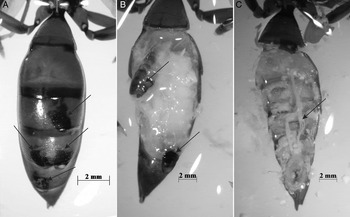
A single species of the genus Xenos parasitized females in only 10% (n = 1) of the colonies collected. As only the genus could be identified by the taxonomist, we will treat this species as Xenos sp. from now on. A total of 32 females were sampled from the colony, with 68·75% (n = 22) being parasitized and 31·25% (n = 10) non-parasitized. The average infection prevalence of the parasitized colonies was 1·47 endoparasites per female. Considering the parasitized females, in 54·54% of cases (n = 12) it was possible to observe the cephalothoraxes of strepsipteran females among the intersegmental membranes of the wasps gasters (Fig. 1A). The parasitized females were mostly young (90·9%, n = 20), with 9·1% (n = 2) being old.
Endoparasitism by Xenos sp. in Polistes ferreri. (A) Parasitized female with four endoparasites (arrows); (B) Adult female of P. ferreri with a male Xenos in the pupal stage and one female inside its gaster (arrows); (C) Filamentous ovarium after parasitism of the females (arrow).

The results showed that 40·91% (n = 9) of the females were infected by one endoparasite, 27·27% (n = 6) by two, 18·18% (n = 4) by three, 4·54% (n = 1) by four, and 9·1% (n = 2) by five, totalling 47 endoparasites. The endoparasites were 78·72% (n = 37) females and 21·28% (n = 10) males in the pupal stage and ready for emergence (Fig. 1B).
Regardless of the number of endoparasites, the parasitized females showed filamentous ovarioles without oocytes in development (Fig. 1C), while 60% (n = 6) of the non-parasitized females had partially developed ovarioles, 30% (n = 3) had filamentous ovarioles, and only 10% (n = 1), possibly the queen, had a fully developed and inseminated ovary.
There were significant morphometric differences among the non-parasitized females, females with one endoparasite, and females with two or more endoparasites (Wilks’ Lambda = 0·12; F = 4·32, P < 0·05). The first canonical root explained 88·5% of the results, and the second the remaining 11·5%. The most significant variable for separation of the groups was the T2AW.
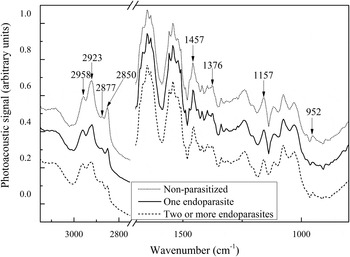
Figure 2 shows the average spectra of the cuticular chemical profiles of non-parasitized females, females with one endoparasite, and females with two or more endoparasites, according to the eight wavenumbers used for the statistical analysis. The results of the discriminant analysis performed with the selected peaks indicated significant differences among groups (Wilks’ Lambda = 0·29; F = 2·28; P < 0·05). The first canonical root was the most significant, explaining 79·4% of the data variation, while the second canonical root explained 20·6% of the variation (giving a total of 100%).
Mid-infrared absorption spectra obtained from the cuticular chemical profiles of Polistes ferreri females: non-parasitized, with one endoparasite, and with two or more endoparasites of one species of the genus Xenos.

For the first canonical root, the discriminant analysis indicated that wavenumbers 2958 and 1376 cm−1, corresponding to the functional groups –C–H(CH2) and C–CH3, were the most important for separation of the groups, while wavenumbers 1457 and 1157 cm−1 (C–CH2 and in-plane C–H, respectively) were more important for the second canonical root. Analysis of the mean spectra (Fig. 2) revealed differences in the 2923/2958 cm−1 wavenumber intensity ratios, with values of 1·09, 1·03 and 1·02 for non-parasitized females, females with one endoparasite, and females with two or more endoparasites, respectively. Similar values were observed for the 2850/2877 cm−1 wavenumber intensity ratios (1·05, 1·00 and 0·96, respectively).
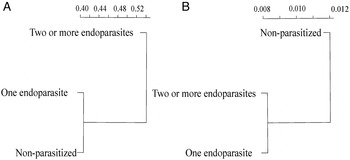
The similarity dendrogram obtained using the morphometric variables showed a correlation between the non-parasitized females and females with one endoparasite, while these groups differed from the females with two or more endoparasites, with a cophenetic correlation coefficient of 0·89 (Fig. 3A).
Similarity dendrograms based on (A) the morphometric variables and (B) the cuticular chemical profiles of Polistes ferreri females, according to the presence or absence of endoparasites and their numbers.

The similarity dendrogram constructed with the absorption intensity values showed that the cuticular chemical profiles of the females parasitized with one or more endoparasites were different compared to the non-parasitized females, with a cophenetic correlation coefficient of 0·66 (Fig. 3B).
DISCUSSION
We report in this study a strepsipteran of the genus Xenos using females of P. ferreri as hosts. In Brazil, studies with the genus Xenos in species of Polistinae have only been reported by Kathirithamby (Reference Kathirithamby, Rafael, Melo, Carvalho, Casari and Constantino2012) and Kudô et al. (Reference Kudô, Komatsu, Mateus, Zucchi and Nascimento2014). A greater number of studies have been performed with wasps sampled in regions with temperate climates (Hughes et al. Reference Hughes, Kathirithamby and Beani2004a ; Hughes and Kathirithamby, Reference Hughes and Kathirithamby2005; Manfredini et al. Reference Manfredini, Giusti, Beani and Dallai2007; Beani et al. Reference Beani, Dallai, Mercati, Cappa, Giusti and Manfredini2011; Cook, Reference Cook2014).
There are 34 species of Strepsiptera recorded in Brazil, and it is believed that this number could increase to 200, due to the number of cryptic species (two or more distinct species classified as a single one because they appear to be identical but are incapable of interbreeding) (Kathirithamby, Reference Kathirithamby, Rafael, Melo, Carvalho, Casari and Constantino2012). Since strepsipterans parasitize specific hosts and the species belonging to the Xenidae family are exclusive of social wasps and of solitary Sphecidae wasps (Kathirithamby, Reference Kathirithamby1989, Reference Kathirithamby, Rafael, Melo, Carvalho, Casari and Constantino2012), more studies are needed to determine if the species of Xenos observed in P. ferreri can use other organisms as hosts.
In this study, the endoparasite caused alterations of gaster size, significant changes in the cuticular chemical profile and sometimes physiological castration in parasitized females of P. ferreri. Only 10% (n = 1) of the colonies sampled were parasitized, differing from the 50 to 60% described by Hughes et al. (Reference Hughes, Beani, Turillazzi and Kathirithamby2003) for parasitized colonies of Polistes carnifex, Polistes dominula and Polistes gallicus. However, in the same study, Hughes et al. (Reference Hughes, Beani, Turillazzi and Kathirithamby2003) found an infection prevalence of 13% in colonies of Polistes stabilinus. The infection prevalence could be dependent on many factors, including the nesting environment and (especially) the sample size.
Among the 22 females parasitized, 59·09% (n = 13) had two or more endoparasites. Hughes et al. (Reference Hughes, Kathirithamby and Beani2004a ) found 61 parasitized females of P. dominula, while only 11·47% (n = 7) had two or more Xenos vesparum endoparasites.
The present results also demonstrated that females with endoparasites were physiologically castrated (Fig. 1C), as already reported in other species of Polistes (Wheeler, Reference Wheeler1910; Hughes et al. Reference Hughes, Kathirithamby and Beani2004a ; Beani, Reference Beani2006; Beani et al. Reference Beani, Dallai, Mercati, Cappa, Giusti and Manfredini2011). These females were unable to develop their ovaries, inferring that could not reproduce and were therefore unable to acquire a higher hierarchical rank, hence altering their normal interactions within the colony.
A greater prevalence of endoparasitism in young females was reported previously by Hughes et al. (Reference Hughes, Kathirithamby, Turillazzi and Beani2004b ) in P. dominula species and it was concluded that older parasitized females might leave the nest and form a winter aggregation. In addition, Hughes et al. (Reference Hughes, Kathirithamby and Beani2004a ) observed that low parasitism prevalence in some Polistes colonies could be explained by desertion of the nest by the females.
The non-parasitized females, females with one endoparasite, and females with two or more endoparasites showed significant inter-group differences in terms of morphometry as well as cuticular chemical profiles. These findings were probably due to the morphological and physiological changes caused by the endoparasite in the host.
The changes in the T2AW suggested that the quantity of endoparasites in the gasters of the females was the main factor influencing the morphometric alterations, since Soares et al. (Reference Soares, Torres and Antonialli-Junior2014) did not find any morphometric differences between the queen and worker castes of this species when they assessed females of non-parasitized colonies. The absence of morphometric differences between the castes has also been reported in Polistes versicolor (Torres et al. Reference Torres, Sguarizi-Antonio, Lima, Andrade and Antonialli-Junior2014).
Differences were found in the ratios between the mean intensities for wavenumbers 2923/2958 and 2850/2877 cm−1, with smaller values for females with two or more endoparasites. This indicated a higher concentration of the CH3 functional group in these females, probably corresponding to an increase of methyl groups in the hydrocarbons. Neves et al. (Reference Neves, Montagna, Andrade, Súarez, Lima and Antonialli-Junior2013) found that these peaks were important for distinguishing facultative parasitism between the species Mischocyttarus consimilis and Mischocyttarus cerberus, based on the cuticular chemical profile. It was observed that the cuticular chemical profiles of both the facultative parasite and the host changed during the interaction of the two species, which was probably a strategy that enabled the parasite to invade the host colony successfully, without being rejected.
Changes in the cuticular composition are important, because this composition is used for signalling the physiological condition of the female (Peeters et al. Reference Peeters, Monnin and Malosse1999; Sledge et al. Reference Sledge, Boscaro and Turillazzi2001; Heinze et al. Reference Heinze, Stengl and Sledge2002; Kelstrup et al. Reference Kelstrup, Hartfelder, Nascimento and Riddiford2014; Soares et al. Reference Soares, Torres and Antonialli-Junior2014; Torres et al. Reference Torres, Sguarizi-Antonio, Lima, Andrade and Antonialli-Junior2014), which consequently determines its role in the colony. The effect of the endoparasite in altering the chemical signature in P. dominula was reported by Dapporto et al. (Reference Dapporto, Cini, Palagi, Morelli, Simonti and Turillazzi2007), with differences in the cuticular hydrocarbons among unparasitized females, females parasitized by X. vesparum males and females parasitized by X. vesparum females.
Concluding remarks
The presence of the endoparasite provoked significant morphophysiological changes and altered the cuticular chemical profile of P. ferreri females, confirming our hypothesis. It is likely that this parasitism effect could confuse wasp colonies and hamper their maintenance, since females could experience changes in the cuticular chemical profile that normally signals their pre-established hierarchy. In addition, the parasitism could affect colony cohesion and lead to nest desertion. Further studies are needed to determine the overall impact of these endoparasites on wasp populations, especially in species from the Neotropical ecoregion.
ACKNOWLEDGEMENTS
The authors thank Orlando T. Silveira for the identification of the host species and Jeyaraney Kathirithamby for the identification of the genus of the endoparasite.
FINANCIAL SUPPORT
This work was supported by Fundação de Apoio ao Desenvolvimento do Ensino, Ciência e Tecnologia do Estado de Mato Grosso do Sul (FUNDECT) (grant number 23/200·285/2014 to V. O. T.) and Conselho Nacional de Desenvolvimento Científico e Tecnológico (CNPq) (grant number 307998/2014-2 to W. F. A. J., grant number 306970/2011-2 to S. M. L. and grant number 305412/2014-0 to L. H. C. A.).