Implications
This study compared the effect of feeding 10% (dry matter basis) chopped alfalfa hay, corn silage or their equal blend in the starter diets on Holstein calf performance. The results indicated that either alfalfa hay or corn silage can be used in the starter diet until 70 days of age, thus providing the producers with greater choices in choosing the feed ingredients and improving their profits when feed prices are competitive.
Introduction
Adequate feed intake is crucial for reticulorumen development and allows calves to maintain weight gain through the transition from liquid to solid feed (Beiranvand et al., Reference Beiranvand, Ghorbani, Khorvash, Nabipour, Dehghan-Banadaky, Homayouni and Kargar2014; Pazoki et al., Reference Pazoki, Ghorbani, Kargar, Sadeghi-Sefidmazgi, Drackley and Ghaffari2017). Therefore, starter feeds with relatively low NDF contents (16% to 18%) are formulated to maximize feed intake and digestibility in dairy calves (Castells et al., Reference Castells, Bach, Araujo, Montoro and Terré2012; Beiranvand et al., Reference Beiranvand, Ghorbani, Khorvash, Nabipour, Dehghan-Banadaky, Homayouni and Kargar2014; Pazoki et al., Reference Pazoki, Ghorbani, Kargar, Sadeghi-Sefidmazgi, Drackley and Ghaffari2017). Provision of dietary fiber in the starter diet may be necessary to maintain physical abrasion in the rumen and to prevent hyper-keratinization and clumping of the ruminal papillae (Beiranvand et al., Reference Beiranvand, Ghorbani, Khorvash, Nabipour, Dehghan-Banadaky, Homayouni and Kargar2014; Pazoki et al., Reference Pazoki, Ghorbani, Kargar, Sadeghi-Sefidmazgi, Drackley and Ghaffari2017), especially with finely ground starter diets. According to a recent meta-analysis, forage provision is likely to positively affect the dairy calf performance; however, its effect can be modulated by the forage source, forage level and the physical form of the starter diet (Imani et al., Reference Imani, Mirzaei, Baghbanzadeh-Nobari and Ghaffari2017).
Alfalfa hay (AH) and corn silage (CS), the primary sources of forages in the ruminant diets, are commonly utilized in many dairy-producing areas of the world, including Iran. Positive effects of chopped AH (Beiranvand et al., Reference Beiranvand, Ghorbani, Khorvash, Nabipour, Dehghan-Banadaky, Homayouni and Kargar2014; Pazoki et al., Reference Pazoki, Ghorbani, Kargar, Sadeghi-Sefidmazgi, Drackley and Ghaffari2017) or CS (Mirzaei et al., Reference Mirzaei, Khorvash, Ghorbani, Kazemi-Bonchenari and Ghaffari2017) in increasing calf feed intake and weight gain were observed when supplemented to a finely ground starter diet as total mixed ration (TMR). When AH and CS were offered to young calves separately from the starter feed, calves provided CS consumed a less amount of forage compared with calves provided AH, but it was still sufficient to foster an increase in the starter feed intake (Castells et al., Reference Castells, Bach, Araujo, Montoro and Terré2012). Provision of CS v AH in the finely ground starter diet (at 15% of dietary DM) increased starter intake and weight gain possibly due to reduced dustiness or greater palatability of the starter feed with increased dietary moisture (Mirzaei et al., Reference Mirzaei, Khorvash, Ghorbani, Kazemi-Bonchenari and Ghaffari2017).
Limited information is available on how changes in the forage source (AH v. CS) of the starter diet influence the performance of dairy calves when fed at the level of ≤ 10% of dietary dry matter (DM) to avoid gut fill effect (Imani et al., Reference Imani, Mirzaei, Baghbanzadeh-Nobari and Ghaffari2017). The objective of this study was to evaluate the potential benefits of replacing AH with CS in a finely ground starter feed containing similar forage levels (10% of dietary DM) and NDF contents. We hypothesized that growth performance of dairy calves would increase if feed intake or feed efficiency is increased by feeding CS or AHCS (an equal blend of AH and CS) compared with feeding AH. To this end, we measured the starter feed intake, weight gain, skeletal growth, nutrient digestibility, rumen fermentation and selected blood metabolites in Holstein calves which were fed starters varying in the CS level.
Materials and methods
This study was performed on a local dairy farm (Foudeh-Sepahan Agriculture and Animal Husbandry, Isfahan, Iran) from July to October 2017. All animal procedures, recommended by the Iranian Council of Animal Care (1995), were approved by the Animal Care Committee of Shiraz University.
Treatments, calves and management
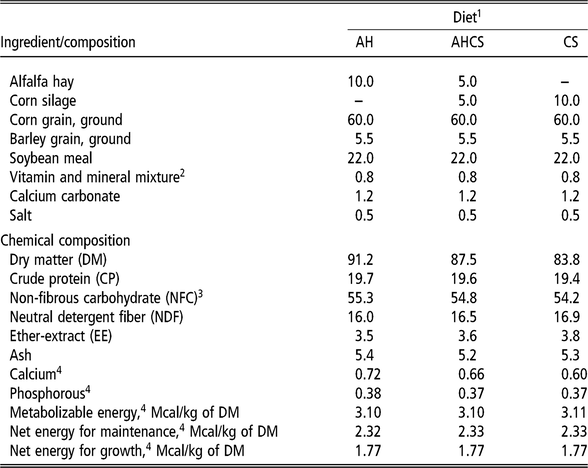
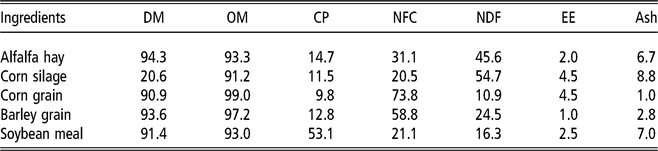
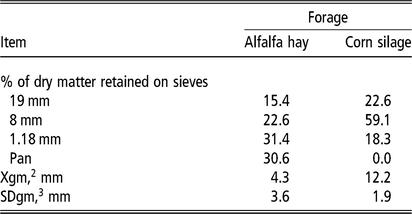
A total of 30 male Holstein calves (3 days of age; 40.2 ± 1.28 kg BW) were assigned randomly to three starter diets (n = 10 per diet, Tables 1 and 2), including (1) a diet containing 10% (DM basis) chopped AH, (2) a diet containing 10% CS and (3) a diet containing equal proportions (5%) of AH and CS (AHCS). The corn silage variety used in this study was Dekalb C 65-89 (Falat-e-Iran Company, Tehran, Iran) and was planted on 21 May 2016, and harvested on 22 September 2016. Corn silage was harvested at late milk to early dough stage of maturity and chopped using a pool-type chopper (Model 965, Claas, Omaha, NE, USA) set to produce particles with an average theoretical length cut of 25 mm. After harvesting, CS was ensiled (without any additive) in a bunker silo and allowed to ferment for 9 months before being fed. Alfalfa hay was chopped to a theoretical length cut of 30 mm, using a harvesting machine with screen-size regulator (Golchin Trasher Hay Co., Isfahan, Iran). Particle size distribution of AH and CS is presented in Table 3. The geometric mean particle size of AH and CS used in this study was 4.3 ± 0.15 mm and 12.2 ± 1.9 mm, respectively. Calves had free access to fresh drinking water and a TMR formulated according to the National Research Council (NRC, 2001), allowing at least 10% refusals.
Ingredients and chemical composition (% dry matter unless otherwise indicated) of the experimental diets fed to Holstein dairy calves

1 AH = starter diet containing 10% alfalfa hay; AHCS = starter diet containing 5% alfalfa hay and 5% corn silage; and CS = starter diet containing 10% corn silage.
2 Contained per kilogram of supplement: 975 000 IU of vitamin A, 750 000 IU of vitamin D, 1 800 IU of vitamin E, 143 g of Zn, 76 g of Mn, 48.6 g of Cu, 19.5 g of Se, 18.4 g of Fe, 8 g of Ca and 1.3 g of Co.
3 NFC = 100 – (CP + NDF + EE + Ash) (NRC, 2001).
4 Calculated from NRC (2001).
Chemical composition (% dry matter) of the feed ingredients fed to Holstein dairy calves

DM = dry matter; OM = organic matter; CP = crude protein; NFC = non-fibrous carbohydrate; NDF = neutral detergent fiber; EE = ether-extract.
Physical characteristics of alfalfa hay and corn silage fed to Holstein dairy calves measured using the Penn State Particle Separator1

1 Particle length variables were measured using the Penn State Particle Separator (The Pennsylvania State University, University Park; Kononoff et al., Reference Kononoff, Heinrichs and Buckmaster2003).
2 Geometric mean particle size, calculated according to the method of the American Society of Agricultural Engineers (ASAE, 1995; method S424.1).
3 Geometric standard deviation of particle size, calculated according to the method of the American Society of Agricultural Engineers (ASAE, 1995; method S424.1).
Calves consumed a total of 5.5 l colostrum with 3.5 l being fed within 2 h of life and 2 l at 8 h after the first feeding. On day 2 of life, calves received transition milk (4 l) in two meals of equal volumes at 0900 and 1700 h. From day 3 onwards, calves were individually fed twice daily with waste milk containing 2.93 ± 0.23% fat and 2.78 ± 0.20% CP in steel buckets in two meals of equal volumes at 0900 and 1700 h. Calves were offered milk at 6 l/day from day 3 to day 43, 4 l/day from day 44 to day 46 and 2 l/d from day 47 to day 49 of age. Calves were housed in a naturally ventilated barn with individual pens (2.9 m × 1.1 m × 1.8 m; length × width × height). Fresh wood shavings were used as bedding, refreshed every day, and manure was removed daily to keep the pens visibly clean and dry. Calves were weaned on day 50 and remained on the study until day 70.
Feed sampling and analyses
Amounts of starter feed offered (at 0900 h) and the refusals were weighed daily for calculation of the feed intake. Representative samples (n = 7; pooled within study period) of AH, CS and TMR were taken every 10 days during the experiment. The DM concentration of samples was measured by drying at 100 °C in a forced-air oven for 24 h (AOAC International, 2000; method 925.40). After mixing, the samples were ground to pass a 1-mm screen in a Wiley mill (Ogawa Seiki Co., Ltd., Tokyo, Japan) and analyzed in duplicate for CP (Kjeltec 1 030 Auto Analyzer, Tecator, Höganäs, Sweden; AOAC International, 2000; method 955.04), ether extract (EE; AOAC International, 2000; method 920.39), ash (AOAC International, 2000; method 942.05); NDF was measured according to Van Soest et al. (Reference Van Soest, Robertson and Lewis1991) using a heat stable α-amylase (100 μl/0.5 g of sample) and sodium sulfite. The non-fibrous carbohydrate (NFC) component was calculated as 100 – (CP + NDF + EE + Ash) (NRC, 2001; Tables 1 and 2).
Growth and skeletal measurements
Calves were weighed on day 3 after birth and every 10 days thereafter before the morning feeding using an electronic balance, and average daily gain (ADG; kg of BW/day) was calculated as the difference between BW taken every 10 days apart divided by 10. Feed efficiency was computed as kilogram of BW gain divided by DM intake (milk and starter DM). Body measurements including the heart girth, withers height, body length (distance between the points of shoulder and rump), body barrel (circumference of the paunch before feeding), hip height and hip width (distance between the points of hook bones) were recorded at the start of the study and every 10 days thereafter as described by Pazoki et al. (Reference Pazoki, Ghorbani, Kargar, Sadeghi-Sefidmazgi, Drackley and Ghaffari2017). Calf health was monitored daily by a veterinarian unaware of the diets during the pre-weaning period (days 1 to 49). Calves with diarrhea or pneumonia were treated with standard procedures prescribed by the veterinarian. Calves in general were healthy, and no animal died during the study period.
Nutrient digestibility
During the post-weaning period, six fecal grab samples per calf were hand-collected from the rectal contents at 4-h intervals (0800, 1200, 1600, 2000, 2400, 0400 h) by rotating the sampling times over the 2-day collection period. Samples were taken from the six same calves randomly selected per treatment on day 65 (0800, 1600 and 2400 h) to 66 (1200, 2000 and 0400 h), frozen daily, combined on an equal wet weight basis and sub-sampled for analysis. The samples were dried at 60 °C for 72 h (corrected for 100 °C), and ground through a 1-mm screen in a Wiley mill (Ogawa Seiki Co., Ltd., Tokyo, Japan). Apparent total tract nutrient digestibility was estimated by quantifying the acid insoluble ash as an internal marker in the feed (corrected for refusals) and fecal samples (Van Keulen and Young, Reference Van Keulen and Young1977).
Rumen fluid sampling and volatile fatty acid analyses
Ruminal fluid was sampled 4 h after morning feeding on day 35 and day 65 by a stomach tube fitted to a vacuum pump. Ruminal samples were squeezed through four layers of cheesecloth and 8 ml of the ruminal fluid, acidified with 2 ml of 25% meta-phosphoric acid and were stored at –20 °C until analyzed for volatile fatty acid (VFA) by gas chromatography (Kargar et al., Reference Kargar, Ghorbani, Alikhani, Khorvash, Rashidi and Schingoethe2012).
Blood sampling and analyses
Blood samples were taken 4 h after morning feeding into vacuum serum separator tubes containing clot activator on the initiation of the study and every 10 days thereafter during the experiment. Samples were centrifuged immediately at 3000 × g for 20 min at 4 °C, and 1.5 ml of serum was stored in 2 ml microtubes at −20 °C for future analyses. Concentrations of blood variables were measured spectrophotometrically (UNICCO, 2100, Zistchemi, Tehran, Iran) using commercially available kits (Pars Azmoon Co., Tehran, Iran; Catalogue Numbers for: glucose (1-500-017), blood urea N (BUN; 1-400-029), total protein (1-500-028) and albumin (1-500-001)) according to the manufacturers’ instructions. Globulin concentration was computed by subtracting albumin from total protein contents. Concentration of hydroxybutyric acid was determined using a commercial colorimetric kit (Randox Laboratories Ltd., Ardmore, UK) with a Technicon-RA 1 000 Auto-analyzer (DRG Co., Marburg, Germany).
Statistical analyses
Nutrient intake, ADG, feed efficiency, skeletal growth and blood variables were analyzed for three discrete periods as pre-weaning (days 1 to 49), post-weaning (days 50 to 70) and overall (days 1 to 70) periods. Data on growth performance and blood variables were analyzed using the MIXED MODEL procedure (SAS Institute, 2013) as following:
 $$ Y_{ijklm} = \mu + {\rm Calf}_i + {\rm Diet}_j + {\rm Time}_k \\ + \left( {\rm Diet} \times {\rm Time} \right)_{jk} \,\, + \,\,\beta \left( {X_i -{\rm{ }}\overline X } \right){\rm{ }} + E_{ijkl} + e_{ijklm} , $$
where, Yijklm
is the dependent variable; µ is the average experimental value; Calf
i
is the random effect of calf (as experimental unit) and as a random error with mean 0 and calf variance that is the variance between calves within treatment and equals to the covariance between repeated measurements within calves; Diet
j
is the fixed effect of experimental diets j (j = AH, AHCS or CS); Time
k
is the fixed effect of 10-day period (for all variables) k (k = number of 10-day period); (Diet × Time)
jk
represents the effect of the interaction between diet and time; β (Xi
–
 ${\rm{\overline {\it{X}}}}$
) designates the covariate variable, where the β is the regression coefficient relating covariate factor to the variable measured, Xi
is the covariate factor for the ith factor and
 ${\rm{\overline {\it{X}}}}$
is the overall mean of covariate factor; Eijkl
is the sampling error, and eijklm
is the error term.
In the MIXED MODEL mentioned earlier, the effects of diet, time and diet by time interaction were considered as fixed and calf as a random effect. Various covariance structures (including CS, Simple, UN, TOEP, AR (1), ARH (1) and ANTE (1)) were tested to find the best-fitted structure for the model. Time (10-day period) was modeled as a repeated measurement using an autoregressive covariance structure (Type 1) which was determined by the lowest Bayesian information criterion. Initial blood metabolites and skeletal measurements were considered as covariate for the blood biochemical attributes and skeletal growth analyses, respectively. Least squares means for dietary effects were separated using Tukey’s adjustment whenever the overall F-test was P ≤ 0.05. Trends were declared at 0.05 < P ≤ 0.10.
Data on BW, nutrient digestibility and rumen fermentation characteristics were subjected to ANOVA according to the following model:
 $$ Y_{ij} = \mu + {\rm Diet}_i + \beta \left( {X_i -{\rm{ }}\overline X } \right){\rm{ }} + e_{ij} , $$
where, Yij
is the dependent variable; µ is the average experimental value; Diet
i
is the effect of experimental diets i (i = AH, AHCS or CS); β (Xi
–
 ${\rm{\overline {\it{X}}}}$
) designates the covariate variable, where the β is the regression coefficient relating covariate factor to the variable measured, Xi
is the covariate factor for the ith factor and
 ${\rm{\overline {\it{X}}}}$
is the overall mean of covariate factor; eij
is the error term. Initial BW was considered as covariate for the weight (days 49 and 70) analyses.
Results
Nutrient intake and growth performance
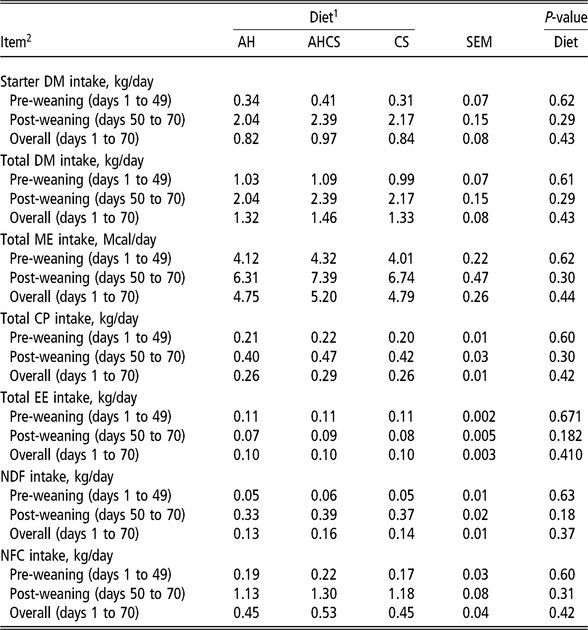
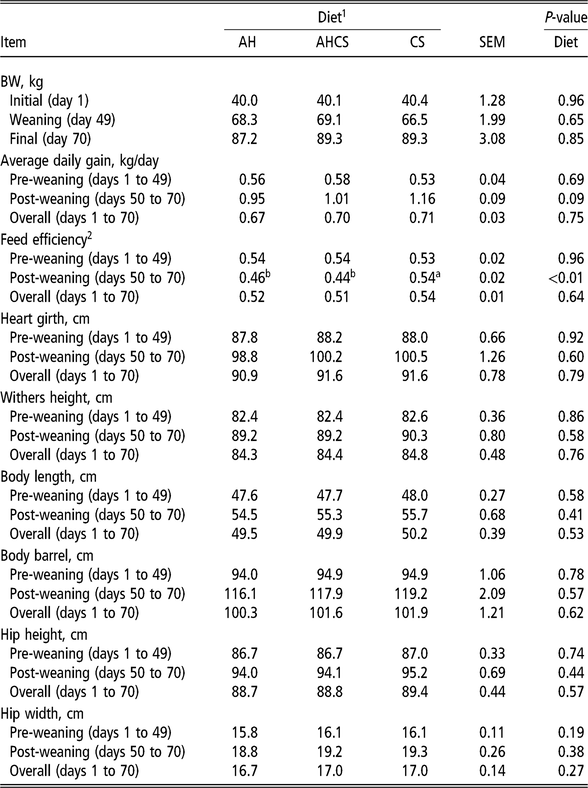
No interaction was detected between the dietary treatments and time on the nutrient intake, growth performance and body measurements (Tables 4 and 5). Replacing AH with CS did not affect the nutrient intake, BW (at weaning or at the end of the trial) or skeletal growth. During the post-weaning period, ADG tended (P = 0.09) to be greater in CS relative to AH calves. Calves fed CS had greater feed efficiency compared with those fed AH or AHCS during the post-weaning period.
Nutrient intake in Holstein dairy calves as influenced by replacing alfalfa hay with corn silage in the starter diet

SEM = standard error of the mean.
1 AH = starter diet containing 10% alfalfa hay; AHCS = starter diet containing 5% alfalfa hay and 5% corn silage; and CS = starter diet containing 10% corn silage.
2 DM = dry matter; Total DM intake = milk DM + starter feed DM; ME = metabolizable energy; CP = crude protein; EE = ether-extract; NDF = neutral detergent fiber; and NFC = non-fibrous carbohydrate.
BW, average daily gain, feed efficiency and skeletal growth in Holstein dairy calves as influenced by replacing alfalfa hay with corn silage in the starter diet

1 AH = starter diet containing 10% alfalfa hay; AHCS = starter diet containing 5% alfalfa hay and 5% corn silage; and CS = starter diet containing 10% corn silage.
2 Feed efficiency was calculated by dividing average daily gain by average total dry matter (DM) intake (milk DM + starter feed DM).
a,b Means within a row with different superscripts are significantly different (P ≤ 0.05).
Nutrient digestibility and rumen fermentation characteristics
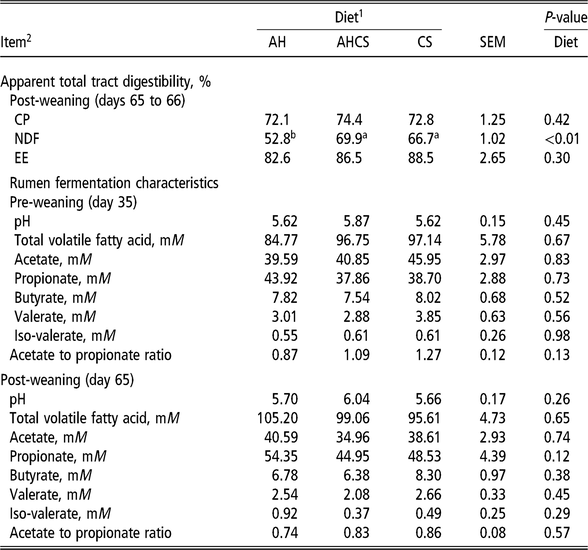
During the post-weaning period, NDF digestibility was higher in AHCS and CS compared with AH calves; however, the diets did not affect the digestibility of CP or EE (Table 6). Ruminal fluid pH, total and individual (acetate, propionate, butyrate, valerate and iso-valerate) VFA concentrations and acetate to propionate ratio in the ruminal fluid were not affected by the diets.
Apparent total tract digestibility and rumen fermentation characteristics in Holstein dairy calves as influenced by replacing alfalfa hay with corn silage in the starter diet

SEM = standard error of the mean.
1 AH = starter diet containing 10% alfalfa hay; AHCS = starter diet containing 5% alfalfa hay and 5% corn silage; and CS = starter diet containing 10% corn silage.
2 CP = crude protein; NDF = neutral detergent fiber; and EE = ether-extract.
a,b Means within a row with different superscripts are significantly different (P ≤ 0.05).
Blood metabolites
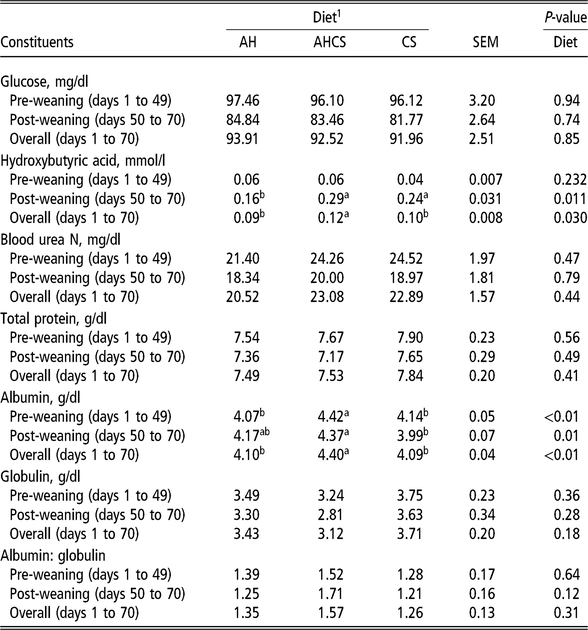
Concentration of blood hydroxybutyric acid (Table 7), exhibiting a diet × time interaction (P = 0.001; Figure 1), was higher for AHCS and CS diets compared with AH on day 60, and also higher than AH and CS on day 70. During the pre-weaning and overall periods, concentration of blood albumin was higher in AHCS compared with AH or CS calves. During the post-weaning period, concentration of blood albumin was greater in AHCS compared with CS calves.
Blood hydroxybutyric acid (mean ± SE; mmol/l) concentration in Holstein dairy calves fed starter diets containing 10% alfalfa hay (AH), 10% corn silage (CS) or their equal blend (5% AH and 5% CS; AHCS), from days 10 to 70 age. SEM = 0.008. Effects in the model: diet (D): P = 0.030; time (T): P = 0.001; D × T: P = 0.001. * P ≤ 0.05 indicates significant difference between treatments.

Blood constituents in Holstein dairy calves as influenced by replacing alfalfa hay with corn silage in the starter diet

SEM = standard error of the mean.
1 AH = starter diet containing 10% alfalfa hay; AHCS = starter diet containing 5% alfalfa hay and 5% corn silage; and CS = starter diet containing 10% corn silage.
a,b Means within a row with different superscripts are significantly different (P ≤ 0.05).
Discussion
Replacing AH with CS decreased DM content of TMR from 91.2% in AH to 87.5 and 83.8% in AHCS and CS diets, respectively, but did not affect the intake of nutrients (Tables 1 and 4). When AH and CS were provided to dairy calves separately from the starter feed, calves on CS consumed a low amount of forage relative to calves on AH, but it was sufficient to foster an increase in starter DM intake (DMI) and to maintain total daily DMI between treatments (Castells et al., Reference Castells, Bach, Araujo, Montoro and Terré2012). Mirzaei et al. (Reference Mirzaei, Khorvash, Ghorbani, Kazemi-Bonchenari and Ghaffari2017) observed an increase in feed intake when calves were fed CS v. AH at 15% dietary DM level. They attributed this effect to an increase in starter moisture by feeding CS; however, our data did not support their finding.
Due to similar feed intake in the present study, BW and skeletal growth were not affected by the diets as also observed by Castells et al. (Reference Castells, Bach, Araujo, Montoro and Terré2012). During the post-weaning period, a tendency for higher ADG in CS v. AH was led to increased feed efficiency in CS calves. The increase in feed efficiency might be related to the higher NDF digestibility (Table 6). This observation was inconsistent with the report of Castells et al. (Reference Castells, Bach, Araujo, Montoro and Terré2012) in which no effect on NDF digestibility was observed when AH (14% of total feed consumed) or CS (5% of total feed consumed) was offered free choice to young calves. However, in the present study, the forage source (AH or CS) was fed as TMR, and thus calves were forced to consume diets containing a pre-determined fixed forage to concentrate ratio (10% to 90%) which was smaller than the ratio in claves on AH (14%) and greater than the ratio in calves on CS (5%) diets (Castells et al., Reference Castells, Bach, Araujo, Montoro and Terré2012); this was substantiated by similar NDF intake between the experimental diets in the present study. The higher NDF digestibility in CS compared with AH diet might be attributed, in part, to effect of ensiling (CS pre-fermentation and a long-term exposure of NDF to acids during ensiling) or higher moisture contents of the CS-supplemented diets as it can decrease the ruminal digestion lag time and thereby increase the NDF digestibility (Pasha et al., Reference Pasha, Prigge, Russell and Bryan1994). Another explanation is that drying at 100 °C (due to increased Maillard reaction) may increase NDF-N formation in fiber fraction of AH and decrease NDF digestibility (Knipfel et al., Reference Knipfel, McLeod, McCaig, Waller and Feather1983). Therefore, NDF digestibility, in the present study, should be considered with caution due to the reasoning mentioned earlier. Inconsistent with the results reported by Mirzaei et al. (Reference Mirzaei, Khorvash, Ghorbani, Kazemi-Bonchenari and Ghaffari2017), ruminal fluid pH was not affected by the diets. Similar ruminal fluid pH and total VFA concentrations and profile, in the present study, may be attributed to similar starter feed intake and nutrient digestibility; however, increased NDF digestibility did not affect these variables. Taken together, our data do not support an effect of forage source or starter moisture on feed intake, nutrient digestibility (except for NDF) and growth performance, indicating that AH and CS can either be used in the starter diet formulation based on their availability and relative costs.
Due to similar DMI and nutrient digestibility (except for NDF), replacing AH with CS had no significant effect on metabolic indicators of rumen development (including blood glucose, hydroxybutyric acid and BUN) in young calves. However, the reason for increased concentration of blood hydroxybutyric acid in calves fed AHCS on days 60 and 70 is unclear. As expected, a gradual increase in blood hydroxybutyric acid concentration with increasing calf age was recorded indicating a physiologically normal shift in energy source from glucose to short-chain fatty acids with the initiation of ruminal fermentation and development (Mirzaei et al., Reference Mirzaei, Khorvash, Ghorbani, Kazemi-Bonchenari and Ghaffari2017). This was substantiated by lower blood glucose and higher blood hydroxybutyric acid concentrations after weaning (Table 7). Higher blood albumin concentration in calves fed AHCS compared with calves fed AH or CS might be attributed to higher protein intake or skeletal muscle breakdown (Pluske et al., Reference Pluske, Kim and Black2018). However, in the present study, neither CP intake nor blood BUN concentration was affected by the forage source of the starter diet.
Conclusions
Calves in general were healthy, and replacing AH with CS did not affect the overall feed intake and growth performance but marginally improved feed efficiency during post-weaning period. Due to similar feed intake, replacing AH with CS did not affect the ruminal fluid pH, total VFA concentrations and profile or metabolic indicators of the ruminal development (although blood hydroxybutyric acid concentration was higher in AHCS after weaning). In general, AH can be replaced with CS without adverse effect on feed intake and growth performance based on availability and feed competitive costs.
Acknowledgements
The authors would like to thank Shiraz University (Shiraz, Iran) for providing facilities and conditions for the execution of the experiment. They also express their kind appreciation to the farm staff at Foudeh-Sepahan Agriculture and Animal Husbandry (Isfahan, Iran) for diligent animal care; and to Mohammad Golkar and Morteza Nemati (Isfahan University of Technology, Isfahan, Iran), Hosein Foudeh, Ali Foudeh, Yadollah Moharrami, Naser Dadkhah and Ali Agha-Tehrani (Foudeh-Sepahan Agriculture and Animal Husbandry, Isfahan, Iran), Abolfazl Soltani (University of Tehran, Karaj, Iran) and Ehsan Mahjoubi (University of Zanjan, Zanjan, Iran) for their help in conducting the experiment.
S. Kargar, 0000-0003-0418-1868
Declaration of interest
The authors declare no conflicts of interest.
Ethics statement
All animal procedures were approved by the Animal Care Committee of Shiraz University as recommended by the Iranian Council of Animal Care (1995).
Software and data repository resources
Authors declare that no data or models are deposited in an official repository.